University of Twente
Faculty of Behavioural, Management and Social sciences
Department of Technology Management and Supply
Master thesis
Assessing E-Procurement maturity as designed in an E-Procurement Maturity Model and Quadrant Model
Author: Priyan Morsinkhof
(Master of Science in Business Administration: Purchasing & Supply Management)
1st supervisor: Prof. Dr. habil. H. Schiele 2nd supervisor: V. Delke, MSc
Document
Master thesis final version Number of pages/words: 97/29.941
Date
Priyan Morsinkhof | Master thesis
Acknowledgement
Finally, after starting the Master of Science program more than a year ago, it has come to an
end. By delivering this master thesis, I present you with research into E-Procurement. I
aimed to develop a model that could be used in practical settings as well as for academic
research. During my research, the one model turned into two models, providing
E-Procurement assessment opportunities at both vendors and users of such software. Hence, I
can only be satisfied with this finishing achievement.
I would like to thank my family and friends who supported me all these years. This all would
not have been possible without my parents, and the whole experience would have been
extremely different without my dear friends. Next, I would also like to thank my colleagues
at Supply Value for making me part of their team, giving me useful feedback and supporting
me in my research. In particular, I would like to thank my former colleague Manfred
Hoogveld for not only providing me with feedback in my research but also guiding me in
consulting skills. Of course, I want to thank all interview participants, with everyone giving
me new insights into procurement and its digital future.
Thanks to both my supervisors at the University, without whom this thesis and its models would have taken a drastically different shape, not to mention my whole Master’s
Programme and future career. During lectures of prof.dr.habil Holger Schiele, I was drawn
to the field of procurement, and in thesis meetings, I received lots of useful feedback to
improve everything presented in this thesis. I would also sincerely like to thank Vincent
Delke, MSc, for all his feedback, supervision and support during the thesis process. Starting
with one meeting talking about a possible maturity model, he took on a supervising role, and
all my work was improved thanks to him.
Finally, I hope you will enjoy reading this master thesis.
Priyan Morsinkhof
Priyan Morsinkhof | Master thesis
Abstract
Firms are increasingly recognising procurement as a strategic process in their organisation,
and seeing the potential benefits the successful management of procurement has. Many firms
already use forms of digital tools to support their procurement processes, but research has
shown the digital maturity of these firms has not progressed as expected. Some firms still
rely on paper-based processes, making little use of E-Procurement software. This thesis
gives insight into the current E-Procurement maturity of organisations, and the results
provided a method to measure the maturity both their maturity and that of the E-Procurement
tools software vendors currently offer. To achieve these measurement tools, a design
research among E-Procurement software vendors was conducted. The study proposes a new
E-Procurement Maturity Model, based on interviews and literature, to accurately measure
end-user firms based on eight dimensions of digital maturity. Furthermore, the study
describes the best practices for the highest E-Procurement maturity in an Industry 4.0 firm,
prescribing firms the ideal situation for industry leaders. Finally, the study proposes a new
E-Procurement Quadrant Model, to further establish the link between an end-user firm and
its relevant software solution options.
Keywords: e-procurement; e-sourcing; e-ordering; purchase-to-pay; procure-to-pay;
Priyan Morsinkhof | Master thesis
Content
List of Figures ... v
List of Tables...vi
List of Abbreviations...vi
1. Introduction: Maturity assessments of E-Procurement in Industry 4.0 supported by new models ... 1
1.1. E-Procurement: powerful digital tools for procurement in organisations ... 1
1.2. Introducing Industry 4.0 and Industry 3.0 within current organisations ... 2
1.3. Consulting firm Supply Value and their use for E-Procurement research ... 3
1.4. Research outline: The need for a maturity model and quadrant model addressing E-Procurement in both Industry 3.0 and Industry 4.0 ... 5
2. Conceptual Background: Digitalisation of procurement and its maturity ... 8
2.1. Systematic literature review of academic and practitioner sources... 8
2.2. Industry 3.0 and 4.0: From digitalisation to autonomy ... 8
2.2.1. Four industrial revolutions: From steam-powered industrial machinery towards the Industry 4.0 paradigm ... 8
2.2.2. Significant differences and developments in Industry 3.0 to 4.0 detail a focus on higher autonomy ... 10
2.3. The use of multiple E-Applications in today’s E-Procurement context ... 12
2.3.1. The procure-to-pay (P2P) cycle: Developing financial processes towards efficient, compliant and automated ordering ... 12
2.3.2. The source-to-contract (S2C) process: Sourcing entails Tendering and E-Auctioning through E-Marketplaces, ending with digital contract management ... 15
2.3.3. Category management and supply chain risk management: Automated software tools support the controlling process ... 18
2.4. Maturity models as an academic and practical tool to assess organisations ... 20
2.4.1. Organisational maturity is often described based on five maturity levels ... 20
2.4.2. Maturity models for Industry 4.0 are recent and similar in maturity levels ... 22
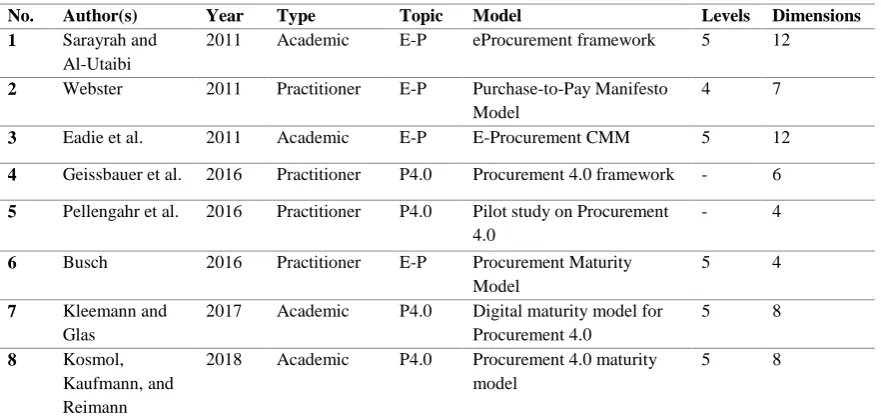
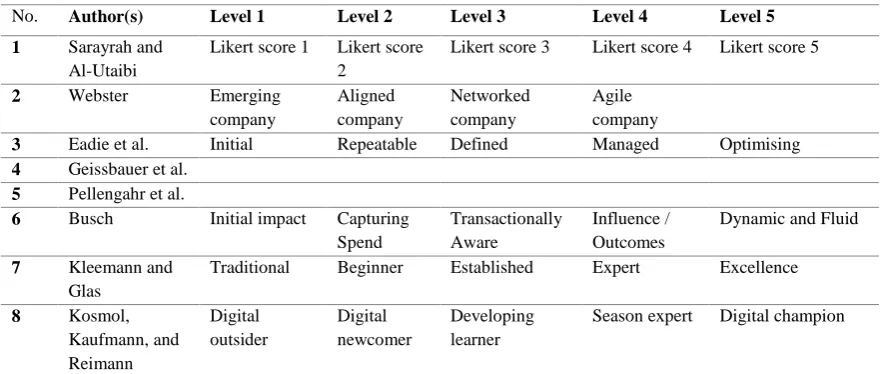
2.4.3. E-Procurement and Procurement 4.0 maturity models show a growing interest in the topic and primarily use five maturity levels ... 24
Priyan Morsinkhof | Master thesis
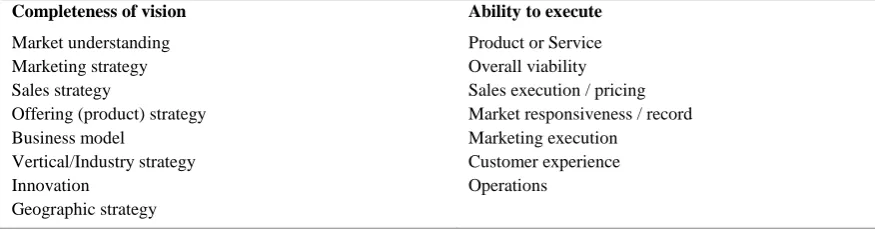
2.5.1. Gartner’s Magic Quadrant combines vision with execution ... 25
2.5.2. Forrester’s Forrester Wave uses a unique linear quadrant categorisation ... 27
2.5.3. SpendMatters’s SolutionMap combines customer scores with analyst scores ... 28
2.5.4. Capgemini’s Digital Procurement Research scores based on an extensive feature survey ... 30
3. Methodology: Conducting a design process based on a multiple-case study ... 33
3.1. The research design is based on in-depth semi-structured interviews ... 33
3.2. Sampling and data collection: Industry leaders offer extensive knowledge ... 33
3.3. Data gathering: Conducting questionnaire based semi-structured interviews provide essential, comparable research data ... 34
3.4. Iteratively designing a new Maturity Model and Quadrant Model based on literature review and interview results ... 36
3.5. Assessing the research quality concerning validity and reliability ... 37
4. Results and analysis: Development of the Maturity Model and Quadrant Model, with an additional E-Procurement & Industry 4.0 Trend Analysis ... 39
4.1 Developing the Maturity Model based on literature review and interviews ... 39
4.1.1. Literature review shows reasons to use four maturity levels to build the Maturity Model ... 39
4.1.2. Semi-structured interviews with software vendors and consultants provide insight for building the eight organisational dimensions in the Maturity Model ... 39
4.1.3. The ideal situation of E-Procurement and Industry 3.0-4.0 based on the literature review and interview results is categorised as the final maturity stage ... 49
4.1.4. Combining the collected data to develop the Maturity Model describes four stages for E-Procurement maturity ... 50
4.2. Developing the Quadrant model ... 51
4.2.1. Building the Quadrant Model based on a literature review of four quadrants ... 51
4.2.2. Developing the Quadrant Model with four distinct software vendor types ... 53
4.3. Trends and the future of Procurement observed from interviews with E-Procurement vendors and consultants describe a high focus on technology... 55
Priyan Morsinkhof | Master thesis
5.1. Contribution to literature: E-Procurement specific Industry 3.0-4.0 Maturity Model
and E-Procurement Quadrant ... 58
5.2. Managerial implications: Efficiently assessing the current E-Procurement maturity and blueprint for an optimal Industry 4.0 E-Procurement organisation and software vendor ... 58
5.3. Limitations and future research: Theoretical research calls for practical validation. 59 Bibliography ... 61
Appendices ... 70
I. Invitation letter for an interview (Dutch) ... 70
II. Interview guide... 71
III. Ethical approval form ... 72
IV. Interview questionnaire for external respondents (E-Procurement vendors) ... 73
V. Interview questionnaire for internal respondents (consultants) ... 75
VI. Quadrant Model questionnaire for E-Procurement vendors ... 76
VII. Final E-Procurement Maturity Model ... 77
VIII. Final E-Procurement Quadrant Model ... 88
IX. Checklist for basic and descriptive design principles according to Pöppelbuß and Röglinger (2011, p.7) ... 89
List of Figures Figure 1. Procurement process and its linked E-Procurement application based on Van Weele (2014, p.7) ... 1
Figure 2. Developments towards Industry 4.0 and future outlook based on Strategy& (2016, p. n/a) ... 3
Figure 3. Modern characteristics of Industry 4.0 based on Schiele (2018, p. n/a) ... 3
Figure 4. Different layers of software integration based on Kleemann and Glass (2017, p. 11) ... 5
Figure 5. Visualisation of problem statement (own elaboration) ... 6
Figure 6. Procure-to-pay process according to Trkman & McCormack (2010, p. 339) ... 12
Figure 7. Visual format of Gartner's Magic Quadrant based on Gartner (2018a, p. 3; 2018b, p. 5) ... 27
Figure 8. Visual format of Forrester's Forrester Wave based on Forrester (2017, p. 7) ... 28
Figure 9. Visual format of SpendMatters' SolutionMap based on SpendMatters (2018b, p. 7) ... 30
Figure 10. Visual format of Capgemini's Digital Procurement Matrix based on Capgemini (2018b, p. 10) ... 31
Priyan Morsinkhof | Master thesis
List of Tables
Table 1. Overview of Industry 4.0 maturity models ... 23
Table 2. Overview of different maturity levels of Industry 4.0 maturity models ... 23
Table 3. Overview of E-Procurement and Procurement 4.0 maturity models ... 24
Table 4. Overview of different maturity levels of E-Procurement and Procurement 4.0 maturity models ... 25
Table 5. Rated aspects in Gartner’s Magic Quadrants ... 26
Table 6. Rated aspects in Forrester's Forrester Wave ... 28
Table 7. Rated aspects in SpendMatter's SolutionMap ... 29
Table 8. Rated aspects in Capgemini's Digital Procurement Matrix ... 31
Table 9. Overview of interviewed companies... 34
Table 10. Structure and main questions of the vendor interview questionnaire ... 35
Table 11. Structure and main questions of the consultant interview questionnaire ... 36
Table 12. Four maturity stages according to Schiele (2007, p. 278) ... 51
Table 13. Scoring scheme for innovation strategy left, current product right ... 54
Table 14. Rated aspects in the Quadrant Model ... 54
List of Abbreviations
AI Artificial Intelligence
BI Business Intelligence
CMM Capability Maturity Model
CMMI Capability Maturity Model Integration
CPO Chief Procurement Officer
CPS Cyber-physical systems
EDI Electronic Data Interchange
EP Electronic Procurement
ERP Enterprise Resource Planning
IoT Internet of Things
KPI Key Performance Indicator
MDM Master Data Management
MRP Material Requirement Planning
M2M Machine to Machine (Communications)
PO Purchase Order
P2P Purchase-to-Pay / Procure-to-Pay
P4.0 Procurement 4.0
RFI Request for Information
Priyan Morsinkhof | Master thesis
RFQ Request for Quotation
RFX Catch-all term for RFI, RFP, and RFQ
SLM Supplier Lifecycle Management
SRM Supplier Relationship Management
S2C Source-to-Contract
S2P Source-to-Pay
UBL Universal Business Language
UI User Interface
Priyan Morsinkhof | Master thesis
1. Introduction: Maturity assessments of E-Procurement in Industry 4.0 supported by new models
1.1. E-Procurement: powerful digital tools for procurement in organisations
Nowadays, organisations rely heavily on digital systems to support their employees in
business processes. After decades of firms digitising and automating their daily tasks and
processes, it is hard to imagine any firm that would prefer to work paper-based instead of
through digital systems. Through these digital systems, next to virtual elimination of
paperwork, organisations receive a reduction in overhead costs, sourcing costs, time spent
in the purchasing process, transparency, overview, and more.1 For example, industry leaders
can process up to ten times more invoices per employee, while also leading to higher
employee satisfaction through reducing laborious, monotonous tasks.
However, while there are obvious benefits to digital systems, there are still many firms that
do not possess the digital capabilities of their peers. Despite many consulting firms offering
business transformation services, research leads to the conclusion many firms are still in the
early phases of digital capabilities.2
Those digital capabilities include the use of E-Procurement software in the whole
procurement process of organisations. Van Weele (2014) defines the procurement process
as obtaining goods and services from external sources that are needed for maintaining and
developing direct and indirect production activities in the best conditions.3 The author
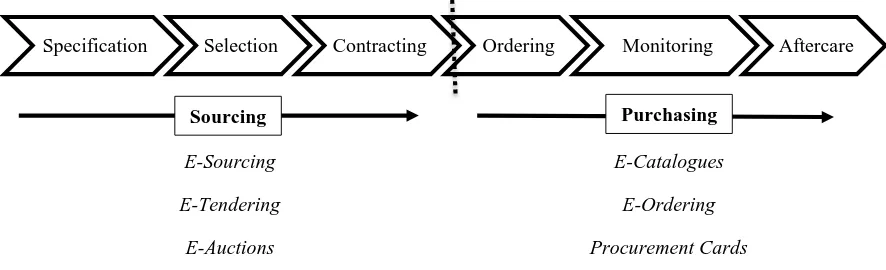
divides the procurement process into tactical sourcing and operational purchasing. Both of
these two parts comprises three distinct phases, resulting in the following six phases of the
purchasing process, with its related E-Procurement application (see figure 1).
E-Sourcing
E-Tendering
E-Auctions
E-Catalogues
E-Ordering
[image:9.595.113.556.564.699.2]Procurement Cards
Figure 1. Procurement process and its linked E-Procurement application based on Van Weele (2014, p.7)
1 See Monczka, Handfield, Giunipero, and Patterson (2014), p. 44. 2 See Torn (2017), p. 67.
3 See Van Weele (2014), p. 7.
Specification Selection Contracting Ordering Monitoring Aftercare
Priyan Morsinkhof | Master thesis
Nowadays, there are many E-Procurement software suppliers, some of which offer a full
Source-to-Pay (S2P) suite or Procure-to-Pay (P2P) suite, while others focus on a specific
aspect of the electronic purchasing process. As De Boer, Harink, and Heijboer (2002) state,
only focusing on one aspect “underlines the danger of treating E-Procurement as one
solution, and therefore the impact of various forms should be investigated separately”.4
Therefore, for this research the following definition of E-Procurement is used: the use of
specific electronic tools, through the Internet as well as other information and networking
systems, to support the specific phases in the business-to-business procurement process.
1.2. Introducing Industry 4.0 and Industry 3.0 within current organisations
Industry 4.0 is a concept which was firstly published by Kagermann in 2011 for a project by
the German government.5 It has built the foundation for the Industry 4.0 manifesto published
in 2013.6 While a surge of academic interest in Industry 4.0 can be observed, with new
publications increasing almost tenfold in four years, there is still no generally accepted
definition of Industry 4.0. Over the next five years, the companies PwC surveyed expect to
increase annual revenues by an average of 2.9% and reduce costs by an average of 3.6% per
year through application of Industry 4.0.7 Due to rising investments in Industry 4.0
applications, for example, investing an estimated average of 3.3 percent of annual turnover
of German industrial firms,8 the importance of further research into Industry 4.0 is clear.
Industry 4.0 is commonly understood as the start of the “application of the generic concept
of cyber-physical systems,”9 in which systems can autonomously perform their production
and provide machine to machine (M2M) communication, supported by the Internet of Things
(IoT) (see figure 2).
4De Boer, Harink, & Heijboer (2002), p. 32. 5See Kagermann, Lukas, & Wahlster (2011), p. n/a.
6 See Stock and Seliger (2016), p. 536.
Priyan Morsinkhof | Master thesis
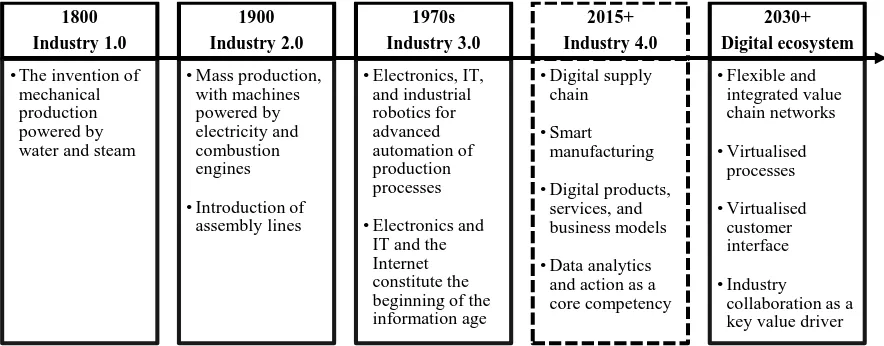
Figure 2. Developments towards Industry 4.0 and future outlook based on Strategy& (2016, p. n/a)
However, the distinction between Industry 3.0 and 4.0 is important because otherwise
organisations will try to sell their Industry 3.0 solutions as Industry 4.0 to unsuspecting
buying organisations (see figure 3). To distinguish Industry 4.0 from the previous revolution named Industry 3.0, PwC state that “while Industry 3.0 focused on the automation of single
machines and processes, Industry 4.0 focuses on the end-to-end digitisation of all physical
assets and integration into digital ecosystems with value chain partners.”10 Research by
Schiele (2018) shows modern characteristics of Industry 4.0, related to Industry 4.0 (see
[image:11.595.112.553.485.598.2]figure 3).11
Figure 3. Modern characteristics of Industry 4.0 based on Schiele (2018, p. n/a)
1.3. Consulting firm Supply Value and their use for E-Procurement research
The thesis is the result of research performed both for academic purposes, as for practical
purposes. The practical purpose entails the usability for Supply Value, a Dutch procurement
consultancy company that advises on procurement activities; clients include firms in the
10 See Geissbauer et al. (2016), p. 6. 11 See Schiele (2018), p. n/a.
1800 Industry 1.0
• The invention of mechanical production powered by water and steam
1900 Industry 2.0
• Mass production, with machines powered by electricity and combustion engines • Introduction of
assembly lines
1970s Industry 3.0
• Electronics, IT, and industrial robotics for advanced automation of production processes • Electronics and
IT and the Internet constitute the beginning of the information age
2015+ Industry 4.0
• Digital supply chain
• Smart manufacturing • Digital products,
services, and business models • Data analytics
and action as a core competency
2030+ Digital ecosystem
• Flexible and integrated value chain networks • Virtualised processes • Virtualised customer interface • Industry
collaboration as a key value driver
Industry 3.0 Industry 4.0
Human-machine interface Machine to machine communication
Digitalisation Cyber-physical systems
Priyan Morsinkhof | Master thesis
Dutch public and private sector with companies such as the Dutch National Police, UWV,
Port of Rotterdam, and Grolsch. As an independent consulting firm, Supply Value advises
in the areas of cost reduction, value creation, and procurement infrastructures, such as the
organisation of procurement departments and supporting systems, such as E-Procurement.12
Supply Value sees procurement and supply chains as an important function in companies,
and aims to their clients’ operations with their strategy and company objectives. As a central
objective Supply Value aims to reduce cost and risk while increasing the value added in the
supply chain so that not only their client benefit but also their partners and suppliers. Supply
Value uses a three-step approach to realise sustainable results for their clients:
Thinking: Supply Value collects and analyses information to give robust solutions
Support: Supply Value combines the input of both the client and its partners into
improvement proposals; by using information from multiple sides they can create a
fast improvement process
Doing: Supply Value helps their clients in implementing strategies and systems,
keeping them on track and finally realising concrete results
One of the procurement activities that Supply Value consults on are E-Procurement systems,
as there are many of these systems used worldwide and new systems also appear frequently.
Supply Value wants to study E-Procurement systems to better inform their customers about
the various possibilities, trends, and upcoming functionality. This study is part of the
Thinking and Support process that Supply Value uses for providing solutions to their clients.
The results will be used to give selection and implementation advice on E-Procurement
systems. Supply Value provides the following services concerning E-Procurement:
Business and procurement consultancy: design and strategy regarding
E-Procurement with the goal to improve the effectiveness of the company's strategy,
operations, and operational processes
Implementation consultancy: advise and assisting in the implementation of
E-Procurement in the areas of change management, procurement processes, and
package knowledge of the implemented procurement system
Priyan Morsinkhof | Master thesis
Project- and program management: managing project and programs around
E-Procurement (e.g., forming a strategy, purchasing the E-E-Procurement package and
implementing the procured package and implementations)
1.4. Research outline: The need for a maturity model and quadrant model addressing E-Procurement in both Industry 3.0 and Industry 4.0
Research shows many advantages to using E-Procurement software, including a reduction
in communication costs (i.e., sourcing costs),13 the faster throughput of orders, higher
compliance to preferred suppliers, transparency, and so forth. However, while these
advantages are widely known in organisations, the degree of E-Procurement implementation
is still low and lots of organisations mainly make use of general Material Requirements
Planning (MRP) or Enterprise Resource Planning (ERP) systems. The implementation of
Industry 4.0 in purchasing requires organisations to successfully implement the
E-Procurement applications of Industry 3.0 first, which are the basis for further development
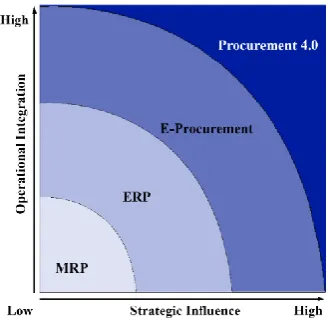
into Industry 4.0 processes.14 E-Procurement, as is defined in chapter 1.1, is shown to be the
[image:13.595.114.279.444.604.2]missing linkbetween regular ERP-systems and Purchasing / Procurement 4.0 (see figure 4).
Figure 4. Different layers of software integration based on Kleemann and Glass (2017, p. 11)
By being able to accurately assess the digital maturity of the purchasing function and its
possible use of E-Procurement within an organisation, divided into several aspects, an
assessed organisation will be more successful in choosing appropriate process
improvements, in which E-Procurement software can be used. For consulting firms, a better
Priyan Morsinkhof | Master thesis
assessment of digital purchasing maturity will lead to better advice, and therefore to better
implementation of the software solutions. This, in turn, allows for a higher success rate in
organisations who participate in E-Procurement implementation. Next, through the use of a
software solution-focused quadrant model, which assesses the maturity of available
E-Procurement vendors and their tools, organisations are able to easily find which software
tool best fits their need. Several analyst firms are renowned for their quadrant models, in
which they categorise some of the largest software vendors into structured quadrants based
on vendor organisation and software solution characteristics. However, the software vendors
in the quadrants often do not operate fully in the European market, and these quadrants are
therefore not valuable to a large amount of organisations. By having a model that also allows
smaller software vendors to be rated and connected to the maturity model, end-user
organisations are more likely to find a software solution that will fit their specific maturity
level.
The research aim of developing both a maturity model and quadrant model leads to the main
research question for the research: How are the E-Procurement Maturity Model and
Quadrant Model designed to successfully determine an organisations maturity level? To
obtain further insights, the main research question is answered by exploring three
sub-questions: (1) What is the current situation of Industry 3.0 – 4.0 in procurement?; (2) How
do Industry 3.0 – 4.0 aspects in procurement relate to E-Procurement maturity levels for
both end-users and software vendors?; (3) What is the roadmap for E-Procurement software
vendors towards Industry 4.0?
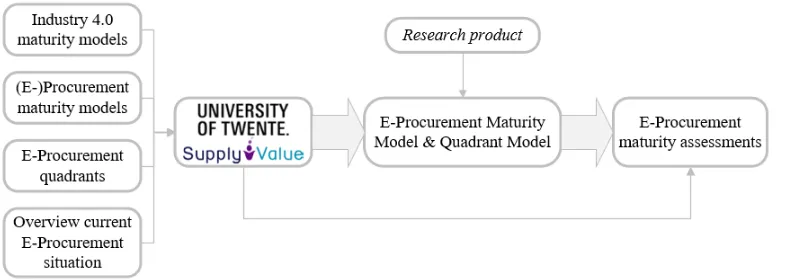
To visualise the problem statement accompanying these research questions, the following
[image:14.595.114.508.606.746.2]chart is made and depicted in figure 5.
Priyan Morsinkhof | Master thesis
In order to answer the research questions, the research first reviews the current literature on
Industry 4.0, E-Procurement, and maturity models. Next, through a design process making
use of interviews, the new maturity models are made and iteratively developed. Based on
these interview results, a trend analysis of the Industry 4.0 application in E-Procurement is
detailed. The research closes with the newly proposed E-Procurement Maturity Model and
E-Procurement Quadrant Model.
1.5. Thesis outline: Explanation of each chapter
After the introduction above, the research continues with the second chapter containing the
conceptual background regarding Industry 4.0, E-Procurement and Maturity Models, ending
with Quadrant Models, based on an extensive literature review. The third chapter concerning
methodology describes how the research is structured. Following, the fourth chapter
describes the analysis, i.e., interview results, the ideal situation, how the new Maturity Model
and Quadrant Model is developed, and the identification and exploration of trends in the
E-Procurement industry. Concluding this research, the fifth chapter details the discussion of
the research and its results, while the thesis ends by describing the limitations and future
Priyan Morsinkhof | Master thesis
2. Conceptual Background: Digitalisation of procurement and its maturity 2.1. Systematic literature review of academic and practitioner sources
To establish a conceptual background of E-Procurement, the qualitative research method of
a literature review is used. By performing a literature review, insight into the topic leads to
further research directions. Both academic sources, as practitioner sources, are reviewed for
relevant articles regarding the E-Procurement topics included in the research. Next,
information from E-Procurement software vendors (websites, conferences, and personal
communication) is used to obtain information about current trends in the E-Procurement
market, Industry 4.0, and developments contained within this paradigm.
To find academic sources, the literary databases Scopus, Web of Science, and Google
Scholar is used. Based on the two topics of this research, namely Industry 4.0 and
E-Procurement, keywords used were ‘Industry 4.0’, ‘E-E-Procurement,’ ‘E-Sourcing’,
‘Procure-to-Pay’, and ‘Purchase-to-Pay.’ Additionally, these keywords will be combined with the use
of the keywords ‘Maturity’, ‘Maturity Model,’, ‘Quadrant’ and ‘Quadrant Model’ to find
more specific articles. Furthermore, practitioner sources are found through Google searches
with the same keywords used for academic sources. Additionally, websites of software
vendors will be reviewed to find specific content regarding subjects that are included in the
literature review, for example supply chain risk management, or E-Catalogues.
2.2. Industry 3.0 and 4.0: From digitalisation to autonomy
2.2.1. Four industrial revolutions: From steam-powered industrial machinery towards the Industry 4.0 paradigm
To be able to describe the new industrial revolution, named Industry 4.0, first the previous
three industrial revolutions need to be described. By identifying patterns in these revolutions,
the distinguishing factors of the fourth industrial revolution are shown.
Firstly, the first industrial revolution consisted of the transition of manual labour towards
mechanical labour through the use of steam engines in the 1780s.15 The centralisation of
production towards factories instead of private homes increased productivity extremely,16
and flourished mechanisations systems and textile industry.17 Factories produced the same
products grouped near each other, close to their core sources, creating industrial centres in
Priyan Morsinkhof | Master thesis
cities. These first industrial centres with heavy use of mechanisation grew rapidly, creating
a divergence in industrialised and non-industrialised economies.18
Afterwards, the second industrial revolution started in the third quartile of the 19th and the
beginning of the 20th centuries,19 through the main factor of the use of new energy sources,
namely electricity, oil, and gas. These new energy sources allowed for the use of continuous
production lines and conveyor belts with divided labour, which caused a productivity boost
and marks the start of mass production.20 In the second revolution, two dimensions of
demand were addressed, namely volume and variety. Following, the immense steel industry,
the railroad and telegraph systems were created, and electrically powered mass production
was introduced.21 The combination of research and capital, with mass production factories
at the centre, also lead to the invention and production of the car and the airplane at the
beginning of the 20th century. These breakthroughs in transportation further expanded the
reach of these industrial centres.
Eventually, the third industrial revolution started through the invention of the transistors in
1947, among other inventions, which gave a path to the digital age and information
technology as an industrial revolution.22 Literature does not describe a clear time span of the
third industrial revolution, nor is there a clear agreement whether the third revolution has
ended at all.23 In his research, Torn (2017) found that both the first logical control system in
1969, as the oil crisis in 1973 are mentioned as the catalyst for automated manufacturing.24
With new possibilities through digital programming of automation systems, electrical
gadgets, and applications for computers, Industry 3.0 started.25 Several manufacturing
processes could be automated, using machines that can perform standardised physical tasks
with little human input.26 The third industrial revolution increased the dimensions of demand
to three, namely by adding the delivery time as a demand, which promoted the use of flexible
manufacturing systems.27
Finally, the fourth industrial revolution started, bringing us to Industry 4.0 in which system
autonomy and smart manufacturing are key points. Industry 4.0 is the product of research
18 See Rodrigue (2017), p. n/a. 19 See Hwang (2016), p. 10.
20 See Drath & Horch (2014), p. 56; Hwang (2016), p. 10. 21 See Yin, Stecke, & Li (2017), p. 848.
Priyan Morsinkhof | Master thesis
into high-tech strategy by the German government in 2012, named Industrie 4.0.28 In the
United States, the terms smart manufacturing and smart factories describe the same concept
as Industry 4.0.29 Authors describe the use of cyber-physical systems (CPS) and Internet of
Things (IoT) as defining the concept of Industry 4.0.30Use of CPS and IoT is noted to be
autonomous within the systems, instead of purely automated.31 The utilisation of CPSs can
lead to acquisition of data through sensors, actuators and metres, which can be processed
autonomously and/or communicated to humans for further tasks.32 The use of these
technologies is not only for tactical and strategic purposes, but also to find constraints within
operational processes, and mitigate or remove them.33
2.2.2. Significant differences and developments in Industry 3.0 to 4.0 detail a focus on higher autonomy
Industry 4.0 is commonly understood as the start of the “application of the generic concept
of cyber-physical systems”34, in which systems can autonomously perform their production
and provide machine to machine communication, supported by the Internet of Things.
However, this understanding also indicates the importance of making a clear distinction
between industrial revolutions, which is stated by Torn, Pulles, and Schiele (2018): “If the
distinction between third and fourth revolution is not made clear, however, the danger
remains that Industry 3.0 applications are simply relabeled, and no progress is made
whatsoever.”35 Therefore, without understanding the line between both stages, progress
might not happen, or not fast enough. Moreover, companies might try to buy or sell Industry
3.0 techniques or information labelled as Industry 4.0, without actually being part of the
Industry 4.0 concept and advancing their processes and business in general. One example of
an exclusive Industry 4.0 feature is the ability to fulfil individual customer requirements with
product variants in a very small lot size, down to one-off items.36
PwC state that “while Industry 3.0 focused on the automation of single machines and
processes, Industry 4.0 focuses on the end-to-end digitisation of all physical assets and
28 See Kagermann (2013), p. 15.
29 See Thoben, Wiesner, and Wuest (2017), p. 6.
30 See Fatorachian and Kazemi (2018), p. 2; Thoben et al. (2017), p. 4; Qin, Liu, & Grosvenor (2016), p. 174. 31 See Fatorachian and Kazemi (2018), p. 2; Qin et al. (2016), p. 174.
32 See Fatorachian and Kazemi (2018), p. 4. 33 See Fatorachian and Kazemi (2018), p. 4. 34 Drath, and Horch (2014), p. 1.
Priyan Morsinkhof | Master thesis
integration into digital ecosystems with value chain partners.”37 According to PwC,
generating, analysing and communicating data seamlessly underpins the gains promised by
Industry 4.0, which aligns with many other academic sources mentioned in this paper.38
Deloitte and IHS Markit define Industry 4.0 to be different from Industry 3.0 in the way that
it transforms data to usable information, bringing more possibilities for collecting new data,
and consequently using these possibilities to increase worker mobility, while also allowing
for new product designs.39
New developments and transitions from Industry 3.0 to Industry 4.0 can be categorised in
the aspects of automation, digitalisation, and miniaturisation.40 Firstly, far-reaching
automation, mechanisation and autonomy describes how more and more precise technical
support will be used in the field, such as the autonomous production of cells that can
independently process the production of smaller, more precise steps. Secondly, networking
and digitalisation details the increasing digitalisation from producing and
manufacturing-aiding tools resulting in an increasing support of data collected with sensors which support,
control and analyse the process, which leads to fully digitalised surroundings. Thirdly,
miniaturisation is about the smaller and more powerful devices that can be installed on just
a few cubic centimetres, to fully support in the context of logistics and production, while a
few years ago these devices needed significant more space.
These technological innovations give an outlook for Industry 4.0 of massive increases in
productivity, mass customisation, lowering of production costs, reduction in manufacturing
and delivery times, and many more features,41 including aspects such as improved working
conditions, improvement in customer satisfaction.42 Smart factories will consist of
workspaces filled with sensors, actors and autonomous setups.43 More future trends will be,
for example, the adaptation to human needs, where machines are designed to follow humans,
instead of the reverse. It can be concluded that Industry 4.0 is mainly focused on IT-driven
changes and innovations.44 These developments are expected to not have only technological,
but largely multifaceted organisational implications, which results in changes in the industry
focus of mainly product oriented, into service oriented industries.45 Supporting this focus
37 Geissbauer et al. (2016), p. 6. 38 See Geissbauer et al. (2016), p. 6.
39 See Geissbauer et al. (2016), p. 6; West (2017), slide 4. 40 See Lasi, Fettke, Kemper, Feld, and Hoffman (2014), p. 240. 41 See Pilloni (2018), p. 7-8.
42 See Pilloni (2018), p. 7-8.
43 See Lucke, Constantinescu, and Westkämper (2008), p. 1. 44 See Lasi et al (2014), p. 241.
Priyan Morsinkhof | Master thesis
shift is shown through increasing use of E-Applications in organisations, corresponding with
the IT-driven changes and innovations Industry 4.0 introduces. Within the procurement
function, several important aspects need to be detailed to fully grasp the impact of these
IT-software tools, and their impact on procurement.
2.3. The use of multiple E-Applications in today’s E-Procurement context 2.3.1. The procure-to-pay (P2P) cycle: Developing financial processes towards efficient, compliant and automated ordering
Procure-to-pay, Purchase-to-pay, or just P2P, is the process of acquiring goods and services
in a Business to Business setting.46 According to Murphy (2012), the P2P process typically
involves creating a purchase order (PO), authorising the PO, sourcing, provision of the PO
to the supplier, material receipt, invoice receipt and authorisation, and finally, invoice
payment.47 When taking into account the broader understanding that in the P2P cycle, before
a PO can be generated, a buyer has specific demands that are specified and sourced (i.e.,
vendor selection after comparing E-Catalogues in a P2P tool),48 the following process is
[image:20.595.116.564.444.496.2]discerned (see figure 6).
Figure 6. Procure-to-pay process according to Trkman & McCormack (2010, p. 339)
Moreover, while the P2P process describes a significant part of the purchasing process, the
P2P process distinguishes itself by the fact that it also includes the payment and financial
processes. These two processes are most commonly referred to as Accounts Payable process.
Palmer and Gupta (2011) name eight technological categories that are transforming the
acquisition cycle, of which payment technology and policy compliance software are
categories, next to E-Procurement software itself.49 While the traditional P2P process was
focused mainly on control, organisations are changing their focus towards cost reduction,
through process efficiency and automation.50
46 See Hazelaar (2016), p. 12; Vanjoki (2013), p. 7.
47See Murphy (2012), p. 2
48 See Trkman and McCormack (2010), p. 339. 49 See Palmer and Gupta (2011), p. 74.
50 See Palmer and Gupta (2011), p. 66.
Forecast planning & Coordination
Need specification
Sourcing decision
Contracting/ Generating
PO
Receiving Materials &
Documents
Priyan Morsinkhof | Master thesis
In the ordering process, the most widely used Procurement technology is that of
E-Catalogues, containing specifications and prices of all products and services available from
suppliers.51 Specifically, for buying firms the process of matching their demands to offered
goods on the market becomes more efficient, while the software can also automatically
perform the cross-catalogue comparison, and process contract pricing in real-time.52 In a
comparison, specific suppliers can also be dynamically included or excluded, and ranked
according to user-defined criteria,53 mitigating maverick buying and therefore increases
buying compliancy. Moreover, Mehrbod, Zutshi, and Grilo (2014) also describe how
suppliers may upload their product E-Catalogue to software vendor portals, to find a call for
tenders or new markets for its product.54 This automated tendering process helps suppliers
identify the best suitable opportunities, decreasing the time required to locate and respond.55
However, while E-Catalogues seem to provide clear advantages for both buyers and
suppliers, issues can also be identified. Mehrbod et al. (2014) identify the fact that there are
no widely established formats, therefore leading to use of various E-Catalogue formats used
in the market.56 Therefore, a focus on translation and integration of multiple formats in the
software is required. Basware (2018) and SAP Ariba (2018a) indicate they support
E-Catalogue creation from spreadsheets or directly from back-end systems, which seems to
address this issue.57 When internal demands are met, E-Catalogues prove to be a very useful
tool. Benefits include lower advertisement and distribution costs, more flexibility to browsing, updating information, adapting information based on users’ preferences, and
extending searches to other catalogues.58 The mentioned adaptation possibilities also include
the use of different buyer-specific versions of E-Catalogues, i.e., making use of different
prices, discounts, or currencies.59
As Hazelaar found in her research, there are multiple possible reasons for performance issues
in the P2P process, such as maverick buying (i.e., non-compliant purchasing) and low
pooling of demand.60 Both of these risks can be mitigated in E-Procurement software. By
51 See Trkman and McCormack (2010), p. 342; Alrobai (2013), p. 2. 52 See Mehrbod et al. (2014), p.135, SAP Ariba, 2018b, p. n/a. 53 See SAP Ariba (2018b), p. n/a.
54 See Mehrbod et al. (2014), p. 135. 55 See Mehrbod et al. (2014), p. 135. 56 See Mehrbod et al. (2014), p. 135.
57 See Basware (2018), p. n/a; SAP Ariba (2018a), p. n/a. 58 See Alrobai et al. (2013), p. 3..
Priyan Morsinkhof | Master thesis
use of software, lists of preferred suppliers and buying channels can be defined, which are
automatically used during the ordering process, leading buyers to their preferred supply. One
of the recent developments by E-Procurement software vendors is the use of guided buying
and digital assistants. Through the use of guided buying, especially non-procurement
professionals are supported in their procurement tasks, while procurement professionals are
assisted in aiming for higher policy compliance and savings. Users are able to use keyword
searches in a webshop-like environment, searching cross-catalogue.61 Results are
automatically adjusted and filtered according to pre-defined settings, with a real-time
connection to purchasing budgets, and other internal data. Software vendors are actively
developing guided buying through using data analytics and end-user feedback, with market
leaders promising guided sourcing and guided contracting possibilities in the future.
A recent development within the P2P process is increasing use of electronic invoices
(E-Invoices), a technology originally stemming from Electronic Data Interchange (EDI)
transactions. Organisations that use digital tools to assist the payment process often still rely
on paper invoice conversion methods. Through OCR (optical character recognition)
software, paper invoices are scanned, with the extracted data turned into applicable input in
the invoice software. While the end result is a digitally processed invoice, the invoice process
itself is still very dependent on human input and corrections, while also not offering the
many benefits of true E-Invoices. True E-Invoices are based on Extensible Markup
Language (XML), with the most common E-Invoice format being Universal Business
Language (UBL), and are created, shared, and processed fully digital. Benefits of electronic
invoices and automation of the payment processes include less administration and therefore
faster processing, no lost invoices, authorisation transparency, reduced costs, greater use of
early payment discounts, and improved supplier relationships.62 In 2014, the European
Union drafted regulations regarding a compulsory use of E-Invoices in government, with
mandatory use of E-Invoices within Dutch government starting April 18th, 2019. However,
research also shows processing E-Invoices might be more complex, with the added
complexity requiring more human intervention, therefore slowing down the process.63
Hence, caution is still needed when deciding on a transition to E-Invoices within an
organisation and its network.
61 See SAP Ariba (2017), p. 2.
Priyan Morsinkhof | Master thesis
2.3.2. The source-to-contract (S2C) process: Sourcing entails Tendering and E-Auctioning through E-Marketplaces, ending with digital contract management
When analysing the sourcing process in relation to Procurement, the application of
E-Sourcing can be distinguished through separate functions of E-Tendering, E-Marketplaces,
and E-Auctioning. With each application having its own use and characteristics, a separate
review of each aspect is necessary.
E-Sourcing is often confused with E-Procurement, E-Tendering, and E-Auctioning while
each term has its own attributes. Therefore, each term is reviewed to make a clear distinction.
Most commonly, E-Sourcing can be defined as “the process of identifying new suppliers for a specific category of purchasing requirements using Internet technology”,64 or as the
application of Internet technology to the complete supplier selection process,65 through use
of online negotiations, reverse auctions, and other related tools.66 E-Sourcing lowers costs
for organisations as information becomes more readily available via the marketplaces,
instead of having to examine each and every single supplier individually.67
E-Sourcing applications typically provide platforms for online negotiations, such as requests
for information (RFI’s), requests for proposals (RFP’s), requests for quotes (RFQ’s),
lowering negotiation costs.68 These platforms for the comprehensive RFX process allow for
use of E-Tendering, which includes the creation of RFX’s, defining award criteria, sending RFX’s to suppliers, collecting and structuring responses, and so forth.69 In practice,
E-Tendering is often confused for E-Sourcing, with practitioners using these terms as
synonyms.70 While in E-Sourcing multiple methods may be used leading to a contracted
supplier, E-Tendering itself does not include closing the deal with a supplier.71 Next, one
important distinction is to be made within the field of E-Tendering, namely the different
processes behind E-Tenders and E-Auctions. While in E-Auctions suppliers bid directly
against each other,72 in E-Tendering there is no such process. E-Tendering consists of
64 De Boer, Harink and Heijboer (2002), p. 26. 65 See Presutti (2003), p. 221.
66 See Engelbrecht-Wiggans and Katok (2006), p. 581. 67 See Knudsen (2003), p. 727.
68 See Engelbrecht-Wiggans and Katok (2006), p. 582. 69 See Harink (2003), p. 65.
70 See Harink (2003), p. 74.
Priyan Morsinkhof | Master thesis
organisations offering a single proposal,73 as is done in a regular tender procedure, which
can be locked in a digital vault in E-Procurement software.74
E-Marketplaces are specific websites that aim to bring buyers and suppliers together to
facilitate the electronic purchasing process.75 These E-Marketplaces are open networks, as
opposed to extranets, which are private networks open only to pre-selected business
partners.76 One instance of these extranets is EDI systems, however, other
inter-organisational information systems are also included.77 One important difference between
these two types of networks is the amount of strategic information sharing: while in closed
networks information sharing and collaboration is stimulated, there is a much lower degree
of both aspects in these open networks.78 Thitimajshima (2017) claims many B2B models
are shifting from legacy systems using EDI, to open online platforms such as these
E-Marketplaces.79 E-Marketplaces have three primary functions: matching buyers and sellers,
facilitating transactions (e.g., through E-Catalogues and E-Auctions), and maintaining
institutional infrastructures, such as legal and regulatory frameworks.80 A further distinction
in E-Marketplaces can be made, namely of buy-side versus sell-side marketplaces.81
Specifically, buy-side marketplaces aggregate buyers, focusing primarily on efficiencies for
corporate buyers, while sell-side marketplaces concentrate on aggregating multiple sellers
into a central catalogue and product information repository.82 One development in the
industry is a growing use of neutral marketplaces, driven by third parties such as Amazon or
E-Procurement software vendors. While academic interest in E-Marketplaces has risen due
to the rise of internet giants such as Alibaba and Amazon, many E-Marketplaces have failed
over the years.83 Already in 2003, Skjøtt and Larsen described the “chicken-and-egg” issue
where buyers do not want to participate unless there are a sufficient number of suppliers,
while suppliers only want to participate when there are enough buyers.84 The largest
E-Marketplace in E-Procurement is the Ariba Network by SAP Ariba, having more than two
73 See Harink (2003), p. 74. 74 See Negometrix (2017), p. n/a.
75 See Monczka et al. (2014), p. 687; De Boer et al. (2002), p. 26. 76 See Dai & Kauffmann (2006), p. 111.
77 See Dai & Kauffmann (2006), p. 111. 78 See Skjøtt and Larsen (2003), p. 201. 79 See Thitimajshima (2017), p. 129. 80 See Bakos (1998), p. 35-37.
Priyan Morsinkhof | Master thesis
million global business connected, processing over US$1 trillion in total commerce each
year.85
One other tool within Sourcing are Auctions, most commonly offered on
E-Marketplaces,86 but they are not the majority of E-Sourcing transactions.87 E-Auctions can
take multiple forms, with especially the E-Reverse Auction as a popular form. Instead of a
traditional auction, in which buyers offer increasingly higher bids on goods or services from
suppliers, in reverse auctions the suppliers bid increasingly lower on the goods or services
buyers request. In most cases, E-Reverse Auctions focus on price of goods and services
auctioned, with other criteria neglected, although firms are able to design multiple criteria in
the software tools.88 The use E-Auctions enable a large number of suppliers to cost
effectively participate in the bidding process, and therefore, a buying firm’s potential for
finding the most capable suppliers.89 The strategic benefit of identifying new suppliers is a
major benefit, next to the potential for cost savings. Moreover, suppliers also benefit by
obtaining market information, better manage excess capacity, and by competing for business
from new customers. 90
The final step in the E-Sourcing process is the contracting phase, which is commonly
separated from the preliminary E-Tendering process, being either the end of an E-Auctioning
process, or as a separate E-Contract Management process.91 In the contracting phase, direct
transaction costs are lowered through the use of E-Procurement tools, while also decreasing
potential maverick buying.92 Firms that are less mature in contracting and contract
management often rely on contracts that are not centrally archived, reducing insight intro
contracts and therefore reducing potential contract compliance.93 While in 2003, Harink
described how E-Contract Management was still a new development, now many software
vendors provide tools to support contracting.94 The most recent developments in digital
contracting are those making use of new technologies such as Artificial Intelligence. For
85 See SAP Ariba (2016), p. 1. 86 See Harink (2003), p. 3.
87See Engelbrecht-Wiggans and Katok (2006), p. 582.
88 See De Boer et al (2002), p. 27; Harink (2003), p. 37. 89 See Hartley (2004), p. 153.
90 See Hartley (2004), p.153; Engelbrecht-Wiggans and Katok (2006), p. 581. 91 See Harink (2003), p. 33; Harink (2003), p. 36.
Priyan Morsinkhof | Master thesis
example, IBM is working together with SAP Ariba to create a new type of contract
intelligence, in which their software can perform a content analysis on contracts,
autonomously processing stated agreements, requirements, and possible issues in these
contracts.95 Benefits of using digital contracting tools include increased access to contracts,
version control, automatic alerts based on specific contract content, and the use digital
signatures for faster processing.96
2.3.3. Category management and supply chain risk management: Automated software tools support the controlling process
Category management entails the strategic and tactical management of a distinct category of
goods or services that a buying firm purchases, by grouping together similar or related items,
managing them like a separate business unit.97 In category management, the use of portfolio
models represents the most established use of strategy tools.98 Portfolio models in category
management are used to classify resources or relationships according to their strategic
relevance in different portfolio quadrants to support the decision-making process.99 The most
renowned and cited portfolio model in procurement literature is the Kraljic Matrix (1983),
which is a two-by-two matrix that classifies purchasing spend along the dimensions of supply
risk and strategic importance.100 In the Kraljic matrix, four quadrants are defined, each with
their own specific tactics or strategies: non-critical, leverage, bottleneck, and strategic
purchases.101 One other technique is the ABC-analysis, also named Selective Inventory
Control, which involves the principle, also known as the 80/20 rule. The
Pareto-principle describes how in many firms 80% of the consequences stemmed from 20% of the
causes, in other words, how 80% of your spend might be with 20% of your suppliers.102
Successful category management is supported by spend analysis, which is a process that can
be largely automated within E-Procurement software. Through E-Procurement tools, both
ABC-analyses and Kraljic Matrix-analyses are integrated in the system, and are performed
automatically when end-users request it. New developments are autonomous alerts when
thresholds are reached, for example, when specific suppliers or portfolio groups have
95 Connect-to-innovate, personal communication, October 3, 2018 96 See Negometrix (2018), p. n/a; Supply Value (2018b), slide 8. 97 See Forbes (2015), p. n/a.
98 See Stange (2017), p. 22. 99 See Stange (2017), p. 22. 100 See Kraljic (1983), p. 111. 101 See Kraljic (1983), p. 111.
Priyan Morsinkhof | Master thesis
become increasingly important for the end-user organisation. By using software tools, there
is less need for manual work, decreasing the costs while increasing insight into process
efficiency, bottlenecks, and savings.103
Next, E-Procurement tools do not only support the classification and analysis of goods and
services into these quadrants, but also classification into materials or services categories.
Accurate classification is a requisite for achieving maximum efficiency in product
categories. While there are classification schemes for goods and services such as CPV and
eCl@ass, these systems still rely on the same translation and integration possibilities as
posed for the E-Catalogue format issue.104 Basware (2018) and Zycus (2018) indicate their
software can perform auto-classification of catalogue items, which should reduce the needed
human efforts to maintain these classifications.105
Within category management (e.g., portfolio management or supplier management), supply
chain risk management is also seen as an increasingly important aspect.106 Due to increased
globalisation, higher customer expectations, and environment volatility, supply chains are
more easily exposed to risks.107 Authors discern two types of supply chain risk, namely
operational risk, which concerns processess, people and systems, and disruption risk, which
concern man-made or natural disasters such as terrorist attacks, earthquakes, or floods.108
One example of such disruption risk is that of the flooding disaster in Thailand in 2011,
causing a major disruption in production in several industries, leading to significant price
increases and parts unavailability.109 When looking at current tools by E-Procurement
software vendors, newly developed analytical and active capabilities are shown. Continuous
risk monitoring based on financial, judicial, social media, news sentiment, and other scores
are offered by multiple vendors.110 Naturally, because the software tools are often provided
as a comprehensive software solution, risk monitoring is assisted by the large amount of
internal and externa data available, and possibilities for information sharing. This
supply-chain wide visibility of vulnerabilities is a requirement for successful risk assessment
103 See Coupa (2018b), p. 3.
104 See Mehrbod et al. (2014), p. 135; Alrobai (2013), p. 27. 105 See Basware (2018), p. n/a; Zycus (2018), p. n/a. 106 See Van Veen (2018), p.39.
107 See Chen, Sohal, and Prajogo (2013), p. 2186.
108 See Chen et al. (2013), p. 2187; Sawik (2013), p. 259; Kleindorfer and Saad (2005), p. 53; Van Veen
(2018), p. 36.
Priyan Morsinkhof | Master thesis
processes.111 Through the use of intelligence sharing within open or closed networks, firms
are able to better mitigate potential risks in their firm, leading to a more optimal supply chain.
As Chen, Sohal, and Prajogo (2013) found in their research, better collaboration was proven
to decrease supply chain risk, through increasing knowledge and reducing variability in
process, product and services.112 Vendors describe continuous monitoring of transactional
data, with autonomous alerts or actionable recommendations for supplier management
possible, based on risk assessments performed autonomously in the software.113
2.4. Maturity models as an academic and practical tool to assess organisations 2.4.1. Organisational maturity is often described based on five maturity levels
The concept of maturity models has seen wide use in the academic world in the last 40
years114, with the first maturity models published in 1979.115 Afterwards, in 1993 the
Capability Maturity Model (CMM) was introduced by Paulk, Curtis, Chrissi, & Weber. The
CMM, and other maturity models aim to describe a path to maturation which is mostly linear,
in which an organisation improves considerably regarding the current capabilities.116 The
underlying assumption behind maturity models is that the maturing of separate dimensions
in the model leads to the maturation of the total entity as well.117 Next, besides academic
research, organisations can also utilise maturity models themselves for benchmarking
purposes, in essence, to compare themselves against other similar organisations.118
The first CMM was aimed mainly at assessing software maturity, with organisations having
to use various CMM’s within their firm to assess different disciplines. To address the
struggles with integration, overlap, and inconsistencies that accompanied the original
method, the various CMM’s were integrated into the Capability Maturity Model Integration
(CMMI).119 Now, many researchers have developed different maturity models, many using
the CMM(I) as their base design. Therefore, the CMMI will be detailed to serve as a
reference to a base maturity model. The five levels of maturity used in the CMMI are
described on the next page.120
111 See Kleindorfer and Saad (2005), p.57. 112 See Chen et al. (2013), p. 2195.
113 See Coupa (2018a), p. n/a; SAP Ariba (2018c), p. n/a.
114 See Cienfuegos (2013), p. 70; Menon, Kärkkäinen, & Lasrado (2016), p. 3. 115 See Wendler (2012), p. 1317.
116 See Menon et al. (2016), p. 3. 117 See Menon et al. (2016), p. 3. 118 See Cienfuegos (2013), p. 71. 119 See Royce (2002), p. 3.
Priyan Morsinkhof | Master thesis
Level 1, Initial: The first level is characterised by unpredictable results, with process primarily reactive. The firm predominantly relies on the skills of its team to succeed,
increasing risk and inefficiency.
Level 2, Managed: The second level is characterised by having a repeatable project performance, with projects planned, performed, measured and controlled. However, the key
focus is still only this project-level activities and practices.
Level 3, Defined: The third level is characterised by improved project performance, with consistent cross-project performance leading to organisation-level activities. Organisations
are more proactive than reactive and know how to address their deficiencies through clear
improvement goals.
Level 4, Quantitatively managed: The fourth level is characterised by improved organisational performance, and predicting organisational results. By using quantitative
data, the business is mitigating risks through data-driven insight into process deficiencies.
Level 5, Optimised: The final level is characterised by rapidly reconfigurable organisational performance, shown through flexibility in continuous process improvement. The
organisation is stable and in a predictable environment, which allows this agility for
innovation.
As detailed above, each following maturity level builds on the foundation of practices of the
current maturity level, developing from an initial point to a more advanced state.121
Therefore, trying to skip a level in the maturity process is more counterproductive than an
optimal way of progress.122
A maturity model aims to describe different stages and the maturity path of an organisation.
When designing a maturity model, several purposes can be distinguished. Pöppelbuß and
Röglinger (2011) defined a set of principles based on the purpose of the maturity model.123
● Descriptive: The maturity model is used as a diagnostic tool, to assess the current
capabilities of the entity under investigation.
121 See Cienfuegos (2013), p. 71. 122 See De Haan (2018), p. 34.
Priyan Morsinkhof | Master thesis
● Prescriptive: The maturity model is used to identify desirable maturity levels, and
provides guidelines on improvement measures through specific and detailed courses
of action.
● Comparative: The maturity model is used for internal or external benchmarking,
assuming sufficient historical data from a large number of assessment participants
can be collected.
In this study, a prescriptive maturity model is developed, in which the detailed maturity
levels provide users with guidelines on improvements and detailed courses of action, all
related to E-Procurement. For the design of a maturity model, specific requirements need to
be met to substantiate the model. By using the following design principles for a maturity
model, the practical applicability of a maturity model will benefit.124 Next, in addition to the
basic design principles, the prescriptive design principles will be taken into account.
However, as Pöppelbuß and Röglinger (2011) themselves state, it is not required for each
maturity model to meet all design principles.125 It is merely to assist researchers and to serve
as a checklist when designing a maturity model. Based on these statements, the design
principles will be taken into account, while considering the specific applicability of each
principle.
2.4.2. Maturity models for Industry 4.0 are recent and similar in maturity levels
Industry 4.0, as detailed in chapter 2.2., is a new technological development with many facets
for every organisation. Organisations may strive towards implementing its many features
and technologies, but in many cases, those organisations are not mature enough to utilise all
of those technologies. To assess the maturity, several maturity models have been developed
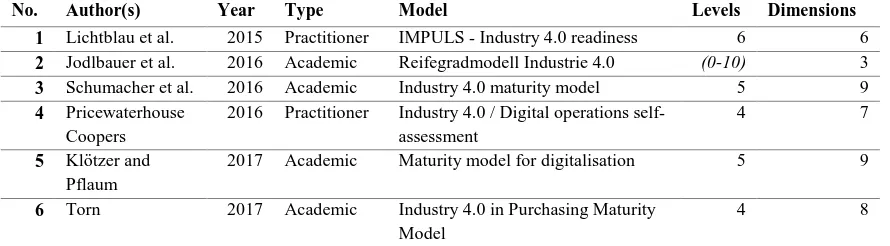
to assess Industry 4.0 or digitalisation as a subject (see table 1). Also, a maturity model that
aims at a maturity assessment for digitalisation was added, namely that of Klötzer and
Pflaum (2017). While it is named as a model for essentially the digitalisation of a supply
chain, it overlaps with Industry 4.0 models through its focus on a smart factory. It takes into
account Cyber-Physical Systems, Big Data Analytics, and other aspects, all of which are
applicable in an Industry 4.0 maturity model.