Two-View Label Propagation to Semi-supervised Reader Emotion
Classifi-cation
Shoushan Li, Jian Xu, Dong Zhang, Guodong Zhou
Natural Language Processing Lab
School of Computer Science and Technology, Soochow University, China
[email protected]
,
[email protected]
[email protected]
,
[email protected]
Abstract
In the literature, various supervised learning approaches have been adopted to address the task of reader emotion classification. However, the classification performance greatly suffers when the size of the la-beled data is limited. In this paper, we propose a two-view label propagation approach to semi-supervised reader emotion classification by exploiting two views, namely source text and response text in a label propagation algorithm. Specifically, our approach depends on two word-document bipartite graphs to model the relationship among the samples in the two views respectively. Besides, the two bipartite graphs are integrated by linking each source text sample with its corresponding response text sample via a length-sensitive transition probability. In this way, our two-view label propagation approach to semi-supervised reader emotion classification largely alleviates the reliance on the strong sufficiency and independence assumptions of the two views, as required in co-training. Empirical evaluation demonstrates the effec-tiveness of our two-view label propagation approach to semi-supervised reader emotion classification.
1 Introduction
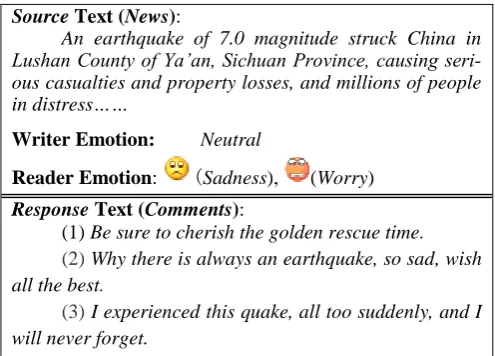
Source Text (News):
An earthquake of 7.0 magnitude struck China in Lushan County of Ya’an, Sichuan Province, causing seri-ous casualties and property losses, and millions of people in distress……
Writer Emotion: Neutral
Reader Emotion: (Sadness), (Worry)
Response Text (Comments):
(1) Be sure to cherish the golden rescue time.
(2)Why there is always an earthquake, so sad, wish all the best.
[image:1.595.174.422.455.633.2](3) I experienced this quake, all too suddenly, and I will never forget.
Figure 1: An example of a news article, together with its writer and reader emotions
Emotion classification aims to predict the involving emotion towards a piece of text. For a particular text, there always exist two kinds of emotions, namely writer emotion and reader emotion, where the former concerns the emotion produced by the writer who writes the text and the latter concerns the
This work is licensed under a Creative Commons Attribution 4.0 International Licence. Licence details: http://creativecom-mons.org/licenses/by/4.0/
Corresponding author
emotion produced by the reader who reads the text. For instance, in Figure 1, given the news text about earthquake, the writer emotion is more likely to be neutral due to the professionalism of the news re-porter, while the reader emotion might be sadness, or worry. Recent years have seen growing interest in reader emotion classification due to its importance in more and more real-life applications, such as con-tent recommendation and online advertisement.
Conventional approaches to reader emotion classification conceptualize the task as a supervised learn-ing problem and rely on a large-scale human-annotated data for model learnlearn-ing. Although such super-vised approaches deliver reasonably good performance, the reliance on labeled data, which is normally difficult and highly expensive to obtain, presents a major obstacle to the widespread application of reader emotion classification.
To alleviate the problem above, Liu et al. (2013) originally propose a semi-supervised learning ap-proach to reader emotion classification to improve the performance by enlarging the labeled data with automatically inferred annotations of unlabeled instances. Their basic idea mainly lies on unique char-acteristics in reader emotion analysis, different from the case in writer emotion analysis. That is, apart from the source text (e.g., news text), another type of text, the response text (e.g., comment text) written by the reader as a response to the source text, is available to help determine the reader emotion of the
source text. For example, in Figure 1, the comment “Why there is always an earthquake, so sad, wish
all the best” explicitly express reader emotion sadness. Therefore, the source text and the response text
are casted respectively as two views in a co-training algorithm to perform semi-supervised learning. However, the success of co-training largely depends on two strong underlying assumptions, i.e., suf-ficiency and independence, of the two views (Blum and Mitchell, 1998), which are actually violated in reader emotion classification when the source text and response text are utilized as two views.
On one hand, the response text often lacks sufficient information to correctly predict the label of an instance, since the response text tends to be short. For example, in Figure 1, if there is only one existing comment, e.g., (1) “Be sure to cherish the golden rescue time”, the reader emotion is difficult to predict
because no emotion is clearly expressed in this sentence. Even worse, as an extreme example, the source
text (e.g., some newly posted news) sometimes has no response at all.
On the other hand, the response text normally depends on the source text, since both the response
text and the source text talk about the same topics. It is really hard for them to meet the view
independ-ence assumption in co-training.
In this paper, we propose a novel semi-supervised learning approach, namely two-view label propa-gation (LP), to reader emotion classification. As an extension of traditional label propapropa-gation with a single view (Zhu and Ghahramani, 2002), our two-view LP approach depends on two graphs, i.e., one depicting the connections among the source text samples and the other depicting the connections among
the response text samples. Besides, the two graphs are integrated by linking each source text sample
with its corresponding response text sample to capture the dependence between the source text and the
response text. Such a two-view LP approach thus avoids the independence assumption, as required in
traditional co-training. Finally, we assign a variable weight between each source text sample and its
response text sample to address the information insufficiency in the response text. Specifically, we
de-sign a length-sensitive linear function to calculate the transition probability between the source and re-sponse text samples.
The remainder of this paper is organized as follows. Section 2 overviews related work on emotion classification. Section 3 introduces the baseline approach to semi-supervised reader emotion classifica-tion with single-view label propagaclassifica-tion. Secclassifica-tion 4 presents our two-view label propagaclassifica-tion approach to semi-supervised reader emotion classification. Section 5 empirically evaluates our approach. Finally, Section 6 gives the conclusion and future work.
2 Related Work
Among the large number of studies in sentiment analysis over the last decade (Pang et al., 2002; Turney, 2002; Alm et al., 2005; Wilson et al., 2009), only a small portion focus on emotion classification.
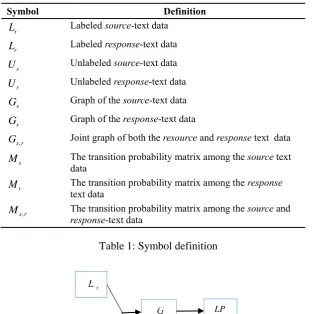
Symbol Definition
s
L Labeled source-text data
r
L Labeled response-text data
s
U Unlabeled source-text data
r
U Unlabeled response-text data
s
G Graph of the source-text data
r
G Graph of the response-text data
, s r
G Joint graph of both the resource and response text data
s
M The transition probability matrix among the source text
data
r
M The transition probability matrix among the response
text data
, s r
M The transition probability matrix among the source and response-text data
[image:3.595.144.459.68.382.2]Table 1: Symbol definition
Figure 2: The framework of single-view label propagation approach to semi-supervised learning on reader emotion classification
2005; Chen et al., 2010; Purver and Battersby, 2012; Hasegawa et al., 2013; Qadir and Riloff, 2014), mainly from the supervised learning paradigm.
Compared with above studies on writer emotion classification, studies on reader emotion classifica-tion are much limited. Lin et al. (2007) first describe the task of reader emoclassifica-tion classificaclassifica-tion on news articles with some standard machine learning approaches. Lin et al. (2008) further exploit more features to improve the performance.
More recently, Liu et al. (2013) propose a co-training approach to semi-supervised learning on reader emotion classification by considering the message text and the comment text as two views. However, their success is much limited due to the required two strong assumptions on co-training, i.e. sufficiency and independence assumptions on the two views in co-training.
3 Single-view LP to Semi-supervised Reader Emotion Classification
In reader emotion classification, each target (e.g., a news article) is represented by two kinds of text, namely source text and response text. Formally, we refer the training data containing the source text samples as Ls and the one containing the response text samples as Lr. In this study, we only consider two emotion categories, i.e., positive and negative emotions. The task of semi-supervised learning on reader emotion classification is to leverage the training data Lsand Lr, together with the unlabeled data
s
U and Ur, to train a classifier. For clarity, Table 1 illustrates some important symbols.
Figure 2 illustrates the framework of the LP-based semi-supervised approach to when only the view of the source text is utilized. Traditional label propagation (LP) is a graph-based semi-supervised learn-ing approach with a slearn-ingle view (Zhu and Ghahramani, 2002). In general, a LP-based approach to semi-supervised learning consists of two main steps: graph construction to represent the relationship among the document samples and label propagation to propagate the labels of the labeled data to the unlabeled
Figure 3: The word-document bipartite graph
Input:
P: The n2 matrix, while pir represents the probability of document Di
(i=1...n) with label r (r=0,1);
M : The n n transition probability matrix Output:
The unlabeled data with prediction labels
Procedure:
1) Initialize P as P0
a) Assign each labeled sample with a fixed probability distribution (1, 0) or (0,1) according to its label r;
b) Assign each unlabeled sample with an initial probability distribution (0.5, 0.5); 2) Loop until P converges;
a) Propagate the labels of any vertex to nearby vertices by T 1
t t
PM P ; b) Clamp the labeled data, that is, replace the probabilities of the labeled samples
in Pt1 with their initial ones inP0;
3) Assign each unlabeled instance with a label by computing arg max ir
r p
Figure 4: The LP algorithm
data in the obtained graph.
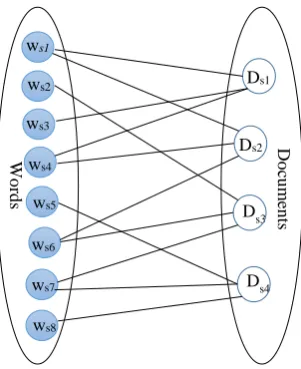
In detail, in the first step, we adopt a word-document bipartite graph to model the relationship among the document samples due to its excellent performance in sentiment classification (Sindhwani and Mel-ville, 2008). Figure 3 illustrates the structure of the word-document bipartite graph, in which the nodes consist of two parts: all documents and all words extracted from the documents. An undirected edge (D wi, k) exists if and only if document Di contains word wk. Let xik be the frequency of word wkin document Di. From the bipartite graph, the probability of walking from document Di to word wk can
be calculated as ik / ik
k
x
x and the probability of walking from wordwk to document dj can becal-culated as jk / jk
j
x
x . Thus the probability of walking from document Di to document Dj thoughthe word wkcan be calculated as ( ik / ik) ( jk / jk)
k j
x
x x
x . When all words are considered, we getthe transition probability from Di to Dj as:
jk ik
ij k
ik jk
k j
x x
t
x x
(1) Ds3Ds4 ws1
Ds2 ws2
ws4 ws3
ws7 ws5
ws6
ws8
Ds1
Wo
rd
s
Do
cu
m
en
and the transition probability matrix M { }tij .
[image:5.595.192.405.171.320.2]In the second step, we adopt the standard LP algorithm to perform semi-supervised learning. In detail, Figure 4 illustrates the LP algorithm (Zhu and Ghahramani, 2002), during which the probabilities of the labeled data are clamped in each loop using their initial ones and act as a force to propagate their labels to the unlabeled data.
[image:5.595.192.403.367.561.2]4. Two-View LP to Semi-supervised Reader Emotion Classification
Figure 5: The framework of our two-view label propagation approach to semi-supervised learning on reader emotion classification
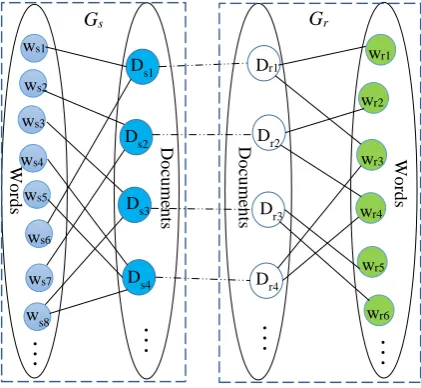
Figure 6: The joint two-view graph that contains both the source and response text sub-graphs
Figure 5 illustrates the framework of our LP-based semi-supervised approach to reader emotion classi-fication when two views, i.e., the source text and the response text, are utilized. The graph in our ap-proach consists of two sub-graphs, i.e., Gsand Gr, and each of them is modeled as a word-document bipartite graph. Each pair of the source text document and its corresponding response text document is connected to join the two sub-graphs together. Figure 6 illustrates the joint two-view graph of both the
source text and response text data.
Basically, the transition probability between the source text document and its corresponding response
text document can be set to 1, assuming that they exhibit the same category. Therefore, the transition probability matrix Ms r, of the joint graphGs r, can be represented as follows:
, [ ]
s s r
r
M I
M
I M
(2)
LP
Dr3
Dr4 ws1
Dr2 ws2
ws5 ws3
ws4
ws7 ws6
Dr1
D
o
cu
m
en
ts
wr1
wr2
wr3
wr5 wr4
wr6 Ds1
Ds2
Ds3
Ds4
W
o
rd
s
Do
cu
m
en
ts
Wo
rd
s
ws8
. . .
. . .
. .
. .. .
Where I is an identity matrix of dimension n, containing ones along the diagonal and zeros in all other positions; Ms and Mr are the transition probability matrixes, calculated using formula (1) in the sub-graphs, Gsand Gr, respectively.
However, when a response text contains too few information or even no words, it becomes a noisy sample. In this scenario, it is not appropriate to propagate the emotion label of its source-text sample to this noisy sample. Therefore, for the source text sample and its corresponding response text sample (e.g.,
1 s
D and Dr1as shown in Figure 6, we design a function to measure the transition probability by taking the length of the response text into account, as follows:
,
1 ( )
/
i
i i i
i i
r max s r r
r max r max
z l
t z
z l z l
(3)
Where
i
r
z is the length of the response text document
i
r
D , defined as the number of the words in the
response text document; lmax denotes the threshold of the document length. If the length is larger than
this threshold, it is given a transition probability of 1. If the length is smaller than this threshold, the longer the response text sample it is, the higher transition probability it has.
Accordingly, the transition probability matrix Ms r, of the joint graphGs r, can be refined as follows:
,
'
[ ]
'
s s r
r
M I
M
I M
(4)
Where 'I is a matrix of dimension n, containing the transition probabilities, calculated using formula (3).
5. Experimentation
We systematically evaluate our semi-supervised learning approach to reader emotion classification.
5.1 Experimental Settings
Data collection: The data is collected from Yahoo! Kimo News (http://tw.news.yahoo.com). Each news
article and its comments are considered as a source-text sample and a response-text sample, respectively. Besides, each news article is voted with emotion tags from eight categories: happy, sad, angry,
mean-ingless, boring, heartwarming, worried, and useful. Following Liu et al. (2013), we consider happy and
heartwarming as positive category while sad, angry, boring, and worried as negative category. The
emotion label of a news article is automatically derived from the votes, i.e. the news article with over 10 votes of positive (negative) emotions is assigned with a positive (or negative) label. Unlike Liu et al. (2013), we do not filter those news articles with less than 5 comments.
Data setting: We randomly select 1300 positive and 1300 negative source and response instances for
the empirical study. Among them, 300 positive and 300 negative source and response instances are used as test data while the remaining 1000 positive and 1000 negative source and response instances are used as training data. In the training data, we select 0.5%, 1%, and 2% data as initial labeled data and the remaining data as unlabeled data respectively.
Features: Each source (or response) text is treated as a bag-of-words and transformed into binary
vectors encoding the presence or absence of word unigrams.
Classification algorithm: The maximum entropy (ME) classifier implemented with the Mallet Toolkits (http://mallet.cs.umass.edu/).
Evaluation Measurement: The performance is evaluated using the standard accuracy measurement.
Significance test: T-test is used to evaluate the significance of the performance difference between
two approaches (Yang and Liu, 1999).
5.2 Experimental Results on Single-view LP
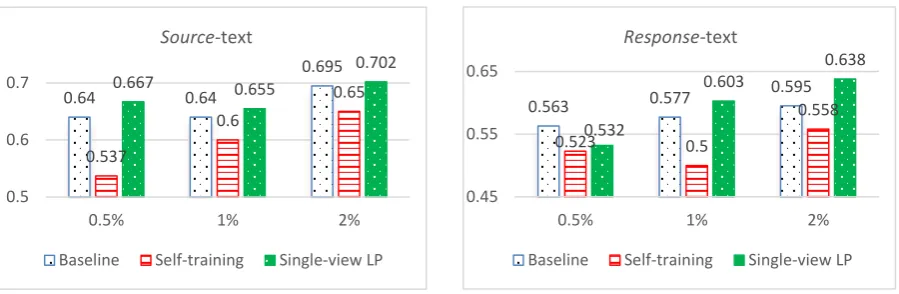
Figure 7: Performance comparison of different semi-supervised learning approaches to reader emotion classification when only one view is utilized
Figure 8: Performance comparison of different semi-supervised learning approaches to reader emotion classification when two views are utilized
Baseline: using only labeled data to train the classifier for predicting the reader emotion of each
view (No unlabeled data is used.)
Self-training: using self-training, a simple bootstrapping approach, to iteratively add the
high-con-fident unlabeled samples as automatically labeled samples in each view.
Single-view LP: first using the word-document bipartite graph to model the relationship among the
document samples in each view and then applying label propagation to perform semi-supervised learning as introduced in Section 3.1.
Figure 7 shows the performance of different approaches when either the source-text or the response -text view is utilized. From the figure, we can see that self-training performs dramatically worse than the single-view LP approach, even worse than the baseline approach. In general, the single-view LP ap-proach is effective on using unlabeled data to improve the performance, although the average improve-ment is limited with around 2%. Besides, the single-view LP approach fails in the case when only 0.5% of the training data are used as initial labeled data. This is possibly because too few initial labeled sam-ples make it extremely difficult to correctly bootstrap enough unlabeled samsam-ples.
5.3 Experimental Results on Two-view LP
In this section, we compare different approaches to semi-supervised learning on reader emotion classi-fication when two views are utilized. For comparison, we implement following approaches:
Co-training: using the source–text and response-text as two views in co-training, as described in Liu
et al. (2013).
Two-view LP: our two-view LP approach with the unique transition probability of 1 between the
source-text sample and its response-text sample.
Two-view LP (New): the two-view LP approach with a variable transition probability between the
source text sample and its corresponding response text sample, as calculated with formula (3). Here,
0.64 0.64
0.695
0.537
0.6
0.65
0.667 0.655
0.702
0.5 0.6 0.7
0.5% 1% 2%
Source-text
Baseline Self-training Single-view LP
0.563 0.577
0.595
0.523 0.5
0.558 0.532
0.603
0.638
0.45 0.55 0.65
0.5% 1% 2%
Response-text
Baseline Self-training Single-view LP
0.605 0.602 0.637
0.676
0.735 0.725
0.685 0.74
0.745
0.5 0.6 0.7
0.5% 1% 2%
Source-text
Co-training Two-view LP Two-view LP(New)
0.568
0.548 0.563
0.542
0.605 0.627
0.568
0.623
0.652
0.5 0.55 0.6 0.65
0.5% 1% 2%
Response-text
Figure 9: Sensitiveness of the performance on parameter lmax
parameter lmax is fine-tuned to be 50.
Figure 8 shows the performance of different approaches when both the source-text and the response -text views are utilized. From this figure, we can see that the two-view LP approach performs much better than co-training. Significance test shows that the improvement of two-view LP (New) over two-view LP is significant (p-value<0.05). This indicates the appropriateness of a variable transition probability between the source text sample and its corresponding response text sample.
From both Figure 7 and Figure 8, we can see that co-training fails to exploit unlabeled data to improve the performance, quite different from that in Liu et al. (2013). This is mainly due to the fact that the
response text samples in our data contain much less comments. This makes the sufficiency assumption
violated in co-training. Furthermore, we find that two-view LP significantly outperforms single-view LP (p-value<0.05) with a large margin. This verifies the effectiveness of using two views to perform semi-supervised learning on reader emotion classification.
Finally, Figure 9 shows the performance of two-view LP (New) with varying values of parameter lmax
when testing on the source-text samples. Due to the space limitation, we only show the performance when using 2% training data as the initial labeled data. From this figure, we can see that our approach performs consistently well when the parameter is set from 40 to 90, which is a very broad range.
6. Conclusion
In this paper, we propose a novel approach, namely, two-view label propagation, to semi-supervised learning on reader emotion classification. Our approach consists of two main steps: (1) constructing a joint graph containing two word-document bipartite sub-graphs; (2) performing label propagation to incorporate the unlabeled data. Furthermore, we design a length-sensitive function to measure the tran-sition probability from a source text sample to its responding response text sample. Experimental studies demonstrate that our two-view label propagation approach is capable of employing the two views and unlabeled data to improve the performance.
This work mainly focuses on reader emotion classification with only two categories, i.e., positive and
negative emotions. In the future work, we will explore semi-supervised learning on reader emotion
clas-sification when more fine-grained categories, such as happiness, sadness, and anger, are considered. Moreover, given the wide potential of the two-view LP approach, we will explore it in other NLP tasks where two views are involved.
Acknowledgements
This research work has been partially supported by three NSFC grants, No.61273320, No.61375073, No.61331011.
References
Cecilia Ovesdotter Alm, Dan Roth and Richard Sproat. 2005. Emotions from Text: Machine Learning for Text-based Emotion Prediction. In Proceedings of EMNLP-05, pages 579-586.
Avrim Blum and Tom Mitchell. 1998. Combining Labeled and Unlabeled Data with Co-training. In Proceedings of COLT-98.
0.66 0.68 0.7 0.72 0.74 0.76
0 10 20 30 40 50 60 70 80 90
100 200 400
The parameterlmax
Ying Chen, Sophia Yat Mei Lee, Shoushan Li and Chu-Ren Huang. 2010. Emotion Cause Detection with Linguis-tic Constructions. In Proceeding of COLING-10, pages 179-187.
Dipankar Das and Sivaji Bandyopadhyay. 2009. Word to Sentence Level Emotion Tagging for Bengali Blogs. In
Proceedings of ACL-09, pages 149-152.
Takayuki Hasegawa, Nobuhiro Kaji, and Naoki Yoshinaga. 2013. Predicting and Eliciting Addressee’s Emotion in Online Dialogue. In proceedings of ACL-13, pages 964-972.
Kevin Hsin-Yih Lin, Changhua Yang and Hsin-Hsi Chen. 2007. What Emotions do News Articles Trigger in Their Readers? In Proceeding of SIGIR-07, poster, pages 733-734.
Kevin Hsin-Yih Lin, Changhua Yang and Hsin-Hsi Chen. 2008. Emotion Classification of Online News Articles from the Reader’s Perspective. In Proceeding of the International Conference on Web Intelligence and Intelli-gent AIntelli-gent Technology, pages 220-226.
Huanhuan Liu, Shoushan Li, Guodong Zhou, Chu-Ren Huang, and Peifeng Li. 2013. Joint Modeling of News Reader’s and Comment Writer’s Emotions. In proceedings of ACL-13, short paper, pages 511-515.
Bo Pang, Lillian Lee and Shivakunmar Vaithyanathan. 2002. Thumbs up? Sentiment Classification using Machine Learning Techniques. In Proceedings of EMNLP-02, pp.79-86.
Matthew Purver and Stuart Battersby. 2012. Experimenting with Distant Supervision for Emotion Classification. In Proceedings of EACL-12, pages 482-491.
Ashequl Qadir and Ellen Riloff. 2014. Learning Emotion Indicators from Tweets: Hashtags, Hashtag Patterns, and Phrases. In Proceedings of EMNLP-14, pages 1203-1209.
Changqin Quan. and Fuji Ren. 2009. Construction of a Blog Emotion Corpus for Chinese Emotional Expression Analysis. In Proceedings of EMNLP-09, pages 1446-1454.
Vikas Sindhwani and Prem Melville. 2008. Document-Word Co-Regularization for Semi-supervised Sentiment Analysis. In Proceedings of ICDM-08, pages 1025-1030.
Jacopo Staiano. and Marco Guerini. 2014. Depeche Mood: a Lexicon for Emotion Analysis from Crowd-Anno-tated News. In Proceedings of ACL-14, pages 427-433.
Peter D. Turney. 2002. Thumbs up or Thumbs down? Semantic Orientation Applied to Unsupervised Classifica-tion of comments. In Proceedings of ACL-02, pages 417-424.
Svitlana Volkova, William B. Dolan and Theresa Wilson. 2012. CLex: A Lexicon for Exploring Color, Concept and Emotion Associations in Language. In Proceedings of EACL-12, pages 306-314.
Theresa Wilson, Janyce Wiebe, and Paul Hoffmann. 2009. Recognizing Contextual Polarity: An Exploration of Features for Phrase-Level Sentiment Analysis. Computational Linguistics, vol.35(3), pages 399-433.
Ge Xu, Xinfan Meng and Houfeng Wang. 2010. Build Chinese Emotion Lexicons Using A Graph-based Algorithm and Multiple Resources. In Proceeding of COLING-10, pages 1209-1217.
Yiming Yang and Xin Liu. 1999. A Re-Examination of Text Categorization Methods. In Proceedings of SIGIR-99, pages 42-49.
Xiaojin Zhu and Zoubin Ghahramani. 2002. Learning from Labeled and Unlabeled Data with Label Propagation.