Referring Expression Generation as a Search Problem
Bernd Bohnet
[email protected] Institute for Intelligent Systems
University of Stuttgart 70569 Stuttgart
Germany
Robert Dale [email protected] Centre for Language Technology
Macquarie University Sydney nsw 2109
Australia
Abstract
One of the most widely explored issues in natu-ral language generation is the generation of re-ferring expressions (gre): given an entity we want to refer to, how do we work out the content of a referring expression that uniquely identifies the intended referent? Over the last 15 years, a number of authors have proposed a wide range of algorithms for addressing different aspects of this problem, but the different approaches taken have made it very difficult to compare and con-trast the algorithms provided in any meaningful way. In this paper, we propose a characterisa-tion of the problem of referring expression gen-eration as a search problem; this allows us to recast existing algorithms in a way that makes their similarities and differences clear.
1 Introduction
A major component task in natural language generation (nlg) is the generation of referring expressions: given an entity that we want to refer to, how do we determine the content of a referring expression that uniquely identifies that intended referent? Since at least (Dale, 1989), the standard conception of this task in the lit-erature has been as follows:
1. We assume we have a knowledge base that characterises the entities in the domain in terms of a set of attributes and the values that the entities have for these attributes; so, for example, our knowledge base might represent the fact that entity e1 has the value cup for the attribute type, and the valuered for the attributecolour.
2. In a typical context where we want to re-fer to some ei, which we call the intended referent, there will be other entities from which the intended referent must be distin-guished; these are generally referred to as
distractors. So, for example, we may want to distinguish a particular cup from all the other items present in the context of a din-ing table.
3. The goal of referring expression generation is therefore to find some collection of at-tributes and their values which distinguish the intended referent from all the potential distractors in the context.
Over the last 15 years, a wide variety of algo-rithms have been proposed to deal with specific aspects of this problem. For example, while ear-lier algorithms focussed on the use of attributes that correspond to simple one-place predicates, later work attempts to address the use of rela-tional predicates, and other work looks at the incorporation of boolean operators such as not and and. The consequence is that we now have a considerable body of research in this area, but it is difficult to establish just how these different algorithms relate to each other.
2 A Brief Review of Work To Date
Although the task of referring expression gen-eration is discussed informally in earlier work on nlg (in particular, see (Winograd, 1972; McDonald, 1980; Appelt, 1981), the first for-mally explicit algorithm was introduced in Dale (1989). This algorithm, which we will refer to as the Full Brevity (fb) algorithm, is still frequently used as a basis for other gre al-gorithms. The fb algorithm searches for the best solution amongst all possible referring ex-pressions for an entity; the algorithm derives the smallest set of attributes for the referent in question, producing a referring expression that is bothadequate andefficient.
This initial algorithm limited its ap-plication to one-place predicates. Dale and Haddock (1991) introduced a constraint-based procedure that could generate referring expres-sions involving relations (henceforth ir), using a greedy heuristic to guide the search.
As a response to the computational complexity of greedy algorithms, (Reiter and Dale, 1992; Dale and Reiter, 1995) introduced the psycholinguistically motivated Incremental Algorithm (ia). The most used and adapted algorithm, this is based on the observation that people often produce referring expressions which are informationally redundant; the algo-rithm uses a preference ordering over the at-tributes to be used in a referring expression, ac-cumulating those attributes which rule out at least one potential distractor.
In recent years there have been a num-ber of important extensions to the ia. The Context-Sensitive extension (cs; (Krahmer and Theune, 2002)) is able to generate referring ex-pressions for the most salient entity in a con-text; the Boolean Expressions algorithm (be; (van Deemter, 2002)) is able to derive expres-sions containing boolean operators, as inthe cup that does not have a handle; and the Sets algo-rithm (set; (van Deemter, 2002)) extends the basic approach to references to sets, as in the red cups.
Some approaches combine algorithms which reuse only parts of other algorithms: the Branch and Bound (bab; (Krahmer et al., 2003)) algorithm uses the Full Brevity algo-rithm, but is able to generate referring expres-sions with both attributes and relational de-scriptions using a graph-based technique.
We have identified here what we be-lieve to be the most cited strands of research in this area, but of course there are many other al-gorithms described in the literature: see, for ex-ample, (Horacek, 1997; Bateman, 1999; Stone, 2000). Space limitations prevent a complete summary of this other work here, but our in-tention is to extend the analysis presented in this paper to as many of these other algorithms as possible.
All these algorithms focus on the gen-eration of definite references; they are typically embedded in a higher-level algorithm that in-cludes cases for when the entity has not been previously mentioned (thus leading to an ini-tial indefinite reference) or when the referent is in focus (thus leading to a pronominal refer-ence); see, for example, (Dale, 1989; Krahmer and Theune, 2002; Dale, 2003).
3 gre from the Perspective of Problem Solving
With so many algorithms to choose from, it would be useful to have a uniform framework in which to discuss and compare algorithms; unfor-tunately, this is rather difficult given the variety of different approaches that have been taken to the problem.
Within the wider context ofai, Russell and Norvig (2003) present an elegant definition of a general algorithm for problem solving by search. The search graph consists ofnodeswith the components state and path-cost; the prob-lem is represented by aninitial-state, an expand-method which identifies new states in the search space, a queuing-method which determines the order in which the states should be considered, and a path-cost-function which determines the cost of reaching a given state. In this frame-work, the search strategy is determined by the combination of queuing-method and path-cost-function used.
1. The initial-state is of the form h{}, C, Pi, whereC is the set of distractors in the ini-tial context, andP is the set of all proper-ties true of the intended referent.
2. The goal state is of the form h{λxP1, λxP2, . . .},{}, P0i, where the
first term contains a set of properties of the intended referent that, by virtue of the second term (the set of distractors) being an empty set, distinguish the intended referent; P0 contains any properties of
the intended referent not yet used in the description.
3. All other states in the search space are then intermediate states through which an algo-rithm will move as it adds new properties to the description.
4. The search strategy is carried out by the expand-method and the queuing-method, which together characterise the specific gre algorithm (for example,fb,gh oria) that is used.
5. The path-cost-function allows us to route the search as required; this can be used to take account of salience weights, or to em-body some kind of heuristic search.
For any given algorithm, not all of the methods and functions need to be implemented; in par-ticular, some algorithms do not require a path-cost-function.
4 gre Algorithms in Terms of Problem Solving
We adopt here an object oriented formalism,1 since this allows the representation of depen-dencies between the algorithms by means of in-heritance and overwriting.
To enable more fruitful comparison of the different gre algorithms, we want to dis-tinguish those aspects of the algorithms which are true of all algorithms, and those which are unique to each particular algorithm. In Sec-tion 4.1, we first describe the elements that are shared by all the algorithms; we then go on to describe the distinct aspects of each algorithm in turn.
1We follow the code conventions as used in
OO-languages, where the names of classes start with upper case characters, and the names of methods and variables start with lower case characters.
4.1 Common Elements
This approach allows us to separate out those aspects of the various algorithms which remain constant.
Following from the previous section, the definitions of the node and state classes are as shown in Definition 1. This figure also shows the definitions for initial-state and goal, which remain constant across the algorithms.
Definition 1: The Node and State Classes
classNode{ s// State
path-cost// Cost of the path
getState()
{returns}// returns the state of the node }
classState{
L// Set of chosen properties and/or relations
C // Set of distractors
P // Set of available properties and/or relations }
initialState(){return newState(∅,C,P)} // the goal is the empty set of distractors
goal(s){
ifs.C = ∅ then returntrue else returnfalse
}
Given these components, the main method makeRefExp is then as represented in Definition 2. This takes two arguments, which serve as the parameters that distinguish one algorithm from another: an expand method to create the successors of a given state, and a queue method, which defines how to insert nodes into the node queue. Depending on the order in which the nodes are inserted, differ-ent search strategies can be realized: for exam-ple, when the nodes are inserted at the front of the queue, the search strategy is depth-first; when the nodes are inserted at the end of the queue, the search strategy is breadth-first; when the nodes of the queue are sorted by the esti-mated distance to the goal, then the search type is best-first; and so on.
Definition 2: The Basic Algorithm Struc-ture
makeRefExp(){
// create a initial queue with a single node
nodeQueue ←[newNode(initialState())]
whilenodeQueue 6= ∅ do
node←removeFront(nodeQueue)
ifgoal(node.getState())then returnnode// success
end
nodeQueue←queue(nodeQueue,expand(node))
end
returnnil// failure }
With this machinery in place, we can now redefine the existing algorithms in terms of their core differences, which correspond essen-tially to different ways of expanding the search space.
4.2 The Full Brevity Algorithm
The distinctive property of the Full Brevity (fb) algorithm is that it computes all combinations of the available properties P with increasing length, so that it may find the shortest combi-nation that succeeds in identifying the intended referent.
This behaviour is captured by the ex-pand method shown in Definition 3. The method creates a set of successors by creating a node for each property pi which has not so far been checked, provided thatpi rules out at least one distractor.
The fb algorithm uses a breadth-first search implementation of the queue, as shown in Definition 4. Consequently, any solution for which goal returns true will have a minimal number of properties, since the breadth-first search considers smaller combinations of prop-erties first.
The fb algorithm uses the expand method, and createNode method which are shown in Definition 3 and it is invoked by a call of makeRefExp method which is shown in Definition 2.
4.3 The Incremental Algorithm
The distinctive property of the Incremental Al-gorithm is that it reduces the computational complexity of constructing a referring expres-sion by considering properties to use in
se-Definition 3: The Full Brevity Algorithm
expand(node){
N ← ∅
s ← node.getState()
foreachp∈s.P do
N ←N∪ {createNode (node, p)}
end returnN }
createNode(node,p){ s ← node.getState()
out ← rulesOut(p,s.C)
ifout6=∅then
return newNode(s.C−out,s.L ∪ {p},
s.P− {p})
else return newNode(s.C,s.L,s.P− {p}) }
Definition 4: Breadth-first Queueing
queue(actN odes, newN odes){ // append the nodes at the end
return actN odes∪newN odes }
quence from a predefined ordering of the avail-able properties. The implementation of the ex-pandmethod shown in Definition 5 provides this behaviour.
If the set of properties of the current state s.P is not empty, then the first property
p according to the given orderO is chosen from the set of properties of the current state s.P, and a node is created with a new state by the method createNode. Note that the createNode method is the same as that used in thefb algo-rithm and shown in Definition 3.
Unlike the expand method used in the fb algorithm, however, the set of nodes re-turned here contains only one node. The main method applies the goal predicate to this node; if this returns true, then the node containing the state with the list of properties for the referring expression is returned.
4.4 Extension of the IA to Sets
Definition 5: The Incremental Algorithm O// Predefined constant order of properties
expand(node){
N ← ∅
s ← node.getState()
ifs.P 6=∅then
p ← choose the first p in O, wherep∈s.P
N ← N∪ {createNode(node, p)}
end return N }
Definition 6: The Set Algorithm R// Set of referents
createNode(node,p){ out←rulesOut(p, s.C)
if(¬∃x∈R&x∈out)&(∃x∈C&x∈out)then return newNode(s.C−out, s.L∪{p},s.P− {p})
else return newNode(s.C, s.L,s.P− {p}) }
Note that, precisely because this algo-rithm is an extension of the ia algorithm, we reuse the expand method from that algorithm. Consequently, the extension requires only the rewriting of thecreateNodemethod, whereby an attributepi is only chosen when it does not rule out entities from the set of referentsRand when it rules out at least one entity from the set of distractorsC. If a property does not fulfil that condition, then a node with the current state is returned and the process is continued, as in the ia, with the next property.
4.5 gre Involving Relations
The algorithm forgre Involving Relations (ir) introduced by Dale and Haddock (1991) is constraint-based. The search strategy used to fulfil the constraints is a combination of a greedy search, which chooses the relation that leads to the smallest set of distractors, and depth-first search to describe the entities, that is, the in-tended referent as well as entities which are ref-erenced in the relations.
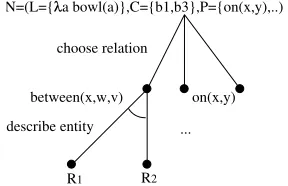
The strategy can be explained best by means of anand/or-tree, as shown in Figure 1. Here, the top node represents a state in which relational properties are to be considered as ad-ditions to the set of chosen properties. Each search step consists of two stages: in the first stage, we choose the relation pi which rules out
the largest number of distractors; in the sec-ond stage, each entity which is referenced by the chosen relation has to be described by re-peating the process recursively. This is done in a depth-first manner, but if the related entity is not uniquely distinguished then the next pj
that the intended referent participates in is cho-sen, and so on. This process continues until all entities are uniquely described (success) or no further relations can be chosen (failure).
describe entity ...
between(x,w,v) on(x,y)
N=(L={ a bowl(a)},C={b1,b3},P={on(x,y),..)
choose relation
[image:5.595.350.494.216.309.2]R1 R2
Figure 1: Expansion tree for theiralgorithm
The algorithm is represented in the problem solving paradigm as in Definition 7. Here, the expand method chooses a relation which rules out the largest number of distrac-tors; it then calls the methodcreateNode, which recursively calls makeRefExp for each new ref-erent contained in the relation.
4.6 Context-Sensitive GRE
Krahmer and Theune (2002) also introduced a number of extensions to the ia: the use of salience weights in order to add a definite arti-cle to the description for the most salient entity; contrastive properties in order to add properties which impose a contrast between two entities; and a relational extension, similar in spirit but not in form to that in theiralgorithm described above.
Again, as for the sets algorithm, the commonality with the ia algorithm surfaces as the reuse of the latter algorithm’s expand method; only the createNode method needs to be rewritten, as in Definition 8. To model this variant in our framework, we introduce the fol-lowing additional methods (cf. (Krahmer and Theune, 2002)):
• contrastive takes a referent r and a prop-erty pi; it checks whether the property un-der consiun-deration is contrastive.
prop-Definition 7: Involving Relations r // Referent
expand(node){
s ← node.getState()
pc ← nil
// Chosen relation ispc, whereprules out
// the largest number of distractors
foreachp∈s.P do ifpc=nilor
|rulesOut(p, s.C)|>|rulesOut(pc, s.C)| thenpc ←p
end end
nodec← createNode(node, pc) if(nodec=nil)then return ∅ else return{nodec}
}
createNode(node, p){ s ← node.getState()
C ← rulesOut(p, s.C)
L←s.L∪ {p}
// Extend Description
foreachr0 ∈ {r
p|rp ∈ referents(p) &rp6=r}do
noder0 ← makeRefExp(r0)
ifnoder0 =nilthen returnnil// failure
L←L∪node.getState().L
end
return newNode(C, L, s.P − {p}) }
erties, and a set of distractors; it checks whether every entity in the set of distrac-tors has a lower salience weight thanr.
5 Conclusions and Future Work
In the foregoing, we have shown how a num-ber of the most frequently discussed algorithms for the generation of referring expressions can be represented within a common framework. There are three significant advantages to this approach.
First, it allows us to determine what the algorithms have in common. This is partic-ularly interesting in that it allows us to begin to assemble a collection of core functionalities that are usable in a variety of different approaches to gre. This is apparent not only in terms of the general framework (where, for example, the no-tions of states and their initialisation, and def-inition of what it is to be a goal state, and the overall algorithmic pattern) are shared, but in terms of ‘helper’ routines (such as rulesOutand mostSalient) which can be modularised out of the essence of different algorithms.
Definition 8: Context-Sensitive Algorithm r // Referent
createNode(node,p){ s ← node.getState()
out← rulesOut(p, s.C)
C← s.C−out L← s.L
if(out 6=∅ orcontrastive(r, p))then
L← L ∪ {p}
ifv expresses a relation betweenrandr0 then
noder0 ← makeRefExp(r0)
L← L ∪ noder0.getState().L end
end
ifmostSalient(r, L, C)then
L← L ∪ {defArt}
// The most salient rules out all distractors:
C← ∅
end
returnnew Node(C, L,s.P− {p}) }
Second, it makes it possible to see what the differences between the algorithms re-ally consist in. In their original forms, these differences are obscured, due to the absence of a common vocabulary for expressing the algo-rithms; by representing the algorithms within a common framework, it becomes easier to see where the algorithms differ, and where the dif-ferences are simply due to difdif-ferences in nota-tion or presentanota-tion. By using the framework of problem solving as search, we have effectively decomposed the algorithms into a number of key elements: a search srategy, represented by the queuing-method, and an expand-method, which encompasses two aspects of each algorithm: the basic strategy adopted and the particular kinds of referring expressions covered. Furthermore, the expand-method decomposes into a general strategy for expansion (as found in, for exam-ple, the Full Brevity algorithm and the Incre-mental Algorithm), and a createNode method, which varies depending upon the kind of refer-ring expression targetted.
com-puted); our approach separates out these differ-ent facets of the algorithms, and makes it much easier to see that the choice of search strategy is an independent decision. Consequently, for example, we can easily experiment with a vari-ant of the ir algorithm that uses breadth-first search rather than depth-first search.
So far, we have used the framwework to express the most widely-known algorithms in the literature. Preliminary examination of the algorithms in (Krahmer et al., 2003), (van Deemter and Krahmer, forthcoming), and (Ho-racek, 2004) suggests that these will also be relatively straightforward to express within the framework described here. As we capture more algorithms in the framework, our intention is to tease out an inventory of basic constituent ele-ments which can then be reassembled and inte-grated in different ways, so that we can derive a better understanding of the nature of the prob-lem of referring expression generation.
References
D. E. Appelt. 1981. Planning Natural Language Utterances to Satisfy Multiple Goals. Ph.D. thesis, Stanford University. J. Bateman. 1999. Using Aggregation for
Se-lecting Content when generating Re-ferring Expressions. In Proceedings of the 37th Annual Meeting of the ACL. University of Marylad.
R. Dale and N. Haddock. 1991. Generating re-ferring expressions involving relations. InProceedings of the 5th EACL, pages 161–166, Berlin, Germany.
R. Dale and E. Reiter. 1995. Computational in-terpretations of the gricean maxims in the generation of referring expressions. Cognitive Science, 19(2):233–263. R. Dale. 1989. Cooking up referring
ex-pressions. In Proceedings of the Twenty-Seventh Annual Meeting of the ACL, pages 68–75, Vancouver, British Columbia.
R Dale. 2003. One-anaphora and the case for discourse-driven referring expression generation. InProceedings of the Aus-tralasian Language Technology Work-shop. University of Melbourne.
H. Horacek. 1997. An Algorithm for Generat-ing Referential Descriptions with Flex-ible Interfaces. In Proceedings of the
35th Annual Meeting of the ACL. Uni-versity of Madrid.
H. Horacek. 2004. On Referring toSets of Objects Naturally. In H. Bunt and R. Muskens, editors, Third Interna-tional Natural Language Generation Conference, pages 70 – 79. Springer-Verlag Heidelberg.
E. Krahmer and M. Theune. 2002. Efficient context-sensitive generation of refer-ring expressions. InInformation Shar-ing: Reference and Presupposition in NLG and Interpretation, pages 223– 264. CSLI.
E. Krahmer, S. van Erk, and A. Verleg. 2003. Graph-based generation of referring expressions. Computational Linguis-tics, 29(1):53–72.
D. D. McDonald. 1980. Natural Language Generation as a Process of Decision-making Under Constraints. Ph.D. the-sis, Massachusetts Institute of Tech-nology.
E. Reiter and R. Dale. 1992. A fast algorithm for the generation of referring expres-sions. In Proceedings of the 14th ACL, pages 232–238.
S. Russell and P. Norvig. 2003. Artificial Intelligence: A Modern Approach. Prentice-Hall, Englewood Cliffs, NJ, 2nd edition.
H. A. Simon and A. Newell. 1963. GPS, a pro-gram that simulates human thought. Computers and Thought, pages 279– 293.
M. Stone. 2000. On identifying sets. In Pro-ceedings of the First International Nat-ural Language Generation Conference. Mitzpe Ramon.
K. van Deemter and E. Krahmer. forthcom-ing. Graphs and booleans: On the generation of referring expressions. In H. Bunt and R. Muskens, editors, Computing Meaning Vol. III. Dor-drecht: Kluwer.
K. van Deemter. 2002. Generating referring ex-pressions: Boolean extensions of the incremental algorithm. Computational Linguistics, 28(1):37–52.