ASM Kernel: Graph Kernel using Approximate Subgraph Matching for
Relation Extraction
Nagesh C. Panyam, Karin Verspoor, Trevor Cohn and Kotagiri Ramamohanarao Department of Computing and Information Systems,
The University of Melbourne, Australia [email protected]
{karin.verspoor, t.cohn, kotagiri}@unimelb.edu.au
Abstract
Kernel methods have been widely stud-ied in several natural language process-ing tasks such as relation extraction and sentence classification. In this work, we present a new graph kernel that is de-rived from a distance measure described in prior work as Approximate Subgraph Matching (ASM). The classical ASM dis-tance, shown to be effective for event ex-traction, is not a valid kernel and was pri-marily designed to work with rule based systems. We modify this distance suitably to render it a valid kernel (ASM kernel) and enable its use in powerful learning al-gorithms such as Support Vector Machine (SVM).
We compare the ASM kernel with SVMs to the classical ASM with a rule based ap-proach, for two relation extraction tasks and show an improved performance with the kernel based approach. Compared to other kernels such as the Subset tree nel and the Partial tree kernel, ASM ker-nel outperforms in relation extraction tasks and is of comparable performance in a general sentence classification task. We describe the advantages of the ASM ker-nel such as its flexibility and ease of modi-fication, which offers further directions for improvement.
1 Introduction
Many natural language processing tasks such as relation extraction or question classifica-tion are cast as supervised classificaclassifica-tion prlems (Bunescu and Mooney, 2005), with the ob-ject to classify being an entity pair or a sentence. Traditional approaches have typically focussed on transforming the input into a feature vector which
is then classified using learning algorithms such as decision trees or SVM. A primary limitation of this approach has been the manual effort required to construct a rich set of features that can yield a high performance classification. This effort is evident for the construction of features from the syntactic parse of the text, which is often repre-sented as an ordered structure such as a tree or a graph. Linearizing a highly expressive structure such as a graph, by transforming it into a flat array of features is inherently harder. This problem of constructing explicit feature sets for complex ob-jects is generally overcome by kernel methods for classification. Kernel methods allow for an im-plicit exploration of a vast high dimensional fea-ture space and shift the focus from feafea-ture engi-neering to similarity score design. Importantly, such a kernel must be shown to be symmetric and positive semi-definite (Burges, 1998), to be valid for use with kernelized learning algorithms such as SVM. Deep learning based approches (Zeng et al., 2014; Xu et al., 2015) are other alternatives to eliminate the manual feature engineering efforts. However, in this work we are primarily focussed on kernel methods.
In NLP, kernel methods have been effectively used for relation extraction and sentence classifi-cation. Subset tree kernels (SSTK) and partial tree kernels (PTK) were developed to work with con-stituency parse trees and basic dependency parse trees. However, these kernels are not suitable for arbitrary graph structures such as the enhanced dependency parses (Manning et al., 2014). Sec-ondly, tree kernels can only handle node labels and not edge labels. As a work around, these ker-nels require that the original dependency graphs be heuristically altered to translate edge labels into special nodes to create different syntactic repre-sentations such as the grammatical relation cen-tered tree (Croce et al., 2011). These limitations were overcome with the Approximate Subgraph
Matching (ASM) (Liu et al., 2013), that was de-signed to be a flexible distance measure to handle arbitrary graphs with edge labels and edge direc-tions. However, the classic ASM is not a valid kernel and therefore cannot be used with power-ful learning algorithms like SVM. It was therefore used in a rule-based setting, where it was shown to be effective for event extraction (Kim et al., 2011).
1.1 Contributions
In this work, our primary contribution is a new graph kernel (ASM kernel), derived from the clas-sical approximate subgraph matching distance, that:
• is flexible, working directly with graphs with cycles and edge labels.
• is a valid kernel for use with powerful learn-ing algorithms like SVM.
• outperforms classical ASM distance with rule based method for relation extraction.
• outperforms tree kernels for relation extrac-tion and is of comparable performance for a sentence classification task.
2 Methods
In this section, we first describe the classical ASM distance measure that was originally proposed in (Liu et al., 2013). We then discuss the modifica-tions we introduce to transform this distance mea-sure into a symmetric,L2 norm in a valid feature
space. This step allows us to enumerate the under-lying feature space and to elucidate the mapping from a graph to a vector in a high dimensional fea-ture space. We then define the ASM kernel as a dot product in this high dimensional space of well defined features. Besides establishing the validity of the kernel, the feature map clarifies the seman-tics of the kernel and helps design of interpretable models.
2.1 Classic ASM distance
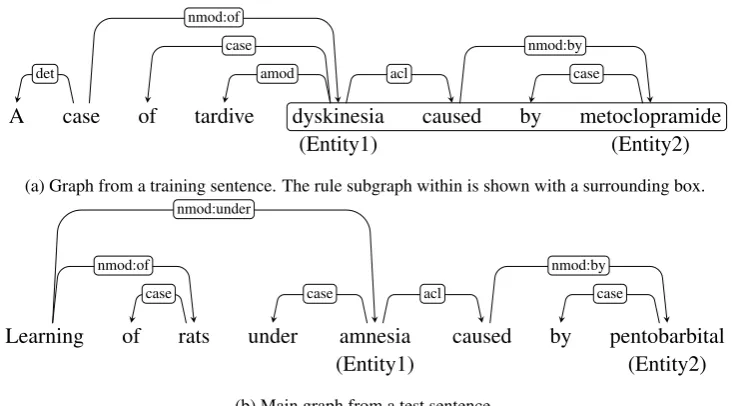
We describe the classic ASM distance in the con-text of a binary relation extraction task. Consider two sample sentences drawn from the training set and test set of such a task corpus, as illustrated in Figure 1. Entity annotations are given for the whole corpus, which are character spans referring to two entities in a sentence. In the illustrated ex-ample, the entities are chemicals (metoclopramide and pentobarbital) and diseases (dyskinesia and amnesia). The training data also contains relation
annotations, which are related entity pairs (meto-clopramide, dyskinesia). We assume that the rela-tion (causarela-tion) is implied by the training sentence and then to try to infer a similar relation or its ab-sence in the test sentence.
Preprocessing The first step in the ASM event extraction system is to transform each sentence to a graph, whose nodes represent tokens in the sentence. Node labels are derived from the cor-responding tokens properties, such as the word lemma or part of speech (POS) tag or a combi-nation of both. The node labels for entities are usually designated as Entity1 and Entity2. This process is referred to as entity blinding and is known to improve generalization (Thomas et al., 2011). Labelled edges are given by a dependency parser (Manning et al., 2014). A graph from a test sentence is referred to as amain graph. Given a training sentence and its corresponding graph, we extract the subgraph within it, that consists of only those nodes that represent the entities or belong to the shortest path1between the two entities. This is referred to as arule subgraph(see Figure 1a).
Approximate Subgraph Isomorphism The main idea in ASM is that a test sentence is considered to be of same type or express the same relation as that of a training sentence, if we can find a subgraph isomorphism of rule graph (training sentence) in the main graph (test sentence). Exact subgraph isomorphism (boolean) is considered too strict and is expected to hurt generalization. Instead, ASM tries to compute a measure (a real number) of subgraph isomorphism. This measure is referred to as the
Approximate Subgraph Matchingdistance. If the ASM distance between a rule graph and main graph is within a predefined threshold, then the test sentence is considered positive, or of the same relation type as the rule graph.
ASM distance We first compute an injective mapping M from rule graph to main graph. An injective matching scheme essentially maps each node of the subgraph to a node in the main graph, with identical labels. If no matching scheme can be found, then the ASM distance is set to a very large quantity (∞) . Following the node matching, we do not demand a matching of edges between
1Throughout this paper, shortest path refers to the path
A case of tardive dyskinesia caused by metoclopramide
(Entity1) (Entity2)
det
case
amod nmod:of
acl case
nmod:by
(a) Graph from a training sentence. The rule subgraph within is shown with a surrounding box.
Learning of rats under amnesia caused by pentobarbital
(Entity1) (Entity2)
case nmod:of
case nmod:under
acl case
nmod:by
(b) Main graph from a test sentence.
Figure 1: Sample dependency graphs from two sentences expressing a relation of type “causation” be-tween two entities.
the two graphs, like in a typical exact isomorphism search. Instead, we compute the difference be-tween these edges to get an approximate subgraph matching (ASM) distance. The ASM distance is a weighted summation of3 components, namely structural distance, label distance and direction-ality distance. These are described below, with the aid of notations described in Table 1. Note that edge directions are interpreted as special di-rectional labelsof type “forward” or “backward”. The structural distance (SD), label distance (LD) and the directionality distance (DD) for a pathPx,yr is defined as:
SD(Px,yr , Pxm0,y0) = |Len(Px,yr )−Len(Pxm0,y0)|
LD(Px,yr , Pxm0,y0) = #EL(Px,yr )4EL(Pxm0,y0)
DD(Px,yr , Pxm0,y0) = #DL(Px,yr )4DL(Pxm0,y0)
(1)
Essentially, these distances reflect the differ-ences in the structure of the two graphs, focussed at one vertex pair at a time. Notice that the above distances are defined for a given shortest path be-tween two vertices. However, there could be mul-tiple shortest paths of equal length between two vertices in a graph. The distances for a given ver-tex pair is taken to be the minimum distance over all possible choices for a shortest path.
If SP(x, y) and SP(x0, y0) denote the set of shortest paths forx, yin the rule graph andx0, y0in the main graph respectively, the distance measures for the vertex pairx, yare defined as:
Symbol Meaning
Gm =< Vm, Em > Main graph Gr =< Vr, Er> Rule graph M ={(x, x0), . . .},
∀x∈Vrs.t , label(x) =label(x0) andx0∈Vm.
Mis the injective mapping scheme, i.e M(x) =x0
Px,yg
Shortest path in graph gbetween the vertices x, y.
Len(P) The length of the path
P.
EL(P) The multiset of edge
labels on the pathP.
DL(P)
The multiset of directional labels on the pathP.
S14S2
The set symmetric difference of setsS1
andS2 .
|r1−r2|
The absolute difference of real numbersr1 andr2
#S The cardinality of set
S.
SD(x, y) = min
∀P∈SP(x,y),P0∈SP(x0,y0)SD(P, P 0
)
LD(x, y) = min
∀P∈SP(x,y),P0∈SP(x0,y0)LD(P, P 0)
DD(x, y) = min
∀P∈SP(x,y),P0∈SP(x0,y0)DD(P, P 0
)
(2)
The (unnormalized) distance measure between two graphs Gr andGm is obtained from the dis-tances between all possible vertex pairs:
SD(Gr, Gm) = X
∀x,y∈Vr
SD(x, y)
LD(Gr, Gm) = X
∀x,y∈Vr
LD(x, y)
DD(Gr, Gm) = X
∀x,y∈Vr
DD(x, y)
(3)
The final classical ASM distance in its unnor-malized form is a weighted summation of the above3components:
ASM(Gr, Gm) =w1×SD(Gr, Gm)
+w2×LD(Gr, Gm)
+w3×DD(Gr, Gm)
(4)
The classic ASM distance includes a normaliza-tion process that we have not described, as it is not central to our discussion. Notice that this distance does not meet the conditions of a positive semi-definite kernel. Trivially, it is an asymmetric dis-tance and undefined when an injective matching is unavailable. In the next section, we describe a modified form of ASM that is shown to be a||L2||
norm in a valid feature space.
2.2 Modified ASM distance
Classical ASM distance measure evaluates dis-tances between two pairs of verticesx, y∈Grand x0, y0 ∈ Gm wherex0 = M(x) andy0 = M(y) and M is the injective matching scheme. Re-call that the simplest injective matching scheme maps vertices with identical labels. We assume that node labels in a graph are all distinct. Fur-ther, for all missing labels in a graphG, we (vir-tually) insert a single disconnected dummy node with that label. These steps ensure that all la-bels in the label vocabulary are represented in the graph G and map to unique vertices. We can
Symbol Meaning
Px,yg
The representative shortest path in graph gbetween the vertices x, y.
EL(P)
The bag of words representation of edge labels on the pathP.
DL(P)
The bag of words representation of directional labels on the pathP.
||V1−V2||2
The||L2||norm of the
vector difference V1−V2
L={a, an, the, . . .} The vocabulary of all node labels (lemmas)
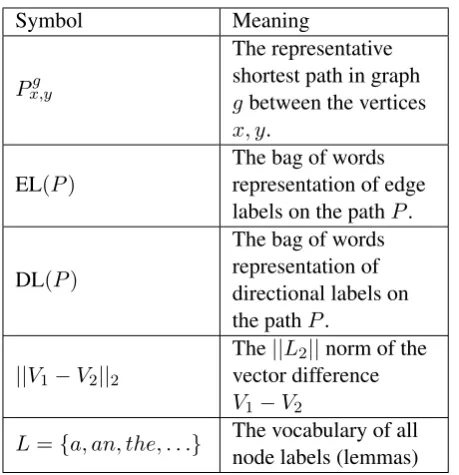
Table 2: Additional notations for the modified ASM
now define the modified ASM distance over la-bel pairs, instead of vertex pairs. Next, in the modified ASM distance, we consider only a single shortest path between a label pairx, y. For exam-ple, in Figure 1a the shortest pathP“caused”,“by” =
(“caused”,“Entity2”,“by”). When more than one such shortest path is available (due to cycles), we simply choose the first of such paths as the rep-resentative shortest path. Finally, we transform the set of edge labels in each path into a vector representation (i.e, a bag of words representation). For example, EL(P“caused”,“by”) = (“nmod:by” :
1,“case” : 1). We use the euclidean distance between these vectors, instead of the cardinality of set symmetric difference used in the classical ASM label distance. Directionality distance is modified similarly.
SD(Gr, Gm) =
X
∀l1,l2∈L×L
(Len(Px,yr )−Len(Pxm0,y0))2
LD(Gr, Gm) =
X
∀l1,l2∈L×L
kEL(Px,yr )−EL(Pxm0,y0)k2
DD(Gr, Gm) =
X
∀l1,l2∈L×L
kDL(Px,yr )−DL(Pxm0,y0)k2
where label(x) =label(x0) =l1
and label(y) =label(y0) =l2
(5)
The final modified ASM distance in its un-normalized form is a weighted summation of the above3components:
ASM(Gr, Gm) =w1×SD(Gr, Gm)
+w2×LD(Gr, Gm)
+w3×DD(Gr, Gm)
(6)
2.3 ASM Kernel: Validity and Semantics
A valid kernel function is required to be symmet-ric and positive semidefinite (Burges, 1998). Also, from Mercer’s condition (Burges, 1998), we note that such a kernel is essentially equivalent to a dot product (K(x, y) = P
iφ(x)iφ(y)i) in a
eu-clidean (or a general RKHS) “feature” space and a valid mapping function(φ) exists, that transforms the input object to the feature space. Kernel valid-ity can be directly established by deriving the un-derlying feature map (φ), and computing the ker-nel directly as a dot product of the mapped vec-tors (hφ(x), φ(y)i). Also, this feature map directly relates to the semantics of the kernel and helps to interpret the resulting model. We follow this approach, to first derive the feature space φ un-derlying the modified ASM distance and show it to be equivalent to the||L2|| norm in this feature
space. That is, modified ASM distance(x, y) =
P
i(φ(x)i−φ(y)i)2. The ASM kernel can then
be obtained by replacing the sum of squared dif-ferences with sum of products. That is, the ASM kernel(x, y) =P
iφ(x)iφ(y)i.
The feature space of structural distance can be indexed by the set {L×L} where L is the vo-cabulary of node labels. Each feature value is just the length of the shortest path between a label pair corresponding to the feature index. Similarly, the
directionality distance corresponds to two sets of features indexed by{L×L}. The first feature set counts the number of “forward” edges and the sec-ond set counts the number of “backward” edges in the shortest path corresponding to the feature in-dex. Finally, the label distance can be seen as an extension of directionality distance, obtained by extending the set of edge labels from a limited set of two symbols{“forward”,“backward”}to the fi-nite set of all possible dependency edge labels.
Consider the example illustrated in Figure 1a. The ASM kernel transforms the rule graph in the above example, to an explicit set of features as described below. The set of node labels for this example is L0 = {“Entity1”, “caused”, “by”, “Entity2”}. The set of edge labels for this example is EL0 = {“acl”, “nmod:by”, “case”}. The features corresponding to this example can be indexed by the set L0 × {EL0∪ {“distance”,“forward”,“backward”}}. Tu-ples such as (“Entity1”,“caused”,“distance”) and (“Entity1”,“by”,“distance”) represent structural distance features. The values for these are 1 and 3 respectively. Tuples such as (“Entity1”,“caused”,“forward”) and (“Entity1”,“by”,“forward”) denote the forward directionality features. The values for these are 1 and 2 respectively. Similarly, features for label distance are generated by consider-ing the elements of EL0. For example, the edge label “acl” is associated with the tu-ples such as (“Entity1”,“caused”,“acl”) and (“Entity1”,“by”,“acl”). The values for these features are1and1respectively. This is because, there is exactly one instance of the edge label “acl” in the shortest path from “Entity1” to “caused” and from “Entity1” to “by”.
To summarize, we note that the modified ASM distance is a sum of squared differences of feature counts (real numbers) and the corresponding fea-ture space is a finite and enumerable set as shown above. By replacing the sum of squares with sum of products of the feature counts, we obtain the dot product in the same valid feature space, which forms the ASM kernel.
2.4 Running times
sen-tences and therefore large dependency graphs are quite rare. However, the current ASM kernel eval-uation is polynomial in runtime as there is no re-quirement for an isomorphism test.
Consider two graphs withmandnvertices and m ≤ nwithout loss of generality. We first iden-tify the vertices with common labels across the graph, via a sort merge of label lists. This step takes O(n· log(m)). Next, note that there are at most m2 label pairs that are common to two
graphs. Each label pair corresponds to a path in the graph with at mostnnodes. Enumerating the features of this graph involves a single traversal of each such path, which translates to a complexity bound ofO(n·m2)or simplyO(n3)(a looser up-per bound). Finding the shortest paths across all node pairs can be done inO(n3)time using stan-dard graph algorithms (Seidel, 1995).
2.5 Implementation details
We used the Java based Kelp framework (Filice et al., 2015) for implementing and testing the ASM kernel with SVM. For this paper, the weights as-sociated with the ASM method (w1, w2, w3) are
all set to1. The feature set for each graph can be computed in parallel and cached. In practice, we found that SVM train-test cycle with ASM kernel took about a day for some of the largest datasets described in this paper. For classic ASM distance, we used the implementation2 made freely avail-able by the authors.
3 Evaluation
We described the classic ASM distance in the con-text of a binary relation extraction task in Sec-tion 2.1. In this section, we report the perfor-mance of this approach over two relation extrac-tion tasks, namely the Chemical-induced-Disease (CID) task (Wei et al., 2015) and the Seedev-Binary relation extraction task (Chaix et al., 2016). Note that it is a rule based with a single parame-ter being the distance threshold. We deparame-termine the optimal threshold value with a grid search over the validation set. We compare this rule based system with a supervised classification approach for rela-tion extracrela-tion. The dependency graph of a sen-tence is made entity aware, by setting the labels of the two nodes corresponding to entities as “En-tity1” and “Entity2”. Relation extraction is cast as the task of graph labelling using a multiclass SVM
2http://asmalgorithm.sourceforge.net
Kernel P R F1
Classical ASM system 35.1 81.1 49.0
PTK with LCT 43.3 77.3 55.5
SSTK with CP 42.6 72.8 53.7
ASM Kernel with DP 46.4 77.7 58.1
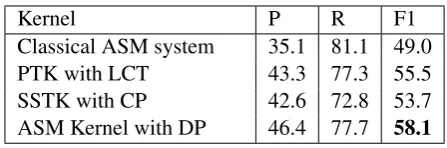
Table 3: Results on CID test data for sentence level relations. Key: LCT= Location Centered Tree, CP = Constituency Parse, DP = Dependency Parse
with ASM kernel. We extend the comparison to two well known tree kernels, namely Subset Tree Kernel (SSTK) and the Partial Tree Kernel (PTK) that have been shown to be effective for relation extraction (Zelenko et al., 2002; Moschitti, 2006; Chowdhury et al., 2011). Note that unlike con-stituency parse trees, dependency trees have edge labels which cannot be handled by these tree ker-nels. Therefore, the edge labels are converted into node labels of specially inserted nodes in the orig-inal dependency graph, to get a modified structure referred to as the Location Centered Tree (LCT) (Lan et al., 2009).
Finally, we compare the ASM kernel with tree kernels in a sentence classification task. This is a straightforward application of kernels in a graph classification problem, over the unmodified de-pendency graphs of the corpus.
3.1 Chemical induced Disease (CID) task
The goal of the CID shared task (Wei et al., 2015) is to infer the “induces” relation between Chemicals and Disease from biomedical publica-tions. The shared task has provided a corpus of 1500PubMed abstracts, divided equally into train-ing, development and test datasets. The corpus includes non-sentence relations, i.e. Chemical-Disease pairs whose relationship cannot be in-ferred by a single sentence and requires analyzing the whole abstract. We omit such relations and fo-cus on extracting sentence level relations only. We compare ASM kernel against Subset tree kernels (SSTK) and Partial tree kernels (PTK) and report the results in Table 3.
3.2 Seedev Binary
Kernel P R F1
Classical ASM 8.8 41.7 14.5
PTK with DP 11.6 38.0 17.8
SSTK with DP 14.4 24.6 18.2
SSTK with CP 14.8 32.6 20.3
ASM Kernel 25.0 27.9 26.4
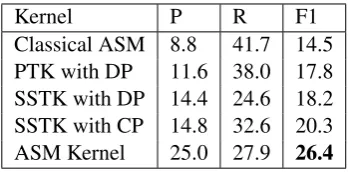
Table 4: Aggregate results over the development dataset of the Seedev Binary task. Key:CP = Con-stituency Parse, DP = Dependency Parse
provided paragraphs from manually selected full text publications on seed development of Ara-bidopsis thalianaannotated with mentions of bi-ological entities like proteins and genes, and bi-nary relations like Exists In Genotype and Oc-curs In Genotype. The Seedev task involves ex-traction of22different binary relations over16 en-tity types. The corpus provided consists of a total of 7,082 entities and 3,575binary relations, di-vided into training, development and test datasets. Entity mentions within a sentence and the events between them are provided in the gold standard annotations. We created22separate classifiers for detecting each of these relation types. A special feature of this task is that each relation type is as-sociated with a type signature, that specifies which entity types are allowed for the given relation, as its two arguments. We use this type signature, to filter the corpus to create22separate training and test sets, for each of the22classifiers. In Table 4 aggregate results over the 22 event types are re-ported for the development set (the annotations for the test set are not available).
3.3 Question Classification
This task deals with classifying general questions expressed in natural language, into one of6 cate-gories such as HUMAN and LOCATION, a first step in a question answering system. For exam-ple, “What is the width of a football field?” is to be classified as a NUMBER. The corpus for this task is the UIUC dataset (Li and Roth, 2002) that consists of 5,542questions for training and 500 questions for test3.
Tree kernels were shown to offer state of the art classification accuracy for this dataset. More details about tree kernels for question classifica-tion can be found in (Annesi et al., 2014). In this work, we are concerned with exploiting
lex-3http://cogcomp.cs.illinois.edu/Data/QA/QC/
Kernel Accuracy
(% age)
Bag of Words 86.2
Partial Tree Kernel with LCT 90.6 Subset Tree Kernel with GRCT 91.4
ASM Kernel 89.6
Table 5: Results on Question Classification dataset.
ical and syntactic information only and there-fore choose SSTK and PTKs for comparison with ASM and exclude Semantic Partial Tree Kernel (SPTK) that incorporates semantic word similarity (via clustering or word2vec (Goldberg and Levy, 2014) ). In Table 5, we report the accuracy of these kernels for the question classification task.
4 Discussion
Evaluation over the two relation extraction tasks reveals that the ASM kernel outperforms both the tree kernels and the classical ASM rule based sys-tem. For a more general sentence classification task, we note that the ASM kernel performs com-petitively to tree kernels but not better. A study of the final scores attained also reveals that the rela-tion extracrela-tion tasks are more difficult than gen-eral sentence classification tasks. We infer that the flexibility of the ASM kernel such as ability to handle edge labels and directions, is more ad-vantageous in a relation extraction task than a gen-eral sentence classification task. This may be due to the fact that relation extraction is primarily fo-cussed on the interaction between two entities in a sentence, which is best described by the edge la-bels on the shortest dependency path. In contrast, sentence classification is more general and consid-ers the overall properties of a sentence.
component analysis (PCA) that we plan to explore in future.
Semantic matching ASM relies on comparing properties of paths or graph walks, that are in-dexed by label pairs. In the simplest case, node la-bels are taken to be word lemmas instead of word tokens, to improve generalization across minute variations in word usage (such as “cured” and “curing”). We hypothesize that the generalizabil-ity of ASM can be further improved by choosing node labels on word classes. Node labels may be set to cluster ids, post word clustering. A seman-tic matching of lemmas (such as “cured” and “im-proved”), based on word semantics using distribu-tional word similarities may allow for improved generalization (Saleh et al., 2014).
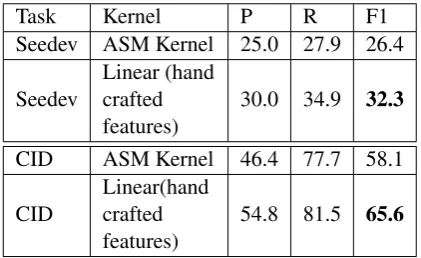
Task Kernel P R F1
Seedev ASM Kernel 25.0 27.9 26.4
Seedev
Linear (hand crafted features)
30.0 34.9 32.3
CID ASM Kernel 46.4 77.7 58.1
CID
Linear(hand crafted features)
54.8 81.5 65.6
Table 6: Comparison of ASM kernel with a linear classifier with hand crafted features.
5 Related Work
The closest work to ours is the classical ASM distance (Liu et al., 2013) that has been succes-fully used in several shared tasks (Kim et al., 2011). Tree kernels in NLP have been studied extensively in (Collins and Duffy, 2001). Rela-tion extracRela-tion has been of particular importance within biomedical domain and has been studied in different contexts such as drug-drug interac-tion (Bjorne et al., 2011) and proteprotein in-teraction (Lan et al., 2009). Kernels that use con-stituent parses or dependency structures are stud-ied in (Chowdhury et al., 2011; Airola et al., 2008) for the protein-protein interaction extrac-tion. All path graph (APG) kernel (Airola et al., 2008) over dependency graph is a related work, that has different semantics as compared to ASM. The APG kernel considers all paths between a ver-tex pair and not just single shortest path as done in the ASM kernel. The primary feature in the
APG kernel is the strength of connection between a vertex pair, which is computed as the product of edge weights along the path. Note that edge la-bels and not edge weights are the natural proper-ties of a dependency graph. APG proposes mod-ifications to the dependency graph to accommo-date edge labels and heuristically driven assign-ment of edge weights to the dependency graph. An other recent approach in kernel design (Saleh et al., 2014), has been the efforts to include word similarity such as distributional word similarity given by word2vec (Goldberg and Levy, 2014). Incorporating semantic word similarity in ASM is likely to further improve its performance.
6 Summary and Conclusion
In this work, we defined a graph kernel from a pre-viously studied Approximate Subgraph Matching (ASM) distance measure. We demonstrate the ef-fectiveness of this new kernel by experimenting over standard datasets for question classification and relation extraction. Results indicate that the ASM kernel is of comparable performance to the tree kernels for sentence classification, but outper-forms tree kernels in relation extraction tasks. We show the validity of the ASM kernel by deriving its feature space and illuminating the semantics of the kernel. Following on these steps, we identify several improvements to the ASM kernel that are likely to further boost its performance.
References
Antti Airola, Sampo Pyysalo, Jari Bj¨orne, Tapio Pahikkala, Filip Ginter, and Tapio Salakoski. 2008. A graph kernel for protein-protein interaction ex-traction. InProceedings of the workshop on current trends in biomedical natural language processing, pages 1–9. Association for Computational Linguis-tics.
Paolo Annesi, Danilo Croce, and Roberto Basili. 2014. Semantic compositionality in tree kernels. In Pro-ceedings of the 23rd ACM International Conference on Conference on Information and Knowledge Man-agement, CIKM ’14, pages 1029–1038, New York, NY, USA. ACM.
Jari Bjorne, Antti Airola, Tapio Pahikkala, and Tapio Salakoski. 2011. Drug-drug interaction extraction from biomedical texts with SVM and RLS classi-fiers. CEUR Workshop Proceedings, 761:35–42.
in Natural Language Processing, pages 724–731. Association for Computational Linguistics.
Christopher JC Burges. 1998. A tutorial on support vector machines for pattern recognition. Data min-ing and knowledge discovery, 2(2):121–167.
Estelle Chaix, Bertrand Dubreucq, Abdelhak Fatihi, Dialekti Valsamou, Robert Bossy, Mouhamadou Ba, Louise Delger, Pierre Zweigenbaum, Philippe Bessires, Loc Lepiniec, and Claire Ndellec. 2016. Overview of the regulatory network of plant seed development (seedev) task at the bionlp shared task 2016. In Proceedings of the 4th BioNLP Shared Task workshop, Berlin, Germany, August. Associ-ation for ComputAssoci-ational Linguistics.
Faisal Mahbub Chowdhury, Alberto Lavelli, and Alessandro Moschitti. 2011. A study on de-pendency tree kernels for automatic extraction of protein-protein interaction. In Proceedings of BioNLP 2011 Workshop, BioNLP ’11, pages 124– 133, Stroudsburg, PA, USA. Association for Com-putational Linguistics.
Michael Collins and Nigel Duffy. 2001. Convolution kernels for natural language. InAdvances in neural information processing systems, pages 625–632.
Danilo Croce, Alessandro Moschitti, and Roberto Basili. 2011. Structured lexical similarity via con-volution kernels on dependency trees. In Proceed-ings of the Conference on Empirical Methods in Nat-ural Language Processing, pages 1034–1046. Asso-ciation for Computational Linguistics.
Simone Filice, Giuseppe Castellucci, Danilo Croce, and Roberto Basili. 2015. Kelp: a kernel-based learning platform for natural language pro-cessing. InProceedings of ACL-IJCNLP 2015 Sys-tem Demonstrations, pages 19–24, Beijing, China, July. Association for Computational Linguistics and The Asian Federation of Natural Language Process-ing.
Yoav Goldberg and Omer Levy. 2014. word2vec explained: deriving mikolov et al.’s negative-sampling word-embedding method. arXiv preprint arXiv:1402.3722.
Jin-Dong Kim, Sampo Pyysalo, Tomoko Ohta, Robert Bossy, Ngan Nguyen, and Junichi Tsujii. 2011. Overview of bionlp shared task 2011. In Proceed-ings of the BioNLP Shared Task 2011 Workshop, pages 1–6. Association for Computational Linguis-tics.
Man Lan, Chew Lim Tan, and Jian Su. 2009. Feature generation and representations for protein-protein interaction classification. Journal of Biomedical In-formatics, 42:866–872.
Xin Li and Dan Roth. 2002. Learning question clas-sifiers. In Proceedings of the 19th international conference on Computational linguistics-Volume 1, pages 1–7. Association for Computational Linguis-tics.
Haibin Liu, Lawrence Hunter, Vlado Keˇselj, and Karin Verspoor. 2013. Approximate subgraph matching-based literature mining for biomedical events and re-lations.PloS one, 8(4):e60954.
Christopher D Manning, Mihai Surdeanu, John Bauer, Jenny Finkel, Steven J Bethard, and David Mc-Closky. 2014. The stanford corenlp natural lan-guage processing toolkit. In Proceedings of 52nd Annual Meeting of the Association for Computa-tional Linguistics: System Demonstrations, pages 55–60.
Alessandro Moschitti. 2006. Efficient convolution kernels for dependency and constituent syntactic trees. InEuropean Conference on Machine Learn-ing, pages 318–329. Springer.
I Saleh, Alessandro Moschitti, Preslav Nakov, L M`arquez, and S Joty. 2014. Semantic Kernels for Semantic Parsing. Proceedings of the 2014 Con-ference on Empirical Methods in Natural Language Processing (EMNLP), pages 436–442.
Raimund Seidel. 1995. On the all-pairs-shortest-path problem in unweighted undirected graphs. Journal of computer and system sciences, 51(3):400–403.
Philippe Thomas, Mariana Neves, Ill´es Solt, Domonkos Tikk, and Ulf Leser. 2011. Rela-tion extracRela-tion for drug-drug interacRela-tions using ensemble learning. Training, 4(2,402):21–425.
Chih-Hsuan Wei, Yifan Peng, Robert Leaman, Al-lan Peter Davis, Carolyn J Mattingly, Jiao Li, Thomas C Wiegers, and Zhiyong Lu. 2015. Overview of the biocreative v chemical disease re-lation (cdr) task. InProceedings of the fifth BioCre-ative challenge evaluation workshop, Sevilla, Spain.
Yan Xu, Lili Mou, Ge Li, Yunchuan Chen, Hao Peng, and Zhi Jin. 2015. Classifying relations via long short term memory networks along shortest depen-dency paths. InProceedings of Conference on Em-pirical Methods in Natural Language Processing (to appear).
Dmitry Zelenko, Chinatsu Aone, and Anthony Richardella. 2002. Kernel methods for relation ex-traction. Journal of Machine Learning Research, 3:1083–1106.