Leveraging Auxiliary Tasks for Document-Level
Cross-Domain Sentiment Classification
Jianfei Yu
School of Information Systems Singapore Management University
Jing Jiang
School of Information Systems Singapore Management University
Abstract
In this paper, we study domain adap-tation with a state-of-the-art hierarchical neural network for document-level senti-ment classification. We first design a new auxiliary task based on sentiment scores of domain-independent words. We then propose two neural network architectures to respectively induce document embed-dings and sentence embedembed-dings that work well for different domains. When these document and sentence embeddings are used for sentiment classification, we find that with both pseudo and external senti-ment lexicons, our proposed methods can perform similarly to or better than sev-eral highly competitive domain adaptation methods on a benchmark dataset of prod-uct reviews.
1 Introduction
Sentiment classification is a fundamental task in opinion mining (Pang et al., 2002; Hu and Liu,
2004; Choi and Cardie, 2008; Nakagawa et al.,
2010). Recently, with the advances of deep learn-ing techniques for many NLP applications, various kinds of neural network (NN)-based models have been proposed for this task (Socher et al., 2013;
Lei et al.,2015;Yang et al.,2016).
As with any supervised learning method, the NN-based models also suffer from the domain adaptationproblem, where training data and test data come from different domains. The reason for this is that sentiments are often expressed with domain-specific words and expressions. For ex-ample, in the Book domain, expressions like an insider’s look anda must read are usually posi-tive, but they may not be useful for the Kitchen
domain. Similarly, words such assharpandclean,
which are positive in the Kitchen domain, can rarely be seen in the Book domain. Due to the high cost of obtaining labeled data, it would be very attractive if we can adapt a model trained on asource domainto atarget domain.
A number of different models have been pro-posed for cross-domain sentiment classification, and the core idea of them is to learn a shared la-tent representation that is general across domains. Most of these studies can be categorized into two lines. The first line of work focuses on carefully designing some auxiliary prediction tasks to in-duce a robust cross-domain representation (Blitzer et al.,2007;Pan et al.,2010;Bollegala et al.,2015,
2016). With the trend of deep learning, another line of work centers on employing denoising auto-encoders to learn hidden representations across domains in a purely unsupervised learning man-ner (Glorot et al.,2011;Chen et al., 2012;Zhou et al.,2016).
However, most of the two lines of research are based on traditional discrete feature representa-tions, and the induced shared representations are not necessarily specific to sentiment classification. In our recent work, we designed two simple aux-iliary tasks, which are closely related to the ac-tual end task, for sentence-level cross-domain sen-timent classification (Yu and Jiang, 2016). Fur-thermore, we proposed to jointly learn domain-independent sentence embeddings based on the two auxiliary tasks together with the classifier for the end task in a unified NN framework. Al-though our joint learning model has been shown to outperform previous domain adaptation meth-ods in sentence-level sentiment classification, it is unclear how to extend this to document-level sen-timent classification since the two auxiliary tasks will become much less useful for documents.
In this paper, we aim to propose a domain adap-tation method for document-level sentiment
sification based on our earlier joint model (Yu and Jiang,2016). Specifically, instead of predict-ing the occurrence of pivot words as in previous work (Blitzer et al., 2007; Yu and Jiang, 2016), we introduce a new auxiliary task based on senti-ment scores of pivot words. Moreover, we propose two different architectures to incorporate the aux-iliary task into a state-of-the-art hierarchical NN model for document-level sentiment classification, in which we respectively induce a shared docu-ment embedding for each docudocu-ment in both do-mains and a shared sentence embedding for each sentence in all documents. Evaluation on a widely used dataset about product reviews from four dif-ferent domains shows that our methods can signif-icantly outperform a number of baselines and are able to achieve comparable or even better results compared with a strong baseline proposed by us.
2 Related Work
Domain Adaptation: Domain adaptation has been extensively studied in recent years (Pan and Yang, 2010). In NLP, it has also attracted much attention, where most domain adaptation methods can be categorized into two groups: instance re-weighting (Jiang and Zhai,2007;Xia et al.,2014) and shared representation learning (Blitzer et al.,
2006;Daum´e III,2007;Titov,2011). In this work, we follow the latter line of work, and focus on in-ducing a domain-independent feature space based on a recently proposed NN architecture.
Neural Networks for Sentiment Classification:
With the recent trend of deep learning, a large amount of NN models, including Convolutional Neural Network (Kim, 2014), Recursive Neural Network (Irsoy and Cardie, 2014) and Recurrent Neural Network (Tai et al.,2015), have been pro-posed for sentiment classification. Although these models have achieved highly competitive results on different benchmarks, most of them are tar-geted at sentence-level sentiment classification. Considering that the relations between sentences are important for predicting the sentiment polar-ity of any document,Tang et al. (2015) proposed a hieararchical NN model to encode the relations between sentences for document-level sentiment classification. Since it has been shown to signifi-cantly outperform standard non-hierarchical mod-els on several benchmarks, we try to apply this model to domain adaptation settings in this work.
Cross-Domain Sentiment Classification: For
sentiment classification, most existing domain adaptation methods focus on inducing shared rep-resentations across domains. One line of work tries to leverage the co-occurrences of domain-specific and domain-independent features to learn a general low-dimensional cross-domain represen-tation (Blitzer et al., 2007; Pan et al., 2010; He et al., 2011; Bollegala et al., 2015; Bhatt et al.,
2015). Another line of work is based on a purely unsupervised learning method, denoising auto-encoders, where the hidden layers in multi-layer neural networks are believed to be robust against domain shift (Glorot et al.,2011;Chen et al.,2012;
Zhou et al.,2016). However, all these methods are still based on traditional discrete representations, and the shared representations are learned sepa-rately from the final classifier and therefore not directly related to sentiment classification. More recently, we proposed a unified neural model to jointly learn the shared sentence embeddings and the final classifier together for sentence-level sen-timent domain adaptation (Yu and Jiang, 2016). But the auxiliary task in this earlier work is only designed for sentences; it will be less useful for documents. Moreover, the neural model is based on CNNs, which fail to achieve satisfactory results in document-level sentiment classification. Hence in this work, we focus on proposing a new auxil-iary task for documents, followed by incorporating it into a state-of-the-art hierarchical NN model for document-level sentiment domain adaptation.
3 Methodology
In this section we present our domain adaptation method for document-level sentiment classifica-tion.
3.1 Problem Definition and Notation
Our task is sentiment classification at the docu-ment level. We assume that each input d is a document containingnsentences, and theith
sen-tence contains a sequence ofmiwords. Let us use wi,j ∈ Vto denote thejthword of theithsentence,
where V is the vocabulary. Lety ∈ {+,−} de-note the sentiment label of inputd, where+and −denote the positive sentiment and the negative sentiment, respectively.
We consider a cross-domain setting, in which we assume that we have a set of labeled training documents from a source domain, denoted byDs.
from a target domain, denoted byDt,u. Our goal is
to train a good document-level sentiment classifier usingDsandDt,uso that the classifier can
gener-ally work well in the target domain. To evaluate the trained classifier, we test its performance on a set of labeled documents from the target domain, denoted byDt,l.
3.2 Method Overview
The core of our domain adaptation method is to use a domain-independent auxiliary task to help induce a cross-domain hidden representation that is useful for both source and target domains. The idea of learning cross-domain hidden represen-tations by leveraging auxiliary tasks for domain adaptation is not new (Blitzer et al., 2006, 2007;
Yu and Jiang, 2016; Ding et al., 2017). These previous studies essentially follow the multi-task learning framework (Ando and Zhang,2005). The rationale behind them is that if there are some aux-iliary tasks related to the actual prediction task and the labels of the auxiliary tasks can be easily obtained for both source and target domains, the induced low-dimensional feature space is a good representation for domain adaptation.
Our work follows this line of research and aims to extend our recently proposed domain adapta-tion method for sentence-level sentiment classi-fication (Yu and Jiang, 2016). Our method is based on an existing hierarchical neural network (HNN) model for document-level sentiment clas-sification proposed by Tang et al. (2015), which encodes each sentence in the input document into a sentence embedding vector through a CNN, fol-lowed by combining all sentence embeddings into a document embedding vector with a gated RNN. Different from Tang et al. (2015), however, we use the sentence embeddings or document embed-dings for predicting not only the actual sentiment labels but also the labels of a carefully designed auxiliary task. Since the auxiliary task is domain-independent, we expect the sentence embeddings and document embeddings learned by our method to work well in both domains.
3.3 A Hierarchical Neural Network for Document-level Sentiment Classification
We first describe our baseline method for document-level sentiment classification. This is a HNN model proposed by Tang et al.(2015) that has been shown to significantly outperform sim-pler, non-hierarchical models. We re-implement
this model with some minor modifications. Recall that an input documentdis represented by a sequence of sentences, each containing a se-quence of words, and wi,j ∈ V is the jth word
of the ith sentence in d. We use xi,j ∈ Rl to
denote an l-dimensional dense embedding vector for word wi,j, which is retrieved from a lookup
table X ∈ Rl×|V| for all words. We first ap-ply a one-layer CNN (Kim, 2014) to obtain an embedding vector zi ∈ Rp for the ith sentence: zi = CNNΘ1(xi), whereΘ1 denotes all the pa-rameters in this CNN.
After obtaining the sentence embeddings for all thensentences in d, we then apply an LSTM to sequentially combine all sentences together:hi =
LSTMΘ2(hi−1,zi), wherehi ∈ Rq is theith hid-den state, and Θ2 denotes all the parameters in
the LSTM1. Note that Tang et al.(2015) used
bi-directional gated RNN to chain the sentences into a document embedding, but we did not observe any significant gain over LSTM based on our pre-liminary experiments.
Finally, a softmax classifier is learned to map the document representationhnto a labely:
p(y|hn) =softmax(Whn+b),
whereW ∈ R2×qis a weight matrix andb ∈R2
is a bias vector.
In the following sections, we will present two NN architectures built on top of the baseline method that leverages an auxiliary task for domain adaptation of document-level sentiment classifica-tion. The first architecture uses a document-level auxiliary task to help induce a document-level hid-den representation, while the second architecture uses a sentence-level auxiliary task to help induce a sentence-level hidden representation.
3.4 Document-level Shared Representation Learning for Domain Adaptation Document-level Auxiliary Task
We first introduce an auxiliary task that is closely related to the original task of document-level sen-timent classification. Our auxiliary task is in-spired by our recent work for sentence-level cross-domain sentiment classification (Yu and Jiang,
2016). In this recently proposed method, we used two auxiliary tasks to induce shared sen-tence embeddings across domains. Considering
1To simplify the discussion, we will not give the details
that an input sentence containing a positive (or negative) domain-independent sentiment word is more likely to express an overall positive (or neg-ative) sentiment, the two auxiliary tasks are about whether an input sentence contains at least one positive or one negative domain-independent sen-timent word, respectively.
Although the two auxiliary tasks have been shown to benefit sentence-level cross-domain sen-timent classification, they may not work well in document-level sentiment classification. The rea-son is the following. In sentence-level sentiment classification, since sentences are short, a sen-tence is more likely about only one aspect of the topic being discussed, and it tends to express a consistent sentiment polarity towards that aspect. However, in document-level sentiment classifica-tion, a document may contain mixed opinions to-wards different aspects of the topic, and the sen-timent polarities towards different aspects may differ. Moreover, at document level, there may also be comparison and contrast among different topics, and the sentiment polarities towards them could be different. In summary, it is highly pos-sible for a document to contain both positive and negative domain-independent sentiment words. In this case, the two auxiliary tasks would not be of much use because most documents would have the same labels for both these two tasks2.
To address this limitation, we propose an alter-native auxiliary task based on sentiment scores of the domaindependent sentiment words. The in-tuition is as follows. Assume that we have an ex-ternal sentiment lexicon, where each word is as-signed a general sentiment score. For an input document, if it contains more domain-independent words with high positive sentiment scores, the document is more likely to express an overall pos-itive sentiment, regardless of the domain the docu-ment is from. More importantly, the remainder of the document without domain-independent words may also contain domain-specific positive words or expressions.
Take the following review as an example.
One of thebest! You will gowrongif you read this as an intro to deep learning. Trulyan insider’s look. A must read for everyone wholovesneural networks.
2Based on our observation on a benchmark dataset
collected by Blitzer et al. (2007), for almost all the 12 source/target pairs, over 90% of the reviews contained both positive and negative domain-independent sentiment words.
We can see that the document contains three words with high positive sentiment scores (shown in italic), and one word with a high negative timent score (shown in bold). But overall, its sen-timent polarity is positive, which correlates with the sum of all the domain-independent words’ sen-timent scores. Then, if we hide all the domain-independent sentiment words and use the remain-ing domain-specific words to predict the overall sentiment score of the domain-independent senti-ment words, it should be helpful for identifying some important domain-specific sentiment expres-sions such asan insiders’ lookanda must readin the example above.
Hence, we propose a new auxiliary task by predicting whether the sum of all the domain-independent sentiment words’ sentiment scores is larger than, equal to or less than 0. It is worth noting that (1) given any sentiment lexicon, we can automatically derive the label of the auxiliary task3, and (2) the auxiliary task is closely related
to the main binary sentiment classification task. Formally, let us assume that we have a senti-ment lexicon, which can be either directly taken from an external resource or derived from the la-beled source domain data. Details of how the sen-timent lexicon is obtained will be given in Sec-tion 3.7.1. Following SCL (Blitzer et al., 2007), we choose the words which frequently occur in both domains and have a high (positive or nega-tive) sentiment score as the domain-independent sentiment words, and refer to them as pivot words. For each input document d, we use a special to-ken UNK to substitute these pivot words, which follows the practice in our earlier work (Yu and Jiang, 2016). To be consistent with the notation before, let us used0 to denote the new document withUNKtokens andw0
i,j thejth token in theith
sentence in d0. Let x0
i,j ∈ Rl denote the
embed-ding vector ofw0
i,j. x0i,j is the same asxi,j when w0
i,j is notUNK. Whenw0i,j isUNK,x0i,j is set to
be a special embedding vector forUNK. We then introduce an auxiliary labely0 ford0, which indi-cates whether the sum of the sentiment scores of the pivot words in the original documentdis larger than, equal to or less than 0. We further useDa,dto
denote documents with the document-level auxil-iary labels derived from bothDsandDt,u.
3For any sentiment lexicon, we can rescale its original
s1 sn-1 sn CNN
CNN CNN
...
...
sn’ sn-1’ s1’
CNN CNN CNN
...
...
sentimentauxiliary task y
y’
s1 s1’ sn-1 sn-1’ sn sn’
...
CNN
CNN CNN
...
CNN CNN CNN
y
u1’ un-1’ un’
sentiment
[image:5.595.82.528.70.187.2](a) Document-level Shared Representation (b) Sentence-level Shared Representation
Figure 1: Overview of our proposed methods.
Document-level Shared Representation (DSR)
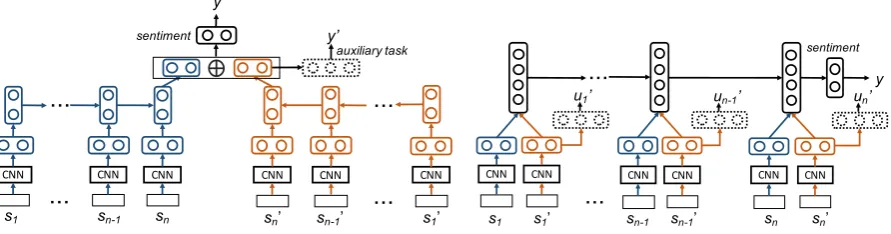
Now that we have defined the auxiliary task, we can present the NN architecture. Figure1(a) gives the outline of this method, which essentially tries to directly learn an auxiliary hidden layer for each input document. For theithsentence ind0, we first use a CNN to obtain its auxiliary embedding vec-torz0
i=CNNΘ0
1(x0i). These sentence embeddings are further combined together with an LSTM pa-rameterized byΘ0
2, and the final hidden stateh0nis
fed to predict the auxiliary labely0:
p(y0 |h0n) =softmax(W0h0n+b0).
Besides, we also apply another CNN and LSTM to obtain the standard document representation
hn, and concatenate it with the auxiliary hidden
vectorh0
nto predict the sentiment labely:
p(y|hn,h0n) = softmax
W(hn⊕h0n) +b
.
3.5 Sentence-level Shared Representation Learning for Domain Adaptation
Unlike the first architecture, our second proposal focuses on learning an auxiliary hidden layer for each sentence in a given document. As illustrated in Figure 1(b), instead of using an overall auxil-iary label for the whole document, we will have an auxiliary label for each sentence in the document.
Sentence-level Auxiliary Task
Although the auxiliary task in Section3.4 is de-signed for documents, it is also suitable for sen-tences since if a sentence contains more domain-independent words with high positive sentiment scores, the rest of the sentence excluding these words may still express a positive sentiment.
To facilitate the discussion, let us usesi to
de-note the ith sentence in the original document d
ands0
i the ith sentence in the modified document d0. We then introduce an auxiliary labelu0
i fors0i,
which indicates whether the sum of the sentiment scores of the pivot words insiis larger than, equal
to or less than 0. We further useu0 ∈Rnto denote
the auxiliary labels for all then sentences in d0. LetDa,sdenote documents with the sentence-level
auxiliary labels derived from bothDsandDt,u. Sentence-level Shared Representation (SSR)
Based on the sentence-level auxiliary task, we use two CNNs to obtain sentence embeddingszi and z0
i, respectively for si ands0i. Next, the auxiliary
hidden layerz0
iwill be used for predicting the
aux-iliary labelu0
i:
p(u0
i |z0i) =softmax(W0z0i+b0).
Besides, we also concatenateziandz0itogether as
a combined sentence embedding for thei-th sen-tence. Then, all thencombined sentence embed-dings are further combined together via an LSTM:
hi = LSTMΘ2
hi−1,(zi⊕z0i)
.
Finally, we feed the last hidden representation
hnto predict the label of our main task:
p(y |hn) = softmax(Whn+b).
3.6 Parameter Learning
W0andb0by minimizing the following function:
J(Θ1,Θ2,Θ01,Θ02,W,b,W0,b0)
= − X
(d,y)∈Ds
logp(y|d)
+ X
(d0,y0)∈Da,d
logp(y0 |d0).
3.7 Implementation Details 3.7.1 Sentiment Lexicons
We use two kinds of sentiment lexicons, which we refer to as WN and MI.
WN is extracted from a well-known sentiment lexicon called SentiWordNet (Baccianella et al.,
2010). Since the original sentiment scores in Sen-tiWordNet are probabilities for each word being positive or negative, we rescale them to [−2,2]. Also, for the same words with different part-of-speech tags, we only keep the sentiment score with the highest absolute value.
To reduce the reliance on external resources, we also experiment with another method based on mutual information (MI) on the source labeled dataDsto automatically derive a pseudo sentiment
lexicon. Specifically, we first extract only adjec-tives, adverbs and verbs from the documents inDs,
and measure each remaining word’s MI with the positive and the negative classes:
r(wi, y) = logp˜p˜(w(wi, y) i)˜p(y),
wherewi denotes theith word in V, y ∈ {+,−}
is a sentiment label, andp˜(wi, y)is the empirical
probability of observingwi andytogether. Then,
we only keep those words with positive MI, i.e.,
r(wi, y) > 0, and obtain two lists R+ and R−. Moreover, for each wordw ∈ R+, we use its MI
score as its sentiment score, while for each word
w ∈ R−, we reverse its MI score as its sentiment score. Finally, we merge the two word lists to form the pseudo sentiment lexicon, and rescale the sen-timent scores into[−2,2].
3.7.2 Pivot Words Selection
Recall that pivot words should frequently occur in both domains and be sentiment sensitive. Hence, we first choose those words occurring at least 10 times in Ds and at least 30 times inDt,u as pivot
candidates4, and remove negation and stop words.
4The ratio between|Ds|and|Dt,u|is 1:3 in our dataset.
Then, we only keep those candidates with high sentiment scores ([−2,−1]and [1,2] for WN or
[−2,−0.9]and[0.9,2]for MI) as the pivot words.
3.7.3 Training Details
In our domain adaptation setting, for the labeled data Ds from the source domain, we have
la-bels for both the main task and the auxiliary task, while for the unlabeled data Dt,u from the
tar-get domain, we only have labels for the auxiliary task. Hence, we adopted an alternating training approach, where in each epoch we first optimize all the model parameters givenDs, and then switch
to only optimizing the parameters corresponding to the auxiliary task (including Θ0
1, Θ02, W0 and b0) givenDt,u. During the training stage, we share
the word embeddings of the actual task and our auxiliary task, and never update the word embed-ding ofUNKby setting it as a zero vector.
4 Experiments
4.1 Experiment Settings
Datasets: To evaluate our proposed method, we conduct experiments on a benchmark dataset re-leased byBlitzer et al.(2007). This dataset con-sists of Amazon product reviews from four dif-ferent domains: Book, DVD, Electronics and Kitchen. Each domain has 1000 positive and 1000 negative reviews as well as 17547 unlabeled re-views on average. Since the number of unlabeled reviews in each domain is different, we randomly choose 6000 unlabeled reviews for each domain.
Following previous studies (Pan et al., 2010;
Zhou et al.,2016), we consider 12 pairs of source-target domain pairs. For each pair, all the 2000 la-beled reviews from the source domain are treated as training data. We randomly choose 200 posi-tive and 200 negaposi-tive reviews from the target do-main as development data, and the redo-mainder (i.e., 800 + 800 reviews) from the target domain as test data. Moreover, for domain adaptation methods, we also use the 6000 unlabeled reviews from the target domain during the training stage.
Methods for comparison:
• Naive is a non-domain-adaptive baseline based on traditional discrete representations. • SCLis the Structural Correspondence
• mDAis one of the state-of-the-art methods, marginalized denoising auto-encoders (Chen et al., 2012), which learns a shared hidden representation by reconstructing pivot fea-tures.
• HNN is another non-domain-adaptive
NN-based baseline as detailed in Section3.3.
• H-WNsimply combinesHNNwith our
aux-iliary task, which represents each label de-rived from our auxiliary task using WN as a three-dimensional one-hot vector and ap-pends it to the document embedding hn in HNN, followed by a softmax classifier. • H-SCLis a naive combination ofSCLwith
HNN, which appends the induced represen-tation fromSCLto the document embedding inHNN, followed by a softmax classifier. • H-mDAis similar toH-SCLbut uses the
hid-den representation from mDA, and this can be considered as a strong baseline.
Meanwhile, to show the effectiveness of the proposed auxiliary tasks, we also use the two aux-iliary tasks in our earlier work as the auxaux-iliary task of our two architectures for comparison, respec-tively denoted byDSREandSSRE(Yu and Jiang,
2016).
Besides, we consider four variants of our pro-posed methods, where the auxiliary tasks inDSR
and SSR are derived from the pseudo sentiment lexicon, while the auxiliary tasks in DSRW and
SSRWare based on SentiWordNet.
• DSRE, DSR and DSRW are based on our
first NN architecture to learn document-level shared representations, as introduced in3.4. • SSRE,SSRandSSRWare based on our
sec-ond NN architecture to induce sentence-level shared representations, as introduced in3.5.
Hyperparameters: For Naive, we train linear classifiers with LibLinear5by using unigrams and
bigrams with a frequency of at least 5 as features. For SCL and mDA, we use mutual information to select pivot features, and the number of chosen pivots is tuned from{500, 1000, 1500, 2000}on the development set. In SCL, we tune the num-ber of induced features K in {25, 50, 100}, and also use normalization and rescaling. InmDA, we employ the dropout noise strategy used by Yang and Eisenstein (2014) without any parameter. In
5http://www.csie.ntu.edu.tw/cjlin/liblinear/
all the neural network models, we set the dimen-sion of word embeddingsl to 300, and initialize the lookup table X with word2vec6. We set the
non-linear activation function in CNN as ReLU, and set the sizes of hidden layers in both CNN and LSTM as 150, i.e.,p = q = 150. All the models were trained using AdaGrad with a learning rate of 0.05 and a minibatch size of 5. Also, the dropout rate α equals 0.5, and all the model parameters are regularized with a L2 regularization strength of10−4.
4.2 Results
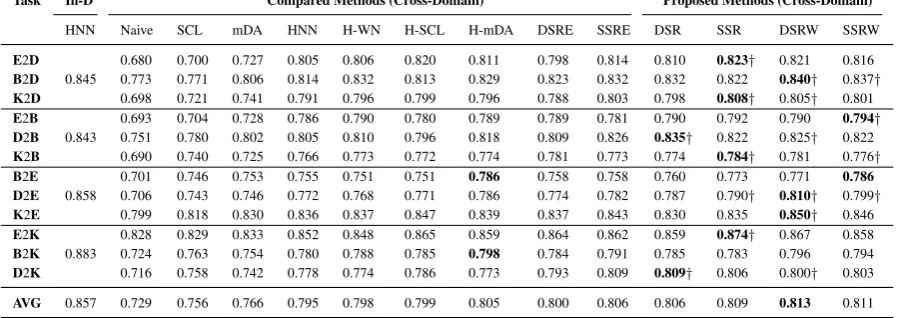
In Table 1, we report the results of all the meth-ods. It is easy to see that the performance ofNaive
is very limited. SCL and mDA can outperform the baseline model respectively by 2.7 and 3.7 percentage points on average, which shows that these two methods are useful for domain adapta-tion based on discrete representaadapta-tions. However, we can also see that the performance of these do-main adaptation methods is much lower than the hierarchical neural network model (HNN) based on continuous representations. This demonstrates thatHNNis more robust against domain shift. But comparing the performance of HNN in standard in-domain and our cross-domain settings, we find that the in-domain performance still outperforms the cross-domain performance by 6.2 percentage points on average. This indicates that it will be more challenging and useful to develop domain adaptation methods based on such a competitive baseline.
Moreover, we can easily see that the perfor-mance of simply appending three-dimensional one-hot vector from the auxiliary task to HNN
(i.e.,H-WN) is close to the performance ofHNN
in most cases. In addition, althoughSCLcan out-performNaivewith a large margin on almost all the data set pairs, the performance of H-SCL is not satisfactory, which can only improve the base-line by 0.5 percentage point on average. But for H-mDA, although the shared hidden representations are also derived from discrete representations, it can improve the performance ofHNNon all data set pairs except one. This implies that the derived shared hidden representations by mDAcan gen-eralize better across domains, and are generally useful for domain adaptation. Furthermore, it is easy to observe that by simply incorporating the
Task In-D Compared Methods (Cross-Domain) Proposed Methods (Cross-Domain) HNN Naive SCL mDA HNN H-WN H-SCL H-mDA DSRE SSRE DSR SSR DSRW SSRW E2D 0.680 0.700 0.727 0.805 0.806 0.820 0.811 0.798 0.814 0.810 0.823† 0.821 0.816 B2D 0.845 0.773 0.771 0.806 0.814 0.832 0.813 0.829 0.823 0.832 0.832 0.822 0.840† 0.837†
K2D 0.698 0.721 0.741 0.791 0.796 0.799 0.796 0.788 0.803 0.798 0.808† 0.805† 0.801 E2B 0.693 0.704 0.728 0.786 0.790 0.780 0.789 0.789 0.781 0.790 0.792 0.790 0.794†
D2B 0.843 0.751 0.780 0.802 0.805 0.810 0.796 0.818 0.809 0.826 0.835† 0.822 0.825† 0.822 K2B 0.690 0.740 0.725 0.766 0.773 0.772 0.774 0.781 0.773 0.774 0.784† 0.781 0.776†
B2E 0.701 0.746 0.753 0.755 0.751 0.751 0.786 0.758 0.758 0.760 0.773 0.771 0.786 D2E 0.858 0.706 0.743 0.746 0.772 0.768 0.771 0.786 0.774 0.782 0.787 0.790† 0.810† 0.799†
[image:8.595.75.524.71.230.2]K2E 0.799 0.818 0.830 0.836 0.837 0.847 0.839 0.837 0.843 0.830 0.835 0.850† 0.846 E2K 0.828 0.829 0.833 0.852 0.848 0.865 0.859 0.864 0.862 0.859 0.874† 0.867 0.858 B2K 0.883 0.724 0.763 0.754 0.780 0.788 0.785 0.798 0.784 0.791 0.785 0.783 0.796 0.794 D2K 0.716 0.758 0.742 0.778 0.774 0.786 0.773 0.793 0.809 0.809† 0.806 0.800† 0.803 AVG 0.857 0.729 0.756 0.766 0.795 0.798 0.799 0.805 0.800 0.806 0.806 0.809 0.813 0.811
Table 1:Comparison of classification accuracies of different methods.†indicates that DSR and DSRW (or SSR and SSRW) are significantly better than HNN, H-WN, H-SCL and H-mDA, DSRE (or SSRE) withp <0.05based on McNemar’s paired significance test. In-Ddenotes the in-domain setting by splitting each target domain’s labeled reviews into 1400/200/400 as training, development and test sets.
two auxiliary tasks in our earlier work into our two architectures, the performance of DSRE is not satisfactory, but SSRE can perform the best on average among all the compared systems. This demonstrates that the two auxiliary tasks are more suitable in sentence level, but become less useful in document level, which agrees with the intuition behind our auxiliary task.
Finally, we observe that (1) all of our proposed methods can significantly outperform the baseline
HNN in almost all the data set pairs, and per-form better thanH-WNandH-SCLin most cases, which shows that the idea of learning a hidden representation using our proposed auxiliary tasks is generally effective; (2) even compared with H-mDA,DSRcan achieve comparable results while
SSR,DSRWandSSRWcan still achieve signifi-cantly better performance in most cases. We con-jecture that the gains of our methods may come from the sharing between two word embedding lookup tables and joint learning of our auxiliary task and the actual task; (3) in comparison with
DSRE andSSRE, DSRand SSR can bring
im-provements in both sentence level and document level on average, which shows the effectiveness of the proposed auxiliary task; (4) among our pro-posed models, we find that the performance of
DSRandSSR is not stable: sometimes they can achieve the best result, but sometimes they per-form even worse than or similar to the baseline
HNN. In contrast,DSRWandSSRWcan always outperform HNN, and perform better than DSR
and SSR on average. This is intuitive since the sentiment scores in MI, derived from source
la-beled data, are specific to the source domain, while the sentiment scores in SentiWordNet are general across domains. Besides, we can also see that the gap betweenSSRandSSRWis much smaller than the gap betweenDSRandDSRW. This sug-gests that our document-level shared representa-tion learning method is more sensitive to the qual-ity of sentiment lexicons, and with a high qualqual-ity sentiment lexicon, it can perform best on average.
4.3 Case Study
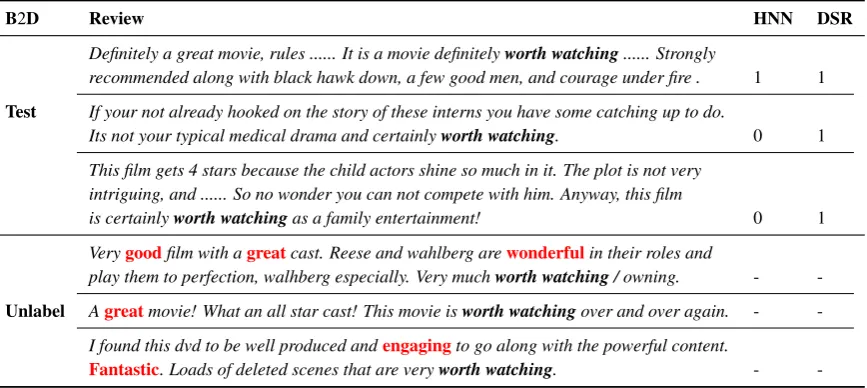
Finally, to explore how our proposed models help to improve the performance of HNN in the test data set, we conduct a case study on B2Dto get a deeper insight of our modelDSR.
Specifically, we sample several samples from the test data set, i.e., DVD. As shown in Table2,
HNNonly correctly predicts the sentiment of the first document but gives wrong predictions on an-other two documents, since worth watchingonly occurs once in the sourceBookdomain. However, our modelDSRcan make correct predictions for all of them. The reason is as follows. In Table
there-B2D Review HNN DSR
Definitely a great movie, rules ... It is a movie definitelyworth watching... Strongly
recommended along with black hawk down, a few good men, and courage under fire . 1 1
Test If your not already hooked on the story of these interns you have some catching up to do.
Its not your typical medical drama and certainlyworth watching. 0 1 This film gets 4 stars because the child actors shine so much in it. The plot is not very
intriguing, and ... So no wonder you can not compete with him. Anyway, this film
is certainlyworth watchingas a family entertainment! 0 1 Verygoodfilm with agreatcast. Reese and wahlberg arewonderfulin their roles and
play them to perfection, walhberg especially. Very muchworth watching/ owning. -
-Unlabel Agreatmovie! What an all star cast! This movie isworth watchingover and over again. -
-I found this dvd to be well produced andengagingto go along with the powerful content.
Fantastic.Loads of deleted scenes that are veryworth watching. -
-Table 2: Examples drawn fromB2Dwhose sentiment labels are incorrectly predicted by the baseline model (HNN) but correctly inferred by our model (DSR). The sentiment words specific to the target domain are inboldanditalic, and the pivot sentiment words are only inbold. 0 and 1 denote the negative and positive sentiments respectively.
fore improve the performance.
5 Conclusions
We presented a domain adaptation method for document-level sentiment classification. We first devised a new auxiliary task based on sentiment scores of pivot words. Then, we proposed two neural network architectures to respectively in-duce shared document embeddings and sentence embeddings across domains. Experiment results show that with a pseudo sentiment lexicon, our methods can achieve comparable results compared with several highly competitive domain adaptation methods; and with an external sentiment lexicon, we can further boost the performance of both ar-chitectures to achieve the state-of-the-art result.
Acknowledgments
We would like to thank the anonymous reviewers for their constructive comments. This research is supported by the National Research Foundation, Prime Minister’s Office, Singapore under its Inter-national Research Centres in Singapore Funding Initiative.
References
Rie Kubota Ando and Tong Zhang. 2005. A framework for learning predictive structures from multiple tasks
and unlabeled data. The Journal of Machine
Learn-ing Research6:1817–1853.
Stefano Baccianella, Andrea Esuli, and Fabrizio Sebas-tiani. 2010. Sentiwordnet 3.0: An enhanced lexical resource for sentiment analysis and opinion mining. In Proceedings of the Seventh conference on Inter-national Language Resources and Evaluation.
Himanshu Sharad Bhatt, Deepali Semwal, and Shourya Roy. 2015. An iterative similarity based adaptation technique for cross-domain text classification. In Proceedings of the Nineteenth Conference on Com-putational Natural Language Learning.
John Blitzer, Mark Dredze, and Fernando Pereira. 2007. Biographies, bollywood, boom-boxes and blenders: Domain adaptation for sentiment
classi-fication. InProceedings of the 45th Annual Meeting
of the Association of Computational Linguistics.
John Blitzer, Ryan McDonald, and Fernando Pereira. 2006. Domain adaptation with structural
correspon-dence learning. In Proceedings of the 2006
Con-ference on Empirical Methods in Natural Language Processing.
Danushka Bollegala, Takanori Maehara, and Ken-ichi Kawarabayashi. 2015. Unsupervised cross-domain
word representation learning. InProceedings of the
53rd Annual Meeting of the Association for Compu-tational Linguistics.
Danushka Bollegala, Tingting Mu, and John Gouler-mas. 2016. Cross-domain sentiment classification
using sentiment sensitive embeddings. IEEE TKDE
6(2):398–410.
Minmin Chen, Zhixiang Eddie Xu, Kilian Q. Wein-berger, and Fei Sha. 2012. Marginalized denoising
autoencoders for domain adaptation. In
[image:9.595.84.518.63.257.2]Yejin Choi and Claire Cardie. 2008. Learning with compositional semantics as structural inference for
subsentential sentiment analysis. InProceedings of
the Conference on Empirical Methods in Natural Language Processing.
Hal Daum´e III. 2007. Frustratingly easy domain
adap-tation. InProceedings of the 45th Annual Meeting
of the Association of Computational Linguistics. Ying Ding, Jianfei Yu, and Jing Jiang. 2017.
Recur-rent neural networks with auxiliary labels for
cross-domain opinion target extraction. InProceedings of
the Thirty-First AAAI Conference on Artificial Intel-ligence.
Xavier Glorot, Antoine Bordes, and Yoshua Bengio. 2011. Domain adaptation for large-scale sentiment
classification: A deep learning approach. InIn
Pro-ceedings of the Twenty-eight International Confer-ence on Machine Learning.
Yulan He, Chenghua Lin, and Harith Alani. 2011. Automatically extracting polarity-bearing topics for
cross-domain sentiment classification. In
Proceed-ings of the 49th Annual Meeting of the Association of Computational Linguistics.
Sepp Hochreiter and J¨urgen Schmidhuber. 1997. Long
Short-Term Memory. Neural Computation pages
1735–1780.
Minqing Hu and Bing Liu. 2004. Mining and
sum-marizing customer reviews. In Proceedings of
SIGKDD.
Ozan Irsoy and Claire Cardie. 2014. Deep recursive neural networks for compositionality in language. InAdvances in Neural Information Processing Sys-tems.
Jing Jiang and ChengXiang Zhai. 2007. Instance
weighting for domain adaptation in NLP. In
Pro-ceedings of the 45th Annual Meeting of the Associa-tion of ComputaAssocia-tional Linguistics.
Yoon Kim. 2014. Convolutional neural networks for
sentence classification. InProceedings of the 2014
Conference on Empirical Methods in Natural Lan-guage Processing.
Tao Lei, Regina Barzilay, and Tommi Jaakkola. 2015. Molding CNNs for text: non-linear, non-consecutive
convolutions. InProceedings of the Conference on
Empirical Methods in Natural Language Process-ing.
Tetsuji Nakagawa, Kentaro Inui, and Sadao Kurohashi. 2010. Dependency tree-based sentiment
classifica-tion using CRFs with hidden variables. In
Proceed-ings of the North American Chapter of the Associa-tion for ComputaAssocia-tional Linguistics.
Sinno Jialin Pan, Xiaochuan Ni, Jian-Tao Sun, Qiang Yang, and Zheng Chen. 2010. Cross-domain senti-ment classification via spectral feature alignsenti-ment. In
Proceedings of of the 19th international conference on World Wide Web.
Sinno Jialin Pan and Qiang Yang. 2010. A survey on
transfer learning. IEEE TKDE22(10):1345–1359.
Bo Pang, Lillian Lee, and Shivakumar Vaithyanathan. 2002. Thumbs up?: sentiment classification using
machine learning techniques. InProceedings of the
Conference on Empirical Methods in Natural Lan-guage Processing.
Richard Socher, Alex Perelygin, Jean Wu, Jason Chuang, Christopher D. Manning, Andrew Ng, and Christopher Potts. 2013. Recursive deep models for semantic compositionality over a sentiment
tree-bank. InProceedings of the Conference on
Empiri-cal Methods in Natural Language Processing. Kai Sheng Tai, Richard Socher, and Christopher D.
Manning. 2015. Improved semantic representations from tree-structured long short-term memory
net-works. InProceedings of the 53rd Annual Meeting
of the Association for Computational Linguistics. Duyu Tang, Bing Qin, and Ting Liu. 2015. Document
modeling with gated recurrent neural network for
sentiment classification. InProceedings of the
Con-ference on Empirical Methods in Natural Language Processing.
Ivan Titov. 2011. Domain adaptation by constraining inter-domain variability of latent feature
representa-tion. InProceedings of the 49th Annual Meeting of
the Association for Computational Linguistics. Rui Xia, Jianfei Yu, Feng Xu, and Shumei Wang. 2014.
Instance-based domain adaptation in NLP via
in-target-domain logistic approximation. In
Proceed-ings of the Twenty-Eighth AAAI Conference on Arti-ficial Intelligence.
Yi Yang and Jacob Eisenstein. 2014. Fast easy unsu-pervised domain adaptation with marginalized
struc-tured dropout. In Proceedings of the 52nd Annual
Meeting of the Association for Computational Lin-guistics.
Zichao Yang, Diyi Yang, Chris Dyer, Xiaodong He, Alex Smola, and Eduard Hovy. 2016. Hierarchical attention networks for document classification. In Proceedings of the North American Chapter of the Association for Computational Linguistics.
Jianfei Yu and Jing Jiang. 2016. Learning sentence em-beddings with auxiliary tasks for cross-domain
sen-timent classification. In Proceedings of the 2016
Conference on Empirical Methods in Natural Lan-guage Processing.
Guangyou Zhou, Zhiwen Xie, Jimmy Xiangji Huang, and Tingting He. 2016. Bi-transferring deep neural
networks for domain adaptation. InProceedings of