Semi-Supervised Answer Extraction from Discussion Forums
Rose Catherine, Rashmi Gangadharaiah, Karthik Visweswariah, Dinesh Raghu IBM Research
Bangalore, India
{rosecatherinek, rashgang, v-karthik, diraghu1} @in.ibm.com
Abstract
Mining online discussions to extract an-swers is an important research problem. Methods proposed in the past used super-vised classifiers trained on labeled data. But, collecting training data for each target forum is labor intensive and time consum-ing, thus limiting their deployment. A re-cent approach had proposed to extract an-swers in an unsupervised manner, by tak-ing cues from their repetitions. This as-sumption however, does not hold true in
many cases. In this paper, we propose
two semi-supervised methods for extract-ing answers from discussions, which uti-lize the large amount of unlabeled data available, alongside a very small training
set to obtain improved accuracies. We
show that it is possible to boost the perfor-mance by introducing a related, but paral-lel task of identifying acknowledgments to the answers. The accuracy achieved by our approaches surpass the baselines by a wide margin, as shown by our experiments.
1 Introduction
Online discussion forums, also known as com-munity question answering (CQA) sites, are inter-net sites that provide a medium for users to dis-cuss and share information on a wide range of top-ics. Due to their vast popularity, gradually, they have aggregated a massive collection of discussion data. Mining such forums have numerous appli-cations such as improving question–answer (QA) retrieval (Cong et al., 2008), learning important insights like features of products that are draw-ing negative reviews (Lakkaraju et al., 2011) or discovering longstanding unresolved severe tech-nical issues (Gangadharaiah and Catherine, 2012) etc. For this reason, substantial research effort has been directed at mining discussions, in recent
times. In this paper, we focus on the specific prob-lem of extracting answers from these discussions. In forums, typically a user starts a discussion by posting a question to which multiple mem-bers of the forum suggest answers. The discus-sion evolves into a complex multi-party conversa-tion as the quesconversa-tion gets refined, with addiconversa-tional details specified, clarifications sought, multiple answers provided, frequent digressions, and oc-casional follow-up discussions and
acknowledg-ments, altogether spanning several pages.
An-swers easily get buried deep within this and locat-ing them automatically is far from straightforward. In this paper, we propose two semi-supervised approaches that require only a very small amount of training data (only 3 manually tagged discus-sion threads ) and achieve high accuracy levels by using the available unlabeled data. With this, we eliminate the need to collect vast amounts of train-ing data, thus aidtrain-ing faster deployment for new do-mains. Specifically, our contributions are:
• A semi-supervised answer extraction method for discussions: This paper makes the first attempt at extracting answers from discussions in a semi-supervised manner. We show how existing fea-tures can be engineered into a co-training frame-work to accomplish this.
• A parallel co-training method to leverage ac-knowledgments for improved answer extraction accuracy: We motivate and demonstrate that it is possible to improve the performance tremen-dously by introducing a related task of identify-ing acknowledgments in the discussions, which we run as a parallel task alongside the main an-swer extraction task (Section 5).
• We demonstrate that with a very small training data and by using the available unlabeled data, it is possible to extract answers from forums with an accuracy that is substantially better than ex-tracting them in an unsupervised manner or in a fully supervised setting.
The rest of the paper is organized as follows: Section 2 discusses related work. Section 3 sets the terminology and introduces the co-training framework, which is used throughout this paper. Section 4 details how the co-training framework can be applied to the answer extraction task. Sec-tion 5 introduces the acknowledgment extracSec-tion task in a parallel co-training framework. Experi-ments and results are discussed in Section 6 fol-lowed by conclusions in Section 7.
2 Related work
Research in the area of extracting question and answers from online forums, has grown consider-ably. Almost all approaches proposed so far for this task are supervised learning methods. Ding et al. (2008), Kim et al. (2010), Raghavan et al. (2010) and Kim et al. (2012) employed Condi-tional Random Fields, Hong and Davison (2009), Huang et al. (2007) and Catherine et al. (2012) used Support Vector Machines (SVM), Shrestha and McKeown (2004) learnt rules using Ripper, and Yang et al. (2009) used Struct SVMs for ex-tracting answers. The obvious downside to these methods is that for any new domain or forum, sub-stantial amounts of manually labeled training ex-amples have to be collected. This is usually time consuming and costly. Gandhe et al. (2012) pro-posed an approach for adapting an answer extrac-tor trained on one domain to another, by separating out the lexical characteristics of an answer from its domain relevance. However, learning the lexical characteristics still required a training set.
A recent work by Cong et al. (2008) proposed an unsupervised method using PageRank-style random walks on a graph representation of the dis-cussion, with the hypothesis that inter-candidate similarities can improve accuracy of the answer extraction task. The intuition is that posts that bear more resemblance to other posts in the thread have higher chances of being answers. However, in a lot of discussion forums, especially those related to troubleshooting and problem resolution, we found that this assumption usually does not hold. An an-swer that was suggested earlier in the discussion is not usually suggested again – only new ones or a modification of the same would appear. A gen-eral observation here was that posts that had simi-lar content as other posts were found to be others complaining about the same issue. This was also noted by Gandhe et al. (2012) and Catherine et al. (2012). Nevertheless, (Cong et al., 2008) is the
only work so far, that sought to extract answers without supervision.
One of the methods proposed in this paper that uses a parallel acknowledgment classification task, belongs to the family of Multi-Task Learn-ing (MTL) (Caruana, 1997) since what is learned for each task is used to improve the other task. However, to the best of our knowledge, this is the first work that proposes a MTL-type answer classifier for forums in a semi-supervised setting. Cross-Training (Sarawagi et al., 2003) is a related methodology which improves classification per-formance on one taxonomy by accessing labels
from another taxonomy for the same document.
Our method differs because, the answer and
ac-knowledgment labels are ondifferentposts.
Some other closely related works are listed be-low; however, their focus is different from the task proposed in this paper. Jijkoun and de Rijke (2005) proposed a method to automatically extract question–answer pairs from FAQ pages using for-matting cues. Since it is known that the entry fol-lowing the question is definitely an answer, they did not have to classify the entries. Sarencheh et al. (2010) proposed a semi-automatic wrapper in-duction method for extracting different structural components of a discussion, like the time of post-ing, author name, content of the post etc. Answer retrieval is another closely related task where the emphasis is on retrieving the most relevant post (Xue et al., 2008). The scope of our paper, how-ever, is limited to tagging posts in forum discus-sions as answers or not.
3 Preliminaries
3.1 Terminology and Scope
A discussion in an online forum is created when a user posts a question. Other members of the fo-rum reply to this post or to other replies, thereby evolving the discussion. A sample discussion with 7 posts including 2 answers and 2 acknowledg-ments, is shown in Figure 1. In this paper, we
use the termsdiscussionandthread(as in,
a thread of discussion) interchangeably.
An answer is typically spread over multiple sen-tences within the same post, especially in the case of non-factoid answers. It would have been ideal, if the system extracted answers at the granularity of a sentence. However, the inter-annotator
agree-ment1for answer sentences in our dataset (Section
6) was a mere 0.19. Hence, we extract answers at
I am having the same problem when charging the phone from the USB port charger. I just plugged it into a wall outlet and it is now charging fine. Maybe it's not recognizing the new lightning cable? Try using an AC outlet Post: 0
My iPhone 5 will not charge has anyone else got this problem? When I plug the lightning cable in, its as if the phone registers this but it will not charge.
Post: 2 Author: A Level: 1 Points: 50
Thanks for the reply, the AC outlet has already been tried but it won't charge at all.
Question
Answer Suggestion
Acknowledgment - Negative
Exactly the same problem here. Tried USB on computer and wall using the plug provided. It detects the cable, but zero charge! Bad times for a new product!
Post: 3 Author: C Level: 1 Points: 0
I'm having the same issue, and it's not recognizing it at all. There's always a problem!
Post: 4 Author: D Level: 1 Points: 5
Sounds like “Lightning Gate”... I have the same issue. The phone won't charge via the wall plug or connect to the computer. Sounds like bad cable or connection. Why don't you get another cable?
Post: 5
I have managed to use another cable and the phone now charges with no problems. Thanks to everyone who has contributed to this discussion, it really is appreciated!
Acknowledgment - Positive
Figure 1: A Sample Discussion
a post level – a post is classified as an answer if any sentence within it suggests a solution.
Digressions are very common in such commu-nity question answering systems. We do not at-tempt to find these questions or separate out the sub-discussions. Question detection as well as dis-entangling multi-party discussions, is a well re-searched area (Cong et al., 2008; Elsner and Char-niak, 2010), and is outside the scope of this paper. For the purposes of this paper, the first post is the question and we attempt to find answers to only this question. Answers to other questions within the discussion are negative examples.
3.2 Co-Training Methodology
Co-Training introduced by Blum and Mitchell
(1998), is a general framework for
semi-supervised classification, where the features for classifying each data point can be partitioned into two distinct sets or views. The views are such that either of them is sufficient to classify any data-point, had there been enough training examples.
The algorithm proceeds in two half-steps: in
it-eration i, the current set of labeled examples Li
(initially, a very small set) is used to train a
classi-fierC1 that uses only one view v1 of each
train-ing instance and another classifier C2 that uses
only viewv2. C1 and C2 are then used to
clas-sify the unlabeled points, and the most confident
mpredictions are moved from the unlabeled pool
U to the set of labeled examples, which are used
Φ1(x) Φ2(x)
C1 C2
Most confident predictions on U – Li Li
Iteration i
Figure 2: Co-Training Framework
for training in the i+ 1th iteration. Essentially,
each classifier teaches the other by providing ex-amples which the other would have misclassified.
Figure 2 shows this workflow, where Φ1 andΦ2
are the feature vectors of the input corresponding
to the two views v1 and v2. The paper showed
that when the two views are independent given the label of the data point (conditional indepen-dence), any initial weak predictor can be boosted to a high accuracy using unlabeled examples by co-training. This was empirically evaluated for a
webpage classification task wherev1was the set of
words in the webpage andv2, the anchor texts of
all links pointing to that page. Co-training frame-work is widely used in many text mining tasks like parsing (Sarkar, 2001), machine translation (Callison-Burch, 2002) and for creating parallel corpora (Callison-Burch and Osborne, 2003).
4 Answer Extraction by Co-Training:
ANS CT Model
To apply the co-training framework to the task of answer extraction, we need two independent views of the data. Prior work in supervised an-swer extraction from forum discussions have re-ported good accuracies when using features con-structed from the structure of the thread (Ding et al., 2008; Hong and Davison, 2009; Kim et al., 2010; Catherine et al., 2012). This provides us with one of the views, which we refer to as the STRUCTview.
Cong et al. (2008) had previously used pattern mining for the related task of question sentence ex-traction. Similarly, Jindal and Liu (2006) had used pattern mining for identifying comparative sen-tences in a supervised learning setting. We mine patterns on the sentences of the posts and employ
it as the second view, which we refer to as the PAT
-TERNview. The exact set of features are explained
Note that we have used only a modest set of
features in both STRUCTand PATTERN views, to
highlight the effect of co-training in improving the answer extraction accuracy.
4.1 STRUCTview
Compared to a general text document, discus-sion threads have a structure, which can be used to construct features for classification. The
fea-tures that we use, referred to as STRUCTfeatures
henceforth, are listed in Table 1. All the features are eventually converted to binary attributes for the experiments, where numerical attributes are grouped into a suitable number of buckets. Each binary value corresponds to a dimension in the STRUCTview,Φistruct, which is1if that
attribute-value was present in the post; else, is set to0.
STRUCTFeature Description
Author Rating
A forum specific value measuring the expertise of the author. Could be nu-merical (e.g. 50 points) or categorical (e.g.Expert).
Relative Post Position
The position of the post with respect to the thread. It is grouped into Beginning,MiddleandEnd. Post Rating A measure of how informative the
post is. Could be numerical (e.g. 50 votes) or categorical (e.g. Helpful).
Table 1: STRUCTfeatures for a post
4.2 PATTERNview
Consider the below snippets from different dis-cussion threads. Some words have been intention-ally masked to illustrate that it is possible to iden-tify to a considerable extent, that these are answer suggestions from the structure of the sentence and without regard to the context or the question.
... You can see if X will solve it ...
... Try resetting your X with the Y turned off and then turn it back on after the X is fully booted back up ...
... Go to A->B->C and toggle the D mode ... ... X is no longer supported by Y ...
The PATTERNview uses a pattern mining
mod-ule, which mines the answer posts in Li to
dis-cover the most frequent sequential patterns, F Pi
for iterationi. Each such discovered patternp ∈
F Picorresponds to a dimension in the PATTERN
view, Φi
pattern, which is 1 if p matches (is
sub-sequence of) any sentence of the post.
We implemented the PrefixSpan (Pei et al., 2001) algorithm for mining sequential patterns, but with the following modifications to contain the blow up in the number of patterns:
• Variable Minimum Support: the number of
items in which a pattern appears is called its
support, and minimum support, min sup is an input parameter that determines whether a
pattern is frequent enough. We set min sup
tomax(min sup0,frac×numItemsi), where
frac is a preset fraction, set to0.03 in our
ex-periments, numItemsi is the number of items
being mined in iterationi, andmin sup0is a
de-fault minimum, set to 3 in our experiments. • Pattern Length: only patterns of length at least
min len, set to 3 in our experiments, are accept-able.
• Item Gap: the items of a frequent pattern are sequential, but not consecutive, thus allowing PrefixSpan to pick items that are arbitrary num-ber of items apart (gap). We constrain the gap between items of a pattern to a maximum of
max gap, set to again 3 in our experiments. Posts are mined at a sentence level, for which we
use OpenNLP2sentence detector.
4.2.1 Text Pre-Processing
We found that using the exact words limited the number of frequent patterns that could be found. To minimize this problem, we used Part-Of-Speech (POS) tags of the words to:
• Replace all nouns with their POS tags.
• Replace all verbs with its root/stemmed (us-ing Porter stemmer (Porter, 1980)) form and
its POS tag. For example, restarting
be-comesrestart VBG. We let PrefixSpan pick
the verb-stem and/or the POS tag according to their support.
All words are lowercased. A discussion on the set of patterns that were detected is in Section 6.3.
5 Leveraging Acknowledgment Signals:
ANS-ACK PCT Model
In this section, we motivate and introduce a re-lated task of extracting acknowledgments in forum discussions and inducing signals from them to im-prove the accuracy of the answer extraction task.
Merriam-Webster3 defines an acknowledgment
as a recognition or favorable notice of an act or achievement. Acknowledgment is an inevitable component of any conversation, especially, when it evolves around seeking assistance. And so they find their place in forum discussions too. Consider the below snippets taken from replies by question
2
http://opennlp.apache.org
authors. They are grouped according to their po-larity – Positive, Negative and Neutral.
Positive:author reports that the suggestion solved the issue.
... Great! That solved it! Thanks a bunch ... ... Thanks for your help. Finally got it working ... ... Switching on X did the trick. Now I can Y without any problem ...
... Thanks a lot guys. X solved my woes. I must have Y-ed it by mistake at some point ...
Negative:the suggestion did not solve the issue.
... That didn’t help. Any other suggestions? ... ... I tried that. It is still showing X ...
... Getting the same X. Thanks anyway ...
... Thanks for your advice. Unfortunately, it didn’t help!
Neutral:it is not clear if the issue was solved, but the statement is an acknowledgment nevertheless
... Thanks for the reply ... ... I will try that ...
... Thanks for the helpful advice. Hope resetting X prop-erly will fix my problem ...
... I’m reinstalling X. Will keep you posted ...
Similar to the case of answer sentences in Sec-tion 4, the above examples can be easily identi-fied as acknowledgments and it is fairly clear that the posts to which the above sentences are replies, are answer suggestions. Note that this can be de-termined without knowing the contents of the lat-ter, if we can assume that the reply-to relation of the posts is known. This however is not always the case. In a small study conducted, we found that only 75% of forums displayed or had the re-quired information in the html of the webpage for constructing the reply-to relation of the posts, out of 12 technical forums that we inspected. In the absence of this information, (Wang et al., 2011; Seo et al., 2009; Wang and Ros´e, 2010) propose techniques to automatically recover the structure. For the purposes of this paper, we assume that the reply-to structure of the discussion thread is given.
ANS-ACK PCT (ANSwer ACKnowledgment
Parallel Co-Training) aims to leverage signals from acknowledgment posts, to better identify an-swer posts. We cast this as another instance of semi-supervised learning task (another co-training instance) which runs in parallel to the main an-swer extraction instance of co-training. Hence the
name, PARALLELco-training.
It is worth listing down some of the design de-cisions for this choice of approach:
(i) There is no public dataset available to train an acknowledgment classifier. So, it is important to note here that the task of detecting acknowledg-ments cannot be fully supervised where a large
amount of training data is collected for the spe-cific domain; this will defeat the entire purpose of semi-supervised answer extraction.
(ii) For the initial small training set required for the semi-supervised approach, we do not label ad-ditional threads. Instead, we create a training set from the initial training set of the answer extrac-tion task by marking replies from the quesextrac-tion au-thor to posts that are answers, as positive exam-ples. Other replies from the question author be-come negative examples. To avoid getting influ-enced by digressions, we do not consider replies from other authors.
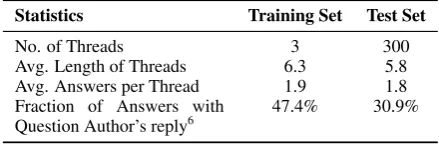
(iii) The reader might suggest using acknowledg-ment as one of the views within the co-training instance of answer detection, instead of two par-allel co-training instances. i.e. to mark all posts that have an acknowledgment as an answer in that view. Here, we would like to point out that ac-knowledgment is a strong indicator only when it is available. In other words, even if we learn to classify acknowledgment posts perfectly, it cannot classify all answer posts perfectly since not all an-swers are acknowledged. In our test set (Section 6), there were 559 answers, but only 173 of them had any reply from the question author (30.9%), of which only 72% were actually acknowledgments, as found through manual inspection (the rest had to do with refining the question, requesting clarifi-cation on the answer, etc.). So, the hope is to learn how to use the signal when it is available, and not rely on it exclusively by using it as one of the two views of answer co-training.
The acknowledgment extraction uses the same
two views – STRUCT and PATTERN – for its
co-training instance, similar to the ANSCT model of
Section 4, to generate the views, ackΨistruct and
Ψ ack i
pattern, respectively. Except that here, positive
examples are the posts that are acknowledgments, as obtained by Point (ii) above.
5.1 Parallel Co-Training for Answer Extraction
Parallel Co-Training is a method for semi-supervised learning where there are two (or more) co-training instances corresponding to different, but related learning tasks running side by side,
where in iterationi, each task can induce features
based on the current state of the system. i.e. using
the outcome of iterationi−1of other tasks.
Most confident Answer
ans Most confident Ack
predictions on U –
Figure 3: Parallel Co-Training Methodology
• Two tasks run in parallel:
1. Answer Co-training: the main task which
learns to classify each post asansorans.
2. Acknowledgment Co-training: the auxil-iary task which learns to classify each post
asackorack.
• In iterationi, Answer Co-training uses the
Ac-knowledgment classifiers, ackHi·−1 of the i −
1th iteration, to induce more features (detailed
in Section 5.2), ackΦi· which is then
concate-nated to its original feature vector, ansΦi·, to
get the new feature vector
to represent concatenation of two vectors, where the length of the new vector is
). The concatenated feature vector is
then used to train the answer classifiersansSi·of
theithiteration.
• The STRUCT view of Answer Co-training uses
predictions from the acknowledgment classifier
that was trained on the STRUCT view of
Ac-knowledgment Co-training, and similarly for the PATTERNview, so that the concatenated features vectors still remain independent.
5.2 Inducing Features from Acknowledgments
Given a thread and acknowledgment tags on some of the posts, the most obvious feature that
can be induced on an answer post is a hasAck
feature which isTrue if any child of this post is
marked as an acknowledgment; elseFalse. All
features that we generated are listed in Table 2.
ACKFeature Description
Has Ack True if this post has a reply that is tagged as an acknowledgment; else False.
Ack Distance
The number of posts, in the chronolog-ical order, between this post and its ac-knowledgment.
Last Ack Distance
The number of posts, in the chronologi-cal order, between this post and the last acknowledgment post in the thread.
Table 2: Features induced from Acknowledgments
6 Experiments
We crawled about 140K threads from Apple
Discussions4. From these, after discarding those
with no replies, 303 threads were randomly
cho-sen, and manually tagged. The inter-annotator
agreement5between 3 annotators for this task was
0.71. For the experiments, the training set had 3 of the tagged threads and the remaining 300 formed the test set, the statistics of which are in Table 3.
Statistics Training Set Test Set
No. of Threads 3 300
Avg. Length of Threads 6.3 5.8
Avg. Answers per Thread 1.9 1.8
Fraction of Answers with Question Author’s reply6
47.4% 30.9%
Table 3: Statistics of the Training and Test Sets
We used Support Vector Machines (Vapnik,
1995) (implementation from the LibSVM7
li-brary) for all the individual classifiers,ansSi· and
4
https://discussions.apple.com
5
http://en.wikipedia.org/wiki/Cohen’s kappa
H ack i
·, used in the different views of the co-training
instances of ANSCT and ANS-ACKPCT models.
6.1 Study of Improvement in Answer Extraction Accuracy
STRUCT PATTERN COMBINED
SVM 1.1% 2.5% 28.6%
ANSCT 55.6% 55.6% 55.6%
ANS-ACKPCT 63.7% 63.6% 67.8%
Table 4: F Scores for the Answer Extraction task
To demonstrate the benefits of co-training, we first trained a supervised classifier (SVM) on the training set for answer extraction, separately on
the two views – STRUCT and PATTERN. With
such a little amount of training data, the classi-fiers gave unimpressive F scores (van Rijsbergen, 1979), shown in the first row of Table 4. The COMBINED classifier is a combination of the
in-dividual STRUCT and PATTERN classifiers,
com-puted as: (P(ans|Scombined)∝P(ans|Sstruct)×
P(ans|Spattern)); and similarly for ans. The
post is tagged as ans if P(ans|Scombined) ≥
P(ans|Scombined). Else, it isans.
Next, we performed 40 iterations of co-training and in each step, 5 threads with the most confi-dent predictions were added by each view from the unlabeled pool to the training set. If more than one thread had the same confidence, any one thread was chosen randomly. The accuracies
achieved by ANSCT after the final iteration
(av-eraged over 3 runs) is listed in Table 4. Clearly,
both STRUCTand PATTERNclassifiers drastically
improved their F scores and the COMBINED
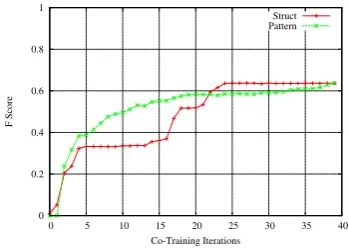
clas-sifier showed a substantial 94% improvement over the SVM baseline. The growth of F score of the two sub-classifiers as the co-training proceeds, is plotted in Figure 4. It can be seen that both the classifiers reached their best within 10 iterations and did not improve any further.
0 0.2 0.4 0.6 0.8 1
0 5 10 15 20 25 30 35 40
F Score
Co-Training Iterations Struct Pattern
Figure 4: ANS CT: F-scores of the STRUCT and
PATTERNsub-classifiers after each iteration
0 0.2 0.4 0.6 0.8 1
0 5 10 15 20 25 30 35 40
F Score
Co-Training Iterations Struct Pattern
Figure 5: ANS-ACK PCT: F scores of the
STRUCT and PATTERN sub-classifiers of the An-swer Classifierafter each iteration
0 0.2 0.4 0.6 0.8 1
0 5 10 15 20 25 30 35 40
F Score
Co-Training Iterations Struct Pattern
Figure 6: ANS-ACKPCT: F scores of theSTRUCT
and PATTERN sub-classifiers of the
Acknowledg-ment Classifierafter each iteration
For ANS-ACK PCT, we performed 40
co-training iterations similar to ANS CT; the
num-ber of threads chosen after each iteration was sim-ilarly set to 5, for both answer and acknowledg-ment instances. The answer classification
accu-racies achieved by ANS-ACK PCT after the
fi-nal iteration (averaged over 3 runs) is also listed
in Table 4. Similar to ANS CT, both STRUCT
and PATTERN classifiers improved their F scores
significantly. The COMBINED classifier showed
a substantial 137% improvement over the SVM
baseline and 22% improvement over ANS CT.
The F score growth of the answer and the ac-knowledgment classifiers as the co-training pro-ceeds, is plotted in Figure 5 and Figure 6 respec-tively. Unlike Figure 4, the answer classifiers in Figure 5 continue to improve even after 10 itera-tions, since the acknowledgment instance is
sup-plying it with more signals. In Figure 6, the PAT
-TERN sub-classifier of the acknowledgment
clas-sifier constantly improved throughout the 40
iter-ations even though its STRUCTcounterpart
stabi-lized in about 10 iterations. The F scores of the ac-knowledgment classifiers at the end of the final it-eration was 82.8%, 52.9% and 81.9% respectively
6.2 Comparison between approaches
Precision Recall F score
SVM - STRUCT 75.0% 0.5% 1.1%
SVM - PATTERN 25.9% 1.3% 2.5%
ANSCT 40.6% 88.0% 55.6%
ANS-ACKPCT 56.8% 84.1% 67.8%
CONG 29.7% 55.6% 38.7%
Table 5: Comparison of accuracy measures of dif-ferent methods for the answer classification task
Graph Propagation based Answer Extraction by Cong et al. (Cong et al., 2008) is an unsuper-vised method for extracting answers from discus-sion forums. It is based on the premise that a correct answer will be repeated often within the discussion and thus, the similarity of the post to other posts can be used as a measure of their “answer-ness”. We used our own implementation
of this algorithm, referred to as CONGin the
ex-periments . The similarity between posts is com-puted using Kullback-Leibler divergence (Kull-back, 1997), which was reported by the authors to have given the best performance. The Precision,
Recall and F scores of CONGare compared with
those of the proposed methods in Table 5.
Table 5 shows that both proposed methods
per-form substantially better than CONG: ANSCT
ex-ceeds it by 43.6% and ANS-ACK PCT surpasses
it by 75.1% (F score). Consequently, we can con-clude that with very small training data, it is pos-sible to achieve high accuracies compared to ex-tracting them in an unsupervised manner.
6.3 Discussion: Answer and Acknowledgment Patterns
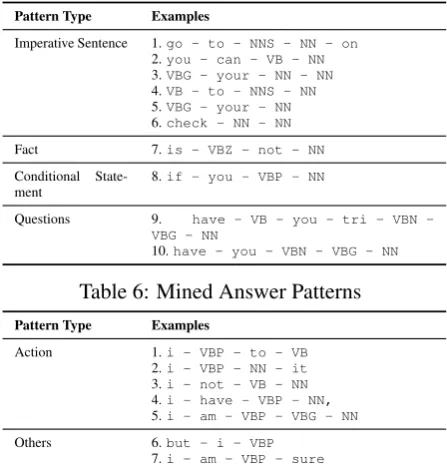
This section studies the patterns that were mined from answers and acknowledgments, which reveal the types of sentence structures that fre-quently appear in them. Some of the interesting answer patterns are listed in Table 6. They are grouped into Imperative, Factual, Conditional and Questions, based on manual inspection. Similarly, the acknowledgment sentences also showed inter-esting patterns, manually grouped into Action and Others, listed in Table 7. From inspecting the an-swer and acknowledgment patterns, we conjecture that it should be possible to build classifiers based on rules defined over the structure of the sentence, without requiring access to a training set.
7 Conclusion and Future Work
In this paper, we proposed two semi-supervised methods for extracting answers from discussion
Pattern Type Examples
Imperative Sentence 1.go - to - NNS - NN - on
2.you - can - VB - NN
3.VBG - your - NN - NN
4.VB - to - NNS - NN
5.VBG - your - NN
6.check - NN - NN
Fact 7.is - VBZ - not - NN
Conditional
State-ment
8.if - you - VBP - NN
Questions 9. have VB you tri VBN
-VBG - NN
10.have - you - VBN - VBG - NN
Table 6: Mined Answer Patterns
Pattern Type Examples
Action 1.i - VBP - to - VB
2.i - VBP - NN - it
3.i - not - VB - NN
4.i - have - VBP - NN,
5.i - am - VBP - VBG - NN
Others 6.but - i - VBP
7.i - am - VBP - sure
Table 7: Mined Acknowledgment Patterns
threads. We showed how the structural features and sentence construction patterns could be en-gineered into a co-training setting such that by using a very small training set, and the large amount of unlabeled data available, answers could be extracted with high accuracy, substantially sur-passing that attained by an unsupervised method. To demonstrate the benefits of our method, we also showed that completely supervised methods would fail to train a decent model with the very little training data that we used.
In one of our methods, we motivated and intro-duced a related task of identifying acknowledg-ments to the answers, which was cast in a paral-lel co-training setting. We proposed new features which the answer labeling instance could induce from the acknowledgment instance. Our experi-ments showed that having access to this view of the discussion thread substantially improved the answer extraction accuracy.
References
A. Blum and T. Mitchell. 1998. Combining labeled and un-labeled data with co-training. InProc. eleventh annual conference on Computational learning theory, COLT’ 98, pages 92–100.
C. Callison-Burch and M. Osborne. 2003. Bootstrapping parallel corpora. In Proc. HLT-NAACL 2003 Workshop on Building and using parallel texts: data driven ma-chine translation and beyond - Volume 3, HLT-NAACL-PARALLEL ’03, pages 44–49. Association for Computa-tional Linguistics.
C. Callison-Burch. 2002. Co-training for statistical machine translation. InProc. of the 6th Annual CLUK Research Colloquium.
R. Caruana. 1997. Multitask learning. Machine Learning, 28(1):41–75, July.
R. Catherine, A. Singh, R. Gangadharaiah, D. Raghu, and K. Visweswariah. 2012. Does similarity matter? the case of answer extraction from technical discussion fo-rums. InProc. 24th International Conference on Com-putational Linguistics, COLING, pages 175–184. G. Cong, L. Wang, C. Lin, Y. Song, and Y. Sun. 2008.
Find-ing question-answer pairs from online forums. InThe 31st Annual International ACM SIGIR Conference, pages 467– 474.
S. Ding, G. Cong, C. Y. Lin, and X. Zhu. 2008. Using con-ditional random fields to extract contexts and answers of questions from online forums. InMeeting of the Associa-tion for ComputaAssocia-tional Linguistics (ACL).
M. Elsner and E. Charniak. 2010. Disentangling chat. Com-putational Linguistics, 36:389–409.
A. Gandhe, D. Raghu, and R. Catherine. 2012. Domain adaptive answer extraction for discussion boards. InProc. 21st international conference companion on World Wide Web, WWW ’12 Companion, pages 501–502. ACM. R. Gangadharaiah and R. Catherine. 2012. Prism:
discov-ering and prioritizing severe technical issues from prod-uct discussion forums. InProc. 21st ACM International Conference on Information and Knowledge Management, CIKM ’12, pages 1627–1631.
L. Hong and B. D. Davison. 2009. A classification-based approach to question answering in discussion boards. In
Proc. 32nd Annual Intl ACM SIGIR Conf. on Research and Dev. in Information Retrieval.
J. Huang, M. Zhou, and D. Yang. 2007. Extracting chatbot knowledge from online discussion forums. InProc. 20th international joint conference on Artifical intelligence, IJ-CAI’07, pages 423–428.
V. Jijkoun and M. de Rijke. 2005. Retrieving answers from frequently asked questions pages on the web. InProc. 14th ACM international conference on Information and knowledge management, CIKM ’05, pages 76–83. Nitin Jindal and Bing Liu. 2006. Identifying comparative
sentences in text documents. InIn Proc. 29th SIGIR. S. N. Kim, L. Wang, and T. Baldwin. 2010. Tagging and
linking web forum posts. InProc. Fourteenth Conference on Computational Natural Language Learning, CoNLL ’10, pages 192–202. Association for Computational Lin-guistics.
S. N. Kim, L. Cavedon, and T. Baldwin. 2012. Classifying dialogue acts in multi-party live chats. InProc. 26th Pacic Asia Conference on Language, Information and Compu-tation, pages 463–472.
S. Kullback. 1997.Information Theory and Statistics. Dover Publications.
H. Lakkaraju, C. Bhattacharyya, I. Bhattacharya, and S. Merugu. 2011. Exploiting coherence for the simul-taneous discovery of latent facets and associated senti-ments. InProc. 11th SIAM International Conference on Data Mining, SDM ’11, pages 498–509.
J. Pei, J. Han, B. Mortazavi-asl, H. Pinto, Q. Chen, U. Dayal, and M. Hsu. 2001. Prefixspan: Mining sequential pat-terns efficiently by prefix-projected pattern growth. In
Proc. 17th International Conference on Data Engineer-ing. IEEE Computer Society.
M.F. Porter. 1980. An algorithm for suffix stripping. In
Program.
P. Raghavan, R. Catherine, S. Ikbal, N. Kambhatla, and D. Majumdar. 2010. Extracting problem and resolution information from online discussion forums. InProc. 16th International Conference on Management of Data, CO-MAD.
S. Sarawagi, S. Chakrabarti, and S. Godbole. 2003. Cross-training: learning probabilistic mappings between topics. InProc. ninth ACM SIGKDD international conference on Knowledge discovery and data mining, KDD ’03, pages 177–186.
S. Sarencheh, V. Potdar, E. Yeganeh, and N. Firoozeh. 2010. Semi-automatic information extraction from dis-cussion boards with applications for anti-spam technol-ogy. In Computational Science and Its Applications -ICCSA 2010, volume 6017 ofLecture Notes in Computer Science, pages 370–382. Springer Berlin Heidelberg. A. Sarkar. 2001. Applying co-training methods to statistical
parsing. InProc. second meeting of the North American Chapter of the Association for Computational Linguistics on Language technologies, NAACL ’01.
J. Seo, B. Croft, and D. A. Smith. 2009. Online community search using thread structure. InProceeding of the 18th ACM conference on Information and knowledge manage-ment, CIKM ’09, pages 1907–1910. ACM.
L. Shrestha and K. McKeown. 2004. Detection of question-answer pairs in email conversation. In Proc. 20th International Conference on Computational LIN-Guistic(COLING).
C. J. van Rijsbergen. 1979.Information Retrieval (2nd ed.). Butterworth.
V. N. Vapnik. 1995.The Nature of Statistical Learning The-ory. Springer.
Y. Wang and C. P. Ros´e. 2010. Making conversational struc-ture explicit: identification of initiation-response pairs within online discussions. InHuman Language Technolo-gies: The 2010 Annual Conference of the North American Chapter of the Association for Computational Linguistics, HLT ’10, pages 673–676. Association for Computational Linguistics.
H. Wang, C. Wang, C. Zhai, and J. Han. 2011. Learning online discussion structures by conditional random fields. InProc. 34th international ACM SIGIR conference on Re-search and development in Information Retrieval, SIGIR ’11, pages 435–444.
X. Xue, J. Jeon, and W. B. Croft. 2008. Retrieval models for question and answer archives. InProc. 31st annual inter-national ACM SIGIR conference on Research and devel-opment in information retrieval, SIGIR ’08, pages 475– 482. ACM.