fastSense: An Efficient Word Sense Disambiguation Classifier
Tolga Uslu, Alexander Mehler, Daniel Baumartz, Wahed Hemati
TTLab, Goethe University FrankfurtFrankfurt, Germany
{uslu, mehler, baumartz, hemati}@em.uni-frankfurt.de
Abstract
The task ofWord Sense Disambiguation(WSD) is to determine the meaning of an ambiguous word in a given context. In spite of its importance for most NLP pipelines, WSD can still be seen to be unsolved. The reason is that we currently lack tools for WSD that handle big data – “big” in terms of the number of ambiguous words and in terms of the overall number of senses to be distinguished. This desideratum is exactly the objective of fastSense, an efficient neural network-based tool for word sense disambiguation introduced in this paper. We train and testfastSenseby means of the disambiguation pages of the German Wikipedia. In addition, we evaluatefastSensein the context of Senseval and SemEval. By reference to Senseval and SemEval we additionally perform a parameter study. We show thatfastSensecan process huge amounts of data quickly and also surpasses state-of-the-art tools in terms of F-measure.
Keywords:WSD, Big Data, Wikipedia
1.
Introduction
One of the core tasks in natural language processing isWord Sense Disambiguation. Without disambiguation, we just consider a word as a combination of characters and not the meaning behind it. Without properly disambiguating the lexical constituents of a text, it is almost impossible to process its content automatically. Our goal is to solve this problem and to make it applicable to large amounts of data. To this end, we present a neural network-based classifier for WSD calledfastSense. We take sequences of words as input and compute a sense label per ambiguous word in that sequence as output. This approach was mo-tivated by the classifier called fastText (Joulin et al., 2016). As the name suggests, fastTextis designed to perform text classifications as quickly as possible. How-ever,fastTextis not suitable for disambiguating words. In addition, the neural network used byfastTextdoes not support training of multi-labels. Therefore, we imple-mented our own word embedding-based neural network by analogy to the architecture offastText. This allows us to applyfastSenseto WSD efficiently even on big data. In order to test the time complexity of our approach, we cre-ated a disambiguation corpus from the German Wikipedia with over 50,000,000 training and test sets. We use the disambiguation pages and the link structure of Wikipedia to match words with their corresponding Wikipedia senses. In this paper, we deal with the German Wikipedia. In terms of size or space complexity, its sense model is far beyond what is normally studied, for example, in the framework of Senseval or SemEval. However, in order to show that our approach is language independent, we additionally perform multiple tests related to Senseval and SemEval. These tests show that our model keeps up with state-of-the-art tools by reaching 73.47% at Senseval-2, 73.48% at Senseval-3 and up to 87,57% on SemEval 2007 tasks.
The paper is structured as follows: In Section 2., we con-trastfastSensewith related approaches to WSD. In Sec-tion 3. we introduce the architecture offastSense. In Section 4., we explain the experiments carried out to
eval-uatefastSenseand show the results achieved by it. In Section 4.3., we discuss our findings and in Section 5., we give a summary of the paper.
2.
Related Work
Our approach is motivated by fastText (Joulin et al., 2016). This relates to the very efficient and successful way by whichfastTextallows for classifying data. The main purpose offastTextis text classification. Its architecture is similar toword2vec(Mikolov et al., 2013): both ap-proaches are based on a bag-of-words model. Further, both of them use a single hidden layer. The difference between
word2vec andfastText is that the latter requires to define a label for any input text, while word2vec uses context windows of lexical units to predict single words or vice versa. We transposefastTextto word sense disam-biguation in order to efficiently determine the meaning of ambiguous words even in cases in which we face big data. By this we mean scenarios in which hundreds of thousands of different words are ambiguous.
com-pare them with the data of Senseval 2. (Mihalcea et al., 2004) use a PageRank algorithm operating on semantic net-works to perform WSD. The underlying network is spanned by means of semantic relations of synsets, entailment and other WordNet relations. The PageRank algorithm assigns scores to words and chooses the disambiguating synset of highest score. (Yuan et al., 2016) present two WSD al-gorithms, achieving the best results by means of a semi-supervised algorithm combining labeled sentences with un-labeled ones and propagating labels based on sentence sim-ilarity. (Tripodi and Pelillo, 2016) describe an approach to WSD based on evolutionary game theory, in which words tend to adapt senses of their neighborhood so that WSD is reformulated as a kind of constraint satisfaction. (Zhong and Ng, 2010) present a framework for English all-words WSD. It disambiguates each content word of a given sen-tence using a linear kernel-based SVM (Joachims, 2002). (Iacobacci et al., 2016) show that the use of word em-beddings achieves an improvement in WSD compared to standard features. (Chaplot et al., 2015) propose a graph based unsupervised WSD system which requires Word-Net, a dependency parser and a POS-Tagger. They model WSD as a maximum-a-posteriori inference query operating on a Markov random field. (Raganato et al., 2017a) de-fine WSD in terms of a sequence learning problem. This is done by means of a bidirectional LSTM-based neural network (Hochreiter and Schmidhuber, 1997). (Melamud et al., 2016) presentcontext2vecwhich is also based on bidirectional LSTMs for learning disambiguating word contexts.
Unlike these approaches, we present a method that can han-dle big data: in terms of the number of senses to be distin-guished andin terms of the number of units to be disam-biguated. On the one hand, knowledge driven approaches using, for example, WordNet and related resources are lim-ited in terms of the number of senses distinguished by them. GermaNet, for example, distinguishes 33,630 senses of 13,445 ambiguous words – that is much less than consid-ered by us. On the other hand, approaches that rely on al-gorithms like PageRank or classifiers like SVMs or LSTMs are limited in terms of their time efficiency: it is a compu-tational challenge to maintain, for example, SVMs for each of the 825,179 senses of the 221,965 ambigous words of the German Wikipedia which, however, are easily covered by our approach. Thus, we are in need of a flexible, easy-to-compute, but efficient method for WSD as presented in the next section.
3.
Model architecture
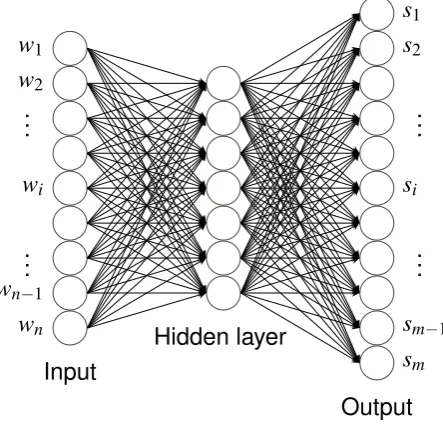
During training, fastSense requires text as input and the corresponding senses as output (see Figure 1). Its sgle hidden layer is an embedding layer in which word in-dexes from the input layer are converted into word vectors. More specifically, the number of hidden nodes corresponds to the dimension of the pre-trained word embedding vec-tors so that the weights of edges between input and hidden nodes correspond to the respective coordinates of the lat-ter vectors. We computed the word embeddings by means of word2vec(Mikolov et al., 2013) using Wikipedia as the underlying corpus. The embeddings are then merged in
the hidden layer according to theglobal averaging pooling principle(Lin et al., 2013).
Input
w
1w
2..
.
w
i..
.
w
n−1w
nHidden layer
Output
s
1s
2s
is
m−1s
m..
.
[image:2.595.311.533.111.326.2]..
.
Figure 1: Model architecture offastSense.
To support multi-label training we used thesigmoid func-tion as an activafunc-tion funcfunc-tion of the output layer. For the sake of optimizing, Adamax, a special variant of Adam
(Kingma and Ba, 2014), is a very efficient choice in prac-tice. It uses theinfinity norm, which makes it possible to stabilize the training over longer periods of time and, thus, to achieve faster and better results. To prevent overfitting, we usedDropout(Srivastava et al., 2014) as regularization method. Dropout removes nodes during each training ses-sion, ignores them and does not train with them. After the training process, the nodes are reinserted with their original weights.
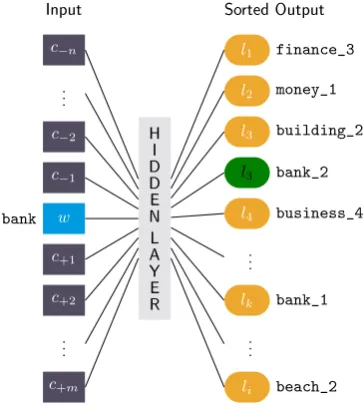
To apply this model to WSD, we additionally developed a method for post-processing the output of the neural net-work. Usually, the sense of highest probability is selected as output. However, since the output layer contains all senses of all ambiguous words, it is unlikely that the tar-get sense of a wordxto be disambiguated equals the top ranked sense. Thus, we do not necessarily select the la-bel of highest probability, but go through the list of rank-ordered candidates until the first occurrence ofxtagged by a corresponding sense number is reached. This sense unit is then produced as the output of disambiguatingx. As an example, consider processing the ambiguous wordbankas depicted in Figure 2: when observing an occurrence of this word in a sentence about afinancialtopic, a classifier like
labeling that is performed byfastSenseby analogy to
fastText.
Input
c−n
...
c−2
c−1
w
c+1
c+2
...
c+m
bank
RE Y AL NE D DI H
l1
l2
l3
l3
l4
...
lk
...
li
Sorted Output
finance_3
money_1
building_2
bank_2
business_4
bank_1
[image:3.595.78.260.107.312.2]beach_2
Figure 2: fastSensein work: bank 2is selected as the first occurrence prefixed bybank.
4.
Experiment
We perform two disambiguation experiments. The first one uses the German Wikipedia to demonstrate the efficiency offastSense. The second one is based on Senseval and SemEval. It aims at comparing fastSensewith state-of-the-art tools. Table 1 lists the parameters used for these evaluations.
Short Description
POS Part of speech is considered. Lemma Lemma information is considered. Token Token information is considered.
WP POS information is added.
x-Nb xneighbors (left and right) are consid-ered as context.
MinContext(k) Any input text must contain at leastk tokens to be used in training or testing.
Table 1: Parameters used for evaluatingfastSense.
4.1.
Wikipedia-based Disambiguation
In order to show that our approach allows for capturing large amounts of data, we created a corpus using the dis-ambiguation pages of the whole German Wikipedia. For preprocessing this data we used the TextImager (Hemati et al., 2016) pipeline. Every word listed on a disam-biguation page in Wikipedia corresponds to a different meaning of the corresponding lemma (page title). In to-tal, we processed 221,965 disambiguation pages related to 825,179 senses. On average, this gives 3.72 senses
per word. The disambiguation page Bank1, for exam-ple, distinguishes 42 senses. For classification, we take each paragraph in Wikipedia that contains one of the tar-get words to be disambiguated as a sample for training semantic representations of these words. This results in a corpus of 55,796,534 instances (49.9 GB) . Using this corpus, we trained fastSenseon 51,067,054 instances (46GB) and tested it on the remaining 4,729,480 instances (3.9GB). The test takes only 20 minutes on a single thread. This runtime can be further reduced linearly by distribut-ingfastSenseover different threads. The results of the Wikipedia-based evaluation are shown in Table 3.
We compared several entity linking tools with
fastSense in terms of time expenditure. With the same hardware, these tools take 6 to 188 days to process our test set. The effort was estimated based on a sub-set of elements as documented in Table 2. Obviously,
fastSense outperforms these competitors. However, since these tools link to different resources (e.g., DBpedia, WordNet or Wikipedia), this comparison only holds for time effort.
Tools 1 500 1000 5000 4729480
Wikifier 0:01 8:20 16:41 1:24:06 ≈55 days Illinois 3:28 5:05 6:53 24:40 ≈14 days IXA 0:03 28:20 58:49 4:47:32 ≈188 days
Babelfy 0:01 0:55 1:50 - ≈6 days
TAGME 1:19 3:20 5:42 28:40 ≈18 days
fastSense 0:07 0:07 0:10 0:13 20:46
Table 2: Runtime-related evaluation regarding similar tools using 1, 500, 1000 and all test instances.
Type Min-Context F1-score
fastSense 1 0.735
fastSense 2 0.778
fastSense 5 0.810
fastText 1 0.071
[image:3.595.305.541.330.419.2]MFS Baseline 1 0.627
Table 3: Wikipedia-based evaluation of fastSense in comparison to fastText and the most frequent sense (MFS) baseline. We used a learning rate of 0.05, a hidden layer size of 10 and 5 training epochs.
4.2.
Senseval and SemEval related
Disambiguation
SemCor (Mihalcea, 2016) provides texts with semanti-cally annotated WordNet senses, which are automatisemanti-cally mapped to WordNet. We trained on SemCor 3.0 for per-forming Senseval and SemEval related tests. Because of the small amount of data provided by this corpus (234,136 disambiguated words), we were able to perform a parame-ter study to search for the best performing parameparame-ter set-tings. Candidates for feature selection are POS, token,
[image:3.595.53.287.480.609.2]lemma and combinations thereof (see Table 1). Next, we tested different word context sizes (Context), word-n-grams (NGrams), learning rates (LR), dimensions of the hidden layer (Dim) and the number of epochs (Epoch). After each optimization step, we used the best performer of the pre-liminary round (see Table 4).
1. Type SE2
Token WP 0.703 Lemma WP 0.697
POS 0.662
Token 0.701
Lemma 0.699
2. Context SE2
S 0.703
1-Nb 0.732
2-Nb 0.718
3-Nb 0.720
4-Nb 0.706
3. NGrams SE2
1 0.723
2 0.730
3 0.732
4. LR SE2
0.025 0.718
0.05 0.724
0.1 0.732
0.5 0.724
5. Dim SE2
5 0.710
10 0.732
25 0.711
50 0.712
6. Epoch SE2
5 0.727
10 0.732
15 0.735
25 0.724
50 0.719
Table 4: Parameter study based on Senseval 2 and SemCor 3.0.
After completion we applied the optimal settings on Sen-seval 2 (English all-words) (SE2) and SenSen-seval 3 (En-glish all-words) (SE3). We also tested fastSense on SemEval-2007 Task 17 Subtask 1 (SE7) and Subtask 3 (SE7’), SemEval-2013 Task 12 (SE13) and SemEval-2015 Task 13 (SE15).
Since no information about lemmas or POS was given in the SE7 test sets, we carried out these experiments only on token basis. The results are listed in Table 5 and are compared to those of state-of-the-art tools in Table 6.
Input SE2 SE3 SE7 SE7’ SE13 SE15
Token WP 0.735 0.735 – – 0.662 0.732
[image:4.595.54.288.152.389.2]Token – – 0.876 0.624 – –
Table 5: F1-scores of the Senseval/SemEval-related tasks.
4.3.
Discussion
We successfully used Wikipedia as a disambiguation cor-pus and show that fastSensecan handle such a large amount of data (see Table 3).fastSensenot only stands out for its speed, but also for the quality of its classifica-tion. We outperform the baseline considerably and show that similar approaches cannot keep up withfastSense
in terms of runtime. ThusfastSenseis a step towards performing WSD in relation to large amounts of data. Since the SemCor data is many times smaller than the data derived from Wikipedia, we were able to carry out a pa-rameter study in the Senseval- and SemEval-related
exper-Model SE2 SE3 SE7 SE7’ SE13 SE15
Iacobacci, 2016 0.634 0.653 0.894 0.578 0.6732 0.7152
Tripodi, 2016 0.660 0.647 0.828 0.565 – –
Yuan, 2016 0.736 0.692 0.828 0.642 0.670 –
Chaplot, 2015 0.605 0.586 – 0.506 – –
Zhong, 2010 0.6251 0.6501 0.8791 0.5651 0.6532 0.6952 Raganato, 2017 0.720 0.702 – 0.648 0.669 0.724 Melamud, 2016 0.7182 0.6912 – 0.6132 0.6562 0.7192 fastSense 0.735 0.735 0.876 0.624 0.662 0.732
1(Iacobacci et al., 2016) 2(Raganato et al., 2017b)
Table 6: Comparison of state-of-the-art WSD tools on the Senseval 2, 3 and SemEval 7, 13 and 15 tasks using SemCor for training.
iments. Most interesting is our finding concerning the size of the context window. Using one neighbor of a word as context (1-Nb) and word-3-grams perform best. We also found that token in combination with POS-related informa-tion (see the parameter list in Table 1 and Table 4) perform best.
Note that fastSense is comparably fast: it takes only 20 minutes for disambiguating 4,729,480 instances on a single thread – that is, ca. 3,941 senses per second. Fur-ther, as mentioned in Section 3.,fastTextis less suited for WSD; accordingly, it performs worse compared to
fastSense (see Table 3). In this sense, though being based on a related architecture,fastSensebetter fits the needs of WSD.
5.
Conclusion
We presented a novel approach to word sense disam-biguation called fastSense. We tested this model in the framework of Senseval and SemEval tasks as well as in terms of a big data-experiment based on the German Wikipedia. We achieve an F-score of up to 81.00% using the Wikipedia-based data. Further, we achieved 73.47% and 73.48% on Senseval 2 and 3, 87.57% and 62.40% on SE7 and SE7’ and also 66.20% and 73.20% on SE13 and SE15. We show thatfastSensecannot only work with huge data sets, but also surpasses state-of-the-art tools. Fu-ture work will address a parameter study on the Wikipedia-based data sets derived from different language releases. We will also account for dependency structures of sen-tences to gain an additional source of information for WSD. Our tool and all Wikipedia-based training and test data used in this paper will be made available open source on GitHub.
6.
Bibliographical References
Agerri, R., Bermudez, J., and Rigau, G. (2014). Ixa pipeline: Efficient and ready to use multilingual nlp tools. InLREC, volume 2014, pages 3823–3828. Chaplot, D. S., Bhattacharyya, P., and Paranjape, A.
(2015). Unsupervised word sense disambiguation using markov random field and dependency parser. InAAAI, pages 2217–2223.
Hemati, W., Uslu, T., and Mehler, A. (2016). Textimager: a distributed uima-based system for nlp. InProceedings of the COLING 2016 System Demonstrations. Federated Conference on Computer Science and Information Sys-tems.
Hochreiter, S. and Schmidhuber, J. (1997). Long short-term memory.Neural computation, 9(8):1735–1780. Iacobacci, I., Pilehvar, M. T., and Navigli, R. (2016).
Em-beddings for word sense disambiguation: An evaluation study. InProceedings of the 54th Annual Meeting of the Association for Computational Linguistics, ACL 2016, August 7-12, 2016, Berlin, Germany, Volume 1: Long Papers.
Joachims, T. (2002). Learning to classify text using sup-port vector machines. Kluwer, Boston.
Joulin, A., Grave, E., Bojanowski, P., and Mikolov, T. (2016). Bag of tricks for efficient text classification. arXiv preprint arXiv:1607.01759.
Kingma, D. and Ba, J. (2014). Adam: A method for stochastic optimization. arXiv preprint arXiv:1412.6980.
Lin, M., Chen, Q., and Yan, S. (2013). Network in net-work. arXiv preprint arXiv:1312.4400.
Melamud, O., Goldberger, J., and Dagan, I. (2016). con-text2vec: Learning generic context embedding with bidi-rectional lstm. InCoNLL, pages 51–61.
Mihalcea, R. and Csomai, A. (2007). Wikify!: linking documents to encyclopedic knowledge. InProceedings of the sixteenth ACM conference on Conference on in-formation and knowledge management, pages 233–242. ACM.
Mihalcea, R., Tarau, P., and Figa, E. (2004). Pagerank on semantic networks, with application to word sense dis-ambiguation. In Proceedings of the 20th international conference on Computational Linguistics, page 1126. Association for Computational Linguistics.
Mihalcea, R. (2007). Using wikipedia for automatic word sense disambiguation. InHLT-NAACL, pages 196–203. Mihalcea, R. (2016). Rada mihalcea. http:
//web.eecs.umich.edu/˜mihalcea/
downloads.html#semcor. Accessed: 2016-12-05. Mikolov, T., Chen, K., Corrado, G., and Dean, J. (2013). Efficient estimation of word representations in vector space.arXiv preprint arXiv:1301.3781.
Moro, A., Raganato, A., and Navigli, R. (2014). Entity linking meets word sense disambiguation: a unified ap-proach. Transactions of the Association for Computa-tional Linguistics, 2:231–244.
Raganato, A., Bovi, C. D., and Navigli, R. (2017a). Neural sequence learning models for word sense disambigua-tion. In Proceedings of the 2017 Conference on Em-pirical Methods in Natural Language Processing, pages 1167–1178.
Raganato, A., Camacho-Collados, J., and Navigli, R. (2017b). Word sense disambiguation: A unified evalu-ation framework and empirical comparison. InProc. of EACL, pages 99–110.
Ratinov, L., Roth, D., Downey, D., and Anderson, M.
(2011a). Local and global algorithms for disambiguation to wikipedia. InACL.
Ratinov, L., Roth, D., Downey, D., and Anderson, M. (2011b). Local and global algorithms for disambigua-tion to wikipedia. In Proceedings of the 49th Annual Meeting of the Association for Computational Linguis-tics: Human Language Technologies-Volume 1, pages 1375–1384. Association for Computational Linguistics. Srivastava, N., Hinton, G. E., Krizhevsky, A., Sutskever, I.,
and Salakhutdinov, R. (2014). Dropout: a simple way to prevent neural networks from overfitting. Journal of machine learning research, 15(1):1929–1958.
Tripodi, R. and Pelillo, M. (2016). A game-theoretic ap-proach to word sense disambiguation. arXiv preprint arXiv:1606.07711.
Yuan, D., Doherty, R., Richardson, J., Evans, C., and Altendorf, E. (2016). Word sense disambigua-tion with neural language models. arXiv preprint arXiv:1603.07012.