Wide-Coverage Semantic Representations from a
CCGParser
Johan Bos, Stephen Clark, Mark SteedmanSchool of Informatics, University of Edinburgh
jbos,stevec,steedman @inf.ed.ac.uk
James R. Curran
School of Information Technologies, University of Sydney [email protected]
Julia Hockenmaier
Institute for Research in Cognitive Science, University of Pennsylvania [email protected]
Abstract
This paper shows how to construct semantic representations from the derivations produced by a wide-coverageCCGparser. Unlike the de-pendency structures returned by the parser it-self, these can be used directly for semantic in-terpretation. We demonstrate that well-formed semantic representations can be produced for over 97% of the sentences in unseenWSJtext. We believe this is a major step towards wide-coverage semantic interpretation, one of the key objectives of the field ofNLP.
1 Introduction
The levels of accuracy and robustness recently achieved by statistical parsers (e.g. Collins (1999), Charniak (2000)) have led to their use in a num-ber ofNLPapplications, such as question-answering (Pasca and Harabagiu, 2001), machine transla-tion (Charniak et al., 2003), sentence simplifica-tion (Carroll et al., 1999), and a linguist’s search engine (Resnik and Elkiss, 2003). Such parsers typically return phrase-structure trees in the style of the Penn Treebank, but without traces and co-indexation. However, the usefulness of this output is limited, since the underlying meaning (as repre-sented in a predicate-argument structure or logical form) is difficult to reconstruct from such skeletal parse trees.
In this paper we demonstrate how a wide-coverage statistical parser using Combinatory Cat-egorial Grammar (CCG) can be used to generate se-mantic representations. There are a number of ad-vantages to using CCG for this task. First, CCG provides “surface compositional” analysis of certain syntactic phenomena such as coordination and ex-traction, allowing the logical form to be obtained for such cases in a straightforward way. Second,CCGis a lexicalised grammar, and only uses a small num-ber of semantically transparent combinatory rules to
combine CCG categories. Hence providing a com-positional semantics forCCGsimply amounts to as-signing semantic representations to the lexical en-tries and interpreting the combinatory rules. And third, there exist highly accurate, efficient and ro-bust CCG parsers which can be used directly for this task (Clark and Curran, 2004b; Hockenmaier, 2003).
The existing CCGparsers deliver predicate argu-ment structures, but not semantic representations that can be used for inference. The present paper seeks to extend one of these wide coverage parsers by using it to build logical forms suitable for use in various NLP applications that require semantic in-terpretation.
We show how to construct first-order represen-tations from CCG derivations using theλ-calculus, and demonstrate that semantic representations can be produced for over 97% of the sentences in unseen WSJtext. The only other deep parser we are aware of to achieve such levels of robustness for the WSJ is Kaplan et al. (2004). The use of the λ-calculus is integral to our method. However, first-order rep-resentations are simply used as a proof-of-concept; we could have used DRSs (Kamp and Reyle, 1993) or some other representation more tailored to the ap-plication in hand.
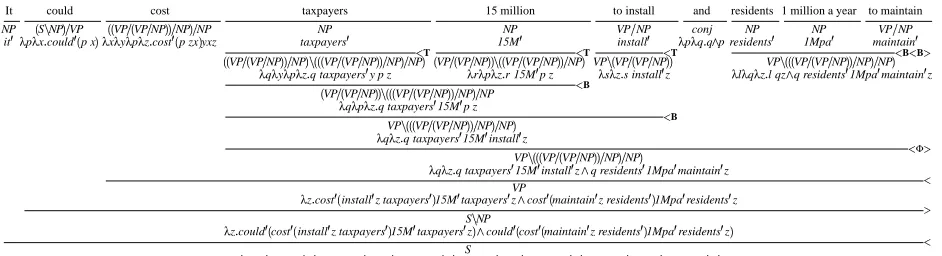
It could cost taxpayers 15 million to install and residents 1 million a year to maintain
Figure 1: An example CCG derivation with a provisional semantics using predicate-argument structures
separate module to the syntax, whereas in the LFG and HPSG approaches the semantic representation forms an integral part of the grammar. This means that, in order for us to work with another seman-tic formalism, we simply have to modify the lexical entries with respect to the semantic component.
2 Combinatory Categorial Grammar
We assume familiarity withCCG(Steedman, 2000), an entirely type-driven lexicalized theory of gram-mar based on categorial gramgram-mar. CCGlexical en-tries pair a syntactic category (defining syntactic va-lency and directionality) with a semantic interpre-tation. For example, one of the categories for the verb cost can be written as follows, with a provi-sional Montague-style semantics expressed in terms of predicate-argument structure:1
Combinatory rules project such lexical category-interpretation pairs onto derived category-interpretation pairs. The specific involvement inCCGof rules of functional composition (indexed
B and B in derivations) and type-raising
(in-dexed
T and T) allows very free derivation of
non-standard constituents. This results in semantic interpretations that support the “surface composi-tional” analysis of relativization and coordination, as in Figure 1 for the sentence It could cost tax-payers £15 million to install and BPC residents 1 million a year to maintain.2
1This semantic notation uses x
yz and pqrs as variables,
identifies constants with primes and uses concatenation a b to indicate application of a to b. Application is “left-associative,” so abc is equivalent to abc. The order of arguments in the
predication is “wrapped”, consistent with the facts of reflexive binding.
2Some details of the derivation and of the semantics of
noun phrases are suppressed, since these are developed
be-While the proliferation of surface constituents al-lowed byCCGadds to derivational ambiguity (since the constituent taxpayers £15 million to install is also allowed in the non-coordinate sentence It could cost taxpayers £15 million to install), previous work has shown that standard techniques from the statisti-cal parsing literature can be used for practistatisti-cal wide-coverage parsing with state-of-the-art performance.
3 The Parser
A number of statistical parsers have recently been developed for CCG (Clark et al., 2002; Hocken-maier and Steedman, 2002b; Clark and Curran, 2004b). All of these parsers use a grammar de-rived from CCGbank (Hockenmaier and Steedman, 2002a; Hockenmaier, 2003), a treebank of normal-form CCG derivations derived semi-automatically from the Penn Treebank. In this paper we use the Clark and Curran (2004b) parser, which uses a log-linear model of normal-form derivations to select an analysis.
The parser takes a POS tagged sentence as in-put with a set of lexical categories assigned to each word. A CCG supertagger (Clark and Cur-ran, 2004a) is used to assign the categories. The supertagger uses a log-linear model of the target word’s context to decide which categories to assign. Clark and Curran (2004a) shows how dynamic use of the supertagger — starting off with a small num-ber of categories assigned to each word and gradu-ally increasing the number until an analysis is found — can lead to a highly efficient and robust parser.
The lexical category set used by the parser con-sists of those category types which occur at least 10 times in sections 2-21 of CCGbank, which results in a set of 409 categories. Clark and Curran (2004a) demonstrates that this relatively small set has high coverage on unseen data and can be used to create
a robust and accurate parser. The relevance of a rel-atively small category set is that, in order to obtain semantic representations for a particular formalism, only 409 categories have to be annotated.
The parser uses theCKY chart-parsing algorithm from Steedman (2000). The combinatory rules used by the parser are functional application (for-ward and back(for-ward), generalised for(for-ward composi-tion, backward composicomposi-tion, generalised backward-crossed composition, and type raising. There is also a coordination rule which conjoins categories of the same type.
The parser also uses a number of unary type-changing rules (Hockenmaier and Steedman, 2002a) and punctuation rules taken from CCGbank. An example of a type-changing rule used by the parser is the following, which takes a passive form of a verb and creates a nominal modifier:
Spss NP NP NP (1)
This rule is used to create NPs such as the role played by Kim Cattrall. An example of a comma rule is the following:
S S S S (2)
This rule takes a sentential modifier followed by a comma and returns a sentential modifier of the same type.
Type-raising is applied to the categories NP, PP and Sadj NP (adjectival phrase), and is
imple-mented by adding the relevant set of type-raised categories to the chart whenever an NP, PP or Sadj NP is present. The sets of type-raised
cate-gories are based on the most commonly used type-raising rule instantiations in sections 2-21 of CCG-bank, and currently contain 8 type-raised categories for NP and 1 each for PP and Sadj NP.
For a given sentence, the automatically extracted grammar can produce a very large number of deriva-tions. Clark and Curran (2003) and Clark and Cur-ran (2004b) describe how a packed chart can be used to efficiently represent the derivation space, and also efficient algorithms for finding the most probable derivation. The parser uses a log-linear model over normal-form derivations.3 Features are defined in terms of the local trees in the derivation, including lexical head information and word-word dependen-cies. The normal-form derivations in CCGbank pro-vide the gold standard training data.
For a given sentence, the output of the parser is a set of syntactic dependencies corresponding to the
3A normal-form derivation is one which only uses
type-raising and function composition when necessary.
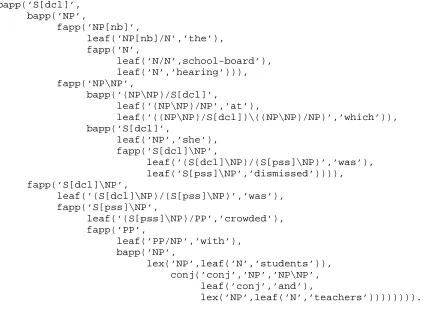
most probable derivation. However, for this paper the parser has been modified to simply output the derivation in the form shown in Figure 2, which is the input for the semantic component.
4 Building Semantic Representations
4.1 Semantic Formalism
Our method for constructing semantic representa-tions can be used with many different semantic for-malisms. In this paper we use formulas of first-order logic with a neo-Davidsonian analysis of events. We do not attempt to cover all semantic phenomena; for example, we do not currently deal with the res-olution of pronouns and ellipsis; we do not give a proper analysis of tense and aspect; we do not distinguish between distributive and collective read-ings of plural noun phrases; and we do not handle quantifier scope ambiguities.
The following first-order formula for the sentence A spokesman had no comment demonstrates the rep-resentation we use:
x(spokesman(x) y(comment(y)
e(have(e) agent(e,x) patient(e,y)))).
The tool that we use to build semantic representa-tions is based on the lambda calculus. It can be used to mark missing semantic information from natural language expressions in a principled way usingλ, an operator that binds variables ranging over vari-ous semantic types. For instance, a noun phrase like a spokesman can be given theλ-expression
λp.
x(spokesman(x) (p@x))
where the @ denotes functional application, and the variable p marks the missing information provided by the verb phrase. This expression can be com-bined with the λ-expression for lied, using func-tional application, yielding the following expres-sion:
λp.
x(spokesman(x) (p@x))@ λy.
e(lie(e) agent(e,y)).
β-conversion is the process of eliminating all oc-currences of functional application by substituting the argument for theλ-bound variables in the func-tor.β-conversion turns the previous expression into a first-order translation for A spokesman lied:
x(spokesman(x)
e(lie(e) agent(e,x))).
al., 1981). However, we merely use the lambda-calculus as a tool for constructing semantic rep-resentations, rather as a formal tool for model-theoretic interpretation. As already mentioned, we can use the same method to obtain, for exam-ple, Discourse Representation Structures (Kuschert, 1999), or underspecified semantic representations (Bos, 2004) to deal with quantifier scope ambigu-ities.
4.2 Method and Algorithm
The output of the parser is a tree representing a CCG derivation, where the leaves are lexical items and the nodes correspond to one of the CCG com-binatory rules, a unary changing rule, a type-raising rule, or one of the additional miscellaneous rules discussed earlier. Mapping the CCG deriva-tion into a semantic representaderiva-tion consists of the following tasks:
1. assigning semantic representations to the lexi-cal items;
2. reformulating the combinatory rules in terms of functional application;
3. dealing with type-raising and type-changing rules;
4. applying β-conversion to the resulting tree structure.
Lexical items are ordered pairs consisting of the CCGcategory and a lemmatised wordform. This in-formation is used to assign aλ-expression to the leaf nodes in the tree. For most open-class lexical items we use the lemma to instantiate the lexical seman-tics, as illustrated by the following two examples (intransitive verbs and adjectives):
S[dcl]\NP, walk λqλu.q@λx.
e(walk(e) agent(e,x) u@e)
N/N, big
λpλx.(big(x) p@x)
For closed-class lexical items, the lexical seman-tics is spelled out for each lemma individually, as in the following two examples:
(S[X]\NP)\(S[X]\NP), not λvλqλf.
((v@q)@f)
NP[nb]/N, all λpλq. x(p@x q@x)
The second task deals with the combinatory rules. The rules we currently use are forward and back-ward application (FAPP, BAPP), generalised for-ward composition (FCOMP), backfor-ward composition (BCOMP), and generalised backward-crossed com-position (BCROSS).
The type-raising and type-changing rules are dealt with by looking up the specific rule and replac-ing it with the resultreplac-ing semantics. For instance, the rule that raises categoryNPtoS[X]/(S[X]\NP)
converts the semantics as follows:
TYPERAISE(NP, S[X]/(S[X]\NP), x) =λvλe.((v@x)@e)
The following type-changing rule applies to the lexical semantics of categories of typeN and con-verts them toNP:
TYPECHANGE(N,NP, y) =λp.
x(y@x p@x)
Tasks 1–3 are implemented using a recursive al-gorithm that traverses the derivation and returns a λ-expression. Note that the punctuation rules used by the parser do not contribute to the compositional semantics and are therefore ignored.
Task 4 reduces theλ-expression to the target rep-resentation by applying β-conversion. In order to maintain correctness of this operation, the functor undergoes α-conversion (renaming all bound vari-ables for new occurrences) before substitution takes place. β-conversion is implemented using the tools provided by Blackburn and Bos (2003).
4.3 Results
There are a number of possible ways to evaluate the semantic representations output by our system. The first is to calculate the coverage — that is, the per-centage of syntactic parses which can be given some analysis by the semantic component. The second is to evaluate the accuracy of the semantic representa-tions; the problem is that there is not yet an accepted evaluation metric which can be applied to such rep-resentations.
bapp(’S[dcl]’, bapp(’NP’,
fapp(’NP[nb]’,
leaf(’NP[nb]/N’,’the’), fapp(’N’,
leaf(’N/N’,school-board’), leaf(’N’,’hearing’))), fapp(’NP\NP’,
bapp(’(NP\NP)/S[dcl]’,
leaf(’(NP\NP)/NP’,’at’),
leaf(’((NP\NP)/S[dcl])\((NP\NP)/NP)’,’which’)), bapp(’S[dcl]’,
leaf(’NP’,’she’), fapp(’S[dcl]\NP’,
leaf(’(S[dcl]\NP)/(S[pss]\NP)’,’was’), leaf(’S[pss]\NP’,’dismissed’)))), fapp(’S[dcl]\NP’,
leaf(’(S[dcl]\NP)/(S[pss]\NP)’,’was’), fapp(’S[pss]\NP’,
leaf(’(S[pss]\NP)/PP’,’crowded’), fapp(’PP’,
leaf(’PP/NP’,’with’), bapp(’NP’,
lex(’NP’,leaf(’N’,’students’)), conj(’conj’,’NP’,’NP\NP’,
leaf(’conj’,’and’),
lex(’NP’,leaf(’N’,’teachers’)))))))).
some A ((school-board[A] & hearing[A]) & some B (female[B] & some C
(dismiss[C] & (patient[C,B] & (at[A,C] & some D (crowd[D] & (patient[D,A] & ((some E (student[E] & with[D,E]) & some F (teacher[F] & with[D,F])) & event[D]))))))))
Figure 2: Parser output and semantic representation for the example sentence:
The school-board hearing at which she was dismissed was crowded with students and teachers
that the CCG parser produces dependencies which are essentially predicate-argument dependencies, the accuracy of the syntactic component should be a good indication of the accuracy of the semantics, especially given the transparent interface between syntax and semantics used by our system. Hence we report coverage figures in this paper, and repeat figures for dependency recovery from an earlier pa-per.
We do not evaluate the accuracy of the system output directly, but we do have a way of check-ing the well-formedness of the semantic represen-tations. (The well-formedness of the representation does not of course guarantee the correctness of the output.) If the semantic representation fails to β -convert, we know that there are type conflicts re-sulting from either: incorrect semantics assigned to some lexical entries; incorrect interpretation of one of the combinatory rules; or an inconsistency in the output of the syntactic component.
We assigned lexical semantics to the 245 most
frequent categories from the complete set of 409, and implemented 4 of the type-raising rules, and the 10 unary type-changing rules, used by the parser. We used section 00 from CCGbank for development purposes; section 23 (2,401 sentences) was used as the test set. The parser provides a syntactic analysis for 98.6% of the sentences in section 23. The ac-curacy of the parser is reported in Clark and Curran (2004b): 84.6% F-score over labelled dependencies for section 23. Of the sentences the parser analyses, 92.3% were assigned a semantic representation, all of which were well-formed. The output of the sys-tem for an example sentence is given in Figure 2.
The reason for the lack of complete coverage is that we did not assign semantic representations to the complete set of lexical categories. In future work we will cover the complete set, but as a simple remedy we have implemented the following robust-ness strategy: we assign a semantic template to parts of the tree that could not be analysed. For example, the template for the NP category is λp.
This was done for the 10 most frequent categories and results in a coverage of 98.6%.
Although we expect the accuracy of the seman-tic representations to mirror those of the syntacseman-tic component, and therefore be useful inNLP applica-tions, there is still a small number of errors arising from different sources. First, some constructions are incorrectly analysed in CCGbank; for example, ap-positives in CCGbank are represented as coordinate constructions (Hockenmaier, 2003). Second, errors are introduced by the semantic construction com-ponent; for example, the non-head nouns in a noun-noun compound are currently treated as modifiers of the head noun, in the same way as adjectives. And finally, the parser introduces errors because of in-complete coverage of the lexicon, and mistakes due to the parsing model. We expect general improve-ments in statistical parsing technology will further improve the accuracy of the parser, and we will fur-ther develop the semantic component.
5 Conclusions and Future Work
This paper has demonstrated that we can construct semantic representations using a wide-coverage CCG parser, with a coverage of over 97% on un-seenWSJsentences. We believe this is a major step towards wide-coverage semantic interpretation, one of the key objectives of the field ofNLP.
The advantages of our approach derive largely from the use ofCCG. The lexicalised nature of the formalism means that our system has a high degree of modularity, with separate syntactic and semantic components.
We have shown how to construct simple first-order semantic representations from CCG deriva-tions. We have not dealt with all semantic phe-nomena, such as quantifier scope ambiguities and anaphora resolution. In future work we will in-vestigate using underspecified semantic representa-tions. The utility of our system forNLPapplications will be tested by integration with an existing open-domain Question-Answering system (Leidner et al., 2003).
We will also investigate the construction of a tree-bank of semantic representations derived automati-cally from CCGbank. Previous work, such as Li-akata and Pulman (2002) and Cahill et al. (2003), has attempted to generate semantic representations from the Penn Treebank. Cahill et al. use a transla-tion of the Treebank toLFG F-structures and quasi-logical forms. An advantage of our approach is that our system for constructing semantic represen-tations, whatever semantic formalism is used, can be applied directly to the derivations in CCGbank.
Acknowledgements
This research was partially supported by EPSRC grant GR/M96889.
References
Patrick Blackburn and Johan Bos. 2003. Represen-tation and Inference for Natural Language. A First Course in Computational Semantics. Draft available athttp://www.comsem.org, June.
Johan Bos. 2004. Computational semantics in dis-course: Underspecification, resolution, and inference.
Journal of Logic, Language and Information, 12(2).
Ted Briscoe and John Carroll. 2002. Robust accurate statistical annotation of general text. In Proceedings
of the 3rd LREC Conference, pages 1499–1504, Las
Palmas, Gran Canaria.
Aoife Cahill, Mairead McCarthy, Josef van Genabith, and Andy Way. 2003. Quasi-Logical Forms from F-Structures for the Penn Treebank. In Harry Bunt, Ielka van der Sluis, and Roser Morante, editors,
Pro-ceedings of the Fifth International Workshop on Com-putational Semantics (IWCS-5), pages 55–71. Tilburg
University.
J. Carroll, G. Minnen, D. Pearce, Y. Canning, S. De-vlin, and J. Tait. 1999. Simplifying text for language-impaired readers. In Proceedings of the 9th Meeting
of EACL, pages 269–270, Bergen, Norway.
Eugene Charniak, Kevin Knight, and Kenji Yamada. 2003. Syntax-based language models for machine translation. In Proceedings of the MT Summit IX, New Orleans, Louisiana.
Eugene Charniak. 2000. A maximum-entropy-inspired parser. In Proceedings of the 1st Meeting of the
NAACL, pages 132–139, Seattle, WA.
Stephen Clark and James R. Curran. 2003. Log-linear models for wide-coverage CCG parsing. In
Proceed-ings of the EMNLP Conference, pages 97–104,
Sap-poro, Japan.
Stephen Clark and James R. Curran. 2004a. The impor-tance of supertagging for wide-coverage CCG pars-ing. In Proceedings of the 20th International
Confer-ence on Computational Linguistics (COLING-04) (to appear), Geneva, Switzerland.
Stephen Clark and James R. Curran. 2004b. Parsing the WSJ using CCG and log-linear models. In
Pro-ceedings of the 42nd Meeting of the ACL (to appear),
Barcelona, Spain.
Stephen Clark, Julia Hockenmaier, and Mark Steedman. 2002. Building deep dependency structures with a wide-coverage CCG parser. In Proceedings of the
40th Meeting of the ACL, pages 327–334,
Philadel-phia, PA.
Michael Collins. 1999. Head-Driven Statistical Models
for Natural Language Parsing. Ph.D. thesis,
Univer-sity of Pennsylvania.
Julia Hockenmaier and Mark Steedman. 2002a. Acquir-ing compact lexicalized grammars from a cleaner tree-bank. In Proceedings of the Third LREC Conference, pages 1974–1981, Las Palmas, Spain.
Julia Hockenmaier and Mark Steedman. 2002b. Gen-erative models for statistical parsing with Combina-tory Categorial Grammar. In Proceedings of the 40th
Meeting of the ACL, pages 335–342, Philadelphia, PA.
Julia Hockenmaier. 2003. Data and Models for
Statis-tical Parsing with Combinatory Categorial Grammar.
Ph.D. thesis, University of Edinburgh.
Hans Kamp and Uwe Reyle. 1993. From Discourse
to Logic; An Introduction to Modeltheoretic Seman-tics of Natural Language, Formal Logic and DRT.
Kluwer, Dordrecht.
Ronald M. Kaplan, Stefan Riezler, Tracy H. King, John T. Maxwell III, Alexander Vasserman, and Richard Crouch. 2004. Speed and accuracy in shal-low and deep stochastic parsing. In Proceedings of
the HLT/NAACL Conference, Boston, MA.
Susanna Kuschert. 1999. Dynamic Meaning and
Ac-commodation. Ph.D. thesis, Universit¨at des
Saarlan-des.
Jochen L. Leidner, Johan Bos, Tiphaine Dalmas, James R. Curran, Stephen Clark, Colin J. Bannard, Mark Steedman, and Bonnie Webber. 2003. The QED open-domain answer retrieval system for TREC 2003. In Proceedings of the Twelfth Text Retrieval
Conference (TREC 2003), pages 595–599,
Gaithers-burg, MD.
Maria Liakata and Stephen Pulman. 2002. From trees to predicate-argument structures. In Shu-Chuan Tseng, editor, COLING 2002. Proceedings of the 19th
In-ternational Conference on Computational Linguistics,
pages 563–569. Taipei, Taiwan.
Marius Pasca and Sanda Harabagiu. 2001. High per-formance question/answering. In Proceedings of the
ACL SIGIR Conference on Research and Development in Information Retrieval, pages 366–374, New
Or-leans LA.
Philip Resnik and Aaron Elkiss. 2003. The
lin-guist’s search engine: Getting started guide. Tech-nical Report LAMP-TR-108/CS-TR-4541/UMIACS-TR-2003-109, University of Maryland, College Park, MA.
Mark Steedman. 2000. The Syntactic Process. The MIT Press, Cambridge, MA.
Kristina Toutanova, Christopher Manning, Stuart
Shieber, Dan Flickinger, and Stephan Oepen. 2002. Parse disambiguation for a rich HPSG grammar. In
Proceedings of the First Workshop on Treebanks and Linguistic Theories, pages 253–263, Sozopol,