129
Abstract— The main aim of this paper is to provide a review of two different networks, mobile ad hoc network and wireless sensor network. MANET and WSN is a issue too wide ranging to exposure about how to suffer from different confronts like low bandwidth, overhead and speed of nodes. For WSNs, based on four protocols AODV, DSDV, TORA and LEACH are chosen and evaluated. In wireless ad hoc network, the nodes must be able to intersect each other to launch the link from starting place to the target. The AODV between LEACH both attain better AODV is less baggage than LEACH since the consequence of AODV is fluctuated but LEACH shows permanence. It is secondary that AODV indicates improved execution in the two situations contrasted with DSDV and TORA. In any case, standard end-to-end delay is significantly superior in WSNs contrasted through MANETs
Keywords: MANETs , MANETs,, Ad Hoc on Demand
Distance Vector, Temporary Ordered Routing Algorithm, Wireless Sensor Network, Quality Of Service, Routing Protocols.
I. INTRODUCTION
MANETs and WSNs are the front line remote frameworks have a couple of similarity and dissimilarity. Sensor frameworks be familiar with ascend as a promising mechanical assembly to make sure the physical world, utilizing self-orchestrating systems of battery-controlled remote sensors that can differentiate, action and give. The objective of this work is to revolve around the middle issues of guiding instruments like ordinary end-to-end delay especially for MANETs and WSNs[3][4]. In sensor frameworks, fundamental resource, while applications demonstrate a bound course of action of characteristics. Along these lines, there is both a accuse and an event to update the framework building for the application observance at the top of the priority list the ultimate objective to restrict resource ate up.
There is some numeral check of steering conventions accessible for both, MANETs and WSNs. It is intended to evaluate the success of one surely understood on-request responsive convention AODV, alongside the one proactive convention DSDV and one versatile directing convention TORA with the aftereffect of similitude and dissimilarities of the accomplishment of steering conventions of MANETs and WSNs [1]. No less than one centers among them will fill in as sink that are furnished for talking with the customer either straightforwardly or through the current wired frameworks.
Figure1. Wireless network
The slight sensor hubs, which encompass of detect, on board processor for information prepare, and conveying segments, use the possibility of sensor systems in view of community oriented effort of an expansive number of hubs. Our examination endeavors are centered around reenactment edited compositions to investigate a few parameters, for example, activity designs, hub thickness and starting example of hubs that may influence the steering execution. This examination think about is finished by utilizing extensively perceived and enhanced system test system NS-2 adaptation for MANETs and the Mannasim consolidated with Network Simulator NS-2 variant for WSNs, with adjusted change on NS-2 documents and TCL contents for reasonable accomplishment evaluation and executions of modified directing conventions.
N. RAVI
1and G. RAMACHANDRAN
21Research Scholar, Division of Computer and Information Science, Annamalai University, Annamalainagar –
608 002, Tamilnadu, India, Email: [email protected]
2Department of Computer Science & Engineering, Annamalai University, Annamalainagar-608 002, Tamilnadu,
India.
Comparative Study of Mobile Ad Hoc Network
(MANET) Routing Protocols with Wireless Sensor
Figure 2. Ad-Hoc Wireless network
[image:2.612.48.298.314.489.2]Each hub routinely includes the four sections: sensor unit, focal preparing unit, control unit, and communication unit [11].
Figure 3: Structural view of sensor network
A.MANET Applications
Rescue Military Networks Conferencing Law and Security
Figure displays the collaborator appearance of a sensor composes in which sensor center points are appeared as child circles. Every center point reliably includes the four segments: sensor unit, central getting ready unit. In this paper the going with section, we take a gander at the obvious sorts of MANET, the qualities and its controlling traditions. In Section 3, we take a gander at the unquestionable sorts of WSN, the qualities and its controlling traditions. In Section 4 we delineated the examination of MANET and WSN. At long last, it finishes the paper.
MANET comprises of an arrangement of portable has that can speak with one another without the help of base stations. Manets are heterogeneous blend of various remote and cell phones, going from minimal hand held gadget to laptops [3]. A few parameters that influenced the nature of administration like deposit control, interface soundness between two hubs, blunder check and bounce tally. MANET hubs are furnished with remote transmitters and recipients utilizing receiving wires which might be Omni directional (communicated), exceptionally directional (point-to-point)[12], conceivably steerable, or some blend thereof. At a given point in time, contingent upon the hubs' positions and their transmitter and collector inclusion designs, transmission control levels and co-channel impedance levels, a remote availability as an arbitrary, multi-hop chart or "specially appointed" system exists between the hubs. This impromptu topology may change with time as the hubs move or modify their transmission and gathering parameters.
Two mainstream sorts of MANET are • VANET.
• iMANET
B.Wireless Sensor Network (WSN)
WSN advantage from the advances in selecting improvement, which incited the period of almost nothing, remote, battery controlled awe inspiring sensor center points. These focuses are dynamic contraptions with selecting and correspondence limits that model certified contemplate and also can channel, offer, join and work on the information they sense. Low-rate low-control use [6] and negligible exertion correspondence are the key demonstrates that lead the assurance of the IEEE 802.15 standard [17]. Sensor sort out centers are compelled with respect to essentialness supply, restricted computational utmost and correspondence exchange speed [11].
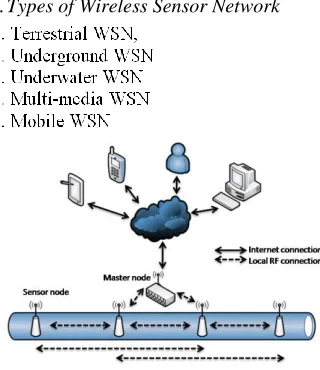
[image:2.612.320.480.528.713.2]C.Types of Wireless Sensor Network
131 Natural WSNs ordinarily involve hundreds to thousands of
modest sensor centers sent in a given district, either in an extraordinarily selected or in a pre-organized manner [16].
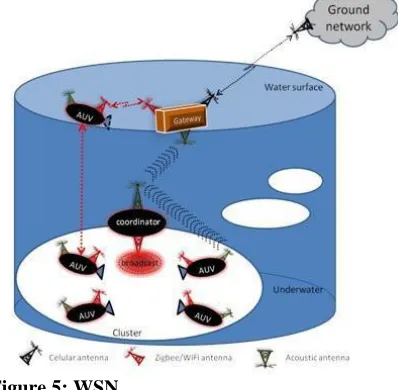
[image:3.612.314.558.112.263.2]Underground WSNs in which sensor center point anchored underground, basically it used for recognize used to screen underground situation. Additionally, sink center are used for transmit information to the sensor center to the base station [16]. As to, association, and support is simply more over the top in underground WSN when diverged from natural WSN. Number of sensor centers and vehicles passed on submerged [14] not in the slightest degree like natural WSNs, submerged sensor centers are simply more excessive and less thick. Independent submerged vehicles are utilized for looking or assembling information from sensor focus focuses. Sensor focus focuses give by strategies for acoustic waves in submerged WSN Sensor focus have limited battery control which can't be revives and supplant. For significance protection, submerged WSNs join making beneficial submerged correspondence and structures association techniques.
Figure 5: WSN
[image:3.612.52.251.344.539.2]Adaptable WSNs is a collection of sensor center points that can go before forward their own specific and interface with the physical condition. Compact center points have the limit of identifying, figuring, and correspondence like static center points. A key complexity is adaptable center points can change the position and get it together in the framework. Flexible WSNs can start with some fundamental.
Figure 6: Multimedia WSN
II. PROBLEM FORMATION
MANETs and WSNs appearance has been finished to perceive the key edges and foggy territories of necessity for an examination. Effort started with the consideration of accomplishments direction of Wireless, Mobile Ad hoc and Wireless Sensor Networks. The MANETs and WSNs both are the remote systems with some comparability like low data transfer capacity, high mistake rate, more successive connection breakage, end-to-end delay, loss of pockets, and so on with difference like hub recognizable proof components, assets, correspondence worldview, organize execution goals, convention configuration issues, and so on.
Table 1: MANET and WSNs
The two systems share some fundamental coordinating traditions. An examination with respect to considerations qualities perceived status application zones, and engineered directing calculations and customs have been done. With this work it is discovered that controlling in MANETs and WSNs [2] is to an incredible degree testing and specific because of the common properties that see these structures from different remote systems like cell and work frameworks.
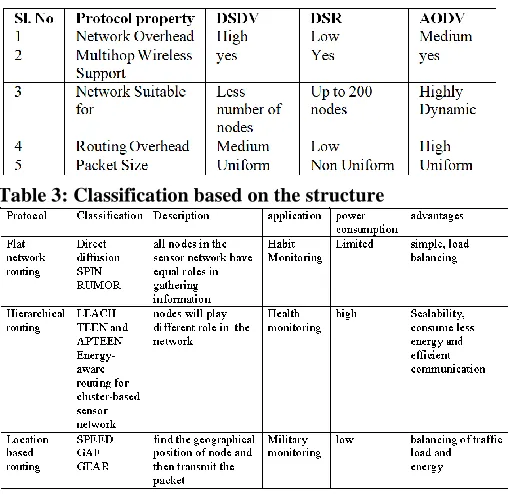
A.DSDV, DSR and AODV
[image:3.612.316.530.431.526.2]speed in coordinating table. Proactive guiding traditions are DSDV and OLSR.
DSDV try to keep up dependable, achievement coordinating information of the whole framework. It restricts the deferral in correspondence and empowers centers to quickly make sense of which centers are accessible or reachable in the framework. AODV sets up a course to an objective just on ask for [15]. It is fit for unicast, impart and multicast coordinating. AODV have some join feature of DSR and AODV. AODV keeps up a key separation from the counting to-incomprehensibility issue of other detachment vector traditions by using progression numbers on course revives. In DSR the course ways are found after source sends a package to an objective center point in the uniquely named framework. ZRP separates the topology into zones and endeavor to utilize unmistakable directing traditions inside and between the zones in perspective of the inadequacies and characteristics of these conventions [18]. ZRP is completely segregated, inferring that any coordinating tradition can be used inside and between zones. ZRP describes a framework called the Border cast Resolution Protocol (BRP) to control development between zones [9].
[image:4.612.48.302.372.619.2]Table 2: DSDV, DSR and AODV
Table 3: Classification based on the structure
B. Comparison of Manets and Sensor Networks
MANETS and sensor frameworks are two classes of the remote Adhoc frameworks with resource objectives. MANETS usually involve contraptions that have high limits, flexible and work in collusions. Sensor frameworks are ordinarily sent specifically restricted zones for following, watching and recognizing. Both these remote frameworks are delineated by their outstandingly assigned natures that not have passed on foundation for enlisting and correspondence. Both split several attributes like system topology isn't settled,
control is an over the top asset and focuses in the structure are connected with one another by remote correspondence joins. WSNs are specific in different key courses from MANETS as said underneath.
Sensor systems are for the most part used to assemble data while MANETS are intended for conveyed figuring beautiful than data gathering.
Sensors hubs for the most part utilize communicate correspondence worldview though all MANETS depend on point-to-point interchanges.
The number of hubs in sensor systems can be a few requests of size higher than that in MANETs.
Sensor hubs might not have worldwide recognizable proof (ID) on account of the expansive measure of overhead and extensive number of sensors.
Sensor hubs are substantially less expensive than hubs in a MANET and are normally sent in thousands.
Sensor hubs are constrained in control, computational limit, and memory where as hubs in a MANET can be restored somehow.
Usually, sensors are conveyed once in their lifetime, while hubs in MANET move truly in an Ad-hoc way.
Sensor hubs are substantially more constrained in their calculation and correspondence capacities than their MANET partners because of their ease.
C.Categorization of Routing Protocols
The arrangement space for guiding estimations for WSNs is enormously far reaching and we can designate the coordinating figurings for WSNs in many undermined ways [2]. Steering conventions are delegated hub driven, information driven, or area mindful (geocentric) and QoS based directing conventions [14]. Most Ad-hoc orchestrate directing traditions are center driven traditions where objectives are obvious in perspective of the numerical areas (or identifiers) of center points. In WSNs, center driven correspondence is certainly not a routinely expected correspondence create. Thusly, coordinating traditions proposed for WSNs are more data driven or geocentric [2].
Controlling traditions can likewise be requested in perspective of whether they are responsive or proactive. A proactive tradition sets up coordinating ways and states before there is an enthusiasm for directing development [18]. Ways are kept up even there is no action stream around at that point. In responsive steering convention, directing activities are activated when there is information to be sent and scattered to different hubs. Here ways are setup on request when questions are started [16].
133 conveyance [18]. An objective began tradition, on the other
hand, begins path setup from an objective center.
Coordinating traditions is additionally portrayed based sensor organize plan. Some WSNs include homogenous center points, while some involve heterogeneous hubs [2]. In perspective of this thought we can orchestrate the traditions whether they are wearing down a level topology [11] or on a different leveled topology [18]. In Flat controlling traditions all center points in the framework are managed reliably.
D.Design Issues of Routing Protocols
At first WSNs was essentially persuaded by military applications. Later on the regular citizen application area of remote sensor systems have been viewed as, for example, ecological and species observing, generation and social insurance, savvy home etc [9].
1)Fault Tolerance
Some sensor hubs may come up short or be infertile because of absence of intensity, have physical harm or natural obstruction [11]. The disappointment of sensor hubs must not influence the general endeavor of the sensor arrange [7].
2)Scalability
The measure of sensor hubs send in the detecting locale might be in the organize of hundreds, thousands or more and steering plans must be sufficiently versatile to react to occasions [11].
3)Production Costs
Since the sensor systems comprise of countless nodes [7], the cost of a lone hub is fundamental to support the general cost of the frameworks and from now on the cost of each sensor center point must be kept low.
4)Operating Environment
We can set up sensor organize [7] in the inside of substantial apparatus, at the base of an ocean[3], in a battle zone past the enemy lines, in a home or a tremendous working, in an enormous stockroom, joined to animals, annexed to brisk moving vehicles, in forest domain for condition watching etc[5].
5)Power Consumption
Since the transmission force of a remote radio is comparing to isolate squared or considerably higher demand inside seeing obstacles, multi-hop directing will eat up less imperativeness than organize correspondence [3]. Regardless, multi-bounce controlling presents basic overhead for topology organization and medium access control [10].
6)Data Delivery Models
Data transport models choose when the data accumulated by the center must be passed on. Dependent upon the usage of the sensor organize [7], the data transport model to the sink can be Continuous, Event driven, Query-driven and Hybrid.
7)Data Aggregation/Fusion
Since sensor hubs may create critical excess information, comparable bundles from various hubs can be accumulated so the quantity of transmissions would be diminished [11]. Data collection is the blend of data from different sources by using limits, for instance, camouflage (abstaining from duplicates), min, max and average[13].
8)Quality Of Service (QoS )
These segments will impact the assurance of directing traditions for a particular application[11]. In a couple of uses (e.g. some military applications) the data should be passed on inside a particular time period from the moment it is recognized.
9)Data Latency And Overhead
Data mixture and multi-bob exchanges cause data inertness. Additionally, some guiding traditions make exorbitant overheads to execute their figuring’s, which are not proper for honest to goodness imperativeness constrained networks[9].
10)Node Deployment
Center point course of action is application ward and impacts the execution of the guiding tradition. The association is either deterministic or self-masterminding. In deterministic conditions, the sensors are physically set and data is controlled through pre-chosen ways.
E. Comparison of Routing Protocols
In this paper we differentiated the going with directing conventions concurring with their blueprint traits [14].
III. EXPERIMENTAL RESULTS FOR MANETs
Table 4: Simulation environment is as follows:
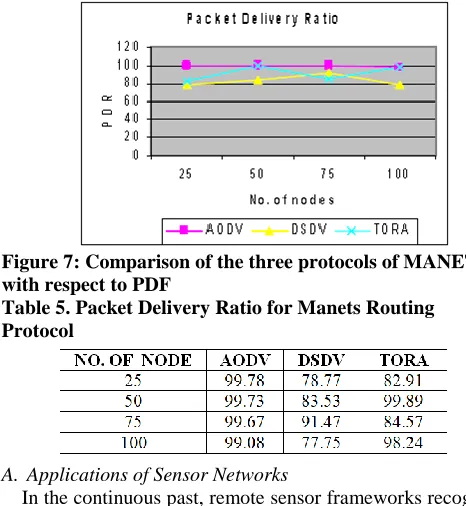
3.2 Examination and Results Comparison In this section we survey the execution of AODV, DSDV and TORA traditions on the going with parameters:
[image:6.612.46.279.334.587.2]3.3 Packet Delivery Ratio/Packet Delivery Fraction (PDR/PDF) The proportion between the quantity of bundles that are gotten and the quantity of parcels sent[15].
[image:6.612.87.273.336.456.2]Figure 7: Comparison of the three protocols of MANETs with respect to PDF
Table 5. Packet Delivery Ratio for Manets Routing Protocol
A. Applications of Sensor Networks
In the continuous past, remote sensor frameworks recognize begin their way into a moved group of employments and structures with terribly hasty necessities and qualities [3][4]. Table 6: Several applications for special areas.
The sensor networks[7] can be balanced in Disaster Relief, Emergency Rescue action, Military, Habitat Monitoring[5], Health Care, Environmental checking, Home frameworks, perceiving manufactured, natural, radiological, nuclear, and dangerous material et cetera as consolidated in table[2].
IV. OUTCOME FOR WSNs
4.1 Simulation Environment
The appraisal of execution of WSNs guiding conventions [2] AODV, DSDV, TORA rely upon following estimations Simulation condition is as follows[18]:
4.2 Analysis and Results Comparison
In this fragment we evaluate the execution of AODV, DSDV, TORA and LEACH traditions on the going with parameters for WSNs: [6][14]
4.3 Packet Delivery Ratio (PDR)
The extent between the amount of groups that are gotten and the amount of bundles sent.
4.4 Discussion on Results
135 V. CONCLUSION
Similarly, conflicting MANETS, sensor frameworks are laid out [7], when all is said in done, for particular applications. Thus, orchestrating beneficial coordinating traditions for sensor sorts out that suits sensor frameworks serving various applications is basic [7]. As we decided already, for MANETs we perceive called three procuring traditions AODV, DSDV and TORA and present a relative execution break down among them. In context of our advantageous outcomes it is considered that the AODV perform better in MANETs and gives better yield and execution. TORA is authentic poor not solid for MANETs. Then again coordinating traditions for WSNs are picked; these are AODV, DSDV, TORA and LEACH and centered their execution [6]. The deferred result of our work done is that AODV and LEACH both perform better in any case AODV is less attempted and valid than LEACH in light of the manner in which that the postponed outcome of AODV is changed yet that of LEACH isn't. Sensor Networks hold ace a broad extent of vow in applications where gathering perceiving data in remote districts is required [7]. It is a making field, which offers scope for a great deal of research. As our examination uncovers, it isn't conceivable to plan a directing tally which will have remarkable execution under all conditions and for all applications.
REFERENCES
[1] Elaine Shi, Adrian Perrig: Designing Secure Sensor Networks IEEE Wireless Communications, pp. 38-43 (December 2004).
[2] Al-Karaki, J.N,Al-Mashagbeh: Energy-Centric Routing in Wireless Sensor Networks Computers and Communications, ISCC 06 Proceedings, 11th IEEE Symposium (2006).
[3] Kay Romer, Friedemann Mattern: The Design Space of Wireless Sensor Networks, IEEE Wireless Communications, pp. 54-61 (December 2004).
[4] Wendi B. Heinzelman, Amy L. Murphy, Hervaldo S. Carvalho, Mark A. Perillo: Middleware to Sensor Network Applications, IEEE Network, pp. 6-14, (January/February 2004).
[5] N. Sadagopan et al.: The ACQUIRE mechanism for efficient querying in sensor networks, in the Proceedings of the First International Workshop on Sensor Network Protocol and Applications, Anchorage, Alaska (May 2003).
[6] W. Heinzelman, A. Chandrakasan, and H. Balakrishnan: Energy-efficient communication protocol for wireless sensor networks, in the Proceeding of the Hawaii InternationalConference System Sciences, Hawaii (January 2000).
[7] A. Manjeshwar and D. P. Agrawal: APTEEN: A Hybrid Protocol for Efficient Routing and Comprehensive Retrieval in Wireless Sensor Networks, in the Proceedings of the 2 nd International Workshop
on Parallel and Distributed Computing in Wireless Networks & Mobile computing, Ft. Lauderdale, FL (April 2002).
[8] S. Lindsey and C. S. Raghavendra: PEGASIS: Power Efficient GAthering in SensorInformation Systems, in the Proceedings of the IEEE Aerospace Conference, Big Sky, Montana ( March 2002).
[9] T. He et al. :SPEED: A stateless protocol for real-time communication in sensor networks, in the Proceedings of International Conference on Distributed Computing Systems, Providence, RI ( May 2003).
[10] J. Pan, L. Cai, T. Hou, Y. Shi, and S. Shen: Topology for wireless sensor networks, Proceedings of the 9th ACM MobiCom, (2003).
[11] J N.Al-Karaki, A E.Kamal: Routing Techniques in Wireless Sensor Networks: A Survey,in the proceeding of in IEEE Wireless Communications ( Dec. 2004). [12] H. Baldus, K. Klabunde, and G. Musch: Reliable Set-
Up of Body-Sensor Network, EWSN 2004, LNCS 2920, pp. 353- 363 (2004).
[13] K. Romer: Tracking real-world phenomena with smart dust, in Proc. first European Workshop on Wireless Sensor Networks, pp. 28–43, Berlin, Germany (2004). [14] Kemal Akkaya and Mohamed Younis – “A Survey on
Routing Protocols for Wireless Sensor Networks”, Elsevier Journal of Ad Hoc Networks. v3 i3. Pages:325-349, Year of Publication: 2008, ISSN:1570-8705.
[15] M.K. Tiwari, O.P. Vyas, Rika Sharma, “Evaluation of Impact mobility Routing Protocols”, In Proc. of International Conference on “Challenges & Opportunities in Industry”, 2005, PCTE, Ludhiyana, Punjab, INDIA.
[16] Y. Li, T. Newe “Wireless Sensor Networks of Routing Protocol for Applications”, In Proc. of the ATNAC 2006, Melourne, Australia.
[17] M. Becker, S. Schaust, E. Wittmann – “Performance of Routing Protocols for Real Wireless Sensor Networks”,
International Symposium on Performance Evaluation
of Computer and Telecommunication Systems
(SPECTS'07), San Diego, USA, 2007.
[18] Jason Liu, Yougu Yuan, David Nicol, Robert Gray, Calvin Newport, David Kotz, Luiz Perrone, “Simulation Validation Using Direct Execution of Wireless Ad-Hoc Routing”. PADS-04, 18th Workshop on Parallel and Distributed Simulation, 2004.