Distributed Minimum Error Rate Training of SMT
using Particle Swarm Optimization
Jun Suzuki, Kevin Duh, and Masaaki Nagata
NTT Communication Science Laboratories, NTT Corp. 2-4 Hikaridai, Seika-cho, Soraku-gun, Kyoto, 619-0237 Japan
{suzuki.jun, kevin.duh, nagata.masaaki}@lab.ntt.co.jp
Abstract
The direct optimization of a translation metric is an integral part of building state-of-the-art SMT systems. Unfortunately, widely used translation metrics such as BLEU-score are non-smooth, non-convex, and non-trivial to optimize. Thus, stan-dard optimizers such as minimum error rate training (MERT) can be extremely time-consuming, leading to a slow turn-around rate for SMT research and exper-imentation. We propose an alternative ap-proach based on particle swarm optimiza-tion (PSO), which can easily exploit the fast growth of distributed computing to obtain solutions quickly. For example in our experiments on NIST 2008 Chinese-to-English data with 512 cores, we demon-strate a speed increase of up to 15x and reduce the parameter tuning time from 10 hours to 40 minutes with no degradation in BLEU-score.
1 Introduction
Recent statistical machine translation (SMT) sys-tems employ a linear combination of several model components, such as translation models, language models, and reordering models. Trans-lation is performed by selecting the most-likely translation, which is the candidate translation with the highest score based on the different model components. We usually refer to this search pro-cess as ‘decoding’. Although the development of decoding algorithms is a key topic in SMT re-search, if we are to construct better SMT systems it is also important to find a way to determine the weights of different model components. We refer to this process as ‘parameter tuning’.
The current standard strategy for tuning the pa-rameters of SMT systems is to search for the weights that maximize a given translation quality
metric such as BLEU-score (Papineni et al., 2002). In fact, minimum error rate training (MERT) pro-posed by (Och, 2003) is the most widely used pa-rameter tuning method in SMT community. This is because, empirically, we obtain better trans-lation system performance by directly optimiz-ing the translation metric than by maximizoptimiz-ing the likelihood function. However, translation met-rics such as BLEU-score are often non-smooth, non-convex, and non-trivial to optimize, and di-rect maximization does not allow us simply to ap-ply well-known fast and robust optimization tech-niques such as the gradient-ascent method. This restriction makes the parameter tuning process ex-tremely slow.
In this paper, we propose a novel distributed MERT framework based on particle swarm opti-mization (PSO) (Kennedy and Eberhart, 1995), a population based stochastic optimization tech-nique, to improve the slow parameter tuning pro-cess. The main characteristics of our method are that: (1) it directly optimizes a metric such as BLEU-score, (2) it greatly reduces the parame-ter tuning time compared with the conventional MERT, and (3) it is highly scalable, meaning that additional distributed processors lead to better and faster performance.
Our main motivation is to improve the experi-ment turn-around time for SMT system develop-ment. A faster parameter tuning algorithm would have a positive impact on research on all the com-ponents of the SMT system. Imagine a researcher designing a new pruning algorithm for decoding, a new word alignment model, or a new domain adaptation method. Any of these methods need to be evaluated in the context of a full SMT sys-tem, which requires parameter tuning. If we can reduce the parameter tuning time from 10 hours to 1 hour, this can greatly increase the pace of inno-vation. Thus our motivation is orthogonal to re-cent research on improving MERT, such as efforts to escape local maxima problems (Cer et al., 2008;
Foster and Kuhn, 2009; Moore and Quirk, 2008), or incorporate lattices (Macherey et al., 2008).
2 Parameter Tuning for SMT Systems
Most recently developed SMT systems consist of several model components, such as translation models, language models, and reordering models. To combine evidence obtained from these differ-ent compondiffer-ents, we often define a discriminative (log-)linear model.
Suppose the SMT system has D components.
The log probabilities of the components are usu-ally treated as features in the discriminative model. We denote the d-th feature, or log probability of
thed-th component given a source sentencef and
its translatione, asφd(e,f). We also denote the
d-th weight asλd. Then, finding the most likely
translationˆeof a given source sentencef with the
SMT system can be written in the following max-imization problem:
ˆ
e= arg max
e
∑
d={1,...,D}
λdφd(e,f). (1)
This process is called ‘decoding’ in SMT.
Next, to obtain better translation quality for any translations, we need somehow to tune the com-ponent weightsλdfor alld. The current standard
strategy for parameter tuning is to directly maxi-mize a translation quality measure such as BLEU-score rather than likelihood.
Suppose we have a dataset consisting ofS sen-tences. Let fs be the s-th input sentence (source
language) in the tuning dataset. We also sup-pose that eachfshasQreference translations that
are usually generated by hand. Thus, let rs,q be
theq-th reference translation offs. We write the
weights in the vector representation as, for exam-ple,λ = {λd}D
d=1, and a system translation offs obtained when the weights areλasˆe(f,λ)to
pro-vide a better explanation. Then, the direct maxi-mization of a translation metricMcan be written in the following form:
λ∗= arg max
λ M
({fs,{rs,q}Qq=1,eˆs(fs,λ)}Ss=1). (2) whereλ∗represents the optimal solution.
2.1 Outline of Och’s MERT
The most widely used parameter tuning frame-work for solving Equation 2 in SMT is MERT
proposed by (Och, 2003). There are several vari-ations for updating weights during the iterative tuning process in MERT. The most commonly used algorithm for MERT is usually called Koehn-coordinate descent (KCD), which is used in the MERT utility packaged in the popular Moses sta-tistical machine translation system (Koehn et al., 2007). Another choice is Powell’s method that was advocated when MERT was first introduced for SMT (Och, 2003). Since KCD tends to be marginally more effective at optimizing the MERT objective, and is much simpler to implement than Powell’s method, this paper focuses only on KCD. KCD is a variant of a coordinate ascent (or descent) algorithm. At each iteration, it moves along the coordinate, which allows for the great-est progress of the maximization. The routine per-forms a trial line maximization along each coordi-nate to determine which one should be selected. It then updates the weight vector with the coordinate that it found to be the best objective in the trial.
To perform an iterative parameter update with MERT, it is necessary to evaluate the system trans-lation quality given by the current weights by the translation metric to be optimized. This process obviously requires us to perform decoding (Equa-tion 1), and decoding is usually a very expensive process. Thus, it often becomes infeasible to un-dertake decoding every iteration if the size of the tuning dataset is relatively large. To overcome this issue, Och (2003) has also introduced theN-best
approximation method. This method separates de-coding and the parameter tuning process into an outer and an inner loop. The outer loop first runs the decoder over the source sentences in the tun-ing dataset with the current weights to generate
N-best lists of translations. Then, the method
employs the inner loop procedure to optimize the weights based on thoseN-best lists instead of
de-coding the tuning dataset. After obtaining the op-timal weights from the inner loop, we repeat the outer loop to generate a new N-best list. Figure
1 shows the system outline, which is described in detail elsewhere (Bertoldi et al., 2009).
We note here that the method proposed in this paper essentially involves the replacement of the inner loop algorithm of the conventional MERT.
3 Particle Swarm Optimization (PSO)
Decoder results (n-best lists) Tuning dataset
decoder
scorer References
Translation metric
Model components
Outer loop
Inner loop
optimizer
final weights
weights weights
(i.e., BLEU-score)
Figure 1: System outline of MERT proposed by (Och, 2003); This system diagram was first pub-lished in (Bertoldi et al., 2009)
in (Kennedy and Eberhart, 1995). This optimiza-tion technique is explained in terms of emulating the social behavior of flocks of birds and shoals of fish, or taking advantage of the concept of the social sharing of information.
The basic strategy of this optimization tech-nique is that each particle flies individually through the search space to find the best position in the search space. By this iterative search pro-cess, each particle can learn from the experience of other particles in the same population (called a swarm). In other words, each particle in the itera-tive search process would adjust its flying velocity as well as position based on both its own acquain-tance and the flying experience of other particles in the swarm. PSO has been shown to be effec-tive in solving a variety of complex optimization problems in practice. Thus, PSO may also work relatively well in MERT since optimizing transla-tion metric such as BLEU-score is also a complex optimization problem.
3.1 Basic definition
Suppose we have aD-dimensional problem space
(search space) given by the task at hand. Then, we also assume that we have an objective function
F, which is generally called a fitness function in
the context of PSO, to evaluate the solution. Basi-cally, solving the task is equivalent to either max-imizing or minmax-imizing the objective function. For example, with the parameter tuning of SMT sys-tems, the objective functionFis BLEU-score, and
the solution should be the parameter set that maxi-mizes the BLEU-score over a given tuning dataset. Hereafter, we assume a maximization problem.
For PSO, we assume that the swarm consists of
K particles. Each individual particle Pk, where
k ∈ {1, . . . , K}, can be represented as a
three-tuple Pk = (xk,vk,bk), where xk is the
cur-rent position in the search space,vkis the current
velocity, and bk is the personal best position in
the search space. Note thatxk, vk,andbk are all
represented asD-dimensional vectors. As briefly
explained in Section 3, PSO is an iterative opti-mization technique. The personal best position,
bk, corresponds to the position in the search space
where particlekhas the largest value of objective
functionF over all the past iterations. Hereafter,
let t represent the PSO iteration counter, where t ∈ {1, . . . , T}, and T represents the maximum
iteration number given by a user, or is possibly set at infinity. In our case, we setT = 100,000.
Formally, the personal best values for the k-th
particle at thet-th iteration, bk(t), is updated by
the following equation:
bk(t+ 1) =
{
xk(t+ 1) if F(xk(t+ 1))> F(bk(t))
bk(t) otherwise ,(3)
where we setbk(0) =xk(0)for allk.
The position yielding the largest objective among all the particles in the swarm is called the global best position. We denote this global best position asg, and denote the global best position
att-iteration asg(t). g(t) can be easily obtained
by finding thebk(t)that has the largest objective,
which is written as follows:
g(t) = arg max
b∈{b1(t),b2(t),...,bK(t)}
F(b). (4)
We assume U(a, b) is a function that returns a
value betweenaandbdrawn from a uniform
dis-tribution. We denoteU(a, b)as aD-dimensional
vector all of whose elements are U(a, b). Then,
the iterative PSO tuning process is mainly built on the following equations:
vk(t+ 1) =ξ(t)vk(t)
+c1U(0,1)(bk(t)−xk(t)) +c2U(0,1)(g(t)−xk(t)),
(5)
xk(t+ 1) =xk(t) +vk(t+ 1). (6)
whereξ is the inertia weight of the past velocity,
c2 = 2.0, and ξ(t) = 1.0−t/T, which are one standard setting for PSO. We also definevk(0) =
U(−1,1)andxk(0) =U(−1,1)for allk.
To summarize the process, the velocitiesvkfor
all particlesPkare individually updated at the
be-ginning of each iterationtby using the (personal)
past velocity, and information about the personal and global best position. The new velocity for each particle is then added to its own current posi-tionxk to obtain the next position of the particle.
After that, each particle updates its personal best position by using Equation 3, and finally the global best position of the swarm is updated by the mu-tual sharing of the personal best positions. PSO performs the above process iteratively until con-vergence is reached or iterations attain the maxi-mum numberT defined by the user.
The key feature of the PSO architecture is that information regarding the global best positiongis
shared by all particles as shown in Equation 5.
3.2 Extension to guarantee local convergence
The standard PSO algorithm described in the pre-vious section does not guarantee convergence on a local maximum. It merely means that all the par-ticles have converged on the best position discov-ered so far by the swarm. To address this issue, we use the modified version of PSO proposed in (van den Bergh and Engelbrecht, 2002) that can guarantees convergence to a local maximum. The basic idea of the modification is allow the global best particle to move until it has reached a local maximum. To achieve this, they introduced a new velocity update equation for the global best parti-cle. Note that particles other than the global best particle in the swarm continue to use the usual ve-locity update as shown in Equation 5.
Let τ be the index of the global best particle. Then, we use the following equation to update the velocity of the global best particle at thet-th
iter-ation:
vτ(t+ 1) =−xτ(t) +g(t) +ξ(t)vτ(t) +ρ(t)U(−1,1), (7)
whereρ is a scaling factor of the stochastic term U(−1,1), which is defined as follows:
ρ(t+ 1) =
2ρ(t) if #S > Ts 0.5ρ(t) if #F > Tf
ρ(t) otherwise
, (8)
where#Sand#F, respectively, denote the
num-ber of consecutive failures or successes in finding
a new global best point where a failure is defined asf(g(t)) =f(g(t−1)).
Then, in the same manner as Equation 6, the new position can be calculated by adding the new velocity:
xτ(t+ 1) =xτ(t) +vτ(t+ 1)
=g(t) +ξ(t)vτ(t) +ρ(t)U(−1,1).
(9) The −xτ(t) term in the velocity update is
can-celed when updating the position. This means that a new position is always updated from the global best position g(t). This is one of the key tricks
of the modification; the global best particle always searches for a new position around the current best position until new global best position is found. ρ
also plays an important role in guaranteeing the locally convergence of the method. The diameter of this search area is controlled by the parameter
ρ. The updating ofρmeans that if the global best
objective function value does not change, then ρ
shrinks to half its original size and the search space around the global best position becomes smaller. The initial default value ofρ(0) = 1.0.
Finally, if we cannot find a new global best po-sition around the current global best popo-sition in a certain number of iterationsTc then the current
global best position can be considered a local max-imum. We useTc= 15.
A proof of guaranteed convergence to lo-cal maxima for this algorithm can be found in (van den Bergh and Engelbrecht, 2002). Note that this modification still does not guarantee conver-gence to the global optimum position unless the objective function is a convex function.
4 MERT-PSO for SMT
This section describes a way to incorporate PSO into the MERT framework. First, the positionx
in PSO corresponds to the component weights in the SMT systemλ. Next, the objective functionF
in PSO can be defined as a translation metric such as BLEU-scoreMshown in Equation 2.
There-fore, in our case,F is calculated by using a
tun-ing datasetD and system translations of the tun-ing dataset given by the current weight (position)
x. We denote a translation metric such as
BLEU-score asF(x,D)for MERT-PSO.
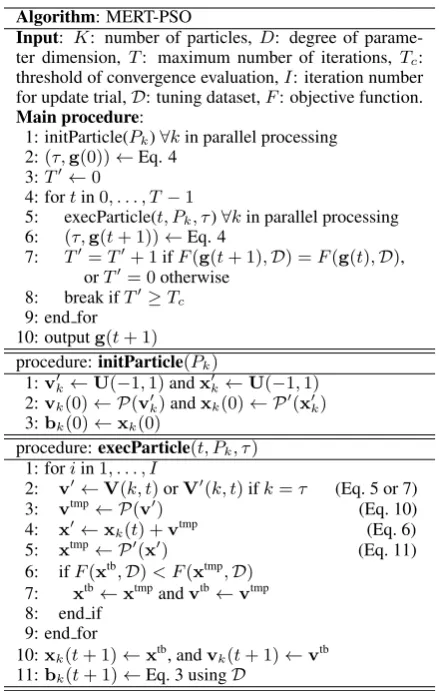
uti-Algorithm: MERT-PSO
Input: K: number of particles,D: degree of
parame-ter dimension, T: maximum number of iterations, Tc:
threshold of convergence evaluation,I: iteration number
for update trial,D: tuning dataset,F: objective function. Main procedure:
1: initParticle(Pk)∀kin parallel processing
2:(τ,g(0))←Eq. 4 3:T0←0
4: fortin0, . . . , T−1
5: execParticle(t, Pk, τ)∀kin parallel processing
6: (τ,g(t+ 1))←Eq. 4
7: T0=T0+ 1ifF(g(t+ 1),D) =F(g(t),D),
orT0= 0otherwise
8: break ifT0≥Tc
9: end for 10: outputg(t+ 1)
procedure:initParticle(Pk)
1:v0k←U(−1,1)andx0k←U(−1,1)
2:vk(0)← P(v0k)andxk(0)← P0(x0k)
3:bk(0)←xk(0)
procedure:execParticle(t, Pk, τ)
1: foriin1, . . . , I
2: v0←V(k, t)orV0(k, t)ifk=τ (Eq. 5 or 7)
3: vtmp← P(v0) (Eq. 10)
4: x0←xk(t) +vtmp (Eq. 6) 5: xtmp← P0(x0) (Eq. 11) 6: ifF(xtb,D)< F(xtmp,D)
7: xtb←xtmpandvtb←vtmp 8: end if
9: end for
10:xk(t+ 1)←xtb, andvk(t+ 1)←vtb
11:bk(t+ 1)←Eq. 3 usingD
Figure 2: MERT-PSO algorithm implemented in the inner loop of MERT.
lize a master-slave architecture for parallelization. We simply allocate one particle to one slave node (or processor), and the master node manages the global best position and the convergence test.
4.1 Extensions
This section describes our four proposed exten-sions for PSO that make it possible to fit PSO to parameter tuning for SMT systems.
The value of each dimension of every velocity is usually clamped to the range[−vmax, vmax]to avoid having too large an absolute velocity and thus realizing better convergence. Here, we intro-duce another procedure that can also avoid having velocities that are too large. Our proposed proce-dure is well-known as a ‘norm projection’ in the discriminative machine learning community, i.e., (Shalev-Shwartz et al., 2007), which can be de-fined as follows:
P(v) = min
{
1, β
||v||p
}
v, (10)
whereβ represents the radius ofLp-norm ball. In
our experiments, we setβ = 1andp = 1. We project the velocity vector into the Lp-norm ball
immediately after we update the velocities. Next, in a similar manner to Equation 10, we also project the current positions for all particles ‘onto’ Lp-norm ball after updating. We use the
following function:
P0(x) = 1
||x||px, (11)
Suppose x0 = P(x), then note that eˆ(f,x) and ˆ
e(f,x0) for any f can be identical. This is
be-cause we assume the translation models used in our method to be the linear model described by Equation 1. This assumption guarantees that any system translationeˆgiven by Equation 1 is never
changed as a result of this position projection. This fact implies that we can find the solution onto an Lp-norm ball with a fixed radius. Thus, this
projection may lead to faster convergence since it enables us to reduce the search space of PSO.
Third, for each iteration, we update the veloc-ity and position of each particle to those with the best objective value among I trials, in our
case I = 10. Let the right-hand side of
Equa-tions 5 and 7 beV(k, t)andV0(τ, t), respectively,
that isV(k, t) =ξ(t)vk(t) +c1U(0,1)(bk(t)−
xk(t)) +c2U(0,1)(g(t)−xk(t)), andV0(τ, t) = −xτ(t) +g(t) +ξ(t)vτ(t) +ρ(t)U(−1,1). Both
V(k, t) andV0(τ, t) have randomness
character-ized byU. Therefore, we select the best position
and velocity inI random trials as the position and
velocity oft+ 1intiterations. This extension re-duces the number of inefficient searches (and also the communication cost between particles). Thus, this may also lead to a faster tuning process.
Finally, we slightly modify the update scheme ofρ explained in Equation 8 to simplify the
pro-cess as follows:
ρ(t+1) =
{
0.5ρ(t) if F(g(t)) =F(g(t−1))
1.0 otherwise .
To summarize our method, Figure 2 shows its overall algorithm.
4.2 Implementations
weights weights
Decoder results …. Tuning dataset
processor.1
decoder decoder decoder
processor.2 processor.K
particle.1 particle.2 Particle.K processor.1 processor.2 …. processor.K MERT-PSO
Decoder results Tuning dataset
decoder processor.1
MERT processor.1
Decoder results …. Tuning dataset
processor.1
decoder decoder decoder
processor.2 processor.K
MERT MERT MERT
processor.1 processor.2 …. processor.K (merge) A partitioned tuning dataset
Decoder results of a partitioned tuning dataset
Select weight set that gives the maximum BLUE on tuning dataset
Moses-MERT (original: single processor) Moses-MERT (parallel: processors=K) MERT-PSO (processors=K)
weights weights
final weights
final weights
final weights
weights
Figure 3: Outline process images (a) Moses-MERT (original), (b) Moses-MERT (our parallel version), and (c) MERT-PSO
NIST-08 WMT-10
Source lang. Chinese German
Target lang. English English # of sent. in tuning dataset (S) 2679 2524
# of reference per sent. (Q) 4 1
# of dimensions (D) 8 14
# ofN-best per sent. (N) 100 100 Table 1: Details of data used in our experiments.
of Moses MERT. The source code was written in C++ with boost:::MPI libraries for parallelization. Moreover, we also substituted the code we de-veloped for the outer loop code to run a decoder in parallel to work on a large number of computa-tional resources such as cluster PCs. This is sim-ply accomplished by separating the tuning dataset, and then each computational resource executes the decoder independently to decode part of the parti-tioned dataset.
Additionally, in our experiments, we also im-plemented a parallel version of Moses-MERT as a competitor for comparison with our method. In this case, we independently performed the inner-loop algorithm of the original Moses-MERT in many computers with randomly selected initial weights. After completing all the Moses-MERT procedures, we selected a weight set that provided the best BLED-score.
Outline process images for three different im-plementations are shown in Figure 3.
5 Experiments
In our experiments, we evaluated the effective-ness of the proposed MERT-PSO in terms of both performance and runtime by comparison with a MERT package in Moses (Moses-MERT), and our parallel extended version of Moses (Moses-MERT parallel). All three algorithms use the Moses
de-coder (Koehn et al., 2007) to select the best trans-lation given a source sentence (Equation 1).
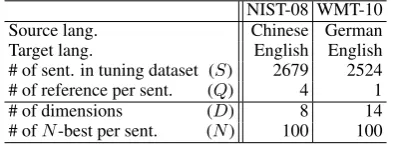
We conducted our experiments on NIST-08 and WMT-10 datasets. Table 1 summarizes the data statistics used in our experiments. Note that the tuning datasets are formed from NIST-04 and NIST-05 test data for NIST-08, and WMT-09 test data for WMT-10. For both tasks, we train phrase tables from the provided training data using the standard GIZA++ pipeline and train language models using SRILM. The feature set consists of the standard 5 translation model probabilities, 1 language model probability, 1 distortion feature and 1 word penalty feature for 8 features, and an additional 6 reordering models for 14 features.
6 Results and Discussion
6.1 Evaluations for overall tuning process
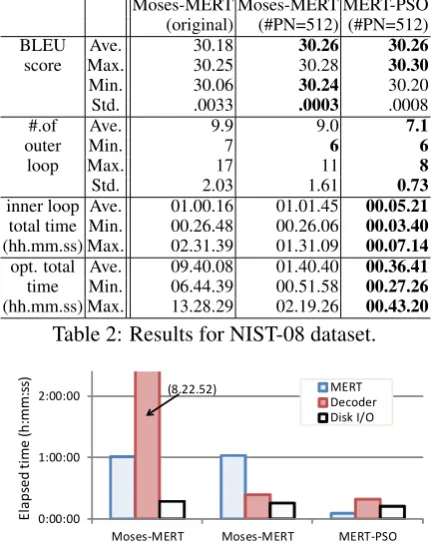
Tables 2, and 3 show the results of our exper-iments comparing the parameter tuning qualities of the original Moses-MERT, Moses-MERT (par-allel) and MERT-PSO. All the experiments were performed ten times using different random seeds for each trial. We assumed the number of avail-able computational resources, which we refer to as ‘#PN’, to be 512 in these experiments. In the tables, Ave, Max., Min., and Std. represent the average, maximum, minimum and standard devia-tion of ten trials, respectively.
Clearly, MERT-PSO greatly reduced the total runtime compared with the original Moses-MERT. Although MERT-PSO used a lot more computa-tional resources than the original Moses-MERT, the original Moses-MERT can never achieve the tuning speed of MERT-PSO.1 Additionally, we
Moses-MERT Moses-MERT MERT-PSO (original) (#PN=512) (#PN=512)
BLEU Ave. 30.18 30.26 30.26
score Max. 30.25 30.28 30.30
Min. 30.06 30.24 30.20
Std. .0033 .0003 .0008
#.of Ave. 9.9 9.0 7.1
outer Min. 7 6 6
loop Max. 17 11 8
Std. 2.03 1.61 0.73
inner loop Ave. 01.00.16 01.01.45 00.05.21
total time Min. 00.26.48 00.26.06 00.03.40
(hh.mm.ss) Max. 02.31.39 01.31.09 00.07.14
opt. total Ave. 09.40.08 01.40.40 00.36.41
time Min. 06.44.39 00.51.58 00.27.26
(hh.mm.ss) Max. 13.28.29 02.19.26 00.43.20
Table 2: Results for NIST-08 dataset.
0:00:00
Figure 4: Detailed rates of parameter tuning pro-cess (inner loop), decoding (outer loop), and disk I/O times in total runtimes for NIST-08 dataset.
can find the tendency that the standard deviations of the BLEU-scores for MERT-PSO are relatively small. This implies that MERT-PSO has the power to produce a robust solution. This property is im-portant for stochastic optimization algorithms.
The results of our developed parallel Moses-MERT are largely similar to those obtained by MERT-PSO in terms of BLEU-scores. However, the average runtimes of MERT-PSO are at least three times faster than those of Moses-MERT (par-allel). These observations may be interesting; PSO searches almost randomly for the model com-ponent weights during the parameter tuning pro-cess, but it can still find good weights sufficiently quickly. The faster runtime of MERT-PSO is also explained by this simple randomized update pro-cedure of PSO in contrast to KCD used in Moses-MERT, which tries to find the optimal coordinate by using an iterative line search.
Another interesting finding is that MERT-PSO tends to reduce the number of outer loops. This can be a good characteristic for the current MERT framework since decoding (outer loop) is usually expensive.
own developed system that is not implemented in the orig-inal Moses open source software.
Moses-MERT Moses-MERT MERT-PSO (original) (#PN=512) (#PN=512)
BLEU Ave. 20.17 20.21 20.23
score Max. 20.21 20.24 20.26
Min. 20.06 20.13 20.19
Std. .0552 .0331 .0245
#.of Ave. 13.0 12.5 7.4
outer Min. 10 10 5
loop Max. 17 16 9
Std. 2.06 1.80 1.20
inner loop Ave. 03.40.22 03.18.43 00.09.09
total time Min. 02.02.11 02.12.57 00.04.11
(hh.mm.ss) Max. 05.55.01 05.14.53 00.13.23
opt. total Ave. 25.40.38 07.14.40 02.07.12
time Min. 20.08.22 05.20.47 01.15.40
(hh.mm.ss) Max. 37.51.22 10.04.13 02.23.24
Table 3: Results for WMT-10 dataset.
Figure 4 summarizes the parameter tuning pro-cess (inner loop), decoding (outer loop), and disk I/O times for each method for NIST-08 dataset. Most SMT researchers would agree that the most of the MERT runtime is spent on decoding (outer loop). As shown in this figure, this is basically true for Moses-MERT (original) when the tun-ing dataset is large. However, with the parallel method, it appears not always to be true. For example, the dominant process of Moses-MERT (parallel) is parameter tuning process (inner loop). Thus, developing a faster parameter tuning algo-rithms is still meaningful.
6.2 Evaluations for inner loop process
This section evaluates the compared methods in terms of single inner loop process. To allow fair comparisons, all the methods are evaluated using the sameN-best lists, even though running
multi-ple iterations of MERT would normally produce different N-best lists. To perform this
experi-ment, we first constructed models using the origi-nal Moses. Then, we utilized the generated inter-mediate files for the experiments described in this section.
6.2.1 Effect of parallelization
29.6
Figure 5: Runtimes and BLEU-score of changing parallelization number in a single inner loop pro-cess for NIST-08 dataset (vertical line at each bar represents Std.).
Note that larger #PN provided better BLEU-score but slower runtime in Moses-MERT. This is because Moses-MERT (parallel) runs the orig-inal MERT processes individually on every pro-cessors. Thus, the runtime of Moses-MERT de-pends on the slowest MERT process for all MERT processes. Instead, it can select the weights that provide the best BLEU score among all the results of the MERT processes. This is the reason of this observation.
6.2.2 Robustness againstSandN
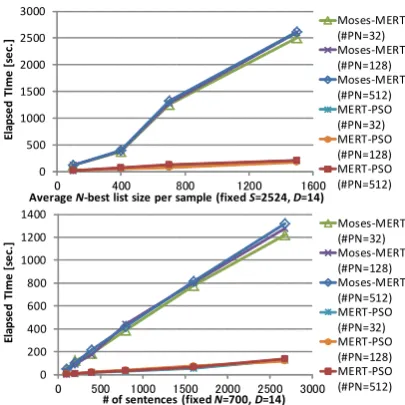
Figure 6 shows the runtimes against the average number of N-best lists in a single inner loop,
where the number of sentences in a tuning set is fixed, and runtimes against the sentences in a sin-gle inner loop, where the average number of N
-best list is fixed.
We can find MERT-PSO has an almost linear relation in both figures in the same way as Moses-MERT. These figures also clarified that MERT-PSO is very robust as regards increasing the num-ber of sentences and the averageN-best list size
per sentence.
6.3 Test data performance
Table 4 shows the average BLEU-scores provided by ten models of Moses-MERT and MERT-PSO with 512 parallel processing for the test data. We
0
0 400 800 1200 1600
Moses-MERT
0 500 1000 1500 2000 2500 3000
Moses-MERT
Figure 6: Runtimes vs. averageN-best list size
per sentence (top), and number of sentences in tun-ing dataset (bottom) in a stun-ingle inner loop process for WMT-10 dataset.
Moses-MERT MERT-PSO (#PN=512) (#PN=512) NIST-08 (Ch-En) Ave. 21.32 21.40
WMT-10 (Ge-En) Ave. 21.25 21.22 Table 4: Results for test data comparing Moses-MERT (parallel: #PN=512) and Moses-MERT-PSO (#PN=512).
confirmed that the translation qualities of MERT-PSO for unseen sentences are nearly the same level as those of Moses-MERT in terms of BLEU-score. This empirical evidence encourage us to use MERT-PSO as a replacement of Moses-MERT: MERT-PSO can provide the same quality level models as those provided by Moses-MERT with much faster runtime.
7 Conclusion
References
Nicola Bertoldi, Barry Haddow, and Jean-Baptiste Fouet. 2009. Improved Minimum Error Rate Train-ing in Moses.Prague Bulletin of Mathematical Lin-guistics, No. 91:7–16.
Daniel Cer, Dan Jurafsky, and Christopher D. Manning. 2008. Regularization and search for minimum er-ror rate training. InProceedings of the Third Work-shop on Statistical Machine Translation, pages 26– 34, Columbus, Ohio, June. Association for Compu-tational Linguistics.
George Foster and Roland Kuhn. 2009. Stabilizing minimum error rate training. InProceedings of the Fourth Workshop on Statistical Machine Transla-tion, pages 242–249, Athens, Greece, March. As-sociation for Computational Linguistics.
James F. Kennedy and Russell C. Eberhart. 1995. Particle Swarm Optimization. In Proceedings of IEEE International Conference on Neural Networks, pages 1942–1948.
Philipp Koehn, Hieu Hoang, Alexandra Birch, Chris Callison-Burch, Marcello Federico, Nicola Bertoldi, Brooke Cowan, Wade Shen, Christine Moran, Richard Zens, Chris Dyer, Ondrej Bojar, Alexan-dra Constantin, and Evan Herbst. 2007. Moses: Open source toolkit for statistical machine transla-tion. InProceedings of the 45th Annual Meeting of the Association for Computational Linguistics Com-panion Volume Proceedings of the Demo and Poster Sessions, pages 177–180, Prague, Czech Republic, June. Association for Computational Linguistics.
Wolfgang Macherey, Franz Och, Ignacio Thayer, and Jakob Uszkoreit. 2008. Lattice-based minimum er-ror rate training for statistical machine translation. In Proceedings of the 2008 Conference on Empiri-cal Methods in Natural Language Processing, pages 725–734, Honolulu, Hawaii, October. Association for Computational Linguistics.
Robert C. Moore and Chris Quirk. 2008. Random restarts in minimum error rate training for statistical machine translation. InProceedings of the 22nd In-ternational Conference on Computational Linguis-tics (Coling 2008), pages 585–592, Manchester, UK, August. Coling 2008 Organizing Committee.
Franz Josef Och. 2003. Minimum error rate training in statistical machine translation. InProceedings of the 41st Annual Meeting of the Association for Com-putational Linguistics, pages 160–167.
Kishore Papineni, Salim Roukos, Todd Ward, and Wei-Jing Zhu. 2002. Bleu: a method for automatic eval-uation of machine translation. In Research Report RC22176, IBM Research Division, Thomas J. Wat-son Research Center, pages 311–318.
Shai Shalev-Shwartz, Yoram Singer, and Nathan Sre-bro. 2007. Pegasos: Primal Estimated sub-GrAdient SOlver for SVM. In Proceedings of
the Twenty-Fourth International Conference on Ma-chine Learning, pages 807–814.