Scholarship@Western
Scholarship@Western
Electronic Thesis and Dissertation Repository
8-15-2018 10:00 AM
The Light Triad Scale: Developing and Validating a Preliminary
The Light Triad Scale: Developing and Validating a Preliminary
Measure of Prosocial Orientation
Measure of Prosocial Orientation
Laura K.D. Johnson
The University of Western Ontario
Supervisor
Saklofske, Donald H.
The University of Western Ontario Graduate Program in Psychology
A thesis submitted in partial fulfillment of the requirements for the degree in Master of Science © Laura K.D. Johnson 2018
Follow this and additional works at: https://ir.lib.uwo.ca/etd
Part of the Personality and Social Contexts Commons
Recommended Citation Recommended Citation
Johnson, Laura K.D., "The Light Triad Scale: Developing and Validating a Preliminary Measure of Prosocial Orientation" (2018). Electronic Thesis and Dissertation Repository. 5515.
https://ir.lib.uwo.ca/etd/5515
This Dissertation/Thesis is brought to you for free and open access by Scholarship@Western. It has been accepted for inclusion in Electronic Thesis and Dissertation Repository by an authorized administrator of
Most research on prosocial behaviour focuses on situational factors rather than individual differences. Empathy, compassion, and altruism are three constructs related to prosocial behaviour that also overlap theoretically. However, prosocial traits are rarely studied together, and measures of prosocial orientation are lacking. To address this gap, the Light Triad Scale (Light-3) was developed to assess individual differences in prosocial orientation. Three subscales with 12 items each, assessing empathy, compassion, and altruism, were created using existing measures of each construct. Items were selected according to theory and literature. The Light-3 was then administered to a sample of undergraduate psychology students at Western University (N = 451). To assess construct validity, participants also completed the Short Dark Triad (SD3; Jones & Paulhus, 2014), the Assessment of Sadistic Personality (ASP; Plouffe, Saklofske, & Smith, 2017), the Managing the Emotions of Others Scale – Very Short Form (MEOS-VSF; Austin, Saklofske, & Smith, Under Review), the Trait Emotional Intelligence Questionnaire – Short Form (TEIQue-SF; Petrides & Furnham, 2004), the Honesty-Humility scale of the HEXACO Personality Inventory (Lee & Ashton, 2004), and the Big Five Inventory – 10 Item scale (BFI-10; Rammstedt & John, 2007). First, the undiminensionality of each subscale was confirmed using exploratory factor analysis, and items with poor loadings were deleted. The sample was originally split for exploratory and confirmatory purposes; however, because good model fit could not be obtained in the second half of the sample regardless of the model attempted, the full sample was used for further analyses. Using Exploratory Structural Equation Modelling and Jackson’s Differential Reliability Index, items were deleted that loaded onto other subscales, had substantial negative loadings on other subscales, or had loadings greater than one. A final confirmatory factor analysis was conducted using the reduced 24-item Light-3. After three modifications, model fit was acceptable. Ultimately, the hypothesized hierarchical model with a higher-order Prosocial Orientation factor and three lower-higher-order factors (Empathy, Compassion, Altruism) was supported. Overall, as a preliminary measure of prosocial orientation, the Light-3 demonstrates adequate factor structure and good support for the construct. Future studies should further refine the scale by writing items that specifically target and confirm the factor structure identified in the current study.
Empathy, Compassion, Sympathy, Altruism, Helping, Prosocial behaviour, Scale development, Factor analysis
A warm thank you to my supervisor, Don Saklofske, for your support during my thesis. You helped me refine my maelstrom of ideas into a manageable Masters project. Your constant support during the entire process kept me going, especially when I became very sick in January 2018. I would also like to thank Paul Tremblay for his valuable advice regarding statistical analyses and Mplus troubleshooting, as well as Julie Schermer and Claire Crooks for their suggestions and thought-provoking discussion on prosocial behaviour and traits.
Of course, a huge thank you is owed to my family, whose unconditional love and
encouragement is very much cherished. Thanks for introducing me to psychology, Mom!
Finally, I would like to thank some of my friends in the department for their unwavering support: Anjana Balakrishnan, James Boylan, Hiten Dave, and Alex McGregor. You have definitely demonstrated overwhelming amounts of compassion when I needed it, and also encouraged me to take breaks and set aside “me time.” Live long and prosper.
Abstract...i
Table of Contents...iv
List of Tables...vi
List of Figures...vii
List of Appendices...viii
1. Introduction and Literature Review...1
1.2 Individual Differences in Prosocial Traits...3
1.3 Empathy-Altruism Hypothesis...3
1.4 Empathy...4
1.5 Compassion...8
1.6 Altruism...10
1.7 The Assessment of Prosocial Personality...13
1.8 Rationale and Study Hypotheses...14
2. Method...17
2.1 Participants...17
2.2 Construction of the Light Triad Scale...17
2.3 Additional Materials...20
2.4 Procedure...21
3. Results...22
3.1 Missing Data...22
3.2 Unidimensionality of Individual Subscales...22
3.3 Item-Level Analyses and Initial Deletion of Items...25
3.4 Item Analysis and Scale Refinement Using CFA...26
3.5 Testing the Model using CFA in Sample 2...27
3.7 Differential Reliability Index (DRI) in Sample 1...29
3.8 CFA with Refined Subscales in Samples 1 and 2...29
3.9 Examining Other Possible Models using EFA...30
3.10 ESEM and DRI in the Full Sample...32
3.11 Construct Validity for the Light-3 and its Subscales...33
4. Discussion...36
4.1 General Discussion...36
4.2 Limitations and Future Directions...39
4.3 Implications...42
References...44
Appendices...50
Curriculum Vitae...55
Table 1: Demographic information of the sample...17
Table 2: Factor loadings for the 12-item Empathy subscale...22
Table 3: Factor loadings for the 12-item Compassion subscale...23
Table 4: Factor loadings for the 12-item Altruism subscale...24
Table 5: Item properties for the original 36-item Light-3 scale...25
Table 6: Model fit of the CFA – Sample 1...27
Table 7: Model fit of the CFA – Sample 2...27
Table 8: Model fit of the CFA – 24 items (full sample)...32
Table 9: Descriptive statistics and bivariate correlations – 24-item Light-3 Scale...33
Table 10: Total scores of Light-3 and subscales for men and women...53
Table 11: Bivariate correlations for men and women...53
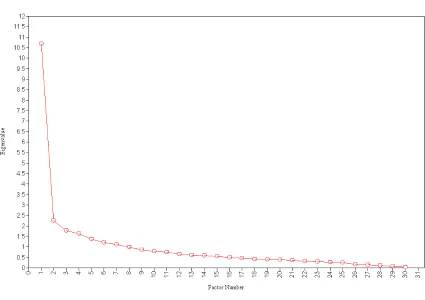
Figure 1: Scree plot of the EFA of the Light Triad Scale (Sample 1)...31
Appendix A: Original 36-item Light Triad Scale...49
Appendix B: Ethics Approval ...51
Appendix C: Final 24-item Light Triad Scale ...52
Appendix D: Correlations and scale means for men and women...53
Chapter 1
Introduction and Literature Review
1.1 Introduction
Across societies and religions, there often exists a “golden rule” of social behaviour: treat others how you wish to be treated.Prosocial behaviour refers to a wide range of
voluntary actions that benefit others or society, regardless of motive (Graziano &
Eisenberg, 1997; Staub, 1978). In addition to situational factors, research in this area has also linked personality traits to prosocial behaviours, such as donating money or
volunteering to assist others in need (Habashi, Graziano, & Hoover, 2016). Specifically, individuals high in prosocial traits are other-oriented, in contrast to those high in
antisocial personality traits, who are self-focused (Staub, 2003). To explain prosocial behaviour, Batson (1991) proposed the empathy-altruism hypothesis, which links perspective-taking, emotional responding, empathic concern (i.e. compassion), and altruism. According to the empathy-altruism hypothesis, individuals who experience empathy and feel compassion for others are more likely to engage in altruistic behaviour, even at a cost to themselves.
Self-Report Altruism Scale (SRA; Rushton, Chrisjohn, & Fekken, 1981) focuses heavily on the frequency of specific past helping behaviours, rather than general altruistic tendencies and attitudes. Furthermore, several of its items are culture-specific, limiting the utility of the measure. The Helping Attitude Scale (HAS; Nickell, 1998) has been employed as a proxy measure for altruism in studies of prosocial behaviour; however, while both helping and altruism are prosocial behaviours, not all helping is altruistically motivated. Some items on the HAS indicate helping that could be motivated by external rewards (e.g. social status) or by the avoidance of punishment (reducing or preventing guilt).
To date, there have been few attempts to unify empathy, compassion, and altruism under the umbrella of “prosocial personality” or “prosocial orientation.” Penner’s (2002) Prosocial Personality Battery (PSB) reflects a two-factor structure of prosocial
thoughts/feelings and helpfulness (i.e. past helping behaviour). However, this definition of prosocial behaviour focuses on volunteerism to the exclusion of other types of helping. It is also unclear how empathy, compassion, and altruism are incorporated within this scale. As such, there is a gap in the literature in studying and measuring prosocial traits.
To address this gap, the goal of the present study was to develop a self-report
1.2 Individual Differences in Prosocial Traits
Despite decades of research on prosocial emotions, motivations, and behaviour, there is an absence of research on measuring individual differences in prosocial orientation. With the exception of empathy, which has benefited from considerable research as both an individual difference and a capacity, compassion and altruism remain studied
predominantly as emotions or behaviours, respectively. It is also unclear whether these traits, although semantically distinct, differ significantly on a psychometric level. However, theoretical perspectives on empathy, compassion, and altruism suggest that they are distinct both conceptually and empirically.
1.3 Empathy-Altruism Hypothesis
To unify empathy and altruism, Batson (1991) proposed the empathy-altruism hypothesis, which states that empathic concern for others motivates altruistic behaviour. Baton’s use of altruism refers to a motivational state in which an individual seeks to improve the welfare of another person, in contrast to egotistic motivation, in which an individual seeks to improve their own welfare. As such, the empathy-altruism hypothesis provides a framework for how prosocial emotions can produce prosocial behaviour.
The first component of the empathy-altruism hypothesis is empathic concern. Although numerous definitions of empathy exist, Batson (2011) defines empathic concern as an “other-oriented emotion elicited by and congruent with the perceived welfare of someone in need” (pp. 11). Because empathic concern is “other-oriented,” the focus is on other people’s well-being, rather than on one’s own. That is, one feels for the other. This contrasts with personal distress, in which one also reacts emotionally to another’s emotions or needs, but with the self-focused goal of reducing one’s own emotional arousal, which is perceived as unpleasant (Batson, 2011). By describing empathic concern as being “congruent” with another’s emotion, Batson refers to emotions of the same valence as the others’ state, but not necessarily matching. For example,
also includes elements of compassion (e.g. concern for an individual in need) in addition to congruent emotional reactivity.
The second component of the empathy-altruism hypothesis is psychological altruism. Batson (2011) defines altruism as “a motivational state with the ultimate goal of increasing another’s welfare” (pp. 20). That is, altruism is the goal itself, rather than a means to achieving a different goal (i.e. obtaining rewards like social status, or avoiding punishments like guilt). Although altruistic behaviour may result in experiencing positive emotions, Batson (2011) argues that this is not mutually exclusive or in conflict with the ultimate goal of altruistic behaviour being to benefit another. It is the goal (or
motivation), not the consequences, of a behaviour that determines if it is altruistic or not. Similarly, a behaviour is not altruistic if the ultimate goal is a social reward (e.g.
improvement in self-esteem) or to avoid a punishment (e.g. negative emotions from witnessing another in distress). Batson (2011) also distinguishes altruism from the broader behaviour of helping, which only focuses on the outside, not motivation.
The final component of Batson’s (1991) empathy-altruism hypothesis is that empathic concern causes altruistic motivation. More specifically, seeing others in need generates a congruent emotional reaction in the self, which then leads to the goal of improving the welfare of the individual in need. The empathy-altruism hypothesis has found support in a number of studies and experiments (e.g. Batson et al., 1988; Batson et al., 1989; Schroeder, Dovidio, Sibicky, Matthews, & Allen, 1988). Although Batson’s (1991) use of altruism is as a goal-oriented motivation, rather than a disposition, the empathy-altruism hypothesis provides a conceptual and theoretical link for empathy, compassion, and altruism as belonging together under a broader prosocial “umbrella.”
1.4 Empathy
Empathy has been studied in a variety of subdomains of psychology, including
identifying what constitutes empathy remains a challenge. Some researchers describe empathy as a process by which one understands and reacts to emotional stimuli in other people (e.g. Bird & Viding, 2014, Feshbach, 1975). Others portray empathy as an innate ability or disposition (e.g. Hogan, 1969; Mehrabian & Epstein, 1972; Davis, 1983). Of the prosocial traits, empathy has received considerable attention in the personality literature, leading to the development of several self-report measures. As a personality trait, empathy refers to individual differences in these tendencies to respond empathically.
Despite these varying definitions, researchers seem to agree that, at a minimum, empathy includes both cognitive and affective components. This distinction between cognitive and emotional or affective components of empathy has been endorsed by many other authors (e.g. Baron-Cohen & Wheelwright, 2004; Davis, 1996, Decety & Jackson, 2006; Jolliffe & Farrington, 2006; Lawrence, Shaw, Baker, Baron-Cohen, & David, 2004; Preston & de Waal, 2002; Rankin, Kramer, & Miller, 2005). Under the label of “affective empathy,” empathy refers to emotional contagion (i.e. experiencing or reacting to the emotions of another individual). Under the label “cognitive empathy,” empathy refers to the ability to recognize and understand others’ emotions (Joliffe & Farrington, 2006). Some
researchers also incorporate perspective-taking, the ability to understand another’s point of view, into the definition of cognitive empathy (e.g. Feshbach, 1975).
1.4.1 Empathy versus compassion. Empathy and compassion are distinct; however, this difference is not always reflected in discussions of these constructs or in self-report measures. For example, the IRI (Davis, 1983) has a subscale labelled Empathic Concern. However, items such as “I am often quite touched by things that I see happen” measure compassionate feelings, rather than empathic responding. Additionally, Baron-Cohen and Wheelwright (2004) define compassion as a specific form of affective empathy involving a desire to reduce another person’s distress. Likewise, Rankin et al. (2005) incorporate feelings of concern at others’ distress into their conceptualization of affective empathy and include helping others in distress as part of empathic responding.
concern for others or tender-heartedness, which are more indicative of compassion than empathy, and in defining emotional empathy, compassion is often included. As will be elaborated on in Section 1.5, concern for others in distress and the desire to reduce the suffering of others are both components of compassion, not empathy. While empathy involves sharing emotions (affective) or understanding emotions (cognitive), compassion involves concern for the welfare of the individual in question (Joliffe & Farrington, 2006). That is, compassion goes beyond emotional contagion to motivate individuals to help others (Davis, 1996). Eisenberg and Miller (1987) also distinguish between empathy and compassion, acknowledging that while both have an emotional component, empathy involves vicariously experiencing an emotion and compassion involves concern.
1.4.2 Affective Empathy. When describing empathy, many researchers focus on its affective components. As Baron-Cohen and Wheelwright (2004) point out, definitions of affective empathy, while similar, differ primarily in terms of how broad or narrow they are. For example, researchers have defined [affective] empathy as a “vicarious affective response” (Feshbach, 1975, p. 27), an “affective reaction to the perceived emotions of another” (Joliffe & Farrington, 2006), an “affective state that stems from the
apprehension of another’s emotional state or condition, and that is congruent with it” (Eisenberg & Miller, 1987, p. 91), a “vicarious emotional response to the perceived emotional experiences of others” (Mehrabian & Epstein, 1972, pp. 523), the “ability to be sensitive to and vicariously experience the feelings of others” (Reniers, Corcoran, Drake, Shryane, & Völlm, 2011, pp. 85), and an “affective response more appropriate to
another’s situation than one’s own” (Hoffman, 2000, pp. 93). Specifically, these
definitions focus on reacting to or vicariously experiencing the emotional states of other people, known as emotional contagion.
negative emotion in another (e.g. distress) is a negative emotion in oneself (e.g. sadness) (Eisenberg, Shea, Carlo, & Knight, 1991). Thus, while distress and sadness are not identical emotions, they are both negative emotional states. As such, individuals high on emotional contagion resonate strongly with others’ emotional states, whereas those low on emotional contagion are largely unaffected.
1.4.3 Cognitive Empathy. Cognitive empathy is frequently described as “knowing what others are feeling” (Vachon & Lynam, 2016, pp. 136). As discussed previously, some authors incorporate perspective-taking when defining cognitive empathy, describing the use of visual, auditory, or situational cues to facilitate emotion understanding (e.g. Rankin et al., 2005). Although conceptually similar to Theory of Mind, cognitive empathy focuses on recognition and understanding of emotion, rather than specific cognitions (Reniers et al., 2011). Thus, it contains two components: recognizing emotional states and understanding emotional states.
1.4.4 Early empathy scales. Early scales include the Hogan Empathy Scale (HES; Hogan, 1969) and the Questionnaire Measure of Emotional Empathy (QMEE; Mehrabian & Epstein, 1972). These two scales are predominantly measures of cognitive or
emotional empathy, respectively (Joliffe & Farrington, 2006; Spreng, McKinnon, Mar, & Levine, 2009). The QMEE has been criticized for conflating empathy and compassion, which is a common pitfall in empathy research, and being a measure of emotional sensitivity rather than emotional empathy (Joliffe & Farrington, 2006; Spreng et al., 2009).
2004). More recent scales attempt to incorporate both cognitive and affective elements when developing items, including the Basic Empathy Scale (BES; Joliffe & Farrington, 2006), the Toronto Empathy Questionnaire (TEQ; Spreng et al., 2009), the Questionnaire of Cognitive and Affective Empathy (QCAE; Reniers et al., 2011), and the Affective and Cognitive Measure of Empathy (ACME; Vachon & Lynam, 2016).
1.5 Compassion
As a personality trait, compassion (sympathy) is the capacity to feel warmth and other-oriented concern for those in distress and to be motivated to reduce that distress, such as through reassurance (Lazarus, 1991; Singer & Klimecki, 2014). In studying compassion, researchers describe this construct as being multifaceted, which is reflected both in definitions of compassion and more explicitly in models of compassion. Kanov et al. (2004) argue for three facets of compassion: noticing, feeling, and responding.
Additionally, Pommier (2010) identifies three major elements of compassion: kindness (concern for others’ suffering vs. criticism and indifference), mindfulness (detection of suffering without being overwhelmed by it), and common humanity (suffering happens to everyone). More recently, Strauss et al. (2016) identify five elements of compassion: recognizing suffering, distress tolerance, concern for others who suffer (emotional resonance), the desire to reduce others’ suffering, and understanding that human suffering is universal. While researchers argue for different numbers of components of compassion, there is considerable overlap in the elements described, and each conceptualization includes cognitive, affective, and behavioural components.
1.5.1 Recognizing suffering. Kanov et al. (2004) argue for “noticing” as a component of compassion. Specifically, compassionate individuals recognize when others are in
distress, either through cognitive or affective channels (Strauss et al., 2016). Similarly, Batson (1987, 1991) proposed that one antecedent to experiencing compassion is perceiving that another is in need, which has been supported by research conducted by Batson, Eklund, Chermok, Hoyt and Ortiz (2007).
(Strauss et al., 2016). Without this capacity, individuals can be overwhelmed by others’ negative emotions and be motivated to reduce their own emotional arousal rather than help the other who is suffering, an emotional state that Davis (1983) labels “personal distress.”
1.5.3 Concern for others who suffer. According to Kanov et al. (2004)’s three-faceted conceptualization of compassion, empathic concern maps onto the “feeling” facet. Similarly, valuing the welfare of others is one antecedent of compassion (Batson et al., 2007). Caring and kindness for others lies in opposition to being indifferent to or critical of others in need (Neff, 2003b; Pommier, 2010).
1.5.4 Desire to reduce others’ suffering. In addition to feeling concern for those in need, compassionate individuals are also motivated to reduce the suffering of that individual (Goetz, Keltner, & Simon-Thomas, 2010; Lazarus, 1991; Strauss et al., 2016). This motivation to act maps onto Kanov et al. (2004)’s “responding” facet of compassion.
1.6 Altruism
Altruism is a type of prosocial behaviour in which one helps another individual in need, potentially at great cost to oneself, but without any expectation of reward, whether social or material. As a trait, altruism refers to a general orientation to engaging in behaviours that ultimately benefit others (Rushton et al., 1981). Behaviours that help others but have egotistic motives, such as obtaining social status, are prosocial but not altruistic (Batson, 2011).
The concept of altruism has been around for centuries; however, despite substantial research examining prosocial behaviour, helping, and altruism, there is a lack of
consensus on what altruism is. Researchers disagree on whether humans are even capable of true altruism, or if there is always a self-serving motive behind “altruistic” behaviour, such as avoiding punishment (e.g. guilt for not helping) or obtaining reward (e.g.
commendation). Furthermore, conceptualizations of altruism differ depending on the discipline, such as evolutionary altruism and psychological altruism. Evolutionary biologists focus on altruism as increasing reproductive fitness either through acting altruistically toward one’s relatives (kin altruism) or with the expectation that the favour will be returned in kind (reciprocal altruism) (Sober & Wilson, 1998; Trivers, 1971). Additionally, evolutionary altruism emphasizes self-sacrifice, rather than more modest helping behaviours. The ultimate goal, then, is to maximize reproductive fitness through successfully passing on one’s genes to the next generation.
The other view, psychological altruism, emphasizes an ulterior goal of improving
another’s welfare, rather than more general helping behaviour (Batson, 1991; 2011; Sober & Wilson, 1998). This conceptualization of altruism focuses on intention behind
prosocial behaviour, rather than the outcome of that behaviour. Unlike the definition of evolutionary altruism, self-sacrifice is possible, but a willingness to self-sacrifice is not required for an act to be considered altruistic. Furthermore, two versions of psychological altruism have been proposed: strong altruism and weak altruism (Davis, 1996).
internal punishments (e.g. guilt/shame). What matters for weak altruism is the absence of external rewards, such as status or praise, and external punishments, such as being shamed.
1.6.1 Trait altruism. Although altruism research has predominantly focused on
behaviour, some researchers have argued for research on altruism as a personality trait. In developing the SRA, Rushton et al. (1981) argue that altruistic tendencies can be stable across situations and use the SRA to demonstrate that some people are generally more caring, helpful, and generous than others. Similarly, Staub (1974) reported relationships between helping behaviour, social responsibility and having helpful values.
Altruism has been measured by a few questionnaires developed in the late twentieth century. Altruistic tendencies, as measured by the SRA, reflect the frequency of performing less costly altruistic acts (such as giving directions), more costly altruistic acts (e.g. helping a friend move), and willingness to donate (e.g. time, blood, clothes). The SRA is positively related with scales measuring emotional empathy, nurturance, social responsibility and morality (Rushton et al., 1981). Another measure, the Helping Orientation Questionnaire (HOQ; Romer, Gruder, & Lizzardo, 1986), distinguishes between two types of helpers: altruistic helpers and receptive givers. Altruistic helpers will help with no expectation of reward, whereas receptive givers help but are more likely to do so if they expect compensation. Additionally, altruistic helpers are more likely to help a researcher in need, regardless of compensation, and spend more time volunteering than selfish individuals (Romer et al., 1986). Finally, though designed to measure helping tendencies, rather than altruistic tendencies, the Helping Attitude Scale (HAS; Nickell, 1998) has used to measure altruism in absence of better measures. Like the HOQ, scores on the HAS are positively correlated with social responsibility (Nickell, 1998).
Veldhuizen (2012) define warm glow as positive feelings (e.g. enjoyment) and boost in self-image resulting from altruistic behaviour (e.g. blood donation). Their definition of warm glow also incorporates positive reinforcement by others’ approval and avoidance of negative emotions, such as guilt. However, altruistic individuals should be intrinsically motivated, rather than driven by the desire for compensation or the fear of punishment.
While Ferguson, Farrel, and Lawrence (2008) claim that warm glow is part of benevolence, rather than altruism, Staub (2003) argues otherwise: “[T]rue altruists, people who really care about others’ welfare, get the most meaning and satisfaction out of helping. Such people don’t act to make themselves feel good. The satisfaction they experience is due to the improved welfare of the ‘other’ they have helped” (p.149). Ferguson, Taylor, Keatley, Flynn, and Lawrence (2012) label the combination of warm glow and principle of care as “impure altruism,” as there are benefits for the helper as well as the recipient. However, this assumes that people help in order to obtain warm glow, rather than warm glow being an inadvertent consequence of altruistic behaviour. What Ferguson et al., (2012b) label “pure altruism” is altruistic behaviour at cost to oneself, but with no benefits. Similarly, what Ferguson et al. (2008) label “benevolence” (helping with benefit to the self; c.f. receptive givers by Romer et al., 1986) and
“altruism” (i.e. helping without benefit to the self) are strongly positively correlated (r = .52). Warm glow has been reported as a key component of donating for experienced blood donors, but not novice or first-time blood donors (Ferguson et al., 2012a). However, Ferguson et al. (2012b) do agree with Staub (2003) that personal benefit (i.e. from warm glow) does not detract from the virtue of an altruistic act. As such, based on previous research, experiencing warm glow is a key component of altruistic tendencies.
individuals focus on improving others’ well-being and the well-being of society above their own well-being, as well as valuing the importance of helping others in general. In a study investigating giving to those in need, Bekkers and Ottoni-Wilhelm (2016) reported that principle of care predicted charitable giving, but also that it mediated the relationship between empathic concern and charitable giving. Thus, this second component of
altruism reflects individual values toward helping others: that helping is the right thing to do in general, rather than helping out of pity or guilt.
1.7 The Assessment of Prosocial Personality
The study of prosocial behaviour investigates “behaviours that benefit others” (Staub, 1978, pp. 2). Although prosocial behaviour is influenced by situational factors, it has been suggested that individual differences in prosocial attitudes and tendencies also exist. Indeed, the concept of a “prosocial personality” is not new. Oliner and Oliner (1988) and Rushton et al. (1981) both describe an altruistic personality. As previously described, three traits in particular—empathy, compassion, and altruism—are strongly related. For example, compassion (sympathy) has been labelled a reactive outcome of empathy (Davis, 1996), and altruism as being motivated by empathy (Hoffman, 1978). Empathy, which involves both emotional and cognitive components, has received considerable attention as both a personality trait and an ability. However, individual differences in compassion (also called sympathy) and altruistic tendencies are less researched.
Additionally, there is little empirical research investigating the extent to which empathy, compassion, and altruism overlap.
Factor structures between researchers differ in regards to a prosocial orientation
In light of the limitations of existing scales and the absence of research on individual differences in prosocial orientation more broadly, the purpose of the current study was to develop a preliminary measure of prosocial personality that comprised three facets: empathy, compassion, and altruism. Theory and previous literature suggests that these traits strongly overlap and should be studied in tandem. Additionally, interest in antisocial personality traits, such as the Dark Triad (i.e. narcissism, Machiavellianism, psychopathy; Paulhus & Williams, 2002), has led to the creation of novel personality scales (e.g. Short Dark Triad (SD3); Jones & Paulhus, 2014) and a burgeoning body of research on these traits. However, there is a paucity of measures for prosocial personality traits. While empathy has received considerable attention in the literature as a trait, compassion and altruism have not. Given this, an instrument is required to measure prosocial tendencies quickly but also comprehensively.
1.8 Rationale and Study Hypotheses
Currently, the literature on prosocial traits is convoluted. While empathy and compassion are widely studied as both traits and emotions, conceptualizations of these traits vary between researchers. Furthermore, measures of empathy often include items that reflect compassion, and likewise for compassion with empathy. Conversely, altruism has
received little attention at the trait level. While Rushton et al. (1981) developed the SRA, this measure only assesses frequency of past altruistic behaviours, such as helping push a stranger’s car out of snow. These items are quite specific and do not reflect all the
elements of an altruistic personality. The present study will clarify the relationships between various prosocial personality traits through the development of a unified scale that includes content from three widely recognized prosocial constructs: empathy, compassion, and altruism. Ultimately, this scale will be useful for future research on prosocial personality and clarify to what extent empathy, compassion, and altruism overlap.
(2013) reported a non-significant relationship. Likewise, the Empathic Concern subscale of the IRI, which has been argued to be a measure of compassion (e.g. Joliffe &
Farrington, 2006), demonstrated significant negative correlations with Machiavellianism psychopathy, and narcissism (e.g. Giammarco & Vernon, 2014); however, Jonason and Kroll (2015) reported a non-significant correlation between Empathic Concern and narcissism. Though the literature has not investigated sadism’s relationship with empathy or compassion, it was hypothesized that it would follow the same pattern of correlations. Likewise, while trait altruism and the Dark Tetrad have not been investigated, given the self-focused nature of the Dark Tetrad traits, trait altruism should be low. Negative relationships were also hypothesized between the Light-3 and the antisocial subscales of the MEOS-VSF (Worsen, Inauthentic). These associations were hypothesized because manipulating others’ emotions in ways that makes them feel worse is malevolent, rather than benevolent.
Additionally, other traits should be positively related to the Light Triad traits. Low Honesty-Humility is associated with deceptive behaviour and psychopathy, which runs in direct contrast to the facets of the Light-3 scale, whereas high Honesty-Humility score is positively associated with both empathy and altruism (Romero, Villar, & López-Romero, 2015). Finally, positive relationships were expected between the Light-3 traits and Agreeableness and Conscientiousness, based on positive correlations reported in previous studies (e.g. Melchers et al., 2016).
A summary of the study’s hypotheses are as follows:
Hypothesis 1: A model with a higher-order Prosocial Orientation factor with three lower-order factors representing Empathy, Compassion, and Altruism will be found.
Hypothesis 3: The Light-3 scale and its subscales will be negatively correlated with Machiavellianism, psychopathy, narcissism, sadism, and the Worsen and Inauthentic subscales of the MEOS-VSF.
Hypothesis 4: The Light-3 scale and its subscales will be positively correlated with Agreeableness and Conscientiousness, as measured by the 10-Item Big Five Inventory (BFI-10; Rammstedt & John, 2007)
Chapter 2
Method
2.1 Participants
A sample of 499 undergraduate students was recruited from the Psychology Participant Pool at Western University, Ontario. Prior to analyses, participant data was screened for careless, incomplete, or abnormal responding. Data from 31 participants who failed two or more of the validity checks (e.g. Failing to answer “Strongly Agree” when the question asked them to) or who responded carelessly were removed. Seventeen responses were also removed for excessive missing data (i.e. only completing the demographic questionnaire). In total, 48 cases were deleted, resulting in a final sample of 451 participants.
2.1.1Splitting of the dataset. Study 1 used half of the dataset, consisting of 225
randomly selected cases. Study 2 used the remaining 226 cases. The demographics of the overall sample, as well as each of the subsets, is presented in Table 1. One anomaly noted was the high rate of missing responses for age in the sample (N = 106), occurring in 23.5% of the dataset.
Table 1: Demographic information of the sample
N (Male, Female) Mage (SD) Age Range Study 1 225 (57 male, 167 female, 1 missing) 19.32 (2.10) 17 - 34 Study 2 226 (60 male, 166 female) 19.12 (1.81) 17 - 27 Entire Sample 451 (117 male, 333 female, 1 missing) 19.23 (1.97) 17 - 34
Note. For calculating mean and standard deviation for age, the number of cases were as follows: Study 1, N = 183, Study 2, N = 162, Entire sample, N = 345.
2.2 Construction of the Light Triad Scale
The subscales for the Light-3 were derived from three themes observed in the prosocial literature: empathy (cognitive, affective), compassion (empathic concern, sympathy), and altruism. The initial item pool for the Light-3 was compiled based on theoretical
review. Each construct was defined, highlighting the key elements of each one. To develop the initial item pool, I relied on existing self-report measures of these constructs and selected items that reflected components of each construct. In the following sections, I describe my steps in greater depth.
2.2.1 Selection and definition of the constructs to assess. After consulting the literature on prosocial behaviour, I selected the three constructs that emerged the most and
identified key components that comprised each. As such, three subscales were created: Empathy, Compassion, and Altruism. For a more detailed explanation of each trait and their components, refer to Sections 1.4, 1.5 and 1.6 of the literature review.
2.2.1.1 Empathy. For empathy, which has been widely studied both as a capacity and a personality trait, identifying key elements was straightforward. I examined a combination of theory and existing measures to identify characteristics that were shared across
definitions and conceptualizations of empathy, incorporating both cognitive and affective empathy.
2.2.1.2 Compassion. For compassion, elements of the trait had to be disentangled from empathy. Compassion and empathy share terms often used synonymously in everyday language (i.e. sympathy) and in the academic literature (i.e. empathic concern). As such, studies that used “empathic concern” (i.e. the Empathic Concern subscale of the IRI (Davis, 1983)) or looked at “sympathy” were also considered when defining compassion. The CS (Pommier, 2010) and theories of compassion that incorporate Eastern
conceptualizations of this construct were also consulted.
2.2.1.3 Altruism. For altruism, modern trait measures and theories about trait altruism are largely absent. The current existing measure, the SRA (Rushton et al., 1981), focuses exclusively on specific past altruistic behaviours, but also contains items that are
2.2.2 Developing the item pool. Items for the initial item pool were derived from
existing measures of the traits where possible. This made for a potential pool of 142 items (91 for empathy, 31 for compassion, 20 for altruism).
2.2.2.1 Empathy. Items for the Empathy subscale were derived from four existing measures of cognitive or affective empathy: the BES (Joliffe & Farrington, 2006), the TEQ (Spreng et al., 2009), the QCAE (Reniers et al., 2011), and the Cognitive Empathy and Affective Resonance subscales of ACME (Vachon & Lynam, 2016).
2.2.2.2 Compassion. Items for the Compassion subscale were derived from three scales: the CS (Pommier, 2010), the Empathic Concern subscale of the IRI (Davis, 1983), and the Personal Distress Scale of the IRI (Davis, 1983).
2.2.2.3 Altruism. Items for the Altruism subscale were derived from the HAS (Nickell, 1998), which has been used as a proxy measure for altruism in previous research (e.g. Lemmens et al., 2009). The SRA (Rushton et al., 1981) was not used, for reasons described in Section 1.8.
2.2.3 Selection of items. After assembling the initial pool of items, items were sorted according to the key components of each trait. Items that did not fit any of the categories or seemed to measure other constructs were removed from the pool. Once categorized, items were examined for repetitiveness, and duplicate items (or items with very similar wording) were removed. Additionally, after consultation with my supervisor, this item pool was further reduced into three 12-item subscales.
2.2.4 Initial item pool. The final measure had a total of 36 items divided evenly between empathy, compassion, and altruism. For the Empathy subscale, this meant approximately six items per component (cognitive empathy: perspective-taking/emotion recognition; affective empathy: emotional contagion). For the Compassion subscale, this resulted in two to four items per component (desire to reduce suffering, distress tolerance, concern for others who suffer, universality of human suffering). The fifth component, recognizing suffering, was not represented, as it was already part of the “emotion recognition”
per component (warm glow, principle of care). After selecting the items, the original Light-3 was ready for use in the data collection stage. Items were scored on a 5-point Likert scale (1 = Strongly Disagree, 5 = Strongly Agree).
2.3 Additional Materials
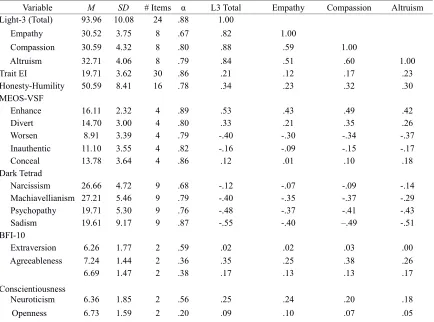
Other personality measures were administered to participants to assess construct validity of the Light-3. Descriptions of these scales are listed below. Scale properties, along with bivariate correlations with the Light-3 and its subscales, are displayed in Table 9.
2.3.1 Short Dark Triad (SD3; Jones & Paulhus, 2014). The SD3 is a self-report measure of Machiavellianism, narcissism, and psychopathy, known collectively as the Dark Triad. Each subscale contains nine items that were measured on a 5-point Likert Scale (1 = Strongly Disagree, 5 = Strongly Agree).
2.3.2 Assessment of Sadistic Personality (ASP; Plouffe, Saklofske, & Smith, 2017). The ASP is a nine-item self-report measure of everyday sadism. Items were scored on a 7-point Likert scale (1 = Strongly Disagree, 7 = Strongly Agree).
2.3.3 Trait Emotional Intelligence Questionnaire - Short Form (TEIQue-SF, Petrides & Furnham, 2004). The TEIQue-SF is a 30-item version of the original TEIQue, a self-report measure of trait EI. It has four factors: Well-Being (6 items), Self-Control (6 items), Emotionality (8 items) and Sociability (6 items), along with five items that are not part of any factor. Items were scored on a 7-point Likert scale (1 = Completely Disagree, 7 = Completely Agree).
2.3.5 Honesty-Humility subscale of the HEXACO Personality Inventory - Revised (HEXACO-PI-R; Lee & Ashton, 2004). The Honesty-Humility subscale of the HEXACO-PI-R measures an individual’s sincerity, fairness, greed avoidance, and modesty. It contains 16 items measured on a 5-point Likert scale (1 = Strongly Disagree, 5 = Strongly Agree).
2.3.6 Big Five Inventory - 10 (BFI-10; Rammstedt & John, 2007). The BFI-10 is a very brief measure of the Big Five traits (Extraversion, Agreeableness,
Conscientiousness, Neuroticism, Openness to Experience) with two items per trait. Items consist of adjectives on which the participant rates themselves on a 5-point Likert scale (1 = Strongly Disagree, 5 = Strongly Agree).
2.4 Procedure
Chapter 3
Results
3.1 Missing Data
Missing data was handled in Mplus 7.4 using Maximum Likelihood (ML) estimation. For analyses conducted using SPSS, pairwise deletion was used.
3.2 Unidimensionality of Individual Subscales
Exploratory factor analysis (EFA) was conducted separately on each subscale (Empathy, Compassion, Altruism) using ML estimation and Promax rotation to confirm the
unidimensionality of each subscale. To evaluate the factor structure of each subscale, the Eigenvalues, scree plot, and factor loadings were considered. Problematic items were flagged for deletion during item-level analyses.
3.2.1 Empathy. Although four factors had Eigenvalues greater than 1.00, an inspection of the scree plot suggested either a one- or two-factor solution (first factor = 3.467, second factor = 1.568). However, an examination of the factor loadings suggested a one-factor solution was superior. In the two-factor solution, only two items loaded above .35 on the second factor; in the one-factor solution, all items loaded above .35. This supports the undimensionality of the Empathy subscale. The loadings for the unrotated one-factor solution are presented in Table 2.
Table 2: Factor loadings for the 12-item Empathy subscale
Item Factor Loading
1. It is hard for me to see why some things upset people so much. (R) .394
2. When someone is feeling ‘down’ I can usually understand how they
feel. .415
3. I find it easy to put myself in somebody else’s shoes. .394
4. I have a hard time reading people’s emotion. (R) .414
5. I can tell when others are sad even when they do not say anything. .525
6. I can usually tell how people are feeling. .501
7. People I am with have a strong influence on my mood. .434
9. Other people’s feelings don’t bother me at all. (R) .577
10. I am happy when I am with a cheerful group and sad when the others
are glum. .359
11. I get very upset when I see someone cry. .537
12. I remain unaffected when someone close to me is happy. (R) .441
Eigenvalue 3.467
Note. EFA (n = 225). EFA with maximum likelihood estimations and Promax rotation. Loadings >.35 are bold-faced.
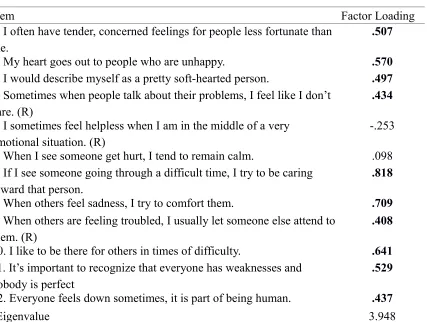
3.2.2 Compassion. Four factors demonstrated Eigenvalues greater than 1.00; however, the scree plot supported a one-factor solution (Eigenvalue = 3.948). With the exception of two problematic items (items 5 and 6), all items loaded above .35 on the unrotated first factor. As such, these low-loading items were flagged for deletion. Otherwise,
unidimensionality of the Compassion subscale was supported. The loadings for the unrotated one-factor are presented in Table 3.
Table 3: Factor loadings for the 12-item Compassion subscale
Item Factor Loading
1. I often have tender, concerned feelings for people less fortunate than me.
.507
2. My heart goes out to people who are unhappy. .570
3. I would describe myself as a pretty soft-hearted person. .497
4. Sometimes when people talk about their problems, I feel like I don’t care. (R)
.434
5. I sometimes feel helpless when I am in the middle of a very emotional situation. (R)
-.253
6. When I see someone get hurt, I tend to remain calm. .098 7. If I see someone going through a difficult time, I try to be caring
toward that person.
.818
8. When others feel sadness, I try to comfort them. .709
9. When others are feeling troubled, I usually let someone else attend to them. (R)
.408
10. I like to be there for others in times of difficulty. .641
11. It’s important to recognize that everyone has weaknesses and nobody is perfect
.529
12. Everyone feels down sometimes, it is part of being human. .437
Eigenvalue 3.948
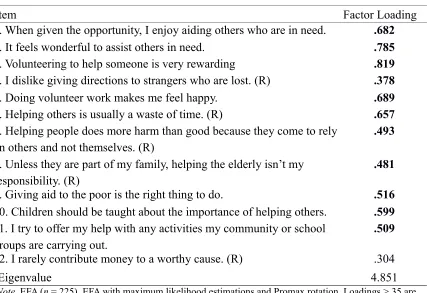
3.2.3 Altruism. Two factors had Eigenvalues above 1.00 (4.851 and 1.055 respectively); however, the scree plot strongly supported a one-factor solution. Because the second factor strongly correlated with the first factor (r = .694), the one-factor solution was ultimately favoured. With the exception of Item 12 (loading = .30), all items loaded greater than .35 on the unrotated first factor. Otherwise, the unidimensionality of the Altruism subscale was supported. The loadings for the unrotated one-factor solution are presented in Table 4.
Table 4: Factor loadings for the 12-item Altruism subscale
Item Factor Loading
1. When given the opportunity, I enjoy aiding others who are in need. .682
2. It feels wonderful to assist others in need. .785
3. Volunteering to help someone is very rewarding .819
4. I dislike giving directions to strangers who are lost. (R) .378
5. Doing volunteer work makes me feel happy. .689
6. Helping others is usually a waste of time. (R) .657
7. Helping people does more harm than good because they come to rely on others and not themselves. (R)
.493
8. Unless they are part of my family, helping the elderly isn’t my responsibility. (R)
.481
9. Giving aid to the poor is the right thing to do. .516
10. Children should be taught about the importance of helping others. .599
11. I try to offer my help with any activities my community or school groups are carrying out.
.509
12. I rarely contribute money to a worthy cause. (R) .304
Eigenvalue 4.851
Note. EFA (n = 225). EFA with maximum likelihood estimations and Promax rotation. Loadings >.35 are bold-faced.
3.3
Item-Level Analyses and Initial Deletion of Items
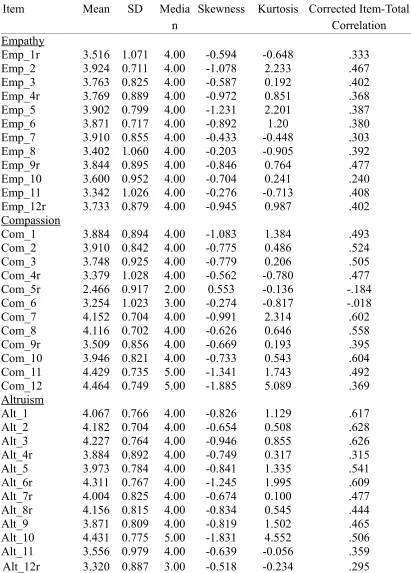
Table 5: Item properties for the original 36-item Light-3 scale
Item Mean SD Media
n
Skewness Kurtosis Corrected Item-Total Correlation Empathy
Emp_1r 3.516 1.071 4.00 -0.594 -0.648 .333
Emp_2 3.924 0.711 4.00 -1.078 2.233 .467
Emp_3 3.763 0.825 4.00 -0.587 0.192 .402
Emp_4r 3.769 0.889 4.00 -0.972 0.851 .368
Emp_5 3.902 0.799 4.00 -1.231 2.201 .387
Emp_6 3.871 0.717 4.00 -0.892 1.20 .380
Emp_7 3.910 0.855 4.00 -0.433 -0.448 .303
Emp_8 3.402 1.060 4.00 -0.203 -0.905 .392
Emp_9r 3.844 0.895 4.00 -0.846 0.764 .477
Emp_10 3.600 0.952 4.00 -0.704 0.241 .240
Emp_11 3.342 1.026 4.00 -0.276 -0.713 .408
Emp_12r 3.733 0.879 4.00 -0.945 0.987 .402
Compassion
Com_1 3.884 0.894 4.00 -1.083 1.384 .493
Com_2 3.910 0.842 4.00 -0.775 0.486 .524
Com_3 3.748 0.925 4.00 -0.779 0.206 .505
Com_4r 3.379 1.028 4.00 -0.562 -0.780 .477
Com_5r 2.466 0.917 2.00 0.553 -0.136 -.184
Com_6 3.254 1.023 3.00 -0.274 -0.817 -.018
Com_7 4.152 0.704 4.00 -0.991 2.314 .602
Com_8 4.116 0.702 4.00 -0.626 0.646 .558
Com_9r 3.509 0.856 4.00 -0.669 0.193 .395
Com_10 3.946 0.821 4.00 -0.733 0.543 .604
Com_11 4.429 0.735 5.00 -1.341 1.743 .492
Com_12 4.464 0.749 5.00 -1.885 5.089 .369
Altruism
Alt_1 4.067 0.766 4.00 -0.826 1.129 .617
Alt_2 4.182 0.704 4.00 -0.654 0.508 .628
Alt_3 4.227 0.764 4.00 -0.946 0.855 .626
Alt_4r 3.884 0.892 4.00 -0.749 0.317 .315
Alt_5 3.973 0.784 4.00 -0.841 1.335 .541
Alt_6r 4.311 0.767 4.00 -1.245 1.995 .609
Alt_7r 4.004 0.825 4.00 -0.674 0.100 .477
Alt_8r 4.156 0.815 4.00 -0.834 0.545 .444
Alt_9 3.871 0.809 4.00 -0.819 1.502 .465
Alt_10 4.431 0.775 5.00 -1.831 4.552 .506
Alt_11 3.556 0.979 4.00 -0.639 -0.056 .359
Alt_12r 3.320 0.887 3.00 -0.518 -0.234 .295
After considering the item properties and factor loadings, four items were deleted. Compassion items 5 (“I sometimes feel helpless when I am in the middle of a very emotional situation” and 6 (“When I see someone get hurt, I tend to remain calm”), as well as Altruism item 12 (“I rarely contribute money to a worthy cause”), were deleted for poor factor loadings (i.e. loadings <.35) in the EFA for their respective factors (see Tables 3 and 4). Item 10 on the Empathy subscale and Item 12 on the Compassion subscale were deleted at the recommendation of a committee member for poor wording (i.e. multiple items within a single item).
3.4 Item Analysis and Scale Refinement Using CFA
Having confirmed the undimensionality of the subscales, the items were then analyzed collectively using Confirmatory Factor Analysis (CFA) in Mplus 7.4 with weighted least squares estimator with mean and variance adjustment (WLSMV). WLSMV is used when the data are categorical. The items used were scored on a 5-point Likert-type scale, which are ordinal data and are often treated as continuous. However, because the responses to most items were not normally distributed (i.e. negatively skewed, see Table 5), it was more conservative to treat them as categorical.
Table 6: Model fit of the CFA – Sample 1
Model Summary of
modification
χ2(df) RMSEA CFI TLI WRMR
Original N/A 1118.301
(431)
.084
[90% CI: .078 - .090]
.876 .866 1.508
Modification 1 Emp_5 with Emp_6
921.770 (430)
.071
[90% CI: .065 - .078]
.911 .904 1.305
Modification 2 Com_1 with Com_2
893.227 (429)
.069
[90% CI: .063 - .076]
.916 .909 1.276
3.5 Testing the Model using CFA in Sample 2
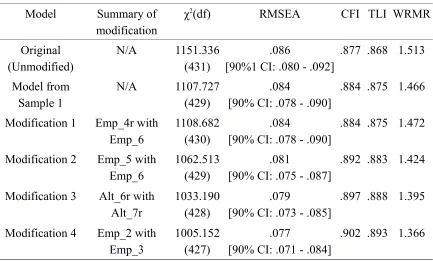
To test the model of the Light-3 identified in Sample 1, a CFA was performed in Mplus 7.4 using WLSMV using Sample 2. However, the model demonstrated poor fit, and even after five modifications, fit indices were only adequate (see Table 7). Additionally, in both Sample 1 and Sample 2, the lower-order Compassion factor loaded greater than one on the hypothesized higher-order Prosocial Orientation factor, suggesting considerable cross-loadings between Compassion and the other factors.
Table 7: Model fit of the CFA – Sample 2
Model Summary of
modification
χ2(df) RMSEA CFI TLI WRMR
Original (Unmodified)
N/A 1151.336
(431)
.086
[90%1 CI: .080 - .092]
.877 .868 1.513
Model from Sample 1
N/A 1107.727
(429)
.084
[90% CI: .078 - .090]
.884 .875 1.466
Modification 1 Emp_4r with Emp_6
1108.682 (430)
.084
[90% CI: .078 - .090]
.884 .875 1.472
Modification 2 Emp_5 with Emp_6
1062.513 (429)
.081
[90% CI: .075 - .087]
.892 .883 1.424
Modification 3 Alt_6r with Alt_7r
1033.190 (428)
.079
[90% CI: .073 - .085]
.897 .888 1.395
Modification 4 Emp_2 with Emp_3
1005.152 (427)
.077
[90% CI: .071 - .084]
Modification 5 Emp_8 with Emp_9r
982.035 (426)
.076
[90% CI: .070 - .082]
.905 .897 1.342
Note. Modifications made are from the original, unmodified model.
3.6 Exploratory Structural Equation Modelling (ESEM) in
Sample 1
Because the modified model in Sample 2 was not parsimonious, and in light of potential cross-loadings, attempts were made to purify item content. Specifically, Sample 1 was revisited using Exploratory Structural Equation Modelling (ESEM) to identify
problematic and high cross-loading items. The advantage of ESEM is that, like with CFA, a hypothesized model can be tested, but unlike with CFA, cross-loadings are not fixed at zero. As such, an ESEM was conducted on Sample 1 with the original hypothesized model, and item loadings and cross-loadings were inspected. Because Empathy item 6 had a loading greater than one on the Empathy factor and a modest but negative cross-loading on the Compassion factor, it was removed. Then the ESEM was re-run. At this stage, Empathy item 8 and Altruism item 5 demonstrated significant negative cross-loadings on other factors. Since all three factors should be positively related, negative cross-loadings are not valid. As such, these two items were systematically removed.
Following this step, the CFA was re-run in Sample 1 to examine whether removing these three items improved model fit. Without any modifications, fit indices were adequate (χ2(347) = 778.347, RMSEA = .074 [90% CI: .067 - .081], CFI = .913). As such, the CFA was re-run in Sample 2. However, model fit in Sample 2 was still poor (χ2(347) =
874.806, RMSEA = .082 [90% CI: .075 - .089], CFI = .900), and model fit did not improve much even after several modifications.
3.7 Differential Reliability Index (DRI) in Sample 1
the desired scale and subtracting the squared correlation the item has with an undesired scale, then taking the square root of that value. This value can be interpreted as an index of content saturation on a desired scale, or the variance remaining after subtracting the variance from another scale.
DRIs for each item were calculated in comparison to the factor it cross-loaded mostly highly on. The lowest DRI was removed. Each time an item was removed, the DRIs were re-calculated, since deleting an item can potentially change the factor saturation of other items. Based on these, the following items were removed (in order): Com_11, Emp_2, Com_2, Emp_3, Alt_9. After this stage, every DRI was above .40 (an arbitrary cutoff).
3.8
CFA with Refined Subscales in Samples 1 and 2
Following this, a CFA was re-run in Sample 1. As with previously CFAs in Sample 1, fit indices were good to adequate (χ2(227) = 496.390, RMSEA = .073 [90% CI: .064 - .081], CFI = .933). Additionally, Compassion no longer loaded above one on the higher-order Prosocial Orientation factor, and all items loaded greater than .40 on their respective factor. As such, the CFA was run again in Sample 2. However, fit indices were poor (χ2(227) = 629.429, RMSEA = .089 [90% CI: .080 - .097], CFI = .904). Furthermore, model fit was worse than the previous CFA run in Sample 2. Despite poor model fit, all items loaded above .35 on their respective factor.
3.9 Examining Other Possible Models using EFA
As previously outlined, several different analyses were conducted in an attempt to resolve model fit issues in Sample 2. However, they were unsuccessful in obtaining a three-factor model that was both parsimonious and had good fit in both samples. As such, EFAs were conducted in Sample 1 with all the items to examine other possible models (excluding Empathy item 6, which was overall problematic, and those removed in Section 3.3). These previously removed items were re-added because they had been removed based on the hypothesized model. Promax rotation was used, as the extracted factors were
3.9.1 One-factor solution. A preliminary examination of the scree plot suggested a large single factor (see Figure 1). The criteria of extracting Eigenvalues greater than one was not used, as this rule is subject to fluctuation and can lead to the over-extraction of factors (Patil, Singh, Mishra, & Donavan, 2008). Instead, parallel analysis was used. The results of the parallel analysis, calculated using an online parallel analysis engine developed by Patil, Singh, Mishra, and Donavan (2007), also suggested extracting one factor.
Furthermore, the one-factor solution had factor loadings greater than .35 on all items. The Eigenvalue of this factor was 10.675. However, a CFA of the one-factor solution
demonstrated poor model fit (χ2(405) = 1098.862, RMSEA = .087 [90% CI: .081 - .093], CFI = .867).
3.9.2 Two-factor solution.A two-factor solution suggested a joint Empathy/Compassion factor and an Altruism factor (Eigenvalues = 10.675, 2.256). Factor loadings were good (> .35), and cross-loadings were low, with the exception of Compassion item 11, which loaded onto Altruism instead of Compassion. While the hierarchical two-factor model did
not converge, the two-factor model with correlated factors demonstrated adequate model fit (χ2(404) = 946.372, RMSEA = .077 [90% CI: .071 - .084], CFI = .896). Model fit improved when Compassion item 11 was moved to the Altruism factor (χ2(404) = 900.413, RMSEA = .074 [90% CI: .067 - .080], CFI = .905). Because a negative cross-loading was suggested for Empathy item 8 with the Altruism subscale, which was not theoretically sound, it was deleted and omitted from future analyses. After this
modification, however, model fit was good (χ2(376) = 822.744, RMSEA = .073 [90% CI: .066 - .079], CFI = .914). However, when this model was run in Sample 2, model fit was poor (χ2(376) = 981.592, RMSEA = .084 [90% CI: .078 - .091], CFI = .892).
3.10 ESEM and DRI in the Full Sample
Given that model fit could not be obtained in Sample 2 regardless of the model tested, it is possible that respondents in Sample 2 responded to certain items differently than respondents in Sample 1, despite the removal of careless responders in the data inspection stage and the randomized selection of cases when dividing the original sample. As such, analyses were re-run using the full sample (N = 451). A combination of using DRIs and ESEM was used to eliminate items until each subscale contained eight items high on content saturation. The ESEM used the original hypothesized model.
The initial ESEM was run to flag problematic items. These items were systematically removed and the ESEM re-run, as the removal of a single item can change loadings. In total, five items were deleted. First, Empathy item 6 was removed for loading greater than one on the Empathy subscale. Then Empathy item 8 was deleted for a moderate negative loading (loading >.20) on the Altruism subscale, and Altruism item 2 and 11 were deleted for moderate negative loadings on the Empathy subscale. Finally,
Compassion item 11 was deleted for loading strongly onto the Altruism scale, rather than the Compassion scale. Then, to evaluate content saturation, DRIs were calculated for the remaining items. Items were deleted until DRIs for each variable exceeded .40, resulting in the removal of Empathy item 11 and Altruism item 1.
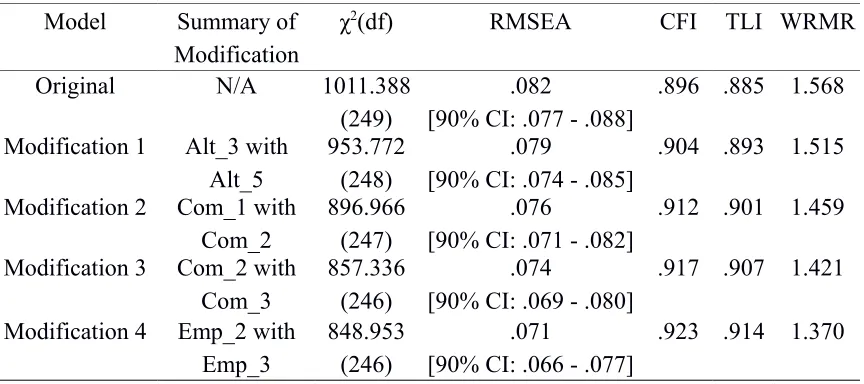
adequate model fit. After allowing correlated residuals, model fit was adequate. Specifically, the residuals of Altruism items 3 and 5 were allowed to correlate because they both had similar wording related to “volunteering” compared to the other Altruism items, which emphasized “helping.” Additionally, the residuals of Compassion items 1 and 2, along with 2 and 3, were permitted to correlate, as they contain elements of tender-heartedness and concern for less fortunate others and may therefore be more similar to each other than the other items. Finally, the residuals of Empathy items 2 and 3 were allowed to correlate. They both involve perspective-taking and emotion understanding elements. After making these modifications to the model, model fit was adequate, and further modifications would not have resulted in large gains to model fit (see Table 8).
Table 8: Model fit of the CFA – 24 items (full sample)
Model Summary of
Modification
χ2(df) RMSEA CFI TLI WRMR
Original N/A 1011.388
(249)
.082
[90% CI: .077 - .088]
.896 .885 1.568
Modification 1 Alt_3 with Alt_5
953.772 (248)
.079
[90% CI: .074 - .085]
.904 .893 1.515
Modification 2 Com_1 with Com_2
896.966 (247)
.076
[90% CI: .071 - .082]
.912 .901 1.459
Modification 3 Com_2 with Com_3
857.336 (246)
.074
[90% CI: .069 - .080]
.917 .907 1.421
Modification 4 Emp_2 with Emp_3
848.953 (246)
.071
[90% CI: .066 - .077]
.923 .914 1.370
3.11 Construct Validity for the Light-3 and its Subscales
Table 9: Descriptive statistics and bivariate correlations – 24-item Light-3 Scale (N = 396 - 451)
Variable M SD # Items α L3 Total Empathy Compassion Altruism Light-3 (Total) 93.96 10.08 24 .88 1.00
Empathy 30.52 3.75 8 .67 .82 1.00
Compassion 30.59 4.32 8 .80 .88 .59 1.00
Altruism 32.71 4.06 8 .79 .84 .51 .60 1.00
Trait EI 19.71 3.62 30 .86 .21 .12 .17 .23
Honesty-Humility 50.59 8.41 16 .78 .34 .23 .32 .30
MEOS-VSF
Enhance 16.11 2.32 4 .89 .53 .43 .49 .42
Divert 14.70 3.00 4 .80 .33 .21 .35 .26
Worsen 8.91 3.39 4 .79 -.40 -.30 -.34 -.37
Inauthentic 11.10 3.55 4 .82 -.16 -.09 -.15 -.17
Conceal 13.78 3.64 4 .86 .12 .01 .10 .18
Dark Tetrad
Narcissism 26.66 4.72 9 .68 -.12 -.07 -.09 -.14 Machiavellianism 27.21 5.46 9 .79 -.40 -.35 -.37 -.29 Psychopathy 19.71 5.30 9 .76 -.48 -.37 -.41 -.43
Sadism 19.61 9.17 9 .87 -.55 -.40 –.49 -.51
BFI-10
Extraversion 6.26 1.77 2 .59 .02 .02 .03 .00
Agreeableness 7.24 1.44 2 .36 .35 .25 .38 .26
Conscientiousness
6.69 1.47 2 .38 .17 .13 .13 .17
Neuroticism 6.36 1.85 2 .56 .25 .24 .20 .18
Openness 6.73 1.59 2 .20 .09 .10 .07 .05
Note. α = Cronbach’s alpha (calculated in SPSS); Enhance, Divert, Worsen, Inauthentic, and Conceal are subscales of the MEOS-VSF (Austin et al., Under Review). Openness = Openness to experience. Correlations above +/- .10 are significant at .05; correlations above +/- .13 are significant at .01; and correlations above +/- .16 are significant at .001.
It was hypothesized that positive relationships would be observed between the Light-3 and Trait EI, Honesty-Humility, Agreeableness, Conscientiousness, and the prosocial ways of managing the emotions of others (Enhance, Divert). It was also hypothesized that negative relationships would be observed between the Light-3 and the Dark Tetrad traits (narcissism, Machiavellianism, psychopathy, sadism), as well as between the Light-3 and the antisocial ways of managing the emotions of others (Worsen, Inauthentic). No
Chapter 4
Discussion
4.1 General Discussion
The primary objective of the current study was to develop and test a preliminary measure of prosocial orientation using items borrowed from empathy, compassion, and altruism measures. The secondary objective was to validate the construct validity of the new scale with a variety of other personality traits. It was hypothesized that a hierarchical three-factor structure would emerge, with the lower-order three-factors representing empathy, compassion, and altruism and the higher-order factor representing prosocial orientation. The original 36-item scale was developed by taking items from previously established scales that best represented components of empathy, compassion, and altruism, as identified in the literature review. Three subscales of 12 items each were generated, and poorly functioning items were deleted after being identified in preliminary analyses, resulting in a reduced pool of 32 items. To test this structure, a combination of techniques (i.e. EFA, ESEM, DRI, and CFA) were used to identify and remove poorly functioning items. While some smaller facets of the subscales were lost during this process, namely the “distress tolerance” and “universality of human suffering” elements of the
Compassion subscale, the larger core elements of the subscales remained intact. A final pool of 24 items, tested using the full sample, was obtained and supported the
hypothesized model.
Except for two components of Compassion, which were lost in the scale refinement stage for having poor psychometric qualities, the components of each subscale were retained. Given that the single item for “recognizing the universality of human suffering”
component loaded onto Altruism instead of Compassion in the ESEM, it is unclear whether the unexpected loading is a result of poor item characteristics, or if it suggests that recognizing that all humans suffer is more closely related to altruistic behaviour, such as the “principle of care” component. Additionally, both “distress tolerance” items had poor loadings on Compassion. Again, it is not clear whether these were poor items, or if distress tolerance is not a component of a unidimensional conceptualizations of
compassion. While Pommier (2010) proposed five dimensions of compassion, including the two aforementioned subscales, Ministero, Poulin, Buffone, and DeLury (2018) recently proposed two broad components of compassionate responding: “desire to help” and “empathic concern,” which map onto the two components of compassion that were retained in the Light-3 Compassion subscale: “desire to reduce suffering” and “concern for others who suffer.”
After finding support for the factor structure of the Light-3, hypotheses regarding its relationships with other traits were tested for purposes of construct validity. Relationships with trait EI, managing the emotions of others, honesty-humility, the Dark Tetrad, and the Big Five traits were examined. Overall, hypothesized relationships were supported.
Small positive correlations were also supported for conscientiousness, which reflects an individual’s tendency to be organized, hard-working, and reliable. While it is not as closely linked to prosocial orientation at face value, previous research has indicated that high conscientiousness is associated with empathic concern (e.g. Chopik, O’Brien, & Konrath, 2017; Mooradian, Davis, & Matzler, 2011), and low conscientiousness is associated with antisocial traits such as the Dark Triad (e.g. Jonason, Kaufman, Webster, & Geher, 2013).
Extraversion and openness to experience demonstrated non-significant relationships with the Light Triad traits, whereas neuroticism demonstrated a positive relationship. This contrasts findings by Taylor, Kluemper, and Mossholder (2010) and Mooradian et al. (2011), who reported significant positive correlations between the Empathic Concern subscale of the IRI (i.e. compassion) and both extraversion and openness to experience, as well as a non-significant correlation between empathic concern and emotional stability/neuroticism. Perhaps the tendency to experience negative emotions (i.e. neuroticism) is related to experiencing concern for others in distress and reacting to others’ negative emotional states. However, given the brevity of the Big Five measures used and the low alpha reliabilities of these measures in the current study, relationships between the Light Triad traits and the Big Five traits should be re-examined in a future study with longer scales.