A Case Study on Optimization of Renewable Energy Sources
for DC Microgrid
Ranjna Gaud
& Durgesh Vishwakarma
1
M Tech. Scholar, EEE Department, REC Bhopal.
2
Assistant Professor, EEE Department, REC Bhopal.
Abstract:
Nowadays Renewable Energy plays a great role in power system around the world. It is a demanding task to integrate the renewable energy resources into the power grid .The integration of the renewable resources use the communication systems as the key technology, which play exceedingly important role in
monitoring, operating, and protecting both
renewable energy generators and power systems. This paper presents about the integration of renewable energy mainly focused on wind and solar to the grid.
Keywords
Microgrid, Optimization, Solar, Wind.
1.
INTRODUCTION
The energy system proposed in this project aims to address issues related to electricity and transportation sectors. One of the potential solutions is a micro-grid that can be vertically integrated with a high-rise building as frequently encountered in urban areas. The harvesting of renewable wind and solar energy occurs at the top of the building. The rooftop generation system connects to the ground level via a micro-grid where electric vehicle (EV) charging stations are supplied, and a battery supports maintaining the balance of supply and demand.
The potential value of an urban integration within buildings as considered here comes from the sources where rooftop energy generation is used, the storage of the latter for offering EV fast charging at the ground level, the co- location and integration of generation, the contribution to emission-free EV transportation in urban areas and load in urban areas, and the grid-friendly integration of the micro-grid with the rest of the power system main grid. The combination of wind and solar energy leads to reduced local storage requirements and it was verified.
The combination of diverse but complementary storage technologies in turn can form multilevel energy storage, where super-capacitor or flywheel provides cache control to compensate for fast power fluctuations and to smoothen the transients encountered by a battery with higher energy capacity. Micro-grids or hybrid energy systems have
been shown to be an effective structure for local interconnection of distributed renewable generation, loads, and storage.
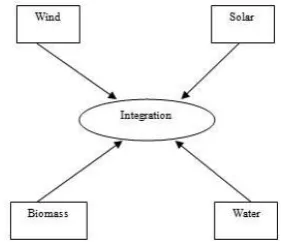
Fig. 1 Renewable energy integration
Research Objectives:
● To optimize the cost and efficiency of microgrid using renewable sources.
● Comparison of hybrid (Wind and solar) with other system.
● Mathematical modelling of an optimization of microgrid and implementation.
● Comparison of results (Modelling and Simulation).
2.
LITERATURE SURVEY
[1]In this paper, author presented the state-of-the-art on stochastic modelling and optimization tools for microgrid planning, operation, and control. The tools can be used to locate the randomness in renewable power generation, the buffering effect of energy storage devices and the mobility of PEVs in V2G systems. Furthermore, the unique features of micro-grid are the dual (islanded and micro-grid-connected) operation modes, the spatial correlation of renewable power generation and the integration of CHP with both heat and electricity outputs, are taken into account.
provide better integration of renewable energy sources due to its internment power supply and it also helps to prepare conventional distribution grids to new smart grid concept.
[3]In this, author told about St. Martin’s Island which is a little Island in the Bay of Bengal about 9 km far from the main land of Bangladesh. Nearly 5000 residents live there and their primary livelihood is fishing and as a tourist spot there are many lodges and rest houses. Since the Island is far away from the conventional national grid connection, is almost unachievable even in future as a result of its geographical location. Locally installed diesel generator is used to provide electricity to inhabitants is established by power development board of Bangladesh but now it is not in working condition. In this paper, an effort has been made to design a model of micro-grid by means of hybrid electricity generation system for a small society of the Island. This system incorporates an arrangement of solar PV, wind turbine, storage battery, biogas and diesel generator. MATLAB is software for optimization of renewable based amalgamative distributed generation systems has been used to find out the predominant technical effective renewable based energy efficient system for 650 family units. To perceive the impact of solar insulation, PV investment cost and wind speed and diesel fuel price on the optimum result the sensitivity analysis is also completed. During peak load the conferential diesel generator is switched on after covering demand by renewable source.
[4] In this paper, for the special case of a dc micro-grid that is vertically integrated within a high-rise host building of an urban area the controls are implemented. Previously untapped wind and solar power are harvested on the roof and sides of a tower, thereby supporting delivery to electric vehicles on the ground. The micro-grid vertically integrates with the host building without creating a large footprint.
[5]In this, the new concept in power generation is micro-grid. The Micro-grid concept assumes array of loads and micro sources operating as a single controllable system which supplies both power and heat to its local area. Some models exist which describe the components of a micro-grid. In this paper, model of micro-grids with steady state and their transient responses to changing inputs are presented. Current models of a wind turbine, fuel cell, micro-turbines and solar cell have been discussed. Finally a complete model built of micro-grid including the power sources, power electronics and a load and mains model in MATLAB/Simulink is presented.
[6]In this Integration of wind and solar within dc microgrids into a so-call net zero-energy buildings is studied. The dc ring microgrid is proposed to include a wind energy conversion system (WECS), a photovoltaic array (PV) and battery energy storage system (BESS). First, an optimized operation strategy in day ahead is presented to utilize maximum clean energy and minimum consumption of electricity from the main grid. Optimal generated power operation of the WECS and PV is run follows on the maximal power point tracking method (MPPT). Second, a coordinated droop scheme is introduced to provide coordination control of BESS and the main AC grid. Several simulations are performed to realize the presented method.
[7] The integration of wind, solar power and flying capacitor with DC micro grids. An aggregated model of renewable wind and solar power generation proposed to support the increases renewable energy sources and equilibrium of the micro grid’s real-time supply and demand, implemented high-rise host building of an urban area. The MPPT controller incorporating an RPM algorithm was developed in consistence with the previous design of the perturbation parameters. The proposed control algorithms based on a VSIC method. This is easy to implement in simple microcontrollers and is fast as compared to normal fixed-step IC and perturb and observe algorithms. The RPM was used to limit the output power of the PV generator if the generation exceeds the system rating due to reduced ambient temperature and high solar radiation. This mode can also be used when there is excessive energy to be stored in a stand-alone system. The proposed algorithm has been validated by simulation and laboratory experiment. It can be seen that the proposed algorithm can prevent oscillation and is able to quickly track the optimal operating point in severe transient conditions with changes of solar radiation and temperature.
[8]In this project the data obtained from the DC micro grid constructed at Xiamen University shows that DC micro grid with rooftop solar system is an efficient way to power varies DC loads inside the building. To ensure the stable bus voltage and continuous operation of the DC micro grid, a suitable energy storage energy unit and two way AC/DC inverters are needed. Therefore we believe to use the solar power only for the matched DC loads, and keep existing AC power in the building to power the rest loads (or an AC and DC hybrid micro grid) maybe a more viable solution.
It highlights some important issues and challenges in the design and energy management of hybrid RE/AE systems. System configurations, generation unit sizing, storage needs, and energy management and control are addressed. Statistics on the current status and future trend of renewable power generation, as well as some critical challenges facing the widespread deployment of RE/AE power generation technologies and vision for future research in this area are also presented.
[10] In this project reports the performance of 4 kW grid connected residential wind photovoltaic system (WPS) with battery storage located in Lowell, MA. The system was originally designed to meet a typical New-England (TNE) load demand with a loss of power supply probability (LPSP) of one day in ten years as recommended by the Utility Company.
3.
PROPOSED WORK
The proposed strategy of operation is mainly determined on using an appropriate energy management and control strategies to enhance the operation of a dc micro-grid, formed by using a photovoltaic (PV) solar energy and wind, batteries, and loads.
Fig.2 Proposed System Flow Chart
This control strategy is used to execute decentralized power management of a PV/battery hybrid unit in a droop-controlled microgrid. To support the integration of wind and solar power within microgrids operational controls are designed. To support the quantification of the operational reserve for day-ahead and real-time scheduling an aggregated model of renewable wind and solar power generation forecast is proposed.
The proposed power/frequency characteristics, of the wind and solar combine unit and of the whole microgrid, adapt autonomously to the microgrid operating conditions so that the this unit may supply the maximum PV power, match the load, and/or charge the battery, while maintaining the power
balance in the microgrid and respecting the battery SOC limits. By comparing with the existing droop controls, it is distinguished in that the droop curves are set as a function of the storage state-of-charge (SOC) and can become asymmetric. The adaptation of the slopes ensures that the power output supports the terminal voltage while at the same keeping the SOC within a target range of desired operational reserve.
4.
WIND POWER INTEGRATIONN
The idea of grid integration connected Wind Turbine Generation Systems have been developed in the last decades to MW size power generation units with advanced control .The power output is not only based on the incoming wind speed but also based on system requirements. In contrast with the past, the WTGS technological developments [1] enable wind farms to be operated according to the Virtual Power Plant (VPP) concept, thus providing necessary support to the primary activities.
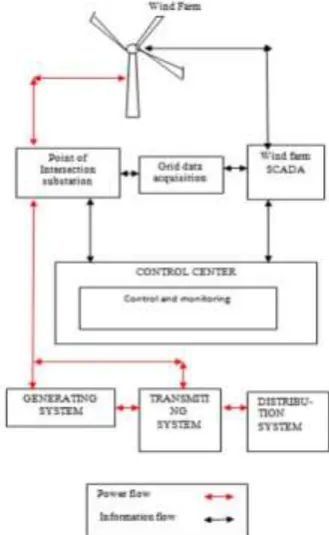
Fig. 3. Grid integration of a wind farm
Communication systems are the basic tool that transmits the measured information and control signals between wind farms and power systems. A Proper communication system can explore the wind potentials and facilitate farm controls, helps in peak load and providing voltage support for power systems. Fig. 3 shows the grid integration of the wind farm. It can be seen that a modern power system is composed of communication networks. Energy flows through the power grid to meet customer demand, while information flows through the communication system to monitor the system status, control the dynamic energy flows presented in the grid, and transfer the information collected from an internet of smart devices for sensing and control across the power grid. From the wind farm the data are given to control center through the SCADA communication where the control, monitoring, operation is done and connected to transmission system.
5.
GRID
CODES
OF
WIND
INTEGRATION
Grid operators, both in transmission and distribution, have developed grid codes for connecting WTGS and the wind turbine manufacturers have responded to these requirements by developing advanced functionalities in the field of WTGS control and electrical system design Essential grid code requirements are discussed below.
A. Frequency control
Several grid codes require the participation of wind farms in primary and secondary frequency control, including frequency response capability and limitation of both ramp rates and active power output. The requirements are expected to become stricter at higher wind power integration levels in order to avoid exceed power gradients of conventional power plants responsible for primary and secondary frequency control. Some operators also require that WTGS should stay connected and in operation at a wider frequency band in order to contribute to frequency restoration and stable power systems operation.
B. Voltage control
The individual WTGS have to control their own terminal voltage to a constant value by means of an automatic voltage regulator, allowing that modern wind farms have capability to control the voltage at the Point of Common Coupling (PCC) to a pre-defined set-point of grid voltage. Expanded reactive power capabilities can bring advantages for system
operators because it offers the possibility of better balancing the reactive power demand.
C. Fault Ride-Through capability
WTGS must remain connected during and after severe grid disturbances, ensuring fast restoration of active power to pre-fault levels as soon as the fault is cleared and inject reactive current in order to support the grid voltage during disturbances and to provide fast voltage recovery after fault clearing.
6.
SOLAR ENERGY INTEGRATION
The first application of photovoltaic power was as a power source for space satellites. Mostly the photovoltaic modules are used for utility-interactive power generation. Grid connected solar systems are typically classified as three categories: residential, commercial, and utility scales. Residential scale is the smallest type of installation and refers to all installations less than 10kW usually found on private properties.
Fig. 4. Three-level monitoring of photovoltaic Power systems
In this technique using integrate communication systems [4] - the photovoltaic panel, voltage, current and temperature of each module was collected and the information is sent to the monitoring interface.
The solar power monitoring [3] can be classified as three categories: system level, string-level, and module-level. Fig. 4 shows the three-level monitoring based on wireless communication systems. The system will monitor the status of solar modules, solar strings, and solar inverters based on the IEEE 802.15.4-2003 ZigBee standard. Either star or mesh topology can be used. With this wireless monitoring capability, each solar module status is visible.
7.
WIND
AND
SOLAR
ENERGY
INTERGRATION
The combination of wind and solar energy leads to reduced local storage requirements. The combination of complementary and multilevel energy storage technologies, where a super capacitor or flywheel provides cache control to compensate for fast power fluctuations and to smoothen the transients encountered by a battery with higher energy capacity.
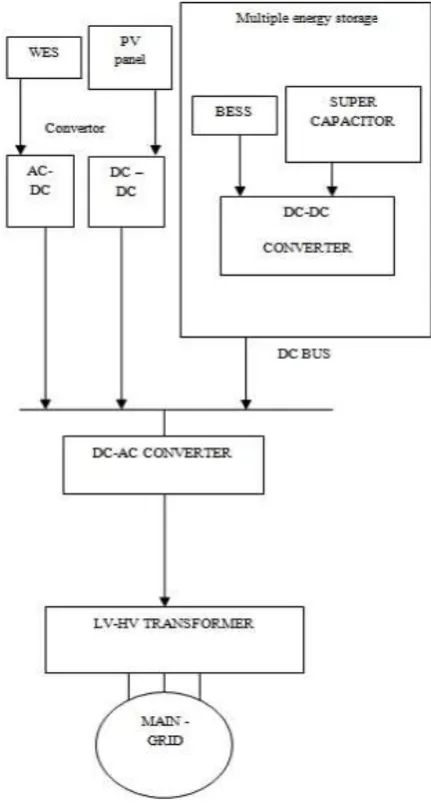
Micro grids or hybrid energy systems have been shown to be an effective structure for local interconnection of distributed renewable generation, loads, and storage. Recent research has considered the optimization of the operation on one hand and the usage of dc to link the resources on the other .A schematic of the dc micro grid with the conventions employed for power is given in Fig. 5.
The dc bus connects wind energy conversion system (WECS), PV panels, multilevel energy storage comprising battery energy storage system (BESS) and super capacitor. The WECS is connected to the dc bus via an ac–dc converter. PV panels are connected to the dc bus via a dc–dc converter. The BESS can be realized through flow battery technology connected to the dc bus via a dc–dc converter. It is connected close to the LV–MV transformer to reduce losses and voltage drop and it is connected to main grid.
8.
ADVANTAGE OF WIND AND SOLAR
– HYBRID SYSTEM
The major advantage of the system is that it meets the basic power requirements of non-electrified remote areas, where grid power has not yet reached. The power generated from both wind and solar components is stored in a battery bank for use whenever required. A hybrid renewable energy
system utilizes two or more energy production methods, usually solar and wind power. The major advantage of solar / wind hybrid system is that when solar and wind power productions are used together, the reliability of the system is enhanced.
Fig. 5. Wind and Solar Integration
option whenever there is a significant improvement in terms of output and performance - which happens when the sun and the wind resources have opposite cycles and intensities during the same day or in some seasons.
9.
GRID CONGESTION
Power grid congestion is a situation where in the existing transmission and/or distribution lines are unable to accommodate all required load during periods of high demand or during emergency load conditions, such as when an adjacent line is taken out of service or damaged by a storm, it also reflects a decrease in efficiency.
Under high load conditions, line losses escalate exponentially. If lines are congested and operating at or near their thermal limits, they would also be exhibiting significant line losses during high load conditions.
There have been cases when wind farms are forced to shut down even when the wind is blowing because there is no capacity available in the lines for the electricity they create. Without adequate transmission to transport power from "renewable" rich areas (like Arizona) to densely populated areas, it is only cost effective to use renewable sources in certain areas of the country. While building new infrastructure would certainly help, smart grid technologies can also help utilities alleviate grid congestion and maximize the potential of our current infrastructure.
Smart grid [2] technologies can help provide real-time readings of the power line, enabling utilities to maximize flow through those lines and help alleviate congestion. As smart grid technologies become more widespread, the electrical grid [5] will be made more efficient, helping reduce issues of congestion. Sensors and controls will help intelligently reroute power to other lines when necessary, accommodating energy from renewable sources, so that power can be transported greater distances, exactly where it's needed. Relieving grid congestion can be achieved in several ways:
● By adding new transmission lines
● By building new electric generating capacity near load centers
● By reducing the demand for electricity in congested areas through greater use of energy efficiency and conservation.
10.
CONCLUSION
Two-way communications are the fundamental infrastructure that enables the accommodation of distributed renewable energy generation. In this paper, we reviewed communication technologies
available for the grid integration of renewable energy resources. The concept of wind and solar integration is been discussed, which gives better output, reduce the losses and provides better monitoring ,control and operation is achieved with help of power electronics devices like converters and also with communication technologies. Distinct characteristics in integration of renewable energy resources pose new challenges to the communication systems, which merit further research.
11.
REFERENCES
[1]. M. A. Mahmud, H. R. Pota, and M. J. Hossain, “Dynamic stability of three-phase grid-connected photovoltaic system using zero dynamic design approach,” IEEE J. Photovoltaics, vol. 2, no. 4, pp. 564–571, Oct. 2012.
[2]. M. A. Mahmud, H. R. Pota, and M. J. Hossain, “Dynamic stability of three-phase grid-connected photovoltaic system using zero dynamic design approach,” IEEE J. Photovoltaics, vol. 2, no. 4, pp. 564–571, Oct. 2012.
[3]. C.-H. Lin, W.-L. Hsieh, C.-S. Chen, C.-T. Hsu, T.-T. Ku, and C.-T. Tsai, “Financial analysis of a large-scale photovoltaic system and its impact on distribution feeders,” IEEE Trans. Ind. Applicat., vol. 47,no. 4, pp. 1884–1891, Jul./Aug. 2011.
[4]. M. Cheng, S. Kato, H. Sumitani, and R. Shimada, “Flywheel-based AC cache power for stand-alone power systems,” IEEJ Trans. Electr. Electron. Eng., vol. 8, no. 3, pp. 290–296, May 2013.
[5]. R. Majumder, B. Chaudhuri, A. Ghosh, R. Majumder, G. Ledwich, and F. Zare, “Improvement of stability and load sharing in an autonomous microgrid using supplementary droop control loop,” IEEE Trans. Power Syst., vol. 25, no. 2, pp. 796–808, May 2010.
[6]. A. Chaouachi, R. M. Kamel, R. Andoulsi, and K. Nagasaka, “Multiobjective intelligent energy management for a microgrid,” IEEE Trans. Ind. Electron., vol. 60, no. 4, pp. 1688–1699, Apr. 2013.