Available Online at www.ijcsmc.com
International Journal of Computer Science and Mobile Computing
A Monthly Journal of Computer Science and Information Technology
ISSN 2320–088X
IMPACT FACTOR: 5.258
IJCSMC, Vol. 5, Issue. 6, June 2016, pg.267 – 273
VIRTUAL MULTI-PATH
COMMUNICATION SYSTEM IN
ADHOC NETWORKS
ANVESH K
1, P JEEVAN KUMAR
21
Department of Information Technology & JNTU Hyderabad, India
2
Department of Information Technology & JNTU Hyderabad, India
1
[email protected], 2 [email protected]
Abstract - A Mobile Ad-Hoc Network (MANET) is a self-configuring network of mobile nodes connected by wireless links to form an arbitrary topology without the use of existing infrastructure. In wireless mobile ad hoc networks (MANETs), packet transmission is impaired by radio link fluctuations. Using the same information, paths can be reused when they become available again, rather than being discarded. In our work, we have proposed how to reduce the overhead on transforming a key between mobile nodes. Another interesting research direction is the formulation of accurate metrics and mechanisms to predict path security, both confidentiality and availability, based on historical information. And also we can construct virtual small world network by adding virtual long links to reduce the chance of a protocol encountering local minima in greedy mode, and thus decrease the chance to invoke inefficient methods. The Improved CA-AOMDV provides better performance than AOMDV.
Index Terms- Mobile Ad Hoc Network, Routing Protocols, Channel Adaptive Routing.
1. INTRODUCTION
A major performance constraint comes from path loss and multipath fading [1]. Many MANET routing protocols exploit multihop paths to route packets. The probability of successful packet transmission on a path is dependent on the reliability of the wireless channel on each hop. Rapid node movements also affect link stability, introducing a large Doppler spread, resulting in rapid channel variations [2].
Some network certification courses distinguish between routing protocols and routed protocols. A routed protocol is used to deliver application traffic. It provides appropriate addressing information in its Internet Layer (Network Layer) addressing to allow a packet to be forwarded from one network to another.
Several channel adaptive schemes that have been developed for MANETs to maintain connection stability can be found in the literature. In [3], [4] channel adaptive schemes are implemented in medium access control (MAC) protocols; [5] considers link stability largely in terms of longevity of a given link, termed “associativity”; a similar idea, with respect to node mobility, is considered in [6] while [7] considers node mobility to improve path reliability, utilizing only the naive transmission range channel model, not taking into account the fading characteristics of the wireless channel; [8] utilizes node-to-node routing, based on the “best” node which received a given transmission. Signal strength as a path selection criterion, is used in [9]; [10] introduces outage probability into both the routing and MAC protocols; [11], [12], [13] utilize the bit transmission rate in the network layer; and [14] employs SNR to support channel adaptive routing.
Figure 1: Association of Nodes Mobility model & Routing protocols performance
Description of Routing Protocol
A routing protocol specifies how routers communicate with each other, disseminating information that enables them to select routes between any two nodes on a computer network. Routing algorithms determine the specific choice of route. Each router has a priori knowledge only of networks attached to it directly. A routing protocol shares this information first among immediate neighbors, and then throughout the network. This way, routers gain knowledge of the topology of the network.
A. Destination-Sequenced Distance-Vector (DSDV)
Destination-Sequenced Distance-Vector Routing protocol is a proactive table driven algorithm based on classic Bellman-Ford routing. In proactive protocols, all nodes learn the network topology before a forward request comes in. In DSDV protocol each node maintains routing information for all known destinations. The nodes periodically send this table to all neighbors to maintain the topology, which adds to the network overhead. Each entry in the routing table is marked with a sequence number assigned by the destination node. The sequence numbers enable the mobile nodes to distinguish stale routes from new ones, thereby avoiding the formation of routing loops [9].
B. Dynamic Source Routing (DSR)
Dynamic Source Routing protocol is a reactive protocol i.e. it determines the proper route only when a packet needs to be forwarded. The node floods the network with a route-request and builds the required route from the responses it receives. DSR allows the network to be completely self-configuring without the need for any existing network infrastructure or administration. The DSR protocol is composed of two main mechanisms that work together to allow the discovery and maintenance of source routes in the ad hoc network. All aspects of protocol operate entirely on-demand allowing routing packet overhead of DSR to scale up automatically.
Route Discovery: When a source node S wishes to send a packet to the destination node D, it obtains a route to
D. This is called Route Discovery. Route Discovery is used only when S attempts to send a packet to D and has no information on a route to D.
Route Maintenance: When there is a change in the network topology, the existing routes can no longer be used. In such a scenario, the source S can use an alternative route to the destination D, if it knows one, or invoke Route Discovery. This is called Route Maintenance [10] [11].
Mobility Models
Different mobility models can be differentiated according to their spatial and temporal dependencies.
Spatial dependency: It is a measure of how two nodes are dependent in their motion. If two nodes are moving in same direction then they have high spatial dependency.
Temporal dependency:It is a measure of how current velocity (magnitude and direction) are related to previous velocity. Nodes having same velocity have high temporal dependency.
Given below are the descriptions of four mobility models with detailed explanation for how they emulate real world scenario. Each description is accompanied by a Network Animator (NAM) Screenshot to give a visual representation of node movement in the model. NAM is a graphical simulation display tool. It has a GUI similar to that of a CD player (play, fast forward, rewind, pause and so on), and also has a display speed controller. All the simulations are performed on Network Simulator Version 2.27 which generates an output NAM file.
A. Random Waypoint
The Random Waypoint model is the most commonly used mobility model in research community. At every instant, a node randomly chooses a destination and moves towards it with a velocity chosen randomly from a uniform distribution [0,V_max], where V_max is the maximum allowable velocity for every mobile node. After reaching the destination, the node stops for a duration defined by the 'pause time' parameter. After this duration, it again chooses a random destination and repeats the whole process until the simulation ends. Figures 2,3,4 & 5 illustrate examples of a topography showing the movement of nodes for Random Mobility Model.
Figure 2: Topography showing the movement of nodes for Random mobility model.
B. Random Point Group Mobility (RPGM)
Random point group mobility can be used in military battlefield communication. Here each group has a logical entre (group leader) that determines the group’s motion behavior. Initially each member of the group is uniformly distributed in the neighborhood of the group leader. Subsequently, at each instant, every node has speed and direction that is derived by randomly deviating from that of the group leader. Given below is example topography showing the movement of nodes for Random Point Group Mobility Model. The scenario contains sixteen nodes with Node 1 and Node 9 as group leaders.
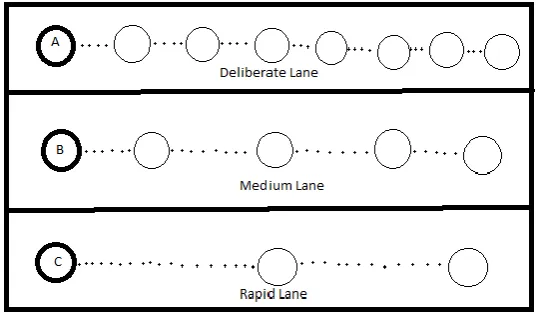
C. Freeway Mobility Model
This model emulates the motion behavior of mobile nodes on a freeway. It can be used in exchanging traffic status or tracking a vehicle on a freeway. Each mobile node is restricted to its lane on the freeway. The velocity of mobile node is temporally dependent on its previous velocity.
Figure 4: Topography showing various movement of nodes for Freeway mobility model.
The differences between Random Waypoint and Freeway are the following: (a) Each mobile node is restricted to its lane on the freeway.
(b) The velocity of mobile node is temporally dependent on its previous velocity
D. Concoction Mobility Model cocktail
We introduce the Concoction model to emulate the movement pattern of mobile nodes on streets. It can be useful in modeling movement in an urban area .The scenario is composed of a number of horizontal and vertical streets. The Routing Information Protocol (RIP) is one of the oldest routing protocols still in wide use. Today's open standard version of RIP, sometimes referred to as IP RIP, is formally defined in RFC 1058 and in STD 56. RIP is a distance-vector routing protocol that uses hop count as a metric. RIP prevents routing loops by implementing a limit on the number of hops allowed in source/destination paths, and also implements split horizon, route poisoning and holddown mechanisms to prevent incorrect routing information from being propagated.
Given below is example topography showing the movement of nodes for Concoction Mobility Model with seventeen nodes. The map defines the roads along the nodes can move.
Figure 5: Topography showing the movement of nodes for Concoction mobility model
Important Characteristics: Maps are used in this model too. However, the map is composed of a number of horizontal and vertical streets. The mobile node is allowed to move along the grid of horizontal and vertical streets on the map. At an intersection of a horizontal and a vertical street, the mobile node can turn left, right or go straight with certain probability. Except the above difference, the inter-node and intra-node relationships involved in the Manhattan model are the same as in the Freeway model. It too imposes geographic restrictions on node mobility. [13]
2. RELATED WORK
Wireless connections can result in large packet losses. Thus, it makes sense to consider routing protocols which adapt to channel variations. A channel-aware routing protocol which extends the Ad hoc On-Demand Multipath Distance Vector (AOMDV) routing protocol. We call it CA-AOMDV. AOMDV is, itself, an extension of the Ad hoc On-Demand Distance Vector (AODV) routing protocol [16]. In this section, we review the details of these two predecessor protocols.
2.1 AODV
AODV is a single-path, on-demand routing protocol. When a source node, ns, generates a packet for a particular destination node, nd, it broadcasts a route request (RREQ) packet. The RREQ contains the following fields:
where the source and destination IP addresses remain constant for the lifetime of the network, source sequence number is a monotonically increasing indicator of packet “freshness,” destination sequence number is the last known sequence number for nd at ns and hop-count is initialized to zero and incremented at each intermediate node which processes the RREQ. A RREQ is uniquely identified by the combination of source sequence number and broadcast ID. An intermediate node only processes a RREQ if it has not received a previous copy of it. If an intermediate node has a route to nd with destination sequence number at least that in the RREQ, it returns a route reply (RREP) packet, updated with the information that it has. If not, it records the following information: source IP address, source sequence number, broadcast ID, destination IP address and expiration time for reverse path route entry, and forwards the RREQ to its neighbors.
Drawbacks
of AODV
It is possible that a valid route is expired. Determining of a reasonable expiry time is difficult, because the nodes are mobile, and sources’ sending rates may differ widely and can change dynamically from node to node. Moreover, AODV can gather only a very limited amount of routing information, route learning is limited only to the source of any routing packets being forwarded. This causes AODV to rely on a route discover y flood more often, which may carry significant network overhead. Uncontrolled flooding generates many redundant transmissions which may cause so-called broadcast storm problem. The performance of the AODV protocol without any misbehaving nodes is poor in larger networks. The main difference between small and large networks is the average path length. A long path is more vulnerable to link breakages and requires high control overhead for its maintenance.
2.2 AOMDV
The key distinguishing feature of AOMDV over AODV is that it provides multiple paths to nd. These paths are loopfree and mutually link-disjoint. AOMDV uses the notion of advertized hop-count to maintain multiple paths with the same destination sequence number. In both AODV and AOMDV, receipt of a RREQ initiates a node route table entry in preparation for receipt of a returning RREP. In AODV, the routing table entry contains the fields:
Disadvantages of AOMDV:
The only drawback of Multi-Path Routing Load Balancing Protocols such as AOMDV and MSR is the use of a large number of control packets for calculating and maintaining multiple routes between a source and destination but such disadvantage is minimized in the network conditions as the rate of control packets generated by MSR or AOMDV is slightly higher than the rate generated by the Single-Path protocols at high load and density nodes. Ad hoc On- Demand Multipath Distance Vector (AOMDV) routing protocol to accommodate channel fading.
3. PROPERTIES OF NODES WITH INHIBITED FORCE
Each node in a MANET serves as a host and/or router generating, consuming or forwarding information [7]. These nodes are fitted with and powered by batteries. The depletion of participating nodes’ battery power in a routing path will shorten the network lifetime. As charging or replacing batteries on site is a difficult operation, it is necessary to use the available energy efficiently to extend the lifetime of the nodes [8-9]. Developing an energy efficient routing scheme is one way of achieving optimized performance of nodes.
Nodes consume energy while transmitting beacon signals to neighboring nodes for the purpose of detecting their existence or transmitting data to another node [4].When an intermediate node has been selected as a router, it consumes more energy than an idle node as it is actively involved in communication [10]. Thus, the nodes’ residual energy is important in determining the path to successfully completing data transfer without interruption. Hence a routing protocol that considers the nodes’ residual energy will perform better than the protocols that do not.
be evaluated over various mobility models taking in to consideration number of average connected paths to gain greater insights into the relationship between them.
4. DYNAMIC POSITION BASED ROUTING AND PROVIDER MODEL
The design of DPBR is based on the opportunistic forwarding and executed in the service model that composed by core and access routers
The proposed probability based node selection method considers a new parameter known as the energy distance factor. This factor helps to select the best next hop node for optimizing the energy efficiency of the network. The scheme also considers the residual energy of the nodes as a fraction rather than the absolute energy levels. Based on this scheme of selecting nodes with sufficient residual energy, an energy aware routing protocol for MANETs is proposed in this paper.
It is common for each node in a network to have a different energy level. Hence it is important to select the best intermediate node in terms of residual energy. Route discovery is costly in terms of both transmission delay and energy consumption. During the route discovery, multiple nodes will have to be contacted for the purpose of identifying and establishing the route again. This would consume more energy than that required for transmitting data.
The nodes between the source and destination are divided into tiers as shown in Figure 2. The tier arrangement is as follows; every node that can be reached directly or by one hop from the source is considered a Tier 1 node, Tier 2 nodes can be reached with only two hops. Similarly, Tier 3 nodes need three hops from the source and so on. Figure 3 shows the distribution of nodes between the source and destination. Depending on the availability of nodes, node distribution can be symmetrical by the straight line connecting the source and destination nodes. The straight line path between the source and destination is the most preferable as it would create the shortest possible path consuming the lowest energy.
Farthest Distance Deviation Discovery of Nodes
5. FUTURE SCOPE
There are still many problems such as tunnelling attacks, selectively drop packets; etc are still persist in these ad-hoc networks. So it is also possible to implement the other way by using shortest routing protocols.
6. CONCLUSION
In wireless mobile ad hoc networks (MANETs), packet transmission is impaired by radio link fluctuations. By utilizing the average nonfading duration, combined with hop-count, we can select stable links which proposed a channel based routing metricIn this paper we have studied a novel channel adaptive routing protocol which extends the Ad hoc On-Demand Multipath Distance Vector (AOMDV) routing protocol to accommodate channel fading. Specifically, we have construct virtual small world network by adding virtual long links to reduce the chance of a protocol encountering local minima in greedy mode, and thus decrease the chance to invoke inefficient methods. If require we evaluate our framework using the Network Simulator (NS-2) to check whether the privacy and confidentiality of the originator are met.
REFERENCES
[1] W.C. Jakes, Microwave Mobile Communications, second ed. Wiley Interscience, 2001. [2]G.L. Stuber, Principles of Mobile Communication, second ed. Kluwer Academic, 2001.
[3] S. Jain and S.R. Das, “Exploiting Path Diversity in the Link Layer in Wireless Ad Hoc Networks,” Proc. Sixth IEEE Int’l Symp. World of Wireless Mobile and Multimedia Networks (WoWMoM), pp. 22-30.
[4] P. Pham, S. Perreau, and A. Jayasuriya, “New Cross-Layer Design Approach to Ad Hoc Networks under Rayleigh Fading,” IEEE J. Selected Areas in Comm., vol. 23, no. 1, pp. 28-39, Jan. 2005.
[5] C. Toh, “Associativity-Based Routing for Ad-Hoc Mobile Networks,” Wireless Personal Comm., vol. 4, pp. 103-139, Nov. 1997.
[6] H. Zhang and Y.N. Dong, “Mobility Prediction Model Based Link Stability Metric for Wireless Ad Hoc Networks,” Proc. Int’l Conf. Wireless Comm., Networking and Mobile Computing (WiCOM), pp. 1-4, Sept. 2006.
[7] O. Tickoo, S. Raghunath, and S. Kalyanaraman, “Route Fragility: A Novel Metric for Route Selection in Mobile Ad Hoc Networks,” Proc. IEEE Int’l Conf. Networks (ICON), pp. 537-542, Sept. 2003.
[8] S. Biswas and R. Morris, “ExOR: Opportunistic Multi-Hop Routing for Wireless Networks,” ACM SIGCOMM Computer Comm. Rev., vol. 35, no. 4, pp. 133-144, Aug. 2005.
[9] R. Dube, C. Rais, K.Y. Wang, and S.K. Tripathi, “Signal Stability- Based Adaptive Routing (SSA) for Ad Hoc Networks,” IEEE Personal Comm., vol. 4, no. 1, pp. 36-45, Feb. 1997.
[10] M. Park, J. Andrews, and S. Nettles, “Wireless Channel-Aware Ad Hoc Cross-Layer Protocol with Multiroute Path Selection Diversity,” Proc. IEEE Vehicular Technology Conf. (VTC)-Fall, vol. 4, pp. 2197-2201, Oct. 2003.
[11] X. Lin, Y.K. Kwok, and V.K.N. Lau, “RICA: A Receiver-Initiated Approach for Channel-Adaptive On-demand Routing in Ad Hoc Mobile Computing Networks,” Proc. Int’l Conf. Distributed Computing Systems (ICDCS), pp. 84-91, July 2002.
[12] B. Awerbuch, D. Holer, and H. Rubens, “High Throughput Route Selection in Multi-Rate Ad Hoc Wireless Networks,” Proc. Conf. Wireless On-Demand Network Systems (WONS), pp. 251-269, March 2004.
[13] S. Zhao, Z. Wu, A. Acharya, and D. Raychaudhuri, “PARMA: A PHY/MAC Aware Routing Metric for Ad-Hoc Wireless Networks with Multi-Rate Radios,” Proc. Sixth IEEE Int’l Symp. World of Wireless Mobile and Multimedia Networks (WoWMoM), pp. 286-292, June 2005.
[14] M.R. Souryal, B.R. Vojcic, and R.L. Pickholtz, “Information Efficiency of Multihop Packet Radio Networks with Channel- Adaptive Routing,” IEEE J. Selected Areas in Comm., vol. 23, no. 1, pp. 40-50. [15] M.K. Marina and S.R. Das, “On-Demand Multipath Distance Vector Routing in Ad Hoc Networks,” Proc. Ninth Int’l Conf. Network Protocols (ICNP), pp. 14-23, Nov. 2001.
[16] Xiaoqin Chen, Haley M. Jones, and Dhammika Jayalath, “Channel-Aware Routing in MANETs with Route Handoff” IEEE Transactions on Mobile computing, VOL. 10. NO. 1, JANUARY 2011.