OUTCOMES IN SOCIAL STUDIES AMONG PUPILS IN PUBLIC
PRIMARY SCHOOLS IN KIAMBU COUNTY, KENYA
NDEGWA KENNETH KIRAGU
E55/CE/26107/2014
A RESEARCH PROJECT SUBMITTED IN PARTIAL FULFILLMENT
OF THE DEGREE OF MASTER OF EDUCATION (CURRICULUM
DEVELOPMENT) IN THE SCHOOL OF EDUCATION,
KENYATTA UNIVERSITY
ii
DECLARATION
I declare that this research project work is my original work and has not been presented in any other university or institution for certification. This research project has been complemented by referenced sources duly acknowledge where text data, graphics or tables was borrowed from other sources, including the internet, the sources was specifically accredited through referencing in accordance with anti-plagiarism regulations.
Ndegwa Kenneth Kiragu Date
E55/CE/26107/2014
I confirm that the work reported in this research project was carried out by the candidate under my supervision.
Supervisor Date
Dr. Samson Ikinya Kariuki
Department of Educational Management, Policy and Curriculum Studies
iii
DEDICATION
iv
ACKNOWLEDGEMENT
v
TABLE OF CONTENTS
DECLARATION... ii
DEDICATION... iii
ACKNOWLEDGEMENT ... iv
TABLE OF CONTENTS ...v
LIST OF TABLES ... ix
LIST OF FIGURE ... xi
LIST OF ABBREVIATIONS AND ACRONYMS ... xii
ABSTRACT ... xiii
CHAPTER ONE: INTRODUCTION AND BACKGROUND OF THE STUDY ...1
1.1 Introduction ... 1
1.2 Background of the Study ... 1
1.3 Statement of the Problem ... 9
1.4 Purpose of the Study ... 10
1.5 Objectives of the Study ... 11
1.6 Research Hypotheses ... 11
1.7 Significance of the Study ... 12
1.8 Limitation of the Study ... 13
1.9 Delimitation of the Study ... 13
1.10 Assumption of the Study ... 13
1.11 Theoretical Framework ... 14
1.12 Conceptual Framework ... 16
1.13 Operational Definition of Key Terms ... 17
CHAPTER TWO: REVIEW OF RELATED LITERATURE ...18
2.1 Introduction ... 18
2.2 Utilization of Instructional Materials ... 18
2.3 Teaching Pedagogies in Social Studies ... 22
2.3.1 Question and Answer ... 24
2.3.2 Discussion Method ... 26
vi
2.5 Assessment Strategies ... 30
2.5.1 Objectives Test ... 31
2.5.2 Multiple Choice Tests ... 32
2.5.3 Oral Assessment ... 32
2.6 Summary ... 34
CHAPTER THREE: RESEARCH DESIGN AND METHODOLOGY ...35
3.1 Introduction ...35
3.2 Research Design...35
3.2.1 Study Variable ...35
3.2.2 Locale of the Study ...36
3.3 Target Population ...36
3.4 Sampling Techniques and Sample Size ...37
3.4.1 Sampling Techniques ...37
3.4.2 Sample Size ...37
3.5 Construction of Research Instruments ...38
3.5.1 Questionnaire for the Social Studies Teachers ...38
3.5.2 Structured Interview for Class Seven and Eight Pupil...38
3.6 Pilot Study ...39
3.6.1 Validity of the Research Instruments ...39
3.6.2 Reliability of Research Instruments ...39
3.7 Data Collection Procedures ...40
3.8 Data Analysis ...40
3.9 Logistical and Ethical Considerations ...40
CHAPTER FOUR: FINDINGS, INTERPRETATIONAND DISCUSSION .42 4.1 Introduction ...42
4.2 General and Demographic Information ...43
4.2.1 Questionnaires Return Rate ...43
4.2.2 Distribution of Pupils by Age and Gender ...43
4.2.3 Teachers Personal Variables ...44
4.2.4 Social Studies lesson per week and attendance of capacity building ...48
vii
4.4 Teaching Pedagogies used in Social Studies on Pupils Learning
Outcomes ...54
4.4.1 Teacher use of Various Teaching Pedagogies on Pupils Learning Outcomes ...57
4.4.2 Teacher Organization of Pupils during Discussion and their Merit ...58
4.4.3 Good Questioning Techniques ...60
4.4.4 Teacher Frequency use of Question and answer and Rating of Pupils...61
4.4.5 Motivation of Pupils ...62
4.4.6 Pupils Motivation Intervals ...62
4.4.7 Pupils Discussion Group ...63
4.4.8 Pupils Personal Timetable...64
4.4.9 Study of Social Studies by Pupils ...65
4.5 Pupils Attitudes towards Social Studies ...66
4.6 Assessment Strategies ...68
4.6.1 Marking of Pupils‟ Work ...72
CHAPTER FIVE: SUMMARY, CONCLUSION AND RECOMMENDATIONS ...73
5.1 Introduction ...73
5.2 Summary of the Study ...73
5.3 Conclusions of the Study ...75
5.4 Recommendations of the Study ...76
5.5 Suggestions for the Further Research ...77
REFERENCES ...78
APPENDICE ...83
APPENDIX I: INTRODUCTORY LETTER ...83
APPENDIX II: PUPILS STRUCTURED INTERVIEW ...84
APPENDIX III: SOCIAL STUDIES TEACHER QUESTIONNAIRE ...89
viii
APPENDIX V: MAP OF GITHUNGURI SUB- COUNTY, KENYA ...95 APPENDIX VI: RESEARCH APPROVAL LETTER ...96 APPENDIX VII: RESEARCH AUTHORIZATION LETTER FROM THE
UNIVERSITY...97 APPENDIX VIII: RESEARCH AUTHORIZATION LETTER (NACOSTI) ...98 APPENDIX IX: RESEARCH PERMIT (NACOSTI) ...99 APPENDIX X: RESEARCH AUTHORIZATION COUNTY
COMMISSIONER ...100 APPENDIX XI: RESEARCH AUTHORIZATION COUNTY DIRECTOR OF
ix
LIST OF TABLES
Table 1.1: Analyze KCPE mean score of public primary schools in Githunguri
Sub-County from 2013 – 2015 ...7
Table 1.2: Social Studies results of some selected public primary schools in Githunguri Sub-County form 2013 – 2015 ...8
Table 4.1: Questionnaire Return Rate ...43
Table 4.2: Pupils Age and Pupils Gender ...44
Table 4.3: Teacher Gender and Professional Qualification ...45
Table 4.4: Class size and Teaching Experience ...47
Table 4.5: Social Studies Lesson per Week and Attendances of Capacity Building...48
Table 4.6: Social Studies Teachers‟ Responses on Utilization of Instructional Materials ...50
Table 4.7: Pupils utilization of instructional materials- Model Summary ...51
Table 4.8: Pupils Utilization of Instructional Materials -ANOVAa ...52
Table 4.9: Pupils Utilization of Instructional Materials -Coefficientsa ...53
Table 4.10: Pupil use of teaching Pedagogies-Model Summary ...54
Table 4.11: Pupils use of Teaching Pedagogies-ANOVAa ...55
Table 4.12: Pupils use of Teaching Pedagogies-Coefficient ...55
Table 4.13: Teaching Pedagogies known to be used by Social Studies teachers 56 Table 4.14: Teacher Organization of Pupils during Discussion and their Merit .59 Table 4.15: Frequent use of question and answer and rating of pupil during questioning ...61
Table 4.16: Teachers interval of motivation to pupils ...62
Table 4.17: Pupils Discussion Group ...63
Table 4.18: Personal timetable and Social Studies Study ...64
Table 4.19: Study of the Social Studies by Pupils ...65
Table 4.20: Pupils attitude towards Social Studies-Model Summary ...66
Table 4.21: Pupils attitude towards Social Studies-ANOVA ...67
Table 4.22: Pupils attitude towards Social Studies- Coefficientsa ...68
Table 4.23: Pupils Assessment-Model Summary ...69
Table 4.24: Pupils Assessment Strategies-ANOVAa ...70
x
xi
LIST OF FIGURE
xii
LIST OF ABBREVIATIONS AND ACRONYMS
A.S.S.P : African Social Studies Programme. C.A.T : Continuous Assessment Test. D.F : Degree of Freedom.
ICT : Information Communication Technology. K.C.P.E : Kenya Certificate of Primary Education. K.I.C.D : Kenya Institute of Curriculum Development. K.I.E : Kenya Institute of Education.
KNEC : Kenya National Examination Council. MOE : Ministry of Education.
NACOSTI : National Commission for Science, Technology and Innovation.
SDG : Sustainable Development Goals. SPSS : Statistical Package for Social Science. TSC : Teachers Service Commission.
xiii
ABSTRACT
1
CHAPTER ONE
INTRODUCTION AND BACKGROUND OF THE STUDY
1.1 Introduction
This chapter entails the background of the study, statement of the problem, purpose of the study, objectives of the study, research questions, significance of the study, limitation of the study, delimitation of the study, assumption of the study, theoretical frame work, conceptual framework and operational definitions of the terms.
1.2 Background of the Study
Education is an important tool for social, economic and political development of any country in the world. Quality education is the fundamental rights of every citizen (SDG, 2016). World governments have put emphasis on provision of formal basic education for all their children (UNESCO, 2010). This play a vital role in promotion of human rights, dignity, eradication of poverty and sustainable development.
2
wholly accepted by all including Kenya. It was adopted to respond to the needs of African children. This was to Africanize Social Studies primary school curriculum with aim of in calculating norms and moral rules which was essential to African countries especially to free Kenya from the vice of ethnicity, nepotism, discrimination and unfair treatment. In Kenya integrated Social Studies ideas have been in primary school curriculum since 1969(MOE, 2008). Lamula (2007) argue that a decision to adopt the integrated approach was arrived in 1984 and 1985 to equip the learners „with desired skills for self-reliance.
3
identity, sense of belonging and togetherness through symbol of national unity such as national flag, national anthem, public seal and coat of arm (Kenya constitution, 2010). According to K.I.E (2012) the knowledge and skills acquired in Social Studies provide learners with opportunity to appreciate changing environment in which they live and in realization of their own place, privilege‟s, rights and responsibilities as citizens. It proceeds that knowledge gained exposes learners to broad variety of lifestyles. The learners acquire ideas and skills learnt in the subject to make informed decisions, assessing issues, value judgment, diagnose problems and look for productive and viable solutions. For its achievement appropriate and effective teaching and learning process is detrimental.
Education is one of the way that help individuals to realize better and productive lives (Republic of Kenya, 2011). The teaching pedagogies are keys as they can influence effectiveness of learners learning process and outcomes. This concern is whether teaching instruction used in teaching Social Studies in primary school is promoting quality learning and whether pupils are achieving required levels of learning outcomes and develop holistic individuals. In addition, it has necessity for curriculum based competency (MOE, 2017).
4
issues like unemployment, climatic change, terrorism, radicalization, natural disasters among others. It enhances greater knowledge of political systems, procedure and policies of different countries in the world. Be a well-grounded, informed and holistic citizen a knowhow of government structure and human rights is essential. This can be fully realized by learner centered learning process.
According to K.I.E (2008) currently KICD Geography, History and Civics is a combined course that is taught as Social Studies as it includes environmental education, Civil Education and aspect of Business Studies. Social Studies prepare pupils for every day to day life. The primary concern of Social Studies is the study of man and it focuses on how man influence and is influenced by various environments. Through the subject it accounts how interdependence on natural resources for survival. As people live they co-exist with one another hence enhancing love, peace and harmony. Pellogrino and Hilton (2012) indicate it as process of education that involves transmission of knowledge, skills and attitudes that is detrimental to every child. Social Studies play critical role in developing creativity, critical and imaginative procedures of practical problem solving. Social Studies in Kenya is a very effective means of bringing people together of diverse ethnic communities.
5
of a nation. Tebabal and Kahssay (2011) observe that learning process at all levels of education changes students to be viable, helpful and productive members of the society in meeting their various needs. A children education starts at home as they join pre-primary schools they have diverse learning experiences. It is of essence to note that teaching and learning of Social Studies provides insight to human society. Social Studies being a subject in 8.4.4 Kenya education system it requires instructional materials for the teaching and learning process. These materials include pupils text books, teachers‟ guides, globe, relevant maps, atlases, pictures, newspapers cuttings, relevant magazines, models, regalia, locally improvised materials, curiosity charts, audio and audiovisuals among others (MOE, 2008). These ensure empirical, structured and systematic understanding of the subject content. Social Studies knowledge, skills and attitudes that are developed from early childhood education and primary school level enable learner to transit to secondary school level or village polytechnics institutions.
6
and respect own and people‟s culture, recognize and understand the need for and importance of interdependence of people and nations, acquire knowledge and skills necessary to understand and analyze population issues which affect the quality of life of the people of Kenya, understand and show appreciation for the love for and loyalty to the nation, be willing and able to resolve disputes in and out of school and understand and promote economic activities in the society.
For the realization of general objectives of teaching and learning of Social Studies, it is proper utilization of Social Studies instructional materials, appropriate use of Social Studies teaching pedagogies, pupil‟s positive attitudes towards Social Studies and appropriate Social Studies assessment strategies. Pupils perceptions about other subjects such as Science, Mathematics, Religious Education as well as others in primary school level curriculum enables leaner to have inter-disciplinary approach in learning. (MOE, 2012).
To evaluate whether pupils have mastered certain competencies for the preparation of secondary school education, Social Studies is examined through CAT, instructional evaluation through quizzes, home assignment, oral assessment and at national level by KNEC in KCPE examinations. Gibson and Rankin (2015) assert that academic parameter for measuring academic progress and success is through examinations.
7
difficult to effectively attain better performance due among reasons underutilization of learning resources, inappropriate teaching pedagogies and assessment strategies. It possesses great challenges to the sub-county. The trend analysis of the KCPE Social Studies performance for the recent years for many Githunguri Sub-County public primary schools, Kiambu County was clear justification of low level of acquisition of Social Studies learning outcomes and practical skills (Githunguri Sub-County Education Office ,2015) Even if there were improvement it was by slight margin. It was an indication that most learners particularly for class seven and eight cannot fully conceptualize the content of Social Studies.
Table 1.1: Analyze KCPE mean score of public primary schools in Githunguri Sub-County from 2013 – 2015
Year Subject Mean Deviation
2013 Social Studies English Kiswahili Mathematics Science 45.87 52.31 53.03 51.89 54.62 -3.24 +1.02 +2.34 -0.32 +1.62 2014 Social Studies English Kiswahili Mathematics Science 46.67 53.39 55.91 54.26 55.43 +0.8 +1.08 +2.88 +2.37 +0.83 2015 Social Studies English Kiswahili Mathematics Science 44.21 55.09 53.89 55.99 55.84 -2.46 +1.7 -2.02 +1.73 +0.43
8
It was revealed from information presented in table 1.1 that performance of Social Studies in KCPE from 2013 to 2015 has been lower compared to other subjects. For three consecutive years‟ data on performance for Githunguri Sub-county was analyzed and presented in table 1.1 Social Studies scored below mean mark of fifty. The poor performance of learners in the subject at sub county level calls for adoption of proper teaching in delivering curriculum and utilization of teaching-learning resources.
The KCPE trends analysis of the Social Studies performance in Githunguri Sub-County had raised concern among educational stakeholders which should be adequately addressed. The performance of the subject is not stable. This was evident by some of selected results of average performing public primary schools in the sub-county (Githunguri Sub County Education Office, 2015).
Table 1.2: Social Studies results of some selected public primary schools in Githunguri Sub-County form 2013 – 2015
Year 2013 2014 Deviation 2015 Deviation
9
Despite many Social Studies teacher covering primary school Social Studies syllabus, only few schools exhibited above average performance that is above fifty percent mark. From this poor performance the researcher in the current study felt that there was a need to examine the influence of curriculum components on learning outcomes in Social Studies among pupils in public primary schools in Githunguri Sub-County, Kiambu County, Kenya.
1.3 Statement of the Problem
Social Studies is an important subject in primary school curriculum. The education knowledge and skills in Social studies depend on teacher knowledge of subject content and interaction between instructional materials, teaching pedagogies, pupils‟ attitudes and assessment strategies. Despite teachers teaching reports from Githunguri Sub County Education Office shows failure of acquisition of necessary skills, knowledge and competence to develop learners holistically. The key concern is the declining of Social Studies learner performance that goes hand in hand with teaching.
10
Most of public primary schools mean scores in Githunguri Sub County are on downward trends. The poor performance in the subject calls for extra efforts to ensure success among pupils. Despite the challenges in learning Social Studies including wide syllabus, it important teachers to use appropriate instructional materials, teaching pedagogies and suitable assessment strategies to acquire desired learning outcomes. The poor academic progress calls for concerted efforts for practical learning of Social Studies as a subject as it hinders learners‟ opportunity for progression as holistic individual. Teaching and learning of Social Studies could be more effective if different teaching and learning approaches could be advocated to improve and enhance subject performance and competencies in the classroom situation. The study focuses on; the influence of curriculum components on learning outcomes in Social Studies among pupils in public primary schools in Githunguri the Sub-County.
1.4 Purpose of the Study
11
1.5 Objectives of the Study
The objectives of the study were: -
i. To determine the influence of utilization of instructional materials on pupils learning outcomes in Social Studies among pupils in public primary schools in Githunguri Sub-County.
ii. To assess the influence of teaching pedagogies on pupils learning outcomes in Social Studies among pupils in public primary schools in Githunguri Sub-County.
iii. To establish the influence of pupils‟ attitudes towards Social Studies on pupils learning outcomes in Social Studies among pupils in public primary schools in Githunguri Sub-County.
iv. To investigate the influence of assessment strategies on pupils learning outcomes in Social Studies among pupils in public primary schools in Githunguri Sub-County.
1.6 Research Hypotheses
To interrogate the relationship between curriculum components and learning outcomes in Social Studies among pupils in public primary schools in Githunguri sub county, Kiambu county, the following four null hypotheses were formulated and tested: -
12
Ho2. There is no significant relationship between use of teaching pedagogies and pupils learning outcomes in Social Studies among pupils in public primary schools in Githunguri Sub-County.
Ho3. There is no significant relationship between pupils‟ attitudes and pupils learning outcomes in Social Studies among pupils in public primary schools inGithunguri Sub-County.
Ho4. There is no significant relationship between assessment strategies and pupils learning outcomes in Social Studies among pupils in public primary schools in Githunguri Sub-County.
1.7 Significance of the Study
13
1.8 Limitation of the Study
According to Orodho (2012), limitation is an aspect that researcher knows that may adversely affect generalization of the results of the study, but he or she has no control over them. During the study some of the sampled school were sitting for their opener examination and were not willing to be interrupted with data collection during research. The study also had a limitation in trying to access the indicators of measuring learning outcomes in comparison of curriculum components. The limitations of the study therefore did not influence the study outcomes since all issues were addressed as they occurred.
1.9 Delimitation of the Study
The research study was carried out in public primary schools in Githunguri Sub-County of Kiambu Sub-County, Kenya. It involved Social Studies teachers and standard seven and eight pupils; as they directly promote good performance. However, it was not possible to involve all Social Studies teachers, and all standard seven and eight pupils in the study.
1.10 Assumption of the Study
14
1.11 Theoretical Framework
The study employed constructivism learning theory which was credited to Swiss psychologist Jean Piaget (1950). Jean Piaget emphasis on how information from environment and ideas from the individuals interact and result to internalized structures that are developed by learners who are internally motivated. Theory asserts that in the process of interaction learners construct new knowledge out of their experiences with proper pedagogic approaches, suitable learning resources and evaluation tools that promote active learning when learners experience correspond with the familiar experiences. Constructivism learning theory is based on importance of learner being actively involved in learning process under suitable and warm environment which is independent and responsible unlike previous traditional educational methods where the responsibility of learning rested with instructor to teach and the learner played a passive receptive role. However, he further states that learners should be allowed to build their own in-depth knowledge and understanding hence reflecting on their experiences as it with unison with center for innovation in teaching and learning (UNC, 2015). Use of various instructional resources offers pleasant learning experiences to learners therefore promoting practical learning in the subject.
15
The constructivism theory indicates that, learners have prior knowledge which should be utilized during instruction that is they are not empty or void. The teacher plays a role of guide, facilitator or active coach though required to be very active in pre-requisite lesson design and preparation. Learners are more visible as classroom learning is more interactive. Assessment in learning that is emphasized includes observation, learner work test and even oral assessment.
It is of great importance that pupils learning outcomes is highly influenced by proper utilization of instructional materials, appropriate teaching learning strategies, positive pupils‟ attitude and suitable assessment procedures. Teachers are able to design the instruction that include learner centered interaction that complements pupils‟ good performance and acquisition of desired learning outcomes in the subject.
16
1.12 Conceptual Framework
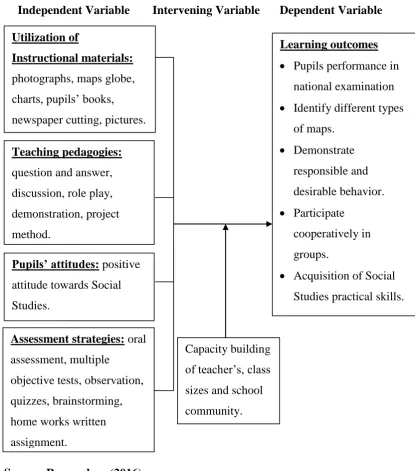
A conceptual framework is a model or represent of the relationship between variables of study represented graphically or diagrammatically conceptualizes the relationships (Orodho, 2012). The research study adopted the following conceptual framework.
Source: Researcher, (2016)
Figure 1.1: The Conceptual Framework on influence of curriculum components on learning outcomes in Social Studies among pupils in public primary schools in Githunguri Sub-County, Kenya.
Utilization of
Instructional materials:
photographs, maps globe, charts, pupils‟ books, newspaper cutting, pictures.
Teaching pedagogies:
question and answer, discussion, role play, demonstration, project method.
Pupils’ attitudes: positive attitude towards Social Studies.
Assessment strategies: oral assessment, multiple
objective tests, observation, quizzes, brainstorming, home works written assignment.
Capacity building of teacher‟s, class sizes and school community.
Learning outcomes Pupils performance in
national examination
Identify different types of maps.
Demonstrate responsible and desirable behavior.
Participate cooperatively in groups.
Acquisition of Social Studies practical skills.
17
Figure 1.1 Illustrate how four independent variables namely: instructional materials, teaching pedagogies, pupils attitudes and assessment strategies influence dependent variable; pupils‟ performance in national examination, identify different types of maps, demonstrate responsible and desirable behavior, participate cooperatively in groups. Therefore, Social Studies high achievement is interplay between the interactions of independent and dependent variables therefore influencing performance. The researcher endeavored to find out the influence of curriculum components on learning outcomes in Social Studies.
1.13 Operational Definition of Key Terms
Assessment strategies: Refer to the use of instruments to measure learner achievement.
Curriculum component: It is the determinant that influences learning and it include instructional materials, teaching pedagogies, pupils attitudes and assessment strategies.
Instructional material: This refer to what the teachers and pupils uses to make lesson and learning more interesting, real, practical and understandable to pupils and it include charts, textbooks, models, real object, pictures and photographs.
Learning outcomes: Refer to the statements of what learner is expected to recall, identify, demonstrate and acquire at the end of learning period.
Pupils’ attitude: Refer to learner interest towards Social Studies.
Teaching pedagogies: These are methods used in Social Studies to impart knowledge, skills and attitude to the learners.
18
CHAPTER TWO
REVIEW OF RELATED LITERATURE
2.1 Introduction
This chapter contains various scholarly reviewed literature works. It comprises utilization of instructional materials, teaching pedagogies, pupil attitudes and assessment strategies. The sources sought are scholarly journals, references to books, theses, dissertation, internet and books.
2.2 Utilization of Instructional Materials
Instructional materials are made up of graphic and non-graphic materials such as charts, photographs pictures, maps, atlas, globe, textbooks, magazines, audio and audio visuals that aid successfully delivery of Social Studies lesson (Chumba, 2010). Bolick (2003), further points out that there are good relationships between the teaching of Social Studies and using instructional materials. He argued that big portion of educators like Social Studies teachers are perplexed by the potential of instructional materials to enhance teaching and learning but they are hardly used therefore halting acquisition of desirable Social Studies learning outcomes. These materials are important component of learning as they stimulate learners to seek more knowledge. Over and above, learning difficulties and problems are complemented hence influencing academic progress of the learners.
19
abstract knowledge to concrete and simple to the learners. He further elaborates that they are used in developing knowledge, skills, attitudes and values to the learners. Dahar and Fraize (2011) categorized instructional materials as either print or non-print materials for passing content to the learners. They include textbooks, magazines, newspapers, pictures, charts and use of technological learning aids. USAID (2006) state clearly that mostly commonly utilized learning aid during classroom instruction is the textbook.
Empirical research done by Joff (1995) indicate that concept of teaching aids has gone far in terms of technology that is from simple and instructional technology, media to communication and educational technology. He further argues that instructional materials are not just object or equipment used during teaching and learning process but there those objects improvised by the teacher to make learning concrete and practical. Social Studies teacher has to improvise using locally available materials to bring reality in class hence preventing reality shock among learners. They should cater for the age, ability as well as level of learners. Improvisation of teaching learning materials and resources develop ability for reflective thinking among learners. Instructional materials are the appropriate teaching aids used by teacher to facilitate Social Studies content by making it interesting. They are unavoidable at any teaching learning process.
20
experiences. Tools for instruction if appropriately utilized by the teachers lead to quality learning. Good teaching requires that rational decisions be made regarding the various determinants that are involved in instructional process (Farrant, 2002). He continues to note that there are differences between teaching and learning is a subtle one, but recognize the fact that the teachers are able to respond appropriately to individual differences of the learners needs according to varying environment. In this Social Studies teacher can vary these materials according to age, maturation and motivational levels.
21
sustaining interest and memory retention among pupils. Teaching can always be effective when adequate and relevant instructional materials are used (Afolabi et al., 2008). Ngaroga (2008) agree that use of learning resources is important and advantageous in learning as they: Motivate learners as they offer stimulus variation and assist in sustaining learner‟s attention throughout the lesson , they help clarify information, sometimes a concept may be a bit complex and a word alone cannot offer a clear explanation, they can stimulate discussion that is they make classroom discussion lively, they can challenge independent thinking especially when used individually in an assignment or class activity, they can influence learner‟s attitudes. Some of the resources can make learners appreciate things they did not like before, some of them promote a high degree of creativity in their preparation, use and presentation of ideas and some of the learning resources make learning real.
Quist (2002) implies that teacher is permitted to organize materials according to pupil interest and provide many activities according to the ability and needs of the class. He urges there is variation in the teacher conceptualization of the process of teaching and learning process. These impacts on presentation of the subject content according to teacher expertise in handling different categories of the learners. When there is active participation they are able to retain and learn Social Studies knowledge more practical than theoretical.
22
There are varieties of Social Studies resource materials, yet there are important considerations which the teacher must face in using these aids effectively. The teacher must know where to find them, how to select relevant materials and which will be appropriate for the lesson needs. He goes further to highlight other considerations in selection of instructional materials. These include content, needs and age of learners (Ngaroga, 2008).
The review of literature provided insights that were vital for the study as it provided important information on the proper utilization of instructional materials to teaching and learning. The research evidence from utilization of learning materials was keys to the acquisition of Social Studies learning outcomes. The findings revealed that underutilization of learning resources hinders pupils learning.
2.3 Teaching Pedagogies in Social Studies
23
teaching tools, approaches and strategies within the instructional situations to suit the specific environment.
Pupils learn through making effective choices by trial and error, critics, inspiration and curiosity. It is important to know how learners learn because this has impact on the teaching strategy in the classroom situation. It is obvious that one teaching approach is not adequate and sufficient to meet different learning needs (Ayot and Patel, 1987). It is ideal that teacher uses suitable learning pedagogy and healthy interaction. The methods of delivery of the content should be learner centered approach with learning outcomes personalized to develop Social Studies discipline. However, use of the best teaching pedagogies facilitates achievement of Social Studies objectives in primary school level (MOE, 2008).
Determination of appropriate teaching pedagogies is influenced by nature of topics, objectives of the lesson, type of learners, teacher personality, interest, ability and creativity of the learners, theories of learning among others. This informs that teacher may frequent prefer some teaching methods compared to others (Ayot, 1962).
24
visible in learning process. The teachers‟ role is facilitation. They include project, discussion and role play.
According to MOE (2008), the teaching pedagogies indicated in primary Social Studies syllabus are: -discussion, question and answer, observation, demonstration, project, storytelling, nature walk, drawing, recitation and role play. Social Studies is a wide discipline that require appropriate instructional strategies to transfer knowledge to learners. The Social Studies teachers need to acquire basic competencies in handling subject. The competencies include best teaching approaches in transmitting the subject content, the teaching learning pedagogies that have meaningful understanding and insight. The most commonly used teaching approaches in teaching and learning Social Studies in public primary schools in Githunguri Sub-County are discussion, question and answer.
2.3.1 Question and Answer
25
The teacher asks a question and identifies one pupil to respond to it then reacts to the pupil response orally. It one of teaching pedagogy that stimulates pupils thinking hence effective learning. According to Ngaroga (2008) the teacher who never ask question never teaches. It is usually normal for the teacher to ask question knowing or unknowing. A Social Studies teacher requires good questioning technique that is pre-planned questions, well distributed question and avoidance of ambiguity questions to learners to cover all cognitive levels of learning according to Bloom taxonomy (1956), of learning which are knowledge, comprehension, application, analysis, synthesis and evaluation.
26
2.3.2 Discussion Method
According to Gitau (2008), discussion method is the oral interaction between learners and teachers that is asking and answering questions. He further emphasis that the method involves active participation of learners and giving immediate feedback making it effective instructional strategy. Pupils are constantly under guidance of the teacher. Pupils exchange their opinions, ideas and knowledge coming up with collective decision of a certain topic or subtopic. It can be exchange of ideas between learners and teacher or between learners and learner. Pupils develop communication and evaluation skills. At the end it results to deeper understanding and ensuring learning is more meaningful, insightful and long lasting (Quist, 2005).
27
process, to stimulate and develop the thinking ability and to develop cooperative, the listening skills and respect for other pupils‟ opinions.
The literature provides insights contribution learners centered pedagogies in improving pupils‟ performance. However, they are effective if appropriate skills are practiced to facilitate practical learning.
2.4 Pupils’ attitude toward Social Studies
Newman (2015) presents learning as important landmark in the journey towards lifelong learning and capabilities. Learning includes what pupils acquire in formal and non-formal setting that is at school or home environment. Most teachers create links between these settings to bring reality in classroom setting.
28
pupils and teachers is crucial and positively affect pupils‟ development in terms of academic and social achievement. They assert that close relationship leads to better academic attainment while poor relationship results to undesirable achievements. This relationship solves learners‟ difficulties hence fostering positive attitudes among various subjects. However, positive pupils‟ attitude cultivates high self-esteem among learners. Pupil attitude towards learning is vital for achievement of perceived goals. It is argued that positive minds facilitate coverage of Social Studies curriculum and prescribed learning outcomes.
Social Studies teachers perceive subject as diverse and dynamic. The subject is crucial in helping individuals to socialize to community leading to acquisition of desirable attitude. Teaching and learning Social Studies require adequate preparedness of minds that will fascinate practicability of learning.
29
These theorists propose that attitude help individuals understand complexity of world, guard their self-worth, help people adjust and permit them to communicate their essential values.
According to Triandis (1971) attitude is learned. Additionally, Allaport (1954) assert that most of the attitude that individual develop are obtained from communication with community, family and friends. Traindis explain further that people also acquire attitude from direct experience with the attitude object. Therefore, the interactions between pupils and teacher, pupil and community is a major aspect of attitude development.
There is negatively towards Social Studies to the learners who feel that it is not valuable and interesting (Schug, 1984). If there is no desire for learning negative attitude towards the subject is reflected. According to Wades (2002) if learners lack interest, their retention of ideas and concepts is going to be minimal. He further explains that low priority from teachers will automatically lead to less time dedicated to Social Studies in the daily curriculum. Wades (2002) categorically emphasis that many of the problems facing teacher leads to poor attitude toward the subject. He aggravates that bland and boring textbooks negatively affect teachers and pupils‟ attitude. For example, a book that presents information in an interesting manner it will be attractive to many learners. Hawkins (1997) observes that in order to teach Social Studies effectively, learners must have interest in history and teacher must actively involve them in learning process.
30
in finding knowledge and reflecting on its experiences, ideas and concept causing negativity. Haladya, et al., (1982) they indicate that enthusiasm in the subject matter displayed by teacher can be directly correlated to the learners‟ interest and attitude that is any like or dislike on subject matter is directly reflected to the learners. The sole responsibility of Social Studies teacher is to bring relevance of the subject and counter any deceptions concerning Social Studies in classroom situations.
In Kenya primary school level there many factors that make pupils develop low opinions about Social Studies. Among them are Social Studies teacher approach to the subject; moral and minimal academic support from community and home background. As pupils transit to different levels of education they are inadequately prepared. These adversely affect the choices of the related discipline which impacts on their future career progression.
2.5 Assessment Strategies
31
Assessment is integral part of teaching and learning process in Social Studies. It must reflect learning needs. This acts as motivation factor. Therefore, teacher can use varieties of pupil‟s knowledge in the subject. The teacher role is central in ensuring quality assessment within school set up (Wyatt–Smith et al., 2010). Teacher must have requisite knowledge and professional skills for developing assessment instrument, Webb (2002) argue that knowledge about how to assess what learners know can do, interpret the results of these assessments, and apply these results to improve students‟ learning and program effectiveness.
There are various methods of assessment that can be used in Social Studies. These assessment procedures are used by teacher in finding out the extent to which pupils have acquired knowledge and skills in developing attitude and values (M.O.E, 2008). The commonly modes of assessments used in Social Studies as recommended in (M.O.E, Social Studies Syllabus, 2008) are: - objectives tests, oral assessment, projects, observations, written assignments and quizzes.
2.5.1 Objectives Test
32
2.5.2 Multiple Choice Tests
In Kenya primary school assessment, they consist of direct questions followed by four possible answer in which a learner chooses the correct answer. For instance, some choices are true to certain extent but one is the test. These tests allow for wide range of content coverage, encourage learners to remember facts, principles and concepts for them to pay close attention to what they are exposed to. However, they tend to promote rote learning, guess work and recall of the facts rather than imaginative, creative thinking and levels of cognitive development. According to Eubanks (1998) most of learners know more than what they demonstrate from multiple choice tests. Research study done show that multiple choices items decontextualize information that is they pull knowledge often facts out of the context (Shepard, 1989, Wiggins, 1989, 2009). They argue that pulling information out of one‟s memory without some context is invalid. Many Social Studies teachers in Kenya believe multiple choice tests can be scored easily and more objective than other forms of assessments.
2.5.3 Oral Assessment
The oral assessment is direct means of assessing learners. Learning outcomes is by questioning unlike interview which usually structured questions. Oral assessment does not have a structured list of questions; the teacher asks questions and request for responses from the learners depending on the various situations and circumstances (Chan, 2008).
33
assessing skills orally develop the cognitive and physical domain but not spiritual domain. Therefore, in Kenya research conducted by Gachari and Ndege (2014) indicate that teacher asking oral question and a learner responding develop learners‟ personality and cognitively. The oral assessment of pupils in Social Studies should be continuous with purpose of recognizing strengths, weakness and addressing academic development of the learners. According to Laven (2008) assessment establish child level of attainment in learning experiences by checking in progress and achievement of stated objectives. Ransuran (2006) asserts that oral assessment promotes holistic development plan, adequately and understand learners‟ abilities, evaluate teaching methods and learning resources in order to adopt relevant teaching and assessing strategies for particular skills, identify children who need remedial measures, care for their individual differences, appraise behavior, skills, knowledge, attitude, achievement of learners and classify learners for further development of skills. This allows friendly interaction between teacher and learners. In process of scoring oral assessment it can be selective, subjective and non-objective. To avoid this teacher must ensure that test is free from biasness.
However, competency of classroom teacher is an important factor in the success of learners as noted by National Commission of Teaching America Future (2009). The competency can be revealed by standards set by the teacher, mastery of content and instructional method.
34
2.6 Summary
The literature reviewed explains the utilization of instructional materials, teaching pedagogies, pupils‟ attitude and assessment strategies are inefficient, they affect quality of instruction and learning outcomes. There can be tendencies of some Social Studies teachers preferring one teaching approach at expense of the other. This can compromise acquisition of important Social Studies learning outcomes. There are wide ranges of instructional materials and teaching pedagogies translate to effective classroom learning.
35
CHAPTER THREE
RESEARCH DESIGN AND METHODOLOGY
3.1 Introduction
This chapter focuses on research designs, locale of the study, target population, sampling and data collection procedure and data analysis.
3.2 Research Design
The study adopted correlation research design since the study variables were measured in continuous nature. More so correlation designs are designed to obtain pertinent and precise information concerning the study and draw valid and general conclusions. These were the most suitable research design that provided useful data on curriculum components on pupils learning outcomes in Social Studies and provide solution. The researcher found the designs as ideal as it did not allow researcher to manipulate variable under investigation.
3.2.1 Study Variable
Independent variables included instructional materials, teaching pedagogies, pupil attitudes, assessment strategies which had been derived from the concept of curriculum components. The variables were measured by use of a number of items which provided a continuous data.
36
3.2.2 Locale of the Study
The study was conducted in Githunguri Sub-County in Kiambu County, Kenya which is located 35 kilometers from Nairobi City County. The head quarter of the Sub-county is based in Githunguri which is rich agricultural town in Central Kenya former Central Province. It is home of East Africa‟s largest dairy processing plant Fresha which is owned by a farmer cooperative (Githunguri Dairy Cooperative Society, 2016). The Sub-County covers an area of 173.50km2 (National census, 2009). It borders Gatundu South to South, Lari to West, Ruiru to South East and Kiambu to the South. Currently, the Sub-County has poor road networks. According to National Census Report of 2009, the population of the Sub-county was 147, 763. It has a warm climate temperature ranging between (140C – 270C) with rainfall of 1000mm each year. These make it conducive for farming. (Kenya Census, 2009). The main economic activity of the residents is dairy farming, coffee and tea farming on small scale. The other population also practice agribusiness and operate medium and small businesses. Subsistence crops such as maize, beans and arrow roots are also grown. Majority of people are Christians and small group of the population ascribe to other faiths including Islamic and Hinduism. Most of the residents have abandoned their traditional belief for Christianity. The Sub-county has five administrative units namely: Githiga, Githunguri, Ikinu, Ngewa and Komothai. The researcher selected the sub county because of poor performance of Social Studies and no similar study has been conducted recently at the sub county.
3.3 Target Population
37
Records available at Githunguri sub county Education Office that in 2017 there are 56 public primary schools. At the same time there were 5000 standard seven and eight learners and 228 social studies teachers handling these classes. The target population therefore added up to 5228.
The study targeted standard seven and eight pupils because they were more exposed to Social Studies content for the period of at least eight years.
3.4 Sampling Techniques and Sample Size
According to Orodho (2009) argue that sampling is the process of selecting a sub-set in order to draw conclusions about entire set.
3.4.1 Sampling Techniques
Stratified sampling, simple random sampling and purposive sampling techniques were adopted. These sampling techniques were justified because of their suitability in selection of sample which after data analysis would provide accurate results. The schools were surveyed through the stratified random techniques. They were placed on strata according to the five administrative units that is 2 schools each administrative units. Simple random sampling was used to give school equal chances to be included in the sample size. Use of raffle was used to get sample size from target population of the Social Studies teachers. Purposive sampling was used to pick sample from the learners in class 7 and 8.
3.4.2 Sample Size
38
Social Studies teachers therefore adding up to 5,228. The sample size for the study were therefore 60 respondents.
3.5 Construction of Research Instruments
The data was collected using: -
i. Questionnaire for Social Studies teachers.
ii. Structured interview for class seven and eight pupils.
3.5.1 Questionnaire for the Social Studies Teachers
Orodho (2009) points out that questionnaire have ability to collect large amount of information in a reasonably quick space of time. Social Studies teacher questionnaire was divided into four parts. Part one was on utilization of instructional materials; part two was on various teaching pedagogies and parts three was on assessment strategies. The researcher used open ended questionnaires where Social Studies teachers gave their direct views and opinions. However, close ended questionnaire gave respondent short time to respond.
3.5.2 Structured Interview for Class Seven and Eight Pupil
39
3.6 Pilot Study
Prior to the actual research the researcher undertook pilot study to test the reliability of the research instruments. The pilot study was carried out in Kagema Primary School in Komothai Education Zone which had all variable of the research. The purpose of piloting the instruments was to test the appropriateness of the items to gather useful information as well time required to fill the questionnaires. As the results necessary corrections or additions were made. The pilot school as well as respondent in pilot school was not included in the main study.
3.6.1 Validity of the Research Instruments
Validity is concerned with the degree to which an empirical measure or several instruments of a concept accurately represent that concept (Orodho, 2009). To ensure validity the researcher of the study both used content and construct validity of instrument was sought from experts in the field of the education and my supervisor in Kenyatta University. This ensured that research instruments used were systematic and accurate in line with purpose and objectives of the study. Therefore, the final instruments were developed.
3.6.2 Reliability of Research Instruments
40
Nackmais (2009) positive co-efficient of over 0.7 is considered as reliable instruments. The correlation co- efficient was 0.76.
3.7 Data Collection Procedures
The researcher first applied research permit from National Commission for Science Technology and Innovation (NACOSTI) through Kenyatta University Graduate School. The research permit was presented to Kiambu County Commissioner Office and Kiambu County Education Office who authorized for the collection of the data from the selected sample schools. The researcher personally sought permission from head teacher of sampled schools with introductory letter. The appointment dates were booked for structured interview and presentation of questionnaire.
3.8 Data Analysis
Before the data analysis, the filled questionnaires were checked and the relevance of responses confirmed. The responses were organized into the main objectives areas of the study. A coding strategy was developed and the data gathered from questionnaires was coded after validation and editing. The coded data was then entered into computer and the analysis of the data was done using computer software that is Statistical Package for Social Science (SPSS). Qualitative data was organized in themes, ordered and grouped then interpreted. Each objective of the study was analyzed by use of regression table, frequency table and cross tabulation in SPSS.
3.9 Logistical and Ethical Considerations
41
conduct research. Permission was sought from Kiambu County Director of Education. After permission was granted, prior visit was done to the sampled schools before the actual visit for the purpose of making appointment. After permission was given dates were fixed for data collection, the researcher visited sampled schools on the appointed dates to collect data. The researcher sought consent from the subjects and explained to them the purpose of the study. During the data collection, the researcher maintained high degree of confidentiality to the respondent. The names of participants were not indicated on research standard seven and eight pupil‟s instruments. The questionnaires were presented individually by researcher to the Social Studies teacher. For truthfulness and accuracy, the subjects were allowed at least forty minutes to respond.
42
CHAPTER FOUR
FINDINGS, INTERPRETATIONAND DISCUSSION
4.1 Introduction
This study sought to determine the influence of curriculum components on learning outcomes in Social Studies among pupils in public primary schools in Githunguri Sub-County, Kiambu County, Kenya. The findings of the study were guided by research objectives as highlighted in chapter one as shown:
i. To determine the influence of utilization of instructional materials on pupils learning outcomes in Social Studies among pupils in public primary schools in Githunguri Sub-County.
ii. To assess the influence of teaching pedagogies on pupils learning outcomes in Social Studies among pupils in public primary schools in Githunguri Sub- County.
iii. To establish the influence of pupils‟ attitude towards Social Studies in pupils learning outcomes in Social Studies among pupils in public primary schools among pupils‟ primary schools in Githunguri Sub-County.
iv. To investigate the influence of assessment strategies on pupils learning outcomes in Social Studies among pupils in pupils in public primary schools in Githunguri Sub- County.
43
4.2 General and Demographic Information 4.2.1 Questionnaires Return Rate
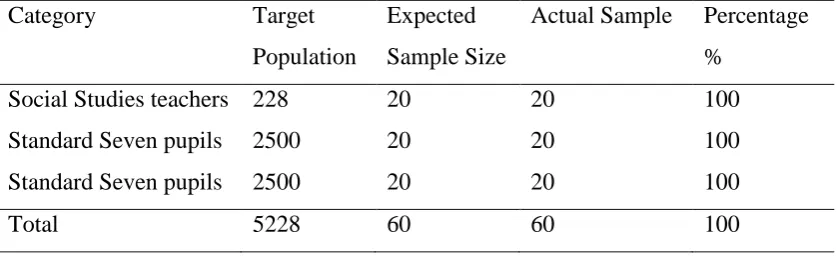
This was the proportion of questionnaires that was returned by the respondents in the study. All the sampled respondents returned their questionnaires as shown in table 4.1.
Table 4.1: Questionnaire Return Rate
Source: Researcher (2017)
4.2.2 Distribution of Pupils by Age and Gender
The pupils‟ personal variables included pupils age and gender. The respondents were asked to indicate their age. Age mean the number of years since birth. Age was essential to determine the maturation rate of pupils in order to reveal whether they were under age, overage or appropriate age in their respective classes. Where 1-represent “12 years”, 2- “13years”, 3- “14 years”,4- “above 15 years.” Gender of pupils either meant boy or girl where 1 represent “boy” and 2 represent “girl.” The total score was analyzed through SPSS and then summated through cross tabulation on the table 4.2.
Category Target Population
Expected Sample Size
Actual Sample Percentage %
Social Studies teachers 228 20 20 100 Standard Seven pupils 2500 20 20 100 Standard Seven pupils 2500 20 20 100
44
Table 4.2: Pupils Age and Pupils Gender
Pupils age Pupils Gender Total Boy Girl
12 years
Count 2 3 5 % within Pupils age 40.0% 60.0% 100.0% % within Pupils gender 10.0% 15.0% 12.5%
13 years
Count 7 8 15 % within Pupils age 46.7% 53.3% 100.0% % within Pupils gender 35.0% 40.0% 37.5%
14 years
Count 9 9 18 % within Pupils age 50.0% 50.0% 100.0% % within Pupils gender 45.0% 45.0% 45.0% Above 15
years
Count 2 0 2 % within Pupils age 100.0% 0.0% 100.0% % within Pupils gender 10.0% 0.0% 5.0%
Total
Count 20 20 40
% within Pupils age 50.0% 50.0% 100.0% % within Pupils gender
100.0%
100.0%
100.0%
Source: Researcher (2017)
The findings of cross-tabulation showed that majority of pupils were aged 14 years and there was equal representation in terms of gender. It was an indication that they were of the appropriate age to handle their respective Social Studies content. This implied that their maturational level was right. Therefore, age was a factor in retention of Social Studies content.
4.2.3 Teachers Personal Variables
45
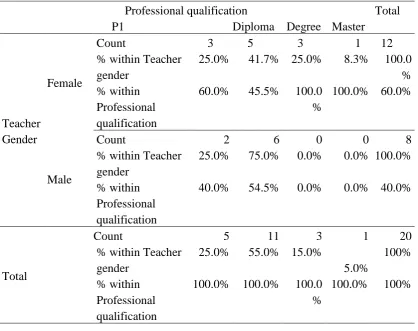
certification attained, class size based on number of pupils‟ teacher was handling, teacher experience on number of year taught, lesson per week on lesson taught in a week and capacity building on the basis of Social Studies related workshop, seminar and induction courses attended and frequency of attendance, where 1 represented; “termly” 2- “after six months” 3- “yearly” 4 – “not attended”. The teachers‟ gender was represented by 1- “female” and 2- “male.” Teacher personal variable were tabulated using cross tabulation on SPSS. The results are shown on table 4.3.
Table 4.3: Teacher Gender and Professional Qualification
Professional qualification Total P1 Diploma Degree Master
Teacher Gender
Female
Count 3 5 3 1 12 % within Teacher
gender
25.0% 41.7% 25.0% 8.3% 100.0 % % within
Professional qualification
60.0% 45.5% 100.0 %
100.0% 60.0%
Male
Count 2 6 0 0 8 % within Teacher
gender
25.0% 75.0% 0.0% 0.0% 100.0% % within
Professional qualification
40.0% 54.5% 0.0% 0.0% 40.0%
Total
Count 5 11 3 1 20 % within Teacher
gender
25.0% 55.0% 15.0% 5.0%
100% % within
Professional qualification
100.0% 100.0% 100.0 %
100.0% 100%
Source: Researcher (2017)
46
holders. In this case more female teacher had higher qualification than their male counterpart. The higher number of Diploma holder in Education was due to most colleges has opened up opportunities for higher education through school based programme. A quarter number of teachers were comfortable with P1 level of qualification hence they did not see the need to pursue higher education due to the fact that there was no promotion on higher qualification. It was evident that Social Studies teachers had pedagogic skills, ideas and knowledge for effective and quality learning.
47
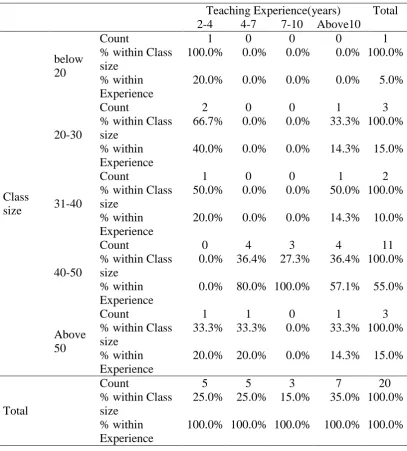
Table 4.4: Class size and Teaching Experience
Teaching Experience(years) Total 2-4 4-7 7-10 Above10
Class size
below 20
Count 1 0 0 0 1 % within Class
size
100.0% 0.0% 0.0% 0.0% 100.0% % within
Experience
20.0% 0.0% 0.0% 0.0% 5.0%
20-30
Count 2 0 0 1 3
% within Class size
66.7% 0.0% 0.0% 33.3% 100.0% % within
Experience
40.0% 0.0% 0.0% 14.3% 15.0%
31-40
Count 1 0 0 1 2 % within Class
size
50.0% 0.0% 0.0% 50.0% 100.0% % within
Experience
20.0% 0.0% 0.0% 14.3% 10.0%
40-50
Count 0 4 3 4 11 % within Class
size
0.0% 36.4% 27.3% 36.4% 100.0% % within
Experience
0.0% 80.0% 100.0% 57.1% 55.0%
Above 50
Count 1 1 0 1 3
% within Class size
33.3% 33.3% 0.0% 33.3% 100.0% % within
Experience
20.0% 20.0% 0.0% 14.3% 15.0%
Total
Count 5 5 3 7 20 % within Class
size
25.0% 25.0% 15.0% 35.0% 100.0% % within
Experience
100.0% 100.0% 100.0% 100.0% 100.0%
Source: Researcher (2017)
48
factor in teaching and learning process. It was clear that many Social Studies teachers had enough teaching experience for effective and quality learning.
4.2.4 Social Studies lesson per week and attendance of capacity building
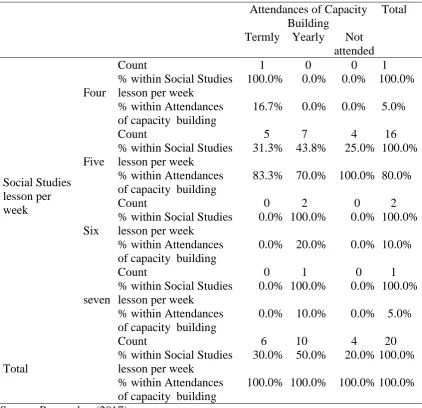
The researcher sought to establish whether Social Studies teacher followed stipulated number of lesson as per Social Studies syllabus in the MOE. The results are provided in table 4.5.
Table 4.5: Social Studies Lesson per Week and Attendances of Capacity Building
Attendances of Capacity Building
Total Termly Yearly Not
attended
Social Studies lesson per week
Four
Count 1 0 0 1
% within Social Studies lesson per week
100.0% 0.0% 0.0% 100.0% % within Attendances
of capacity building
16.7% 0.0% 0.0% 5.0%
Five
Count 5 7 4 16 % within Social Studies
lesson per week
31.3% 43.8% 25.0% 100.0% % within Attendances
of capacity building
83.3% 70.0% 100.0% 80.0%
Six
Count 0 2 0 2 % within Social Studies
lesson per week
0.0% 100.0% 0.0% 100.0% % within Attendances
of capacity building
0.0% 20.0% 0.0% 10.0%
seven
Count 0 1 0 1 % within Social Studies
lesson per week
0.0% 100.0% 0.0% 100.0% % within Attendances
of capacity building
0.0% 10.0% 0.0% 5.0%
Total
Count 6 10 4 20 % within Social Studies
lesson per week
30.0% 50.0% 20.0% 100.0% % within Attendances
of capacity building
49
The results in table 4.5 showed that majority of teacher (43.8%) attended capacity building on yearly basis had four lesson contray to the stipulated lesson per week by MOE. 30% of teachers who attended capacity building on termly basis had five lesson per recommendation of MOE while 20% who did not attend had four lesson. This was contary with (UNC ,2015) that assert that learning require continous professional development to update teacher with new teaching skills according to current trends in education. These results can be probably be attributed by no opportunities to attend, insufficient funds allocated to the subject at sub-county level. This implied that Social Studies teachers should be supported with continuous professional development in form of workshops and seminars at school levels to acquit them with warm and learner centered pedagogies according to changing educational trends.
4.3 Utilization of Instructional Materials on Pupils Learning Outcomes
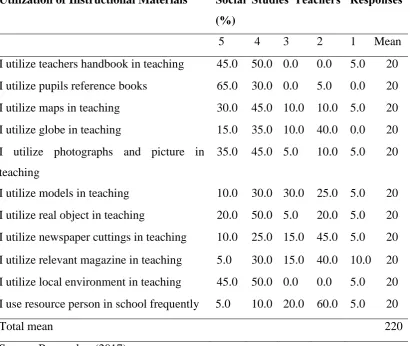
50
partially use”, 3 – “never use”- 4 “use “and 5 – “strongly use.” The Likert scale items were transformed then computed to a summated score to represent utilization of instruction materials using SPSS the results as shown in table 4.6 while pupil table 4.9 on utilization of instructional materials.
Table 4.6: Social Studies Teachers’ Responses on Utilization of Instructional Materials
Utilization of Instructional Materials Social Studies Teachers’ Responses (%)
5 4 3 2 1 Mean I utilize teachers handbook in teaching 45.0 50.0 0.0 0.0 5.0 20
I utilize pupils reference books 65.0 30.0 0.0 5.0 0.0 20 I utilize maps in teaching 30.0 45.0 10.0 10.0 5.0 20 I utilize globe in teaching 15.0 35.0 10.0 40.0 0.0 20 I utilize photographs and picture in
teaching
35.0 45.0 5.0 10.0 5.0 20
I utilize models in teaching 10.0 30.0 30.0 25.0 5.0 20 I utilize real object in teaching 20.0 50.0 5.0 20.0 5.0 20 I utilize newspaper cuttings in teaching 10.0 25.0 15.0 45.0 5.0 20 I utilize relevant magazine in teaching 5.0 30.0 15.0 40.0 10.0 20 I utilize local environment in teaching 45.0 50.0 0.0 0.0 5.0 20 I use resource person in school frequently 5.0 10.0 20.0 60.0 5.0 20
Total mean 220
Source: Researcher (2017)