IJEDR1602163
International Journal of Engineering Development and Research (www.ijedr.org)939
Comparative performance and emissions study of a
lean mixed DTS-i spark ignition engine operated on
single spark and dual spark
1
Hardik Bambhania,
2Vijay Pithiya,
3Rajendrakumar Jani
12 ME Student, 3Associate Professor123Mechanical Engineering Department 123L.D.College of Engineering, Ahmedabad, India
________________________________________________________________________________________________________
Abstract - An internal combustion (IC) engine has a predominant role in a low power generation and a virtual monopoly in mobile applications today. One of the best methods to improve the engine performance and reduce the exhaust emission in a SI engine is by using introduction of twin spark into the combustion chamber. In Present work DTS-i engine is operated with single spark and dual spark mode at 2000rpm and 3000rpm 0, 20%, 40%, 60% and 80% loading condition. Results shows that brake thermal efficiency for dual spark mode is higher as compared to single spark. Also there has been decrease in CO and NOx emission. But there is increase in HC emission.
Index Terms – Spark Ignition Engine, DTS-i.
________________________________________________________________________________________________________
I. INTRODUCTION
S.I. engine transforms chemical energy of a fuel into thermal energy, results in mechanical work. In a spark-ignition engine homogeneous mixture of vaporized fuel, air is ignited by high temperature spark between the spark plug electrodes.
DTS-i has two Spark plugs located at opposite ends of the combustion chamber and hence fast and efficient combustion is obtained. The benefits of this efficient combustion process can be felt in terms of better fuel efficiency and lower emissions. The ignition system on the Twin spark is a digital system with static spark advance and no moving parts subject to wear. It is mapped by the integrated 4 digital electronic control box which also handles fuel injection and valve timing. It features two plugs per cylinder. This innovative solution, also entailing a special configuration of the hemispherical combustion chambers and piston heads, ensures a fast, wide flame front when the air-fuel mixture is ignited, and therefore less ignition advance, enabling, moreover, relatively lean mixtures to be used. This technology provides a combination of the light weight and twice the power offered by two-stroke engines with a significant power boost, i.e. a considerable "power-to-weight ratio" compared to quite a few four stroke engines.
There are number of research paper and studies done and going on performance parameters, emission characteristic under various operating and loading conditions.
Ismail and Atila [1] have performed performance parameters of twin spark SI engine. Result conclude that center twin spark plug arrangement is favorable to single – spark plug configuration and faster burning and lower heat losses achieved by twin spark engines. Also fuel economy has a strong dependency on spark plug location for single-spark engine, but it is not much affected in twin-spark engine.
RamtilakA et al. [2] studied DTS-i engine under various compression ratio. Result shows that compression ratio increased from 9.65 to 9.85. Torque, Power and Specific consumption per liter increased and fuel consumption and emission decreased due to rapid fuel combustion by twin spark plug. At part load condition engine can run under leaner condition with excellent stability at Lambda of 1.2. Maximum flame travel length was reduced by 18 % on a bore size of 57 mm (150 DTS-i).
Nicolas et al. [3] investigated relation between flame propagation characteristics and hydrocarbon emissions under lean operating condition in SI engines. It conclude that when there is increase in air fuel ratio above stoichiometry condition there is increase in HC emission. This is because at leaner condition low flame speed and partial burning of fuel occur. These partial burning cycles is either of slow burning flame that has not completely combustion by the time exhaust valve open.
IJEDR1602163
International Journal of Engineering Development and Research (www.ijedr.org)940
II. EXPERIMENTAL SETUP AND TEST PROCEDUREThe four-stroke digital twins spark ignition engine used in this study has a displacement of 150cc and a compression ratio of 9.5:1. It is a single cylinder, naturally aspirated, forced air cooled with a bowl in piston combustion chamber and equipped with a single overhead camshaft (SOHC). The detail specifications of the engine are listed in Table 1.
Table 1 Specification of DTS-i Engine
Engine Type 4-Stroke Single Cylinder Air-Cooled
Engine Displacement(cc) 134.21 cc
Compression Ratio 9.5:1
Maximum Power 9.64kw (13.10 ps) @ 8500rpm
Maximum Torque 11.88 nm @ 6500 rpm
Cylinder Bore 67 mm
Stoke 56.4 mm
Ignition Microprocessor Controlled Digital CDI
The test was carried out on an Engine and torque is measure with the help of Rope Brake dynamometer. The engine crank-shaft is coupled with pulley by universal joint in the shaft for reducing shocks, vibration and prevents failure of shaft. Pulley is attached with the spring balance with the help of leather belt.
The fuel to the engine is supplied by a fuel tank through a burette having capacity of 50 CC by means of which the fuel consumption could be measured with a stopwatch. To avoid cyclic variation average data is considered
Exhaust gas temperature is measured by K Type Thermocouple which is indicated in K Type Temperature Indicator. Speed is measured by using tachometer.
Exhaust gas analyzer is used to measure the level of pollutants in the exhaust of the engine. The instrument is used for measuring HC (ppm), CO (% by vol.), CO2 (%by vol.), NOx and O2 (% by vol.). Probe of it was fitted in the engine exhaust pipe.
The performance parameters like brake power, break thermal efficiency, brake specific fuel and volumetric efficiency conservation were calculated from measured data. Emission analysis was carried for exhaust gas emissions.
The experiments were conducted at 2000 and 3000 rpm. The original spark plug ‘A’ was made to ignite at its standard ignition timing.
The test was conducted separately in single plug and dual plug mode of operation with pure gasoline as fuel at different load conditions. The different load conditions were 0%, 20%, 40%, 60% and 80% of the load capacity of the engine at 2000 and 3000 rpm. The schematic diagram of the engine test set up is shown in Fig 2.1
III. RESULT AND DISCUSSION
Results obtained from the experiments conducted with single and dual spark plugs at different loading conditions with constant rpm using pure gasoline under lean mixture are presented in Figures 2 to 12. All the results have been taken as per IS Standard and corrected to the atmospheric condition by multiplying with the correction factor.
Brake Thermal Efficiency v/s Load
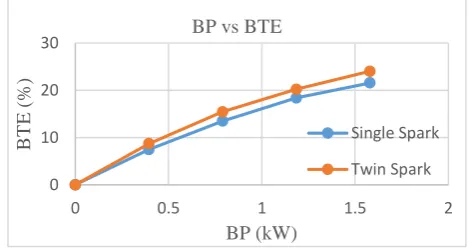
Fig. 3 and Fig. 4 shows variation of brake thermal efficiency with brake power for constant rpm at 2000 and 3500rpm.It is clear from graph that efficiency of dual spark is higher in all condition. Variation become more pronounced as load increases. Also it has been found out that as rpm increases from 2000 to 3000 the efficiency decreases. There is maximum upto 12.24% at increase in brake thermal efficiency at 60%load, 2000rpm and upto 11.36% at 80%load 3500rpm using SI engine in dual spark mode, this is due to dual spark gives faster and more complete burning.
0 10 20 30
0 0.2 0.4 0.6 0.8 1
B
T
E
(
%)
BP (kW)
BP vs BTE
Single Spark
Twin Spark
0 10 20 30
0 0.5 1 1.5 2
B
T
E
(
%)
BP (kW) BP vs BTE
Single Spark
Twin Spark
Figure 1 Brake Power vs Brake Thermal Efficiency at
IJEDR1602163
International Journal of Engineering Development and Research (www.ijedr.org)941
Brake Power vs Brake Specific Fuel ConsumptionFig. 4 and Fig. 5 shows variation of brake power vs brake specific fuel consumption at 2000rpm and 3500rpm. Initially at low load brake specific fuel consumption is higher but as load increases at constant rpm brake specific fuel consumption decreases. Results obtain states that for all condition dual spark have lower brake specific fuel consumption. Initially at 20% load with 2000rpm 14.89% and 14.08% at 3500rpm decrease in brake specific fuel consumption has found operated at single spark and dual spark.
Brake Power vs Volumetric Efficiency
Fig. 6 and Fig. 7 shows variation of brake power vs volumetric efficiency at 2000rpm and 3500rpm. Results show that volumetric efficiency increases with increasing in load. Dual spark exhibits higher volumetric efficiency under all condition. This is due to dual spark enable complete combustion and hence more amount of air utilize in combustion chamber. It has been found out that upto 3.77% increase at 2000rpm and 4.62% increase at 3500rpm. With increase in load the rate of increase in volumetric efficiency becomes slower. As rpm increase the volumetric efficiency under same load has been decreases
Brake Power vs Equivalent Ratio
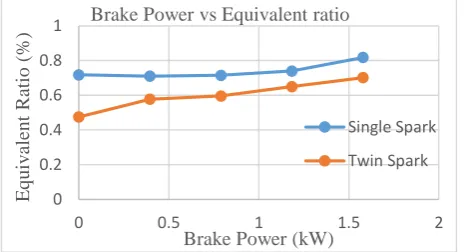
Figure 8 and figure 9 shows brake power vs equivalent ratio at 2000rpm and 3000rpm. Result indicates equivalent ratio is under 1 in all condition hence lean mixture is maintain.
0 0.5 1 1.5
0 0.5 1 1.5 2
B SF C ( k g /k W -h r) BP (kW) BP vs BSFC
Single Spark Twin Spark 0 0.5 1 1.5
0 0.2 0.4 0.6 0.8 1
B SF C ( k g /k W -h r) BP (kW) BP vs BSFC
Singl Spark
Twin Spark
Figure 4 Brake Power vs Brake Specific Fuel
Consumption at 2000rpm Figure 5 Brake Power vs Brake Specific Fuel Consumption at 3500rpm
0 20 40 60 80
0 0.5 1 1.5 2
Vo lu m etr ic E ff icien cy (% )
Brake Power (kW)
Brake Power vs Volumetric Efficiency
Single Spark Twin Spark 0 20 40 60 80
0 0.5 1
Volu m etric Ef fici en cy (% ) BP (kW)
Brake Power vs Volumetric Efficiency
Single Spark
Twin Spark
Figure 6 Brake Power vs Volumetric Efficiency at 2000rpm
Figure 7 Brake Power vs Volumetric Efficiency at 3500rpm 0 0.2 0.4 0.6 0.8
0 0.2 0.4 0.6 0.8 1
E q u iv alen t R atio ( %)
Brake Power (kW)
Brake Power vs Equivalent Ratio
Single Spark
Twin Spark
Figure 8 Brake Power vs Equivalent Ratio at 2000rpm 0 0.2 0.4 0.6 0.8 1
0 0.5 1 1.5 2
E q u iv alen t R atio ( %)
Brake Power (kW) Brake Power vs Equivalent ratio
Single Spark
Twin Spark
IJEDR1602163
International Journal of Engineering Development and Research (www.ijedr.org)942
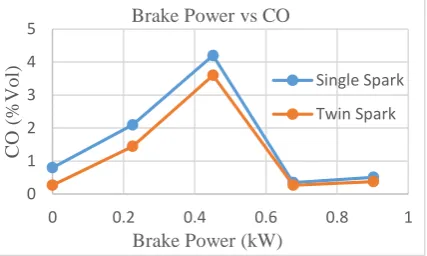
Brake Power vs COFigure 10 shows brake power vs CO emission ratio at 2000rpm There is not much difference in CO emission, but comparatively dual spark has lower CO emission till 60% loading condition and at 80% load single spark and dual spark exhibit same CO emission.
Brake Power vs HC
Figure 11 shows brake power vs HC emission at 2000rpm. Here as graph indicates for dual spark the HC emission is higher than single spark. This is because the exhaust gas temperature for dual spark condition is more this enhances more HC emission.
Another conclusion can be drawn out that at 80% load there is sudden increase in HC emission.
Brake Power vs NOx
Figure 12 shows brake power vs NOx emission at 2000rpm. As load increases the curve stars linearly but at 80% load a sudden decrease has been found out. Dual spark has low NOx emission as compared to single spark
IV. CONCLUSION
From the above discussion dual spark has higher brake thermal efficiency as compared to single spark. Maximum upto 12.24% at increase in brake thermal efficiency at 60%load, 2000rpm and upto 11.36% at 80%load 3500rpm using SI engine in dual spark mode Dual spark have lower brake specific fuel consumption. At 20% load with 2000rpm 14.89% and 14.08% at 3500rpm decrease in brake specific fuel consumption has found operated at single spark and dual spark. Volumetric efficiency increases with
0 1 2 3 4 5
0 0.2 0.4 0.6 0.8 1
CO
(%V
o
l)
Brake Power (kW) Brake Power vs CO
Single Spark
Twin Spark
Figure 10 Brake Power vs CO
0 50 100 150
0 0.2 0.4 0.6 0.8 1
HC
(
p
p
m
)
Brake Power (kW) Brake Power vs HC
Single spark
Twin Spark
Figure 11 Brake Power vs HC
0 50 100 150
0 0.2 0.4 0.6 0.8 1
NOx
(
p
p
m
)
Brake Power (kW) Brake Power vs NOx
Single Spark
Twin Spark
IJEDR1602163
International Journal of Engineering Development and Research (www.ijedr.org)943
increasing in load. Dual spark exhibits higher volumetric efficiency under all condition. Volumetric Efficiency increases upto 3.77% increase at 2000rpm and 4.62% at 3500rpm. There is decrease in CO and NOx emission for dual spark. But there in increase in HC emission for dual spark as compared to single spark. This is because with dual spark operation the exhaust gas temperature is higher.REFERENCES
PAPER
[1] Ismail Altın a, AtillaBilgin b “A parametric study on the performance parameters of a twin-spark SI engine” Energy Conversion and Management 50(2009).
[2] Ramtilak, A., Joseph, A., Sivakumar, G., and Bhat, S., "Digital Twin Spark Ignition for Improved Fuel Economy and Emissions on Four Stroke Engines," SAE Technical Paper 2005-26-008, 2005, doi:10.4271/2005-26-008.
[3] Nicolas Hadjiconstantinou, Kyoungdoug Min and John B. Heywood, “Relation Between flame propagation characteristics and hrdrocarbon emissions under lean operating conditions I spark ignition”, Sloan Automotive Laboratory Massachusetts Institute of Technology Cambridge, MA 02139, USA.