Copyright © 2014 IJECCE, All right reserved
An Adaptive ANT Algorithm for Wireless Mobile Sensor
Network
Dr. Tarun Kumar
Associate Professor, Deptt. Of CSE Radha Govind Groups of Institutions MeerutEmail: [email protected]
Ms. Paramjeet Kaur
M.Tech. (CS) StudentRadha Govind Groups of Institutions Meerut Email: [email protected]
Abstract – In this article we study the performance of Multipath Dynamic Routing Algorithm (MDRA) in Wireless Mobile Sensor Networks (WMSNs), which is based on Swarm Intelligence (SI) or ANT Based Routing Algorithm. The WMSNs is a collection of Mobile nodes which communicate over radio. These kinds of networks are very flexible, thus they do not require any existing infrastructure or central administration. The WMSNs are suitable for temporary communication links. The biggest challenge for such kind of networks is to find a path between the communication end points, what is aggravated through the node mobility. Due to the unstable nature of WMSNs, memory based search algorithms become inefficient and impractical as the network mobility increases. The Adaptive ANT based routing algorithm exploits a dual-mode approach. Each node can independently operate in a local mode as well as in global mode using the information provided by ants. At the same time, the random disturbance is added to prevent premature convergence into local optimal path. The comparison simulations will show that memory based routing algorithms suffer from lack of accuracy while incurring extensive memory usage as well as valuable processing power and bandwidth costs in highly dynamic environments.
Keywords – Multipath Dynamic Routing Algorithm (MDRA), Wireless Mobile Sensor Networks (WMNs), Swarm Intelligence (SI), ANT Based Routing Algorithm, Dual-mode
Approach Network Mobility, Premature Convergence,
Processing Power and Bandwidth.
I. I
NTRODUCTIONToday technological advances are enabling the deployment of wireless mobile sensor networks for many different applications. Such applications are also varied in scope and purpose, ranging from object tracking, structural health monitoring, habitat monitoring and monitoring of the environment and its resources. In the future, with such sensors attached to cars, other electronic devices and human bodies, we will live immersed in an all pervading sensorsphere that is composed by the internetworking of various sensor network applications, i.e., a huge networked collection of spatially distributed data collector and actuator points. To utilize the resources existent in such sensorsphere, an appropriate routing infrastructure must exist. We propose establishing an attribute-based hierarchical clustering structure in the sensor network. The attributes chosen must satisfy locality based relationships (we propose two: containment and adjacency relationships) and may reflect the frequency with which they are present in the inquiries. The clustering mechanism joins attribute equivalent sensors together. Clusterheads in
this context act as attribute-based routers, and can support different routing schemes based on the application needs. Routing in Wireless Mobile Sensor Networks (WMSNs), due to their highly dynamic topology and limited bandwidth is a challenging issue. Routing protocols in traditional wired networks could exploit high processing power and bandwidths available for them to implement broadcasting link-state like protocols or high-process demanding AI based algorithms to solve quality of service related optimization problems [1]. One of the routing protocols considering quality of service is Ant-Net [2]. Ant-Net is based on the shortest path behavior observed in ant colonies and on the related optimization framework of Ant Colony Optimization (ACO) [2].
It has been experimentally observed that ants in a colony can converge on moving over the shortest among different paths connecting their nest to a source of food [3, 4]. Real ants wander stochastically around their nests to forage (Search for food). Upon finding food, they return back to their nests and simultaneously deposit pheromone trails along the paths. Since ants tend to follow the pheromone trails, they are more likely biased towards such paths, and as a result they may not keep on traveling quite randomly. Therefore, they likely move through these paths and reinforce the existent pheromone. This kind of indirect communication is called stigmergy [2] in the biology and entomology literatures. These simple behaviors are sources of inspiration for a class of algorithms called Ant Colony Optimization (ACO). ACO has been applied successfully to a variety of combinatorial problems such as traveling salesman, vehicle routing, job scheduling as well as to routing.
Copyright © 2014 IJECCE, All right reserved limitations which degrade the overall network
performance. AntHocNet [7] has proposed a comprehensive routing algorithm based on ACO for Wireless Networks. AntHoc-Net is comprised of both a proactive and a reactive component. The reactive component is triggered during route setup phase at the start of a data session. The paths are then monitored, maintained and improved proactively while the data session is in progress. Therefore, the ants are not dispatched pro-actively to explore the network before the start of a data session and hence no topology and link-status information are learnt by the ants. This can mitigate the quality of paths discovered particularly when some QoS parameters other than delay is to be optimized.
II. P
RE-C
ONCEPTF
UNDAMENTALSEvery research has some pre-concepts. This section has the pre-concepts of Multipath Dynamic Routing Algorithm (MDRA) and the basics of the Swarm Intelligence or the ANT Colony Optimization Algorithms.
2.1 MDRA
MDRA or Multi-Path Dynamic Routing Algorithm introduced in [8], tries to find multiple disjoint paths from a given source to a destination while guaranteeing that these paths altogether satisfy a given end-to-end reliability Pu where 0 < Pu≤ 1.MDRA achieves route discovery by
determining the number of paths to be discovered (m0) and the lowest reliability (Plower) that each of the m0paths
must have so that the Pureliability can be satisfied. Once,
the appropriate values for the parameters at the source node is calculated, the source node sends m0 Route
Request (RREQ) messages to search for feasible paths. Each RREQ message contains useful information such as, the path it has traversed so far (pathVector), the
pathVector’s corresponding accumulated reliability Pacc
and the lowest reliability Plower. When an intermediate
node receives an RREQ message, it investigates whether or not Pacc is greater than Plower. If pace is less than Plower,
the message is discarded. Otherwise, it appends itself to the pathVector and calculates the new Pacc and then
forwards at most m0 copies of the modified message to its neighbors. After a while, the destination node collects some of the RREQ messages. Using the pathVectors stored in RREQ messages, the destination node uses a path selection algorithm to pick the set of disjoint paths that can satisfy Pu. Two paths are considered disjoint if they only
share a source and a destination node and not any intermediate node. The destination node subsequently responds to the source by sending Route Reply (RREP) messages through the selected paths. The source node commences sending the data packets through the selected paths thereafter.
2.2 Swarm Intelligence & ANT Colony Optimization
2.2.1. Swarm Intelligence (SI):
It is a type of artificial intelligence based on the collective behavior of decentralized, self-organized systems. The expression was introduced by Gerardo Beni and Jing Wang in 1989, in the context of cellular robotic systems. SI systems are typically made up of a population
of simple agents or boids interacting locally with one another and with their environment. The agents follow very simple rules, and although there is no centralized control structure dictating how individual agents should behave, local, and to a certain degree random, interactions between such agents.
2.2.2. ANT Colony Optimization:
Two of the most successful swarm intelligence techniques are Ant Colony Optimization (ACO) and Particle Swarm Optimization (PSO). ACO is a meta-heuristic optimization algorithm that can be used to find approximate solutions to difficult combinatorial optimization problems. In ACO artificial ants build solutions by moving on the problem graph and they, mimicking real ants, deposit artificial pheromone on the graph in such a way that future artificial ants can build better solutions. ACO has been applied successfully to an impressive number of optimization problems. PSO is a global minimization technique for dealing with problems in which a best solution can be represented as a point or surface in an n-dimensional space. ACO is application of ant’s behavior to complex computational optimization problems. ACO is inspired by the foraging behavior of ant colonies, wherein they are able to find shortest path between two points through collective learning. Learning is achieved by deposition of a chemical called pheromone. ACO is based on real ant’s behavior in finding a route to food nest. It has been observed that of available routes, ants find shortest route to food nest. To achieve this, ant communicates through deposition of chemical substance called pheromone along the route. Shortest path has highest concentration leading to more and more ants using this route.
III. B
ASICANT A
LGORITHMThe basic idea of the ant colony optimization Meta heuristic is taken from the food searching behavior of real ants. Figure 2.1 shows a scenario with two routes from the nest to the food place. At the intersection, the first ants randomly select the next branch. Since the route below is shorter than the upper one, the ants that take this path will reach the food place first.
Fig.2.1. Ants take the shortest path after an initial searching time
Copyright © 2014 IJECCE, All right reserved
3.1 Ant Multipath Dynamic Routing Algorithm
(MDRA)
Dynamic Source Routing (DSR) protocol is an on-demand routing protocol that is based on the idea of source routing. Mobile nodes are required to maintain route caches that contain the source routes of which the mobile is aware. Entries in the route cache are continually updated as new routes are learnt. The protocol consists of two major phases: route discovery and route maintenance. Local traffic statistics defines a simple parametric statistical model for traffic distribution over the network as seen by node k. In fact, it keeps track of the amount of traffic flows towards each possible destination. Routing table, for each possible destination d and for each node n, stores a probability value Pnd which expresses the
desirability of selecting n as the next node when the destination node is d. In fact it shows amount of pheromone deposited on the link (k, n). When an ant at node k heads toward a destination node d, it selects the next neighbor node n with the probability P′nd where we
have
1 1
nd n
nd
k
P l
P'
N
(1)
Where
1
1 n
n Nk
n n'
q l
q'
(2)
IV. T
HED
ESIGN OFA
DAPTIVEM
ULTI-P
ATH ANDP
OWER-S
AVINGANT C
OLONYR
OUTINGA
LGORITHMThe designing of the adaptive multipath ant colony based algorithm is based on multi-node data transmission and limited energy consumption at nodes of the wireless mobile network, this paper improves basic ant colony algorithm and MACE algorithm, combining with AODV routing protocol, which gives the new features and path search method to ants. Here introduces the relevant definitions in the research.
Step 1:
from source nodes to destination nodes the path search ants are called forward ants, they performs the path search function, and establish the reverse pheromone table.Step 2:
after the forward ants reach the destination nodes, from the destination nodes returning to the source nodes, these ants are called backward ants, which performs the pheromone update function, and establish the routing table.Step 3:
in the path search process, forward ants reach a certain node to establish the routing table which points to the source nodes and be called reverse pheromone table, which includes the source node, next node, the reverse node pheromone(i, j) .4.1. Rules of Routing Selection
Ants from source routers set out to the end of router d, in each step of the constructed journey, the ant k chooses rule according to the probability behavior known as a
random proportion rule, and to determine the next step will move to which one of router nodes. If the ant k is currently locating at router i, the probability of choosing j as the next visit city is:
ij ij
k k
ij
ij ij k
l N
P , j N
(3)In the above expression, ij = dij -1 represents an in
advance given heuristic information, α and β are two parameters, they decides relative influence of pheromone heuristic information Nikrepresents the set of the adjacent
cities that ant k situated in city i can directly arrive, i.e., the collection of all cities that have not been visited by ant k (the possibility is 0 to choose one from Nikcities). Under
this probability rule, the probability of choosing some edge (i, j) is decided by the corresponding pheromone ij
and heuristic information valueijof this edge.
4.2. Updates of Pheromone Information
When all the ants complete the building of path, that is after reaching the destination router node, the pheromone on each edge will be updated, namely ANT-CYCLE model, and there are also other methods, such as it will update once after the ant passes a node, experiments show that update is better after reaching the destination. First of all, all the pheromone on all edges will reduce the size of a constant factor, and the pheromone will be increased on the edges that ants pass through. The evaporation of pheromone executes according to the following:
ij (1-)ij ,where (i,j)L (4) Among them ρ is the evaporation rate of pheromone, 0<ρ ≤1. The role of ρ parameter is to avoid the pheromone’s infinite accumulation, and still can make the algorithm "forget" the selection of poorer path ago, to reduce the occurrence of local optimum. After the evaporation step of pheromone, all the ants release pheromone on the passing edges:
ij ij +∑ijk,where (i,j)L (5) Among them, Δτij
k
is the pheromone amount that the ant k releases to the passed edges. Δτijk is defined as:
1/ if edge ( ) is in path 0 otherwise
k k
k ij
C , i, j T
,
(6)
Inside the expression, Ckrepresents the length of path T k that ant k established, that is the sum of all the length of edges in Tk. According expression (6), better is the path constructed by ants, more pheromone will be obtained on each edge of the path. Generally speaking, if an edge is selected by more ants, and the total length of the path including this edge is shorter, thus this edge will get more pheromone, and in the later iteration it is more likely chosen by ants.
V. E
XPERIMENTALR
ESULTS ANDA
NALYSISCopyright © 2014 IJECCE, All right reserved are randomly (uniformly) distributed over the field. This
means that the horizontal and vertical coordinates of each node are randomly selected between 0 and the maximum value of the dimension. The sink is in the center and so, the maximum distance of any node from the sink is approximately 70m. The initial energy of a normal node is set to E0 = 0.5 Joules—although this value is arbitrary for the purpose of this study, this does not affect the behavior of our ACO-LBR protocol. The radio characteristics used in our simulations are summarized in Table 3. The size of the message that nodes send to their cluster heads as well as the size of the (aggregate) message that a cluster head sends to the sink is set to 4000 bits.
Table 1: Radio characteristics used in our simulations
Operation Energy Dissipated
Transmitter/Receiver Electronics
Eelec = 50nJ/bit Data Aggregation EDA = 5nJ/bit/report Transmit Amplifier if
dtoBS≤d0
fs = 10pJ/bit/m2
Transmit Amplifier if dtoBS≥d0
mp = 0.0013pJ/bit/m4
5.1. Results for ACO-LBR:
The results of our ACO-LBR simulations are shown in Figure 4 (top) for m = 0.1 and α = 2. We observe that ACO-LBR takes some advantage of the presence of heterogeneity (advanced nodes), as the first node dies after a significantly higher number of rounds (i.e. longer stability period) compared to the homogeneous case (m = α = 0). The lifetime of the network is increased, but as we will show later this does not mean that the nodes transmit (i.e. the throughput may be low.) The reason is that after the death of a significant number of nodes, the cluster head election process becomes unstable and as a result fewer nodes become cluster heads. Even worse, during the last rounds, there are only few rounds where more than one cluster head are elected.
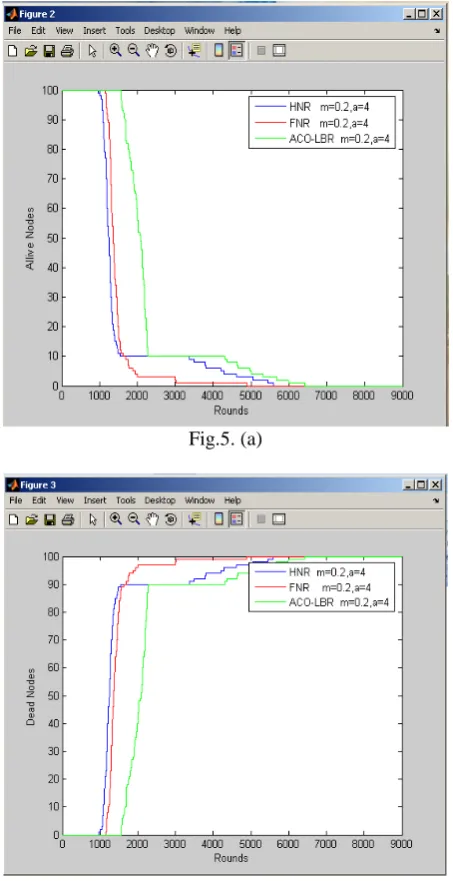
We repeat the same experiment, but now the heterogeneity parameters are set to m = 0.2 and α = 1, however m × α remains constant. Our simulation results are shown in Figure 5(bottom). Although the length of the stability region (until the first node dies) is pretty stable, ACO-LBR takes more advantage of the presence of heterogeneity manifested in a higher number of advanced nodes. In Figure 4, a detailed view of the behavior of ACO-LBR is illustrated, for different distributions of heterogeneity. In Figure 5(a), the number of alive nodes is shown for the scenarios (m = 0.2, α = 1) and (m = 0.2, α = 3). ACO-LBR fails to take full advantage of the heterogeneity (extra energy) as in both scenarios; the first node dies almost at the same round. Moreover, the normal nodes die in both cases very fast (Figure 5(b)) and as a result the sensing field becomes sparse very fast. On the other hand, advanced nodes die in a very slow fashion (Figure 5(c)), because they are not elected very often as cluster heads after the death of the normal nodes (and thus they do not transmit most of the time)—this is because the election process for cluster heads has become unstable and
the number of cluster heads elected are less than the optimal number. Furthermore, as shown in Figure 5(b), when a significant number of normal nodes are dead the average number of cluster heads per round per epoch is less than one. This means that in most of the rounds there is no cluster head, so in our model the remaining nodes cannot report their values to the sink.
5.2. Results for HNR & FNR:
In this subsection we compare the performance of our ACO-LBR protocol to HNR & FNR in the same heterogeneous setting, where the extra initial energy of advanced nodes is uniformly distributed over all nodes in the field. This latter setting turns out to provide the highest throughput during the unstable region-we henceforth refer to it. Figure 7(top) shows results for the case of m = 0.2 and α = 1. It is obvious that the stable region of ACO-LBR is extended compared to that of HNR (by 8%), and FNR (by 10%) even though the gain is not very large.
Fig.5. (a)
Copyright © 2014 IJECCE, All right reserved Fig.5. (c)
R
EFERENCES[1] Joan Triay, Cristina Cervelló Pastor. An Ant-Based Algorithm for Distributed Routing and Wavelength Assignment in Dynamic Optical Network [J]. IEEE Journal On Selected Areas In Communications, Vol. 28, No. 4, May 2010:542-552.
[2] ZHENG Yan-lei, GU Wan-yi, HUANG Shan-guo, ZHANG Pei. An Ant-Based Research on RWA in Optical Networks[C]. 2009 International Conference on Electronic Computer Technology, 2009:73-76.
[3] G. Breed, “Wireless ad hoc networks: Basic concepts,” High Frequency Electronics, 2007, pp. 44-46.
[4] W. Ke, S. A. Ayyash, P. Basu, and T. D. C. Little. Attribute-Based Clustering for Information Dissemination in Wireless Sensor Networks. In Proc. 2nd Annual IEEE Communications Society Conference on Sensor and Ad Hoc Communications and Networks (SECON’05), Sant Clara, CA, USA,September 2005. [5] G. D. Caro, F. Ducatelle, and L. M. Gambardella, “AntHocNet:
An ant-based hybrid routing algorithm for mobile ad hoc networks,” in Proceedings of the 8th International Conference on Parallel Problem Solving from Nature, Vol. 3242, 2004, pp. 461-470.
[6] ANSI. Information processing systems: local area networks, Part 11. Wireless LAN Medium Access Control (MAC) and Physical Layer (PHY) Specifications. American National Standards Institute,1430 Broadway, New York, NY 10018, USA, ANSI/IEEE Std 802.11-1999 edition. International standard ISO/IEC 8802-11, IEEE edition, 2003. ISBN 0-7381-1658-0. [7] J. S. Baras and H. Mehta, “A probabilistic emergent routing
algorithm for mobile ad hoc networks,” in Proceedings of the Conference on Modeling and Optimization in Mobile, Ad Hoc and Wireless Networks, 2003, pp. 20-24.
[8] M. Gunes, U. Sorges, and I. Bouazizi, “ARA − The antcolony based routing algorithm for MANETs,” in Proceedings of International Conference on Parallel Processing Workshops, 2002, pp. 79-85.
[9] M. Dorigo, G. D. Caro, and L. M. Gambardella, “Ant algorithms for distributed discrete optimization,” Artificial Life, Vol. 5, 1999, pp. 137-172.
[10] G. D. Caro and M. Dorigo, “AntNet: Distributed stigmergetic control for communications networks,” Journal of Artificial Intelligence Research, Vol. 9, 1998, pp. 317-365.
A
UTHOR’
SP
ROFILEDr. Tarun Kumar
He holds Masters in Information Technology from GGSIP Delhi and Ph.D. in Computer Science & Engineering from Bansthali University Bansthali (Raj), India. His research areas include Computer Networks, Object Oriented Techniques, and Genetic Algorithms. His areas of teaching interest include Software Engineering, Distributed Computing and Web Technologies. He has published various papers in National and International Journals and Conferences.