IJEDR1602099
International Journal of Engineering Development and Research (www.ijedr.org)560
Effect of burnishing process parameters on surface
Quality- A Review
1 R. G. Solanki1, 2Kiran. A. Patel, 3R. B. Dhruv 1ME scholar, 2Lecturer, 3Lecturer Production Engineering Department,
LDRP Institute of Technology and Research, Gandhinagar, India.
________________________________________________________________________________________________________ Abstract – In present era of globalization for every industry, surface quality of machined components is of utmost importance. The product functionality and reliability depends on the surface quality. Whatever may be the manufacturing process used, it is impossible to produce perfectly smooth surface. The imperfections and irregularities are bond to occur in some form of peaks and valleys on the machined components. In burnishing, a hard and highly polished ball or roller is used to flatten this rough peaks into the valleys by plastic deformation. Burnishing is a very simple, effective and chip less manufacturing method. Quality of the burnished components greatly depends upon the various burnishing parameters which includes speed, feed, depth of cut, No. of tool passes, burnishing force etc. This paper presents the reviews of different works in the area of burnishing and effect of various burnishing parameters on the surface characteristics like surface roughness, hardness, microstructure properties, fatigue strength, corrosion resistance, wear resistance, etc.
Index Terms -Burnishing process, burnishing parameters, Surface characteristics
________________________________________________________________________________________________________
I. INTRODUCTION
In today’s competitive market, surface quality is one of the most specified customer requirements. Major indication of surface quality on machined components is surface finish. Surface finish not only gives good appearance to the material, but also increases the properties of the material such as increase in the surface hardness, decrease in surface roughness and increase in the load carrying capacity of the material. Now, in recent years, a process namely burnishing is commonly used to increase the surface finish of the material. Also surface characteristics are improved by plastic deformation in burnishing.
Burnishing offers an attractive post-machining alternative due to its chip less and relatively simple operation. Schematic working principle of burnishing process is shown in Fig. 1[1]. In burnishing, the force or pressure is applied through a hard ball or roller and when this pressure exceeds the yield strength of the material plastic deformation takes place that lead to the plastic flow of metal from the rough peaks to fill the valleys and thereby surface roughness decreases. Besides producing a good surface finish, the burnishing process has additional advantages over conventional finishing processes such as securing increased hardness, fatigue life, corrosion resistance, wear resistance etc.
Figure 1. Schematic working principle of burnishing process [1] II.
Literature Review
IJEDR1602099
International Journal of Engineering Development and Research (www.ijedr.org)561
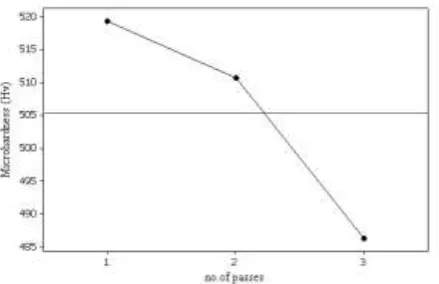
and predicted values at the optimal combination of parameter settings for surface roughness was calculated as 2.82%. N.S.M. El-Tayeb et al. [5] designed and fabricated simple and inexpensive burnishing tools, with interchangeable adapter for ball and roller burnishing. The test material used was aluminium 6061 under different parameters and different burnishing orientations to investigate the effect of burnishing speed, burnishing force and burnishing tool dimension on the surface qualities and tribological properties.The results showed that burnishing speed of 330 rpm and burnishing force of 160N produce optimum results and a decrease in the burnishing ball diameter leads to a considerable improvement in the surface roughness up to 75%. The friction coefficient of burnished surfaces is dependent on the surface roughness. Low friction coefficient corresponds to low surface roughness. Malleswara Rao J. N. et al. [6] studied the effect of roller burnishing on surface hardness and surface roughness on mild steel specimens. The considered burnishing parameters were burnishing force and No. of tool passes. The results show that the surface hardness of mild steel specimens increases with increase in the burnishing force up to 42 kgf. Further increase of burnishing force results in the decrease of surface hardness on mild steel specimens. The maximum surface hardness obtained is 70 HRB. And Maximum reduction in surface roughness is observed in first five passes on mild steel by Roller Burnishing operation. The effect of burnishing speed, feed, number of passes and depth of penetration on the surface micro hardness of Al 6061 was measured by Ashish Deshmukh et al. [7]. In this, DOE using Taguchi’s L9 array was planned to find out the effect of burnishing parameters on response variable. The outcome revealed that the single roller burnished samples of Aluminum 6061 lead to the enhancement in surface micro hardness.Figure 2. Main effects plot of micro hardness Vs. various burnishing process parameter
IJEDR1602099
International Journal of Engineering Development and Research (www.ijedr.org)562
Figure 3. Main Effect Plot for Means for roller and ball burnishing
IJEDR1602099
International Journal of Engineering Development and Research (www.ijedr.org)563
IJEDR1602099
International Journal of Engineering Development and Research (www.ijedr.org)564
Figure 5. Speed, feed, No. of passes vs. Micro hardnessThe effect of various parameters i.e. tool diameter, burnishing speed and burnishing feed on the surface characteristics such as surface roughness and micro hardness are evaluated by Hussein Mesmari et al. [16]. Taguchi method is used to formulate the experimental layout and analyzing the effect of each parameter on the burnishing characteristics, and predicting the optimal choice of each parameter. The result showed that tool diameter mainly affects the surface roughness, while the tool diameter and burnishing speed significantly affects the surface micro hardness. C. S. Jawalkar et al. [17] has conducted the experiments to find optimize value for enhancing the surface quality and hardness economically in roller burnishing process. They have considered the input parameters of roller burnishing process were spindle speed, tool feed, number of passes and lubricants. The surface roughness and micro hardness were main response variables. The commonly used industrial material EN 8 is selected as a work piece for experimental purpose. Taguchi’s standard L9 orthogonal array was used. ANOVA analysis was applied to find out most significant roller burnishing process parameters. After the experimental work they concluded that the number of passes, feed and spindle speed contribute maximum for surface roughness in burnishing for EN 8 material. Number of passes and speed contribute maximum percentage in surface hardness for burnishing of EN 8 due to hard hardening effect. Ghodake A. P. et al. [18] reviewed the effect of burnishing process on the behavior of engineering materials. Their conclusions include – force and number of tool passes are the important parameters to improve ductility of materials. Burnishing greatly affects frictional co-efficient and improves wear resistance of materials.
III. CONCLUDING REMARKS
From the literature review it was found that there is wide applicability of process parameter in the field of burnishing process. The present review has led to the following conclusions.
‒ Reduction in the surface roughness and the increase in hardness with increase in the initial hardness of the burnished work pieces were identified by the application of burnishing process.
‒ When the burnishing process continuously takes place for longer period of time, hardness and surface finish increased significantly. burnishing parameters have significant effect on the surface hardness and wear resistance.
‒ Burnishing is an economical and feasible mechanical treatment for the quality improvement of rotating components, not only in surface roughness but in compressive residual stresses as well.
‒ Ball-burnishing improves both physical and mechanical properties of turned parts. Particularly, this technique improves the surface quality (even reaching 0.3 μm Ra), increases the hardness of the workpiece surface (up to 60% Brinell) and introduces compressive residual stresses, which are favourable for increasing the fatigue life of the piece and improve the wear resistance of the component.
‒ Roller burnishing also gives better result in drilled hole.
IV. REFERENCES
[1] I. Ovali and A. Akkurt, Comparison of Burnishing Process with Other Methods of Hole Surface Finishing Processes Applied on Brass Materials, Materials and Manufacturing Processes, 26(8) 2011,1064-1072.
[2] K Rababa and M Mohammad Al-mahasne, Effect of Roller Burnishing on the Mechanical Behavior and Surface Quality of O1 Alloy Steel, Research Journal of Applied Sciences, Engineering and Technology, 3(3), 2011, 227-233.
[3] A Sagbas, F Kahraman, DETERMINATION OF OPTIMAL BALL BURNISHING PARAMETERS FOR SURFACE HARDNESS, Materiali in tehnologije / Materials and technology, 43(5), 2009, 271–274.
[4] A Sagbas, Analysis and optimization of surface roughness in the ball burnishing process using response surface methodology and desirabilty function, Advances in Engineering Software, 42(11), 2011, 992–998.
IJEDR1602099
International Journal of Engineering Development and Research (www.ijedr.org)565
Processes, 23(3), 2008, 295–302.[12]M.H. El-Axira, O.M. Othmanb, Study on the inner surface finishing of aluminium alloy 2014 by ball burnishing process, journal of materials processing technology, 202(1), 2008, 435–442.
[13]A. Rodríguez, L.N. López de Lacalle, A. Celaya, A. Lamikiz, J. Albizuri, Surface improvement of shafts by the deep ball-burnishing technique, Surface & Coatings Technology, 206911), 2012, 2817–2824.
[14]V Patel, T.S Bisoniya, Experimental investigation of effect of machining parameters on surface roughness in roller burnishing process, International Journal for Technological Research in Engineering,2(9), 2015.
[15]P. S. Kamble, V. S. Jadhav, Experimental study of Roller burnishing process on plain carrier of planetary type gear box, International Journal of Modern Engineering Research, 5(2), 2012, 3.
[16]H Mesmari, I EL Bukhari, Investigation on internal roller burnishing process of al- 2024-t361 surface roughness and micro hardness characteristics, International Journal of Advanced Technology & Engineering Research, 6(4), 2014.
[17]C. S. Jawalkar and R. S. Walia, Study of Roller Burnishing Process On EN8 Specimens Using Design of Experiments, Journal of Mechanical Engineering Research, 1(1), 2009, 038-045.
![Figure 1. Schematic working principle of burnishing process [1]](https://thumb-us.123doks.com/thumbv2/123dok_us/8322939.1380113/1.595.162.442.490.664/figure-schematic-working-principle-burnishing-process.webp)