Structural and Optical Properties of Copper doped Lanthanum Strontium Borate Glasses
Thontadharyadeekshith.M1, Rojashree.S1,Suraj.K1, Abhiram.J1*,R.Rajaramakrishna1*, Rajashekara K M2
1
Department of Post Graduate and Research in Physics, The National College Jayanagar, Bangalore
2
Department of Physics, S.J.C.I.T., Chikkaballapura
Abstract
The glass composition of 10La2O3-30SrO-60B2O3-xCuO, where x = 0, 0.1, 0.2, 0.5 and 1 (in mole %) has
been synthesized by the conventional melt quench technique. The powder X-Ray diffraction analysis of the prepared samples confirms the amorphous nature of the samples. Density measurements for these glasses were done and physical parameters were studied. Structural properties of these glasses were analyzed through infrared spectra that were recorded between 1600cm-1 and 400cm-1 in transmission mode. The optical band gap
for the glasses was obtained from plots between ℎ𝜈 against (𝛼ℎ𝜈)2 and(𝛼ℎ𝜈)
1
2. The value of Band gap were
found to be around 2.8 to 3eV, by extrapolating the straight line tangent to the energy axis the optical band gap for these glasses were measured. IR reveals the existence of various borate segments, above 500cm-1.
Key words: Optical Band gap, Copper doped glasses, Urbach Energy.
Introduction
For the past three decades rare earth based borate glasses has been a boon to opto-electronic device. Borate glasses are chosen for their low melting point and it has a wide range of glass forming region. Lanthanide materials shows improved non-linear optical properties due to f-f shielding. Lanthanum is best host as it does not have optically active electrons, and due to lanthanide contraction amongst other rare earths, it has a better ionic radii, so that there are less immiscible regions [1, 2]. The alkaline earth borate glasses improves chemical durability and enhances optical properties. P.J.Bray et.al. have worked on boron anomaly where alkaline earth/alkali doped glasses exhibit various anomalous behavior due to conversion of BO3 to BO4 as due to bridging
oxides initially, after certain concentration of alkali/alkaline earth added in to matrix, BO4 networks converts to
BO3 by forming excess of non-bridging oxides. This is known as Boron- oxide anomaly [3]. Nurul Syahidah Sabri
et.al. have reported that at 30 mol % of SrO in BO3 system, it forms diborate groups which means the glass exhibit maximum value of N4 [4]. N.Srinivas Rao et.al. have reported earlier that Cu2+ acts as structural probe
where it behaves as modifier up to 3 mol %[5-7]. In this present, study we have found that copper behaves as structural probe for lanthanum strontium borate as it enhances the N4 value and forms more number of
four-coordinated boroxol groups up to 0.2 mol%, beyond 0.2 mol% there is a decrease in N4 values there by relaxing
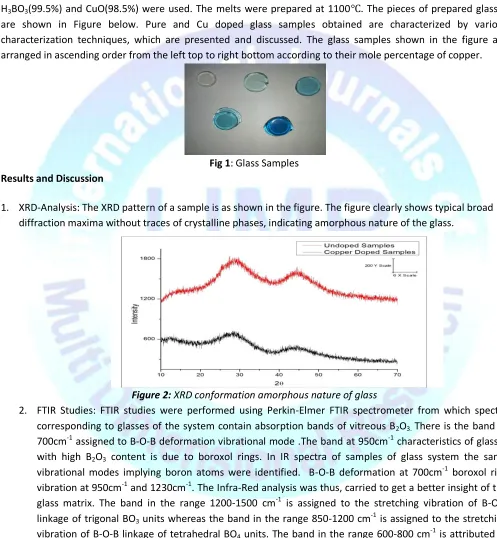
Fig 1: Glass Samples
Results and Discussion
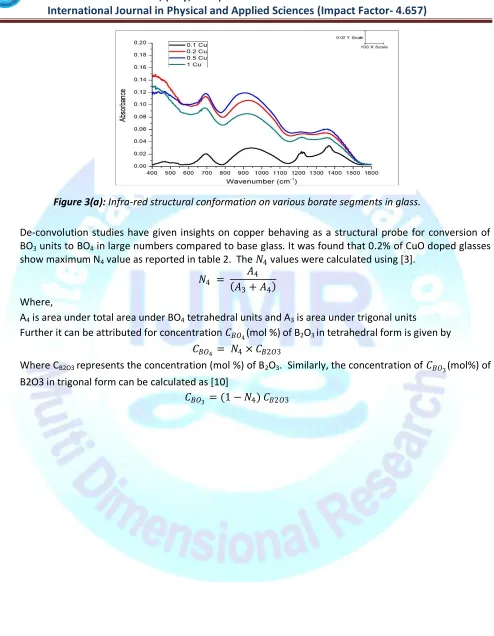
1. XRD-Analysis: The XRD pattern of a sample is as shown in the figure. The figure clearly shows typical broad diffraction maxima without traces of crystalline phases, indicating amorphous nature of the glass.
Figure 2: XRD conformation amorphous nature ofglass
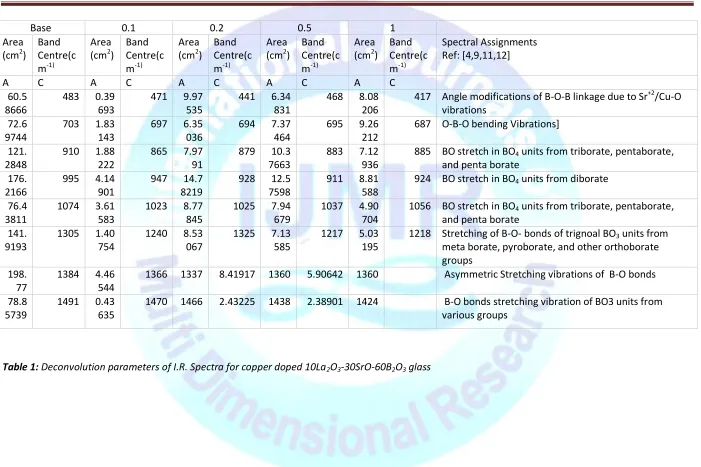
2. FTIR Studies: FTIR studies were performed using Perkin-Elmer FTIR spectrometer from which spectra corresponding to glasses of the system contain absorption bands of vitreous B2O3. There is the band at
Figure 3(a): Infra-red structural conformation on various borate segments in glass.
De-convolution studies have given insights on copper behaving as a structural probe for conversion of BO3 units to BO4 in large numbers compared to base glass. It was found that 0.2% of CuO doped glasses
show maximum N4 value as reported in table 2. The 𝑁4 values were calculated using [3]. 𝑁4 = 𝐴4
𝐴3+ 𝐴4
Where,
A4 is area under total area under BO4 tetrahedral units and A3 is area under trigonal units
Further it can be attributed for concentration 𝐶𝐵𝑂4(mol %) of B2O3 in tetrahedral form is given by
𝐶𝐵𝑂4 = 𝑁4× 𝐶𝐵2𝑂3
Where CB2O3 represents the concentration (mol %) of B2O3. Similarly, the concentration of 𝐶𝐵𝑂3(mol%) of
B2O3 in trigonal form can be calculated as [10]
176. 2166
995 4.14 901
947 14.7 8219
928 12.5 7598
911 8.81 588
924 BO stretch in BO4 units from diborate
76.4 3811
1074 3.61 583
1023 8.77 845
1025 7.94 679
1037 4.90 704
1056 BO stretch in BO4 units from triborate, pentaborate,
and penta borate 141.
9193
1305 1.40 754
1240 8.53 067
1325 7.13 585
1217 5.03 195
1218 Stretching of B-O- bonds of trignoal BO3 units from
meta borate, pyroborate, and other orthoborate groups
198. 77
1384 4.46 544
1366 1337 8.41917 1360 5.90642 1360 Asymmetric Stretching vibrations of B-O bonds
78.8 5739
1491 0.43 635
Figure 3(b): FTIR Deconvoluted spectra for 10La2O3-30SrO-60B2O3-0.2CuO glass
Concentration N4 CBO4 (mol %) CBO3 (mol %) Average Coordination
number of B [13]
Density (g/cc)
Base glass 0.4712 28.272 31.728 3.4712 ---
0.1 0.6045 36.27 23.73 3.6045 3.66
0.2 0.6623 39.738 20.262 3.6623 3.714
0.5 0.632 37.92 22.08 3.6320 3.622
1 0.61 36.6 23.4 3.6100 3.628
Table 2: Concentration of borate in tetrahedral and trigonal form in copper doped 10La2O3-30SrO-60B2O3 glass
Table 2 clearly suggests that as for 10La2O3-30SrO-60B2O3 glass, three boron oxygen triangles are clubbed to
obtain boroxol ring which are connected by loosely bounded BO3/2 units. As SrO is 30 mol%, N4 value is maximum
for base glass which means that the trigonal [BO3/2] units are converted into tetrahedral [BO4/2]- units as the
group is belongs to diborate configuration, it is not associated with non-bridging oxides[4]. When CuO is doped into the matrix the N4 values increases as copper oxide is doped in matrix, for which the average coordination
number of Boron increases. This trend is found till 0.2 mol% copper in glass, beyond 0.2 mol% the density of the glass decreases which clearly says that the average coordination of Boron decreases and there is degradation of diborate units (BO4) is relaxed by formation of non-Bridging oxides beyond 0.2 mol% of copper in this matrix.
3. UV-VISIBLE SPECTROSCOPY
The optical absorption co-efficient α(v) has been derived and displayed as a function of photon energy (hν). The optical absorption at the fundamental edge is given by equation
Α(ω) = (B/hν)(hν-Eopt)n
Along the absorption co-efficient curve and near the optical band edge there is an exponential part called Urbach energy. The spectral dependence of the absorption coefficient (α) and photon energy (hν) is known as Urbach empirical rule which is given by following equation
a=a0exp(hν/Eu)
Where, a0= constant
Eu= Urbach energy
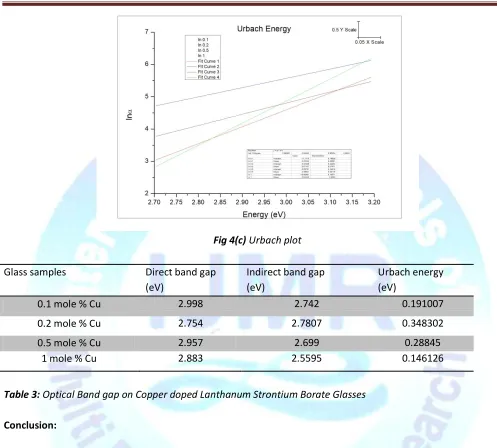
Therefore, the Urbach energy can be obtained from the slope of straight line by plotting ln α along y-axis versus energy in x-axis.
Fig 4(c) Urbach plot
Glass samples Direct band gap
(eV)
Indirect band gap (eV)
Urbach energy (eV)
0.1 mole % Cu 2.998 2.742 0.191007
0.2 mole % Cu 2.754 2.7807 0.348302
0.5 mole % Cu 2.957 2.699 0.28845
1 mole % Cu 2.883 2.5595 0.146126
Table 3: Optical Band gap on Copper doped Lanthanum Strontium Borate Glasses
Conclusion:
From F.T.I.R. data it is clear and evident that the copper acts as structural probe where the base glass exhibits N4
value of 0.4712, on addition of copper into the matrix the N4 values increases to 0.6045 for 0.1 mol% copper and
then increases to 0.6623 for 0.2 mol% which means maximum number of tetrahedral groups are formed in glass, then there is a decrease in N4 values for 0.5 and 1 mol% respectively. As the optical band gap increases with
doi:10.1016/j.physb.2010.06.059 (2010)
6. B. Sumalatha , I. Omkaram, T. Rajavardhana Rao , Ch. Linga Raju, Alkaline earth zinc borate glasses doped with Cu2+ ions studied by EPR, optical and IR techniques, Journal of Non-Crystalline Solids 357 (2011) 3143–3152, doi:10.1016/j.jnoncrysol.2011.05.005
7. I. Ardelean, M. Peteanu, R. Ciceo-Lucacel, I. Bratu, Structural investigation of CuO containing strontium-borate glasses by means of EPR and IR spectrometry, Journal Of Materials Science: Materials In
Electronics (2000)
8. Basudeb Karmakar, Glass Nanocomposites: Synthesis, Properties and Applications, Elsevier (2016) 9. Chandkiram Gautam, Avadhesh Kumar Yadav, and Arbind Kumar Singh, A Review on Infrared
Spectroscopy of Borate Glasses with Effects of Different Additives, International Scholarly Research Network ISRN Ceramics (2012)
10. H. Doweidar , Yasser B. Saddeek , Effect of La2O3 on the structure of lead borate glasses, Journal of Non-Crystalline Solids, doi:10.1016/j.jnoncrysol.2010.04.036
11. R.Ciceo Lucacel, I.Ardelean , Comparative structural investigation of B2O3-MO-CuO glasses by FTIR and Raman spectroscopies., Journal of optoelectronics and advanced materials.
12. Razvan Stefan, Eugen Culea, Petru Pascuta, The effect of copper ion addition on structural and optical properties of zinc borate glasses, Journal of Non-crystalline solids (2012),
doi:10.1016/j.jnoncrysol2100.12.079