Performance Evaluation of SPIHT Using
CDF9/7 Wavelet Along With Huffman Coding
for Lossy Image Compression
P.Dhilleswararao
1,
N.Prathusha
2Assistant Professor, Dept. of ECE, Vignan Institute of Information Technology, Andhrapradesh, India1
PG Student [DECS], Dept. of ECE, Vignan Institute of Information Technology, Andhrapradesh, India2
ABSTRACT
: Image Data Compression is a science that is concerned with the reduction of the number of bits required
to store, transmit and reconstruct images without loss of any information. Though various transforms are used in the field of image compression, wavelets are most popular, and are increasingly being applied in the field of digital image processing. A fundamental shift in the image compression approach came after the Discrete Wavelet Transform (DWT) became popular. After DWT was introduced, several codec algorithms were proposed to compress the transform coefficients as much as possible. Among them, Embedded Zero tree Wavelet (EZW), Set Partitioning into Hierarchical Trees (SPIHT) and Embedded Block Coding with Optimized Truncation (EBCOT) are the most famous ones. To overcome the inefficiencies in the JPEG standard and serve emerging areas of mobile and Internet communications, the new JPEG2000 standard has been developed based on the principles of CDF9/7 wavelet in DWT.
In this paper CDF9/7 and Bior4.4 wavelets are applied with SPIHT (Set Partitioning in Hierarchal Trees) on a lossy image compression and performance is evaluated in terms of performance metrics PSNR and MSE. Further study of SPIHT using wavelet CDF9/7 along with Huffman Coding on gray-scale or monochrome images is done. Simulation results show that SPIHT using CDF9/7 wavelet along with Huffman Coding gives better image quality and compression ratio than traditional SPIHT.
KEYWORDS: Discrete Wavelet Transform (DWT), Embedded Zero tree Wavelet (EZW), Embedded Block Coding
with Optimized Truncation (EBCOT), Set Partitioning in Hierarchal Trees(SPIHT).
I.INTRODUCTION
The image compression can be termed as a technique to reduce the size of the image with no significant loss in the image quality. With the digitalization entering into the field of image sampling a image is used in more fields like photography, medical imaging (DICOM) satellite imaging etc. using a uncompressed required a large storage space, transmission time and band width as well. Despite the rapid growth in data storage capacity, processor speed, digital communication system performance, storage and transmission of images still pose a considerable challenge. The process of image compression can be loss less or lossy. Depending on the application the type of compression can be used.
II. SYSTEM MODEL AND ASSUMPTIONS
A. IMAGE COMPRESSION PROCESS:
Figure1: Image compression process
Our aim is to evaluate the performance of the SPIHT (Set Partitioning In Hierarchal Trees) using CDF9/7 wavelet for smooth images compression and further improve the compression ratio by using Huffman Encoder with SPIHT. CDF9/7 wavelet function gives floating point filter coefficients and due to this floating point nature of filter it gives lossy compression with SPIHT but due to higher energy compaction with fewer wavelet coefficients it results in higher compression ratio. Also output of the SPIHT is embedded bit stream and this bit stream is reduced by using Huffman Encoder with SPIHT.
B.WAVELET TRANSFORM:
Wavelet analysis represents the next logical step: a windowing technique with variable-sized regions. Wavelet analysis allows the use of long time intervals where more precise low frequency information is required and shorter regions where high-frequency information.
Mathematically, the process of Fourier analysis is represented by the Fourier transform:
C.CDF9/7 WAVELETS
Figure 2: Cohen-Daubechies-Feauveau 9/7 scaling and wavelet functions
Performance of SPIHT algorithm using CDF9/7 wavelet is computed in terms of PSNR value for different types of smooth images. Only performance metric PSNR is computed for lossy image compression at different levels of decomposition.
In this paper we are further extending the work by approaching SPIHT algorithm using CDF9/7 wavelet with Huffman encoder. This new scheme is applied on smooth images like (Lena, Barbara, Pepper). These type of images have slow change in gray level values and high redundant data. Due to higher energy compaction of CDF9/7 wavelet, it gives higher compression ratio. Compression efficiency of SPIHT can be improved further by using Huffman encoder without degrading the image quality as Huffman encoder gives lossless compression.
D.SPHIT
A wavelet-based still image coding algorithm known as set partitioning in hierarchical trees (SPIHT) it is developed so that it generates a continuously scalable bit stream, so that a single encoded bit stream can be used to produce images at various bit-rates and quality, without any drop in compression.
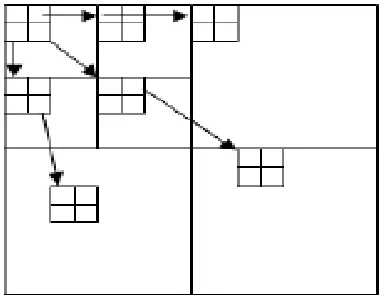
Using the SPIHT algorithm, the image is first decomposed into a number of sub bands using hierarchical wavelet (Bior4.4) decomposition. The sub bands obtained for two-level decomposition are shown in figure 3.
Figure 3:Quad tree organization of wavelet coefficients in SPIHT
The real implementation of SPIHT is illustrated below. To make it simple, the following sets of coordinates are defined.
(1) O(i, j): set of coordinates of all offspring of node (i, j); (2) D(i, j): set of coordinates of all descendants of the node (i, j);
(4) L(i, j)=D(i, j)-O(i, j).
Thus, except at the highest and lowest levels, we have O(i, j)=(2i, 2j), (2i, 2j+1), (2i+1, 2j), (2i+1, 2j+1).
Define the following function.
Denotes the significance of a set of coordinates, where the preset significant threshold used in the nth stage is denoted by T (n). The SPIHT coding algorithm is described as follows.
First, T (0) is assumed to be 2M-1. Here M is chosen such that the largest coefficient magnitude cmax, satisfies
2M-1≤cmax< 2M. In the coefficient magnitude, the encoding is progressive to successfully use a sequence of thresholds
T(n)=2(M-1)-n, n=0,1,2,...M-1. These thresholds are of the power of '2', so that the encoding can be taken as the bit plane encoding of the wavelet coefficients. All the coefficients with the magnitudes between T(n) and 2T(n), at stage n are significant and their positions and the sign bits are encoded. This is called sorting pass process. Then each coefficient with the magnitude at least 2T(n) is refined by encoding the 'n'th most significant bit. This is known as refinement pass.
E. HUFFMAN CODING
From Shannon’s Source Coding Theory, it is known that the source can be coded with an average code length that is close to the entropy of the source. But by Huffman coding technique is used to produce a shortest possible average code length for the given source symbol set and the associated probability of occurrence of the symbols. Codes generated using these coding techniques are popularly known as Huffman codes. Huffman coding technique is based on the following two observations regarding optimum prefix codes.
• The more frequently occurring symbols can be allocated with shorter code words than the less frequently occurring symbols.
• The two least frequently occurring symbols will have codeword of the same length, and they differ only in the least significant bit.
Average length of these codes lies close to entropy of the source. The Huffman coding is an entropy encoding algorithm mainly used for lossless data compression.
The prefix code of each symbol is obtained by choosing special symbols for the representations, so a shorter string of bits are obtained which are used for less common source symbols.
F. SPIHT USING CDF9/7 WAVELET WITH HUFFMAN CODING:
The DWT, wavelet filter are used to decompose the image into different sub band. Now we will be considering the decomposition level 5as it gives a best result. The CDF9/7 wavelet is the second generation wavelet which is used present international standard JPEG 2000. Which has 9 filter-taps for the analysis filter and 7 filter-taps for the synthesis filter? As the filer’s coefficient is floating point in nature results in lossy compression But due to higher energy compaction of image with fewer significant wavelet coefficients it gives higher compression ratio.
Also CDF9/7 wavelet function is symmetrical than Bior4.4 wavelet function that results in better image quality. Output of the DWT, sub bands are used by the SPIHT algorithm by partitioning the sets into three lists by making hierarchical trees as discussed above.
Output of the SPIHT is an embedded bit stream which can be further compressed using entropy encoders. Two popular entropy encoders, Arithmetic and Huffman encoder are used with many lossy compression Standards.
Huffman encoder is used in Current lossy compression standard JPEG which gives the highest compression ratios than other existing techniques with acceptable image quality. Also Significance mapping of SPIHT is such that Arithmetic coding provides very little gain to the compression ratio
Experimentally it has been observed that output of SPIHT has large number of seriate “0” situation and ‘000’ appears with the highest probability. So to best exploit this situation we used the Huffman encoder as variable length coding because of its simplicity and fast execution.
The procedure is as follows:
• Now we have 8 different symbols from 000 to 111.We found the probability of each distinct symbol in long output bit stream of SPIHT.
• After computing the statistical probabilities of each distinct symbol we applied Huffman encoder to best exploit the probabilities of the symbols as it assigns the less numbers of bits to the symbols has high probability of occurrence.
• At the output of the Huffman encoder we have less number of bits as compared to the output bit stream of the SPIHT. Thus Huffman encoder improves the compression ratio of SPIHT compression.
• Decoding is the reverse process of encoding. Huffman coding does not degrade the quality of the reconstructed image as it provides lossless compression.
in a minimum level. This eventually enables CR-Networks nodes to determine optimum path nodes and channels for an efficient communication in CR-Networks. The CR technology allows Secondary Users (SUs) to seek and utilize “spectrum holes” in a time and location-varying radio environment without causing harmful interference to Primary Users (PUs). This opportunistic use of the spectrum leads to new challenges to the varying available spectrum. Using a Trust-Worthy algorithm, it improves the trustworthiness of the Spectrum sensing in CR-Networks.
III. RESULT AND DISCUSSION
The following results are obtained for the smooth image pepper.bmp (512*512) in MATLAB.
The MSE and PSNR values of the SPHIT using the Bior 4.4 and CDF 9/7 wavelet at different bit rate is calculate and tabulated
Bit.rate MSE PSNR(Db)
Bior4.4+SPIHT CDF9/7+SPIHT Bior4.4+SPIHT CDF9/7+SPIHT
.05 161.75 150.52 26.04 26.35
0.1 88.75 77.49 28.65 29.23
0.2 44.14 39.5 31.68 32.16
0.3 29.76 27.99 33.39 33.65
0.4 23.39 21.58 34.44 34.78
0.5 18.58 18.09 35.44 35.55
0.6 16.48 16.11 35.96 36.58
0.7 14.78 14.28 36.43 36.59
0.8 13.51 12.73 36.83 37.49
0.9 12.3 11.56 37.23 37.5
1.0 10.76 10.48 37.81 37.92
For a better compression technique MSE value should be as low as possible and PSNR value should be high for a good image quality.
From the table we observe that CDF 9/7 wavelet that the SPHIT algorithm gives lower MSE value and slightly higher PSNR value when compared to that of SPHIT with Bior(4.4) wavelet. Upto bitrate 0.5, CDF 9/7 gives much improved performance when compared to Bior (4.4)
The graph shows MSE Vs Bitrate The graph shows PSNR Vs Bitrate
Original image pepper with PSNR= 31.68 Reconstructed image using Bior4.4+SPIHT at bitrate 0.2
Reconstructed image using CDF9/7+SPIHT PSNR= 32.16at bitrate 0.2
From the above figures we can see that CDF9/7wavelet with SPIHT gives better image quality of reconstructed image at low bitrate (high compression ratio) as compared to Bior4.4 with SPIHT. Reconstructed image by Bior4.4 wavelet is little blurred while image reconstructed by CDF9/7 is smooth.
Compression Ratio comparison of Traditional SPIHT and SPIHT using CDF9/7 wavelet with Huffman encoder
Bitrate Traditional SPIHT CDF9/7+SPHIT
with Huffman Coding
0.05 160 166.75
0.1 80 84.15
0.2 39.99 42.13
0.3 26.66 27.88
0.4 20 20.77
0.5 16 16.73
0.6 13.33 13.86
0.7 10.66 11.06
0.8 10 10.37
0.9 8.88 9.21
The table shows the comparison between tradition SPIHT and SPIHT with Huffman encoder. From the table we can see that SPIHT using CDF9/7 wavelet along with Huffman encoder gives better compression ratio than original SPIHT. Low bitrates results in high compression ratio but poor image quality.CDF9/7 provides higher energy compaction with fewer wavelet coefficients those results in high compression ratio and Huffman encoder further improves the compression efficiency of SPIHT compression scheme without degrading the image quality.
Finally we obtain the graphical representation where we can see that compression ratio of SPIHT using CDF9/7 wavelet along with Huffman encoder gives is higher than the original SPIHT. Graph shows that as we increase the bitrate above 0.6, compression ratio decreases and not much improvement over traditional SPIHT by the new one. But at low bitrate SPIHT using CDF9/7 wavelet along with Huffman encoder gives significantly improved results with acceptable image quality as shown before in subjective evaluation.
The graph shows Compression ratio Vs Bitrate
IV.CONCLUSION
In this paper we have discussed SPIHT algorithm with Bior4.4 wavelet and CDF9/7 wavelet. Wavelets provide the platform to analyze the image at different resolution by multiresolution analysis property of the wavelet. CDF9/7 wavelet gives floating point filter coefficients that results in lossy compression but it also provides higher energy compaction with fewer coefficient that gives better compression ratio.
Performance of SPIHT is evaluated in terms of MSE (Mean Squared Error), PSNR (Peak Signal to Noise Ratio) and Compression Ratio for smooth gray scale images.
After analyzing the various evaluated results and graphs, we have concluded:
• SPIHT using CDF9/7 wavelet gives better Image quality of reconstructed image as compared to traditional SPIHT that uses Bior4.4 wavelet. Below bitrate 0.05 image quality is not acceptable for both wavelets but as we increase the bitrate image quality increases significantly.
• SPIHT using CDF9/7 wavelet along with Huffman encoder as entropy encoder gives better compression ratio over traditional SPIHT. By using Huffman encoder lot of bits can be saved in image data transmission.CDF9/7 wavelet and Huffman encoder both contribute to improve the compression ratio of SPIHT. Huffman encoder gives lossless compression, it does not degrade the image quality and reduces the system complexity.
REFERENCES
[1] N. Johnston, and R. Safranek, “Signal compression based on models of human perception,”Signal Processing, IEEE, vol. 81, pp.1385–1422, Oct.1993.
[2] Sonja Grgic,MilsavGrgic and BrankaZovko, “Performance analysis of image compressionusing wavelets” IEEE Transactions, vol. 48, No. 3, June 2001.
[3]Ho Weng Leong,UmiKalthumNgah, P.A.Venkatachalam, Noor Eliza Abd.Khalid, "ImageCompression Software Analysis and Design," Proceedings ROVPIA 1999. pp.385-392, Malaysia,16-18 July 1999.
[5] K. Sayood, Introduction to Data Compression, Second edition, Academic Press, 2000.
[6] EBCOT: Embedded Block Coding with Optimized Truncation, ISO/IEC JTC1/SC29/WG1N1020R, Oct. 1998.
[7] B. Yan, H. Zhang, “SPIHT Algorithm and its Improvement,” Computer Applications andSoftware, vol. 25(8), pp.245-247, 2008.
[8] COHEN, DAUBECHIES, FEAUVEAU, “Biorthogonal Bases of Compactly Supported Wavelets”. Comm. Pure and Applied Mathematics, vol. 45, 1992, pp. 485-560.
[9] A.S. Lewis and G. Knowles, “Image Compression using 2-D Wavelet Transform”, IEEETransactions on Image Processing, 1(2):244-250, April 1992.
[10] J.M. Shapiro, “Embedded image coding using zerotrees of wavelet coefficients”, IEEETransactions on Signal Processing, 41:3445-3462, Dec,1993.
[11] H. L. Xu, S. H. Zhong, “Image Compression Algorithm of SPIHT Based on Block-Tree,”Journal of Hunan Institute of Engineering, vol. 19(1), pp.58-61, 2009.