Vulnerability Injection overhead markup using XSS
CHALLA PRATHYUSH KUMAR1 & Mrs. M.SRIDEVI 2
1
M-Tech Dept of CSE Laqshya Institute of Technology and Science, Khammam.
Mail id: [email protected]
2
Asst. Professor & HOD, Department of CSE in Laqshya Institute of Technology and Science,
Khammam. Mail Id: - [email protected]
Abstract
Researchers have devised multiple solutions to cross-site scripting, but vulnerabilities persists in many
Web applications due to developer’s lack of expertise in the problem identification and their
unfamiliarity with the current mechanisms. As proclaimed by the experts, cross-site scripting is among
the serious and widespread threats in Web applications these days more than buffer overflows. Recent
study shows XSS has ranked first in the MITRE Common Weakness Enumeration (CWE)/SANS
Institute list of Top 25 Most Dangerous Software Errors and second in the Open Web Application
Security Project (OWASP). However, vulnerabilities continue to exist in many Web applications due to
developers‟ lack of understanding of the problem and their unfamiliarity with current guarding strengths
and limitations. Existing techniques for defending against XSS exploits suffer from various weaknesses:
inherent limitations, incomplete implementations, complex frameworks, runtime overhead, and intensive
manual-work requirements. Security researchers can address these weaknesses from two different
perspectives. They need to look beyond current techniques by incorporating more effective input
validation and sanitization features. In time, development tools will incorporate security frameworks
such as ESAPI that implement state-of-the-art technology. This paper focus on program verification
perspective, how researchers must integrate program analysis, pattern recognition, concolic testing, data
mining, and AI algorithms to solve different software engineering problems and to enhance the
effectiveness of vulnerability detection. Focus on such issues would improve the precision of current
methods by acquiring attack code patterns from outside experts as soon as they become available.
Keywords:XSS, vulnerability, Injection, overhead, markup.
1.
Introduction
Cross-site scripting (XSS) is a type of computer
insecurity vulnerability typically found in Web
applications, such as web browsers which
breach the security that enables attackers to
infuse client-side script into Web pages viewed
by other users [1]. A cross-site scripting
access controls such as the same origin policy.
Several major websites including Face book,
Twitter, MySpace, eBay, Google, and McAfee
have been the targets of XSS exploits. XSS is
the result of limitations inherent in many Web
applications‟ security mechanisms i.e. the lack
or insufficient refinement of user inputs. XSS
flaws exist in Web applications written in
various programming languages such as PHP,
Java, and .NET where application WebPages
reference unrestricted user inputs. Attackers
inject malicious code via these inputs, thereby
causing unintended script executions through
clients‟ browsers. Researchers have proposed
multiple XSS solutions ranging from simple
static analysis to complex runtime protection
mechanisms. Cross-site scripting carried out on
websites accounted for roughly 80.5% of all
security vulnerabilities recorded by Symantec as
of 2007. Their effect may range from a petty
trouble to a significant overhead of security risk,
depending on the value of the data handled by
the vulnerable site and the nature of any security
mitigation implemented by the site's owner.
From a development perspective, researchers
need to craft simpler, better, and more flexible
security alternatives.
Cross-site scripting flaws are web-application
vulnerabilities which allow attackers to bypass
client-side security mechanisms normally
imposed on web content by modern web
browsers. By finding ways of injecting
malicious scripts into web pages, an attacker can
gain elevated access-privileges to sensitive page
content, session cookies, and a variety of other
information maintained by the browser on
behalf for user. Cross-site scripting attacks are
therefore a unique case of code injection [2].
The expression "cross-site scripting" originally
referred to the act of inducing the attacked,
third-party web application from a distinct
attack site, in a manner that executes a section
of JavaScript programmed by the attacker in the
security framework of the targeted domain. The
definition gradually expanded to encompass
other modes of code injection, including
persistent and nonJavaScript vectors (including
Java, ActiveX, VBScript, Flash, or even pure
HTML, and SQL Queries), causing some
uncertainty to newcomers to the field of
information security [3]. XSS vulnerabilities
have been reported and exploited since the
1990s. Well-known sites affected in the history
include the social-networking sites Twitter, Face
book, MySpace, and Orkut. In recent years,
cross-site scripting flaws surpassed buffer
overflows to become the most common
publicly-reported security vulnerability, with
some researchers in 2007 viewing as many as
68% of websites as likely open to XSS attacks.
2.
Related Work
2.1 TYPES OF XSS EXPLOIT:
Persistent or Stored Attacks: The persistent or
attacker is provided the data is saved back by
the server, and then returned to other users in
the course of normal browsing permanently
displayed as "normal" pages, without
appropriate HTML escaping. Mostly this type of
vulnerability occurs in the Social websites
where-in members scan the profiles of other
members [2]. For privacy reasons, this site hides
everybody's unique personal identity and email.
These are kept secret on the server. Particularly
in the case of social networking sites, the code
would be further designed to self-propagate
across accounts, creating an indirect kind of a
client-side worm. Persistent XSS can be more
significant than other types because an attacker's
malicious script is turned into automatic nature,
without the need to individually target victims
or also lure them to a third-party website. Any
data received by the web application (via email,
system logs, etc.) that can be controlled by an
attacker could befall into injection vector.
Non-persistent or Reflected Attacks:
Non-persistent XSS vulnerabilities in Google could
permit malicious sites to attack Google users
who visit them whilst logged in. A potential
vector is a site search engine, given a search for
a string; the search string will typically be
redisplayed verbatim on the result page to
indicate what was searched for. If this response
does not properly escape or reject HTML
control characters, a cross-site scripting flaw
would result in. A reflected attack is typically
delivered via email or a neutral web site. These
holes show up when the data provided by a web
client, most frequently in HTTP query
parameters or in HTML form submissions, is
used immediately by server-side scripts to
generate a page of results for that user, without
properly cleansing the request. Because HTML
documents have a flat, serial structure that
blends control statements, formatting, and the
actual content, any non-validated user-supplied
data included in the resulting page without
proper HTML encoding[5]. This may result in
markup injection. In this class of scripting
languages are also used, e.g., Action Script and
VBScript. Mostly attackers would write the
scripting in java language only for common
practice of the attack includes a design step. In
this context the attacker creates and tests an
offending URI (Uniform Resource Indicator), a
social engineering step, in which the offender
convinces his victims to load this URI on their
browsers, and the eventual execution of the
offending code [4]. The web application might
filter out”
DOM-Based Attacks: This name refers to the
standard model for representing HTML or XML
contents which is called the Document Object
Model (DOM). JavaScript programs manipulate
the state of a web page and populate it with
dynamically computed data primarily by acting
upon the DOM. With the arrival of web 2.0
emerged i.e. based vulnerabilities.
DOM-based vulnerabilities occur in the content
processing stages performed by the client,
typically in client-side JavaScript [1].
2.2 TYPES OF XSS DEFENCES:
XSS defenses can be broadly classified into four
types:
a. Defensive coding
b. XSS testing
c. Vulnerability detection
d. Runtime attack prevention.
It compares various current techniques, which
each have strengths and weaknesses.
Defensive Coding
XSS arises from the improper handling of
inputs, using defensive coding practices that
validate and sanitize inputs is the best way to
eliminate XSS vulnerabilities. The user must
make sure that the inputs are validated and
conform to a required input format [3]. The four
basic input sanitization options are:
a. Replacement and elimination methods search
for known bad characters (blacklist).
b. The former replaces them with non-malicious
characters, whereas the latter simply removes
them.
c. Escaping methods search for characters that
have special meanings for client-side
interpreters and remove those meanings.
d. Restriction techniques limit inputs to known
good inputs (white list).
Checking blacklisted characters in the inputs is
more scalable, but blacklist comparisons often
fall short as it is difficult to foresee every attack
signature alternative. White list comparisons are
considered more protected, but they can result in
the denial of many unlisted valid inputs.
OWASP has issued rules that define proper
escaping schemes for inputs referenced in
different HTML output locations.
XSS Testing: Input validation testing could
expose XSS vulnerabilities in Web applications.
Specification based IVT methods generate test
cases with a plan of exercising various
combinations of valid or invalid input
conditions stated in specifications. In general,
the effectiveness of both specification and code
based approaches depends largely on the
completeness of specifications or the sufficiency
of generated test suites for discovering XSS
vulnerabilities in source code. Hossain Shahriar
and Mohammad Zulkernine developed
MUTEC, a fault based XSS testing tool that
creates mutated programs by changing
responsive program statements, or sinks, with
mutation operators. Only test cases containing
adequate XSS attack vectors can bring about
original and mutated programs to behave.
Example 1
Vulnerability Detection: This type of XSS
defenses focus on identifying vulnerabilities in
server-side scripts. Static-analysis based
vulnerabilities, but they tend to produce many
false positives. Recent approaches combine
static analysis with dynamic analysis techniques
to improve accuracy.
Static Analysis: Benjamin Livs and Monica
Lam used binary decision diagrams to relate
points to analysis to server-side scripts. Their
approach requires users to specify vulnerability
patterns in Program Query Language [6]
.Yichen Xie and Alex Aiken proposed a static
analysis technique that acquire block and
function summary information from symbolic
execution Pixy, an open source vulnerability
scanner and also includes alias analysis to
improve precision. These techniques identify
tainted inputs accessed from exterior data
sources, track the flow of tainted data, and
check if any reached sinks such as SQL
statements and HTML output statements. For
example, for the program traveler Tip it reports
the following statements as vulnerable:
3.
Implementation
3.1 IMPLEMENTATION OF XSS
DEFENCES:
We all consent that cross-site scripting is a
serious problem, but what continues to amaze
me is the lack of good documentation on the
subject. It is easy to find instructions how to
execute attacks against applications vulnerable
to XSS, but finding something adequate to cover
defense is a real challenge [2]. No wonder
programmers keep making the same errors over
and over again. I am sure that one page that
describes the problems and the solutions is
somewhere out there, but I have been unable to
find it. All I am getting is a page after page after
page of half-truths and partial information, and
even people saying that XSS is impossible to
defend against [3]. To help developers practice
its defensive coding rules, OWASP has created
the Enterprise SecurityAPI
(https://owasp.org/index.php/Category:OWASP
_Enterprise_ Security_API) i.e. ESAPI, an open
source library for many different programming
languages. Microsoft also provides the Web
Protection Library (http://wpl.codeplex.com) for
.NET developers. To produce web applications
that is safe against XSS and other injection
attacks [7]. Every such function must be aware
of the character encoding used in the
application. Then, for every piece of code that
sends data from one component into another,
make sure you use the correct function to
encode data to make it safe check that every
piece of data you receive is in the correct
character encoding and that the format matches
that of the type you are expecting (input
validation). One must use white listing (as
blacklisting does not work) in preventing
attackers from executing JavaScript code in data
pretending to be an Internet address.
4.
Experimental Work
To avoid the conflict arise in this scenario the
the end-users first validate the given URL and
can enter into the authentication process. Only
registered valid URLs will be available to enter
into the system. Thus it avoids the data
capturing by hackers through URL. More devise
thing followed in this URL-SAP is whatever
URL an end-user can get through, but in
authentication process the given details cannot
be attain by hacking. Because of dynamic
mechanism involved in authentication process
no such malicious person capture the data given
by the end-users.
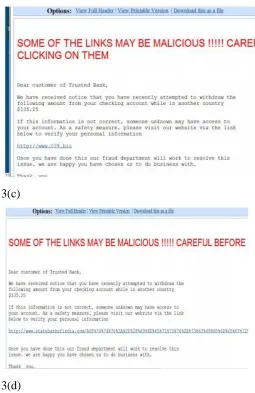
3(a)
3(b)
3(c)
3(d)
Figure 3: URL Obfuscation Attacks and
Cross-Site Scripting Attacks Representation in
Different Views: 3.a) Normal Mail
Representation 3.b) URL with more number of
dots 3.c) Black-listed URL 3.d) Encoded URL
3.
5.
Conclusion
Inherent limitations, unfinished
implementations, complex frameworks, runtime
overhead and rigorous manual-work
requirements. These are the existing techniques
for defending against XSS exploits suffer from
deal with these weaknesses from two different
perspectives. Researchers need to craft simpler,
better, and more flexible security defenses [6] .
They need to look beyond current techniques by
incorporating more effective input validation
and sanitization features. In time to come many
development tools would be incorporated for
security frameworks such as ESAPI that
implement state-of-the-art technology.
Researchers must integrate program analysis,
pattern recognition, concolic testing, data
mining, and AI algorithms would be used
rigorously in future to solve different software
engineering problems to improve the
effectiveness of vulnerability detection. They
can also improve the precision of current
methods by gaining attack code patterns from
outside experts.
6. References
[1]https://www.owasp.org/index.php/Top_10_2
013-Top_10
[2] Nilesh Kochre, Satish Chalukar, Santosh
Kakde, “Survey On SQL Injection Attacks And Their Countermeasures “, International Journal
Of Computational Engineering And
Management, Vol -14, October 2011
[3]https://www.owasp.org/index.php/Top_10_2
013-A2-
Broken_Authentication_and_Session_Managem
ent [4] Hossain Shaihriar and Mahammad
Zulkernine, “S2 XS2 : A Server Side Approach To Automatically Detect XSS Attacks”, Ninth
International Conference on Dependable,
Automatic Secure Computing, IEEE, 2011
PP.7-17
[5] Jeom-Goo Kim, “Injection Attack Detection
Using Removal of SQL Query Attribute Values
“, IEEE 2011
[6] Chai Wenguuang, Tan Chunhui, Duan
Yuting, “Research Of Intelligent Intrusion
Detection System Based On Web Data Mining
Technology”, IEEE 4th International
Conference On Business Intelligence And
Financial Engg. 2011, PP. 14-17
[7] Sruthy Mamadhan, Manesh T, Varghese
Paul, “SQLStor: Blockage of Stored Procedure
SQL Injection Attack Using Dynamic Query
Structure Validation” 12th International
Conference on Intelligent Systems Design and
Applications (ISDA), IEEE, Nov. 2012, PP.
240-245
[8] Gao Jiao, Chang-Ming XU, JING Maohua
“SQLIMW: a new mechanism against SQL-Injection” in Proc. Of 2012 International
Conference on Computer Science and Service
System, 2012, PP. 1178-1180
[9] Jaskanwal Minhas, Raman Kumar,
“Blocking of SQL Injection Attacks by Comparing Static and Dynamic Queries” in
International Journal Computer Network and
Information Security, vol.2, 2013 PP.1-9
[10] D.Huluka, O.Popov, “Root cause analysis
authentication vulnerabilities”, IEEE World
Congress on Internet Security, 2012, PP. 82-86
[11] Yusuki Takamastu, Yuji Kosuga, Kenji
Kono, “Automatic Detection Of Session Fixation Vulnerabilities “, 2012 Tenth Annual
International Conference on Privacy, Security
and Trust IEEE, PP- 112-119
[12] Atul S. Choudhary and M.L Dhore, “CIDT:
Detection Of Malicious Code Injection Attacks
On Web Application”, International Journal Of
Computing Applications Volume-52-N0.2,
August 2012, PP. 19- 25
[13] Takeshi Matsuda, Daiki Koizumi, “Cross
Site Scripting Attacks Detection Algorithm
Based on the Appearance Position of
Characters”, 5th Intern
ational Conference on Communications,
Computers and Applications, IEEE, October
2012, PP. 65-70
[14] Yousra Faisal Gad Mahgoup Elhakeem ,
Bazara I. A. Barry,” Developing a Security
Model to Protect Websites from Cross-site
Scripting Attacks Using Zend Framework
Application”, International Conference on
Computing, Electrical and Electronics
Engineering (ICCEEE), August 2013, PP.
624-629.
Author’s profile
CHALLA PRATHYUSH KUMAR
B-Tech in Laqshya Institute of Technology And
Science, Khammam, M-Tech Computer Science
and Engineering In Laqshya Institute of
Technology and Science, Khammam,
Mail id: [email protected]
Phone number: 9666560146
M.SRI DEVI
Working as Asst.Professor and HOD ,
Department of CSE in Laqshya Institute of
Technology and Sciences since 2008 July to till
date. Working as IEEE student branch
councellor, Deputy Representative for ISO
certification work.