Study on Mechanical Properties of Latex Modified
Concrete Using GGBS Admixture
Mathews Eldho1, Divya Sasi2 and Manju George3
1
Civil Engineering, Mar Baselios Institute of Technology & Science, Nellimattom, Kerala, India
2 Civil Engineering, Mar Baselios Institute of Technology & Science,
Nellimattom, Kerala, India
3
Civil Engineering, Mar Baselios Institute of Technology & Science, Nellimattom, Kerala, India
Abstract
The utilization of one of the by product from the blast furnaces used to make iron and agriculture has been focused in the present study.The by product from the blast furnace i.e.Ground Granulated Blast Furnace Slag and from agriculture i.e. Natural Rubber Latex is causing serious pollution and economic problem. An attempt has been made in the present experimental study to evaluate the properties of hardened concrete such as modulus of elasticity,and durability properties such as sorptivity and permeability by partial replacement of cement with Ground Granulated Blast Furnace Slag(GGBS)(30%,40%,50%) and water by Natural Rubber Latex (N.R.L) from 0.25% to 1.25% with an increment of 0.25%.Test results expose that latex modified concrete of grade M25 using GGBS has enchanced mechanical properties compared to conventional concrete.
Keywords: Ground Granulated Blast Furnace slag(GGBS),Modulus of elasticity, Natural Rubber Late(N.R.L), Sorptivity
1. Introduction
Concrete is the most widely used construction material today.The versatility and mouldability of this material,its high compressive strength,and the discovery of the reinforcing and prestressing techniques which helped to make up for its low tensile strength have contributed largely to its widespread use. However manufacturing OPC requires about two tonnes of raw materials and thus
releases approximately one tonne of CO2 indirectly to
atmosphere causing serious environmental problems. [1]. In this situation, Ground Granulated Blast Furnace Slag represents a promising class of binder with the potential to form a substantial element of maintaining sustainable environment construction. These are non-metallic product consisting essentially of silicates and aluminates of calcium
and other bases and is extensively used as chief component in manufacturing of slag cement.The Properties of GGBS include lower heat of hydration,lower temperature rises,reduces the risk of damages, reduces the risk of reinforcement corrosion and provides higher resistance to attacks by chemicals[2].
Natural rubber also called India rubber consists of polymers of the organic compound isoprene, with minor impurities of other organic compounds plus water[3].It is extensively used in many applications and products, either alone or in combination with other materials and is obtained from the bark of rubber tree by a process called "tapping". It is a process of controlled wounding of the plant in which a thin layer of bark is removed. The latex vessels in the region of the wound are opened by tapping and latex flows out from the tree, which is channeled into a container, attached to it.
2. Objectives
The present study aims in finding effective utilization of natural rubber latex in normal concrete with GGBS as admixture. The main objectives of the study are
:
To evaluate the durability behaviour of latex
modified concrete.
To determine the modulus of elasticity of
combined NRL and GGBS
2.1 Constituent materials
www.ijiset.com 2.1.2 Natural Rubber Latex : N.R.L is obtained from
Hevia Brasiliensis, commonly known as rubber tree.
2.1.3 Coarse Aggregate: Coarse aggregate of 20mm
nominal size was used Laboratory tests were conducted on coarse aggregate to determine the different physical properties as per IS: 2386 [7]. The results showed that the coarse aggregate conformed to IS: 383 [4] specifications.
2.1.4. Fine aggregate: Locally available mineral sand was used as fine aggregate. Laboratory tests were conducted on fine aggregate to determine the different physical properties as per IS: 2386 [7]. The results depicted that the river sand conformed to zone II as per IS: 383 [4].
2.1.5. Cement: Ordinary Portland cement of 53 grade
conforming to IS: 12269 [9] was used for the experimental programme. Various experiments were conducted to determine the initial and final setting time and compressive strength.
2.1.6Water: Water is an important ingredient of concrete as it actively participates in chemical reaction with cement. Potable water is generally considered as being acceptable. Hence clean drinking water available was used for casting as well as curing of the test samples.
2.2 Mix Design
The mix design was carried out as per IS 10262:2009.The grade of concrete adopted for this study is M25. The target strength for M25 grade concrete is 31.4 N/mm2.
3. Mix Designation
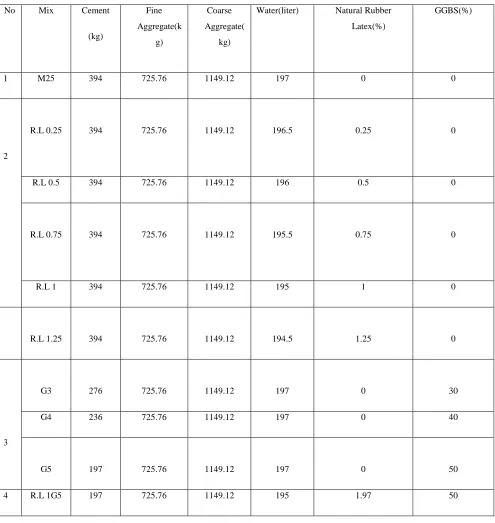
The specimens were casted of normal concrete and concrete with GGBS replacement of 30%,40% and 50% cement. The NRL content was varied from 0.25 to 1.25% with 0.25% increment. Specimens with a combination of GGBS and NRL were also casted. The specimen details are shown in table 2
Table 1 : Mix Proportion
The specimens were casted of normal concrete and concrete with GGBS replacement of 30%,40% and 50% cement. The NRL content was varied from 0.25 to 1.25% with 0.25% increment. Specimens with a combination of GGBS and NRL were also casted. The specimen details are shown in table 3.
4. Experimental Programme
The methods employed in preparing the test specimens
including casting, curing are described. The following
moulds were used to cast the concrete specimen for various studies.
1. 150mm x 150mm x 150 mm moulds were used to
cast cubes for examining durability under chloride and sulphate test.
2. 150 mm x 300 mm moulds were used to cast
cylinders to determine the modulus of elasticity of concrete.
3. 100 mm x 50 mm moulds were used to cast
cylinders to identify permeability and sorptivity of concrete.
5. Test Results
5.1 Modulus of Elasticity
It is observed from table that modulus of elasticity of concrete mix goes on increasing by partial replacement of constituent materials of concrete.The improvement in values may be due to state of wetness of concrete.Wet concrete being saturated with water experience less strain for a given stress and there by confirming that stronger the concrete higher is the modulus of elasiticity.The increase
in strength was 18.51% for G3 mix and for R.L 1 G5 it
was 2.7% with reference to M25 mix.Mathematically modulus of elasticity is given by the expression
Ec= 5000 x√fck (1)
Where Ec = modulus of elasticity of concrete in N/mm2
fck = characteristics strength of concrete
Cement Fine
Aggregate
Coarse Aggregate Water
394 kg 725.76 kg 1149.12 kg 197 litres
Table 2: Mix Designation
No Mix Cement
(kg)
Fine
Aggregate(k
g)
Coarse
Aggregate(
kg)
Water(liter) Natural Rubber
Latex(%)
GGBS(%)
1 M25 394 725.76 1149.12 197 0 0
2
R.L 0.25 394 725.76 1149.12 196.5 0.25 0
R.L 0.5 394 725.76 1149.12 196 0.5 0
R.L 0.75 394 725.76 1149.12 195.5 0.75 0
R.L 1 394 725.76 1149.12 195 1 0
R.L 1.25 394 725.76 1149.12 194.5 1.25 0
3
G3 276 725.76 1149.12 197 0 30
G4 236 725.76 1149.12 197 0 40
G5 197 725.76 1149.12 197 0 50
www.ijiset.com Table 3 : Hardened properties of GGBS modified concrete
Mix Modulus of Elasticity
(N/mm2)
M25 30879.62
G3 37897.72
R.L 1 29417.26
R.L 1 G5 31761.90
It is observed from table 3 that modulus of elasticity of concrete mix goes on increasing by partial replacement of constituent materials of concrete.The improvement in values may be due to state of wetness of concrete.Wet concrete being saturated with water experience less strain for a given stress and there by confirming that stronger the concrete higher is the modulus of elasiticity.The increase in strength was 18.51% for G3 mix and for R.L 1 G5 it was 2.7% with reference to M25 mix.
5.2 Sorptivity Test
Sorptivity, or capillary suction, is the transport of liquids in porous solids due to surface tension acting in capillaries. The sorptivity can be determined by the measurement of the capillary rise absorption rate on reasonably homogeneous material.
Table 4: Sorptivity properties of Latex modified concrete(28 days) Mix Dry weight
in
gram(W1)
Wet weight
in
gram(W2)
Sorptivity
value in
10 -4
mm/min
M25 1100 1120 2.32
G5 1200 1250 2.4
R.L 1 G5 1250 1300 1.8
From table 4 it is observed that capillary suction or sorptivity values goes on decreasing with increase in concentration of GGBS and rubber latex. It may be due to the water tightness behavior possessed by rubber latex inside GGBS.
Fig 1 : Test Specimen under sorptivity
5.3 Permeability Test
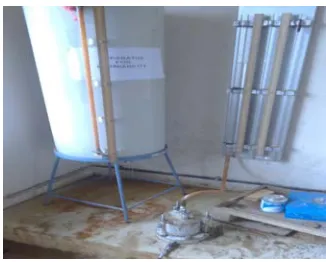
The permeability of various mixes was determined using the falling-head permeability test apparatus as illustrated in figure2.
Fig 2 : Test specimen under permeability
Mathematically coefficient of permeability k is computed by the expression
k = 2.303 log10( ) (2)
Where, k = coefficient of water permeability
a = cross-sectional area of the stand pipe
L = length of the sample
A = cross-sectional area of the specimen
Table 5 : Permeablity properties of latex modified concrete
Mix Coefficient of Permeability
M25 0.039
G5 0.028
R.L 1 0.020
R.L 1 G5 0.019
From table 5 it is observed that permeability seems to be decreasing by the combination of GGBS and rubber latex. The most likely reason for differences in hydraulic conductivity would come from the differences in pore structure because of the effect of rubber latex in the specimen themselves.
5.4 Durability Test
Table 6 : Durability properties of latex modified concrete
From table 6 its observed that final weight of test specimens of nominal mix under chloride and sulphate test goes on decreasing of 100grams.The latex modified concrete shows a slight resistance to chemicals after 28 days of curing inside chemical solutions(chloride and sulphate).The improvement in resistance may be the presence of Natural rubber latex.The percent of variation for both chloride and Sulphate test has found to be 1.1 and 1.7 respectively.
6 Conclusions
Following conclusion can be drawn from the experimental study.
1. Slight resistance to chemical attacks by rubber
latex conformed that natural rubber latex yields
2. Modulus of elasticity remarks the concrete is
satisfactory in terms of strength.
Acknowledgments
First and foremost, I thank ALMIGHTY GOD who gave
me the inner strength and ability to complete my work successfully, without which all my efforts would have been in vain.I express my sincere gratitude to this institution Mar Baselios Institute Of Technology And Science and our Principal Dr. P Sojan Lal for providing me the vision to do the project in successful way.I express my deep and sincere gratitude to Professor Shiney Varghese Head of the Civil Engineering Department for providing me an opportunity to present this project.I am greatly debted to
my project coordinators Ms.Manju George Asst.
Professor ,Department of Civil Engineering MBITS ,for their valuable support that has been the source of inspiration throughout my project work.I am graceful to my guide Ms. Divya Sasi Asst. Professor Department of Civil Engineering MBITS for her valuable suggestions and guidance in completing this project.I also express my heartfelt thanks to all the faculty members of the Department of Civil Engineering MBITS and to my friends and family for their support and cooperation.
References
[1] Bala M. Ismail “Performance of Natural Rubber latex
modified concrete in acidic and sulphated
environments”volume 3 2013
[2].Faruk Eren “Latex modification on fresh state
consistency,short term strength and long term transport
properties of cement mortar”. Volume 6 2015
[3]Dr.Mini Mathew “Study on the properties of natural rubber latex and nano-graphite modified concrete”.volume 8 2016
[4]M.S. Shobha “Mechanical Properties of Latex Modified High
Performance Concrete” IOSR Journal volume 11 2015.
[5]Dr. Vaishali. G. Ghorpade, Sri. k. Munirathanam“Effect
of Natural Rubber Latex with metakaolin admixture” volume