Development and storage of fermented RTS
Probiotic beverage
Riddhi Shah
#& Adrija Sarkar
*Corresponding author E-mail - [email protected]
#
M.Sc. Food & Nutrition Student, J. D. Birla Institute, Kolkata-19, West Bengal, India
*
HOD (M.Sc.) & Assistant professor, Dept. of Fodd Science & Nutrition Management,J. D. Birla Institute, Kolkata-19, West Bengal, India
Abstract-The functional beverage market is predicted to have an increase in growth because people have become more proactive in illness prevention and control. In the past, people were very reactive in their health because health problems are treated after they arrive. Nowadays, people will take an initiative and look for a food product that will supposedly prevent an illness from occurring. Keeping this in view a blend of beverage from fermented cucumber, pineapple juice and basil leaves (Ocimum sanctum) was formulated and evaluated for its storage stability in the year 2014-15. Addition of probiotics to the cucumber and basil leaves in the final RTS beverage increases the nutritional value of the drink and also provides various health benefits to the consumers. The physico-chemical parameters and sensory characteristics were evaluated for 5 days of storage interval. It was observed that TSS mean values decreased (15º Bx-11º Bx) during the storage. Increase in titrable acidity(1.86g/L-3g/L) and decrease in pH(4.83-4.12)was also observed. Regarding sensory attributes, maximum overall acceptability was observed in the RTS beverage containing double the amount of water and 12.5gm of basil leaves .The shelf life of the RTS beverage was 3 days beyond which the organoleptic characteristics were undesirable and hence not acceptable.
Keywords:
RTS, cucumber, pineapple, basil, probiotics, storage1. Introduction
A variety of soft drinks are being presently produced in the country, e.g. sweetened carbonated (aerated) soft drinks, still beverages containing fruit juice/ pulp and soda water. Among these, the share of fruit juice based beverages is presently quite small as compared to synthetic carbonated drinks. Gradually there is a distinct shift towards fruit juice based beverages for obvious advantages of the higher nutritional value over the synthetic aerated waters.
In this economic downturn, many products belonging to the specialty food category are expected to have reduced sales because paying more for those specialty items are not an option
for many consumers. These consumers also tend to shop in discount grocery stores and tend to make fewer grocery trips. Despite this, the functional beverage market is predicted to have an increase in growth. This is because people generally reduce restaurant expenses first before they start cutting down grocery expenses. It has also been determined that people have become more proactive in illness prevention and control. In the past, people were very reactive in their health
Ready to Serve beverage contains at least 10 per cent fruit juice and 10 per cent total soluble solids besides 0.3 percent acid. Punch is a general term for a wide assortment of mixed
Preparation of punches with vegetables and fruit juice combination is a novel method of preparing RTS beverage. Since vegetables are slightly lower in acid content, it is essential that the aciditiy is increased to make it suitable for preparation of RTS beverages which can be done by addition of probiotic bacteria. In this study cucumber is fermented with Lactobacil plus and combined with pineapple juice and basil leaves for preparation of RTS beverage.
2. Materials and Methods
2.1Preparation of cucumber for fermentation
Cucumber was washed and cleaned thoroughly and immersed in warm sterilized water for 15 minutes to kill the soil bacteria if any. They were peeled and then grated with the help of a grater.The grated cucumber was mixed with dry salt and inoculated with LactoBacil powder whose batch number was 988091 manufactured on 7/14 and expiry date was 12/15. The
lactoBacil plus consisted of Lactobacillus
acidophilus (0.8billion), Lactobacillus rhamnosus ( 0.8 billion), Bifidobacterium longum (0.65 billion), Bifidobacterium bifidum (0.65 billion) and Saccharomyces boulardii (0.05 billion)..The fermentation was carried out in aerobic condition covering the vessel using a muslin cloth for 24hours.After 24 hours the fermented cucumber was placed in a muslin cloth and the juice was extracted.The peeled pineapple was washed, grated and the juice was
extracted.The fermented cucumber and
pineapple juices were mixed and kept
aside.Sugar syrup was prepared by taking sugar in a deep bottomed vessel. Measured amount of water and citric acid were added and brought to a boil, strained through a muslin cloth and cooled. The juice was added to the sugar syrup and stored in sterilized bottles. The bottles were stored under refrigeration conditions.
2.2Preparation of the RTS Beverage
The RTS beverage was initially prepared by using cucumber fermented with probiotic bacteria and pineapple juice, later on finely chopped basil leaves were added to enhance the flavor of the RTS beverage for better acceptability of the product . Also an RTS
beverage was prepared with unfermented cucumber and pineapple juice as a control for comparison. The probiotic bacteria to be incorporated was used in the form of
commercially available powder namely
“LactoBacil plus. The control and the variations were evaluated by a fixed group of panel
members. Sensory evaluation sheets were
provided to each of the panel members where they were instructed to rate the RTS beverage according to 9-point hedonic scale. After the evaluation the control as well as the variations, were stored in refrigerator for shelf life testing and for nutritional analysis.
The beverages were filled in presterilized glass bottles of 150ml capacity by leaving one inch head space. The bottles were stored under refrigeration conditions.
The TSS was determined by using handheld
refractometer, pH, titrable acidity were
determined using pH meter, ascorbic acid by DCPIP dye method and tannin by titration with Potassium permanganate method. The sensory evaluation of the RTS beverages was analysed statistically by one-way ANOVA to evaluate significance at P<0.05 and also by using numerical scoring method using 9 point hedonic scale by 15 panel members.
3. Results and Discussion
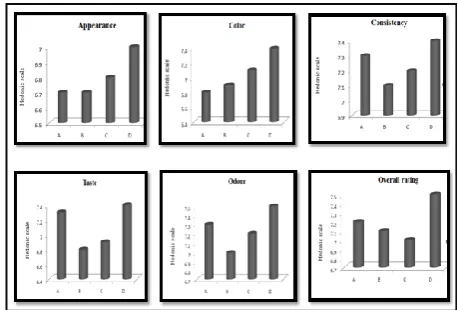
Physico chemical characteristics of the RTS beverages presented graphically in Figure 1
Figure 1 – Comparison of variations A,B,C and D on organoleptic aspects of RTS beverage
most acceptable product. When adjusting the juice and water ratio ,the RTS beverage having water double the volume of the juice was accepted most by the panel members.
Table 1-Comparison between fermented and unfermented RTS beverages
From Table 1 it can be seen that the pH of fermented beverage is lower than that of
unfermented one. Since fermentation process leads to the formation of organic acids and subsequent release of hydrogen ions there is decrease in pH value and increase in titrable
acidity of the fermented RTS beverage. [1]
Tannin content in fermented beverage which is 0.055% is lower than the unfermented beverage which is 0.071%. This is because during fermentation the probiotics degrade the tannins. The ascorbic acid content is higher in the fermented beverage which is 1.5mg/ml than the unfermented beverage which is 0.25mg/ml. The reason for the higher concentration of ascorbic acid in the fermented RTS beverage is attributed to the presence of basil leaves which are rich in Vitamin C and also to the fermentation process where 2 keto-L-Gulonic acid ,an intermediate, is converted to
L-Ascorbic acid.
[2,3]
The unfermented RTS beverage (23ºBx) has higher amount of Total Soluble Solids as compared to the fermented RTS beverage (15ºBx).The increase in TSS in unfermented beverage is attributed to the process of leaching in which the soluble solids including sugars come into the solution. The addition of salt to the grated cucumber extracts out water and
sugars besides other nutrients thus increasing the amount of TSS.
3.1 Shelf- life testing and changes in the nutritional composition of the RTS Beverage Titrable acidity and pH
Figure 2 shows that there is a gradual increase from 1.86g/L to 3g/L in the amount of acidity with the advancement of storage. The increase in the acidity of the RTS beverage may be attributed to increase in the release of hydrogen ion concentration from the citric acid during storage.
Figure 2- Changes in acidity during storage
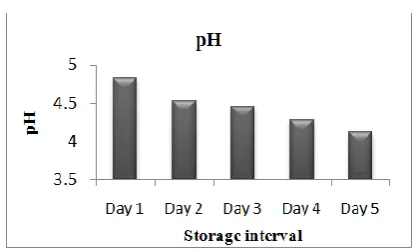
From Figure 3 it can be seen that the values of pH decreased from 4.83 to 4.12 after 5 days of storage as the acidity increased because of the formation of various organic acids during fermentation including sulphurous acid present
in the fruits. [4]
Figure 3- changes in pH during storage
3.2 Tannin
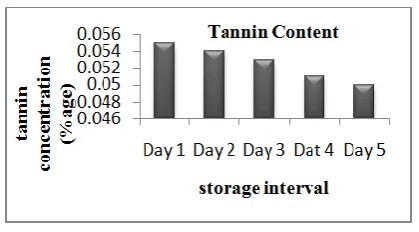
tannin levels of the RTS beverage might be attributed to the activities of the probiotics present in it. [5]
Figure 4 Changes in tannin levels during storage
3.3 Ascorbic acid
From the figure given below it is seen that the concentration of ascorbic acid decreased from 1.5mg/ml to 0.4mg/ml within 5 days of storage.
According to Costa etal, (2003) the decrease in
vitamin C could be probably attributed to oxidation, which occurs in fruit juices during storage and is highly dependent on the presence of oxygen in the head space or dissolved in the
juice [6]
Figure 5 Changes in Ascorbic acid concentration during storage
3.4 Total Soluble Solids
From the given graph below it is seen that the TSS decreased from 15ºBrix to 11ºBrix after the storage interval of 5 days.
The stability of Brix value of the juice indicates that the fruits were collected at mature stage. This might be the reason for good palatability and acceptability of the juice, as can be deduced from the fact that reducing sugars are the main constituents of soluble solids. The decrease in TSS might be due to the utilization
of sugars by fermenting organisms leading to
degradation of sugars. Moreover, decrease could also be attributed to the precipitation of
tannins.[6]
Figure 6-Changes in the Total Soluble Solids during storage
From the graph given below it can clearly be seen that during 5 days of storage under refrigerated condition the RTS beverage was
acceptable from 1st to 3rd day. Whereas from 4th
day the color had started to fade and the RTS beverage had become sour to taste due to high acidity.
4. Conclusion
From the given results and discussions it can be concluded that the nutritional composition of the fermented RTS beverage was much higher than the unfermented RTS beverage. Based on the physico- chemical characteristics, it was seen that there was no microbial growth during 5 days of storage of the final RTS beverage. As per sensory evaluation the RTS beverage stored from 1 to 3 days was
most acceptable by the panel
members.Shelf life studies showed a decrease in pH, ascorbic acid, tannin, TSS levels and an increase in the titrable acidity.
It can be concluded that the probiotics, cucumber, pineapple and basil leaves can be used as a valuable ingredients for the production of healthy RTS beverage with all the important properties and medicinal
characteristics. It is also safe for
consumption since there was no addition of artificial color, flavor, acid or preservative.
5. Acknowledgement
This work was done as postgraduate research work and therefore would like to
acknowledge the management for
infrastructural support. The other
departmental faculty members had helped by giving suggestions.
6. References
[1] Coote. N, Kirsop .B.H. “Factors
responsible for the decrease in pH during
Beer Fermentation”. Journal of Industrial
Brewery. 1976, 82, pp149-153.
[2] Hancock. R.D, Viola. R., “Improving
the nutritional value of crops through enhancement of l-ascorbic acid (vitamin C) content: rationale and biotechnological
opportunities”. Journal of. Agricultural. Food
Chemistry. 2005, 53, pp 5248–5257.
[3] Delic V, Sunic D, Vlasic D,
“Microbial reactions for the synthesis of vitamin C (L-ascorbic acid). Vandamme EJ (ed) Biotechnology of vitamins, pigments and growth factors. Elsevier, London. 1989. Pp 299-334.
[4] Chauhan D.K, Puranik Vinita, Rai G.K. “Development of Functional RTS
Beverage” Open Access Scientific Reports.
2012, 12, pp 1-5.
[5] Murwan. K. “Effect of fermentation period on the chemical composition, in-vitro protein digestibility and tannin content in two sorghum cultivars (Dabar and Tabat) in
Sudan”, Journal of Applied Bioscience. 2011,
39, pp 2602-2606.
[6]Talasila Uma, Vechalapu Rama Rao and Shaik. Khasim Beebi.“Preservation and Shelf
life Extension of Cashew Apple Juice”.
Internet Journal of Food Safety. 2011, 13, pp 275-280.
Authors Biography