System Tuning and Stability Analysis in
Discrete Domain for a Standard Dexterous
Arm Model
Swati Barui1, Debasmita Manna2, Biswarup Neogi3
Assistant Professor, Dept. of ECE, N a r u l a I n s t i t u t e o f T e c h n o l o g y , Kolkata, India1
Assistant Professor, Dept. of ECE, D r . S u d h i r C h a n d r a S u r D e g r e e E n g i n e e r i n g C o l l e g e ,
Kolkata, India2
Faculty, Dept. of ECE, J I S C o l l e g e o f E n g i n e e r i n g , Nadia, India3
ABSTRACT:Dexterity, ability to use the hands or body movement, is the major aspect in modelling dexterous hand. Prostheses are typically used to replace missing body parts. So, dexterity and prosthetic are two related terms.The progress of dexterous arm model is adapted the different implementations of biomedical control engineering. Researchers are working for the improvement of stability of some existing standard prosthetic arm model. This paper demonstrates the discrete domain analysis with Ziegler-Nichols tuning approach of a standard dexterous arm model with PID controller.
KEYWORDS: Dexterous Arm Model, Discrete domain, Pole Zero Plot, Ziegler-Nichols tuning,stability.
I.INTRODUCTION
Dexterity is commonly used in application to motor skills of hands and fingers[1].One of the most used methods for intelligent prosthesis control is based on surface myoelectric signals picked up from the remaining muscles of the amputated arm. For this reason, the resulted prostheses can be named myoelectric prostheses. The processed myoelectric signal corresponding to a constant contraction is not itself constant. Rather, the processed signal fluctuates above and below a mean value corresponding to that contraction level. In order to obtain an estimate of the contraction level, it is necessary to observe the signal for some period of time. Consequently, considerable uncertainty exists in the resulting estimate and the system may not be stable. Accordingly, there is a chance that the system will not act properly even though the desire signal level is produced. The probability of this happening is called "system error"[2,3].Control engineering application to such systems are intended to optimize the error and sustain system stability. The present work is the extended part of the paper published by Swati et.al[4]. In that paper[4] a standard dexterous arm model had considered for designing of controller section. A reference transfer function corresponds to a standard dexterous arm model was taken. The step responses were studied for different controller-PD, PI, PID, by comparing each control parameters the best result that was for PID controller[4] has been selected here for discrete domain analysis. Discrete domain transfer function for the selected model has been generated through simulation approach and stability analysis is done by pole-zero plots. The requirement of further optimized result in terms of stability to achieve better performance is initiated by Ziegler Nichols tuning approach.
II. LITERATURE SURVEY
The disaster in World War-1, influenced the need of body parts prostheses. So, starting from World War-1 immense research work is going on the topic. Advancement in research and development introduced different types of controlling technologies and different advanced arm. Chronologically some important arms are: PreBluft arm-1919, SVEN-Hand-1965, Utah Arm-1982, PALOMA hand-2001, DEKA Luke Arm-2009, Mech Hands-2014[5]etc.
II. DISCRETE DOMAIN ANALYSIS
Discrete time views values of variables as occurring at distinct, separate "points in time", or equivalently as being unchanged throughout each non-zero region of time ("time period")—that is, time is viewed as a discrete variable. Thus a non-time variable jumps from one value to another as time moves from time period to the next [6]. The discrete domain is comparatively more effective than continuous domain for designing aspect. Here, as the model is analyzed in discrete domain and the optimum case for the transfer functions from continuous domain to discrete domain are being developed through simulation using MATLAB.
III.STABILITY CONCEPT IN POLE ZERO PLOT
The stability property is determined by the poles and zeros of H(z). However it is seen that the poles only determine the stability. Asymptotic stable system: All poles lie inside (none is on) the unit circle, or what is the same: all poles have magnitude less than 1.Marginally stable system: One or more poles — but no multiple poles — are on the unit circle Unstable system: At least one pole is outside the unit circle or there are multiple poles on the unit circle [7].
IV. STABILITY ANALYSIS FOR THE MODEL WITH PID CONTROLLER USING POLE ZERO PLOT
H(s) for PID controller was obtained as -
H(S)
=
( )( )
[4]
The discrete time transfer function H(z) was obtained as –
H(z)
=
. . . .. . . .
The zeros and poles are shown in following points –
Table 1: Zeros and Poles location
zeros poles
0 0.9996 + 0.0000i
0. 7102 0.3935 + 0.4624i
0. 9982 0.3935 - 0.4624i
0.6076 0.6053 + 0.0000i
Table 1 tabulates all the Zeros and Poles location.
All the poles are not in the unit circle. So it is not asymptotically stable. No single pole is in outside the unit circle. So it is not unstable also. But it is satisfying the condition of a marginally stable system that states one more poles can stay on the unit circle. So it is perfectly showing, one pole is just on the unit circle at 0.9996 + 0.0000i position. Therefore, the system is marginally stable due to no tuned control parameter of PID Controller.
V. SYSTEM OPTIMIZATION
The controlled parameter Kp, Ki, Kd of PID Controller can be tuned to make the system asymptotically stable for more optimized analysis. Tuning is adjustment of control parameters to the optimum values for the desired control response. Stability is a basic requirement. However, different systems have different behavior, different applications have different requirements, and requirements may conflict with one another. PID tuning is a difficult problem, even though there are only three parameters and in principle is simple to describe, because it must satisfy complex criteria within the limitations of PID control.Tuning methods of controller describe the controller parameters in the form of formulae or algorithms. They ensure that the resultant process control system would be stable and would achieve the desired objectives. In soft computing methods, tuning parameters are estimated based on the guiding principles i.e. uncertainty, tractability achievement approximation, robustness and minimum solution cost.In this paper the tuning methods considered for simulation is Zeiglar Nichols method.The main advantage for choosing this tuning approach includes the easy experimental process. Here only need to change the P Controller. It includes the dynamics of whole process, which gives a more accurate picture of how the system is behaving. Ziegler-Nichols (ZN) tuning rule was the first tuning rule to provide a practical approach for PID controller tuning. Based on the rule, a PID controller is tuned by firstly setting it to the Proportional-only mode but varying the gain to make the process system in continuous oscillation (the edge of the stability) [7,8].
VI. ZIEGLER–NICHOLS TUNING METHOD
This method was introduced by John G. Ziegler and Nathaniel B. Nichols in the 1940s. The Ziegler-Nichols’ closed loop method is based on experiments executed on an established control loop (a real system or a simulated system). The Ziegler-Nichols closed-loop tuning method allows you to use the ultimate gain value, Ku, and the ultimate period
of oscillation, Tu, to calculate Kp . It is a simple method of tuning PID controllers and can be refined to give better
approximations of the controller [6,8]. One can obtain the controller constants Kp ,Ki , and Kd in a system with
feedback. The Ziegler-Nichols closed-loop tuning method is limited to tuning processes that cannot run in an open-loop environment.
Table2 : Control parameters in Zeigler Nichols method
Controller Kp Ki Kd
VII.TUNNING OF PID CONTROLLER FOR THE MODEL
Following the above step the overall transfer function can be obtained as –
Kp. G(s)
1 + Kp. G(s)
=
Kp
s(s + 5)(s + 10)
1
1 +
1
s(s + 5)(s + 10)
=
+ 15
+ 50
+ 15
+ 50 +
+ 15
+ 50
=
p
+ 15
+ 50 +
The critical value of “Kp” as “K” can be obtained considering Routh–Hurwitz criterion – The characteristics equation for the above transfer function -
+ 15
+ 50 +
= 0
Now according to Routh–Hurwitz criterion –
Now,
( )> 0
Or
750-
Kp>
0
And also
K p>
0
K’s value is lying in between 0 and 750. The critical value “K”is now 750. It will be considered as Ultimate gain or Ku. Ku is now750.
Now substituting the value “K” in the even equation of Routh–Hurwitz criterion the critical value of “ὼ” can be found in complex domain.
15
+
= 0
=> 15
+ 750 = 0
=> 15(
ὼ) + 750 = 0
=>
−
15ὼ
+ 750 = 0
=>
ὼ
= 50
=>
ὼ
= 5
√
2
1
15
(750
−
)
p
50
p
0
0
0
0
=> 2
= 5
√
2
=>
=
2
5
√
2
= 0.89
Now substituting the same to table 7 equations, the optimized Kp, Ki, Kd value can be obtained
K
p = 0.6*750 = 450
K
i =
. ∗.
= 1011.23
K
d=
. ∗ ∗ .= 50.0625
With this tuned Kp, Ki, Kd value the another model is formed for stability analysis.
VIII. STEP RESPONSE FOR THE MODEL WITH TUNED PID CONTROLLER
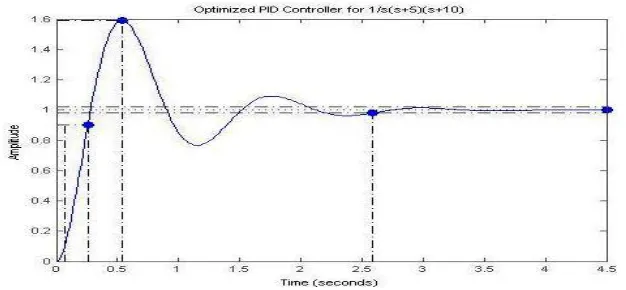
Fig.2: Step response of the model with tuned PID Controller
Fig.2 shows Step response of the model with tuned PID Controller.
Here the value of Kp, Ki and Kd are taken as 450, 1011.23 and 50.0625 respectively.
The corresponding transfer function can be calculated as –
H(s) =
( )
( )
=
. .
The corresponding control parameter are shown in below table
Table 3: Control parameters for the above step response
Table 3 shows control parameters for the above step response and it is clear from the table that overshoot and settling time values are better with the tuned model. So it can be said that better response is achieved for the case.
Different Parameters Value Maximum Overshoot 1.59
Settling Time 2.58s
IX. CONCLUSION
This work involves to implement the transfer function of a standard dexterous arm model with PID controller through discrete domain analysis. Further tuning would be effective to get more accurate error free response for designing the actual system.Proper controller selection made the system useful for tuning parameter value selection through computational approach.. Taking the Pole Zero analysis of the transfer function in discrete domain, stability of the transfer function with PID Controller is found. Further an optimized transfer function with PID Controller is obtained by considering Ziegler-Nichols optimization technique which become more stable and tuned. This transfer function would be effective for further tuning to get more accurate error free response for designing the actual system. I future the nonlinearity effect is also imposed for this particular system. Controllability and observability testing can also be introduced for further analysis of the system.
REFERENCES
1. Brown University, “New metric to track prosthetic arm progress”, ScienceDaily. Retrieved November 11, 2012. 2. Ruch, H., ed., “ Dextrous Robotic Hand.” IEEE Control System Magazine, December 1986.
3. B.Neogi, S.Sinha, S.Banerjee, & A.Das, “Simulation and Design Aspect of Dexterous Hand Model with Control Model Analogy .” International Conference on Systemics, Cybernetics and Informatics , Volume 1 of 2,pp- 200 - 203, 2009.
4. Swati Barui , Debasmita Manna, Subhasish Ghosh, Biswarup Neogi, “Controller Design And Optimized System Analysis For Standard Dexterous Arm Model, International Journal Of Electronics And Communication Engineering & Technology (Ijecet)”, Volume 6, Issue 1, January (2015), Pp. 73-78.
5. El Hamied, M.A. “Controlling Robotic Arm Assisted in Knee Surgery Utilizing Artificial Immunity Technique”, Computer Modelling and Simulation (UKSim), 2013 UKSim 15th International IEEE Conference. , DOI: 10.1109/UKSim.2013.144 . Page(s): 266 – 270
6. Ogata, Katsuhiko (1987), “Discrete-time control systems”.
7. Haag, Michael "Understanding Pole/Zero Plots on the Z-Plane"(June 22, 2005).
8. J.J. Gude and E. Kahoraho, "Comparison between Ziegler-Nichols type tuning rules for PI and Fractional PI controllers - Part 2: The frequency method", in 3rd Seminar for Advanced Industrial Control Applications - SAICA 2009, pp. 181-194. UNED Ediciones, 2009. 9. K. Astrom and T. Hagglund, PID Controller: Theory, Design and Tuning, 2nd ed, Library of Congress Cataloging-in-Publication Data, 1994,