A New Optimized PD-PI Controller using
NSGA-II for Automatic Generation Control
Chittimuru.S.Reddy1, Dr.B.Sarvesh2
Research Scholar, Dept. of EEE, JNTUA, Anantapur, Andhra Pradesh, India1
Professor, Department of EEE, JNTUK, Kakinada, Andhra Pradesh, India2
ABSTRACT: This paper introduces a new powerful cascaded PD-PI controller for solving load frequency control (LFC) problem in power system. A two area non-reheat thermal power plant is considered and gains of PI/PID controllers are optimized using non dominated sorting algorithm-II NSGA-II. This paper compares new controller effectiveness in solving LFC problem with the performances of controllers tuned with other optimization techniques reported in the literature
KEYWORDS: Automatic generation control (AGC); active power frequency control, cascaded controller; proportional integral derivative controller (PID); NSGA-II optimization algorithm
I.INTRODUCTION
The role of automatic generation control (AGC) is very important in power system operation and control to ensure reliability and power quality of the grid by maintaining system frequency and tie line power at their schedule values. In a multi area interconnected system, all the units are connected synchronously and therefore they work with same frequency. Any abrupt change in load in one area or in different areas simultaneously and other abnormal conditions will cause a change in the frequency of the areas and in the transferred power of the tie-lines [1]. These changes must be reduced to zero or to be minimized to the maximum possible extent automatically.
The LFC problem of an interconnected power system network is enlarged by the several researchers from time to time over last few decades in order to present better dynamic responses. Several control mechanisms have been proposed in the literature to solve LFC problem, such as classical controller [2–5], non-integer controller [6–8], sliding mode controller (SMC) [9], robust controller [10], and intelligent controller [11–14]. The authors of [11–13] proposed non-integer controller to solve LFC problem for an interconnected multi-area power system network and showed better system dynamics than the results available in the literature. Several intelligent controllers based on fuzzy logic [11], neuro-fuzzy [12], advance fuzzy [13], artificial neural network [14] were presented in the area of LFC and demonstrated their applicability to improve dynamic performances of the same. Different optimization techniques which are population based such as differential evolution (DE) [4], genetic algorithm (GA) [16], particle swarm optimization (PSO) [17], artificial bee colony algorithm (ABCA) [18], bacteria foraging optimization algorithm (BFOA) [3], hybrid bacteria foraging optimization algorithm – particle swarm optimization (hBFOA-PSO) [2]. However, it was identified from recent research that all the above said algorithms had a drawback of dependency on initialization of input parameters and slow convergence rate. Also a particular evolutionary algorithm which gives better results on a set of problems may show poor performance on a different set of problems. Therefore an attempt has been made in this paper to design and implement a relatively new cascaded controller based on NSGA-II optimization technique to solve LFC problem of an interconnected power system. The dynamic responses are studied with step load perturbation (SLP) in area-1 considering overshoot, settling time of frequency and tie-line power deviations as performance indices. By minimizing time multiplied integral absolute error fitness function, stability of the
interconnected system is improved. Dynamic performances of NSGA-II optimized PD-PI controller are compared with
II.SYSTEM INVESTIGATED
The power system under investigation consists of an interconnected two-area non-reheat thermal–thermal power system network, which is widely used in the literature for design and analysis of LFC problem [2] as shown in Fig. 1. Each area has a rating of 2000MW with a nominal load of 1000 MW. B1 and B2 are the frequency bias parameters; AEC1 and AEC2 are area control errors; u1 and u2 are the control outputs form the controller; R1 and R2 are the
governor speed regulation parameters in p.u. Hz; TG1 and TG2 are the speed governor time constants in sec; ∆PG1 and
∆PG2 are the governor output command (p.u.); TT1 and TT2 are the turbine time constant in sec; ∆PT1 and ∆PT2 are the
change in turbine output powers; ∆PD1 and ∆PD2 are the load demand changes; ∆PTie is the incremental change in tie
line power (p.u.); KPS1 and KPS2 are the power system gains; TPS1 and TPS2 are the power system time constant in sec;
T12 is the synchronizing coefficient and ∆f1 and ∆f2 are the system frequency deviations in Hz. The relevant parameters
are given in Appendix A
III. THE PROPOSED APPROACH
The performance of the power system depends on the controller structure and selection of objective function. The details about controller structure and objective function employed in the present study are presented in this section.
Controller structure
Cascade control is one of the approaches used to enhance the system performance. As the number of tuning knobs is more in a cascade controller than a non-cascade controller, improved system performance is expected with cascade control system [17]. The concept of the cascaded controller comes from two combinational processes, where the inner process supplies its output to the outer process.
for AGC. The control input signals are the respective ACEs and controller output are the reference power settings of individual generating units.
Objective Function
For controller design employing optimization methods, the objective function is generally specified depending on some performance criteria such as Integral of Time multiplied Absolute Error (ITAE), Integral of Absolute Error (IAE), Integral of Squared Error (ISE) and Integral of Time multiplied Squared Error (ITSE). Detailed expression of these objective functions, their comparison on the system performance is available in literature [14–16]. It has also been shown in several studies that ITAE objective function offers improved system response than other alternatives [20].Hence ITAE is chosen as objective function in the present study which is written as:
Multi-objective optimization with NSGA-II
An optimization problem having multiple objectives can be formulated simplistically as a single objective problem as weighted sum of the individual objectives with suitably selected weights for each of them. However, a misjudgment in the ratio of different weights would skew the eventual solution more toward one among all the objectives. On the otherhand, there is a better chance of obtaining a more promising solution after suitably identifying it from those available from the set of Pareto optimal solutions. The later can be obtained with the help of a multi-objective optimization algorithm like NSGA-II. The flowchart of NSGA-II is given in Fig. 3[20].
IV. RESULTS AND DISCUSSION
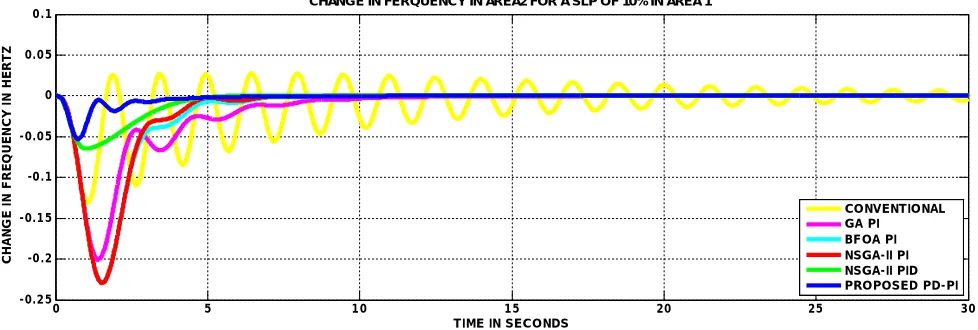
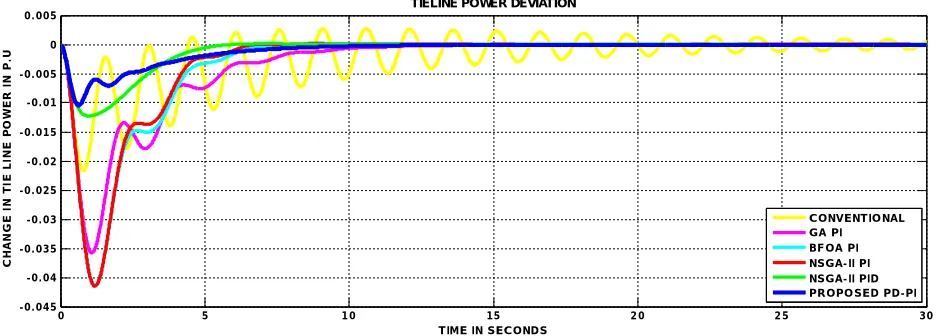
The objective function given in Eq. (1) is evaluated for each individual by simulating the system dynamic model considering a 10% step increase in load demand in area-1. The population of NSGA-II is taken as 10 individuals (real
coded representation) and evolutionary cycle has stopping criterion of 100 generations. The parameters α, β, ϒ are
taken as 1.5, 0.05 and 0.5 respectively. The upper and lower bounds of the PID controller parameters are chosen as (0, 2). Simulations were conducted on an Intel, core 2 Duo CPU of 2.4 GHz and 4 GB MB RAM computer in the MATLAB (R2013a) environment. To show the effectiveness of the proposed controller, results are compared with some recently published modern heuristic optimization methods such as Bacteria Foraging Optimization Algorithm (BFOA) and Genetic algorithm (GA) for the same interconnected power system [3] and are given in Table1. It is clear from Table 1 that tuned parameters are giving better solution than BFOA and GA when all the criteria (ITAE, minimum damping ratio and settling times) are considered simultaneously. It is also clear from Table 1 that ITAE values and settling times are further minimized with the use of NSGA-II optimized PD-PI controller.
0 5 10 15 20 25 3 0 - 0.3 - 0.25 - 0.2 - 0.15 - 0.1 - 0.05 0 0.05
T IME IN SECONDS
C H A N G E IN F R E Q U E N C Y I N H E R T Z
CHANGE IN FREQUENCY IN AREA1 FOR SLP OF 10% IN AREA 1 ALONE
CONVENT IONAL GA PI BF OA PI NSGA- II PI NSGA- II PID PROPOSED PD- PI
Figure 4: Change in frequency in area 1 for SLP of 10% in area 1 alone
0 5 1 0 1 5 20 25 30
- 0.2 5 -0 .2 - 0.1 5 -0 .1 - 0.0 5 0 0.0 5 0 .1
T IME IN SECO NDS
C H A N G E I N F R E Q U E N C Y I N H E R T Z
CHANGE IN FERQUENCY IN AREA2 FOR A SLP OF 10% IN AREA 1
CO NVENT IO NAL GA PI BF OA PI NSGA- II PI NSGA- II PID PRO POSED PD- PI
Figure 5: Change in frequency in area 2 for SLP of 10% in area 1 alone
0 5 10 15 20 25 30
- 0.09 - 0.08 - 0.07 - 0.06 - 0.05 - 0.04 - 0.03 - 0.02 - 0.01 0 0.01
T IME IN SECO NDS
C H A N G E I N T IE L IN E P O W E R I N P .U
TIELINE POWER DEVIATION WHEN A SLP OF 10% IN AREA -I ALONE
CONVENT IONAL GA PI BF OA PI NSGA-II PI NSGA-II PID PRO PO SED PD-PI
0 5 1 0 1 5 20 2 5 3 0 -0 . 35
- 0 .3 -0 . 25 - 0 .2 -0 . 15 - 0 .1 -0 . 05 0 0 . 05
T IME IN SECONDS
C H A N G E I N F R E Q U E N C Y I N H E R T Z
CHANGE IN FREQUENCY IN AREA1
CONVENT IONAL GA PI BF OA PI NSGA- II PI NSGA- II PID PR OPOSED PD-PI
Figure 7: Change in frequency in area 1 for SLP of 10% in area 1 and 5% in area 2
0 5 10 1 5 2 0 2 5 3 0
- 0. 3 -0 .2 5 - 0. 2 -0 .1 5 - 0. 1 -0 .0 5 0 0 .0 5
T IME IN SECONDS
C H A N G E I N F R E Q U E N C Y I N H E R T Z
CHANGE IN FERQUENCY IN AREA 2
CO NVENT IO NAL G A PI BF O A PI NSG A- II PI NSG A- II PID PRO PO SED PD- PI
Figure 8: Change in frequency in area 2 for SLP of 10% in area 1 and 5% in area 2
0 5 1 0 15 2 0 2 5 30
-0. 045 -0. 04 -0. 035 -0. 03 -0. 025 -0. 02 -0. 015 -0. 01 -0. 005 0 0. 005
T IME IN SECONDS
C H A N G E I N T IE L IN E P O W E R I N P .U
TIELINE POWER DEVIATION
CONVENT IO NAL GA PI BF OA PI NSGA- II PI NSGA- II PID PROPO SED PD-PI
V.CONCLUSION
In this paper, cascaded PD-PI controller and was employed for AGC of two area interconnected thermal power system. The superiority of the proposed NSGA-II optimized PD-PI controllers is shown by comparing the results with some recently published modern heuristic optimization approaches such as Bacteria Foraging Optimization Algorithm (BFOA), Genetic Algorithm (GA) and NSGA-II PI and PID based controllers for the similar interconnected power system.
REFERENCES
[1] Ibraheem, Kumar P, Kothari DP. Recent philosophies of automatic generation control strategies in power systems. IEEE Trans Power Syst 2005;20(1):346–57.
[2] Panda S, Mohanty B, Hota PK. Hybrid BFOA–PSO algorithm for automatic generation control of linear and nonlinear power system. Appl Soft Comput 2013;13:4718–30.
[3] Ali ES, Abd-Elazim SM. Bacteria foraging optimization algorithm based load frequency controller for interconnected power system. Int J Elect Power Energy Syst 2011;33:633–8.
[4] Routh UK, Sahu RK, Panda S. Design and analysis of differential evolution algorithm based automatic generation control for interconnected power system. Ain Shams Eng 2013;4:409–21.
[5] Sahu RK, Panda S, Padhan S. A hybrid firefly algorithm and pattern search technique for automatic generation control of multi-area power systems. Int J Elect Power Energy Syst 2015;64:9–23.
[6] Debberma S, Saikia LC, Sinha N. Solution of automatic generation control problem using firefly algorithm optimized IkDl controller. IST Trans 2014;53:358–66.
[7] Debberma S, Saikia LC, Sinha N. Automatic generation control using two degree of freedom fractional order PID controller. Int J Elect Power Energy Syst 2014;55:120–9.
[8] Dash P, Saikia LC, Sinha N. Comparison of performances of several Cuckoo search algorithm based 2-DOF controllers in AGC of multi-area thermal system. Int J Elect Power Energy Syst 2014;55:429–36.
[9] Vrdoljak K, Peric N, Petrovic I. Sliding mode based load frequency controller in power system. Int J Elect Power Sys Res 2010;80:512–27. [10] Ray G, Prasad AN, Prasad GD. A new approach to the design of robust load frequency controller for large scale power system. Int J Elect
Power Sys Res 1999;5:13–22.
[11] Mukherjee V, Ghoshal SP. Comparison of intelligent fuzzy based AGC coordinated PID controller and PSS controlled AVR system. Int J Elect Power Syst Res 2007;29:679–89.
[12] Prakash S, Sinha SK. Simulation based neuro-fuzzy hybrid intelligent PI-control approach in four area load frequency control of interconnected power system. Appl Soft Comput 2014;23:152–64.
[13] Sabahi K, Ghaemi S, Pezeshki S. Application of type-2 fuzzy logic system for load frequency control using feedback error learning approach. Appl Soft Comput 2014;21:1–11.
[14] Khuntia SR, Panda S. Simulation study for automatic generation control of a multi-area power system by ANFIS approach. Appl Soft Comput 2012;12:333–41.
[15] Daneshfar F, Bevrani H. Multiobjective design of load frequency control using genetic algorithms. Int J Elect Power Energy Syst 2012;42:257–63.
[16] Sun S, Zhang J, Wang J, Xu L. The application of new adaptive PSO in AGC and AFC combined control system. Proc Eng 2011;16:702–7. [17] Gozde H, Taplamacioglu MC, Kocaarslan I. Comparative performance analysis of ABC algorithm in AGC for interconnected reheat thermal
power system. Int J Elect Power Energy Syst 2012;42:167–78.
[18] Y. Lee, S. Park, PID controller tuning to obtain desired closed loop responses for cascade control systems, Ind. Eng. Chem. 37 (1998) 1859– 1865.
[19] P. Dash, L.C. Saikia, N. Sinha, Flower pollination algorithm optimized PI-PD cascade controller in automatic generation control of a multi-area power system, Int. J. Electr. Power Energy Syst. 82 (2016) 19–28.