Knowledge Creation Environment in the Iranian Universities: A Case Study
Mahdi Shaghaghi
Assistant Prof., Department of Knowledge & Information Sciences, Shahid Beheshti
University, Tehran, Iran [email protected]
Amir Ghaebi
Associate Prof., Department of Knowledge & Information Sciences, Alzahra University,
Tehran, Iran [email protected]
Seyedeh Fariba Ahmadi
M.A. in Knowledge & Information Sciences, Alzahra University, Tehran, Iran
Corresponding Author: [email protected]
Received: 11 December 2019 Accepted: 14 April 2020
Abstract
construct. The results of the structural equation modeling also revealed that the intervention, intelligence, and involvement constructs are related to the integration construct with the complete mediation of imagination. The present research suggest that knowledge creation at Alzahra University relatively complies with the combination of thei -System and Ba models. Unlike this model, the intervention, intelligence, and involvement constructs are not directly related to the integration construct and this seems to have three implications: 1) the information sources are not frequently used to assess and identify the research biases; 2) problem finding is probably of less concern at the end of studies and at the time of assessment and validation; 3) the involvement of others has a smaller role in the summarization, assessment, and validation of the research.
Keywords: i-System, Ba Model, Knowledge Creation, Knowledge Creation Environment, Knowledge Management, Alzahra University.
Introduction
Knowledge is considered the most important element of value creation due to the increasing complexity of the competition between the institutes and organizations. Therefore, understanding knowledge creation and its determinants and the process of knowledge management is substantially important. Seemingly, mechanical attention to knowledge management regardless of knowledge creation is not adequate and fails to result in improvement and innovation on its own (Nonaka & Takeuchi, 1995). Improvements in the capacity for the creation of knowledge and innovation in organizations and educational centers can considerably contribute to the improvement in performance and survival of these organizations. Organizational innovation revolves around the targeted design and alteration of the products, services, structures, and organizational processes.
The environment plays a key and significant role in the emergence of knowledge and knowledge creation because human is a context-oriented creature that needs to be in the right environment to carry out every task and activity. His performance is also influenced by the attributes of that environment. For instance, a mechanic can only manifest his knowledge if he is in a repair shop and if he has access to the necessary devices and accessories to show the concrete manifestation of his knowledge. If he is in a chemistry laboratory, he basically cannot show his knowledge. Davenport (1998) stressed the role of organizational culture in knowledge management. Moreover, the repeated emphasis on the incompatible organizational culture (Jennex, 2008: 12), as the most important reason for the failure of the knowledge management programs, in different references confirms the role of the environment on the manifestation and circulation of knowledge in organizations.
person shares his/her explicit knowledge in the form of plans, instructions, guidelines, and models with a workgroup, where it transforms into collective explicit knowledge. Following discussions and conversations about the collective explicit knowledge, this knowledge transforms into collective tacit knowledge, setting the scene for the reemergence of the person’s tacit knowledge and continuation of this cycle. Hence the written interpretations, conversations, and observations (five senses) in the interaction cycles form the basis for knowledge creation as acknowledged by all knowledge management and knowledge creation scholars (Nonaka & Takeuchi, 1995).
knowledge creation at Alzahra University? 3) How much does the research conceptual model match the operational model?
Conceptual Model
In works such as Nakamori (2014) and Wierzbicki and Nakamori (2006) as well as the studies by Nakamori (2006), and Kikuchi, Rong, Wang, Wierzbicki & Nakamori (2007), we find that Nakamori as a leader of these works have combined the constructs of i-System model with the ingredients of Ba model and offered a new framework for the evaluation of knowledge creating environments. In this section, we describe elements of this combined model.
Ba model
As Nonaka & Kono (1998) were expressed, Ba is a Japanese concept the best English equivalent of which is the term “place”. This term initially was introduced by the Japanese philosopher, Nishida Kitaro, and was made discursive by Shimizu. The philosophical concept of Ba signifies a place for identification of an individual in a team, and self-identification. Nonaka & Kono (1998) by emphasizing on the German existentialist thinking have stated that Ba is a place in which the meaning is sheltered and by which the meaning is nurtured. Therefore, Ba is a common and public place that makes possible the scientific dialogue and knowledge creation. Nakamori (2006) and Pribadi (2010) stated that Ba have three dimensions: 1. infrastructure (place, material, equipment); 2. Agents (cooperators); and 3.Information (explicit knowledge).
i-System model
This model offers a self-regulating mechanism without the control of an external director (CEO, dean, boss, owners, etc.) for knowledge creation. It is one of the main models of knowledge creation that was inspired by the Nonaka, & Takeuchi’s (1995) model. By using this model, the external data and information are combined by the internal knowledge of agents in order to lead an organization to a new knowledge that have not existed before. Nakamori (2006) stated that this model have 5 dimensions: 1. Intervention (finding problems); 2. Intelligence (explicit knowledge available for problem solving); 3. Involvement (place and equipment for dialogue, oneness and cooperation); 4. Imagination (grasping, digesting and understanding ideas, analyzing them, and imagining new ideas); and 5. Integration (combining and integrating ideas, and assessing and evaluating them).
Mixed model
By combining the i-System and Ba models, we offer a mixed model by 11 constructs using Nakamori (2006). It can be said that construct no 1 serves as the input, constructs 2-10 serve as the process and construct 11 serves as the output:
Intervention
can be some of the observed variables of this construct.
Infrastructure-intelligence
This construct assesses the hardware constraints of the knowledge creating environment. This construct aims to assess the limitations of equipment, appliances, place (books, library space, computer hardware, network equipment, etc.) in finding and aggregating the needed information.
Agent- intelligence
This construct is very individualistic and aims to assess the agent’s liberty and freedom in investigating any problems they want in their knowledge creating environment. To what extent an agent has freedom to investigate a specific problem? Is there any forbidden problem that no one can study? Why?
Information-intelligence
This construct aims to assess whether data gathering from inside and outside of the knowledge creating environment is possible. Is there any prospected mechanism or process for gathering data from inside or outside the knowledge creating environment?
Infrastructure-involvement
This construct targets the hardware dimensions of cooperation and involvement of the agents. The main question of this construct for assessment of the knowledge creation environment is that whether or not the place, appliances, resources, and other physical equipment have been provided for the cooperation of heterogeneous groups (such as the faculty members and students, outside researchers and students).
Agent-involvement
This construct aims at the assessment of the commitment to the rules of cooperation in the knowledge creation environment. To what extent the agents are committed to rules of cooperation? Are there ever any rules for adherence?
Information-involvement
This construct studies the collaborative problem-solving process in the knowledge creating environment and aims to investigate whether the dialogues target the heart of the problem. Is there concentration on the core of problem and whether marginal and none-relevant factors affect mode of the process?
Infrastructure-imagination
This construct investigates the possibility of direct experience and data collection of phenomena inside the knowledge creation environment, or the existence of the routines, facilities or official recommendations for gathering data from outside of the environment.
Agent-imagination
absorption of external explicit knowledge (documents, catalogues, standards, reports, etc.) and converting them into the internal and implicit knowledge by means of the focus groups sessions, reading sessions, research review sessions etc.
Information-imagination
The aim of this construct is to find out whether there is any routine, practice, plan or culture for offhand transaction and information sharing among the homogenous or heterogeneous agents in the knowledge creation environment.
Integration
This construct serves as the output and signifies the process of combining, integrating and evaluating new findings or new interpretations or understandings and their validity.
By combining the above-mentioned dimensions of the Ba and i-System models, the conceptual model of this research is constructed:
Figure 1. Conceptual model of the research
In the following section, we aim to assess the knowledge creation environment of Alzahra University in Iran as a typical Iranian university by means of the conceptual model represented in a questionnaire with 52 questions.
Research Method
received, which accounted for 72.27% of all the distributed questionnaires. This percentagewas considered acceptable. The Content Validity Index (CVI) method was used to assess the content validity of the questionnaire, and 10 experts completed the CVI questionnaire. Since the CVI index was higher than 0.79 for all statements, the validity of this questionnaire was confirmed.
The reliability of a research scale refers to the stability and repeatability of its results. In a reliability assessment, the goal is to ensure whether the scale yields relatively stable results or yields contradictory data on the research population each time. There are various reliability assessment methods, but the split-half method was used in this study. To this end, the research questions were split in half. To wit, the odd questions were put in the group 1 and the even questions were put in the group 2. Next, the Pearson correlation coefficient (Pearson’s r) was calculated for these two variables, which was 0.702. Then, Pearson’s r was put in the Rn=
2r 1+r
formula and since the calculated Rn (0.824) was more than 0.7, the reliability of the
questionnaire was accepted.
We used the SPSS and AMOS statistical software programs for analyzing the data. Furthermore, the descriptive (median, mean, standard deviation, quartiles) and Inferential (t-test, regression analysis, structural Equation Modeling (SEM)) statistics were used for finding patterns.
Findings
At the first stage, the descriptive statistics concerning our sample are presented below.We used the median criteria for computing theresearch variables in SPSS:
Table 1.
Descriptive statistics of the research constructs
Statistics constructs
Median Mean Standard
deviation
quartile 1
quartile 2
quartile 3
Interquartile
Intervention 3 2.79 1.18 2 3 4 2
infra-intell 3 3.14 0.81 3 3 4 1
agent-intell 3 3.32 0.89 3 3 4 1
info-intell 3 2.75 0.79 2 3 3 1
infra-involve 3 2.87 0.95 2 3 3 1
agent-involve 4 4.05 0.63 3 4 4 1
info-involve 3 3.11 0.90 2 3 4 2
infra-image 3.5 3.37 0.74 3 3.5 4 1
agent-image 2 2.25 0.83 1 2 3 2
info-image 3 3.06 0.92 3 3 4 1
integration 4 3.79 0.81 3 4 4 1
total 3 3.20 0.62 3 3 4 1
constructs, namely intervention (mean=2.79), information-intelligence (mean= 2.75) and infrastructure-involvement (mean=2.87) are under the average utility and only agent-involvement (mean=4.05) is in a good condition and other constructs are of average condition.
For testing the significant difference between the upper and lower bound of the spectrum, we used the nonparametric binomial test because of the ordinal data. Table 2 shows the results:
Table 2
Binomial Test
Category N Observed Prop. Test Prop. Exact Sig.
(2-tailed)
Group 1 Group 2 Group 1 Group 2 Total Group 1 Group 2 Total Group 1 Group 1
intervention <= 3 > 3 74 55 129 .57 .43 1.00 .50 .113
infra-intell <= 3 > 3 63 66 129 .49 .51 1.00 .50 .860
agent-intell <= 3 > 3 58 71 129 .45 .55 1.00 .50 .291
info-intell <= 3 > 3 82 47 129 .64 .36 1.00 .50 .003
infra-involve <= 3 > 3 83 46 129 .64 .36 1.00 .50 .001
agent-involve <= 3 > 3 9 120 129 .07 .93 1.00 .50 .000
info-involve <= 3 > 3 61 68 129 .47 .53 1.00 .50 .597
infra-image <= 3 > 3 52 77 129 .40 .60 1.00 .50 .034
agent-image <= 3 > 3 108 21 129 .84 .16 1.00 .50 .000
info-image <= 3 > 3 65 64 129 .50 .50 1.00 .50 1.000
integration <= 3 > 3 19 110 129 .15 .85 1.00 .50 .000
Table 2 shows the results of the binomial test. Null hypothesis maintains no significant difference between the frequencies of upper and lower bound of the spectrum in each of the constructs of the research and alternative hypothesis maintains a significant difference between the frequencies. As mentioned above, there is a significant difference between the frequencies in five constructs: information-intelligence (lower), agent-involvement (upper), infrastructure-imagination (upper), agent-infrastructure-imagination (lower), and integration (upper). Thus we can more precisely say that gathering data from inside and outside the knowledge creation environment and absorption of external explicit knowledge are not in a good condition at Alzahra University but commitment to the rules of cooperation, direct experience of phenomenon, and combining findings and evaluating them is significantly in a good condition.
In the next step, we examined the effects of independent variables (10 variables) on the dependent variable (integration) by means of the multiple regression with stepwise style. The results are shown below:
Table 3
Variables entered in regression
Model Variables Entered Variables
Removed Method
1 information-imagination
. Stepwise (Criteria: Probability-of-F-to-enter <= .050, Probability-of-F-to-remove >= .100).
2 agent-involvement . Stepwise (Criteria: Probability-of-F-to-enter <= .050, Probability-of-F-to-remove >= .100).
a. Dependent Variable: integration
dependent on the variations of information-imagination and agent-involvement and noother nine variables at Alzahra University.
Table 4
Regression coefficient and Durbin-Watson Statistic for spatial dependency of error terms
Model R R Square Adjusted R Square Std. Error of the
Estimate Durbin-Watson
1 .519a .270 .263 .69439
2 .625b .390 .380 .63704 2.126
a. Predictors: (Constant), info-image, b. Predictors: (Constant), info-image, agent-involve, c. Dependent Variable: integration
Table 4 shows the next important output of stepwise regression analysis. It consists of R, R square, and Durbin-Watson coefficient. Pearson’s R shows the strength of correlation between the independent variables (“information-imagination” and “agent-involvement) and the dependent variable. They have a strong correlation with integration because R is more than 0.5. R square or coefficient of determination shows the dependence of the variations of the dependent variable to the variations of the independent variable. As shown in table above, 27 percent of the variance for “integration” is explainable by “information-imagination” and 39 percent of its variations could be explained by “agent-involvement”. The other important output is the Durbin-Watson statistic that shows the spatial dependency or independency of error terms (probable difference between the real values and predicted values by regression analysis). If the said statistics be less than 1.5 or more than 2.5, it indicates a correlation between the error terms and the inconsistent condition for regression analysis. This statistic here is 2.126 and it shows a spatial independency of the error terms and the consistency of conditions for regression analysis.
Table 5
Residual Statistics
Minimum Maximum Mean Std. Deviation N
Predicted Value 2.2242 5.0529 3.8008 .50547 129
Std. Predicted Value -3.119 2.477 .000 1.000 129
Residual -1.89670 1.55164 .00000 .63180 129
Std. Residual -2.977 2.436 .000 .992 129
a. Dependent Variable: integration
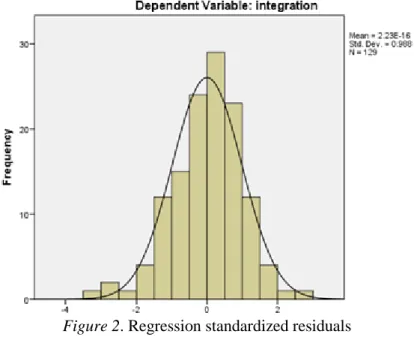
Figure 2. Regression standardized residuals
In the figure 2, we can see normal distribution of standardized residuals that verifies the outputs of table 5 and shows the equal distribution of error terms over regression line. Thusthis condition for regression analysis has been satisfied.
Table 6.
coefficients of regression line equation and beta values
Model
Unstandardized Coefficients
Standardized Coefficients
t Sig.
95.0% Confidence Interval for B
B Std.
Error Beta Lower Bound
Upper Bound
1 (Constant) 2.423 .216 11.240 .000 1.996 2.849
info_imag .453 .068 .519 6.682 .000 .319 .588
2
(Constant) .676 .409 1.653 .101 -.134 1.486
info_imag .427 .062 .489 6.836 .000 .303 .551
agent_involv .448 .092 .349 4.875 .000 .266 .630
a. Dependent Variable: integration
Table 6 is the most important output of regression analysis. Considering that the P value of variables in the model 1 is under 0.05, we chose this model because we recognized it as important for predicting the variations of the dependent variable. Beta value for information-imagination is the biggest value that shows almost 50 percent of variance for the dependent variable regressed on this variable.It reveals that the information-imagination (offhand transaction and information sharing among homogenous or heterogeneous agents) is the most important variable for the integration of knowledge in Alzahra University. But for regression equation, we use unstandardized coefficients; thus:
Integration=2.423+ info-image
×
0.453imagination (routines, practices or plans for offhand transaction and information sharing among homogenous or heterogeneous agents in the knowledge creation environment.) plus the constant value of 2.423. Thus, information imagination is the main variable for predicting the knowledge creation environment in Alzahra University as a typical university in Iran.
In the final phase of the research, we have used the structural equation modeling method and AMOS software (v. 22) for comparing thei-System model of Alzahra University with the basic i-System model and assessing the degree and size of deviation from it.
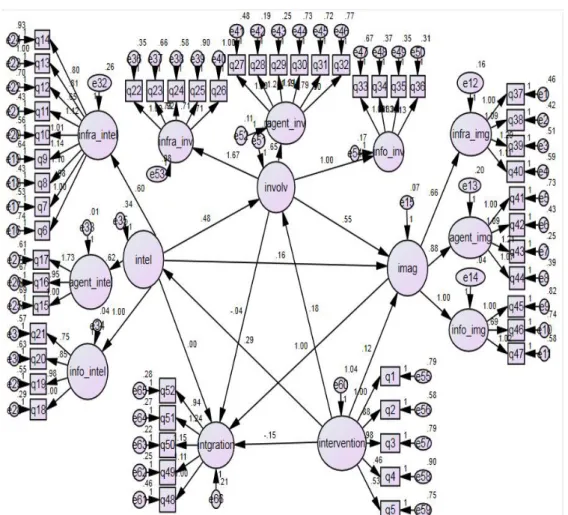
This method was used in order to assess the effects of several independent variables on several dependent ones in a model. In other words, we used structural equation modelling when some endogenous variables are simultaneously exogenous variables (Arbuckle, 2013). In order to evaluate the conceptual model, we should design the targeted model on the basis of the conceptual model. To do this, we should specify the latent variables first. In the model above, the variables “intervention”, “imagination”, “involvement”, “intelligence” and “integration” are the latent variables. Then, the observable variables for “intervention” and “integration” were added. Questions q1 to q5 are observable variables for “intervention” and questions q48 to q52
belong to “integration”. Then, we specified the intermediate variables, namely “infrastructure-imagination”, “agent-intelligence”, “information-intelligence”, “infrastructure-involvement”, “involvement”, “information-involvement”, “infrastructure-imagination”, agent-imagination” and “information-agent-imagination”, and their observable variables, namely the questions q6 to q47. To run the model, we used bootstrapping as a non-parametric method.
Figure 3. Model of the research: the main, intermediate and observable variables with significant or insignificant relations
Table 7
Correlation coefficients among the variables
Paths factor
loading
standard error of mean
confidence level
Estimate S.E. P
Intelligence <--- Intervention 0.295 .075 ***
Involvement <--- Intervention 0.187 .056 0.001
Involvement <--- Intelligence 0.476 .116 ***
Imagination <--- Intervention 0.116 .103 0.090
Imagination <--- Involvement 0.553 .331 0.048
Imagination <--- Intelligence 0.164 .191 0.392
agent-imagination <--- Imagination 0.877 .228 ***
infra-imagination <--- Imagination 0.664 .178 ***
info-imagination <--- Imagination 1.000
infra-intelligence <--- Intelligence 0.601 .133 ***
info-intelligence <--- Intelligence 1.000
agent-intelligence <--- Intelligence 0.623 .161 ***
info-involvement <--- Involvement 1.000
infra-involvement <--- Involvement 0.670 .325 ***
Paths factor loading
standard error of mean
confidence level
Estimate S.E. P
integration <--- Intervention -0.148 .108 0.168
integration <--- Involvement -0.041 .423 0.922
integration <--- Imagination 1.000
integration <--- Intelligence 0.004 0.248 0.986
As shown in the table 7, the paths between intervention and imagination, intelligence and imagination, intervention and integration, involvement and integration, and intelligence and integration are not significant in the 0.95 confidence level (p-values are less than 0.05). However, the direct effects of intervention to intelligence (0.295), intervention to involvement (0.187), intelligence to involvement (0.476), imagination to integration (1.00) and involvement to imagination (0.553) are significant. For studyingthe indirect effects, we got complete and partial mediation data from the outputs of AMOS. Table 8 shows the data for indirect effects:
Table 8.
Indirect effects of the variables
Variables Intervention Intelligence Involvement imagination integration
Intelligence 0 0 0 0 0
Involvement 0.141 0 0 0 0
Imagination 0.224 0.263 0 0 0
Integration 0.328 0.407 0.553 0 0
If the direct path between two variables would not be significant but there would be significant indirect effect with intermediation of another variable, the mediation is complete. If the direct path between two variables would be significant and also there would be significant indirect effect with intermediation of another variable, the mediation is partial.
Table 9
Types of mediation
type of mediation path of indirect effects
complete mediation integration imagination intervention partial mediation imagination involvement Intervention complete mediation integration imagination Intelligence complete mediation imagination involvement Intelligence complete mediation integration imagination Involvement
effect on integration (0.407) with complete mediation of “imagination” and it has indirect effect on “imagination” (0.263) with complete mediation of “involvement”. Eventually, “involvement” has the biggest indirect effect on integration (0.553) with the complete mediation of “imagination”. We can conclude that “imagination” is the most influential mediator for the indirect effects of other variables and plays a key role in the knowledge creation of Alzahra University as a typical university in Iran.
Studying the model fit indices is the final phase of this research. It was probable that model fit indices would not be suitable to saturate standards. Thus we acted on the suggestions of AMOS, namely the modification indices. Modification indices in AMOS are some suggestions for drawing covariance lines between variables or error terms for the improvement of model fit. Arbuckle (2013) suggests that if we can improve indices like “Root Mean Square Error of Approximation” (RMSEA), “chi-square divided by degree of freedom” (χ2/df), “Comparative
Fit Index” (CFI) and “Normed Fit Index” (NFI) to a suitable level, it would be sufficient. We performed the modification indices and this enabled us to improve the indices to a suitable level. The respective results are presented in the table 10:
Table 10
Model fit indices
χ2
/df NFI
CFI RMSEA
model fit indices
1-5 0.9
< 0.8
< 0.1
< criteria
1.023 0.940
0.927 0.107
Values
As shown in the table 10, after performing the modification indices suggested by AMOS, the model fit indices improved to a satisfactory level that can be accepted with some tolerance.
Conclusion
Figure4. Knowledge creation model of a typical university in Iran
The red dashed lines represent the statistically insignificant paths,the orange dashed lines represent the indirect effects, and the green dashed lines represent the statistically significant paths. As shown in the figure 4, effects of all other variables on “integration” as the dependent variable take place with complete mediation of “imagination” and they don’t have direct effect on integration. This finding shows the individualistic mode of knowledge creation vs. the cooperative mode in Iran. It can be an alert for knowledge creation, as a collective subject matter, in Iran and it may have economic, social or ethical implications.
As Showed in fig. 4, direction of all constructs (except “imagination”) toward integration is not significant thus it shows that knowledge creation in the Iranian University occurs actually by means of personal abilities of one researcher without meaningful awareness about real problems of universities, institutions, corporations and organizations. Also, it takes place with minor perception of scientific participation and available true data and information (in libraries, information centers, organizations and corporations) for handling research projects. This may lead researchers to monographs that superficially have more than three or more co-authors. Moreover, this may lead to gathering fake data because of insignificant relationship between intelligence and integration in the studied knowledge creation environment.
The findings of this research are correspondent with some aspects of the work by Tian, Nakamori & Wierbichi (2009). Their research shows that in the Japan Advanced Institute of Science and Technology, there are: 1. weakness in technical backup and IT skills; 2. lack of precise understanding about importance of IT in knowledge management; 3. lack of enough emphasis on cooperation and 4. deficiency in scientific discussions. This research correspondingly showed that weaknesses in the scientific discussions aiming to comprehend and internalize knowledge as well as offhand cooperation and information sharing are important factors for the knowledge creation environment at Alzahra University as a typical university in Iran. Findings of this research are partially correspondent with the findings of Ren, Tian, Nakamori & Wierzbichi (2007). They have shown that four factors were important for the electronic backup for knowledge creation in the Japan Advanced Institute of Science and Technology: 1. creative group communication environment; 2. electronic environment for experiment support; 3. adaptive hermeneutic agents; and 4. planning and road-mapping systems. In the present research, the “creative group communication environment” was emphasized by introducing “agent-imagination” as a key variable for predicting knowledge creation in a typical Iranian university.
They have shown that “stability” as a personal characteristic has a significant relationship with the process variables of the mixed model (infrastructure-intelligence, agent-intelligence, information intelligence, infrastructure-involvement, agent-involvement, information-involvement, infrastructure-imagination, agent-imagination, and information-imagination). Furthermore, they have shown that “information-involvement” and “infrastructure-imagination” had a significant relationship with all personal characteristics of researchers. Thus, in their research, leading dialogues toward the heart of problems, and regulations for gathering data from inside and outside the knowledge creation environment were important. But, in this research, offhand cooperation and commitment to the rules of cooperation are important variables to pay attention.
References
Arbuckle, J.L. (2013). IBM SPSS Amos 22User’s Guide. New York: IBM Corporation. Bukowitz, W.R., & Williams, R.L. (1999). The Knowledge ManagementFieldbook. London:
Pearson Education Limited.
Birkinshaw, J. & Sheehan, T. (2002). Managing the Knowledge Lifecycle. MIT Sloan Management Review, 44 (1), 74-84.
Davenport T.H., Prusak L. (1998). Working knowledge: how organizations manage what they know. Boston: Harvard Business School Press.
Jennex, M.E. (2008). Current Issues in Knowledge Management. Hershey: IGI Global. Kikuchi T., Rong L.L., Wang Z.T., Wierzbicki A.P., Nakamori Y. (2007). Evaluation of
research capabilities and environments in academia based on a knowledge creation model. International Journal of Knowledge and Systems Sciences,4(1), 14–24.
Kikuchi T. & Nakamori Y. (2007) Agent Model Analysis to Explore Effects of Interaction and Environment on Individual Performance. Journal of Systems Science and Complexity, 20 (1), 1-17.
Nakamori, Y. (2003). Systems Methodology and Mathematical Models for Knowledge Management. Journal of Systems Science and Systems Engineering, 12 (1), 49-72.
Nakamori, Y. (2006). Designing, utilizing and evaluating ‘technology‐creating Ba’in a Japanese scientific research institution. Systems Research and Behavioral Science, 23(1), 3-19.
Nakamori, Y. (2014). Knowledge and Systems Science; Enabling Systematic Knowledge Synthesis. London: CRC Press; Teylor & Francis Group.
Nonaka, I. & Konno, N. (1998). The Concept of “Ba”: Building a Foundation for Knowledge Creation. California Management Review, 40 (3), 40-54.
Nonaka, I. & Takeuchi, H. (1995). The knowledge Creating Company: How Japanese Companies Create the Dynamics of Innovation. New York: Oxford University Press. Nonaka I., Reinmöller P., & Toyama, R. (2001). Integrated information technology systems for
knowledge creation. In: M. Dierkes, A. Berthoin, J. Child & I. Nonaka (Eds.), Handbook of organizational learning and knowledge (pp. 827-848). New York: Oxford University Press.
Pribadi, H. (2010). Ba, Japanese-Style Knowledge Creation Concept: A Building Brick of Innovation Process inside Organization. Journal Teknik Industri, 12 (1), 1-8.
(2), 235-253.
Salisbury, M. (2008). From instructional systems design to managing the life cycle of knowledge in organizations. Performance Improvement Quarterly, 20(3-4), 131-145. Tian, J. & Nakamori, Y. (2005): Knowledge Management in Scientific Laboratories: A
Survey-based Study of a Research Institute. Proceeding of the Second International Symposium on Knowledge Management for Strategic Creation of Technology, (pp. 19-26), Kobe, Japan, Kobe: Japan Advance Institute of Science and Technology (JAIST), November 2005.
Tian, J.; Nakamori, Y. & Wierbichi, A.P. (2009). Knowledge management and Knowledge Creation in Academia: A Study based on Surverys in a Japaneas Research University. Journal of Knowledge Management, 13 (2), 76-92.