128
Reliability Investigation of Series-Parallel
Components of Power System using Grey Fuzzy
Theory
P
1
P
Ashok kumar Singh, P
2
P
Neelam Sahu
P
1
P
Department of Computer Science, Scholar, Dr. C.V. Raman University, Bilaspur, India
P
2
P
Department of IT, Dr. C.V. Raman University, Bilaspur, India
Abstract
Grey Fuzzy set based methods have been proved to be effective in handling many types of
uncertainties in different fields, including reliability engineering. This paper presents a new approach
on Grey fuzzy reliability.
In the present paper the probabilistic consideration of basic events is replaced by possibilities,
thereby leading to fuzzy fault tree analysis. Grey Fuzzy GM (1,1) model are used to represent the
failure possibility of basic events. The failure possibility of a basic event will be assigned more than
one Grey numbers by different experts under various operating conditions. The proposed techniques
are discussed and illustrated by taking an example of a thermal power plant.
Keywords:
Fuzzy reliability of series parallel components; Grey Fuzzy, Fuzzy Fault tree analysis (FTA).
1. Introduction
Fault tree analysis (FTA) seems to be a very effective tool to predict probability of hazard,
resulting from sequences and combinations of faults and failure events. A fault tree is a logical and
graphical description of various combinations of failure events. To depict a fault tree, first we
determine the hazards and then look for the events causing this hazard. In conventional FTA based on
a probabilistic approach the basic events are represented by the probabilities (crisp numbers).However
for the system like nuclear power plants, space shuttles, clinical appliances etc., wherein available data
are insufficient for statistical inference(Jackson et al., 1981), it is often very difficult to estimate
precise failure rates of the basic events. For such systems it is therefore unrealistic to assume a crisp
number (classical) for different basic events. Zadeh (1965) suggested a paradigm shift from a theory
of total denial and affirmation to a theory of grading to give new concept of fuzzy set. Tanaka and
Singer (1983, 1990) then usedfuzzy set theory to replace crisp numbers by fuzzy numbers for better
estimation of possibility of top event in FTA. (Suresh et al.1996) used a method based on α-cuts to
129 Accurate failure data is a crucial requirement for reliability assessment. In many situations,
where human judgment, evaluationand decision-making are important, failure data may not be
corrected accurately. It might sometime require linguistic terms toexpress data value (Pandey et al.
2007). But if more than one fuzzy number is assigned to a particular event then randomselection of
any of these fuzzy numbers to determine the failure possibility of this event is not realistic. This work
proposes amethod to obtain a single fuzzy number having least variance with the fuzzy numbers
assigned to that particular event.
In FTA the concept of importance may be used to make some vital modifications in the
designing of system. (Furuta et al. 1984) proposed the concept of fuzzy importance using max-min
fuzzy operator and fuzzy integral. (Pan et al. 1988)developed a model for computing the importance
measure of basic events using variance importance measure. Monte-Carlo simulation is generally used
in the determination of variance importance measure even though computing process is time taking in
this method. Thus for a very complex system having large number of components, the whole
procedure has to be repeated again and again, thus not suitable for the fuzzy approach. (Suresh et
al.1996) proposed another method to evaluate an importance measure called fuzzy importance
measure (FIM).For effective evaluation of the importance index of each basic events, we have
introduced a comparatively easier method to calculate fuzzy importance index (FII), based on ranking
of fuzzy numbers and Hamming distance. The proposed methods are demonstrated by taking an
example of nuclear power plant.
In real system, the information is inaccuracy and supposed tolinguistic representation, the
estimation of precise values of probability becomes verydifficult in many cases. In order to handle the
insufficient information, the type-2fuzzy approach is used to evaluate the failure rate status. Singer
presented a type-2fuzzy set approach for fault tree and the reliability analysis in which the relative
frequencies of the basic events are considered as fuzzy numbers. Pointed out that there are two
fundamental assumptions in the conventional reliability theory, i.e.(a)Binary state assumptions: the
system is precisely defined as functioning or failing.(b) Probability assumptions: the system behavior
is fully characterized in the context of probability measures .However, because of the inaccuracy and
uncertainties of data, the estimation of precise values of probability becomes very difficult in many
systems. (Cai et al. 1993) presented the following two assumptions:(a) Fuzzy-State assumption: the
meaning of the system failure can’t be precisely defined in a reasonable way. At any time the system
may be in one of the following two states: fuzzy success state or fuzzy failure state.(b) Possibility
assumption: the system behavior can be fully characterized in the context of possibility measures.(Cai
et al. 1993) presented the following three forms of “fuzzy reliability theories”. (i) Profust reliability
130 based on the possibility assumption and binary-state assumption. (iii) Posfust reliability theory, based
on the possibility assumption and the fuzzy-state assumption.
(Cheng and Mon 1994) used interval of confidence for analyzing the fuzzy system reliability.
(Chen 1994) presented a new method for analyzing the fuzzy system reliability using fuzzy number
arithmetic operations and used simplified fuzzy arithmetic operations rather than complicated interval
fuzzy arithmetic operations of fuzzy numbers or the complicated extended algebraic fuzzy
numbers.(Chen 1994) presented a new method for fuzzy system reliability analysis based on fuzzy
time series and the α-cuts arithmetic operations of fuzzy numbers. So far, in the literature, arithmetic
operations between same types of vague sets are discussed .Also to analyze the fuzzy system
reliability, it is assumed that the reliability of all components of a system follows the same
membership functions. However, in practical problems, such type of situations rarely occurs.
Therefore, it is need of a method by which we can also find the fuzzy reliability of systems having
components following different type of type-2membership functions.
To illustrate the above approach the fuzzy reliability of series, parallel, parallel-series and
series-parallel systems all consisting of four components has been evaluated using the proposed algorithm.
3. Grey Fuzzy Theory
3.1 Grey System Modeling
Grey numbers, grey algebraic and differential equations, grey matrices and their operations are
used to deal with grey systems. A grey number is such a number whose value is not known exactly but
it takes values in a certain range. Grey numbers might have only upper limits, only lower limits or
both. Grey algebraic and differential equations, grey matrices all have grey coefficients.
3.2 Generations of Grey Sequences
The main task of grey system theory is to extract realistic governing laws of the system using
available data. This process is known as the generation of the grey sequence. It is argued that even
though the available data of the system, which are generally white numbers, is too complex or chaotic,
they always contain some governing laws. If the randomness of the data obtained from a grey system
is somehow smoothed, it is easier to derive the any special characteristics of that system. For instance,
the following sequence that represents the speed values of a motor might be given:
X(0) = (200, 300, 400, 500, 600)
It is obvious that the sequence does not have a clear regularity. If accumulating generation is
applied to original sequence, X(1) is obtained which has a clear growing tendency.
131 3.3 GM (n,m) Model
In grey systems theory, GM (n, m) denotes a grey model,where n is the order of the difference
equation and m is the number of variables. Although various types of grey models can be mentioned,
most of the previous researchers have focused their attention on GM (1, 1) model in their predictions
because of its computational efficiency. It should be noted that in real time applications, the
computational burden is the most important parameter after the performance.
3.4 GM (1,1) Model
GM (1,1) type of grey model is most widely used in the literature, pronounced as “Grey Model
First Order One Variable”. This model is a time series forecasting model. The differential equations of
the GM (1,1) model have time-varying coefficients. In other words, the model is renewed as the new
data become available to the prediction model .The GM (1,1) model can only be used in positive data
sequences. In this paper, a non-linear liquid level tank is considered. It is obvious that the liquid level
in a tank is always positive, so that GM(1,1) model can be used to forecast the liquid level .In order to
smooth the randomness, the primitive data obtained from the system to form the GM(1,1) is subjected
to an operator, named Accumulating Generation Operation(AGO), described above. The differential
equation (i.e.GM (1,1)) thus evolved is solved to obtain the n-step ahead predicted value of the
system. Finally, using the predicted value, the inverse accumulating operation (IAGO) is applied to
find the predicted values of original data. Consider a single input and single output system. Assume
that the time sequence 𝑋(0) represents the outputs of thesystem) x.
𝑋(0) = �𝑥(0)(1), 𝑥(0)(2), … … 𝑥(0)(𝑛)� , 𝑛 ≥ 4 ………..(1)
Where X(0) is a non-negative sequence and n is the sample size of the data. When this
sequence is subjected to the Accumulating Generation Operation (AGO), the following sequence X(1)
is obtained. It is obvious that X(1) is monotoneiP 0)
P
(n) ) , n ≥ 4
𝑋(1) = ��𝑥(1)(1), 𝑥(1)(2), … … 𝑥(1)𝑛�� , 𝑛 ≥ 4… ……… (2)
Where
𝑥(1)(𝑘) = ∑ 𝑥𝑘 (0)(𝑖), 𝑘 = 1,2,3, … . . 𝑛
𝑖=1 …………..(3)
The generated mean sequence Z(1) of X(1) is defined
𝑧(1) = �𝑧(1)(1), 𝑧(1)(2), … … 𝑧(1)(𝑛)� ………(4)
Where z(1)(k) is the mean value of adjacent data, i.e.
𝑧(1)(𝑘) = 0.5𝑥(1)(𝑘) + 0.5𝑥(1)(𝑘 − 1), 𝑘 = 2,3, … . . 𝑛 …………. (5)
The least square estimate sequence of the grey difference quation of GM (1,1) is defined as follows:
𝑥(0)(𝑘) + 𝑎𝑧(1)(𝑘) = 𝑏 ……….(6)
132
𝑑𝑥1(𝑡)
𝑑𝑡 + 𝑎𝑥1(𝑡) = 𝑏 ………(7)
In above, [𝑎, 𝑏]𝑇 is a sequence of parameters that can be foundas follows:
[𝑎, 𝑏]𝑇 = (𝐵𝑇𝐵)−1𝐵𝑇𝑌 ………..(8)
Where
𝑌 = �𝑥(0)(2), 𝑥(0)(3), ⋯ ⋯ ⋯ , 𝑥(0)(𝑛)�𝑇 …………(9).
𝐵 =
⎣ ⎢ ⎢ ⎢ ⎢
⎡−𝑧(1)(2) 1 −𝑧(1)(2) 1
. . .
−𝑧(1)(𝑛) 1⎦⎥
⎥ ⎥ ⎥ ⎤
... (10)
According to equation (6.8), the solution of x(1)(t) at time k:
𝑥𝑝(1)(𝑘 + 1) = �𝑥(0)(1) −𝑎𝑏� 𝑒−𝑎𝑘+𝑏𝑎 ……… (11)
To obtain the predicted value of the primitive data at time (k+1), the IAGO is used to establish
the following grey model.
𝑥𝑝(0)(𝑘 + 1) = �𝑥(0)(1) −𝑏𝑎� 𝑒−𝑎𝑘(1 − 𝑒𝑎) ………(12)
And the predicted value of the primitive data at time (k+H):
𝑥𝑝(0)(𝑘 + 𝐻) = �𝑥(0)(1) −𝑏𝑎� 𝑒−𝑎(𝑘+𝐻−1)(1 − 𝑒𝑎) ……..(13)
The parameter (a) in the GM (1,1) model is called “development coefficient” which reflects the
development states of X(1)p and X(0)p . The parameter b is called “grey action quantity” which
reflects changes contained in the data because of being derived from the background values.
3. Fuzzy importance
In FTA we have observed that each basic event play different role in the occurrence of top
event, which infers that the basicevents are of different importance. Thus a critical analysis of the
importance of different basic events may help in making a propersequence of their importance. On
improving the reliability of the event having greater importance, one can improve the reliabilityof the
system. The fuzzy importance of any event is always calculated in the form of fuzzy importance index
(FII). This FII maybe evaluated by ranking fuzzy numbers (PRT R–PRTiR)for i=1,2,3…n. Here PRTRand
PRTiRdenote the possibility of absolute occurrence oftop event and the possibility of occurrence of top
event in absence of basic event i respectively. In our analysis we have used lesscomplicated and very
significant method for ranking of fuzzy numbers. To rank the fuzzy numbers (PRT R–PRTiR)’s for i=1, 2,...n, firstof all we have to find MAX (PRT R–PRTiR)i=1,2…n, where the MAX operator on fuzzy numbers
133
𝑀𝐴𝑋(𝐴1, 𝐴1, 𝐴1, … . 𝐴𝑛)(𝑧) = 𝑠𝑢𝑝𝑧=𝑚𝑎𝑥�𝑥min
1,𝑥2,−−−𝑥𝑛�[𝐴1(𝑥1), 𝐴2(𝑥2), … . 𝐴𝑛(𝑥𝑛)] WhereAR1R, AR2R, AR3R …An are different fuzzy numbers.
Taking the MAX of given fuzzy numbers, we try to get the distance of all these fuzzy numbers
from their MAX with the helpof Hamming distance formula[0,1]
𝑑𝐻(𝐴, 𝐵) = ∫|𝐴(𝑥) − 𝐵(𝑥)| 𝑑𝑥Between two fuzzy numbers A and B.
The distance of these fuzzy numbers (PRT R–PRTiR)for i =1, 2 …n from their MAX decides the rank
of fuzzy numbers(PRT R–PRTiR).Smaller the distance of fuzzy number (PRT R–PRTiR)from MAX (PRT R–PRTiR) ,i=1,2…n, in comparison to distance of PT PT2 − from MAX(PRT R–PRTiR)implies that fuzzy number (PRT R–
PRTiR)is greater than (PRT R–PRTiR). It concludes that the fuzzy importance index (FII) may bedefined in form
of distance of PRTRfrom PRTi Ri.e.
𝐹𝐼𝐼(𝑖) = 1
1 + 𝐷𝑖𝑠𝑡𝑎𝑛𝑐𝑒 𝑜𝑓 𝑓𝑢𝑧𝑧𝑦 𝑛𝑢𝑚𝑏𝑒𝑟 �𝑃𝑇− 𝑃𝑇𝑖� 𝑓𝑟𝑜𝑚 𝑡ℎ𝑒𝑖𝑟 𝑀𝐴𝑋
4. Reliability Analysis of Series and Parallel Components
In this section, taking the reliability of each component to be a triangular interval type-2 fuzzy
setwe have evolved a fuzzy reliability evaluation technique for series and parallel systems.Let us
consider a system consisting of n components, the interval type-2 fuzzy 𝑅�𝑗𝑖sets j=1,2,3…….n, are taken to represent the reliability of each component. If the components areconnected as a series
system as shown in Fig.3, the reliability𝑅�𝑠𝑖 of the series system isdefined as follows:
𝑅�𝑠𝑖 = ⨂𝑗=1𝑛 𝑅�𝑗𝑖 =
< ��� 𝑎1𝑗 𝑛
𝑗=1
, � 𝑎2𝑗 𝑛
𝑗=1
, � 𝑎3𝑗 𝑛
𝑗=1
� : min𝑗=1…𝑛𝜇𝐴�𝑗(𝑥)� , ��� 𝑎1𝑗
𝑛
𝑗=1
, � 𝑎2𝑗 𝑛
𝑗=1
, � 𝑎3𝑗 𝑛
𝑗=1
� : max𝑗=1…𝑛𝑣𝐴�𝑗(𝑥)� >
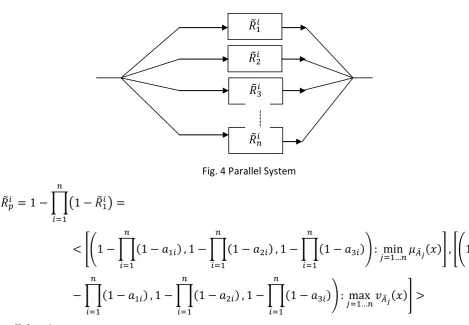
If the components are supposed to be in parallel as shown in Fig.4, the reliability𝑅�𝑝𝑖of theparallel system can be defined by using the expression
𝑅�1𝑖 𝑅�2𝑖 𝑅�2𝑖 ……….. 𝑅�𝑛𝑖
134
𝑅�𝑝𝑖 = 1 − ��1 − 𝑅�1𝑖� 𝑛
𝑖=1
=
< ��1 − �(1 − 𝑎1𝑖) 𝑛
𝑖=1
, 1 − �(1 − 𝑎2𝑖) 𝑛
𝑖=1
, 1 − �(1 − 𝑎3𝑖) 𝑛
𝑖=1
� : min𝑗=1…𝑛𝜇𝐴�𝑗(𝑥)� , ��1
− �(1 − 𝑎1𝑖) 𝑛
𝑖=1
, 1 − �(1 − 𝑎2𝑖) 𝑛
𝑖=1
, 1 − �(1 − 𝑎3𝑖) 𝑛
𝑖=1
� : max𝑗=1…𝑛𝑣𝐴�𝑗(𝑥)� >
Parallel-series system
Consider a parallel-series system consistingof ‘m’ branches connected in parallel andeach
branch contains ‘n’ components asshown in Fig.5. The fuzzy reliability𝑅�RPSR= 1 Ө⊗ 𝑚
𝑘=1(1Ө ⊗ 𝑛
𝑖=1𝑅�RkiR))of the parallel-series system shown in Fig.5 can beevaluated using the algorithm proposed
insection 3 for multiplication and subtraction.where 𝑅�RkiR represents the reliability of the iP th
P
component
at kP th
P
branch.
Series-parallel system
Consider a series-parallel system consistingof ‘n’ stages connected in series and eachstage
contains ‘m’ components as shown inFig.6. The fuzzy reliability𝑅�RSPR= ⊗ 𝑛
𝑘=1 (1 Ө⊗𝑖=1𝑚(1Ө 𝑅�RikR))of
the series-parallelsystem shown in Fig.6 can be evaluatedusing the algorithm proposed in section 3
formultiplication and subtraction.where 𝑅�RikRrepresents the reliability of the iP th
P
component at kP th
P
stage.
𝑅�1𝑖
𝑅�2𝑖
𝑅�3𝑖
𝑅�𝑛𝑖
---Fig. 4 Parallel System
𝑅�11 𝑅�12 𝑅�13 𝑅�1𝑛
𝑅�21 𝑅�22 𝑅�23 𝑅�2𝑛
𝑅�𝑚1 𝑅�𝑚2 𝑅�𝑚3 𝑅�𝑚𝑛
135 5. Fuzzy Fault tree of Thermal Power Plant
A Thermal power plant model is considered. Develop a fault tree for the desired event (i.e. top
event): Each fault event in the fault tree diagram isconsidered as Triangular Interval Type-2 Fuzzy
Number (TIT2FN)&Trapezoidal Interval Type-2 Fuzzy Number (TrIT2FN).Using series parallel
components formula and fuzzy fault tree Fig.7,the reliability of thermal power plant can be
investigated as below.
Steam pressure release (low) is assumed to be a hazard and treated as the top event in fault tree
analysis. The Steam pressure release may becaused due to the occurrence of some events, and these
events may again occur due to some other events as shown in Fig.7
The interval type-2 set operations corresponding to this Fuzzy fault tree is given below:
SP=X ∪Y, X=A ∪B,
Y=C ∩ D ∩ ER0R, A= F ∪GR0R, F=PR0R∩ QR0R, B=HR0R∩ IR0R, C=JR0∪KR0R, D=IR0∪LR0R,
𝑅�11
𝑅�21
𝑅�31
𝑅�𝑚1
𝑅�12
𝑅�22
𝑅�32
𝑅�𝑚2
𝑅�1𝑛
𝑅�2𝑛
𝑅�3𝑛
𝑅�𝑚𝑛
136 Fig.7 Fault tree of Nuclear Power Plant
Where
SPdenotes Steam Pressure Lowin turbine,
X = formation of corrosion product due to turbine blade corrosion,
Y = unwanted shaft vibration,
A= physical damage to the rotor,
B = thermaldamage to the rotor,
C = alarm system fails,
D = stress present,
ER0R= breach of physical boundary, F=mechanical damage to theturbine,
GR0R= explosive damage to the boiler, PR0R= safety signal fails,
QR0R=power fails,
HR0=Rinsufficient thermal generation, IR0R= Safety Valve not working,
JR0R=control circuit of alarm system fails,
Top Event SP
X Y
A B C D
F
P0
G0
Q0
H0
I0
J0 I0
K0
E0
137
KR0R= sensor fails and
LR0R= high premise temperature.
On replacing the Boolean operators with fuzzy logicoperators FNOT, ORF and ANF, we get
the possibility of the top event in form of a fuzzy number. It is also assumed that eachbasic event is
fuzzzified by assigning three fuzzy numbers to each basic event following the decision of three
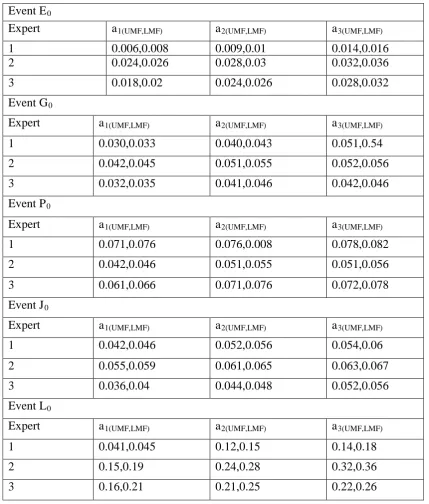
experts. TheTriangularand trapezoidal fuzzy numbers assigned to these basic events are listed in Table
1 and Table 2.
Table 1.Triangular Interval Type-2Fuzzy Numbers (Basic Events)
Event ER0
Expert aR1(UMF,LMF) aR2(UMF,LMF) aR3(UMF,LMF)
1 0.006,0.008 0.009,0.01 0.014,0.016
2 0.024,0.026 0.028,0.03 0.032,0.036
3 0.018,0.02 0.024,0.026 0.028,0.032
Event GR0
Expert aR1(UMF,LMF) aR2(UMF,LMF) aR3(UMF,LMF)
1 0.030,0.033 0.040,0.043 0.051,0.54
2 0.042,0.045 0.051,0.055 0.052,0.056
3 0.032,0.035 0.041,0.046 0.042,0.046
Event PR0
Expert aR1(UMF,LMF) aR2(UMF,LMF) aR3(UMF,LMF)
1 0.071,0.076 0.076,0.008 0.078,0.082
2 0.042,0.046 0.051,0.055 0.051,0.056
3 0.061,0.066 0.071,0.076 0.072,0.078
Event JR0
Expert aR1(UMF,LMF) aR2(UMF,LMF) aR3(UMF,LMF)
1 0.042,0.046 0.052,0.056 0.054,0.06
2 0.055,0.059 0.061,0.065 0.063,0.067
3 0.036,0.04 0.044,0.048 0.052,0.056
Event LR0
Expert aR1(UMF,LMF) aR2(UMF,LMF) aR3(UMF,LMF)
1 0.041,0.045 0.12,0.15 0.14,0.18
2 0.15,0.19 0.24,0.28 0.32,0.36
138 Table 2.Trapezoidal Fuzzy Number (Basic Events)
Event QR0
Expert aR1(UMF,LMF) aR2(UMF,LMF) aR3(UMF,LMF) aR4(UMF,LMF)
1 0.070,0.074 0.078,0.082 0.084,0.088 0.091,0.095
2 0.053,0.057 0.061,0.065 0.072,0.077 0.074,0.078
3 0.044,0.047 0.051,0.055 0.054,0.057 0.062,0.068
Event HR0
Expert aR1(UMF,LMF) aR2(UMF,LMF) aR3(UMF,LMF) aR4(UMF,LMF)
1 0.011,0.015 0.021,0.026 0.023,0.027 0.031,0.035
2 0.021,0.025 0.031,0.035 0.035,0.038 0.044,0.048
3 0.034,0.038 0.04,0.044 0.042,0.046 0.046,0.052
Event IR0
Expert aR1(UMF,LMF) aR2(UMF,LMF) aR3(UMF,LMF) aR4(UMF,LMF)
1 0.068,0.072 0.12,0.016 0.14,0.018 0.15,0.019
2 0.17,0.021 0.22,0.026 0.21,0.025 0.23,0.027
3 0.23,0.027 0.24,0.028 0.26,0.032 0.28,0.034
Event KR0
Expert aR1(UMF,LMF) aR2(UMF,LMF) aR3(UMF,LMF) aR4(UMF,LMF)
1 0.12,0.16 0.14,0.18 0.16,0.20 0.18,0.22
2 0.15,0.19 0.21,0.25 0.22,0.27 0.25,0.29
3 0.28,0.32 0.3,0.34 0.33,0.37 0.35,0.39
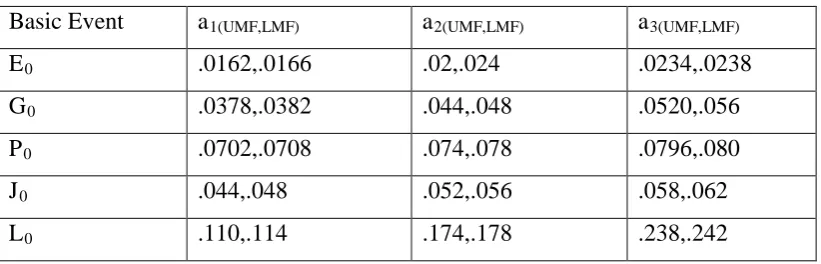
Using the approximation method discussed earlier, a single fuzzy number is obtained by which suits
with all the three experts’decision for each basic event. Thetriangular fuzzy numbers thus obtained for
each basic event are listed in Table 3.
Table 3.Approximated Triangular Fuzzy Numbers (Basic Events)
Basic Event aR1(UMF,LMF) aR2(UMF,LMF) aR3(UMF,LMF)
ER0 .0162,.0166 .02,.024 .0234,.0238
GR0 .0378,.0382 .044,.048 .0520,.056
PR0 .0702,.0708 .074,.078 .0796,.080
JR0 .044,.048 .052,.056 .058,.062
139 Table 4. Approximated Trapezoidal Fuzzy Numbers (Basic Events)
Basic Event aR1(UMF,LMF) aR2(UMF,LMF) aR3(UMF,LMF) aR4(UMF,LMF)
QR0 .058,.062 .064,.068 .068,.072 .074,.078
HR0 .022,.026 .030,.034 .033,.037 .041,.045
IR0 .152,.156 .174,.178 .194,.198 .216,.220
KR0 .192,.196 .224,.228 .244.248 .274,.278
FII of basic events in Thermal Power Plant
The fuzzy importance of each basic event can be obtained in the form of fuzzy importance
index (FII) for all basic events. Wecalculate the possibility of top event RR using fuzzy operators and
possibilities of basic events. The possibility of top event isresulted as trapezoidal fuzzy number
([.044,.048], [.054,.058], [.056,.060, [.064,.068]) given by the following expression.
𝑥−.044
.01 if .044≤ 𝑥 ≤ .054
𝑃RTR= 1 if .054≤ 𝑥 ≤ .056 .064−𝑥
.012 if .056≤ 𝑥 ≤ .064 𝑥−.048
.01 if .048 ≤ 𝑥 ≤ .058
𝑃RTR= 1 if .058 ≤ 𝑥 ≤ .060 .068−𝑥
.012 if .060 ≤ 𝑥 ≤ .068
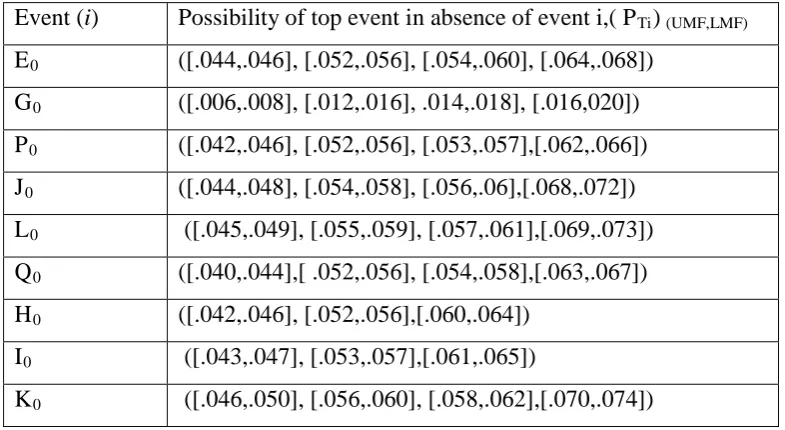
Here PRTiR’s for different events i= E0, G0, P0, J0, L0, Q0, H0, I0 and K0 obtained as triangular
and trapezoidal fuzzy numbers are listedin Table 5.
Table 5.Possibility of Top Event in absence of different basic events
Event (i) Possibility of top event in absence of event i,( PRTiR)R (UMF,LMF)
ER0 ([.044,.046], [.052,.056], [.054,.060], [.064,.068])
GR0 ([.006,.008], [.012,.016], .014,.018], [.016,020])
PR0 ([.042,.046], [.052,.056], [.053,.057],[.062,.066])
JR0 ([.044,.048], [.054,.058], [.056,.06],[.068,.072])
LR0 ([.045,.049], [.055,.059], [.057,.061],[.069,.073])
QR0 ([.040,.044],[ .052,.056], [.054,.058],[.063,.067])
HR0 ([.042,.046], [.052,.056],[.060,.064])
IR0 ([.043,.047], [.053,.057],[.061,.065])
140 First we evaluatePT − PTi, PT − PTiand then MAX of these fuzzy events for i=1,2…n,. The distance of the fuzzy numbers PT − PTi , PT − PTifromtheir MAX is obtained by using Hamming distance formula. Fuzzy importance index (FII) is thus obtained by the followingexpression.
PRTR-PRTi R= [(PT − PTi ) +(PT − PTi)]/2
𝐹𝐼𝐼(𝑖) = 1
1 + 𝐷𝑖𝑠𝑡𝑎𝑛𝑐𝑒 𝑜𝑓 𝑓𝑢𝑧𝑧𝑦 𝑛𝑢𝑚𝑏𝑒𝑟 �𝑃𝑇− 𝑃𝑇𝑖� 𝑓𝑟𝑜𝑚 𝑡ℎ𝑒𝑖𝑟 𝑀𝐴𝑋
Table 6.Fuzzy Importance Index of basic events
Event
(i)
GR0 IR0 ER0 QR0 PR0 LR0 KR0 HR0 JR0
FII (i) .9989 .9756 9638 .9628 .9626 .9621 .9618. .9618 .9617
6. Discussion
The techniques developed in this paper are demonstrated by taking the example of a Thermal
power plant, and the following results are drawn:
*Applying the method developed in our study for the importance of basic events, the fuzzy
importance index (FII) of basic events is calculated. The basic events are listed in Table 6, in
accordance with the descending order of their FII. It is observed that the basic event Go is of higher
sensitivity (greater importance) in comparison to other succeeding events.
*Taking note of FII of basic events listed in Table 6, it is concluded that we should emphasize
on basic event GRo Rrather than other succeeding events IRoR, ERo Retc. to improve the reliability of the
Thermal power plant.
7. Conclussion
This paper presents reliability investigation of Series-Parallel and Components of thermal
power plant using Grey Fuzzy Set Theory. Applying the method developed in our study for the
importance of basic events, the fuzzy importance index (FII) of basic events is calculated. The basic
events are listed in Table 6, in accordance with the descending order of their FII. It is observed that the
basic event Go is of higher sensitivity (greater importance) in comparison to other succeeding events.
Taking note of FII of basic events listed in Table 6, it is concluded that we should emphasize on basic
event GRo Rrather than other succeeding events IRoR, ERo Retc. to improve the reliability of the Thermal
power plant. Also arithmetic operation of proposed TIT2FN/TrIT2FNis evaluated. Here, a method to
141 components of the system are represented by TIT2FN/TrIT2FN fuzzy number. By performing the
techniques developed here early in design phase of various complex systems like nuclear power plant,
potential deficiencies can be identified and averted to precipitate the occurrence of various basic
events causing the happening of top event.
Reference
1. Azad A.K. & Mishra R.B. "Generation System Reliability Evaluation Joint PDF Approach"
Journal of IE(I), PP170-174, Vol-77, 1996
2. Rao AC, Chhalora G.P. & Balkrishnan M "Simulation of reliability indices of power systems by
transient model using transformation method modelling" Simulation & control AMSE France,
Vol-26, No-1, 1990
3. Jang J.S.R. "ANFIS: Adaptive-network-based fuzzy inference systems" IEEE Trans. Syst. Man.
Cy bern. Vol-23, No-3, PP665-685,1993
4. Jin Y "Fuzzy Modeling of High Dimensional Systems: Complexity Reduction and interpretability
Improvement" IEEE Transactions on Fuzzy Systems, Vol-8, No-2, P212, 2000
5. Mishra & Qureshi "Ascertaining Safety and Reliability Attributes of Electrical uses in
Underground coal Mines–A fuzzy logic Approach." Proc. International Symposium on Mine
planning and Equipment selection, New Delhi, 2001
6. Mishra & Qureshi "A study of Reliability of Underground Electrical Power Planning and
Distribution " Proc. of All India Seminar on Power Systems – Recent Advances and Prospect in 21
Century" MREC, Jaipur, 184-189, 2001
7. Timothy J, Ross "Fuzzy logic with Engineering Applications" Mc.Graw Hill Inc. 1995
8. Bhat B.K. & Chhalora G.P. "Digital Simulation of Complicated Sequentially development of fault
on three phase Power Network" Journal of IE (I), Vol-61, PP-9, 1981
9. Takagi & Sugeno "Fuzzy Identification of System and its Application to Modeling and Control"
IEEE Trans. on System man & Cyber, Vol-15, No-1, P116, 1985
10.Moody J & Darken C.J. "Fast learning in Networks of Locally Tuned Processing Units" Neural
Comp, Vol-1,p-2, 1997
11.Dash P.K., Mishra S. and G. Panda "Damping Multimodal Power System Oscillation Using a
Hybrid Fuzzy Controller for Series Connected Facts Devices" IEEE Trans. on Power Systems,
Vol-15, No-4, 2000
12.Jong-Wook Kim and Sang W.K. "Design of incremental fuzzy PI Controller for a Gas-Turbine
plant" IEEE/ASME Trans. on Mechatronics. Vol-8, No-3, PP410-414, 2003
13.Yeung M.R. & Chan P.L. "Development and validation of a steam generator simulation Model"
142 14.Jamshidi M "Fuzzy Control of Complex Systems: in Soft Computing" Berlin Germany : Springer
– Verlag, Vol-1, PP42-56, 1997
15.Babuska R. "Fuzzy Modelling for Control" Dordrecht. The Netherlands : Khiwer, 1998
16.Jang J.S.R. Sun C.T. & Mizutani E. " Neuro-Fuzzy AND Soft Computing : A Computational