A Closer Look at Multiple Forking: Leveraging
(In)dependence for a Tighter Bound
Sanjit Chatterjee and Chethan Kamath, Indian Institute of Science, Bangalore.
{sanjit,chethan0510}@csa.iisc.ernet.in January 1, 2014
Abstract
Boldyrevaet al. introduced the notion of multiple forking (MF) as an extension of (gen-eral) forking to accommodate nested oracle replay attacks. The primary objective of a (mul-tiple) forking algorithm is to separate out the oracle replay attack from the actual simulation of protocol to the adversary, and this is achieved through the intermediary of a so-called wrapper algorithm. Multiple forking has turned out to be a useful tool in the security argu-ment of several cryptographic protocols. However, a reduction employing the MF Algorithm incurs a significant degradation of O q2n
, whereqdenotes the upper bound on the under-lying random oracle calls andn, the number of forkings.
In this work we take a closer look at the reasons for the degradation with a tighter se-curity bound in mind. We nail down the exact set of conditions for the success of the MF Algorithm. A careful analysis of the protocols (and corresponding security argument) em-ploying multiple forking allow us to relax the overly restrictive conditions of the original MF Algorithm. To achieve this, we club two consecutive invocations of the underlying wrapper into a single logical unit of wrapperZ. We then useZ to formulate the notion of “depen-dence” and “indepen“depen-dence” among different rounds of the wrapper in the MF Algorithm. The (in)dependence conditions lead to a general framework for multiple forking and signif-icantly better bound for the MF Algorithm. Leveraging (in)dependence to the full reduces the degradation from O q2n
to O(qn). By implication, the cost of a forking involving two
random oracles (augmented forking) matches that involving a single random oracle (ele-mentary forking).
Finally, we study the effect of these observations on the security of the existing schemes. We conclude that by careful design of the protocol (and the wrapper in the security reduc-tion) it is possible to harness our observations to the full extent.
Contents
1 Introduction 3
1.1 Our Contribution . . . 5
2 Multiple-Forking: A Closer Look 6 2.1 Tightness: An Intuitive Picture . . . 8
2.2 Road-map to a Better Analysis . . . 9
2.3 AGeneralMultiple-Forking Algorithm . . . 11
3 Harnessing (In)Dependence 12 3.1 Multiple-Forking with Index (In)Dependence . . . 12
4 Revisiting the Security Argument of Existing Protocols 17 4.1 Random-Oracle Dependence . . . 17
4.2 The Boldyreva-Palacio-Warinschi Proxy Signature Scheme . . . 19
4.2.1 Improved Security Argument . . . 20
4.3 The Galindo-Garcia Identity-Based Signature . . . 20
4.3.1 Modified Galindo-Garcia IBS . . . 21
4.4 The Chow-Ma-Weng ZKP for Simultaneous Discrete Logarithms . . . 21
4.4.1 A Case for (In)Dependence . . . 22
4.4.2 Improved Argument . . . 23
5 Conclusion 24 A General Forking 26 B (Original) Multiple-Forking Algorithm 27 C Harnessing (In)Dependence 28 C.1 Detailed Steps forLemma 2 . . . 28
C.2 Multiple-Forking with Index Independence . . . 30
C.3 Multiple-Forking with Index Dependence . . . 32
D Constructions 35 D.1 The Boldyreva-Palacio-Warinschi Proxy Signature Scheme . . . 35
D.2 The (Original) Galindo Garcia IBS . . . 37
D.3 The Modified Galindo Garcia IBS . . . 37
D.4 Chow-Ma-Weng Zero-Knowledge Argument . . . 38
E Security Argument for Modified Galindo-Garcia IBS 38 E.1 ReductionR03 . . . 39
1
Introduction
The machinery of oracle replay attack of Pointcheval and Stern [PS00] plays a pivotal role in the security argument of a large class1 of signature schemes [ElG85, Sch91, Oka93]. In the
elementary version of replay attack2, the simulator runs the adversary twice on related inputs
in order to solve the underlying hard problem. The probability of success of the replay attack is then bounded by the Forking Lemma [PS00]. Bellare and Neven [BN06], however, observed that the “Forking Lemma is something purely probabilistic, not about signatures” and proposed a more abstract version called the General Forking (GF) Lemma. The concept of general forking is formulated in terms of randomised algorithms and its outputs, leaving out the notions of signature scheme as well as random oracles [BR93] altogether. The claimed advantage is to allow for more modular and easy to verify proof of cryptographic schemes that apply the notion of forking in their security argument.
Multiple forking. The concept of forking was further generalised by Boldyrevaet al. leading to the Multiple Forking (MF) Algorithm [BPW12]. The immediate motivation behind this new abstraction was to argue the security of a proxy signature scheme that usesmorethan one hash function (modelled as random oracles). The MF Algorithm allows one to mount the so-called
nestedreplay attacks by rewinding the adversary several times on related inputs. In particular, a nested oracle replay attack involves multipleaugmentedforkings3. The MF Algorithm retains the
modularity advantage of GF Algorithm and has been applied in several other security arguments [GG09, CMW12, CKK13] in a more-or-less black-box fashion. Note that the generalisation of forking due to Bagherzhandiet al. [BCJ08] is different from that in [BPW12].
• • •
• • • ∗
• • •
• • •
• ? • ∗
• • •
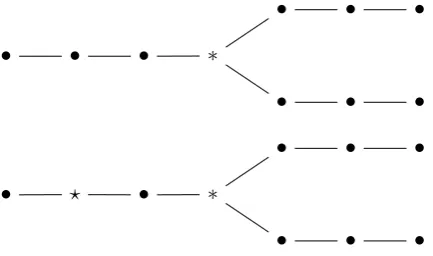
Figure 1: Elementary forking (top) vs. augmented forking (bottom): Elementary forking is successful if the target indices (∗) for the two rounds match. Augmented forking involves two random oracles and, hence, to be successful, the additional target indices (?) also should match.
The modularity of the (General/Multiple) Forking Lemma allows one to abstract out the probabilistic analysis of the rewinding process from the actual simulation in the security ar-gument. The gap between the abstract and the concrete is, then, bridged using the so-called “wrapper” algorithm. While the GF/MF Algorithm takes care of the replay attack, it is the wrapper that handles the simulation of the protocol environment to the actual adversary. The reduction consists of invoking the appropriate forking algorithm (on the associated wrapper) and utilising its outputs to solve the underlying hard problem. So the design of the wrapper is central to any security argument involving GF/MF Algorithm. In fact, the design depends
1To be precise, the signature schemes obtained from three-round identification schemes (Σ-protocols) through
the Fiat-Shamir transformation [FS87].
2We will use the terms forking and oracle replay attack interchangeably.
3We clearly distinguish “augmented” forking from “elementary” forking: the former involves replay of two
on the actual protocol and the security model used–see, e.g., [BN06, BPW12] for the concrete design of the wrappers in their respective contexts.
Role of the wrapper. Let’s now take a simplistic4 look at how the GF Algorithm (given in
Appendix A), together with the wrapper Y, is used to launch the elementary replay attack. The input toY consists of some external randomness (s1, . . . , sq) and the internal coins (ρ) for adversary; the output, whereas, consists of an indexI.
Consider the first invocation of Y (on s1, . . . , sq;ρ) within the GF Algorithm: Y simulates
the protocol environment to the actual adversary A having access to ρ. Y responds to the
random oracle queries ofA usings1, . . . , sq. At the end of the simulation, Y outputs an index
I that refers to the target query5; if the adversary did not make the target query, I is set to 0
(indicating failure). Next, the GF Algorithm invokes Y on an input that is related to the first invocation (s1, . . . , sI−1, sI0, . . . , s0q;ρ). The behaviour ofA remains identical to the first round of simulation, right up to the Ith random oracle query, at which point it diverges (assuming
s0I 6=sI). This is tantamount to forkingA at the indexI. The forking is successful, if thetarget index for the second round of simulation is the same as that for the first, i.e.,I0 =I. One can clearly see how the wrapper acts as an intermediary between the abstract GF Algorithm and the adversary in the concrete setting of the reduction.
While the role of wrapper remains the same in the MF Algorithm, there are a few significant changes in its actual structure. The wrapper now simulates two random oracles and hence its output contains a pair of indices(I, J) withJ < I. The two indices are usually associated to thetarget queriesmade to the two random oracles involved in the augmented replay attack. For reductions employing the MF Algorithm, the design of the wrapper becomes a bit more involved because of the additional index in its output. In particular, the relative “order” among the two target oracle calls must be taken into consideration in the design of the wrapper. (We’ll later see how neglecting the order of the indices, or even worse, using the MF Algorithm as a black-box may lead the reductions to fail.) As the name suggests, the MF Algorithm allows the possibility of more than one forking–this adds another level of complexity in the overall structure.
The cost of multiple forking. The Forking Lemma gives us a lower bound on the probability of success of the forking algorithm in terms of the success probability of the associated wrapper (and hence, the underlying adversary). Roughly speaking, the cost of forking can be measured in terms of the degradation incurred in the forking process. Letq denote the upper bound on the number of random oracle queries, then the cost of general forking is roughly O(q) (and evidence suggests that the bound is more or less optimal [Seu12]). As for multiple forking, the cost according to the MF Lemma (seeLemma 8 in Appendix B), is roughly O q2n, whereq
is the sum of the upper bound on the queries to the random oracles involved and nis, loosely speaking, the number of forking (so the wrapper is calledn+ 1times).6 Consequently, the cost of single augmented forking is O q2 (even though there is only one forking involved). As we see, the bound is quite loose and naturally, the protocols employing the MF Lemma for their se-curity suffer from this bound. This is indicated in the concluding statement of [BPW12] where the authors mention that the concrete security bound of their scheme is not particularly tight
and they leave the possibility of atighterreduction as an open question. In fact, for all security reductions that employ the MF Lemma [BPW12, GG09, CMW12, CKK13], the degradation pri-marily stems from the loose lower bound of the lemma. Hence, it’s important to ask whether
4For the time being, let’s not consider the input stringxor the side-outputσ.
5The random oracle query that is used by Ato produce its desired output is termed the target queryand the index of this query is thetarget index.
6To be precise, ifaccdenotes the probability with which the wrapper is successful for one round, then the cost of
general forking is O(q/acc)and that of multiple forking is O q2n/accn
and to what extent it is possible to improve upon this bound. Investigating these questions in the concrete context of cryptographic protocols forms the focal point of this work.
1.1 Our Contribution
Multiple forking is a further generalisation of general forking and once formulated, this ab-stract notion has been applied in the analysis of concrete cryptographic protocols essentially in a black-box way. Here we undertake a journey from the concrete to the abstract. This has two (complementary) parts. We take a critical look at the various conditions that decide the success of the MF Algorithm as well as revisit the concrete security arguments employing the MF Lemma. This study allows us to come up with a better abstraction of multiple forking.
By the very nature of the rewinding mechanism, the wrapper algorithm is always invoked in pairs. Based on this simple observation, we club two consecutive invocations of the wrapper into a singlelogical unitof wrapperZ. Intuitively, wrapperZ can be viewed as one invocation of the GF Algorithm of [BN06]. Utilizing the extra level of modularity provided byZ, we nail down the exact conditions for the success of multiple forking. This, coupled with our investigation of the actual security arguments employing MF Lemma allow us to formulate two crucial observations: called, respectively, the “independence” condition (OI) and the “dependence” condition (OD). OI is formulated by a careful abstraction of the exact requirements in the security reductions.
In short, it allows the relaxation of success condition related to the indexI across the logical wrapper Z. OD, on the other hand, has its root in the notion of hash function dependence,
which is actually observed in the cryptographic protocols.
A general framework. Based on the above observations, we propose a general framework for the application of the MF Algorithm, which we call the General Multiple-Forking (GMF) Algorithm, and an associated GMF Lemma. Our framework captures the original MF as well as the observations OI and OD (separately and together) leading to four different versions of
the lemma. We prove the new versions of the lemma. Naturally, the analysis becomes more involved as we incorporate the above two conditions–the most involved case occurs when one captures both the observationsOI andOD (O{I,D}, in short). We draw from existing techniques
[BN06, BPW12] as well as introduce some new optimisations tosignificantlyimprove upon the existing bound. To be exact, the degradation reduces from O q2n to O(qn) when both the observations are incorporated in the analysis (seeTable 2for a summary). Thus,informally, we have:
Main Result(seeLemma 2). By carefully designing the protocol, multiple forking can be carried out with a success probability ofΩ(n+1/qn).
Corollary(seeClaim 1,Remark 4). A single augmented forking can be launched as efficiently as an elementary forking.
Recall that the GF Algorithm of [BN06] captures a single elementary forking with a degra-dation of O(q). Our MF Algorithm with O{I,D}, according to the above corollary, seems to be
the best possible generalisation of general forking.
On a related note, we also emphasise on the importance of the proper design of the wrapper algorithm taking into account the intricacies of the actual security argument.
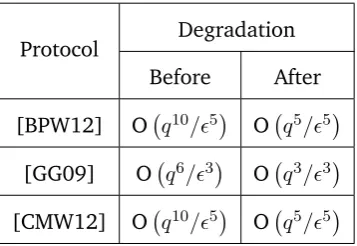
Protocol Degradation
Before After
[BPW12] O q10/5 O q5/5
[GG09] O q6/3
O q3/3
[CMW12] O q10/5
O q5/5
Table 1: Comparison of the security degradation for protocols before and after our result. q
denotes the upper bound on the respective hash oracle queries; is the advantage that the
adversary has in the respective protocols.
Notations. We adopt the notations commonly used in the literature. s ←−U S denotes picking an elementsuniformly at random from the setS. In general,{s1, . . . , sn}
U
←−Sdenotes picking
elementss1, . . . , snindependently and uniformly at random from the setS. In a similar manner,
s ←−$ S and {s1, . . . , sn} ←−$ S denote random sampling, but with some underlying probability distribution on S. (y1, . . . , yn)
$
←− A(x1, . . . , xm) denotes a probabilistic algorithm A which
takes as input (x1, . . . , xm) to produce output (y1, . . . , yn). Sometimes the internal coins ρ of
this algorithm is given explicitly as an input. This is distinguished from the normal input using a semi-colon,e.g.,y← A(x;ρ).
Next, we introduce some notations pertaining to random oracles. The symbol<is used to order the random oracle calls; e.g., H(x) < G(y) indicates that the random oracle call H(x)
precedes the random oracle call G(y). More generally, H < G indicates that the target H-oracle call precedes the target G-H-oracle call. The convention applies to hash functions as well. The symbol, on the other hand, ≺is used to indicate random oracle dependence; e.g. H ≺ G indicates that the random oracle G is dependent on the random oracle H. In the discussion involving the forking algorithms,Qijdenotes thejthrandom oracle query inround iof simulation.
Organisation of the paper. We take a closer look at the MF Algorithm in§2. In§3, we give an improved analysis of the MF Algorithm, while in§4, we apply the improvements to some of the existing schemes. Finally, we end with the concluding remarks in§5. As for the appendix, we begin with the GF Algorithm and the original MF Algorithm inAppendix AandBrespectively. We give the deferred analyses of MF Algorithm withOIandOD(separately) inAppendix C. The
construction of the schemes referred in the paper is given inAppendix D. We conclude with a section dedicated to the detailed security argument of the (modified) GG-IBS.
2
Multiple-Forking: A Closer Look
We begin with a critical look at the MF Algorithm and the associated lemma. Aslightly revised
version of the algorithm is given below (the original algorithm of [BPW12] is reproduced in
Appendix B).
The Multiple-Forking Algorithm. Fix q ∈ Z+ and a set
S such that |S| ≥ 2. Let Y be a
(I, J, σ) consisting of two integers0≤ J < I ≤q and a stringσ. Letn≥ 1be an odd integer. The MF AlgorithmMY,n associated toY andnis defined inAlgorithm 1.
Algorithm 1MY,n(x)
Pick coinsρforY at random
{s01, . . . , s0q}←−U S;
(I0, J0, σ0)← Y(x, s01, . . . , s0q;ρ) //round 0
{s1I
0, . . . , s 1
q}
U
←−S;
(I1, J1, σ1)← Y(x, s01, . . . , s1I0−1, s 1
I0, . . . , s 1
q;ρ) //round 1
if((I0 = 0)∨(J0 = 0))then return(0,⊥) //Condition¬B
if (I1, J1)6= (I0, J0)∨(s1I0 =s 0
I0)
then return(0,⊥) //Condition¬C0
k:= 2
while(k < n)do
{skJ
0, . . . , s
k q}
U
←−S;
(Ik, Jk, σk)← Y(x, s01, . . . , s0J0−1, s
k
J0, . . . , s
k
q;ρ) //round k
{skI+1
k , . . . , s
k+1
q }
U
←−S;
(Ik+1, Jk+1, σk+1)← Y(x, s01, . . . , s0J0−1, s
k
J0, . . . , s
k Ik−1, s
k+1
Ik , . . . , s
k+1
q ;ρ) //round k+1
if(Ik+1, Jk+1)6= (Ik, Jk)∨(skIk+1 =s
k Ik)
then return(0,⊥) //Condition¬Ck
if (Ik, Jk)6= (I0, J0)∨ ∨`:=0,2,...,k−2 (skJ0 =s
` J0)
then return(0,⊥) //Condition¬Dk
k:=k+ 2
end while
return(1,{σ0, . . . , σn})
Note that we have introduced some conceptual changes in the MF Algorithm of [BPW12]. Before delving into the structure of the algorithm and ways to improve upon the bound on its probability of success, we briefly comment on asubtle(but minor in effect) logical flaw that we have fixed in the original version of [BPW12].
Remark 1. For the convenience of the readers we have boxed the modification inAlgorithm 1. The original algorithm checked for (skJ
0 = s
k−1
J0 ). However, this is not sufficient for some of
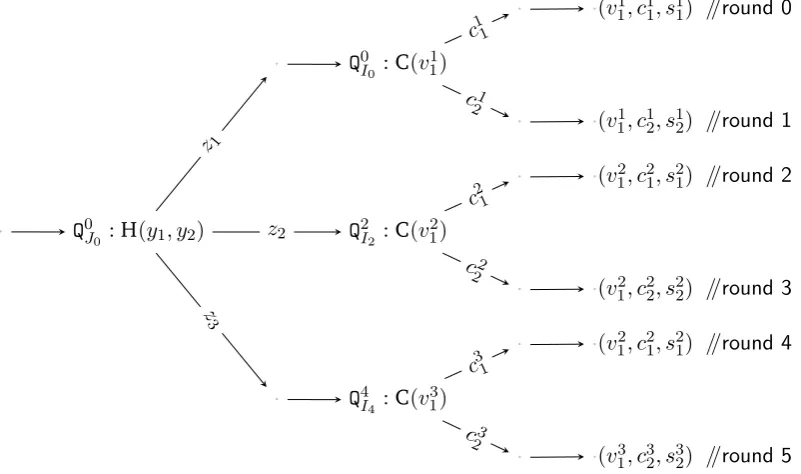
the reduction algorithms that use the originalMY,n. For example, consider the application of MY,5 in the security argument of the [CMW12] protocol. At the end of the simulation, the MF Algorithm outputs six “cheating” transcripts{(vi1, ci1, si1),(v1i, ci2, si2)}, fori:= 1,2,3, and the reduction, subsequently, finds the solution to the DLP by computing
z1w1−z2w2 z1−z2
−z1w1−z3w3
z1−z3
w1−w3 z1−z3
−w1−w2
z1−z2
mod p (1)
where wi = (si1 −si2)/(ci2−ci1) and where z1 := s0J0, z2 := sJ20 and z3 := s4J0 in the original
MY,5. Thus, for a correct solution of the discrete-log problem (DLP), the reduction requires to compute (z1−z2)−1 and(z1 −z3)−1. [CMW12] asserts “[a]ccording to the probing strategy z1, z2, z3 are all distinct”. However, as per the original proposition,MY,5 of [BPW12] willonly
ensure thatz26=z1 andz3 6=z2butnot necessarilyz1 6=z3. Hence, the probing strategydoes not
guarantee that all thezis aredistinctand the reduction may fail even though the MF Algorithm
MF Algorithm, which checks for equality onlywith the round just preceding it and comes into the picture for MY,n for n ≥ 5. A simple fix is to introduce pairwise check for equality, i.e., by changing the proposition from (skJ
0 = s
k−1
J0 )to (∨l:=0,2,...,k−2 s
k J0 = s
`
J0). The change has a
(small) bearing on the security bound given in the original MF Lemma due to an increase in the number of (inequality) checks fromnto(n+ 1)(n+ 3)/8. This is captured in therevisedversion given below.
Lemma 1 (Revised Multiple-Forking Lemma). LetGI be a randomised algorithm that takes no input and returns a string. Let
mfrk:= Prh(b= 1)|x←− G$ I; (b,{σ0, . . . , σn})
$
←− MY,n(x)i and
acc := Pr
h
(I ≥1)∧(J ≥1)|x←− G$ I;{s1, . . . , sq}←−U S; (I, J, σ)←− Y$ (x, s1, . . . , sq)
i
then
mfrk≥acc·
accn
q2n −
(n+ 1)(n+ 3) 8|S|
. (2)
2.1 Tightness: An Intuitive Picture
Each run of MY,n consists of n+ 1runs of the corresponding wrapper Y (called round 0 to
round n), for some odd n. Informally speaking, MY,n is successful provided Y is successful in each of then+ 1 rounds and some additional conditionsare satisfied. We call these set of conditionsA0 :={B,C0, . . . ,Cn−1,D2, . . . ,Dn−1}where
B : (I0 ≥1)∧(J0 ≥1)
Ck : (Ik+1, Jk+1) = (Ik, Jk)∧(skIk+1 6=s
k
Ik) (fork= 0,2, . . . , n−1) Dk : (Ik, Jk) = (I0, J0)∧(∧l:=0,2,...,k−2 skJ0 6=s
`
J0) (fork= 2,4, . . . , n−1)
LetEbe the event that all the conditions inA0 are satisfied,i.e.,
E:B∧ C0∧C2∧ · · · ∧Cn−1
∧ D2∧D4∧ · · · ∧Dn−1
. (3)
What the MF Lemma then gives us is, essentially, a lower bound of the probability of this event.
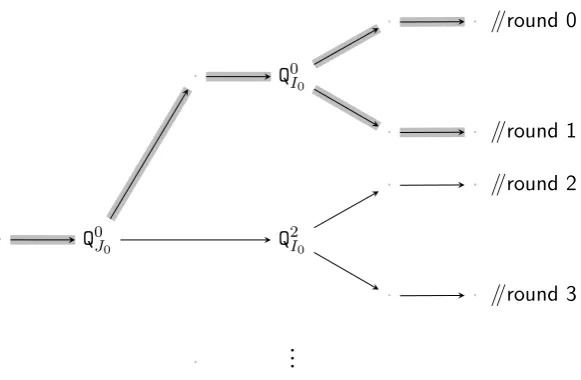
The logical wrapper Z. A simple but crucial observation at this point is that the wrapper algorithmY is alwaysinvoked in pairs (that’s the reason fornbeing odd in the description of MY,n). Note that, the conditions Ck and Dk abovealso pertain to a pair of invocations. This brings us to theconceptualchange introduced in the revised version given inAlgorithm 1. Two consecutive invocations of Y (i.e.,round k andround k+1, for evenk ≥0) have been clubbed together so that it can be visualised (seeFigure 2) as the invocation of a single logical unitZ such that ((Ik, Jk, σk),(Ik+1, Jk+1, σk+1)) ← Z x,Sk,Sk+1;ρ
(for evenk). Here, Sk andSk+1
denote the external random coins for the roundskandk+ 1ofY,i.e.,
Sk:= (s01, . . . , s0J0−1, skJ0, . . . , skq) and Sk+1:= (s01, . . . , s0J0−1, skJ0, . . . , skI
k−1, s
k+1
Ik , . . . , s
k+1
q ).
Accordingly, the MF Algorithm constitutes of m = (n+ 1)/2 rounds of invocation of Z.
· · //round 0
· Q0I0
· · //round 1
· · //round 2
· Q0J0 Q2I0
· · //round 3
· ...
Figure 2: The logical wrapperZ. One such logical wrapper (forround 0andround 1) has been highlighted.
Among the set of conditions A0,Bis relatively easy to deal with as it is checked only at the
beginning and contributes a factor of acc in the final expression formfrk. So let’s look at the effect of the other (more involved) conditions. Consider the event
Ck: (Ik+1, Jk+1) = (Ik, Jk)∧(skI0+16=skI0).
Clearly, the check for equality(Ik+1, Jk+1) = (Ik, Jk)is predominant in the final expression for mfrk (the equality holds only with a probability of 1/q2). On the other hand, (sIk0+1 6= skI0) is almost always true7. It’s a similar case for the eventDk: (Ik, Jk) = (I0, J0) holds only with a
probability of1/q2. Hence, the probability of the eventsC andDis dominated respectively by
∧k:=0,2,...,n−1(Ik+1, Jk+1) = (Ik, Jk) and ∧k:=2,4,...,n−1(Ik, Jk) = (I0, J0). (4)
Consequently, thedegradationfor the MF Algorithm stems, predominantly, from what we term
as the “core” event8
F0: (In, Jn) = (In−1, Jn−1) =· · ·= (I0, J0) (5)
formed by combining the two expressions in (4). Each of the n checks for equality in the
condition contributes (roughly speaking) a factor of O q2
, resulting in an overall degradation of O q2n. That’s the intuitive reason of the (loose) lower bound one gets for mfrk. Naturally, any reduction employingMY,n also loses tightness by a factor of O q2n.
2.2 Road-map to a Better Analysis
By now it should be evident that in order to achieve a better bound for mfrk, one needs to revisit the conditions associated with the number of checks involved in the success eventF0. For a better understanding of the exact role of these conditions, we revisit the concrete protocols and their security argument that employ the MF Lemma [BPW12, GG09, CMW12]. Based on a careful analysis of these protocols and their security arguments, we formulate the following two observations–called, respectively, theindependenceand thedependenceconditions.
Observation 1(Independence condition,OI).It is not necessary for theIindices across the logical wrapperZ to be the same, i.e.,Ikneed not be equal toIk−2, Ik−4, . . . , I0fork= 2,4, . . . , n−1.
7It holds with a probability of(1−(1/|
S|))and for any reasonable security level,|S| 1.
8Note that the event F
Observation 2(Dependence condition,OD). It is possible to design protocols, in particular, define hash functions used in the protocol, such that, for the kth invocation of the logical wrapper Z,
(Ik+1 =Ik)implies (with very high probability) that(Jk+1 =Jk).9
Remark 2. The concrete motivation for the above two observations will become clear when we revisit the actual security argument of the existing schemes in§4.OIis based on a precise
anal-ysis of what is actually required from the process of (multiple) forking in the security argument of [BPW12, GG09, CMW12]. In particular, all known applications of MF Algorithm satisfiesOI. OD finds its root in the more concrete notion of hash function dependence. Intuitively, if a
pro-tocol uses two hash functions H1 and H2 in such a way that the input to H2 is afunctionof the output of H1, then we say that the H2-call isdependenton the H1-call. The BPW proxy signature scheme of [BPW12] is one example where such dependence exists (see§4.1for further details). As in the case ofOI, we’ll show that eitherODis naturally satisfied [CMW12] or one can easily
modify existing construction [GG09] to suit the condition (see §4.4 and §4.3.1 resp.). The abstraction is required in the context of MF Algorithm due to the absence of the notion of hash function (or random oracles, which model the hash functions in the actual security argument). A formal definition of the notion of index dependence, keeping in mind the observationOD, is
given below.
Definition 1(Index Dependence). Let((I, J),(I0, J0))be the two pair of indices that are part of the output of the wrapper Z (associated with two rounds of Y). The indexJ is said to be
η-dependent on the indexI (denoted byJ ≺I) ifPr [J0 6=J |I0 =I]≤η.
In other words, (I0 = I) =⇒ (J0 = J) with probability at least (1−η). A little more specifically, J is said to befully-dependent on I ifη = 0, i.e.(I0 = I) =⇒ (J0 = J). But for most applications, it suffices thatJ beη-dependent onI for someηwhich is negligible10 in the security parameterκ.
Consequences. Let’s look at the consequences of the observations one by one. Based on OI,
the condition in (4) can be relaxed to:∧k:=0,2,...,n−1(Ik+1, Jk+1) = (Ik, Jk)and∧k:=2,4,...,n−1(Jk =
J0), and, by implication, the “core” event in (5) is relaxed to
F1 :∧k=0,2,...,n−1 (Ik+1, Jk+1) = (Ik, Jk)
∧(Jn−1 =Jn−3=· · ·=J0). (6)
Hence, the number of overall checks (in the “core” event) is reduced from2nto(2·(n+ 1)/2 + (n−1)/2) = (3n+ 1)/2 and the complexity of launching the nested oracle replay attack is brought down to O q(3n+1)/2. A similar analysis shows that based on onlyOD (and, assuming
ηto be negligible inκ), the “core” event in (5) relaxes to
F2: (In=In−1 =· · ·=I1 =I0)∧(Jn−1=Jn−3 =· · ·=J0) (7)
In this case the number of overall checks is reduced from2nto(3n−1)/2and the complexity to O q(3n−1)/2. The interesting point is thatOIandOD can be employedin conjunction. This
leads to the “core” event being further simplified to
F3: (In=In−1)∧ · · · ∧(I1 =I0)∧(Jn−1 =Jn−3=· · ·=J0). (8)
Observe that the number of checks is now reduced to nand the complexity to O(qn). Hence, the complexity of launching the nested oracle replay attack is reduced from O q2n to O(qn), but, without losing the modularity of the MF Algorithm.
9Assume, without loss of generality, that among the two indices,Jalways precedesIin a particular run of the
wrapper.
10A function f:
2.3 AGeneralMultiple-Forking Algorithm
As we just observed, depending on whether (or not) the observationsOIandODare taken into
account, we end up with four different sets of “core” conditionsF0 throughF3. The “non-core” conditions, though, remain the same for all the four cases. The resulting set of “full” conditions,
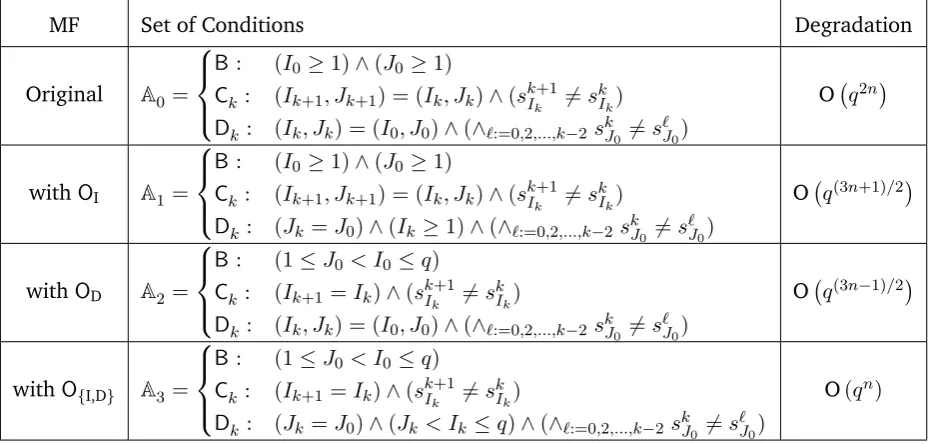
A0throughA3, (along with the associated degradation) are given inTable 2. In order to capture
this extra level of abstraction, we describe a general framework of the MF Algorithm that has, in addition to the algorithmY, an associated (ordered) set of conditionsA. Note that we have
assumed full-dependence in formulating the table.
MF Set of Conditions Degradation
Original A0 =
B: (I0 ≥1)∧(J0 ≥1)
Ck: (Ik+1, Jk+1) = (Ik, Jk)∧(skIk+1 6=skIk)
Dk: (Ik, Jk) = (I0, J0)∧(∧`:=0,2,...,k−2 skJ0 6=s
` J0)
O q2n
withOI A1 =
B: (I0 ≥1)∧(J0 ≥1)
Ck: (Ik+1, Jk+1) = (Ik, Jk)∧(skIk+1 6=s
k Ik) Dk: (Jk=J0)∧(Ik≥1)∧(∧`:=0,2,...,k−2skJ0 6=s
` J0)
O q(3n+1)/2
withOD A2 =
B: (1≤J0 < I0 ≤q)
Ck: (Ik+1 =Ik)∧(skIk+1 6=s
k Ik)
Dk: (Ik, Jk) = (I0, J0)∧(∧`:=0,2,...,k−2 skJ0 6=s
` J0)
O q(3n−1)/2
withO{I,D} A3 =
B: (1≤J0 < I0 ≤q)
Ck: (Ik+1 =Ik)∧(skIk+1 6=skIk)
Dk: (Jk=J0)∧(Jk< Ik≤q)∧(∧`:=0,2,...,k−2 skJ0 6=s
` J0)
O(qn)
Table 2: The set of conditions isA:={B,C,D}whereCdenotesC0,C2, . . . ,Cn−1andDdenotes
D2,D4, . . . ,Dn−1. Also, note that we have ignored the (common)n factor in the degradation
and assumed full-dependence.
The General Multiple-Forking Algorithm Fix q ∈ Z+ and a set
S such that |S| ≥ 2. Let
Y be a randomised algorithm that on input a string x and elements s1, . . . , sq ∈ S returns a
triple (I, J, σ) consisting of two integers 0 ≤ J < I ≤ q and a string σ. Let n ≥ 1 be an odd integer. In addition, letA denote the set of conditions, and be of the form {B,C,D}with C :=C0,C2, . . . ,Cn−1 andD:=D2,D4, . . . ,Dn−1. The General MF AlgorithmN
A,Y,n associated
Algorithm 2N
A,Y,n(x)
Pick coinsρforY at random
{s01, . . . , s0q}←−U S;
(I0, J0, σ0)← Y(x, s01, . . . , s0q;ρ) //round 0
{s1I0, . . . , s1q}←−U S;
(I1, J1, σ1)← Y(x, s01, . . . , s1I0−1, s 1
I0, . . . , s 1
q;ρ) //round 1
if¬(B∧C0)then return(0,⊥)
k:= 2
while(k < n)do
{skJ
0, . . . , s
k q}
U
←−S;
(Ik, Jk, σk)← Y(x, s01, . . . , s0J0−1, s
k
J0, . . . , s
k
q;ρ) //round k
{skI+1
k , . . . , s
k+1
q }
U
←−S;
(Ik+1, Jk+1, σk+1)← Y(x, s01, . . . , s0J0−1, s
k
J0, . . . , s
k Ik−1, s
k+1
Ik , . . . , s
k+1
q ;ρ) //round k+1
if¬(Ck∧Dk)then return(0,⊥)
k:=k+ 2
end while
return(1,{σ0, . . . , σn})
Remark 3 (On usage). We use the set of conditions A2 and A3 only in the case of i)
full-dependence; orii)η-dependence with negligibleη. Forη-dependence, in general, we use the set of conditionsA0andA1 respectively (e.g., seeLemma 2and its proof).
3
Harnessing (
In
)Dependence
We have seen in the previous section that the most effective way of launching the nested replay attack is by exploiting both OI and OD. As expected, the analysis of this case turns out to
be the most involved and in a sense subsumes the analysis of the other two set of conditions (A1 and A2). Hence in this section we focus on analysing NA3,Y,n with η-dependence. The
analysis ofN
A1,Y,n andNA2,Y,n withη-dependence is deferred toAppendix C (see Lemma 9
andLemma 10).
3.1 Multiple-Forking with Index (In)Dependence
The probability of success of the MF Algorithm with bothOI andOD is bounded by Lemma 2
given below. The details of some of the steps in the probability analysis is given in
Ap-pendix C.1.
Lemma 2(Multiple-Forking Lemma with Index (In)Dependence). LetGIbe a randomised algo-rithm that takes no input and returns a string. Let
mfrk3:= Pr
h
(b= 1)|x←− G$ I; (b,{σ0, . . . , σn})
$
←− N
A1,Y,n(x)
i and
On the assumption thatJ isη-dependent onI,
mfrk3≥frk frk
(n−1)/2
q(n−1)/2 −
(n−1)(n+ 1) 8|S|
!
where frk ≥acc
acc
q (1−η)− 1
|S|
(9)
The main hurdle in proving the bounds lies in exploiting the leverage offered byOIandOD,
in the probability analysis. As it turns out,OD is much harder to integrate. We have to appeal
to the underlying sets (i.e. the source of randomness) of the GMF Algorithm. On the other hand, the analysis ofOI is in some sense similar to the analysis of the original MF Algorithm in
[BPW12]. Naturally, the simultaneous analysis ofOIandOD is a “hybrid” of the above two. The
subtle change in the accepting condition to(1≤J < I ≤q)from(I ≥1)∧(J ≥1)inLemma 1
is also crucial in establishing the bounds (seeClaim 3below). The following two inequalities are also used.
Lemma 3(Jensen’s inequality). Let f be a convex function andX be a real-valued random vari-able. Then
Ex[f(X)]≥f(Ex[X]).
Lemma 4(H¨older’s inequality11). Letq ∈
Z+,1≤n < ∞andx1, . . . , xq ≥0be real numbers. Then
q X
k:=1
xnk ≥ 1
qn−1
q X
k:=1 xk
!n
.
Conventions. Before moving on to the proof, we fix some conventions with regard to the coins involved in the GMF Algorithm. The internal coins for the algorithmY is denoted byρ. We assume thatρ is drawn from a setR(not to be confused with the set of real numbers). On
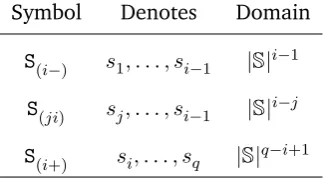
the other hand, the external randomness forY is denoted byS:={s1, . . . , sq}(with the round indicated in the superscript,e.g.S0). For convenience, we use the convention inTable 3to split
upS. Hence,{S(i−),S(i+)}indicatesSsplit up into two at the indexi, whereas{S(j−),S(ji),S(i+)}
Symbol Denotes Domain
S(i−) s1, . . . , si−1 |S|i−1
S(ji) sj, . . . , si−1 |S|i−j
S(i+) si, . . . , sq |S|q−i+1
Table 3: Shorthand for external randomness.
indicates S split into three, at indices j and i respectively. Finally, T(2) denotes the set from
which coins (both internal and external) are drawn forZ andT(n)denotes the set of coins for
the GMF Algorithm12.
11Although, the result is a corollary to a more general H¨older’s inequality (see [Lemma C.3][BPW12]), another
way to proving the bound is by viewing it an optimisation problem. Let f(x1, . . . , xq) :=Pqk:=1x n
k be the objective function under the set of constraints: i)Pq
k=1xk =x; andii)(0≤xk≤1)fork ∈ {1, . . . , q}. Then f attains a minima ofxn/qn−1at the point(x/q, . . . , x/q), thus, establishingLemma 4.
12With regard to the coins, it is apparent that the source of coins for a single invocation ofYis the set
R×Sq. As
for two invocations ofY (single invocation ofZ), it can be worked out that the coins are drawn from the set
T(2):=R× q [
i=2
Proof. For a fixed stringx, let
mfrk3(x) := Prh(b= 1)|(b,{σ0, . . . , σn})
$
←− NA
1,Y,n(x)
i
and
acc(x) := Pr
h
(1≤J < I≤q)| {s1, . . . , sq}←−U S; (I, J, σ)←− Y$ (x, s1, . . . , sq)
i
.
Let A1 := {B,C0,C2, . . . ,Cn−1,D2,D4, . . . ,Dn−1}. For ease of notation, we further break the
eventCk(resp. Dk) into two subeventsCk,candCk,s (resp. Dk,candDk,s) as shown below.
Ck,c: (Ik+1=Ik) Ck,s : (skIk+16=s
k Ik)
Dk,c: (Jk=J0)∧(Jk < Ik≤q) Dk,s : (∧`:=0,2,...,k−2skJ0 6=s
`
J0) (10)
The GMF Algorithm is successful in the eventE:B∧ C0∧C2∧ · · · ∧Cn−1
∧ D2∧D4∧ · · · ∧Dn−1
. In other words, with the probabilities calculated over the coin tosses of the GMF Algorithm, it follows thatmfrk3(x) = Pr [E]. The task of bounding this probability is accomplished through three claims (Claim 1throughClaim 3). The object at the centre ofClaim 1is the logical unit Z. It turns out thatwithindex dependence, the behaviour ofZ is similar to the GF Algorithm [BN06]. The aim ofClaim 1is to bound the probability of success ofZ, denoted byfrk(x), in terms ofacc(x). The bound onfrk(x)is, then, used inClaim 2andClaim 3to boundmfrk3(x). We start with the analysis of a single invocation of Z. Without loss of generality, let’s consider the first two rounds of the GMF Algorithm.
Claim 1. frk(x)≥acc(x)
acc(x)
q (1−η(x))− 1
|S|
.
Argument. With the probability taken over the coin tosses over the two rounds (which we de-note byT(2)), it follows that
frk(x) = Pr [B∧C0] = Pr
B∧C0,c∧C0,s
(using subevents given in (10)) ≥Pr [(J1=J0)∧(I1 =I0)∧(1≤J0 < I0 ≤q)]−Pr
(1≤J0< I0≤q)∧(s0I0 =s 1
I0)
(11)
Let’s denote the two parts of the above expression by frkc(x) and frks(x) respectively. The second part can be computed as follows:
frks(x) = Pr [1≤J0 < I0 ≤q]·Pr
s0I0 =s1I0=acc(x)/|S|. (12)
The first part of (11), on the other hand, forms the “core” probability for the two rounds. In order to analyse it, we define a random variable which captures single invocation of the algorithmY. LetYi :R×Si−1 7→[0,1], for eachi∈ {2, . . . , q}, be defined by setting
Yi(ρ,S(i−)) = Pr
h
(I =i)∧(1≤J < i))|S(i+)←−U S; (I, J, σ)← Y(x,{S(i−),S(i+)};ρ)
i
.
By a simple extrapolation, the coins for the GMF Algorithm are drawn from
T(n):=R× q−1
[
j=1
Sj−1×
q [
i=j+1
Si−j×S(q−i+1)∗2
UsingYi,frkc(x)can be rewritten as follows.
frkc(x) = Pr [(J1=J0)|(I1 =I0)∧(1≤J0< I0≤q)] Pr [(I1=I0)∧(1≤J0< I0≤q)]
= (1−η(x))
q X
i=2
X
ρ,S(i−) 1
|R||S|i−1Y 2
i (ρ,S(i−)) (see (28) inAppendix C.1for details)
= (1−η(x))
q X
i=2
Ex
Yi2
≥ 1
q
q X
i=2
Ex[Yi] !2
(by Jensen’s and H¨older’s inequality)
= (1−η(x))1 qacc(x)
2 (by definition of Y
i and acc(x)) (13)
By substituting (12) and (13) in (11), we get
frk(x) = Pr
T(2)
(I1 =I0)∧(1≤J0 < I0 ≤q)∧(s0I0 6=s 1
I0)
≥acc(x)
acc(x)
q (1−η(x))− 1
|S|
(14) establishingClaim 1.
The fundamental difference between the argument of Claim 1 and the proof of GF
Algo-rithm in [BN06] is the involvement of the additional indexJ. Theonlyreason that the analysis
proceeds as in [BN06] is due to the assumption J ≺ I. Without this assumption, the
argu-ment for Claim 1 would require defining a random variable that takes both the indices into consideration (this is indeed the case in the proof ofLemma 9).
Remark 4. InClaim 1, what we have effectively established is that onO{I,D}, single augmented
forking can be carried out as efficiently as an elementary forking.
The remaining two claims require a random variableZj that captures a single invocation of
Z. LetZj :R×Sj−1 7→[0,1], for1≤j≤q−1, be defined by setting
Zj(ρ,S(j−)) = Pr
(J0 =J =j)∧(I0 =I)∧(j < I≤q)∧(s0I 6=sI)
given
(S(jI),(S(I+),S0(I+)))←−U S and
((I, J, σ),(I0, J0, σ0))← Z(x,{S(j−),S(jI),S(I+)},{S(j−),S(jI),S0(I+)};ρ).
A crucial point is that the observation OIhas been considered in the definition ofZj. Without
this assumption, the analysis would require a random variable that takes both the indices into consideration (as we do later in the proof ofLemma 10using a random variableZi,j). Briefly,
our aim is to bound mfrk3(x) in terms of Zj (Claim 2) and then boundZj in terms offrk(x)
(Claim 3).
Claim 2.
mfrk3(x)≥ 1
q(n−1)/2
q−1
X
j=1
Ex[Zj]
(n+1)/2
−(n−1)(n+ 1)
8|S|
q−1
X
j=1
Ex[Zj]
(15)
Argument. The first step is to separate the “core” subevents out of the eventEas shown below.
Pr [E] = Pr
B∧ ∧k=0,2,...,n−1Ck
∧ ∧k=2,4,...,n−1Dk
≥Pr
B∧C0∧ ∧k=2,4,...,n−1Ck∧Dk,c
−Pr
We denote the first part of (16) by mfrk3,c(x) and the second part by mfrk3,s(x) and analyse them separately.
mfrk3,c(x) =
q−1
X
j=1
Pr∧k=0,2,...,n−1((Jk+1 =Jk=j)∧(Ik+1 =Ik)∧(j < Ik ≤q)∧(skIk+1 6=s
k Ik))
=
q−1
X
j=1
X
ρ,S(j−)
Qn−1
k=0,2Zj(ρ,S(j−))
|R||S|j−1 (see (29) inAppendix C.1for details)
=
q−1
X
j=1
ExhZj(n+1)/2
i
≥ 1
q(n−1)/2
q−1
X
j=1
Ex[Zj]
(n+1)/2
(by Jensen’s and H¨older’s inequality)
(17)
Using a similar line of approach as above, it is possible to boundmfrk3,s too in terms ofZj (see
(31) inAppendix C.1for the intermediate steps).
mfrk3,s(x) = (n−1)(n+ 1) 8|S|
q−1
X
j=1
Ex[Zj]
(18)
Substituting the value ofmfrk3,c(x)from (17) andmfrk3,s(x)from (18) in (16) provesClaim 2.
What remains is to relateClaim 1andClaim 2by establishing
Claim 3. Pq−1
j=1Ex[Zj]≥frk(x).
Argument. Recall that the bound given inClaim 1forfrk(x)is with the probability taken over the set
T(2) :=R×
q [
i=2
Si−1×S(q−i+1)∗2.
LetT(2,j>)denote the underlying set for the random variableZj. From the definition ofZj, we
can infer that
T(2,j>):= R×S
j−1×
q [
i=j+1
Si−j ×S(q−i+1)∗2= R× q [
i=j+1
Si−1×S(q−i+1)∗2 and
Ex[Zj] = Pr T(2,j>)
(J0 =J =j)∧(I0 =I)∧(j < I ≤q)∧(s0I6=sI). (19)
Notice that the setT(2,j>)is a subset of the setT(2). In fact,T(2)can be partitioned into the two
setsT(2,j<)andT(2,j>)where
T(2,j<) :=R×
j [
i=2
Si−1×S(q−i+1)∗2.
At this point the subtle change in the definition of theacc(x) comes into play. The accepting
condition had been altered13 from (I ≥ 1)∧(J ≥ 1) in Lemma 1 to (1 ≤ J < I ≤ q) in
Lemma 2. By implication
Pr
T(2,j<)
(J0=J =j)∧(I0 =I)∧(j < I≤q)∧(s0I 6=sI)= 0. (20)
Intuitively speaking, (20) is a consequence of the fact that the definition ofacc(x) prohibits a successfulY from returning(I, J)such thatI ≤J. The fact thatT(2,j>)⊂T(2), in conjunction
with (20) implies
Pr
T(2,j>)
(J0 =J =j)∧(I0=I)∧(j < I≤q)∧(s0I 6=sI)
≥
Pr
T(2)
(J0 =J =j)∧(I0=I)∧(j < I≤q)∧(s0I 6=sI). (21)
Finally, on taking the sum of Ex[Zj]over the indexj, we get
q−1
X
j=1
Ex[Zj]≥ q−1
X
j=1 Pr
T(2)
(J0 =J =j)∧(I0 =I)∧(j < I≤q)∧(sI 6=s0I) (using (21))
= Pr
T(2)
(J0 =J)∧(I0=I)∧(1≤J < I≤q)∧(sI 6=s0I)
=frk(x) (22)
completing the argument.
On putting all the three claims together, we get
mfrk3(x)≥ frk(x)
(n+1)/2
q(n−1)/2 −
(n−1)(n+ 1) 8|S| frk(x)
=frk(x)· frk(x)
(n−1)/2
q(n−1)/2 −
(n−1)(n+ 1) 8|S|
!
Finally, taking the expectation overx←− G$ I, yields
frk≥acc
acc
q (1−η)− 1
|S|
and mfrk3≥frk· frk
(n−1)/2
q(n−1)/2 −
(n−1)(n+ 1) 8|S|
!
establishing Lemma 2. We conclude with the comment that on assuming |S| 1, one gets
mfrk3≈accn+1/qn.
4
Revisiting the Security Argument of Existing Protocols
We now take a closer look at the protocols that employ the MF Algorithm in their security argument. Our primary objective is to examine the applicability of the observationsOIandOD.
We also comment on the design of the corresponding wrappers. We use the proxy signature
scheme of Boldyreva et al. (BPW-PSS) [BPW12] to motivate the notion of (random oracle)
dependence and show how both OI and OD can be captured in the security argument. We
then suggest a small modification–coined “binding”–in the identity-based signature scheme of Galindo and Garcia (GG-IBS) [GG09] to induce hash function dependence and briefly comment on its security (a detailed argument is provided inAppendix E). The effect on zero-knowledge protocol of Chowet al. (CMW-ZKP) [CMW12] is discussed in§4.4.
4.1 Random-Oracle Dependence
The notion of hash function (or, random-oracle) dependence can be best appreciated through
a concrete example. Consider the construction of BPW-PSS scheme (see Figure 5 of
R for generating proxy secret keys; H is used inProxy Signing for computing proxy signatures. The proxy signature is computed using the proxy secret key which, in turn, is computed using the proxy certificate. Hence, to generate a proxy signature the hash function calls must follow alogicalorder: G<R<H (here<denotes ‘followed by’).
Now let’s take a look at the structure of hash function calls:
c:=G(0kSkY) r:=R(SkYkc) h:=H(0km˜kSkYkVkr).
The critical point is to observe the binding between the hash functions. R takes as an input
c which is the output of G; H takes as an input r which is the output of R. Consequently, to produce a proxy signature, onehas to(except, with a negligible probability of guessing) call the hash functions in the order: G <R <H (which is also the logical order). In other words, the logical order has been explicitly imposed as the onlyviableorder.
Next, consider the simulation of the protocol environment for the BPW-PSS where the hash functions are modelled as random oracles. The aforesaid order among the hash functions nat-urally translates into an order among the corresponding random oracles. Hence, to forge a proxy signature, an adversaryhas to (except, with a negligible probability of guessing) make the target random oracle queries in the order G < R < H. In other words, ifK,J andI are the indices that refer to the target G, R and H random oracle queries corresponding to the forgery, then it follows that(1≤K < J < I ≤q). Now, consider a second round of simulation of the adversary initiated by a forking at I (corresponding to the successful target H-query). Suppose the adversary is successful in the second round and, in addition, the target H index for the second round matches with the first (i.e.,I0 =I). It is not difficult to see that, due to the binding between the random oracles, the R and G target indices for the two rounds alsohave to(except, as we shall see, with probability denoted byηb) match. The advantage with which
an adversary can forge a proxy signature on violating this condition is, in fact, (asymptotically) negligible. Hence,(I0 =I)implies (J0 = J) and(K0 = K). We say that the random oracle H is “dependent” on the random oracles G and R (denoted by{G,R} ≺H) over these two rounds (in other words, within the wrapper of Z in the context of multiple forking). Using a similar line of argument, one can establish that R is dependent on G (i.e. G≺R). On putting together
the two observations, in the case of BPW-PSS we get G ≺ R ≺ H. A little more formally, the
dependence among two random oracles is defined as follows.
Definition 2 (Random-Oracle Dependence). Consider the oracle replay attack in the context
of a cryptographic protocol that employs two hash functions H1 and H2 modelled as random
oracles. Let J [resp. I] denote the target H1-index [resp. H2-index] for the first round of simulation of the protocol. Also, letJ0[resp. I0] denote the target H1-index [resp. H2-index] for the second round of simulation that was initiated by a forking atI. Suppose that the adversary
was successful in both the rounds. The random oracle H2 is defined to be η-dependent on
the random oracle H1 on the target query (denoted by H1 ≺ H2) if the following criteria are satisfied: i)(1≤J < I ≤q)or, in other words H1<H2; andii)Pr[(J0 6=J)|(I0 =I)]≤η.14
The second criterion, in other words, requires (I0 = I) =⇒ (J0 = J) with probability at least(1−η); for the criterion to hold with overwhelming probability,ηshould be negligible inκ. A logical order among the “hash” functions in the protocol does not necessarily mean that there
is a dependence among them.15 Hence, one may need to impose explicit dependence among
the hash functions. A natural way to induce the dependence H1 ≺ H2 is through the binding
technique used in BPW-PSS: by making the input to H2 a function of H1’s output.
14Note that the second criterion is the concrete instance of index-dependence inDefinition 1. The first criterion,
on the other hand, has been alreadyabsorbedin the corresponding definition ofY (see ConditionBofA2andA3). 15Dependence is induced by design in BPW-PSS and was not present in the original GG-IBS. On the other hand,
Claim 4 (Binding induces dependence). Consider the hash functions (and the corresponding random oracles) described in Definition 2. Let q1 denote the upper bound on the number of
queries to the random oracle H1. In addition, letR1denote the range of H1. Binding H2 to H1 (by
making the input to H2 a function of H1’s output) induces a random-oracle dependence H1 ≺H2 withηb:=q1(q1−1)/|R1|.
Argument. Suppose(I0 =I)but(J0 6=J). It is not difficult to see that this can happen only in the scenario illustrated inFigure 3. That is, i) the adversary made a queryQJ∗ (to the random
oracle H1) that is different fromQJ, the target H1-query for theround 0of simulation; andii)QJ∗
was also responded to withsJ (the simulator’s response toQJ). However, this is tantamount to
QI+1 · //round 0
· QJ QJ+1 QJ∗ QJ∗+1 QI
Q0I+1 · //round 1
sJ sJ
Figure 3: Violation of random-oracle dependence.
a collision on the random function corresponding to the oracle H1and according to the birthday bound, can happen with probability at mostq1(q1−1)/|R1|.
Remark 5. The notion of random-oracle dependence can be naturally adapted for (interac-tive) challenge rounds (through [FS87]) with the notion of target commitment-challenge round in place of the notion of target random oracle query. This is demonstrated for the CMW-ZKP scheme in coming section (§4.4).
4.2 The Boldyreva-Palacio-Warinschi Proxy Signature Scheme
We refer the reader to [BPW12] for the definition of proxy signature and the original security
argument of BPW-PSS (the construction is reproduced inAppendix D.1). The extremely
tech-nical and long security argument of [BPW12] consists of five reductions B through F, with
the associated wrappersY,Z0,U,V andW respectively16. The discrete-log problem is reduced
to breaking the scheme in each of them. The reductions C, D and F use the MF Algorithm,
whereas, the reductions B and E use the GF Algorithm. Some features of the relevant
reduc-tionsC,DandF are summarised inTable 4.
Inherent dependence and wrapper design. We have already pointed out the inherent de-pendence of the hash functions used in BPW-PSS. This inbuilt dede-pendence among the hash functions, along with a careful design of the wrappers, ensures that the MF Algorithm is ap-plied properly. An integral part in the design of the wrappers is theexplicitcheck for the logical order among the target random oracle queries. If the order is violated, the wrapper sets a flag and returns (0,⊥). For example, consider the reduction C and the associated wrapper Z0
from [BPW12]. The check ensures that the indices J and I (that the wrapper returns) always
correspond to the target query for the random oracles R and H respectively. Moreover, due to dependence, the adversary is bound (except with a negligible probability of guessing) to make the target oracle queries in the logical order, i.e. R followed by H. These two factors ensure that the reductionC will end up with a correct solution to the DLP whenever the MF Algorithm is successful. The same strategy has been followed meticulously in the construction of D and
16We have renamed the wrapperZ in [BPW12] toZ0
F as well. So the notion of index dependence is to some extent used implicitly in the security argument of BPW-PSS.
However, when we come to the MF Algorithm that corresponds to this particular scheme, neither the notion of index dependence nor that of independence between the logical wrapper Z is considered in the analysis. This brings us to the improved security argument.
4.2.1 Improved Security Argument
The new security argument takes advantage of both the observations OI and OD. We have
already seen thatOD is applicable due to the existing binding. As forOI, we again consider the
case of reductionC and its wrapperZ0due to their relative simplicity. A similar argument works for reductionsD andF as well.
Z0is designed to output indexI (resp. J) corresponding to the target H (resp. R) query. C
uses the MF AlgorithmMZ0,3to secure a set of four forgeriesσ:= (z, h, r), σˆ := (ˆz,ˆh,ˆr), σ¯ :=
(¯z,¯h,¯r) and σ˙ := ( ˙z,h,˙ r)˙ with
z=v+ (rα+y+cloggpki)h z¯= ¯v+ (¯rα+y+cloggpki)¯h
ˆ
z=v+ (rα+y+cloggpki)ˆh z˙= ¯v+ (¯rα+y+cloggpki) ˙h. (23)
What we have now is a system of four congruences in four (effective) unknowns {α,(y +
cloggpki), v,¯v} with α being the solution to the DLP. The forgeries σ and σˆ (resp. σ¯ and σ˙) can be clubbed together as they constitute the output of the the logical wrapperZ that is asso-ciated to wrapperZ0 of MZ0,3. From the structure of the H query, it follows that the indexI
corresponds to the unknownv. The process of solving forαstarts by eliminating the unknownv
from each ofZs (i.e.,vfrom(z,z)ˆ and¯vfrom(¯z,z)˙ ). What is necessary at this point is that the
Iindices must match withinZ. The solution isnotaffected by the value ofIin the second invo-cation ofZ. In other words, eliminatingv from(z,z)ˆ is not affected by the pair(¯z,z)˙ and vice versa. Hence, from the point of view of the reduction, it doesn’t make any difference whether we relax the condition to accommodate independence (the system of congruences one ends up with is exactlythe same as in (23)). In fact, the reduction is unlikely to achieve anything by restricting the indices. Hence, the independence of theI indices is applicable.
Remark 6. The notion of independence can be better appreciated if we visualise the process of multiple forking in terms of congruences and unknowns. At a high level, what the reduction algorithm secures from the MF Algorithm is a set ofn+ 1congruences inn+ 1unknowns (for
some odd n). One of these unknowns is the solution to the hard problem that the reduction
wants to solve. The MF Algorithm needs to ensure that the congruences are linearly indepen-dent of each other with a certain non-negligible probability. The claim inOIcan then be restated
as: even if the condition on the I indices is relaxed as inOI, westill end up with a system of
n+ 1congruences inn+ 1unknowns.
To sum it up, in order to harness bothOI andOD, the only change in the security argument
of [BPW12] is to use the GMF AlgorithmN
A3,Y,n (with Lemma 2) instead of the original MF
Algorithm. The resulting changes are summarised inTable 4.
4.3 The Galindo-Garcia Identity-Based Signature
The original construction from [GG09] is reproduced inFigure 6ofAppendix D.2and we refer the reader to [BNN04] for the definition and security model of IBS schemes. Two hash functions are used in the scheme: H and G (both map arbitrary length strings to the setZ∗p). The structure
of hash function calls is given below.
Security Argument
Particulars
Reduction C D F
Oracles involved R and H G and H G and H
Original Forking Algorithm MZ0,3 MU,5 MW,5
Degradation O (qR+qH)6
O (qG+qH)10
O (qR+qH)10
Improved Forking Algorithm NA3,Z0,3 NA3,U,5 NA3,W,5
Degradation O (qR+qH)3
O (qG+qH)5
O (qR+qH)5
Table 4: Comparison of the original and improved security argument for BPW-PSS.qG,qR and qHdenote the upper bound on the respective hash oracle queries.
H is used to generate the user secret key which, in turn, is required to sign on a message (using G). Hence H<G constitutes the logical order for the hash functions. However,nobinding is in place by construction. The absence of binding (and consequently, the absence of dependence) is precisely the reason for the “incompleteness” of the original security argument that was pointed
out in [CKK13]. The incompleteness was addressed in [CKK13] by using the two-reduction
strategy– give separate reductions for each of the orders of the target H and G calls.
4.3.1 Modified Galindo-Garcia IBS
A better alternative to thetwo-reductionfix is to enforce the logical order on the adversary by binding the G-oracle to the H-oracle.17 A modified GG-IBS with the aforesaid binding is given in Appendix D.3. In short, the structure of the hash function call to G to something like the following:
d:=G(idkAkmkc) where c:=H(Rkid).
Once the binding is in place, the adversary (except with a negligible probability) is bound to make the target queries in the logical order. In addition, through an argument similar to that of BPW-PSS, one can show that OI is also applicable. Accordingly, the security argument
for the modified GG-IBS consists of two reductions R01 andR03. The core of these reductions remains the same as inR1 andR3 respectively of [CKK13]. The only major change is the use
of GMF AlgorithmN
A3,Y,n (withLemma 2) inR 0
3 instead of the original MF Algorithm inR3.
For the sake of completeness, we give a detailed description ofR0
3 (including the wrapper) in
Appendix E. The overall effect is summarised inTable 5.
4.4 The Chow-Ma-Weng ZKP for Simultaneous Discrete Logarithms
We confine ourselves to the basic protocol (n = 2) which is reproduced in Figure 8 of Ap-pendix D.4. The argument can be easily extended for arbitrary values of n. There are two ob-jects in consideration: the hash function H and the (interactive) commitment-challenge round18
17A noteworthy observation is that, binding the H-oracle to the G-oracle–i.e., setting up the dependence G ≺H instead of H ≺G–in the GG-IBS allows more efficient reductions to DLP (using general forking). However, this disturbs the logical order of the hash functions. In such a protocol, the PKG will have to issue user secret keys for each message to be signed, rendering it impractical.
18The round of interaction can be replaced with a hash function (also denoted by C) to make the protocol
Scheme Security Argument
GG-IBS [CKK13]
Reduction R1 R2 R3
Forking Algorithm FY MY,1 MY,3
Degradation O(qGqε) O (qH+qG)2
O (qH+qG)6
Modified GG-IBS (Figure 6)
Reduction R01 R03
Forking Algorithm FY N
A3,Y,3
Degradation O(qGqε) O (qH+qG)3
Table 5: Degradation for Galindo-Garcia IBS and its variant with binding. qG andqHdenote the
upper bound on the respective hash oracle queries, whereas, qε denotes upper bound on the
extract queries. We have assumedηto be negligible.
which we denote by C. The soundness of the CMW-ZKP is based on the hardness of the DLP: the reduction, denoted byB, uses the (original) MF AlgorithmMY,5to launch a nested replay attack involving H and C.
Lemma 5(Soundness,Lemma 4in [CMW12]). In the random-oracle model (the hash function H will be modelled as a random oracle), if there exists an adversaryAthat can-break the soundness of the CMW protocol (i.e.V accepts butloggy1 6= loggy2), there exists an algorithmB which can 0-solve the DLP with
0 ≥·
6 (qH+qC)10
−5
p
,
where qH is the number of random oracle query made by A andqC is the number of interactions betweenAandB.19
The notion of binding/dependence for the CMW-ZKP is, interestingly (and contrary to the previous two examples), between a random oracle (H) and an interactive commitment-challenge round (C).
4.4.1 A Case for (In)Dependence
We now elaborate on the aspects of dependency and independence in the context of CMW protocol (seeFigure 8).
ConditionOI. Recall that the commitment v is of the form(gzh)k, wherez := H(y1, y2). By
construction, the prover has to compute the value ofzbefore making the commitment and the verifier returns the challenge c onlyafter receiving the commitment. Hence the logical order of H < C. However, it also results in a natural binding between C and H which leads to the dependence H ≺ C.20 Next, we consider the simulation of the protocol, in particular, the first invocation ofZ. At the end ofround 0, the adversary produces a cheating transcript(v11, c11, s11),
19We correct a small error in the original expression: the degradation should be by a factor of(q
H+qC)10instead of(qH·qC)10.
20Let’s consider a resource constrained variant of the verifier which, instead of picking the challengeuponreceiving