Weaknesses of an Improvement Authentication Scheme using
Smart Cards
Rafael Martínez-Peláez a,* and Francisco Rico-Novella b
a,*
Universidad de la Sierra Sur, Instituto de Informática, Guillermo Rojas Mijangos S/N. 70800 Miahuatlán de Porfirio Díaz, Mexico
b
Technical University of Catalonia, Department of Telematics Engineering, Jordi Girona 31. 08034 Barcelona, Spain
Abstract: Recently, Sood-Sarje-Singh proposed an improvement to Liou et al.’s dynamic ID-based remote user authentication scheme using smart cards to prevent impersonation attack, malicious user attack, off-line password guessing attack, and man-in-the-middle attack. However, we demonstrate that Sood et al.’s scheme is still vulnerable to malicious user attack, impersonation attack and steal information from a database attack.
Keywords: Cryptanalysis; ID-based; Mutual Authentication; Network Security; Smart Cards
1. Introduction
In 2004, Das et al. (Das, Saxena and Gulati, 2004) introduced the concept of dynamic ID-based remote user authentication scheme using smart cards. Their scheme prevents that an attacker can know the user’s identity. However, the scheme is susceptible to insider attack, masquerade attack, and server spoofing attack (Awasthi, 2004, Goriparthi, Das and Saxena, 2009, Liao and Wang, 2009, Liou, Lin and Wang, 2006, Wang et al., 2009). Liou et al. (Liou, Lin and Wang, 2006) proposed a new scheme which resolves the security vulnerabilities of Das et al.’s scheme, in 2006. However, Sood et al. (Sood, Sarje and Singh, 2010) demonstrated that Liou et al.’s scheme is vulnerable to impersonation attack, malicious user attack, off-line password guessing attack, and man-in-the-middle attack.
In this paper, we demonstrate that Sood et al.’ scheme is still vulnerable to malicious user attack, impersonation attack and steal information from a database attack.
The rest of this paper is organized as follows. In Section 2, we describe the scheme proposed by Sood-Sarje-Singh. Section 3 presents the security drawbacks of Sood et al.’s scheme. Finally, conclusions are given in Section 4.
2. Review of Sood et al.’s scheme
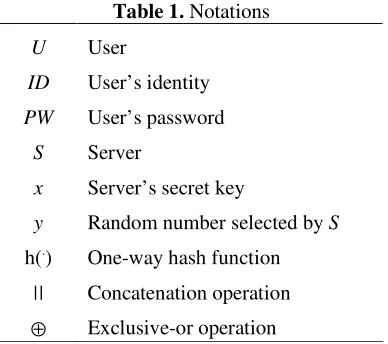
Table 1. Notations
U User
ID User’s identity
PW User’s password
S Server
x Server’s secret key
y Random number selected by S
h(.) One-way hash function
|| Concatenation operation
⊕ Exclusive-or operation
2.1. Registration phase
This phase is invoked when U wants to access S. The process is as follows: 1. U chooses her ID and PW
2. U sends (ID, PW) to Svia a secure communication channel
3. S chooses a random value y
4. S computes:
A = h(x || y)
B = h(ID || PW) ⊕PW⊕ h(x || y)
C = h(x || y) ⊕ h(PW)
D = h(ID || PW) ⊕ h(x)
5. S stores y⊕x and ID⊕ h(x) corresponding to A in a database
6. S issues the smart card to Uthrough a secure communication channel. The smart card contains the following security parameters: B, C, D, h( )
2.2. Login phase
When U wants to login the remote server S, she inserts her smart card to the smart card reader and keys her ID* and PW*. Then, the smart card performs the following steps:
1. Computes:
h(x || y)* = h(ID* || PW*) ⊕PW*⊕B C* = h(x || y)*⊕ h(PW*)
2. Compares:
C* ?= C
3. After verification, the smart card computes: h(x) = h(ID || PW) ⊕D
CID = h(x || y) ⊕ h(h(x) || T) where T is the current date and time of U M = h(h(x) || h(x || y) || T)
4. U’s smart card sends (CID, M, T) to S
2.3. Authentication phase
When S receives the request (CID, M, T) at time T’, S carries out the following steps:
2. Computes:
A* = h(x || y) = CID⊕ h(h(x) || T) 3. Recovers:
y⊕x and ID⊕ h(x) corresponding to A* from its database
4. Extracts:
y from y⊕x ID from ID⊕ h(x) 5. Computes:
M* = h(h(x) || h(x || y) || T) 6. Compares:
M* ?= M if the verification is correct the authenticity of U is assured
7. Computes:
V = h(A || h(x) || T || TS) where TS is the current date and time of S
8. S sends (V, TS) to U’s smart card
Upon receiving the login response message (V, TS), U’s smart card carries out the
following operations:
9. Checks the validity of TS.
10. Computes:
V* = h(h(x || y) || h(x) || T || TS)
11. Compares:
V* ?= V if the verification is correct the authenticity of S is assured
Finally, U and S computes the session key SK = h(ID || h(x || y) || h(x) || T || TS)
2.4. Password change phase
When U wants to change the password, she inserts the smart card into the smart card reader, keys her ID* and PW*, and request to change the password to new one, then the smart card carries out the following operations:
1. Computes:
h(x || y)* = h(ID* || PW*) ⊕PW*⊕B C* = h(x || y)*⊕ h(PW*)
2. Compares:
C* ?= C
3. Request to U a new password PWnew
4. Computes:
Bnew = h(ID || PWnew) ⊕PWnew⊕ h(x || y) Cnew = h(x || y) ⊕ h(PWnew)
Dnew = h(ID || PWnew) ⊕ h(x)
and updates the values B, C, and D stored in its memory with Bnew, Cnew, and Dnew
3. Weaknesses of Sood et al.’s scheme
In this section, we demonstrate that Sood et al.’s scheme is vulnerable to impersonation attack, malicious user attack and steal information from a database attack.
3.1. Malicious user attack
the leaked information (Messerges, Dabbish and Sloan, 2002). However, Sood et al.’s scheme is still vulnerable to this attack.
Suppose a legal but malicious user, she can extract the secret information (B, C and D) stored in her smart card. Then, she can extract h(x) from D = h(ID || PW) ⊕ h(x) because she knows ID and PW. Moreover, the adversary can try to guess the different values of x and check its correctness by verifying it with the value of h(x). Thus, Sood et al.’s scheme cannot resist the off-line password guessing attack.
3.2. Impersonation attack
If the adversary has intercepted one of U’s previous login request message (CID, M, T) and she has extracted h(x), she can perform the impersonation attack as follows:
1. Computes:
h(x || y)* = CID⊕ h(h(x) || T) because she knows h(x) and T
CIDfalse = h(x || y)*⊕ h(h(x) || Tfalse) where Tfalse is the current date and time of the adversary
Mfalse = h(h(x) || h(x || y) || Tfalse)
2. Adversary sends (CIDfalse, Mfalse, Tfalse) to S
In this case, Tfalse is valid because was computed by the adversary with the current time
and date.
Upon receiving the login request message from the adversary, S will carry out the verification process:
3. Checks: the freshness of Tfalse by means of T’ – Tfalse <=
∆
T, where T’ is the S’s current date and time.4. Computes:
A* = h(x || y) = CID⊕ h(h(x) || Tfalse)
5. Recovers:
y⊕x and ID⊕ h(x) corresponding to A* from its database 6. Extracts:
y from y⊕x ID from ID⊕ h(x) 7. Computes:
M* = h(h(x) || h(x || y) || T) 8. Compares:
M* ?= Mfalse it is obvious that S will accept the login request message
It is obvious that Sood et al.’s scheme cannot resist the impersonation attack. Although the session key computed by S is unknown by the adversary, the attack reveals a weakness in Sood et al.’s scheme.
3.3. Steal information from a database attack
4. Conclusions
In this paper, we demonstrate that the improvement authentication scheme proposed by Sood-Sarje-Singh is still vulnerable to malicious user attack, impersonation attack and steal information from a database attack, making the scheme unsecured for electronic services.
Acknowledgments
This research was supported by The Mexican Teacher-Improvement Program (PROMEP)
References
Awasthi A.-K. Comment on A Dynamic ID-based remote user authentication scheme. Transaction on Cryptology 2004; 1(2): 15-16.
Das M.-L., Saxena A., Gulati V.-P. A Dynamic ID-based remote user authentication scheme. IEEE Transactions on Consumer Electronics 2004; 50(2): 629-631.
Goriparthi T., Das M.-L., Saxena A. An improved bilinear pairing based remote user authentication scheme. Computer Standards & Interfaces 2009; 31(1): 181-185.
Kocher P., Jaffe J., Jun B. Differential power analysis. Advances in Cryptology - Crypto'99. (1999), LNCS 1666: 388-397.
Liao Y.-P., Wang S.-S. A secure dynamic ID based remote user authentication scheme for multi-server environment. Computer Standards & Interfaces 2009; 31(1): 24-29.
Liou Y.-P., Lin J., Wang S.-S. A New Dynamic ID-Based Remote User Authentication Scheme using Smart Cards. Proceedings of the 16th Information Security Conference. (2006): 198-205.
Messerges T.-S., Dabbish E.-A., Sloan R.-H. Examining smart-card security under the threat of power analysis attacks. IEEE Transactions on Computers 2002; 51(5): 541-552.
Sood S.-K., Sarje A.-K., Singh K. An Improvement of Liou et al.’s authentication scheme using smart cards. International Journal of Computer Applications 2010; 1(8): 16-23.