A Unicode-based Environment for Creation and Use of Language Resources
Valentin Tablan
∗, Cristian Ursu
∗, Kalina Bontcheva
∗, Hamish Cunningham
∗,
Diana Maynard
∗, Oana Hamza
∗, Tony McEnery
†, Paul Baker
†, Mark Leisher
‡∗Dept. of Computer Science
University of Sheffield Regent Court, 211 Portobello St
Sheffield, S1 4DP, UK
[V.Tablan, C.Ursu, K.Bontcheva, H.Cunningham, D.Maynard, O.Hamza]@dcs.shef.ac.uk
†Department of Linguistics and Modern English Language
Bowland College, Lancaster University Lancaster, LA1 4YT, UK
[email protected], [email protected]
‡Computing Research Laboratory
New Mexico State University
Box 30001/MSC 3CRL, Las Cruces, NM 88003-8001, USA [email protected]
Abstract
GATE is a Unicode-aware architecture, development environment and framework for building systems that process human language. It is often thought that the character sets problem has been solved by the arrival of the Unicode standard. This standard is an important advance, but in practice the ability to process text in a large number of the World’s languages is still limited. This paper describes work done in the context of the GATE project that makes use of Unicode and plugs some of the gaps for language processing R&D.
First we look at storing and decoding of Unicode compliant linguistic resources. The new capabilities for processing textual data and taking advantage of the Unicode standard are detailed next. Finally, the solutions used to add Unicode displaying and editing capabilities for the graphical interface are described.
1.
Introduction
GATE(Cunningham, 2002)1is an architecture,
develop-ment environdevelop-ment and framework for building systems that process human language. It has been in development at the University of Sheffield since 1995, and has been used for many R&D projects, including Information Extraction in multiple languages and for multiple tasks and clients.
It is often thought that the character sets problem has been solved by the arrival of the Unicode standard. This standard is an important advance, but in practice the ability to process text in a large number of the World’s languages is still limited by
• incomplete support for Unicode in operating systems and applications software
• languages missing from the standard
• difficulties in converting non-Unicode character en-codings to Unicode
This paper describes work done in the context of the GATE project2that makes use of Unicode and plugs some
of the gaps for language processing R&D.
1GATE is implemented in Java and is freely available from
http://gate.ac.uk as open-source free software under the GNU li-brary licence.
2
Partly funded in this case by the EMILLE project (McEnery et al., 2000).
The GATE architecture defines almost everything in terms of components - reusable units of code that are spe-cialised for a specific task. There are three main types of components:
• Language Resources (LRs) store some kind of
lin-guistic data such as documents, corpora, ontologies and provide services for accessing it. At the moment all the predefined LRs are text based but the model doesn’t constrict the data format so the framework could be extended to handle multimedia documents as well.
• Processing Resources (PRs) are resources whose
char-acter is principally programatic or algorithmic such as a POS tagger or a parser. In most cases PRs are used to process the data provided by one or more LRs but that is not a requirement.
• Visual Resources (VRs) are graphical components that
are displayed by the user interface and allow the visu-alisation and editing of other types of resources or the control of the execution flow.
The GATE framework defines some basic language re-sources such as documents and corpora, provides resource discovery and loading facilities and supports various kinds of input output operations such as format decoding, file or database persistence.
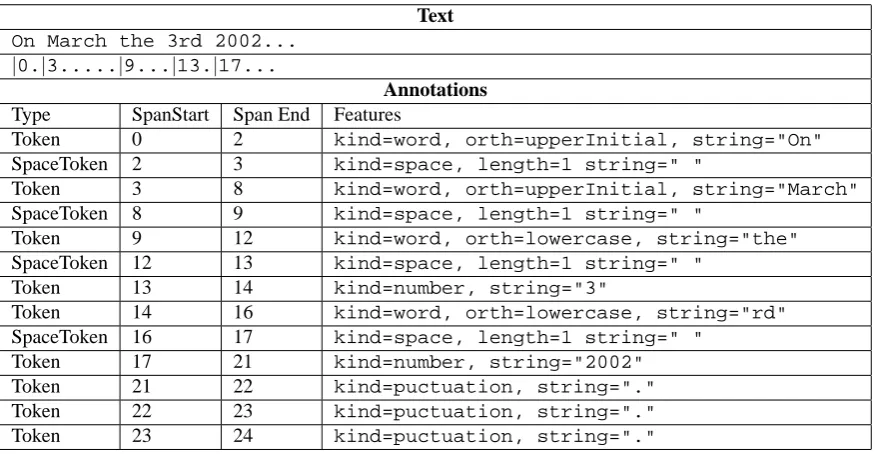
for-Text
On March the 3rd 2002...
|0.|3...|9...|13.|17...
Annotations
Type SpanStart Span End Features
Token 0 2 kind=word, orth=upperInitial, string="On"
SpaceToken 2 3 kind=space, length=1 string=" "
Token 3 8 kind=word, orth=upperInitial, string="March"
SpaceToken 8 9 kind=space, length=1 string=" "
Token 9 12 kind=word, orth=lowercase, string="the"
SpaceToken 12 13 kind=space, length=1 string=" "
Token 13 14 kind=number, string="3"
Token 14 16 kind=word, orth=lowercase, string="rd"
SpaceToken 16 17 kind=space, length=1 string=" "
Token 17 21 kind=number, string="2002"
Token 21 22 kind=puctuation, string="."
Token 22 23 kind=puctuation, string="."
Token 23 24 kind=puctuation, string="."
Table 1: A tokenisation example
regular expression pattern, and then the full FSM for the to-keniser is constructed as a disjunction of all the FSMs de-fined by the rules. We are currently using a tokeniser of 23 rules that recognises many types of words, whitespace pat-terns, numbers, symbols and punctuation and which should handle any language from the Indo-European group with-out any modifications.
UPPERCASE LETTER
(LOWERCASE LETTER|DASH PUNCTUATION)* >
Token;orth=upperInitial;kind=word;
Figure 1: A tokeniser rule.
For situations not handled by the current tokeniser new rules can easily be added extending it for new languages.
The modular architecture of GATE allows for the local-isation of the tokeniser when a particular language requires additional processing, by simply adding another PR after the tokeniser in the execution chain. For instance, in the case of English text, we are using a JAPE transducer (Cun-ningham et al., 2002) which adapts the output of the to-keniser for the needs of the part-of-speech tagger provided with GATE.
4.
The GATE Unicode Kit
The third type of resource provided with GATE are the Visual resources which are used in constructing user inter-faces for the visualisation and editing of data as well as for the control of the execution flow. A Unicode enabled graph-ical user interface (GUI) needs to address two main issues: the capability to display text and the ability to enter text in other languages than the default one.
4.1. Displaying Unicode Data
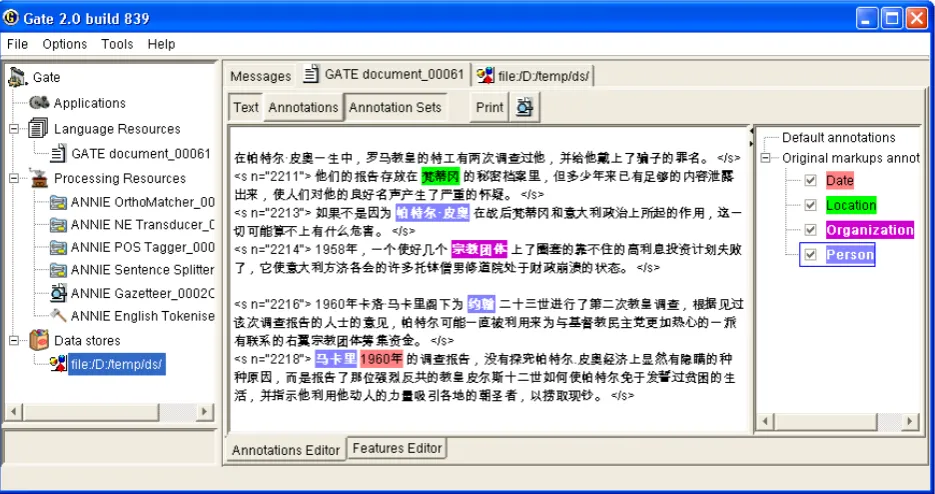
The support for displaying text using different lan-guages and scripts in Java is quite comprehensive and cov-ers many languages supported by the Unicode standard. Sun Microsystems, the authors of the Java programming language, are actively working on extending the support to new languages and we can expect the coverage to get bet-ter with every new released version. One problem is the provision of fonts that cover character blocks that are less mainstream, which are hard to find and expensive to cre-ate. However the situation is improving and for example Microsoft provides a comprehensive font that covers all the character blocks defined by Unicode for the Windows plat-form with new versions of their Microsoft Office product. The support for localisation is improving for other operat-ing systems as well, and the new versions of the Java vir-tual machine are able to make use of the fonts provided by the underlying platform which means that if a particular language can be used on a given platform it is more than probable that it will be available in GATE as well. Figure 2 shows a Chinese document loaded and annotated in GATE on an operating system localised for United Kingdom using the Arial Microsoft Unicode font without having installed any support for Asian languages.
4.2. Unicode Input Methods
While the support for displaying Unicode text is pro-vided to a large extent by the underlying platform, the same is not true with respect to editing Unicode text. Many plat-forms provide some support for localisation but that is not always very comprehensive and is often not Unicode com-pliant, which makes it difficult for Java to make use of it. Also the level of support provided varies largely between platforms and in order to address this problem we have pro-vided our own dedicated solution in the form of the GATE
Unicode Kit (GUK).
facili-Figure 2: A Chinese document annotated in GATE.
ties to a Java application is to define so called input methods
(IM). An IM allows users to enter text in other languages
than the default one by intercepting the events generated by the input hardware such as the system keyboard or mouse and mapping them to a different output from the one nor-mally obtained.
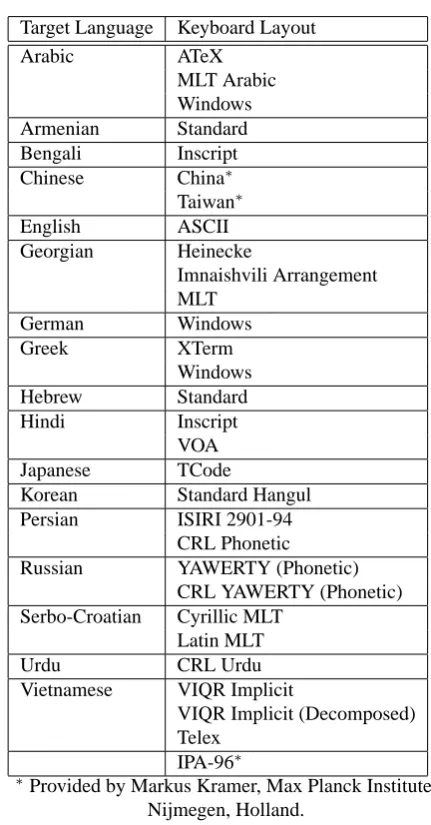
GUK consists of two main components: a set of IM def-initions and the Java code that handles the communication with the system, the decoding of the IM definitions and that does the actual input mapping. At present GUK provides input methods for 17 different languages some of them with more than one version, amounting to a total of 30 different input methods (see appendix A for a full list).
Although distributed with GATE, GUK is effectively a separate entity that can be used outside of GATE as well. To this end, GUK is packaged as a separate library that can either be registered with the Java virtual machine at startup time or can be added to a Java installation as an
in-stalled extension thus making it available to all applications
that run within that particular virtual machine. GUK inte-grates seamlessly with the platform and there are no spe-cial requirements an application needs to fulfill to be able to use its facilities. The GATE distribution contains GUK and makes use of it as a runtime library.
The IMs defined by GUK provide support for text input by means of virtual keyboards. Because of restrictions im-posed by the platform independent manner in which Java treats the input hardware, there is no reliable way to de-termine the actual layout of the physical system keyboard: only the characters generated by a key stroke (e.g “E”) can be obtained but not the actual position of the pressed key (e.g. third from the left in the top row of keys). The vir-tual keyboards defined in GUK are based on the assumption that the system keyboard uses a British layout which could cause some keys to be misplaced when the system keyboard
Figure 3: The GUK Unicode editor using a Korean virtual keyboard.
has a different layout. However, the layout of the currently active virtual keyboard can be displayed on the screen in or-der to assist the user in finding the right key (see figure 3). As long as the virtual keyboard map is visible on screen it can also be used for entering text directly by clicking with the mouse on the virtual keys, which might be more effi-cient, particularly when using a keyboard type the user is not accustomed to.
H. Cunningham. 2002. GATE, a General Architecture for Text Engineering. Computing and the Humanities. (in press).
B. Gamb¨ack and F. Olsson. 2000. Experiences of Lan-guage Engineering Algorithm Reuse. In Second
Inter-national Conference on Language Resources and Evalu-ation (LREC), pages 155–160, Athens, Greece.
R. Grishman. 1997. TIPSTER Architecture Design Document Version 2.3. Technical report, DARPA.
http://www.itl.nist.gov/div894/894.02/-related projects/tipster/.
D. Maynard, V. Tablan, C. Ursu, H. Cunningham, and Y. Wilks. 2001. Named Entity Recognition from Di-verse Text Types. In Recent Advances in Natural
Lan-guage Processing 2001 Conference, Tzigov Chark,
Bul-garia.
A.M. McEnery, P. Baker, R. Gaizauskas, and H. Cunning-ham. 2000. EMILLE: Building a Corpus of South Asian Languages. Vivek, A Quarterly in Artificial Intelligence, 13(3):23–32.
T. Nelson. 1997. Embedded Markup Considered Harmful. In D. Connolly, editor, XML: Principles, Tools and
Tech-niques, pages 129–134. O’Reilly, Cambridge, MA.
K. Pastra, D. Maynard, H. Cunningham, O. Hamza, and Y.Wilks. 2002. How feasible is the reuse of grammars for named entity recognition? In Proceedings of 3rd
Language Resources and Evaluation Conference.
forth-coming.
H. Thompson and D. McKelvie. 1997. Hyperlink seman-tics for standoff markup of read-only documents. In
Pro-ceedings of SGML Europe’97, Barcelona.
A
Appendix: GUK Input Methods
Target Language Keyboard Layout
Arabic ATeX
MLT Arabic Windows Armenian Standard Bengali Inscript Chinese China∗
Taiwan∗ English ASCII Georgian Heinecke
Imnaishvili Arrangement MLT
German Windows
Greek XTerm
Windows Hebrew Standard Hindi Inscript
VOA Japanese TCode
Korean Standard Hangul Persian ISIRI 2901-94
CRL Phonetic
Russian YAWERTY (Phonetic) CRL YAWERTY (Phonetic) Serbo-Croatian Cyrillic MLT
Latin MLT
Urdu CRL Urdu
Vietnamese VIQR Implicit
VIQR Implicit (Decomposed) Telex
IPA-96∗
∗Provided by Markus Kramer, Max Planck Institute,
Nijmegen, Holland.