6HJ:LQD7RROIRU6HJPHQWLQJ$QQRWDWLQJDQG&RQWUROOLQJWKH&UHDWLRQ
RID'DWDEDVHRI,WDOLDQ6SRNHQ9DULHWLHV
0DULR5HILFH0LFKHOLQD6DYLQR0DUFR$OWLHUL5REHUWR$OWLHUL
Department di Elettrotecnica ed ElettronicaPolitecnico di Bari
Via Orabona, 4 - 70125 Bari - ITALY [email protected], [email protected]
$EVWUDFW
A number of actions have been recently proposed, aiming at filling the gap existing in the availability of speech annotated corpora of Italian regional varieties. A starting action is represented by the national project AVIP (Archivio delle Varietà di Italiano Parlato, Spoken Italian Varieties Archive), whose main challenge is a methodological one, namely finding annotation strategies and developing suitable software tools for coping with the inadequacy of linguistic models for Italian accent variations. Basically, these strategies consist in adopting an iterative process of labelling such that a description for each variety could be achieved by successive refinement stages without loosing intermediate stages information. To satisfy such requirements, a specific software system, called SegWin, has been developed by Politecnico di Bari, which:
• “guides” the human transcribers in the annotation phases by a sort of “scheduled procedure”;
• allows incremental addition of information at any stage of the database creation;
• monitors/checks the consistency of the database during every stage of its creation
The system has been extensively used by all the partners of the project AVIP and is continuously updated to take into account the project needs. The main characteristics of SegWin are here described, in relation to the above mentioned aspects.
,QWURGXFWLRQ
The need of spoken corpora, as part of the general framework of “language resources”, for a given language has been widely recognised, pointing out the advantages for both linguistic and more application-oriented research. The methodological and technical problems related to such an effort have been also described and suitable solutions have been found, even though room for further improvements is still largely available (Zampolli, 1998). In all cases, the very basic question consists in defining what is the language the corpus intends to be representative of. In building a speech corpus, the usual language reference is assumed to be the standard variety, which is taken to be representative of the language spoken in a country. Yet unlike other languages like English or German, for which a standard version does exist, Italian language presents some peculiarities for which one definition is not possible
.
For historical reasons, the process of defining a unique national model of the Italian language has been perceived and successfully achieved only for its written form, but not for the spoken one (De Mauro, 1963). The so-called “standard” Italian (derived from the “cultivated” Florentine variety, ILRUHQWLQR FROWR) is an abstract reference used only by actors or professional speakers, being the regional varieties the ones actually spoken in the country. Despite that, traditionally most of the phonetic/phonological studies and technological applications have been dealt with the abstract model, whereas linguistic descriptions (both at segmental and suprasegmental levels) of regional varieties are still inadequate. As a matter of fact, all spoken corpora of Italian already available are of a strong application-oriented nature, thus presenting the usual characteristics in terms of:
a) the speech material collected and analysed (consonant/vowel sequences in various combinations, isolated words, phrases, and short passages)
b) the speaking style (read)
c) the type of language (“standard” variety spoken by professional speakers, or some Northern varieties as an alternative),
where the reference to regional accent variation models is not a basic requirement. Only recently, some attention has been paid to regional accents, even though in the above mentioned terms and for the cited application fields - for example, COLLECT (developed by CSELT), SIVA (developed by FUB) - whereas corpora of spontaneous or semi-spontaneous dialogue-based speech of regional varieties - and consequently also the related descriptive models - are still missing. In the last years, a number of actions at a national level have been proposed aiming at filling such gap. A starting action is represented by the national project AVIP (Archivio delle Varietà di Italiano Parlato, Spoken Italian Varieties Archive), whose main challenge is a methodological one, namely finding annotation strategies and developing suitable software tools for coping with the above mentioned problems in building up a database of Italian accent variations.1
7KH$9,33URMHFW
The ongoing Italian project AVIP aims at building a dialogue-based spontaneous speech corpus of three spoken Italian regional varieties, namely those of Bari, Naples and Pisa 2.
The importance of having a corpus of this kind has been already pointed out also for other languages like German (Burger & Schiel, 1998), both from the side of linguistic
1
Although reference is made to the project AVIP, the responsibility for the ideas expressed in this paper belongs to the authors only.
2
Figure 1: Snapshot of SegWin annotated speech turn
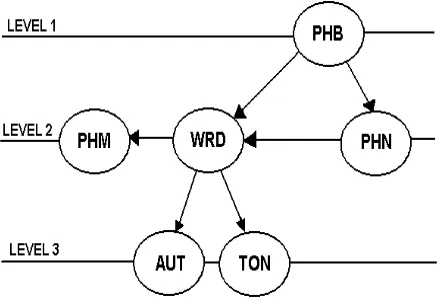
system requires them to be preceded by the word-by-word segmentation, in order to take advantage of information displayed on the WRD tier which can be useful for prosodic labelling (typically, word boundaries coinciding with prosodic edges). Of course, TON and AUT labellings are completely independent of each other. Arrows in Figure 2 represent all the above mentioned operational dependencies.
Figure 2: Operational sequence of labelling actions in SegWin
In order to facilitate the positioning of the temporal markers on the dependent tiers, and ensuring the perfect time alignment with the already existing (upper or lower levels) markers, the system provides a special “snap” functionality. When the operator puts the mouse cursor close to the target point on the screen, the system automatically “snaps” the time marker to the closest one. Two different schemes of dependencies, concerning labels and time markers modifications respectively, are adopted.
/DEHOPRGLILFDWLRQGHSHQGHQF\
Two cases of dependency in label modification procedures are considered: one between the PHB-PHN pair and the other between the WRD-PHM pair.
- PHB Í PHN
As already pointed out, we consider PHN as a refinement of the PHB tier, then the operator is allowed to modify PHN annotations both in terms of labels, and marker position. Every modification concerning existing temporal markers in PHN is then automatically recorded into the PHB tier. Of course, this is not applied to labels (and also to new time markers inserted only at PHN level).
The same dependency scheme applies to the WRD and PHM pair.
- WRD Í PHM
special browser. Modification of existing words is also allowed. Once the graphemic word has been selected, the corresponding citation form phonemic transcription is automatically provided by the system, by applying a set of rules. Each label modification in the WRD tier is therefore automatically applied to the PHM, whereas any modification in the PHM tier does not affect the WRD one. Changes in PHM tier are allowed in cases where the grapheme-to-phoneme conversion routines fail (for example, in cases like exceptions in stress assignment, which are quite frequent in Italian, etc.).
7LPHPDUNHUVPRGLILFDWLRQGHSHQGHQF\
A different dependency scheme is implemented for the positioning of segments boundaries.
The obvious reason for this different strategy is that during the refinement phases it may be necessary, for example, to adjust a time marker position in a more precise way. All modifications made on time markers at a lower level of annotation have a direct influence on the time alignments of all the higher level labels.
Once the PHN annotation tier has been initially created by the system (as a copy of the already filled PHB), it becomes the hierarchical lowest level of labelling, as far as time markers modifications are concerned. This means that every time a temporal marker in the PHN tier is moved (the system does not allow the new position over-cross the neighbouring ones) or deleted, such modification is automatically recorded into all the remaining tiers (the number of them may vary according to the “labelling path” followed). Then, if such marker refers to a word boundary the WRD and PHM tiers (and possibly TON and AUT, if such boundary coincides with one of the related boundaries) are also affected. Otherwise only PHB annotation file is automatically updated. In PHN level it is possible to insert new temporal markers (i.e. new labels) for identifying segmental sub-units with respect to the ones in PHB. In such cases, the above described strict dependency scheme is not applied.
7KH*HQHUDWHG)LOHV
The general structure of the information to be recorded in a corpus is still a debatable matter. Roughly speaking, the main question concerns the choice between the generation of a unique file containing all the required information, or of several files each containing a specific part of the total information. Both solutions have advantages and disadvantages: having a unique file helps in maintaining the consistency of data, while several files may cause possible discrepancies between them, due to the difficulty of maintaining the consistency among a big set of different files. Moreover, the unique file technology facilitates the physical transfer of data between different sites. On the other hand, having several files does not necessarily require the use of a DBMS for analysing the data and running statistics on them. Two examples, among others, can be cited as representative of these two different approaches, namely: the SAM Project (several files) (Fourcin, 1993) and the Kiel Corpus of Spontaneous Speech (one file) (Kohler et al., 1995).
Since the purpose of this project is to meet the urgent needs of as large scientific community as possible, any simple statistical package, or even any special-purpose home made program, running on any platform, can easily
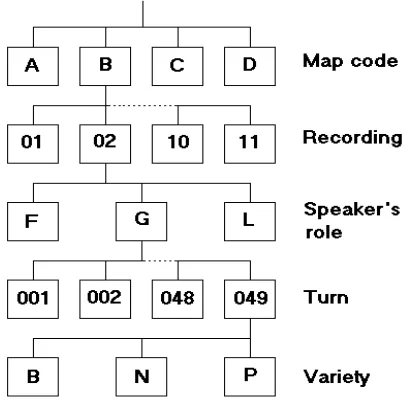
deal with such a data organisation. Also for these reasons, it has been decided to adopt multi-file data organisation, very similar to SAM files structure (Gibbon et al., 1998). All file names are automatically constructed by the system, according to a hierarchical scheme, that is represented in Fig.3. The first level recalls the specific map used in eliciting the dialogue (four different maps have been used so far); the second level numbers the recording session (since several sessions may be performed using the same map); the third level specifies the speaker’s role (either instruction Giver or instruction Follower in a Map Task session, whereas L stands for reading sessions); the forth level numbers the speech turn, while the fifth codes the Italian regional variety (Bari, Naples, and Pisa).
A mapping file provides the correspondence between the coded file names and a more mnemonic file names convention.
Figure 3: Hierarchical file names coding
Information related to annotation tiers are recorded in separeted files of type .WRD, .PHM, .PHB, .PHN, .TON, .AUT. Additional files, managed by the system but not directly related to the annotation tiers, contain some extra information, like orthographic transcription of each turn, atemporal data related to each recording session (header file), temporal information about beginning-end of each turn within the entire dialogue, etc.
'DWDEDVHPDQDJHPHQWVXSSRUW
turn. A supporting tool, which runs offline but in the same environment of SegWin, is also available. Such tool allows reconstructing the correct checksum value, in case of emergency.
A set of other software tools provides additional off-line capabilities for cross checking and spotting any possible inconsistency among the files belonging to the same speech turn. Some of them run interactively, that is, once a possible discrepancy is detected, the system asks a human operator to confirm the needed modification to the related files. Just for an example, a specific tool checks the consistency of the automatically derived citation-form phonemic transcription with the one actually inserted in the PHM tier. As a matter of fact, the operator might have modified some of the labels in this tier, with respect to the automatically converted version. In case of mismatch, the tool asks for a confirmation and records this occurrence. Even though such a procedure may be extremely time-consuming, and cannot ensure a perfect uniformity since different operators may make different choices, it is useful for spotting also the cases in which the grapheme-to-phoneme conversion routines need to be improved.
6XPPDU\
The software system SegWin has been designed and developed by Politecnico di Bari for segmenting, annotating and controlling the construction of a database of Italian regional accent variations, starting from the specific needs of such an effort. It runs on PC Windows environment and has been extensively used within the ongoing national project AVIP for building a semi-spontaneous dialogue-based database of Bari, Naples and Pisa varieties of Italian. Since the system is continuously updated to satisfy the evolving requirements of the project partners, at the moment it cannot be considered available outside the project. As soon as such requirements will be completely satisfied, and the system considered stable, we hope to be able to make it available to a larger community.
5HIHUHQFHV
Anderson A.H., M.Bader, E.G.Bard, E. Boyle, G. Doherty, S.Garrod, S.Isard, J.Kowtko, J.McAllister, J. Miller, C. Sotillo, H. Thompson and R.Weinert (1991).
The HCRC Map Task Corpus. Language and Speech, 34 (4), 351--366.
Barras C., E. Geoffrois, Z. Wu & M. Liberman (1998). Transcriber : a free tool for segmenting, labeling and trascribing speech. Proc. LREC (pp.1373--1376). Granada : ELRA.
Barry W.J. & A.J. Fourcin (1992). Levels of labelling. Computer Speech and Language, 6,1--14.
Beckman M.& G. Ayers (1993). Guidelines for ToBI Labelling. Ohio State University.
Burger S. & F. Schiel (1998). RVG1 – A database for Regional Variants of Contemporary German. Proc. LREC pp 1083—1087. Granada: ELRA.
De Mauro, T. (1963). Storia linguistica dell’Italia unita, Bari: Laterza.
Fourcin A. (1993). The SAM project. Chichester: Ellis Horwood.
Gibbon D., R. Moore, R. Winski (1998). Handbook of Standards and Resources for Spoken Language Systems. Berlin: Mouton de Gruyter.
Grice, M. & M. Savino, (1995 Intonation and communicative function in a regional variety of Italian. Phonus, 1, 19--32.
Grice M. & M. Savino (1995a). Low tone vs ‘sag’ in Bari Italian intonation; a perceptual experiment. Proc. ICPhS 95 (pp 658-661). Stockholm:ESCA.
Hirst D. & A. Di Cristo (1998). A survay of intonation systems. In D. Hirst & A. Di Cristo (Eds.). Intonation systems (pp. 1-44). Cambridge: Cambridge Un. Press. Kohler K., A. Paetzold, A. Simpson (1995). From
scenario to segment. The controlled elicitation, transcription, segmentation and labelling of spontaneous speech. AIPUK, 29.
Ladd R.D. (1996). Intonational phonology. Cambridge: Cambridge University Press.
Refice, M. M. Savino, M. Grice (1997). A contribution to the estimation of naturalness in the intonation of Italian spontaneous speech. in Proc. EUROSPEECH 97 (pp.783-786). Rhodes: ESCA.