ABSTRACT
GRANDINETTI, JUSTIN JOSEPH. Streaming Locality: Mobile Streaming and the Production of Space and Subjectivity (Under the direction of Dr. Adriana de Souza e Silva).
This dissertation is a study of how streaming media through mobile devices in an
expanding variety of spaces is part of changing relations of how the individual senses, perceives,
and moves through space. Specifically, this dissertation examines the importance of mobile
device use, geography, and location to new mobile streaming practices. I employ a mixture of
media archaeology and genealogy with a Deleuzian spatial materialism in order to examine the
historical antecedents of contemporary mobile streaming. In doing so, I trace the continuities and
disruptions of a mobile and portable capture of a desire for entertainment and a valorization of
both time and spaces through the examples of the magic lantern, drive-in cinema, and portable
television. These technologies show alternative material and discursive imaginings of a
ubiquitous mobile entertainment that have begun to be realized by mobile streaming through the
elements of hybridity and data collection. Moreover, I examine contemporary examples of
mobile streaming as part of a construction of space and subjectivity.
Expanding upon Raymond Williams’s concept of mobile privatization, I position
contemporary mobile streaming media as a form of mobile personalization, a mobile way of life
in which streaming technologies, digitization, data collection, and algorithmic recommendations
are part of a transformation of location into personalized spaces of desire. Consequently,
Streaming Locality works to reshape theories about the formation of the subject and how the
individual is interpellated into spatial expectations through the myriad of contemporary mobile
© Copyright 2019 by Justin Grandinetti
Streaming Locality: Mobile Streaming and the Production of Space and Subjectivity
by
Justin Joseph Grandinetti
A dissertation submitted to the Graduate Faculty of North Carolina State University
in partial fulfillment of the requirements for the degree of
Doctor of Philosophy
Communication, Rhetoric & Digital Media
Raleigh, North Carolina
2019
APPROVED BY:
Adriana de Souza e Silva Andrew Johnston
Committee Chair
ii DEDICATION
I dedicate this dissertation to all the people who helped make this journey possible. To
Adriana, who has been nothing but an amazing dissertation chair and mentor to me throughout
this program. To Andrew, who has been a positive influence since my first week of class at NC
State. To Steve, who led me through the toughest class I’ve ever taken and who always provides
thoughtful challenges and positive support. To Chris, who is always there to help me navigate
the challenges of getting at PhD.
I’d also like to thank my close family members in my mom Patricia, my brother Brian,
and my sister-in-law Jill for their unwavering love and support. For my cats Pumpkin and
Crumpet for being the best emotional support animals. And finally, to Melissa for being a light in
iii BIOGRAPHY
Justin Grandinetti is a fourth-year Ph.D. student in North Carolina State University's
Communication, Rhetoric, and Digital Media program. He graduated from James Madison
University in 2015 with his M.A. in Writing, Rhetoric, and Technical Communication.
Justin is a critical media studies scholar interested in mobile media. His research interests
include mobilities, streaming media, new communication technologies, spatial materialism,
digital media studies, media archaeology, popular culture, film, and television. Justin’s work has
appeared in Information, Communication & Society, Critical Studies in Media Communication,
iv TABLE OF CONTENTS
LIST OF FIGURES ... vi
INTRODUCTION ... 1
From Streaming to Mobile Streaming ... 1
Methodology ... 10
Chapter overview ... 15
CHAPTER ONE ... 19
Defining Streaming ... 19
Defining streaming ... 22
Industry shifts ... 28
Liveness and sharedness... 32
Mobility, and Hybridity... 38
Mobile data collection ... 45
Conclusion ... 53
CHAPTER TWO ... 56
The Cinematic Antecedents of Mobile Streaming ... 56
Cinema’s fixed origins ... 61
Cinema and the reconstruction of macro-scale urban spaces ... 67
Cinema’s mobile origins ... 70
The drive-in theater and the reconfiguration of rural spaces. ... 71
The magic lantern and the reconstruction of micro-institutional spaces. ... 75
Conclusion ... 84
CHAPTER THREE ... 87
The Televisual Antecedents of Mobile Streaming... 87
The spaces of the televisual ... 90
Portable television ... 94
Second screens and contemporary mobile engagement ... 104
Streaming hybrid spaces... 106
Location data collection and the hybridization of spaces ... 110
Streaming location-based advertisements ... 118
Conclusion: Toward a spatial and mobile conception of audio-visual media... 122
v
Mobile streaming, subjectivity, and the capture of desire in the late capitalist socius ... 125
The neoliberal socius ... 130
The contemporary process of subjectivation ... 135
Mobile streaming and molecular subjectivation ... 139
Mobile steaming and molar subjectivation ... 145
The implications of mobile streaming subjectivity ... 152
Conclusion: More streaming, more mobile ... 157
CHAPTER FIVE ... 160
Mobile monetization, gamification, control, and affirmative potential ... 160
HQ and mobile streaming monetization... 164
Liveness, sharedness, and plasticity ... 171
Gamification as control versus affirmative potentiality ... 182
Conclusion ... 192
CONCLUSION ... 195
vi LIST OF FIGURES
Figure 0.1 Global streaming media use. Molla, 2017 ... ..3
Figure 1.1 Netflix Hosting Timeline. Richman, 2018 ... 27
Figure 1.2 Google Server Farm. Vaughan, 2015 ...46
Figure 2.1 The kinetoscope. The American Society of Cinematographers, 2019 ...62
Figure 2.2 Kinetoscope parlor. Musser, 1991 ...63
Figure 2.3 Spending at the box office 1929-2002. Orbach & Einay, 2007 ...66
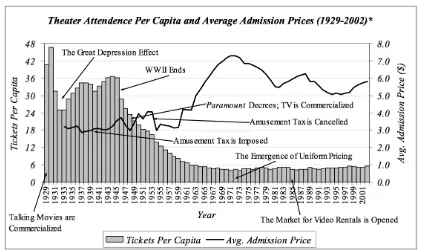
Figure 2.4 Theater attendance per capita and average admission prices 1929-2002. ...67
Figure 2.5 Liberal governance and the city. Hay, 2012 ...69
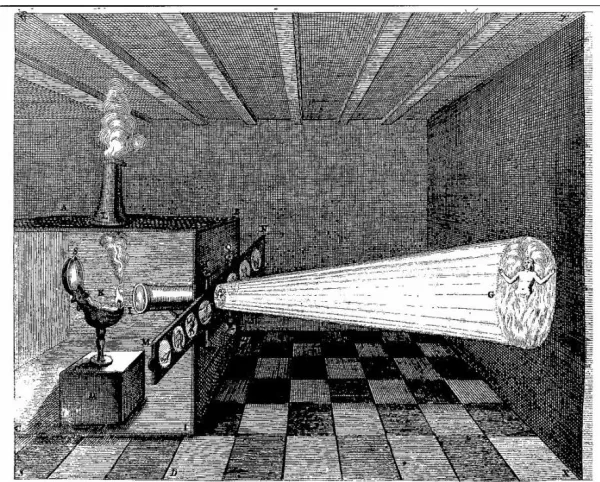
Figure 2.6 The Magic Lantern, Stanford, n.d ...76
Figure 2.7 The 19th Century Magic Lantern, Johnson The Museum of London, n.d ...77
Figure 3.1 Televisual periodizations. Jenner, 2014 ...90
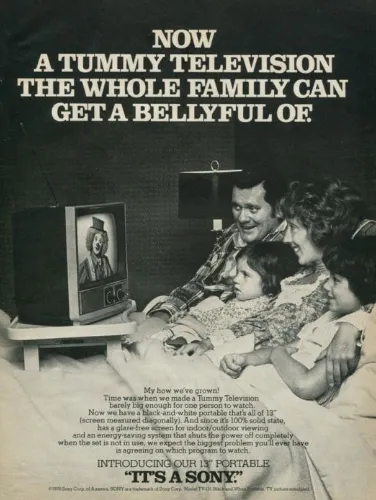
Figure 3.2 Sony Model TV-131 Portable TV Tummy Television (1977) ...96
Figure 3.3 General Electric’s Portable Televisions (1956). Vintage Ad Browser, n.d ...97
Figure 3.4 Sony Portable TV Advert (1960). Retrocards, n.d ...98
Figure 3.5 Be a two TV family (1968). AWA, n.d ...98
Figure 3.6 Hold the future in your hand with SONY (1962). Design-Is-Fine, n.d. ...100
Figure 3.7 SONY Now Offers a Choice in Personal Television (1964) ...100
Figure 3.8 20th-century diffusion of technologies in the U.S. Norris, Pippa, 2001 ...101
Figure 3.9 Airport charging station (2018). Express Observer, 2018 ...108
Figure 3.10 Mobile device use in Cuba around wi-fi hotspot. Grandinetti, 2017 ...109
Figure 3.11 Mobile Location Data Collection Internet Society ...115
Figure 3.12 Who knows where you are? Internet Society. Global Internet Report, 2015 ...116
Figure 4.1 Tech Addiction By the Numbers: How Much Time We Spend Online ...128
Figure 4.2 The dual process of subjectivation. Lazzarato, 2014 ...139
Figure 5.1 Nike Air Max 270 “HQ Trivia” edition. Nike, 2019 ...168
vii
Figure 5.3 HQ Peak Players. Alcantara, C., 2018 ...174
Figure 5.4 Those Who Opposed the War. Blast Theory, 2015 ...178
Figure 5.5 Archival documents. Blast Theory, 2015 ...178
Figure 5.6 Bloodyminded livestreamed to Facebook. Blast Theory, 2019 ...179
Figure 5.7 Bloodyminded Viewer Interaction. Blast Theory, 2019 ...180
1
INTRODUCTION
From Streaming to Mobile Streaming
The 2016 expansion in Netflix’s global availability—70 million subscribers in over 190
countries—was heralded by the company as the birth of a new global internet television network
(Netflix Media Center, 2016). The unprecedented popularity of Netflix is exemplary of the
recent evolution in streaming entertainment. Netflix is just one of many major streaming
providers available in the United States, as the streaming subscription giant has been joined by
Amazon Prime Instant Video, Hulu, HBO Now, and Sling TV. The success of these major
providers has also led to the growth of niche streaming services that offer viewers access to
international content or genre-specific entertainment. Moreover, data indicates a growing number
of Americans choose streaming services in lieu of cable television. This shift is occurring across
all demographics, but is especially popular among younger individuals (Luckerson, 2014;
Nelson, 2013; Paul, 2015). Due to massive domestic success coupled with the search for an
ever-expanding customer base, Netflix and Amazon have become heralds of international expansion.
Streaming media created a host of questions for media scholars. This includes addressing
issues of time in regard to streaming—whether it is changing notions of media liveness, shared
experience, and even the plastic and flexible nature of new viewing patterns (Bury & Li, 2013;
Irani, Jefferies, & Knight, 2010; Turner, 2011; Couldry, 2004). In addition, the practices of data
collection and algorithmic suggestion via streaming platforms have received substantial scholarly
attention (Hallihan & Striphas, 2014; Smith & Telang, 2016; Nelson, 2014; Vonderau, 2014;
Evans and McDonald, 2014). Other examinations of streaming include new viewing practices,
industry shifts, and the importance of streaming metaphors to public understanding of the
2 together, it is clear that streaming media is part of a substantial shift in how individuals engage
with content. Nevertheless, recent changes in how individuals engage with streaming in mobile
and portable practices necessitates attention to what it means “to stream.”
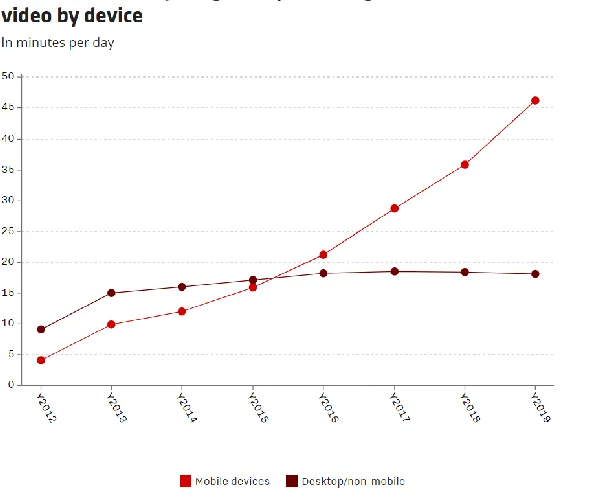
Growth by Netflix and other streaming providers in recent years has been largely driven
by new mobile viewing practices. For example, Netflix continually ranks among the top revenue
earners in Google and Apple app stores by US revenue, as subscriptions purchased through
Netflix’s app on a smartphone or tablet are tallied toward this total (Molla, 2017). In addition to
this mobile monetary gain, American mobile Netflix streaming increased 73% since 2014, and
there are an estimated 70 million monthly active mobile Netflix users in the US alone (Molla,
2017). The 7.47 billion minutes of Netflix watched via smartphone is not merely a US
phenomenon, as mobile use in Europe, Asia, and Latin America has also increased exponentially
in just a few years (Molla, 2017). Consequently, as mobile streaming becomes a normative
practice, it is critical for streaming providers wishing to expand their subscriber base to embrace
3
. Figure 0.1: Global streaming media use. Molla, 2017.
A common theme of streaming scholarship is that streaming media is part of massive
ongoing shifts in the way individuals engage with streaming content. It is surprising, however,
that the increasingly mobile nature of streaming is largely unexplored in scholarship, as various
surveys continually point to new mobile streaming practices. For example, recent surveys show
that all U.S. demographic groups (and particularly younger demographics) are increasingly likely
to engage in video streaming from a smartphone or tablet (Lella, 2014; Siedman, 2017).
Moreover, “the number of people watching video on a smartphone has increased 136 percent in
the U.S. since 2012” (Seidman, 2017). These shifts are echoed in other analysis, including the
plummeting traditional TV habits of younger demographics (Marketing Charts, 2017) and the
increase in streaming news sources in lieu of reading articles (Rainie, 2017). These changing
mobile viewing practices are also accompanied by new ways for users to create and share their
own streaming content through social media sites like Twitter, Facebook, Snapchat, YouTube,
4 mobile devices; users watch 10 million videos on Snapchat per day; and Periscope users created
over 200 million live broadcasts (110 years of content watched live every day) in the first year
(Lister, 2017; Periscope, 2016). Collectively, this data makes clear that streaming media is
continually changing, and that mobile devices are an essential part of these new practices.
This data is meant to provide a contextualization to these mobile practices; however, it is
important not to assume that all mobile practices are the same. First, this type of quantifiable data
has limitations when attempting to account for the imaginings, materiality, and experience of
mobile streaming media. Additionally, this examination of mobile streaming will often focus on
more financially affluent Western spaces due to the more stable infrastructures, disposable
incomes, and device ownership expectations. This is not to claim that these Western spaces
represent the contemporary mobile streaming practices, but instead some of the ways that mobile
streaming has begun to take form. This vanguard of mobile streaming allows consideration of the
various experiments and relations rapidly taking shape in the Western world, but it will be
critical to consider the various localized relations as infrastructures, devices, ,expectations, and
the political and regulatory control of content shift in various places around the world. To this
end, these Western practices do not represent the entire world and should not be taken as the only
story of mobile streaming. The economically affluent individual engaging in streaming media
practices using an expensive mobile device within spaces of constant high-speed connectivity is
a minority in the context of the global population. At the same time, these rapid developments
are important to consider as mobile streaming begins to take hold as a dominant practice.
Of course, along with these quantitative increases in mobile streaming come new framings of
streaming media. Streaming has long been positioned as part of film and televisual history. In
5 such as AT&T’s 2017 commercial titled “Ringing” often define streaming and mobile streaming
as television. A similar connection is often made between streaming and the cinematic. For
example, Netflix and other major streaming providers have begun to release original films,
including the recent best picture nominee Roma. Certainly, these cinematic and televisual
antecedents have a connection to contemporary audio-visual streaming. At the same time, there
exists a disconnect between the increasingly mobile practices of streaming media and the largely
fixed historical arrangements of film and television.
It should be noted that scholars have attempted to resolve the dilemma of how contemporary
streaming media fits into a lineage of television and/or cinema. In a general sense, Manovich
(2001) elucidates five characteristics of what has been termed new media, which include 1.
numerical representation (the importance of digital code in composing new media objects), 2.
modularity (the fractal structure that allows for various media to be assembled together in
different forms), 3. automation (here specifically the removal of human internationality from the
creative process), 4. variability (the ability for new media objects to exist in different and
potentially infinite versions), 5. transcoding (the importance of a computerization of data) (pp.
27-48). As “streaming media” can refer to an array of web-based practices in which audio and
visual content is accessed without a full and permanent download, the flexible nature of
Manovich’s (2001) definitions can assist in characterizing some features that unite contemporary
streaming. However, Manovich’s taxonomy was theorized during an early phase of the
commercial web, and new developments call into question the comprehensive nature of such
definitions. Furthermore, while Manovich is interested in the question of what is new media from
the perspective of software, Galloway (2011) points out that others have focused instead of
6
further by Galloway (2011), “In Manovich a medium is never a dispositif…Manovich would
rather make the argument that new media are first and foremost aesthetic objects (p. 382).
Critiques aside, streaming media does involve such characteristics of digitization of content,
automation of recommendations, and variability of form. At the same time, it is precisely a focus
on the arrangements and compositions of streaming—and in particular the mobile and portable
forms of streaming—that requires attention. One such strategy comes via Jenner’s (2014)
analysis of streaming in relation to televisual history. Jenner (2014) ultimately argues that
streaming might better be conceived of as a matrix media, “where viewing patterns, branding
strategies, industrial structures, the way different media forms interact with each other or the
various ways content is made available shift completely away from the television set” (p. 260).
Even more recent work by Burroughs (2019) places streaming in a cultural lineage that includes
radio, video, and internet broadcasting. Burroughs (2019) argues that streaming, much like other
technological forms, never truly reach equilibrium, but are always unsettled (p. 2). To this end,
streaming is part of cultural meanings and practices that reflect control of media and media
industries (Burroughs, 2019, p. 13). Similarly, Packer and Oswald (2012) “suggest that digital
screens need to be understood outside the conventions of media specificity; that is, we should no
longer treat film, television, the computer, and telephones as separate entities” (p. 277). Here,
Packer and Oswald build on Raymond Williams’ (1974) concept of televisual flow—how the
sequence of program content and commercials create the real and unbroken experience of
watching television as seamless broadcast (p. 87). When engaging with mobile devices in a
contemporary web connected landscape, flow instead functions as a capture of desire through
advertising by creating new forms of spatial and temporal consumption practices for users
7 are part of new patterns of behavior, as subjects are made responsible for managing flow (Packer
& Oswald, 2012, p. 284). As such, it is critical to examine mobile practices as extensions of
control expanded beyond the traditional televisual confines into new spaces. Ultimately, Jenner,
and Packer and Oswald make clear that audio-visual streaming, while a new process of content
engagement for the user, has historical antecedents in prior mass media forms.1
While Packer and Oswald (2012) offer an excellent starting point to reconsidering mobile
screens, an in-depth investigation of mobile streaming must consider the aspects of hybridity of
space, location-awareness and mobile data collection. Before proceeding, it is critical to take a
moment to examine terms such as mobility and portability. These terms are often used
interchangeably in a colloquial sense to denote the movable nature of a technology. The
delineation of “portable” has certainly been used earlier than “mobile”—for example, the
portable television (as will be discussed in detail in chapter three) has conceptual roots in the
1950s, while the portable telephone was debuted by Motorola in 1973 for public use by 1976
(Motorola Inc, 1973). In the absence of a clear scholarly demarcation, it is possible to use this
historical starting point as a place to examine the related but slightly different aspects of mobility
and portability. To this end, portable can be conceived of as the ability to take technology from
various spaces. For example, the portable phone and portable television were far more limited,
clumsy, and tethered to power sources and limited infrastructures comparted to the current
1 I wanted to take a moment in this introduction to make clear that streaming has connections
8 mobile counterparts. Perhaps, then, portability and mobility can be conceived as discursive
demarcations that have evolved over time to differentiate eras of devices. Mobility, by contrast,
is not only more contemporary (smartphones are certainly considered mobile but rarely if ever
referred to as “portable”) but also more neatly defined in a scholarly sense as well. Chapter two
takes up the mobilities turn for scholarship, in which mobility is defined through the aspects of
“the starting point, speed, rhythm, routing, experience, and friction” as well as “the fact of
physical movement…the representations of movement that give it shared meaning; and, finally,
the experienced and embodied practice of movement” (Cresswell, 2009, p. 26; p. 19). Such
attention to mobility and mobile sociotechnical practices allows the ability counter a
media-centric conceptualization of the social to instead “rethink the production of social space in light
of the recent mobilities turn, to rethink the role of communication in the production of social
space, and to rethink the place of media and messages within a broader understanding of
communication” (Wiley & Packer, 2010, p. 265). The importance of the spatial and mobility
turns to the study of communication technologies will be taken up in further detail in chapters
one, two, and three, but what remains important for the moment is that portable and mobile can
be conceived of as interrelated concepts that refer to movable nature of a technology, with
portable commonly used as an antecedent to more contemporary mobile device forms.
In theorizing the relationship between location-aware mobile devices, use practices, and
physical location, Gordon and de Souza e Silva (2010) explain the concept of net locality, “a
cultural approach to the web of information as intimately aligned with the perceptual realities of
everyday life. We don’t enter or leave the web anymore; it is all around us” (p. 3). Net locality
offers an understanding of the web in relation to the local to consider how devices and mobile
9
this dissertation Streaming Locality as an acknowledgement to the work of Net Locality, in that I
examine the importance of location, geography, and device type to streaming media practices.
Taken together, this project builds upon existing approaches that highlight the importance of the
local and location-awareness (Gordon & de Souza e Silva, 2011), the production of global and
local space (Massey 2004; Massey, 2005), data collection and mobile privatization (Sloop &
Gunn, 2012; Andrejevic & Lee, 2014; Andrejevic, 2007), the assemblage of social space (Wiley,
Sutko, & Becerra, 2012), and spatial materialist scholarship on the televisual (Packer & Oswald,
2010; Packer & Oswald, 2012; Hay, 2001; McCarthy, 2001; Vonderau, 2014; Verstraete, 2016).
In doing so, I call for more attention to the understudied aspects of location-awareness and
geography to scholarship on streaming media.
This aforementioned contextualization of mobile streaming leads to a number of new
questions worthy of scholarly investigation. What is clear is that streaming practices in Western
spaces are increasingly mobile, and that there exist both scholarly and colloquial proclivities to
position streaming as part of cinematic and televisual lineages. Furthermore, with mobile
streaming practices come the elements of new user responsibilities and forms of flow, relations
to hybrid space—the elide of the “physical and the digital in a social environment created by the
mobility of users connected via mobile technology devices” (de Souza e Silva, 2006, p. 263)—
through pervasive web connectivity, and forms of monetization and making the user productive
through data collection that includes location, geography, and device data. To this end, I seek to
answer the following questions:
How does mobile streaming remediate prior understandings of liveness, sharedness, and
10
How does mobile streaming include the new attributes of hybridity and mobile data
collection to streaming practices?
What are the cinematic and televisual continuities and disruptions of mobile streaming?
How is mobile streaming an active agent in contemporary production of space, mobility
practices, and production of subjectivity in the neoliberal capitalist socius?
How do mobile streaming experiments engage with new forms of monetization and
control?
What is the affirmative potential of mobile streaming media?
Consequently, this dissertation is a study of how streaming media through mobile devices in
an expanding variety of spaces is part of changing relations of how the individual senses,
perceives, and moves through space.
Methodology
To accomplish this analysis, I employ a mixture of media archaeology and genealogy
with a Deleuzian spatial materialism in order to examine both the present streaming landscape
and the historical antecedents of contemporary mobile streaming. Expanding upon Raymond
Williams’s (1974) concept of mobile privatization, I position contemporary mobile streaming
media as a form of mobile personalization, a mobile way of life in which streaming technologies,
digitization, data collection, and algorithmic recommendations are part of the transformation of
location into personalized spaces of desire. Consequently, Streaming Locality works to reshape
theories about the formation of the subject and how the individual is interpellated into spatial
11 Media archaeological approaches disrupt canonized narratives of media history to give
greater attention to the way media’s materiality and relation to cultural forms shapes power
relations in a given cultural field (Huhtamo & Parikka, 2011). Moreover, media archeology helps
demonstrate the way media is constitutive of how individuals sense and perceive the world. In
media studies, the approach of problematization can show the archaeological—“the specific
affordances and constraints of a technical media apparatus’ functions of capture, processing,
storage, and transmission” and genealogical—the “clashes of power that resulted as multiple
technologies were (counter)posed as potential solutions within a problematic field, and thus trace
the emergence of a stabilized (socio)technical apparatus” (Monea & Packer, 2016, pp.
3145-3146). Media technologies are more than materiality, they are a method of addressing problems
systematically—disciplining, signal processing, etc. Technical media arise out of distributed
discursive networks (bodies of knowledge, objects, techniques), but then crystalize, cut their
roots, become mobile, intermix, recombine, etc. (p. 3147). In other words, from a media
archaeological perspective, it is critical to examine how mobile streaming is part of a field of
social and cultural formations, as well as how mobile streaming can be understood as part of
continuities and discontinuities with both the fixed and mobile imaginings of the televisual.
Media genealogy adds to this inquiry attention to the materiality of these technologies, as well as
how they are part of a reassembling of spatial relations. This is the fusion of archaeology and
genealogy methods.
Media archaeology is a key aspect of my methodological approach, as this approach
makes it possible to tell a new story of streaming media—one that accounts for the importance of
location, geography, and mobility. This examination requires taking seriously the mobile and
12 indebted to legacies of these audio-visual media forms, new regimes of data collection, storage,
and processing are a notable departure from older “one to many” mass media transmission
models. Moreover, among the data being collected is device type and location data. Device type
is important to media archaeology, as the approach takes seriously the materiality of media.
Geography and location data are also critical, not only because these elements are part of new
infrastructural arrangements, but also the new patterns streaming practices in new spaces.. As the
relatively new streaming providers, established television broadcast corporations, production
studios, app designers, and social media platforms provide countless new models in a
competitive and unsettled streaming landscape, any analysis of contemporary streaming media
must account for the importance of location and geography, and media archaeology is a way to
account for these elements.
Of course, the way that mobile streaming media is part of productive arrangement and
rearrangement of space is also critical to this dissertation. Massey (2005) defines spaces as the
product of interrelations, as sphere of possibility and heterogeneous multiplicity, and as always
under construction (p. 9). Both Massey (2004) and Wiley (2005) reject modernist dualisms that
position space as global and abstract and place with the local and concrete. This
conceptualization of space is bolstered by de Souza e Silva’s (2006) aforementioned hybrid
spaces, which account for the imbrication between the physical and digital, as well as local and
global connectivity and forces. Aligned with these goals, a Deleuzian spatial materialism allows
focus on the way that communication technologies are part of the ongoing production of social
space and subjectivity (Wiley, 2005). Spatial materialism is a political project that identifies and
intervenes in power relations by considering the way media is part of the ongoing production of
13 specifically, spatial materialism is a useful theoretical framework for studying how mobile
streaming media is part of new relation to space and the formation of the subject. Previous
investigations of the televisual largely examine the media as fixed; however, mobile screens and
the proliferation of wireless connectivity is part of the creation of new spaces of individualized
viewing.
A Deleuzian spatial materialism emphasizes the importance of mobile technologies,
practices, platforms, and infrastructures in reconstructing space and mobility. Studying social
structures requires attention to media forms, and mobile streaming is increasingly becoming a
dominant practice in Western and, more slowly, global spaces. Media practices, moreover, are
also part of regimes of control; in this regard, mobile streaming is critical to the processes of
contemporary subjectivation. Such a Deleuzian spatial materialist approach offers a toolkit to
identifying the construction of space and subjectivity as ongoing assemblage of affective
relations. Though it takes many forms, mobile streaming is, more often than not, part of a
capitalist valorization of leisure time and space. Critical here is that the local is not erased, but
made salient through mobile devices, infrastructures, streaming practices, location-aware
technologies, and data collection.
Finally,this project is inspired by Mackenzie’s (2010) examination of wirelessness.
Mackenzie (2010) takes a pragmatist approach in making sense of the “banal plasticity and
abundant unfolding of wireless networks”, which operate at the periphery of countless
contemporary practices (p. 13). Here, Mackenzie (2010) focuses on the changes taking place and
the immersive nature of experience in studying conjunctive relations and the trancontextual
situation of wirelessness itself (pp. 15-21). Following Mackenzie, I draw upon a mixture of
14 and evolution, experiences with mobile streaming, the affordances of the technics of mobile
devices, as well as their accompanying infrastructures. Critical to the analysis of mobile
streaming is how to access the concepts of habit and affect. This requires positioning how habit
is tied to a geopolitics of data flow, and how habits are created in different situations. Here, the
question of how content is constructed via channels on sites such as YouTube matters—
particularly the monetization strategies employed by streaming providers, and how spatial and
geographic data matters to the way certain content is promoted to users. These changes over time
allow analysis of how the channels on streaming providers begin to construct themselves, as well
as what type of experience the platform allows.
Spatial materialism focuses on the fact that matter matters—mobile streaming devices
and infrastructure are part of the way that power is exercised through movements to and from
sites, and how the subject is implicated in these relations. I to utilize both media archaeology and
spatial materialism as part of telling a new story of streaming media that emphasizes increasingly
mobile devices and practices in the ongoing production of contemporary space and the subject.
Essentially, increasingly mobile ways of streaming media mean that location and geography are
more important than ever to streaming media practices. To answer these questions, I analyze
mobile streaming from three complimentary perspectives:
Mobile streaming practices and the importance of location-awareness, accounting for the
remediation of liveness, sharedness, and temporal plasticity that is joined by elements of
hybridity of space and new forms of data collection.
Mobile streaming not merely as a linear evolution from fixed streaming, televisual,
and/or cinematic histories. Instead, emphasizing the historical continuities and
15
Mobile streaming technologies and practices as part of the production of space and the
subject. This includes the potential of new forms of monetization and control, but also
affirmative and critical potentiality.
Chapter overview
Chapter one, From Streaming to Mobile Streaming, contextualizes and defines streaming media.
This includes defining streaming and locating contemporary streaming practices within a short
historical context that includes industry shifts. The chapter also examines the attributes of
“classic” forms of streaming, which include liveness, sharedness, and temporarily plasticity.
Additionally, the chapter emphasizes the new mobile elements that include hybridity of space
and mobile data collection. Of course, contemporary mobile streaming practices did not suddenly
appear in recent years. The historical connections between streaming and aspects of the
televisual and cinematic are taken up further in chapters two and three.
The second chapter, The Cinematic Antecedents to Mobile Streaming, presents a spatial
materialist media archaeological examination of the precedents of mobile streaming by
examining the connection among cinema, urban space, liberal control, and mobility. Streaming
media itself is often situated within a lineage of cinema, and this chapter takes seriously some of
the mobile film antecedents of mobile streaming. Beginning with the kinetoscope and early
optical technologies, I specifically highlight the drive-in movie theater and the magic lantern as
parts of a mobile and portable audio-visual lineage. This historical examination of mobile cinema
experiments demonstrates the industrial capitalist ideals of a valorization of leisure time and
space via an expanding capture of desire. Moreover, the chapter notes the way that mobile and
fixed forms of cinema are commonly positioned as a dialectic that confers legitimacy on the
16 construction of and movement through space is expanded upon in chapter three with the
relevance of the televisual to mobile streaming.
Chapter three, The Televisual Antecedents to Mobile Streaming, examines the shift
toward mobile streaming as part of the construction of, movement through, and relation to space
for the subject. I begin the chapter with contextualization of the relation between the televisual
and space before examining the portable television as a historical attempt to capture desire for
televisual engagement in a variety of non-domestic spaces. By examining the technology of the
portable television, I argue that there has long been the desire for a mobile form of televisual
engagement. As such, the discursive imaginings of what mobile audio-visual media could
accomplish, along with the materiality of these experiments positions them as part of a complex
history of which mobile streaming is a part. By following a spatial materialist media
archaeology/genealogy, it is possible to view the historical antecedents of mobile personalization
as a longstanding attempt at a capitalist valorization of time and space, as well as the ubiquitous
capture of desire via a personalized relationship to mobile streaming media. I then provide a brief
overview of the relevance of the spatial and mobilities turn, as well as hybrid space to mobile
streaming media Finally, the chapter ends with contemporary forms of streaming that utilize
location-aware geographic information. Here, I explain the way that streaming from
smartphones, laptops, and tablets alters existing definitions of the televisual as fixed.
Specifically, I consider the mobile and spatial dimensions of televisual technologies in relation to
streaming media, highlighting the ways that audio-visual media has long been part of a
structuring of space and mobility. The construction of space and movement through space are
17 Chapter four, Mobile streaming, subjectivity, and the capture of desire in the late
capitalist socius, engages with contemporary mobile streaming and how mobile streaming is part
of the production of capitalist subjectivity. Through the work of Deleuze, Guattari, Wiley,
Lazzarato, Berlant, and others, I briefly define and outline the production of subjectivity from a
Deleuzian philosophical perspective. Mobile streaming media is a form of ubiquitous immaterial
labor—a labor form that can, and commonly is, accomplished by “filling the cracks” of
non-work time with content engagement and accompanying data collection. This relationship
conforms to theories of a capitalist valorization of time, in which leisure and play time is made
into a productive form of labor. Nevertheless, even decades after the spatial turn, there remains
substantial scholarly attention on the time of such capitalist extension and far less focus on the
spatial dimensions of these behavioral expectations. This examination of mobile streaming in
relation to subjectivity attempts to answer how mobile streaming technologies and practices part
of arrangements of social relations that produce, maintain, and manage the subject. To this end,
this chapter focuses on the spatial and geographic dimension of the production of subjectivity
through the increasingly quotidian practices of mobile streaming media. Mobile streaming and a
personalized relation to space, consequently, is an important practice in that it represents an
efficient form of the machinic capture of desire, but also in that mobile streaming is part of
regimes of control in the connected spaces of late-capitalism.
The final chapter, Mobile monetization, gamification, control, and affirmative potential,
of this dissertation focuses on two in-depth examples of mobile-specific streaming. The first,
HQ, is a mobile streaming trivia gameshow app released in 2017 by the founders of Vine. HQ is
a novel participatory form of mobile streaming that represents an affective capture and
18 to streaming, as individuals are required to “tune in” at certain times during the day to
participate. By contrast, I will also examine three mobile streaming projects by the UK-based
interactive performance art group, Blast Theory. The projects Bloodyminded, I’d Hide You, and
My One Demand offer alternatives to far more common monetary-focused streaming
applications and services and allows example of the potentiality of mobile streaming. Through a
comparative analysis of these novel forms of mobile streaming, I assess how HQ Trivia
functions as an affective capture of desire that is channeled into new monetization practices
while the projects by Blast Theory demonstrate the affirmative possibilities of mobile streaming
through a critical engagement with space. In doing so, I examine the novel monetization
strategies of HQ and how both HQ and the Blast Theory projects reengage with elements of
liveness, sharedness, and plasticity. Finally, I position HQ Trivia and Blast Theory’s projects as
part of strategies of gamification that foster regimes of control versus an affirmative potentiality
19
CHAPTER ONE Defining Streaming
In 2016, the social media platform Instagram introduced Instagram Stories, a feature that
allows users to share photos and videos in slideshow format. In contrast to the other content
posted to Instagram, stories create a sequence that users can add to over the course of a day by
using text and drawing tools to create overlap. Moreover, there is an inherent ephemerality to
Instagram stories, as this content “disappears”2 after 24 hours, no longer accessible to other
platform users (Instagram, 2016). Instagram’s story feature is not necessarily a wholly original
concept—social media platforms such as Vine (a short-form video platform popular from
2012-2016) and Snapchat (a social media platform created in 2011 that allows users to share story-type
content that similarly vanishes after a single viewing) provided the model for Instagram to
appropriate in its own platform. At the same, what is relevant about Instagram’s co-option of the
story feature is the platform’s reach and popularity. As of 2018, Instagram ranks below only
Facebook, YouTube, What’s App, and We Chat globally in terms of monthly active users
(Kallas, 2018; Statista, 2018). Additionally, the rise in Instagram Stories popularity seems to
coincide with users leaving Snapchat (Salinas, 2018). Facebook’s 2012 billion-dollar acquisition
of Instagram is part of this platform recentralization as well, in that users are able to cross-share
their stories to both social media sites.
Instagram Stories are not “streaming media” in the colloquial sense, in that they are not
the same as the streaming audio-visual media often positioned as part of a film and televisual
2 It is well established that social media platforms collect and store even temporary and deleted
20 lineage. Yet, simultaneously, these stories create a streaming flow that is influenced by
antecedent communication technologies. In his canonical work on the televisual, Williams
(1974) explains how serialization, screen size, interruptions, participation, and a sequence of
rhythms were all aspects of prior media forms remediated by television (pp. 57-66).
Pre-televisual habits and vocabulary, nevertheless, were shaped by the experience of discrete,
isolated, and temporary events (Williams, 1974, p. 87). It is the concept of flow—how the
sequence of program content and commercials create the real and unbroken experience of
watching television as unbroken broadcast—that marked a critical departure for this cultural
technology (Williams, 1974, p. 87). The experience of television, then, captures viewers through
this flow and readies them for the planned interruptions of commercials.
As the user selects the story icon in the Instagram app, stories created by individuals,
celebrities, organizations, and brands the user follows on Instagram are shown in unbroken
succession, occasionally interspersed with advertisements based on Instagram’s location-aware
model of data collection. As these stories are updated throughout the day, users are shown only
new content that is added (and of course, new advertisements). When viewing Instagram stories
via a mobile application, one cannot help but feel a remediation of flow (Bolter & Grusin, 2003).
A number of elements, however, marks Instagram’s story flow as different from Williams’
televisual flow, in that location-awareness, algorithms, direct user participation and curation,
temporal duration, and mobility remediate the familiar experience of flow. In updating flow for a
contemporary mobile landscape, Packer and Oswald (2010) focus on the “the larger set of
emerging tele-practices made possible by an increased variety of contents, functions, devices,
mobilities” (p. 281), including the fluidity and mobility of televisual content via the proliferation
21 not only the lineage of televisual and film, but also the more recent examinations of streaming
media itself.
While the Instagram stories example is not representative of all mobile streaming, it is part of
a host of novel forms of streaming engagement that are distinctly mobile and spatially oriented.
The Internet Society (2015) details the growing percentage of mobile device access, purchases,
and infrastructure in relation to more fixed alternatives. Even in the United States, there is an
increasing reliance on smartphones for online access by younger adults, minority groups, and
lower-income populations (Pew Research Center, 2017). The accessibility of mobile devices,
along with more reliable wireless networks, are part of the reason that mobile video becoming
the dominant way to watch online video for the first time globally (William, 2018). Taken
together, mobile internet access is the predominant experience of the web around the world. A
closer look at user practices, such as mobile streaming versions of streaming televisual and
cinematic entertainment and livestreaming via social media along with growing numbers of
device adoption indicate that this mobile paradigm is likely to become even more dominant over
time. Of specific relevance is the way that individuals utilize mobile devices coupled with web
access to engage with new forms of streaming media. Far from being an individualized isolated
experience, mobile streaming requires the reconsideration of many aspects of how streaming has
been previously defined. This chapter contextualizes streaming media and what streaming has
come to mean through a variety of practices and characteristics. In doing so, I engage with the
question of how mobile streaming remediates prior understandings of liveness, sharedness, and
plasticity in traditional streaming practices. In addition, I consider how does mobile streaming
includes the new attributes of hybridity and mobile data collection to streaming practices. As
22 with major and minor audio-visual entertainment platforms, in that it has a social component as
well. Understanding these new forms of social and mobile streaming requires defining streaming,
acknowledging some of the key recent milestones of audio-visual streaming, as well as
highlighting some of the characteristics of the novel practices of streaming. In this chapter, I first
define streaming and contextualize related entertainment industry shifts. I then analyze mobile
streaming by taking into account the characteristics of more traditional streaming in liveness,
sharedness, and plasticity, along with the new attributes of hybridity and mobile data collection.
Finally, I examine the importance of the spatial and mobile turns for this new understanding of
streaming media, ending with how new streaming practices are increasingly part of the hybridity
of space in which location, geography, and mobile device use matter. This chapter situates
mobile streaming as a part of mobile personalization—a mobile way of life in which streaming
technologies, digitization, data collection, and algorithmic recommendations are part of a
transformation of location into personalized spaces of desire.
Defining streaming
Defining streaming media can be tricky, in that streaming media has come to refer to streaming
audio or audio and visual content from centralized corporate sources. As explained by Thibault
(2015), “For the television industry and television audiences alike, the term ‘streaming’ seems to
mark the transition from analogue to digital television and the new types of small-screen
consumption that accompany it” (p. 110). More recently, the use of mobile devices to record and
stream content has become common practice as well. This user-created live streaming (and
subsequent non-live playback of this content) is often housed and accessed on large corporate
web platforms like YouTube, Facebook, Twitch, Periscope, and Snapchat, but can also take
23 Streaming itself has been conceived of as part of a massive industry shift. Smith and Telang
(2016) situate the rise of streaming music, followed by audio-visual streaming as part of market
power dynamic changes in which “long-tail markets, digital piracy, artists’ increased control
over content creation and distribution, the increased power of distributors, and the rise of
data-driven marketing” created a “perfect storm” in which the streaming model coalesced (pp. 58-59).
Of course, the metaphor of the stream has been occasionally utilized to describe pre-internet
media as well. For example, Muzak—often generic and tonal music that is played in elevators,
department and retail stores, and used as part of call waiting—was invented in the early 1920s by
former US Army Chief Signal Officer (Trex, 2011). Preceding radio popularity, Muzak was
transmitted across electrical wires in what could be considered a stream of audio media (Trex,
2011). Thibault (2015) takes seriously both the metaphor and technological lineage of streaming,
noting the importance of discrete, encoded streams of data sent as a contiguous whole (p. 116).
While the signal transmission for technologies such as the telegraph and later the analogue
television represent more of a “true flow”, in that the signal is literally continuous, web-based
content can take multiple paths via packet-switching, though it is critical that they are
reassembled in the correct order in the case of streaming content (Thibault, 2015). Taken
together, it is clear that the metaphor and technological reality of “streaming” is complex—what
exactly qualifies as streaming is certainly debatable and connected to historical periodizations.
From a more contemporary colloquial perspective, however, streaming has become associated
with web-connectivity and the ability to listen to and/or watch content without the need for a
permanent download. Moreover, although streaming has taken on a host of evolutions in recent
years, as noted in the introduction, streaming is often synonymous with major audio-visual
24 examine streaming from a historical perspective. In this dissertation, I attempt to disrupt
commonly evoked audio-visual lineages of streaming as part of a linear evolution of film and/or
television to instead account for the myriad of portable and mobile experiments that attempted to
capture desire for entertainment in a variety of spaces.
Whether streaming is actually the next stage in television history—TVIV perhaps—is a
question addressed by Jenner (2014), who argues that streaming media might be part of a shift
from the televisual to matrix media “where viewing patterns, branding strategies, industrial
structures, the way different media forms interact with each other or the various ways content is
made available shift completely away from the television set” (p. 260). In a colloquial sense,
streaming is often associated with the televisual and film. However, the critical shift of streaming
media is that the content itself is housed and delivered by a provider through the web without the
need for the user to download the file or own the content is the form of a DVD, VHS, CD,
cassette tape, etc. To this end, streaming refers to a delivery method. Nevertheless, as Thibault
notes (2015), the dynamic and hydraulic metaphor of streaming “hides the remediation of past
forms of control and monitoring in mass media” (p. 117). For Thibault, streaming is part of a
return to mainstreaming in digital media, as Web 2.0 discourses of user participation have given
way to a recentralization of control via a limited number of streaming providers and platforms.
Thibault (2015) also notes tensions between immaterial understandings of the internet data
transfer, and the less attended material reality of infrastructural underpinnings (p. 115) or
moorings (Hannam, Sheller, & Urry, 2006). As such, streaming itself is defined by the
outsourcing of content previously located in storage devices such as VHS, DVD, CDs, etc. to
web platforms, the necessity of internet connectivity to access streaming content, and a
25 Locating a definitive moment for the birth of a technology is often difficult, as narratives of
invention are often oversimplified (Johnson, 2011). However, the stream of a live radio
broadcast by ESPN SportsZone of a baseball game on September 5th, 1995 marks the world’s
first livestreamed event (Zambelli, 2013). This broadcast was only audio in nature, yet this
important event marked the beginning of a series of legal battles for ownership of streaming
media technologies (Zambelli, 2013). Girod, Kalman, Liang, and Zhang (2002) detail the four
major components of the streaming process:
(i) The encoder application (often called the ‘producer’ in commercial systems) that
compresses video and audio signals and uploads them to the media server. (ii) The media
server that stores the compressed media streams and transmits them on demand, often
serving hundreds of streams simultaneously. (iii) The transport mechanism that delivers
media packets from the server to the client for the best possible user experience, while
sharing network resources fairly with other users. (iv) The client application that
decompresses and renders the video and audio packets and implements the interactive
user controls (p. 1).
As it is clear from the passage above, streaming media follows some of the fundamental
processes of the web, insofar as, much like loading a website, streaming does not involve a
permanent download. As explained in greater detail elsewhere, the process of packet switching,
in which a message is broken into smaller parts for transfer then reassembled at the destination,
is a fundamental technological process of the web (Hafner & Lyon, 1996; Abbate, 1999;
Berners-Lee, Cailliau, Nielsen, & Secret, 1992). Packet switching works on the distributed
network of the internet because packets are able to take the quickest of multiple routes to their
26 of connection on the web, creating a form of standardization in the way packets are transmitted,
routed, and received (Hafner & Lyon, 1996; Galloway, 2004). While packet switching works
because packets are able to arrive in any order, streaming media requires a temporal continuity.
Streaming video, then, utilizes additional protocols to ensure the correct order, including
real-time transfer protocol (RTP), real-real-time streaming protocol (RTSP), and real-real-time transport
control protocol (RTCP) (Wilson, 2007). One final major shift in streaming media came in 2007
when Move Networks introduced HTTP-based adaptive streaming, which took advantage of the
largely HTTP dominated Web 2.0 landscape. Zambelli (2013) elucidates, “The technology had a
huge impact because it allowed streaming media to be distributed far and wide using contend
delivery networks (CDN) (over standard HTTP) and cached for efficiency, while at the same
time eliminating annoying buffering and connectivity issues for customers.” As other HTTP
protocol-based streaming services followed Move Networks’ design, streaming quickly became
a staple function of the internet. Web 2.0 fixtures such as the ubiquitous video sharing platform
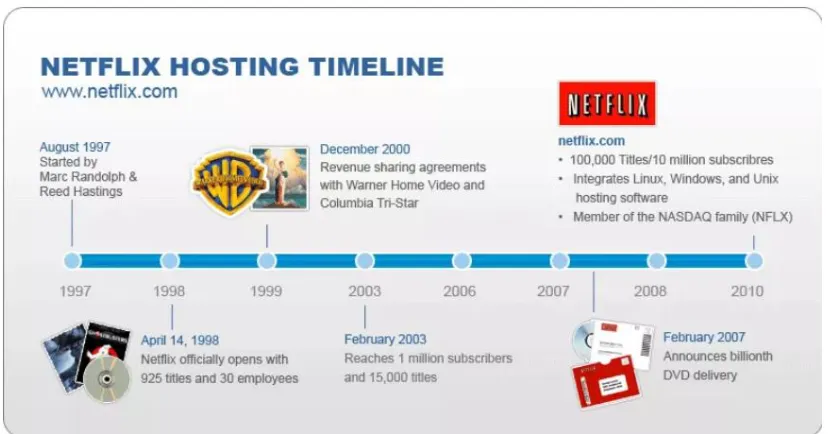
YouTube quickly served as the inspiration for DVD mail-delivery service Netflix (Kyncl, R., &
Peyvan, 2017). Netflix’s success has quickly established the platform as the gold standard of
audio-visual streaming media. The platform has since been joined by major competitors Amazon
Prime Instant Video, Hulu, HBO Now, and Sling TV, as well as a host of niche streaming
27
Figure 1.1: Netflix Hosting Timeline. Richman, 2018.
Of course, the streaming process has become more complicated over time, especially due to the
various corporate and technological partnerships required to produce high-quality content
streams. In a breakdown of this process, Nair (2017) explains the steps of watching content
through Netflix:
Hundreds of microservices, or tiny independent programs, work together to make one
large Netflix service.
Content legally acquired or licensed is converted into a size that fits your screen, and is
protected from being copied.
Servers across the world make a copy of it and store it so that the closest one to you
delivers it at max quality and speed.
When you select a show, your Netflix app cherry picks which of these servers will it load
the video from.
You are now gripped by Frank Underwood’s chilling tactics, given depression by BoJack
28
future of technology by the stories in Black Mirror. And your lifespan decreases as your
binge watching turns you into a couch potato.
Nair’s humorous editorializing aside, it is clear that streaming media (and by extension, mobile
streaming media) is a complex process of content creation and delivery that involves
partnerships between content creators, platforms, server farms and infrastructure providers,
internet service providers, investors, and the individual.
Industry shifts
One of the most common assessments of streaming media is the way streaming has disrupted
previous broadcast methods and the film, television, and music industries. Smith and Telang
(2016) approach streaming as industry disrupter, arguing that steaming media occurred due to the
growth of digital media, advances in microcomputing and mobile technologies, and the advent of
the internet (pp. 47-59). Moreover, Smith and Telang (2016) postulate that that streaming music
industry functioned as a model for streaming television. As previously noted, the first
livestreaming was audio-only, largely due to the infrastructural and technological limitations for
streaming audio-visual content. While often construed in a purely technical sense, Braun (2014)
takes a broad view of infrastructure as “not just the physical and digital artifacts, but also the
heterogeneous social, commercial, and legal strata with which these artifacts intertwine to enable
and constrain the actions of content producers and connected viewers” (p. 125). Such a focus
makes possible explanation of the complex layers of human activity that includes commercial,
regulatory, social, and technical that allow for connected viewing. Therefore, it is critical to
acknowledge the rise in streaming media as not merely a shift in production and consumption,
but a sociotechnical arrangement made possible by infrastructural, technological, cultural, legal,
29 Perhaps the most dynamic shift for contemporary streaming media is the fact that
streaming has become increasingly accessed from mobile devices. For context, a 2014 US survey
showed the percentage of demographic groups that engaged in video streaming from a
smartphone or tablet, with 30% of age 55+, 36% of age 35-54, and 49% of age 19-34
respondents indicating that they stream from mobile devices (Lella, 2014). More recent accounts
show that “The number of people watching video on a smartphone has increased 136 percent in
the U.S. since 2012” (Seidman, 2017). These mobile viewing habits vary by age—American
teenagers spend 55% of their viewing time on mobile devices, and preference for fixed viewing
increases with each age bracket (Seidman, 2017). Similar findings are echoed in other
analysis:traditional TV viewing habits of 18-24-year-olds continues to plummet, as “in the space
of 5 years, more than 40% of this age group’s traditional TV viewing time has migrated to other
activities or streaming” (Marketing Charts, 2017). Notable still is the fact that televisual practices
normally associated with liveness and temporality, such as the news, are not immune to
streaming. Rainie (2017) explains that “37% of the younger adults who prefer watching the news
over reading it cite the web, not television, as their platform of choice”, and that “social media is
a rising source of news”, with 78% of adults under 50 years old use social media for at least
some of their news. Mobile devices are again critical to these shifts, as 85% of adults use their
mobile devices for news and 50% set up news alerts on these devices (Rainie, 2017). This mobile
consumption may be part of the rising second screen experience, as explained by Andrejevic &
Lee, 2014; even in 2012, more than half of adult smartphone users utilized their devices while
watching television (Smith, 2012).
Additionally, the notion of recommended content is worthy of exploration, as roughly a
30 prefer social media for recommendations (Main, 2017). In particular, 48% of millennials prefer
recommendations from social media or friends (Main, 2017). Of course, mobile streaming
practices include not only new ways to view content, but also novel forms of content creation
and sharing, such as the ability of users to create and share video and live streaming content on
sites like Twitter, Facebook, Snapchat, and Periscope. Some numbers that encapsulate this shift
within the United States: 90% of Twitter video views occur on mobile devices; users watch 10
million videos on Snapchat per day; and Periscope users created over 200 million live broadcasts
(110 years of content watched live every day) in the first year (Lister, 2017; Periscope, 2016).
Collectively, this data makes clear that streaming media is continually evolving, and that mobile
devices are an essential part of these new practices.
While streaming media and mobile streaming are complex processes, two key shifts of
note that enable the current streaming landscape are new network and big data infrastructures.
First, the development of General Packet Radio Service (GPRS) in the mid-2000s added internet
access to the existing 2G mobile voice services (Internet Society, 2015). While GPRS speeds
were similar to what we would now consider prehistorically slow dial-up modems (roughly 56
kilobits per second), this mobile internet connectivity paved the way for contemporary 3G and
4G networks, which allow speeds of up to 56 megabytes per second and 1 gigabyte per second
respectively3 (Internet Society, 2015). Another important milestone toward mobile streaming
was the release of the first iPhone in 2007, which ushered in an era of touch screen smartphone
technologies (Internet Society, 2015). Described by de Souza e Silva (2017) as the “‘killer app’
for mobile devices”, both the iPhone and Android operating systems and the accompanying iOS
3 While these speeds are theoretically possible, achieving a 1 GB/s connection is not going to
31 App Store and Google Play for Android marked the explosion of the smartphone era (p. 5). As
more and more individuals engage in mobile forms of streaming, streaming platforms continue to
place greater emphasis on mobile features, such as Netflix’s new mobile playback and next
episode buttons for their iOS app (Lee, 2018). Adding to the proliferation of streaming apps are
social networking platforms that increasingly integrate user-created forms of steaming and live
streaming.
Another critical industry shift is the release windows for audio-visual content. For
example, Nelson (2014) notes how that streaming creates new challenges for release windows of
film content. As previously mentioned, streaming disrupts the notions of ownership, and Steirer
(2014) examines the way that streaming and digital downloads have upset notions of the
collection, as the individual is increasingly limited with the way they can sort, label, and resell in
a digital age due to shifting power concentrations, legal precedents, new technology, social
norms, and values (p. 92). For example, Evans and McDonald (2014) provide case study into
online distribution patters in the UK, highlighting the UK’s own history and culture of television
in influencing attitudes toward and regulation of streaming media. Mobile streaming, however,
complicates the notions of production and distribution even further. Social media streaming, for
example, relies on users to capture, create, and share content. The live streaming platform Twitch
is most commonly associated with streaming video games, and the Twitch app now allows users
to directly streaming mobile gaming (Lagace, 2018). As explained in the introduction of this
chapter, social media streaming can also include short form content, such as Instagram stories, as
well as apps like Periscope and Snapchat. Streaming then, from a discursive, technological, and
32 Taken as a totality, the focus so far on defining and contextualizing contemporary
streaming media makes clear that there is an increasingly mobile dimension to streaming,
particularly in Western spaces. Speculative visions of the kinds of multimedia engagement made
possible by 3G wireless connectivity have shaped mobile practices since the turn of the
millennium (Chen & Lou, 2002). Yet, what it means to engage in mobile streaming has
expanded beyond these discursive imaginings as not only wireless infrastructures have expanded,
but so have smartphone technologies and streaming platforms. Mobile streaming has become
associated with streaming audio-visual media from establish platforms like Netflix, Amazon, and
Hulu, as well as engaging in social media forms of streaming. The following sections position
some of the key ways in which mobile streaming requires amendment to existing notions of
liveness, sharedness, and plasticity.
Liveness and sharedness
Taking seriously the mass media lineage of streaming requires reconsideration of a number of
key social concepts, including the liveness, sharedness, and plasticity of media content. As
previously explained, there remain questions as to the discursive and technological definition of
what it means “to stream.” Thibault (2015) connects the flow of content to the antecedents of the
telegraph, as well as the continuous flow of broadcast via the radio and television. For certain,
streaming—particularly following the advent of Netflix’s foray into streaming content—has been
associated with the televisual. Television was already rapidly becoming digital in the
periodization known as TVIII, commonly conceived of as the late 1990s to the present (Jenner,
2015). TVIII is “marked by certain technological advances and connected branding and
programmable strategies”, Netflix and other streaming platforms have allowed a move away