Creative language explorations through a high-expressivity
n-grams query language
Carlo Strapparava
?, Lorenzo Gatti
◦, Marco Guerini
◦, and Oliviero Stock
? ?FBK-irst, Povo, Italy◦Trento-Rise, Trento, Italy
[email protected], [email protected], [email protected], [email protected]
Abstract
In computation linguistics a combination of syntagmatic and paradigmatic features is often exploited. While the first aspects are typically managed by information present in large n-gram databases, domain and ontological aspects are more properly modeled by lexical ontologies such as WordNet and semantic similarity spaces. This interconnection is even stricter when we are dealing with creative language phenomena, such as metaphors, prototypical properties, puns generation, hyperbolae and other rhetorical phenomena. This paper describes a way to focus on and accomplish some of these tasks by exploitingNgramQuery, a generalized query language on Google N-gram database. The expressiveness of this query language is boosted by plugging semantic similarity acquired both from corpora (e.g. LSA) and from WordNet, also integrating operators for phonetics and sentiment analysis. The paper reports a number of examples of usage in some creative language tasks.
Keywords:N-grams, WordNet, Semantic Similarity, Creative Language.
1.
Introduction
Many tasks in computation linguistics are properly dealt with exploiting a combination of syntagmatic and domain features. Syntagmatic aspects are often managed by in-formation present in large n-gram databases, while domain and ontological aspects are more properly modeled by se-mantic similarity spaces (e.g. latent sese-mantic space) and lexical ontologies such as WordNet (Fellbaum, 1999). This interconnection is even stricter when we are dealing with creative language phenomena, such as metaphors, proto-typical properties, etc.
This paper describes a way to focus on and accomplish some of these tasks by exploiting an improved version of
NgramQuery, a generalized query language on Google N-gram database (Aleksandrov and Strapparava, 2012). The expressiveness of this query language is boosted by plugging semantic similarity acquired both from corpora (e.g. LSA) and from WordNet. It contains several different operators, which combined in a proper query can help users to extract n-grams having similarly close syntactic and se-mantic relational properties. The tool can be useful in a va-riety of tasks, ranging from specific lexicon extraction and lexical substitution task (McCarthy and Navigli, 2007) to the automatization of creative and figurative language pro-cesses (Strapparava et al., 2007; Stock et al., 2008; Veale, 2011) such as puns generation, metaphors, hyperbolae and other rhetorical phenomena.
2.
NgramQuery Language
We used and refined the NgramQuery generalized query language (Aleksandrov and Strapparava, 2012). The start-ing point was the Google Web 1T 5-Grams database (Brants and Franz, 2006). This data set contains English word n-grams and their observed frequency counts. The length of the n-grams ranges from unigrams to five-grams. The n-gram counts were generated from approximately 1 tril-lion word tokens of text from publicly accessible Web
pages. The present version ofNgramQuerycombines sev-eral knowledge sources, in particular:
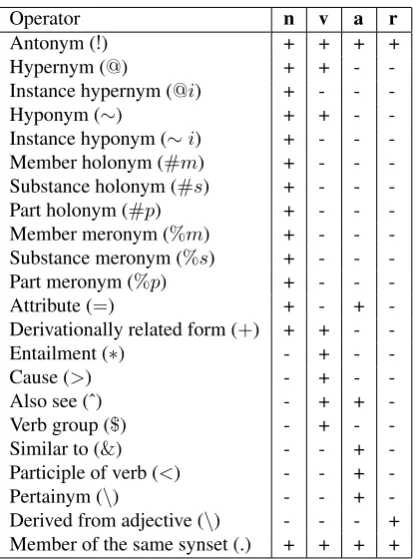
• lexical concepts and their taxonomies, given by Word-Netlexicon database. Besides all the relations present in WordNet, we embedded in the query language also the common similarity measures such as Resnik, Lin, Jiang-Conrath, etc. (Budanitsky and Hirst, 2006; Ped-ersen et al., 2004).
• Similarity from a specific version ofLSAspace (Deer-wester et al., 1990) acquired from the full British Na-tional Corpus.
• TheCMU Pronouncing Dictionary1, for dealing with
assonances, partial homophones, etc.
• Valence scores of the synsets using SentiWordNet (Esuli and Sebastiani, 2006), and SentiWords’ prior polarities (Guerini et al., 2013) for non-disambiguated terms. This is a newly introduced feature.
Finally we designed a query language that is able to express these concepts according to the Google N-gram database. Information extraction from such a database using fixed ex-ternal resources is not straightforward, especially with re-spect to efficiency and completeness. To give a flavor of the expressiveness, a possible query could be:
Italy#L#20 spaghetti with ∼#f ood#n
that retrieves the 4-grams, along with their frequencies, in which the first word is one of the first 20 most simi-lar words to Italy according to LSA (i.e.Italy#L#20), then ‘spaghetti with’ followed by is a hyponym of the nounf ood(i.e. the term∼#f ood#n). The most fre-quent 4-gram (with frequency 150) that satisfies the query is:
1
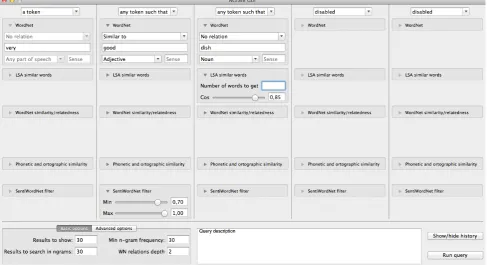
Figure 1: TheNgramQueryGUI
Terminology extraction. Combining information in the n-grams and the hierarchy of WordNet, we can extract spe-cific terminology and phrases related to a particular context.
∼#f ood#n#2 sandwich, pizza, pasta, salad#n
that retrieves the 2-grams, along with their frequencies, that are composed of a hyponym of the second sense of the noun food, followed by any synonym of the nouns sand-wich,pizza,pasta, orsalad. We get the following results:
191865 pasta salad
25152 fish sandwich
20442 seafood pasta
10146 fish salad
8900 chocolate sandwich
6881 meat pasta
6277 meat sandwich
5347 seafood pizza
Lexical substitution. In lexical substitution tasks we can use the ‘member of the same synset’ operator (.) to find substitutes for a given word. For example, if we want to change the adjective indelectable food, the query
.#delectable#a f ood#n
retrieves the 2-grams of a synonym of the adjective
delectable, followed by the nounfood, e.g.
170467 delicious food
31027 yummy food
4292 delectable food
3999 scrumptious food
Since we have the frequency of each expression, we can easily choose the most frequent (i.e., delicious food) or rather select something less used, depending on our pur-poses. If we want to relax the requirement of strict syn-onymy, we can exploit the Wordnet adjective operator ‘sim-ilar to’ (&):
&#yummy#a f ood#n
thus obtaining
47112 tasty food
3.2.
Query Blending
Even if many tasks can be accomplished with a single query, blending the results of different queries can further expand the possibilities of the tool. For example, one could find differences (or similarities) in gender prejudices by comparing the results of the query “men love #n” and “women love #n” (i.e., the operator#nacts as a wild-card among the nouns, so finding names of things that are considered loved by men or women). The top results of the two queries in isolation, ordered by frequency, are shown in Table 2.
To extract gender specific prejudices, we need to take into account also the opposite gender results in order to rule out those objects that are “loved” by both males and females. To do so, we use a mutual information approach.
M I= Pf(objectx, proprietyy)
if(objecti, proprietyy)
developed a graphical tool that facilitates the exploration phase so that we can get to the final applied use quickly and creatively.
Acknowledgement
This work was partially supported by the PerTe project (Trento RISE).
6.
References
Aleksandrov, M. and Strapparava, C. (2012). Ngramquery - smart information extraction from google n-gram using external resources. In Proceedings of the 8th interna-tional conference on Language Resources and Evalua-tion (LREC-2012), Istanbul, Turkey, May.
Bouma, G. (2009). Normalized (pointwise) mutual infor-mation in collocation extraction. Proceedings of GSCL, pages 31–40.
Brants, T. and Franz, A. (2006). Web 1T 5-gram version 1. Linguistic Data Consortium.
Budanitsky, A. and Hirst, G. (2006). Evaluating WordNet-based measures of lexical semantic relatedness. Compu-tational Linguistics, 32:13–47.
Deerwester, S., Dumais, S. T., Furnas, G. W., Landauer, T., and Harshman, R. (1990). Indexing by latent semantic analysis. Journal of the American Society for Informa-tion Science, 41:391–407.
Esuli, A. and Sebastiani, F. (2006). Sentiwordnet: A pub-licly available lexical resource for opinion mining. In
In Proceedings of the 5th Conference on Language Re-sources and Evaluation (LREC’06), pages 417–422. Fass, D. (1991). Met*: A method for discriminating
metonymy and metaphor by computer. Comput. Lin-guist., 17(1):49–90, March.
Fellbaum, C. (1999).WordNet. Wiley Online Library. Gatti, L., Guerini, M., Stock, O., and Strapparava, C.
(2014). Sentiment variations in text for persuasion tech-nology. InProceedings of the 9th International Confer-ence on Persuasive Technology.
Guerini, M., Gatti, L., and Turchi, M. (2013). Sentiment analysis: How to derive prior polarities from SentiWord-Net. InProceedings of EMNLP 2013.
Harabagiu, S. (1998). Deriving metonymic coercions from wordnet. InWorkshop on the Usage of WordNet in Nat-ural Language Processing Systems, pages 142–148. McCarthy, D. and Navigli, R. (2007). The semeval English
lexical substitution task. InProceedings of the ACL Se-meval workshop.
Pedersen, T., Patwardhan, S., and Michelizzi, J. (2004). WordNet::Similarity - measuring the relatedness of con-cepts. In Proceedings of the 19th National Confer-ence on Artificial IntelligConfer-ence (AAAI-2004), pages 1024– 1025, San Jose, CA, July. Lawrence Erlbaum Associates. Stock, O., Strapparava, C., and Valitutti, A. (2008). Ironic expressions and moving words.International Journal of Pattern Recognition and Artificial Intelligence (IJPRAI), 22:1045–1057.
Strapparava, C., Valitutti, A., and Stock, O. (2007). Af-fective text variation and animation for dynamic adver-tisement. In Proccedings of 2nd International
Confer-ence on Affective Computing and Intelligent Interaction (ACII2007), Lisbon, Portugal, September.
Veale, T. (2011). Creative language retrieval: A robust hy-brid of information retrieval and linguistic creativity. In