Optimizing a Distributional Semantic Model for the Prediction of German
Particle Verb Compositionality
Stefan Bott and Sabine Schulte im Walde
Institut f¨ur Maschinelle Sprachverabeitung Univerist¨at Stuttgart
Pfaffenwaldring 5b, 70569 Stuttgart, Germany
{stefan.bott,schulte}@ims.uni-stuttgart.de
Abstract
In the work presented here we assess the degree of compositionality of German Particle Verbs with a Distributional Semantics Model which only relies on word window information and has no access to syntactic information as such. Our method only takes the lexical distributional distance between the Particle Verb to its Base Verb as a predictor for compositionality. We show that the ranking of distributional similarity correlates significantly with the ranking of human judgements on semantic compositionality for a series of Particle Verbs and the Base Verbs to which they correspond. We also investigate the influence of further linguistic factors, such as the ambiguity and the overall frequency of the verbs and a syntactically separate occurrences of verbs and particles that causes difficulties for the correct lemmatization of Particle Verbs. We analyse in how far these factors may influence the success with which the compositionality of the Particle Verbs may be predicted.
Keywords:Particle Verbs, Distributional Semantics, Multi Word Expressions
1.
Introduction
Particle Verbs, such as the English ”to point out” or ”to beat up”, are a special type of Phrasal Verbs and, with that, they are a type of Multi Word Expression. Similar to other Multi Word Expressions, their meaning may show various degrees of compositionality, i.e. they may be more or less opaque with respect to the meaning of their individual com-ponents. In German, particle verbs are very frequent and represent a highly productive paradigm. German Particle Verbs (PVs in what follows) are a challenge for computa-tional lexicography, as well as for many NLP applications since, besides the mentioned problem of semantic compo-sition, they are easily confounded with the base verbs from which they are composed. In addition, German syntax al-lows discontinuous realization with a potentially very large distance between the base verb (BV) and the verb particle, along with an unseparated variant. The verb particle may either occur together with the base verb as one word, as in (1-a), or separated with the verb in the second position of the sentence and the particle in clause-final position, as can be seen in (1-b).
(1) a. Peter Peter
isst eats
das the
Eis ice cream
auf. PRT-up. ’Peter (completely) eats the ice cream.’
b. Peter Peter
m¨ochte wants-to
das the
Eis ice cream
aufessen. eat+PRT-up.
(2) Peter Peter
bringt brings
den the
Eisverk¨aufer ice cream vendor
um.
PRT-around. ’Peter kills the ice cream vendor.’
The formation of particle verb neologisms is possible and productive. Springorum et al. (2013) have shown that test subjects are perfectly able to associate a meaning to
arti-ficially created, previously unattested particle verbs and to construct example sentences for them. Different test sub-jects also agree to a large degree on the meaning they at-tribute to the newly formed lexical items. This shows that the creation of novel PVs is a regular process which must be governed by certain rules. There are two possible sources for the meaning of neologisms: the meaning of the BV or a transfer of the meaning of existing PVs to novel PVs which share the same particle which then creates a new PV mean-ing by analogy. The productive process appears to combine both. Here we are especially interested in the first case, the derivation of the lexical semantics of PVs from the seman-tics of BVs. As already mentioned, the relation between PVs and the BVs they are composed from can be more or less opaque. The meaning of some PVs if fully composi-tional, i.e. derived nearly directly from the meaning of the BV. Example (1) falls into this category: both essen and aufessenmeanto eat. In other cases, like in (2), the mean-ing of the PV is fully opaque and not predicable at all from the meaning of the BV:bringenmeans to bring and umbrin-genmeansto kill. Most PVs can be found in a continuum between the two extremes, being neither fully opaque nor fully compositional.1
1It should be noted that the particles also may have a
tributional in the sense that the assessment of composition-ality is done on the basis of lexical information. They use, however, syntactic information as a filter and only use lex-ical heads as cooccurrence features which also correspond to certain syntactic functions. They compare different fea-ture configurations and conclude that the best results can be obtained with information stemming from direct objects and PP-objects. The incorporation of syntactic information in the form dependency arc labels (concatenated with the head nouns) yields less satisfactory results, putting the syn-tactic transfer problem in evidence, again. Nevertheless, they admit that an incorporation of syntactic transfer infor-mation between BVs and PVs could possibly improve the results.
3.
Research Questions and Motivation
According to the distributional hypothesis (Firth, 1957; Harris, 1968) semantically similar words tend to occur in similar contexts. On this basis we can hypothesize that the more similar a PV and a BV are in their meanings, the more similar the contexts are in which both can be found. For the PVumbringen(to kill) in (2) we would expect it to oc-cur frequently with words that express agents, patients and manners of killing events. For its BVbringen (to bring), however, we would expect strong cooccurrences of words which are bringers and things which can be brought. In other words, we can expect only a weak lexical overlap in the typical context in which the BV and the PV occur. This should indicate us a very low compositionality of the PV. For the PV aufessen in (1) (to eat up), on the other hand, we would expect a high lexical overlap of its typical contexts with the typical contexts of its corresponding BV essen(to eat): both will contain typical eaters and typical things which can be eaten.A well known problem for lexical distributional models is that not all of the words which can be found in the contexts are equally predictive. Words which are very frequent by themselves tend to contribute little discriminative informa-tion. To remedy this, some form of term weighting, such as LMI (Evert, 2004), can be applied. Also purely gram-matical, non-content, words may have little discriminative power and filtering them out may make a model more ade-quate.
These differences in contexts can be captured in terms of distributional semantic models, such as the Word Vector Space Model (Sahlgren, 2006; Turney and Pantel, 2010) which we use below. Distributional Semantics Models are unsupervised and can predict the measure of similarities be-tween contexts (i.e. the distributional semantic similarity between words) but they cannot predict the exact degree of compositionality directly (as for example on a scale from 0 to 10). What we can expect, however, is that for a series of PV-BV pairs the ranking of these pairs in terms of seman-tic similarity will significantly correlate with the ranking of compositionality judgements from a gold-standard of hu-man judgements. Once the two rankings are mapped onto each other, the distributional distance between a previously unseen PV-BV pair may then be mapped onto a scale of compositionality values.
In the present work we attempt to discover whether the
compositionality of the meaning of German PVs is pre-dictable from purely distributional information and in which ways a distributional model may be optimized. We started out from a standard general purpose Word Vector Model and compared this to an improved version of the same type of model which optimizes some technical pa-rameters, which are, however, linguistically motivated. We investigate the influence of term weighting and filtering out non-content words. We also use a model which restores PV lemmata and thus better separates the occurrences of BVs from the occurrences of the homophonous verbs which are actually part of a PV, in those cases where its particle has been separated and usually appears in clause final position. We were interested in the following questions:
• With which degree of success can the compositional-ity of PVs be assessed with the use of purely lexical distributional information and without the use of any syntactic features?
• To which degree can the predictive power of a model improve if we use syntactic information in order to better separate BVs from homographic PVs which oc-cur in syntactic separation from their particle?3 Even if this may seem a technical question, it is linguisti-cally motivated and may potentially affect other com-putational approaches to German PV compositional-ity.
• Can the distributional semantic model be improved by taking only content words in the context into account?
• What role does the ambiguity of the PV play in the predictability of compositionality? One could expect that ambiguous verbs are harder to rank than unam-biguous ones, because of the varying degree of com-positionality among different senses of the same PV.
• What role does the frequency of PVs (and also the fre-quency of BVs) play? We expect that compositionality of high frequency verbs is easier to predict than that of low frequency verbs, simply because of data sparsity issues.
• Which is the ideal size of context to be taken into con-sideration for building predictive models?
In contrast to previous approaches (Hartmann, 2008; K¨uhner and Schulte im Walde, 2010), we use no infor-mation about syntactic subcategorization, nor do we filter cooccurrents by their syntactic relation to the target verb.
4.
Data and Models
We used a lemmatized and tagged version of the SDeWaC corpus (Faaß and Eckart, 2013), a corpus of nearly 885 mil-lion words. SDeWaC is a large resource, but has the dis-advantage that it is distributed in a form where sentences are ordered alphabetically and the origianl contexts of sen-tences are not preserved. As a consequence our windows
3
Window size 1 2 5 10 20 Original 0.2102* 0.2507* 0.2308* 0.2416* 0.2668** Restored 0.3058** 0.2910** 0.3696*** 0.3008** 0.1859
Table 2: Comparison between baseline models vs. models with lemma correction (values are given in Spearman rank order correlation coefficients)
set. The same is true for term weighting with LMI. If no term weighting was applied to the models the prediction of compositionality in most cases failed to shows statisti-cally significant correlations to the gold standard. For this reason we only present comparisons with restricted context and term weighting in the rest of this section.
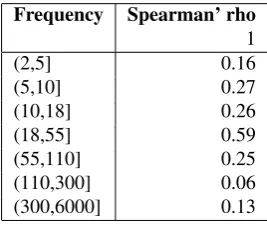
Frequency Spearman’ rho 1
(2,5] 0.16
(5,10] 0.27
(10,18] 0.26
(18,55] 0.59
(55,110] 0.25
(110,300] 0.06
(300,6000] 0.13
Table 3: Spearman rho values for different frequency ranges (models with restored lemma information, window size 5)
Table 2 and its graphical representation in figure 1 show the direct comparison between the two sets of models: with (restored) and without (original) lemma correction for sep-arated PVs. The x-axis represents the use of context win-dows of different size. It is clearly visible that our expec-tation was met: applying lemma correction improves the prediction of compositionality, except for very large win-dow sizes. The values are given in Spearman’s rho values, the critical values for p<0.025, p<0.005 and p<0.001 are 0.199, 0.260 and 0.310, respectively (n=98, values that ex-ceed the critical values are marked with *, ** and ***).
Figure 1: Comparison between baseline models vs. models with lemma correction (x-axis represents window size in number of words, y-axis represents values in Spearman’s rho)
It is interesting to distinguish between the performance of the models for ambiguous and unambiguous verbs. Figure 2 show these for the original model without lemma tion and Figure 3 for the improved model with such
restora-tion applied. From theoretic considerarestora-tions we expected that the compositionality of unambiguous PVs should be easier to predict than that of ambiguous PVs. This pre-diction is borne out and it can be seen, again, in a much clearer way if models with restored lemma information is used. Once more, the best results are obtained with window size 5.
Figure 2: The performance of the baseline models for am-biguous and unamam-biguous PVs (x-axis represents window size in number of words, y-axis represents values in Spear-man’s rho)
Figure 3: The performance of the models with lemma restoration for ambiguous and unambiguous PVs (x-axis represents window size in number of words, y-axis repre-sents values in Spearman’s rho)
Finally, we were interested in how far the frequency of the PVs influences the performance of the models. We expected that the compositionality of more frequent PVs would be easier to predict. But the results, given in Ta-ble 3 speak a different language: As expected, the values for low frequency PVs are hard to predict, but we obtained also very low scores for high frequency verbs (≥110).
7.
Discussion
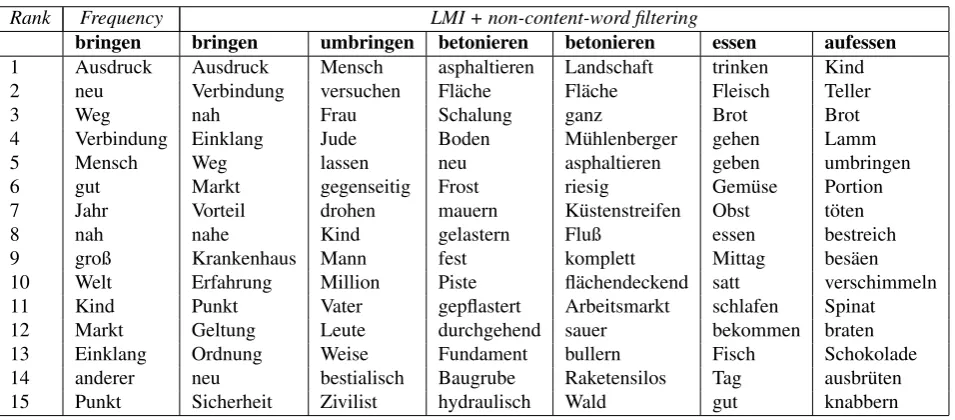
Rank Frequency LMI + non-content-word filtering
bringen bringen umbringen betonieren betonieren essen aufessen
1 Ausdruck Ausdruck Mensch asphaltieren Landschaft trinken Kind
2 neu Verbindung versuchen Fl¨ache Fl¨ache Fleisch Teller
3 Weg nah Frau Schalung ganz Brot Brot
4 Verbindung Einklang Jude Boden M¨uhlenberger gehen Lamm
5 Mensch Weg lassen neu asphaltieren geben umbringen
6 gut Markt gegenseitig Frost riesig Gem¨use Portion
7 Jahr Vorteil drohen mauern K¨ustenstreifen Obst t¨oten
8 nah nahe Kind gelastern Fluß essen bestreich
9 groß Krankenhaus Mann fest komplett Mittag bes¨aen
10 Welt Erfahrung Million Piste fl¨achendeckend satt verschimmeln
11 Kind Punkt Vater gepflastert Arbeitsmarkt schlafen Spinat
12 Markt Geltung Leute durchgehend sauer bekommen braten
13 Einklang Ordnung Weise Fundament bullern Fisch Schokolade
14 anderer neu bestialisch Baugrube Raketensilos Tag ausbr¨uten
15 Punkt Sicherheit Zivilist hydraulisch Wald gut knabbern
Table 4: The most dominant dimensions of some sample vectors, ranked by raw frequency and the values obtained by LMI term weighting and reduced to content words (windows size: 5
(2010), evaluating on the same gold standard. Our results are not fully comparable to theirs because of the difference in the methods applied, which also impose a different way of evaluating. K¨uhner and Schulte im Walde obtain Spear-man’s rho values, but they have to weight them against a coverage value, since they cannot predict the composition-ality of all PVs. Their rho-scores tend to be slightly higher than ours, but this comes on the cost of a reduced cover-age. Our results with respect to the optimal size of the con-text window are, however, along the lines of this study: we found that the optimal size of the window is 5 words to the right and the left, a range which usually includes the argu-ments of the verb and tends to ignore material which is less direcly related to the target verb.
In order to understand why a Vector Space model works well for our problem setting it is interesting to see some sample vectors. Table 4 shows the 15 strongest dimensions for the verbs corresponding to three PV-BV pairs: the ones corresponding to the initial examples (1) and (2) and the pairbetonieren/zubetonieren(to apply concrete/to cover a surface with concrete), which is one of the 3 examples with the highest human compositionality ratings from the gold standard. The vectors for the highly non-compositional pair bringen/umbringen(cf. (2) above) show very little overlap in their most dominant dimension. The strongest dimen-sions for the vector for bringen (to bring) includes typi-cal places where one could bring something or someone (Markt/marketandKrankenhaus/hospital) and some nouns which typically occur in idioms together with this verb (et-was zum Ausdruck bringen/to express s.th.). The vector for umbringen(to kill) has strong dimension for typical killers and killees (humans,men,women,millionaires, etc.) and manners of killing (e.g.bestialisch/crudely). If we compare this to the other two BV-PV pairs, which are both highly compositional, we can observe a much higher lexical over-lap there (e.g. asphaltieren/to asphaltandFl¨ache/surface in the case ofbetonieren/zubetonieren).
The lexical distributional approach has also limits, however.
If we analyse outliers of the predicted ranking we can find different possible error sources. The pairr¨usten/austr¨usten (to stock up on arms/to equip), for example, is predicted by our model to be highly compositional, while human raters tend to judge it as being compositional on a medium level (4.5 on a scale from 1 to 9). The strongest dimensions for ausr¨usteninclude military terms likeWaffe(arm) orFlotte (armada), just because these are also typical things which might be equiped in some way. This leads to a very low vector distance which wrongly predicts a high composition-ality. Also the reverse case can be found in which a PV is highly compositional, but occurs typically in very different contexts. The verbdurchwinken(to wave through, i.e. to signal someone or a vehicle to pass on by waving) is high-tly compositional, but the BV winken(to wave) occurs in many figurative or idiomatic contexts, such as ”ein Preis winkt” (”a price is promised”), ultimately leading to a pre-diction of low compositionality.
The experiments also show that the compositionality of un-ambiguous PVs is easier to assess than the compositionality of the full set, including ambiguous ones. This is not a sur-prise and corresponds to our initial hypothesis. It is more surprising that the assessment of the highest frequency band of PVs is harder than for medium frequency bands. We at-tribute this finding to the tendency of high frequency verbs to be more ambiguous and also to the fact that, they being more frequent, more of the word senses are represented in the corpus.
Verbs. InProceedings of the ACL-SIGLEX Workshop on Multiword Expressions: Analysis, Acquisition and Treat-ment, Sapporo, Japan.
Magnus Sahlgren. 2006. The Word-Space Model: Us-ing Distributional Analysis to Represent Syntagmatic and Paradigmatic Relations between Words in High-Dimensional Vector Spaces. Ph.D. thesis, Stockholm University.
Sabine Schulte im Walde. 2004. Identification, Quantita-tive Description, and Preliminary Distributional Analysis of German Particle Verbs. InProceedings of the COL-ING Workshop on Enhancing and Using Electronic Dic-tionaries, pages 85–88, Geneva, Switzerland.
Sabine Schulte im Walde. 2005. Exploring Features to Identify Semantic Nearest Neighbours: A Case Study on German Particle Verbs. InProceedings of the Interna-tional Conference on Recent Advances in Natural Lan-guage Processing, pages 608–614, Borovets, Bulgaria. Sabine Schulte im Walde. 2006. The Syntax-Semantics
In-terface of German Particle Verbs. Panel discussion at the 3rd ACL-SIGSEM Workshop on Prepositions at the 11th Conference of the European Chapter of the Association for Computational Linguistics.
Sidney Siegel and N. John Castellan. 1988. Nonparamet-ric Statistics for the Behavioral Sciences. McGraw-Hill, Boston, MA.
Sylvia Springorum, Sabine Schulte im Walde, and Antje Roßdeutscher. 2012. Automatic Classification of Ger-mananParticle Verbs. InProceedings of the 8th Inter-national Conference on Language Resources and Evalu-ation, pages 73–80, Istanbul, Turkey.
Sylvia Springorum, Sabine Schulte im Walde, and Antje Roßdeutscher. 2013. Sentence Generation and Compo-sitionality of Systematic Neologisms of German Particle Verbs. Talk at the 5th Conference on Quantitative Inves-tigations in Theoretical Linguistics.
Peter D. Turney and Patrick Pantel. 2010. From Frequency to Meaning: Vector Space Models of Semantics.Journal of Artificial Intelligence Research, 37:141–188.