Modeling Structural Topic Transitions for Automatic Lyrics Generation
Kento Watanabe
1,
Yuichiroh Matsubayashi
1,
Kentaro Inui
1, and
Masataka Goto
2 1Graduate School of Information Sciences Tohoku University, JAPAN
2
National Institute of Advanced Industrial Science and Technology (AIST), JAPAN
1{
kento.w y-matsu inui
}
@ecei.tohoku.ac.jp
2
[email protected]
Abstract
By adopting recent advances in music creation technologies, such as digital audio worksta-tions and singing voice synthesizers, people can now create songs in their personal com-puters. Computers can also assist in creat-ing lyrics or generatcreat-ing them automatically, although this aspect has been less thoroughly researched and is limited to rhyme and meter. This study focuses on the structural relations in Japanese lyrics. We present novel genera-tion models that capture the topic transigenera-tions between units peculiar to the lyrics, such as verse/chorus and line. These transitions are modeled by a Hidden Markov Model (HMM) for representing topics and topic transitions. To verify that our models generate context-suitable lyrics, we evaluate the models us-ing a log probability of lyrics generation and fill-in-the-blanks-type test. The results show that the language model is far more effective than HMM-based models, but the HMM-based approach successfully captures the inter-verse/chorus and inter-line relations. In the result of experimental evaluation, our approach captures the inter-verse/chorus and inter-line relations.
1 Introduction
Recent music creation technologies such as digi-tal audio workstations and singing voice synthe-sizers (Kenmochi and Oshita, 2007) have become immensely popular among enthusiasts of automat-ically created or vocally synthesized music. These technologies assist individuals with their musical
creativity and thereby have promoted automatic song generation. To date, many individual and group musical amateurs have created songs and commercial activities. To satisfy the demand for composer-supportive automatic composition sys-tems and services, various syssys-tems, including Or-pheus (Fukayama et al., 2012), have been developed. Furthermore, as musical composition becomes eas-ier, there is a growing need for automatic lyrics gen-eration.
However, lyrics generation has yet to be thor-oughly explored in the natural language processing field. While several works have tackled lyrics gener-ation based on lyric-specific characteristics, current methods are limited to local contexts, such as single sentences, which cannot capture the overall struc-ture of the generated lyrics (Barbieri et al., 2012; Ra-makrishnan A et al., 2009; Reddy and Knight, 2011; Wu et al., 2013; Greene et al., 2010).
The contribution of our study is twofold: (1) To more comprehensively understand lyrics generation, we examine the characteristics or rules by which people identify Japanese lyrics writing and survey some previous methods. (2) Based on the survey, we construct three generation models as an initial step toward our aim. We focus on two types of informa-tion that are essential for lyrics creainforma-tion: a language model for lyrics and topic transitions for passages.
2 Related Work
Previous studies have attempted to reproduce char-acteristics specific to song lyrics, such as syntax, rhythm, rhyme, and the relation between melody and text. Barbieri et al. (2012) adopted a Markov process to create lyrics satisfying the structural constraints of rhyme and meter. They also ensured syntactical correctness by a part-of-speech template and com-puted the semantic relatedness between a target con-cept and the generated verse/chorus by a Wikipedia link-based measure. Our model extends Barbieri et al.’s approach to capture not only the semantic relat-edness but also the verse-chorus transitions.
Ramakrishnan A et al. (2009) generated melodic lyrics in a phonetic language (in their case, Tamil). First, they labeled an input melody with appro-priate syllable categories using conditional random fields and then filled the syllable pattern with words. Reddy and Knight (2011) developed a language-independent model based on a Markov process that finds the rhyme schemes in poetry and the model stanza dependency within a poem. However, rhyme transition in their model is used to generate a stanza; the overall flow of the poem is not captured.
Some researchers have generated lyrics using sta-tistical machine translation. Wu et al. (2013) ap-plied stochastic transduction grammar induction al-gorithms to generate a fluent rhyming response to the hip hop challenges allowing various patterns of meter. Using a finite-state transducer, Greene et al. (2010) assigned a syllable-stress pattern to ev-ery word in each line, subject to metrical constraints. Moreover, they generated English love poetry and translated Italian poetry into English following a user-defined rhythmic scheme.
Although these works capture lyric-specific char-acteristics to some extent, the structural relations are limited to lines or local word contexts. To the best of our knowledge, no existing method accounts for the semantic relations among large structures, such as verses and choruses.
Inter-text structural relations are frequently con-sidered in text summarization and conversation modeling. The summarization technique of Barzilay and Lee (2004) captures topic transitions in the text span by a hidden Markov model (HMM), referred to as acontent model. Using HMM and a large amount
of tweet data, Ritter et al. (2010) and Higashinaka et al. (2011) modeled the transition of speech acts in an unsupervised manner.
3 Survey on Lyric Writing Techniques
To create a comprehensive model for lyrics genera-tion, we first investigated the characteristics or rules by which people proceed with lyrics writing in gen-eral. We surveyed five textbooks on Japanese lyrics writing (Endo, 2005; Takada, 2007; Aku, 2009; Ueda, 2010; Taguchi, 2012) and identified the com-mon features as follows.3.1 Consistency of Entire Lyrics
The lyrics preferably follow a consistent theme. Au-thors usually desire to convey a message in their lyrics, and they reflect their theme in their lyric top-ics. Frequently, the theme is indirectly expressed through a concrete story composed of who, what, when, where, and why information. Each lyric should be consistent in writing style, such as the point of view (first or third person), gender, and date.
3.2 Lyrics and Melody
Lyrics and melody are mutually dependent and influ-ence each other during the creation process. Which comes first depends on the situation. If develop-ing the melody first, the writer must concentrate on achieving a suitable melody through rhythm, pho-netic length, and lyrical structure. They should also match the word intonation and accents to the melody to ensure that their lyrics can be both sung and heard. Most songs contain some common melodies. However, listeners may experience dissonance when simultaneously hearing upbeat and downbeat melodies. Thus, the writer needs to share the tone and atmosphere of his/her lyrics in the same melody.
3.3 Musical Structure of the Lyrics
In general, each unit plays a typical role in the storyline. For example, verses often describe a con-crete scene or complementary topic that emphasizes a message in the following chorus. Furthermore, the lines of a single verse/chorus may relay a suitable order of topic transitions. In the example as follows, the first and second lines collectively describe a con-crete scene. This description is followed by the pro-tagonist’s reaction to the scene in the third and fourth lines.
Example of relations between lines
✓ ✏
(On the way home, it began to snow.)
——————— Scene (It is touching your shoulder and melting.)
—— Scene (Time flies. Today went by fast, too.)
—— Sentiment (The weekend with you is almost over.)
– Sentiment
Excerpt from “Everlasting” by Mayo Okamoto
✒ ✑
3.4 Balance of Contents
Emotion and scene are often combined in a verse/chorus. For instance, if a verse/chorus ex-presses emotions alone, such as “I love you” and “I want you”, the lyrics are insufficiently balanced to convey the theme. To ensure that their lyrics are eas-ily understood and arouse empathy in listeners, writ-ers should adopt lead-in scenes such as “The road has been long” and “Reflections in a pool”. Sim-ilarly, maintaining the balance between subjective
and objective, concrete and abstract, positive and
negative, anduniversalandnovelwill prevent
ego-centricity in the lyrics.
3.5 Figure of Speech
Lyrical content is frequently emphasized by figures of speech such as rhyme, metaphor, double mean-ing, double negatives, interrogatives, onomatopoeia, inversion, repetition, and rewording. The gram-matical patterns of the lyrical sentence construction markedly differ from those in the general text.
4 Lyrics Generation Task
As noted in the previous section, songwriters incor-porate various features, such as theme, structure, and
Figure 1: Example of a mora composed of musi-cal notes. Japanese writers usually compose lyrics in such a manner that they can be easily sung by the singer. For example, the melody sequence “A-A-B” corresponds to “sa-ku-ra” (meaning “cherry blossom”).
the lyrics-melody relation, into their lyrics, some of which are decided in advance. These predetermined features provide natural inputs to a lyrics generation task.
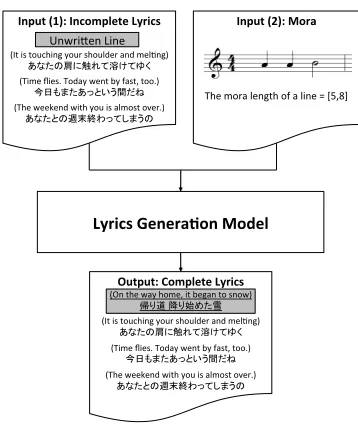
Some previously defined lyrics generation tasks account of the structural features and lyric-melody relation by inputting rhyme and meter. In our ap-proach, the melody is replaced by themoralength of each phrase. In phonology, a mora specifies the period of a sound unit. For example, in Japanese, the mora length of the phrase“ ,
(ka-e-ri-mi-chi)” (On the way home)is 5, whereas that of“
, (fu-ri-ha-ji-me-ta-yu-ki)” (it began to
snow)is 8. In a Japanese song, a mora often
corre-sponds to a musical note as shown in Figure 1. In summary, if the input is provided asMline =
[M0phrase, M1phrase] = [5,8], the task generates
lyrics such as“ ” (On the way
home, it began to snow).
Now, consider that the input includes partially composed lyrics. In this scenario, the system par-tially supports lyrical writer. For example, if the writer has completed a verse but is unsure of the chorus, the system can generate a chorus that is con-sistent with the completed verse. The experiments reported in Section 6 confirm that our models cor-rectly capture the suitable topic transitions.
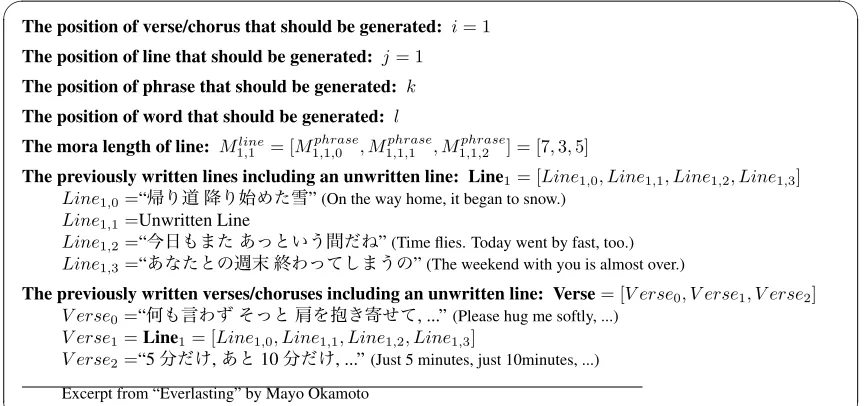
Our lyrics generation task is formally depicted in Figure 2. The task accepts the inputs as follows: (1) previously written parts of the target lyrics including an unwritten line and (2) sequences of mora length Mline = [Mphrase
0 , M
phrase
1 , ...], each
✓ ✏
The position of verse/chorus that should be generated: i= 1 The position of line that should be generated: j= 1
The position of phrase that should be generated: k
The position of word that should be generated: l
The mora length of line: Mline
1,1 = [M1,1,0phrase, M1,1,1phrase, M1,1,2phrase] = [7,3,5]
The previously written lines including an unwritten line: Line1= [Line1,0, Line1,1, Line1,2, Line1,3]
Line1,0=“ ”(On the way home, it began to snow.)
Line1,1=Unwritten Line
Line1,2=“ ”(Time flies. Today went by fast, too.)
Line1,3=“ ”(The weekend with you is almost over.)
The previously written verses/choruses including an unwritten line: Verse= [V erse0, V erse1, V erse2]
V erse0=“ , ...”(Please hug me softly, ...)
V erse1=Line1= [Line1,0, Line1,1, Line1,2, Line1,3]
V erse2=“5 , 10 , ...”(Just 5 minutes, just 10minutes, ...)
Excerpt from “Everlasting” by Mayo Okamoto
✒ ✑
Figure 4: Example of the model input.
w(or a hidden state), and theWml is the word set
with the mora lengthml. To avoid the word
sparse-ness problem, these probabilities are smoothed by Good-Turing discounting using SRILM (a toolkit for building and applying statistical language mod-els) (Stolcke, 2002).
PM L(wl|wl−1, wl−2, ml) =
count(wl−2, wl−1, wl)
!
w∈Wmlcount(wl−2, wl−1, w)
(4)
PM L(wl|C, wl−1, ml) =
count(C, wl−1, wl)
!
w∈Wmlcount(C, wl−1, w) (5)
The generated sequence of the mora word lengths is simply estimated by maximum likelihood (Equa-tion 6).
P(m|Mi,j,kphrase) = ! count(m)
m∈Mi,j,kphrasecount(m)
(6)
6 Experiments
6.1 Evaluation MeasureThe evaluation measure is another open problem in lyrics generation. Barbieri et al. (2012) and Wu et
al. (2013) evaluated the generated lyrics by human annotation. However, because manual evaluations are expensive and time consuming, they are limited to a small number of test instances. Furthermore, the evaluation measures of an artistic quality strongly depend on the individuals; therefore, to achieve an evaluation measure of an adequate quality, copious annotation is required.
We evaluated our generation model by two differ-ent measures: log probability of the original line and fill-in-the-blanks-type testing. In the log-probability measure, we assumed that among all possible lines, the original line is generated with the highest proba-bility. To calculate the log probability, the topic
tran-sition [C0, C1, ...]was predetermined by providing
the lines or verses/choruses and applying the Viterbi
algorithm. The log probability, log"P(Line)# of
generating each line was then calculated as the log-arithm of Equations 1, 2, and 3.
Model Dev Test
Tri-gram Model -28.28 -29.02
Content model for Line -38.36 -38.89 Content model for Verse -33.03 -33.84
Table 1: Log probability of line generation.
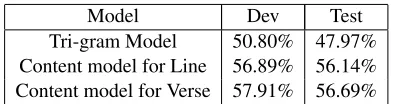
Model Dev Test
Tri-gram Model 50.80% 47.97%
Content model for Line 56.89% 56.14% Content model for Verse 57.91% 56.69%
Table 2: Accuracy of the fill-in-the-blanks-type test.
lent to the chance rate. On the other hand, both con-tent models significantly improve the performance of lyrics generation.
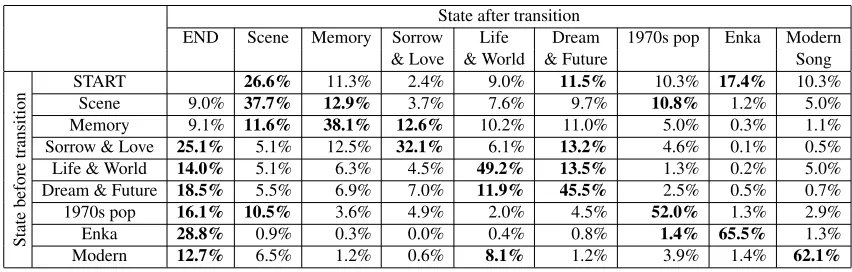
We also qualitatively analyzed the obtained hid-den states and their transitions in the content mod-els. Table 3 illustrates the state transition table in the verse/chorus mode with 10 states. To clarify the dis-cussion, we manually assigned easy-to-understand labels to the states and representative words to each hidden state (see Table 4).
Our content model in the verse/chorus mode con-currently learns two types of hidden states (Table 3). The first type corresponds to specific music gen-res; the second corresponds to specific tendencies of word appearances. The model successfully captures music genres with particular stylistic and vocabulary characteristics, such as1970s pop,Enka, and
mod-ern songs. Once a current state shifts into one of
these states, it rarely shifts to another state. This in-dicates that the model generates suitable words that consistently fit the target genre.
Secondly, some states successfully capture the topics where the transition probabilities between them have some tendency; state transition proba-bilities are not random but instead biased against semantically related contents. As seen in Table 3, this type embraces five states, namely,Scene,
Mem-ory,Sorrow & Love,Dream & Future, andLife &
World. In these topics, (1) the self-transition is the
most likely one. (2) The transition probability from
START toScene is relatively high, and the
transi-tion probability fromScenetoENDis relatively low compared with the ones from others to END. (3)
Interpretation Representative words
Scene town (machi), room (heya), city (tokai), sunset (yuuhi), run (hashiru),
Memory remember (wasurenai), memory (omoide), met (deatta), nostalgic (natsukasii), Sorrow & Love love (koi), express (iu), cry (naku),
affections, sentiment, mind (kimochi), Life & World live (ikiru), future (mirai), bravery (yuuki),
destination (yukusaki), reality (genjitsu), Dream & Future dream (yume), future (mirai),
new (atarashii), world (world), one (hitotsu), 1970s pop lie (uso), romance (romansu), rose (bara)
lullaby (rarabai), kiss (kuchiduke), Enka human life (jinsei), harbor (minato),
traditional ballads sake (sake), old home (kokyou),
Modern Song paradise (paradaisu), cute (kawaii), drama (dorama), dance (danse),
Table 4:Representative Words in each Semantic Class.
The transition probabilities fromMemoryare almost even except for the self-transition and the transition to specific music genres (1970s pop,Enka, and
Mod-ern song). Therefore,Memorytends to play the role
of an intermediate content in a lyrics. (4) The transi-tion probability fromSorrow & Love,Life & World,
andDream & FuturetoENDis relatively high. Thus
the last verse/chorus in whole lyrics tends to become these three states. (5)Life & World andDream &
Future are strongly correlated. This indicates that
the words representing hopes and bright futures tend to appear side by side.
7 Conclusion and Future Works
State after transition
END Scene Memory Sorrow Life Dream 1970s pop Enka Modern
& Love & World & Future Song
State
before
transition
START 26.6% 11.3% 2.4% 9.0% 11.5% 10.3% 17.4% 10.3%
Scene 9.0% 37.7% 12.9% 3.7% 7.6% 9.7% 10.8% 1.2% 5.0%
Memory 9.1% 11.6% 38.1% 12.6% 10.2% 11.0% 5.0% 0.3% 1.1%
Sorrow & Love 25.1% 5.1% 12.5% 32.1% 6.1% 13.2% 4.6% 0.1% 0.5%
Life & World 14.0% 5.1% 6.3% 4.5% 49.2% 13.5% 1.3% 0.2% 5.0%
Dream & Future 18.5% 5.5% 6.9% 7.0% 11.9% 45.5% 2.5% 0.5% 0.7%
1970s pop 16.1% 10.5% 3.6% 4.9% 2.0% 4.5% 52.0% 1.3% 2.9%
Enka 28.8% 0.9% 0.3% 0.0% 0.4% 0.8% 1.4% 65.5% 1.3%
Modern 12.7% 6.5% 1.2% 0.6% 8.1% 1.2% 3.9% 1.4% 62.1%
Table 3: Transition table between the hidden states of a verse/chorus. The vertical axis represents the hidden states before transition. The horizontal axis represents the hidden states after transition. Each cell contains the transition probabilities between the hidden states. The top three transition probabilities are shown in bold. To simplify the table, we omit hidden states that are erroneously reached from the start state.
References
Yu Aku. 2009.Sakushi Nyumon (Introduction to Writing the Lyrics). Iwanami Shoten.
Gabriele Barbieri, Franois Pachet, Pierre Roy, and Mirko Degli Esposti. 2012. Markov constraints for generating lyrics with style. In Luc De Raedt, Chris-tian Bessire, Didier Dubois, Patrick Doherty, Paolo Frasconi, Fredrik Heintz, and Peter J. F. Lucas, edi-tors,ECAI, volume 242 ofFrontiers in Artificial Intel-ligence and Applications, pages 115–120. IOS Press. Regina Barzilay and Lillian Lee. 2004. Catching the
drift: Probabilistic content models, with applications to generation and summarization. InProceedings of HLT-NAACL, pages 113–120.
Kozo Endo. 2005. Sakushi Hon (Bool for Writing the Lyrics). Shinko-Music Entertainment.
Satoru Fukayama, Daisuke Saito, and Shigeki Sagayama. 2012. Assistance for novice users on creating songs for japanese lyrics. Inin Proceedings of the Interna-tional Computer Music Association 2012.
Erica Greene, Tugba Bodrumlu, and Kevin Knight. 2010. Automatic analysis of rhythmic poetry with applica-tions to generation and translation. InProceedings of the 2010 Conference on Empirical Methods in Natural Language Processing, EMNLP ’10, pages 524–533, Stroudsburg, PA, USA. Association for Computational Linguistics.
Saif M. Mohammand Hannah Davis. 2014. Generating music from literature. pages 1–10. Workshop on Com-putational Linguistics for Literature.
Ryuichiro Higashinaka, Noriaki Kawamae, Kugatsu Sadamitsu, Yasuhiro Minami, Toyomi Meguro, Ko-hji Dohsaka, and Hirohito Inagaki. 2011. Building a conversational model from two-tweets. InWorkshop
on Automatic Speech Recognition and Understanding, pages 330–335.
Hideki Kenmochi and Hayato Oshita. 2007. Vocaloid commercial singing synthesizer based on sample concatenation. Inin Proceedings of Interspeech 2007, pages 4009–4010.
Rada Mihalcea and Carlo Strapparava. 2012. Lyrics, mu-sic, and emotions. InProceedings of the 2012 Joint Conference on Empirical Methods in Natural guage Processing and Computational Natural Lan-guage Learning, EMNLP-CoNLL ’12, pages 590– 599, Stroudsburg, PA, USA. Association for Compu-tational Linguistics.
Ananth Ramakrishnan A, Sankar Kuppan, and Sobha Lalitha Devi. 2009. Automatic genera-tion of tamil lyrics for melodies. InProceedings of the Workshop on Computational Approaches to Linguistic Creativity, CALC ’09, pages 40–46, Stroudsburg, PA, USA. Association for Computational Linguistics. Sravana Reddy and Kevin Knight. 2011.
Unsuper-vised discovery of rhyme schemes. InACL (Short Pa-pers)’11, pages 77–82. Association for Computational Linguistics.
Alan Ritter, Colin Cherry, and Bill Dolan. 2010. Unsu-pervised modeling of twitter conversations. InHuman Language Technologies: The 2010 Annual Conference of the North American Chapter of the Association for Computational Linguistics, HLT ’10, pages 172–180, Stroudsburg, PA, USA. Association for Computational Linguistics.
Andreas Stolcke. 2002. Srilm - an extensible language modeling toolkit. pages 901–904.
Motoki Takada. 2007. Sakushi No Kotsu Ga Wakaru (You Understand the How to Write the Lyrics). Chuo Art Publishing.
Tatsuji Ueda. 2010.Yoku Wakaru Sakushi No Kyoukasho (The Textbook of the Lyrics). Ymaha Music Media. Dekai Wu, Karteek Addanki, Markus Saers, and Meriem
![Figure 2. The task accepts the inputs as follows: (1)Our lyrics generation task is formally depicted inpreviously written parts of the target lyrics includingan unwritten line and (2) sequences of mora lengthMline = [M phrase0, M phrase1, ...], each corres](https://thumb-us.123doks.com/thumbv2/123dok_us/1079893.1136020/3.612.328.529.90.157/generation-formally-depicted-inpreviously-includingan-unwritten-sequences-lengthmline.webp)
![Figure 3: Lyrics generation model: (a) The n-gram language model generates a word given the line’s moralength M linei,j= [Mphrasei,j,0, M phrasei,j,1, ...]](https://thumb-us.123doks.com/thumbv2/123dok_us/1079893.1136020/5.612.100.527.77.276/figure-lyrics-generation-language-generates-moralength-mphrasei-phrasei.webp)