An Algorithm of Identifying Semantic Arguments of a Verb from
Structured Data
Minhua Huang
Department of Computer Science Graduate School and University Center
City University of New York New York, U.S.A [email protected]
Robert M. Haralick Department of Computer Science Graduate School and University Center
City University of New York New York, U.S.A [email protected]
Abstract
We discuss a method for identifying se-mantic arguments of a verb from a sen-tence. It differs from existing methods by an unique feature that represents all se-mantic arguments of a verb in a syntactic parse tree. The feature is a path in which at least one of the children of a node is a root of a subtree that associates with a semantic argument. Experiments on WSJ data from Penn TreeBank and PropBank show that our method achieves an average of preci-sion92.3%and an average of recall94.2% on identifying semantic arguments of over six hundred verbs.
1 Introduction
Semantic argument identification is one of the sub-tasks of semantic role labeling (Gildea and Juraf-sky, 2002) (Chen and Rambow, 2002) (Hacioglu, 2004b) which classifies a sequence of words as-sociated with a semantic argument of a verb but does not assign its role. It is the most difficult task in semantic role labeling. Moreover, it is one of the core techniques for a machine to understand the semantics of a sentence. For instance, in the sentencesLisa cut the ribbon with a pair of scis-sors. andThe ribbon was cut by Lisa with a pair of scissors, cut is the verb. Semantic arguments ofcutwill beLisa, the ribbon, and a pair of scis-sors, where Lisais the one who performs the ac-tion of cutting,the ribbonis the material to be cut by Lisa, anda pair of scissorsis the tool used for cutting. For semantic role labeling, arguments of cutneed to be determined. Then, each argument will be assigned to a label, such asagent,theme, andinstrumentin the example. In this report, we presents an algorithm for finding a semantic argu-ment of a verb which is the first task required for assigning a role for the verb.
Over the years, two approaches have been dis-cussed by researchers, such as methods developed based on hierarchical trees (Gildea and Jurafsky, 2002) (Hacioglu, 2004b) (Hacioglu, 2004c) and methods developed based on flat chunks (Hacioglu and Ward, 2003) (Hacioglu, 2004a). In almost all the methods of the first approach, a syntactic tree is transformed into a sequence of constituents. Each semantic argument of a verb is represented by a set of constituents. Each constituent is rep-resented by a set of features. These features are extracted based on linguistic knowledge and local knowledge of the tree structure. Finally, sophisti-cated classifiers such as support vector machines or maximum entropy modeling classifiers are em-ployed to identify semantic arguments of each verb. In contrast to these methods, our method is based on the idea that if a sentence has a cor-respondent labeled rooted tree (parser tree), a se-mantic argument of a verb in the sentence will be associated with a labeled rooted subtree. Hence, all semantic arguments of a verb in the sentence will be represented by a set of labeled rooted sub-trees. For each verb node v, there exists a path from nodeato nodeb, from which, all roots of the subtrees will be extracted. Obviously, all semantic arguments of a verb are represented by an unique feature – a path.
We find the path for a verb in a labeled rooted tree associated with a sentence by the probabilis-tic graphical model discussed in the paper (Huang and Haralick, 2009). This model is fast, uses less memory, and is very effective on text data. We construct the path by starting from a verb node and determining the next node by selecting the node that has the largest probability value among the adjacent nodes which have not been encountered yet. Then, a sibling or a child of a node in the path is identified as a root of a subtree associating with a semantic argument of the verb.
We have tested our method on the WSJ data
the00section from Penn TreeBak and PropBank (Weischedel et al., 2007). There are a total of 233 trees associating with about 600 verbs and 2000semantic arguments. The evaluation metrics we have used areprecision, recall, andf-measure. By applying10-folder cross validation technique, we have obtained an average of precision92.64%, an average of recall 94.94%, and an average of f-measure 93.81%. Our experiments show that our method is particularly effective for identifying such semantic arguments, which them are associ-ated with a sequence of consecutive words. Our method is less effective for semantic arguments, which they are associated with two or more se-quences of consecutive words (separated by other phrases). Details are shown in Section 4. We are doing more experiments on CoNLL-2005 shared task data set to further verify our method.
The paper is organized into six sections. Sec-tion two defines a labeled rooted tree and forest; section three discusses the algorithm; section four demonstrates empirical results; section five shows related research and comparisons; and section six gives a conclusion.
2 A Labeled Rooted Tree and a Labeled Rooted Forest
A rooted treeT is a 3-tuple(V, E, r), whereV is a finite set of vertices,E ⊆ V ×V is a finite set of edges, andr ∈ V is the root that all edges of T are directed away from it. The tree-order is the partial ordering onV for anyv, u ∈ V, u ≤ vif and only if the unique path from the root r to v passes throughu.
InT, the rootris a unique minimal vertex and has level0. An edge(x < y)inE is an ordered pair(x, y)∈(V ×V)s.t. x < yand there exists no z ∈ V with x < z < y. In this case, x is a parent of y andy is a child of x. If two nodes1 x, y have the same parent z, x and y are called siblings. Any nodeyis on the unique path fromr tox is called an ancestor ofx. In this case, xis a descendant ofy. The sub-tree rooted at nodex is the tree induced by descendants ofx. A node with no children is an external node or a leaf. A node that is not a leaf node is an internal node. The largest depth of a node inT is theheightofT.
1In a rooted tree, a vertex can be also called a node.
2.0.1 Definition of a Labeled Rooted Tree
A labeled rooted tree is a 5-tuple (V, E, r, A, L). It is a rooted tree with additional two elements: a labeling alphabet A and a labeling function L : V →Athat assigns labels to vertices.
2.0.2 Definition of a Labeled Rooted Forest
A labeled rooted forest is a set of labeled rooted trees, s.t. F = {Ti|i = 1. . . N} where Ti is a
labeled rooted tree.
3 The Method
3.1 Defining the Task
LetT = (V, E, r, A, L) be a labeled rooted tree associated with a sentence, where A is defined by (Weischedel et al., 2007). Let π be a set of labels associated with verbs, s.t. π ⊆ A. Let C = {C1, C2}be a set of class categories, where
C1represents that a path will be extended from the
current node to an adjacent node; C2 represents
that a path will not be extended from the current node to an adjacent node.
The task can be stated as follows:
• Form a path P(x) = τ1,→ . . . ,→ τK,
where x ∈ V, L(x) ∈ π, and x is not a node inP0(y),P0(y)is a path that has been
already formed previously. Each τk ∈ V,
k= 1, . . . , K
– find a sequence nodes< τ1,. . .,τK >,
s.t.
< τ1, . . . , τK >
= argmax
b1,...,bK
p(c1, . . . , cK, b1, . . . , bK)
– where ck ∈ C, bk is one of adjacent
nodes ofbk−1,bk−1, bk ∈ V,bk−1bk ∈
E.
• Form a set of rootsR(x) ={ri|i= 1. . . M},
whereri ≤τk,L(ri)6∈π, and1≤k≤K.
• Form a labeled rooted forest F(x) = {T1, . . . TM}, where each Ti is a labeled
rooted tree, rooted asri, and induced by the
descendants ofri.
• Tiassociates with a semantic argument ofx.
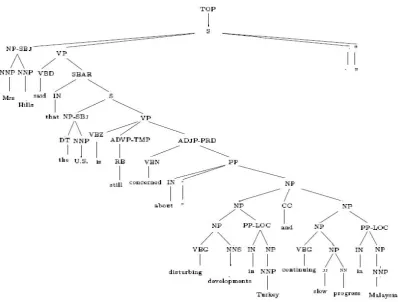
Figure 1: Mrs. Hills said that the U.S. is still concerned about ”disturbing developments in Turkey and continuing slow process in Malaysia”.
Turkey and continuing slow process in Malaysia”.
π={V B,V BN,V BG,V BZ,V BP,V BD} ⊆ A.
3.2 The Algorithm
3.2.1 Obtaining< τ1, . . . , τK >
We use equation (1) proposed by (Huang and Haralick, 2010b) (Huang and Haral-ick, 2009) to obtain the probability value of p(c1, . . . , cK, b1, . . . , bK).
p(c1, . . . , cK, b1, . . . , bK)
=
K
Y
i=1
p(bi−1|bici)p(bi+1|bi, ci)p(bi|ci)p(ci)
=
K
Y
i=1
P(bi−1, bi, bi+1, ci) (1)
We use the equation (2) to find a sequence of op-timal nodes< τ1, ..., τK >inT, where τi 6= τj,
i, j = 1, ..., K, τi−1τi ∈ E andτiτi+1 ∈ E but
τi−1τi+16∈E
< τ1, ..., τK>= argmax c1∈C,b1,b0∈E
{p(b2|b1, c1)p(b1|c1)p(c1)}
argmax c2∈C,b2,b0∈E
{p(b1|s2, c2)p(b3|b2, c2)p(b2|c2)p(c2)}
... argmax cK∈C,bK,b0∈E
{p(bK−1|bK, cK)p(bK|cK)p(cK)}
(2)
Note:b0is a node in a path,b0bk∈E,k= 1...K.
3.2.2 Time Complexity
For each nodebk, we need to assign ack, s.t.
Pk =max{P(bk−1, bk, bk+1, ck)|ck∈C}
To compute a P(bk−1, bk, bk+1, ck), we need to
have four multiplications. To obtain the maximum probability valuePk, we need to haveM−1 com-parisons. In the case of a path ofNnodes, we have
Tc= 4∗N ∗(M−1)∗(L−1) =O(N∗M∗L)
Note:Mis the cardinality ofC,Lis the maximum degree of a node in the tree, andNis the length of the path.
3.2.3 Memory Complexity
information of the current node. That is, we need only storeMprobability values in order to find the maximal probability value. Therefore,
Mc=M =O(M)
3.2.4 An Example of a Path
The path P(x), whereL(x) =VBN (associating with the verb concern) in Figure 1 is V BZ → V P →ADJ P −P RD→V BNin Figure 2.
Figure 2: All the semantic arguments of the verb
concerncan be extracted from this path.
3.2.5 Finding a set of rootsri∈R(x)
LetQ(x)denote a set of nodes in pathP(x) and letR(x)denote a set of roots we want to find.
• R(x) =φ,Q(x) ={τi|1≤i≤K}
• IfQ(x) 6= φcontinue the following proce-dure:
1. For eachτi ∈Q(x)
2. For all siblings ofτi, findz, s.t. L(z)6∈
π andz 6∈ {τi|i= 1, . . . , K},R(x) ←
R(x)∪ {z}
3. For all children of τi, if none of
chil-drenz, L(Z)∈π, GOTO 4. Otherwise, find y, s.t. L(y) 6∈ π and y 6∈ {τi|i =
1, . . . , K},R(x)←R(x)∪ {y} 4. Q(x)←Q(x)− {τi}
• Otherwise, stop the procedure and return R(x).
3.2.6 Building a Labeled Rooted ForestF(x)
LetT be a original labeled rooted tree,R(x)be a set of roots of subtrees that we want to build, and F(x) =φ.
1. For eachri ∈R(x), we assignri to the
vari-ableα. We initializeTiwith only a vertexri.
We visitα.
2. For{α, β} ∈ E, andβ has not been visited, we attach{α, β}toTi.
3. Assignβtoαand visitα. Go to 2.
• Ifα=ri, then the labeled rooted treeTi
has been built.F(x)←F(x)∪Ti
• Ifα6=ri, backtrack fromαto its parent
β inT. Then assignβtoαand go to 2
Figure 3 illustrates a labeled rooted forest for verb concern for the labeled rooted tree corre-sponds to the sentence Mrs. Hills said that the U.S. is still concerned about ”disturbing develop-ments in Turkey and continuing slow process in Malaysia”.
4 Experiments
We have tested our method on data set developed by (Weischedel et al., 2007), specifically, the WSJ section00from Penn Treebank and PropBank. A total of 233 trees associates with 233 sentences and621verbs, each verb has an average of three semantic arguments, hence about 2000 semantic arguments are in total. The evaluation metrics we have used are precision , recall, and f-measure
(F1). Moreover, we have used 10-fold cross
vali-dation technique to obtain the average result. For each sentence, Treebank provides a corre-sponding parse tree while PropBank provides cor-responding semantic arguments of predicates in the sentence. These trees were generated by a statistic parser from corresponding sentences with an average accuracy 95%. These semantic argu-ments of predicates in PropBank were generated manually.
From the experiment, among 621 verbs, we found621paths in total. By excluding30types of paths of which occurs less than 2 times, six types of paths are remained. Among these remaining patterns,86%paths fall in the first three patterns. Table 1 shows these patterns.
Figure 3: A labeled rooted forestF = {T1, T2, T3}for verbconcernfor the sentenceMrs. Hills said
that the U.S. is still concerned about ”disturbing developments in Turkey and continuing slow process in Malaysia”.
Table 1: Six Types of Paths .
NO % Path
1 62.1 V BZ(V BD, V BG, V BP, V BN, V B)→V P
2 14.2 M D(T O)→V P→V P→V B
3 10.1 V BP(V BZ, V BD)→V P
→V P→V BN
4 4.2 V BD(V BZ, V BN)→V P
→RB→V P→V B
5 2.4 T O→V P→V P→V B→V P→V BN
6 2.2 M D→V P→RB→V P →V BP(V B)→V P→V BN
Table 2: testing result onW SJdata
Files Precision Recall F-Measure
% % %
W SJ 20,37,49,89
Average 92.335 94.1675 93.2512
Standard-Deviation 0.6195 0.5174 0.4605
semantic argument consists of two or more word fragments, separated by some phrases, our algo-rithm is less effective. For example, the sentence:
He wants to see for instance the movie Superman.
Our methods can not distinguish the semantic ar-gument ofwantfrom the phrasefor instance. The reason is that this phrase is the part of leaves of the
tree induced from one of the roots determined by our algorithm. This suggests us that in order to ex-clude phrases from a semantic argument, we need to develop a method so that a set of subroots can be found. Each of them corresponds to a fragment of a semantic argument. Then, these fragments must be combined together to obtain the semantic ar-gument. Moreover, other misclassified instances are generated by errors carried in original syntac-tic trees.
5 Related Researches and Comparisons
Methods for identifying semantic arguments of predicates in a sentence can be divided into two categories with respect to the representa-tion of the sentence, namely tree-related (Gildea and Jurafsky, 2002) (Hacioglu, 2004b) (Hacioglu, 2004c) and chunk-related (Hacioglu and Ward, 2003) (Hacioglu, 2004a) semantic argument iden-tifiers. While systems are built use the first ap-proach are more accurate, systems are build use the second approach are very efficient and robust.