Predicting Correlations Between Lexical Alignments and Semantic
Inferences
Simone Magnolini
University of Brescia FBK, Trento, Italy
Bernardo Magnini
FBK, Trento, Italy
Abstract
While there is a strong intuition that word alignments (e.g. synonymy, hyperonymy) play a relevant role in recognizing text-to-text semantic inferences (e.g. textual entailment, semantic similarity), this in-tuition is often not reflected in the sys-tem performances and there is a general need of a deeper comprehension of the role of lexical resources. This paper provides an empirical analysis of the dependen-cies between data-sets, lexical resources and algorithms that are commonly used in text-to-text inference tasks. We define a resource impact index, based on lexi-cal alignments between pairs of texts, and show that such index is significantly cor-related with the performance of different textual entailment algorithms. The result is an operational, algorithm-independent, procedure for predicting the performance of a class of available RTE algorithms. 1 Introduction
In the last decade text-to-text semantic inference has been a relevant topic in Computational Lin-guistics. Driven by the assumption that language understanding crucially depends on the ability to recognize semantic relations among portions of text, several text-to-text inference tasks have been proposed, including recognizing paraphrasing (Dolan and Brockett., 2005), recognizing textual entailment (RTE) (Dagan et al., 2005), and se-mantic similarity (Agirre et al., 2012). A common characteristic of such tasks is that the input are two portions of text, let’s call them T ext1 and T ext2, and the output is a semantic relation between the two texts, possibly with a degree of confidence of the system. For instance, given the following text fragments:
Text1: George Clooneys longest relationship ever might have been with a pig. The actor owned Max, a 300-pound pig.
Text2:Max is an animal.
a system should be able to recognize that there is an ”entailment” relation amongT ext1andT ext2. While the task is very complex, requiring in principle to consider syntax, semantics and also pragmatics, current systems adopt rather sim-plified techniques, based on available linguistic resources. For instance, many RTE systems (Da-gan et al., 2012) would attempt to take advantage of the fact that, according to WordNet, the word animal in T ext2 is a hypernym of the word pig inT ext1. A relevant aspect in text-to-text tasks is that data-sets are usually composed of textual pairs for positive cases, where a certain relation (e.g. entailment) holds, and negative pairs, where the semantic relation does not hold. For instance, the following pair:
Text1: John has a cat, named Felix, in his farm, it’s a Maine Coon, it’s the largest domesticated breed of cat.
Text2: Felix is the largest domesticated animal in John’s farm.
shows a case of ”non-entailment”. It is worth to notice that in both the examples, although the en-tailment judgment is different, still there is an high degree of lexical alignments between words in T ext1andT ext2(e.g. Max−→Max, pig −→ animal, cat−→animal).
In the paper we systematically investigate the relations between the distribution of lexical as-sociations in textual entailment data-sets and the system performance. As a result we define a ”resource impact index” for a certain lexical re-source with respect to a certain data-set, which indicates the capacity of the resource to
nate between positive and negative pairs. We show that the ”resource impact index” is homogeneous across several data-sets and tasks, and that it corre-lates with the performance of available entailment systems.
The paper is structured as follows. Section 2 provides the relevant background about the ongo-ing discussion on the use of lexical resources in textual entailment. Section 3 defines the Resource Impact Index that will be used in the experimental section. Section 4 reports on the experimental set-ting, including data-sets, resources and algorithms that we have been using. Section 5 discusses the results in term of the correlation between the Re-source Index on a certain data-set and the accuracy obtained by two different algorithms using a single lexical relation at time. Section 6 shows how we can combine the Resource Index in case of multi-ple resources, while still maintaining the correla-tion with the algorithm performance. Finally, Sec-tion 7 highlights the potential impact of the paper within the current research on text-to-text seman-tic inferences.
2 Background on Lexical Resources and Text-to-Text Inferences
The role of lexical resources for recognizing text-to-text semantic relations (e.g. paraphrasing, tex-tual entailment, textex-tual similarity) has been under discussion for several years. This discussion is well reflected in the data reported by the RTE-5 ”ablation tests” initiative (Bentivogli et al., 2009), where the performance of an algorithm was mea-sured removing one resource at a time.
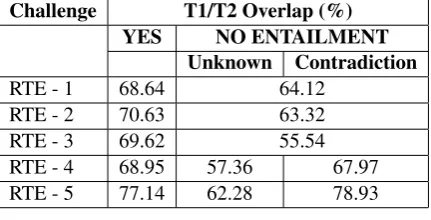
Challenge T1/T2 Overlap (%) YES NO ENTAILMENT
Unknown Contradiction
RTE - 1 68.64 64.12 RTE - 2 70.63 63.32 RTE - 3 69.62 55.54 RTE - 4 68.95 57.36 67.97 RTE - 5 77.14 62.28 78.93
Table 1: Comparison among the structure of dif-ferent RTE data-sets (Bentivogli et al., 2009).
As an example, participants at the RTE evalu-ation reported that WordNet was useful (i.e. im-proved performance) 9 of the times, while 7 out of 16 it was not. In addition, Table 1, again extracted from (Bentivogli et al., 2009), suggests that the
de-gree of word overlap among positive and negative pairs might be a key to understand the complex-ity of a text-to-text inference task, and, as a con-sequence, a key to interpret the system’s perfor-mance. Particularly, we can notice that the word overlap for the ”Yes” cases and the ”Contradic-tion” cases in the RTE-4 data-set is very similar, and even higher for the RTE-5 data-set. While this fact confirms the intuition that contradiction is generated when there is high overlap in mean-ing (de Marneffe, 2012), it also means that word overlap is not a discriminatory feature.
In this paper we claim that the two issues raised at RTE-5 (i.e. mixed evidence for the use of Word-Net, and the fact that word overlap was not dis-criminative) are very much related, and, actually, are part of the same phenomenon. To support our claim, we build on top of previous work (Magno-lini and Magnini, 2014), which we generalize con-sidering: (i) lexical associations with different po-larity (e.g. synonyms and antonyms); (ii) data-sets with different characteristics, (e.g. task, length of the pairs, languages); (iii) different algorithms for calculating textual entailment. We are interested to capture correlations between the use of lexical resources (both single resources and in combina-tion) and the performance of inference algorithms. Particularly, the goal is to predict the behavior of an entailment algorithm given the characteristics of both the resource and the data-set.
There are several factors which, in principle, can affect our experiments, and that we have care-fully considered.
deriva-tion, a resource for the hyperonymy reladeriva-tion, and so on. In addition, in the paper we consider both lexical resources that are supposed to provide sim-ilarity/compatibility alignments (e.g. synonyms) and resources/relations that are supposed to pro-vide lexical oppositions (e.g. antonyms).
Inference Algorithms. Second, different algo-rithms may use different strategies to take advan-tage of resources. For instance, algorithms that calculate a distance or a similarity betweenT ext1
andT ext2may assign different weights to a cer-tain word association, on the basis on human in-tuitions (e.g. synonyms preserve entailment more than hypernyms). In our experiments we avoided as much as possible the use of settings not sup-ported by empirical evidences and we use algo-rithms that are publicly available in order to max-imize the replicability of the experiments.
Data-sets. Finally, data-sets representing differ-ent inference phenomena, may manifest differdiffer-ent behaviors with respect to the impact of a certain resource, which can be specific for each inference type (e.g. entailment and semantic similarity). Al-though reaching a high level of generalization is limited by the existence of a limited number of data-sets, we have conducted experiments both on several textual entailment data-sets, also for differ-ent languages, and on a semantic similarity data-set.
3 Resource Impact Index
In this Section we define the general model through which we estimate the impact of a lexical resource. The idea behind the model is quite sim-ple: the impact of a resource on a data-set should be correlated to the capacity of the resource to dis-criminate positive pairs from negative pairs in the data-set. We measure such capacity as the number oflexical alignments that the resource can estab-lish on positive and negative pairs, and then we calculate the difference among them. We call this measure theresource impact differential - RID. The smaller the RID, the smaller the impact of the resource on that data-set. In the following we provide a more precise definition both of lexical alignments (Section 3.1) and of the model for cal-culating the resource impact differential (Section 3.2).
3.1 Defining Lexical Alignments
The idea that the entailment relation is related to the degree of lexical alignments between the words in a(T1, T2)pair was introduced in (Da-gan et al., 2012) as a useful generalization over the use of lexical resources in Recognizing Textual Entailment. In our work we adopt their definition of alignment, and we apply it to theRID calcula-tion. More precisely, we say that two tokens in a
(T1, T2)pair are aligned when there is at least one semantic association relation, including equality, between the two tokens. For instance, synonyms and morphological derivations are different types of lexical alignments.
In addition, we extend the (Dagan et al., 2012) definition, allowing both positive and negative alignments. In fact, alignments inherit the polarity of the resource from which they are generated. We have aPositive Alignmentwhen the semantic rela-tion of the alignment is derived from a resource bringing positive associations (see Section 2), and we have aNegative Alignment when the source is negative (e.g. antonyms).
Finally, in the experiments reported in this pa-per we consider both word-to-word alignments and phrase alignments, where n-gram sequences are involved.
3.2 Defining the Impact Index
The Resource Impact Index is defined over a cer-tain data-setDand a certain lexical resourceLR.
Data-set (D). A data-set is a set of text pairs D = {(T1, T2)}, including both positive
(T1, T2)pand negative(T1, T2)npairs for a cer-tain semantic relation (e.g. entailment, similarity). As reported in Section 2, this is a quite standard composition of benchmarks for text-to-text infer-ences.
negative lexical resources, denoted withLR−. Resource Impact (RI). The impact of a re-source LR on a data-set D is calculated as the number of lexical alignments returned byLRon all pairs, both positive and negative, normalized on the number of potential alignments for the data-set D. We use|T1| ∗ |T2|(|T|is the number of tokens in text T) as potential number of potential alignments (Dagan et al., 2012, page 52), although there might be other options, such as|T1|+|T2|, andmax(|T1|,|T2|).
RIranges from 0, when no alignment is found, to 1, when all potential alignments are returned by LR.
RI(LR,D)=
P
i∈DLexAl(T1i, T2i) P
i∈D|T1i| ∗ |T2i| (1)
Resource Impact Differential (RID). The im-pact of a resource LRon a certain data-set Dis given by the difference between the RI on posi-tive pairs (T1, T2) ∈ Dp and on negative pairs
(T1, T2)∈Dn.
A RID for a positive lexical resource ranges from -1, when the RI is 0 for the positive pairs (i.e. when entailment holds) and 1 for negative entailed pairs, to 1, when theRI is 1 for entailed and 0 for not-entailed pairs.
RID(LR+,D)=RI(LR,Dp)−RI(LR,Dn) (2)
For a resource with negative polarity (e.g. antonyms) theRID is expected to be the differ-ence between the Resource Impact on negative and on positive pairs (equation 3).
RID(LR−,D)=RI(LR,Dn)−RI(LR,Dp) (3)
TheRIDmeasure is not affected by the length of the pairs in the data-set, because it is normalized on the potential number of alignments for each pair. As far as the relation betweenRIDand the impact of the lexical resource (i.e. the number of lexical alignments produced by the resource), be-ing theRIDa difference, we can consider the im-pact as an upper bound of theRID(see equation 4).
RID(LR,D)≤ PPi∈DLexAl(T1i, T2i) i∈D|T1i| ∗ |T2i| (4)
4 Experiments
In this section we apply the model described in Section 3 to different data-sets and resources, tak-ing advantage of different sources of lexical and phrase alignments.
4.1 Data-sets
We use four different data-sets in order to exper-iment different characteristics of the corpora used for benchmarking text-to-text inferences.
RTE-3 eng. The RTE-3 data-set (Giampiccolo et al., 2007) for English has been used in the con-text of the Recognizing Textual Entailment shared tasks. It has been constructed mainly using appli-cation derived text fragments, and it is balanced between positive and negative pairs (about 1600 in total).
RTE-3 ita. The Italian RTE-3 data-set1 is the
translation of the English one. The goal is to mon-itor the behaviour of theRIDwhile changing the language.
RTE-5 eng. The RTE-5 data-set (Bentivogli et al., 2009) is similar to RTE-3, althoughT1 pairs are usually much longer, which, in our terms, means that a higher number of alignments can be potentially generated by the same number of pairs.
SICK eng. Finally the SICK data-set (Sentences Involving Compositional Knowledge) (Marelli et al., 2014) has been recently used to highlight dis-tributional properties. SICK is not balanced (1299 positive and 3201 negative pairs), andT1andT2, differently from RTE pairs, have similar length.
4.2 Sources for Lexical Alignments
We carried out experiments using six different sources of lexical alignments, whose use is quite diffused in the practice of text-to-text inference systems, and with different expected behavior, as far as the polarity of the lexical resource is con-cerned.
Lemmas. The first source consists of a simple match among the lemmas in T1 and T2: if two lemmas are equal (case insensitive), then we count it as an alignment between T1 and T2. The ex-pected polarity of alignments based on lemmas is positive, as we assume that they increase the simi-larity betweenT1andT2.
1
Synonyms. The second source considers align-ments due to the synonymy relation (e.g. home andhabitation). The sources are WordNet (Fell-baum, 1998), version 3.0 for English, and Multi-WordNet (Pianta et al., 2002) for Italian. If two lemmas are found in the same synset, then we count it as an alignment.The expected polarity of alignments based on synonyms is positive.
Hypernyms. The third source considers the hy-peronymy relation (e.g. dogandmammal): as for synonymy we use WordNet and MultiWordNet, counting as an alignment all the cases where two lemmas are in the hypernym hierarchy, at any dis-tance. The expected polarity of alignments based on hypernyms is positive.
Morphological Derivations. The fourth source of alignment are morphological derivations (e.g. invention and invent). As for English, deriva-tions are covered again by WordNet, while for Italian we used MorphoDerivIT, a resource devel-oped within the EXCITEMENT project2, which
has the same structure of CATVAR (Habash and Dorr, 2003) for English. The expected polarity of alignments based on morphological derivations is positive.
Antonyms. The fifth source of alignment are antonyms (e.g. man andwoman). Antonyms are provided by WordNet for English and by Mul-tiWordNet for Italian. The expected polarity of alignments based on antonyms is negative, as we assume that they increase the opposition between T1andT2.
Paraphrase Tables. The sixth source of align-ment are paraphrase tables (e.g. can be modified andmay be revised). We built paraphrase tables from the Meteor translation tables (Denkowski and Lavie, 2014). The idea is that if an n-gramns in the source languagesis translated into n-gram nt in the target language t, and if nt has multi-ple translations back intos, then all these transla-tions are potential paraphrases of each other. The probability of translation from one language to another can be used to compute the probability that two n-grams in languagesare paraphrases of each other. To compute this probability we use all shared translations into the target languagetof the two n-grams (both in source language s). There
2
http://www.excitement-project.eu/index.php/results/178-public-resources
are two main reasons to consider paraphrase ta-bles: (i) they cover alignments that are only par-tially covered by the other sources that we consid-ered; (ii) most of the phrases are n-grams, which allows us to test theRID behavior on sequences longer than single tokens. The expected polarity of alignments based on paraphrase tables is positive.
0-Knowledge. Finally, in order to investigate the behavior of the RID in absence of any lexical alignment, we include a 0-Knowledge experimen-tal baseline, where the system does not have ac-cess to any source of lexical alignment. As no alignment is produced (including token match), the RIDof the 0-Knowledge baseline is always 0.
4.3 Algorithms
In order to verify our hypothesis that the RID index is correlated with the capacity of a system to correctly recognize textual entailment, we run experiments using two different RTE algorithms, i.e. EDITS and P1EDA, which take advantage of lexical resources in different ways. The two algo-rithms are both supervised, in the sense that they use training data to build a model. As the goal of our experiments is to monitor the behavior of theRIDindex in different settings, rather than to assess the performance of the two algorithms, we decided to simplify as much as possible the experi-mental setting, and we calculated accuracy and F1 for the two algorithms using the training section of the data-sets3.
EDITS (Negri et al., 2009), is a distance-based RTE algorithm based on calculating the Edit Distance between T1 and T2, defined as the minimum-weight sequence of edit operations (i.e. deletion, insertion and substitution) that transforms T1 into T2. The intuition is that the less the cost of transformingT1intoT2, the more likely the entailment relation between the two texts. The final decision is taken on the basis of a threshold, empirically estimated over training data. For all the experiments, the cost of edit operations is set as follows: 0 for substitution if two words are aligned; 1 for substitution if two words are not aligned; 1 for insertion; 0
for deletion. The algorithm is normalized on the number of words of T1 and T2, after stop
3We will investigate the behavior of the RID between
words are removed. As for linguistic processing, the Edit Distance algorithm needs tokenization, lemmatization and Part-of-Speech tagging (in order to access resources). We used TreeTagger (Schmid, 1995) for English and TextPro (Pianta et al., 2008) for Italian. In addition we removed stop words, including some very common verbs.
P1EDA (Noh et al., 2015) is an alignment-based RTE algorithm, developed and fully documented in the software website4, based on alignments
betweenT1andT2. The intuition is that the more the portions of T2 are aligned with portions of T1, the higher the probability of the entailment relation. First the algorithm extracts all possible alignments between portions in T1 and T2, then it extracts a number of features from the alignments, which are finally given as input to a multinomial logistic regression classifier trained on annotated data. The features implemented in the P1EDA version used for our experiments are the following: (i) the ratio of words inT2aligned with T1; (ii) the ratio of content words in T2
aligned withT1and, (iii) the ratio of verbs inT2
aligned with T1. As for linguistic processing, P1EDA needs tokenization, lemmatization and Part-of-Speech tagging. As in the case of EDITS we used TreeTagger (Schmid, 1995) for English and TextPro (Pianta et al., 2008) for Italian.
All the experiments reported in the paper have been conducted using the Excitement Open Plat-form (EOP), (Pad´o et al., 2014) (Magnini et al., 2014), a generic architecture and a comprehensive implementation for textual inference in multiple languages. The platform includes state-of-art al-gorithms, a large number of knowledge resources and facilities for experimenting and testing inno-vative approaches. The architecture is based on the concept of modularization with pluggable and replaceable components to enable extensions and customizations, this way helping to control that experiments are conducted in the proper way, with easily observable intermediate steps. The EOP platform includes both the algorithms and the lex-ical resources used in our experiments, and it is distributed as an open source software.5
4
https://github.com/hltfbk/EOP-1.2.3/wiki/AlignmentEDAP1
5http://hltfbk.github.io/Excitement-Open-Platform/
5 Results
Table 2 and Table 3 report the results of the exper-iments on the four data-sets and the seven sources of alignment (including the 0-Knowledge base-line) described in Section 46. For each resource
we show theRIDof the resource (given the very low values,RIDs are shown multiplied by a104 factor), and the accuracy achieved both by the ED-ITS and the P1EDA algorithms. The last row of the tables shows the Pearson correlation between the RID and the accuracy of the algorithms for each data-set, calculated as the mean of the corre-lations obtained for each resource on that data-set. A first observation is that all RID values are very close to 0, indicating a low expected im-pact of the resources. Even the highestRID(i.e.
523.342for lemmas on SICK), corresponds to a
5%of the potential impact of the resource. Nega-tiveRIDvalues for positive resources, mean that the resource, somehow contrary to the expecta-tion, produces more alignments for negative pairs than for positive (this is the case, for instance, of synonyms on the English RTE-3). On the same line, negativeRIDvalues for negative resources mean that a resource with negative polarity pro-duces more alignments for positive pairs than for negative (this case does not appear in the results).
Alignment on lemmas is by far the resource with the best impact, while alignments produced by paraphrases produce very negativeRID.
Finally, results fully confirm the initial hypothe-sis that theRIDis correlated with the system per-formance; i.e. the accuracy for balanced data-sets and the F1 for the unbalanced one. The Pearson correlation shows thatR is close to1 for all the RTE data-sets (the slightly lower value on SICK reveals the different characteristics of the data-set), indicating that theRID is a very good pre-dictor of the system performance, at least for the class of inference algorithms represented by ED-ITS and P1EDA. The low values for RID are also reflected in absolute low performance, show-ing again that when the system uses a low impact resource the accuracy is close to the baseline (i.e. the 0-Knowledge configuration).
Although improving the performance of RTE systems is not the direct goal of our experiments, it is worth noting that P1EDA outperformed EDITS,
6The EDITS implementation available in the EOP
EDITS RTE-3 eng RTE-3 ita RTE-5 eng SICK eng RID Accuracy RID Accuracy RID Accuracy RID F1
0-Knowledge 0 0.542 0 0.543 0 0.536 0 0.004
Lemmas 97.215 0.635 84.594 0.641 43.221 0.62 523.342 0.347 Synonyms -4.876 0.536 5.343 0.537 10.138 0.561 12.386 0.093 Hypernyms -5.333 0.532 -1.791 0.543 12.921 0.555 48.665 0.221 Derivations -1.747 0.571 -0.024 0.536 5.722 0.553 -6.436 0
Antonyms (*) 1.076 0.542 0 0.543 1.013 0.54 28.479 0
R Correlation 0.943 0.990 0.988 0.862
Table 2: Experimental results on different data-sets with different resources using EDITS. (*) Antonyms have negative polarity.
P1EDA RIDRTE-3 engAccuracy RIDRTE-3 itaAccuracy RIDRTE-5 engAccuracy RIDSICK engF1
0-Knowledge 0 0.527 0 0.517 0 0.506 0 0
Lemmas 97.215 0.682 84.594 0.706 43.221 0.601 523.342 0.485 Synonyms -4.876 0.533 5.343 0.516 10.138 0.521 12.386 0 Hypernyms -5.333 0.527 -1.791 0.512 12.921 0.543 48.665 0.038 Derivations -1.747 0.553 -0.024 0.512 5.722 0.528 -6.436 0.018
Antonyms (*) 1.076 0.532 0 0.517 1.013 0.52 28.479 0
Paraphrases -11.668 0.52 18.049 0.5075 33.803 0.563 -67.148 0.015
R Correlation 0.987 0.967 0.959 0.983
Table 3: Experimental results on different data-sets with different resources using P1EDA. (*) Antonyms have negative polarity.
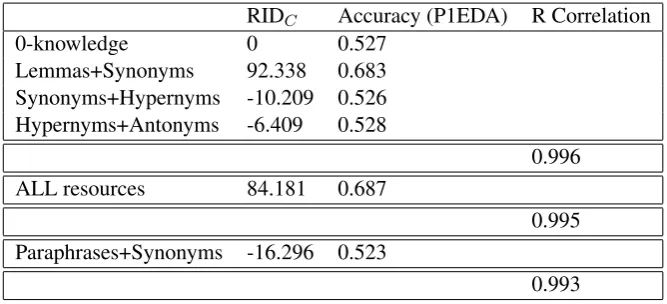
RIDC Accuracy (P1EDA) R Correlation
0-knowledge 0 0.527
Lemmas+Synonyms 92.338 0.683 Synonyms+Hypernyms -10.209 0.526 Hypernyms+Antonyms -6.409 0.528
0.996 ALL resources 84.181 0.687
0.995 Paraphrases+Synonyms -16.296 0.523
0.993
Table 4: Results on combining multiple resources using P1EDA.
and it achieved results (i.e. 0.68 on English RTE-3, 0.70 on Italian RTE-RTE-3, 0.60 on RTE-5) which can be considered at the state-of-art for publicly available systems.
6 CombiningRIDs of Multiple Sources While the previous sections have confirmed our hypothesis that theRIDindex is correlated with the performance of RTE algorithms using sin-gle resources, the aim of this Section is to show that theRIDobtained from a combination of
re-sources is still correlated with the algorithm per-formance.