Optimising Tree Edit Distance with Subtrees for Textual Entailment
Maytham Alabbas
Department of Computer Science, College of Science, Basrah University,
Basrah, Iraq
Allan Ramsay
School of Computer Science, University of Manchester, Manchester, M13 9PL, UK
Abstract
This paper introduces a method for im-proving tree edit distance (TED) for tex-tual entailment. We explore two ways of improving TED: we extend the standard TED to use edit operations that apply to subtrees as well as to single nodes; and we use the ‘artificial bee colony’ algorithm (ABC) to estimate the cost of edit oper-ations for single nodes and subtrees and to determine thresholds. The preliminary results of the current work for checking entailment between two texts are encour-aging compared with the common bag-of-words, string edit distance and standard TED algorithms.
1 Introduction
One key task for natural language systems is to determine whether one natural language sentence entails another. Entailmentcan be defined as a re-lationship between two sentences where the truth of one sentence, the entailing expression, forces the truth of another sentence, what is entailed. Many natural language processing (NLP) tasks such as information extraction and question an-swering have to cope with this notion.
An alternative formulation for the entailment between two texts is given by therecognising tex-tual entailment (RTE) paradigm, which contrasts with the standard definition of entailment above. Dagan et al. (2005) describe RTE as a task of de-termining, for two sentences text T and hypothe-sis H, whether “. . . typically, a human reading T would infer that H is most likely true.” According to these authors, entailment holds if the truth ofH,
as interpreted by a typical language user, can be inferred from the meaning ofT. This notion of en-tailment is less rigorous, and less clearly defined, than the standard notion, but it can be useful for
a number of tasks, and has been investigated very extensively in recent times.
Tree edit distance (TED), which models T-H
pairs by explicitly transforming T into H via a minimal cost sequence of editing operations, has been widely used for this task. Using TED poses two challenges: the standard three operations (i.e. deletion, insertion and exchange) apply only to single nodes, rather than to subtrees; and estimat-ing a combination of costs for these operations with threshold(s) is hard when dealing with com-plex problems. This is because alterations in these costs or choosing a different combination of them can lead to drastic changes in TED performance (Mehdad and Magnini, 2009).
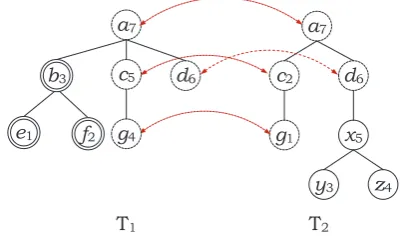
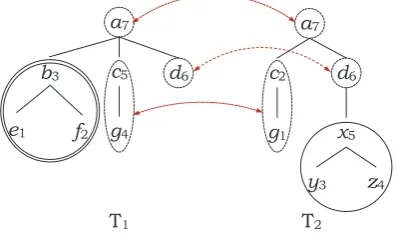
In order to overcome these challenges, we have extended the standard TED to deal with subtree operations as well as operations on single nodes. This allows the algorithm to treat semantically co-herent parts of the tree as single items, thus allow-ing for instance entire modifiers (such as prepo-sitional phrase (PPs)) to be inserted or deleted as single units. We have also applied the artificial bee colony (ABC) algorithm (Akay and Karaboga, 2012) to estimate costs both of edit operations (single node and subtree) and of threshold(s).
The work was carried out as part of an attempt to build a textual entailment (TE) system for mod-ern standard Arabic (MSA)(Alabbas, 2011). MSA poses a number of problems that, while familiar from other languages, make tasks such as TE par-ticularly difficult for this language–the lack of di-acritics in written MSA combines with the com-plex derivational and inflectional morphology of the language to produce worse levels of lexical ambiguity than occur in many other languages; the combination of free word-order, pro-drop, verb-less sentences and complex nominals produces higher levels of syntactic ambiguity than occur in many other languages; and the combination of these combinations makes things even worse. We
have tested our algorithms on a corpus of MSA T-H pairs. This corpus contains 600 pairs, binary annotated as ‘yes’ and ‘no’ (a 50%-50% split). The average length of sentence in this dataset is 25 words per sentence, with some sentences con-taining 40+ words (see (Alabbas, 2013) for fur-ther details of this dataset and description of the methodology used for collecting it). In order to maintain comparability with work on TE for En-glish, in Section 4 we have replicated a number of standard techniques (bag-of-words, Levenshtein distance on strings, standard TED). These exper-iments show that the extended version of TED, ETED, improves the performance of our technique for Arabic by around 3% in f-score and around 2% in accuracy compared with a number of well-known techniques. The relative performance of the standard techniques on our Arabic testset repli-cates the results reported for these techniques for English testsets. We have also applied our ETED to the English RTE2 testset, where it again outper-forms the standard version of TED.
2 TED for RTE
The idea here is to convert bothTandHfrom nat-ural language expressions into parse trees through parsing and then to explicitly transformT’s parse tree intoH’s parse tree, using a sequence of edit operations (Kouylekov and Magnini, 2005; Bar-Haim et al., 2007; Harmeling, 2009; Mehdad and Magnini, 2009; Wang and Manning, 2010; Heil-man and Smith, 2010; Stern et al., 2012). If a low-cost transformation sequence can be found then it may be that T entails H. Dependency parsers (Kübler et al., 2009) are popular for this task, as in other NLP areas in recent years, since they al-low us to be sensitive to the fact that the links in a dependency tree carry linguistic information about relations between complex units.
Different sets of operations on trees, using var-ious types of transformations in order to deriveH
fromT, have been suggested. Herrera et al. (2005), for instance, used the notion of tree inclusion (Kilpeläinen, 1992), which obtained one tree from another by deleting nodes. Herrera et al. (2006) and Marsi et al. (2006) used a tree alignment al-gorithm (Meyers et al., 1996), which produces a multiple sequence alignment on a set of sequences over a fixed tree. TED (Zhang and Shasha, 1989; Klein et al., 2000; Pawlik and Augsten, 2011) is another example of a transformation-based model
in that it computes the minimum cost sequence of transformations (e.g. insertion, deletion and ex-change of nodes) that turns one tree into the other. To obtain more accurate predictions, it is impor-tant to define an appropriate inventory of edit op-erations and assign appropriate costs to the edit operations during a training stage (Kouylekov and Magnini, 2005; Harmeling, 2009). For instance, exchanging a noun with its synonyms or hyper-nyms should cost less than exchanging it with an unrelated word. Heilman and Smith (2010) extended the above mentioned operations (e.g. move-sibling, relabel-edge, move-subtree, etc.), since the available edit operations are limited in capturing certain interesting and prevalent seman-tic phenomena. Similarly, a heurisseman-tic set of 28 edit operations, which include numbers of node-exchanges and restructuring of the entire parse tree, is suggested (Harmeling, 2009).
TED-based inference requires the specification of a cost for each edit operation and a threshold for the total cost of the edit sequence. Selecting a best set of costs and a suitable threshold is challeng-ing. Some researchers have defined costs manu-ally (Kouylekov and Magnini, 2005), but they are usually learned automatically (Harmeling, 2009; Wang and Manning, 2010; Heilman and Smith, 2010; Stern and Dagan, 2011), e.g. Mehdad and Magnini (2009) have used particle swarm opti-mization (PSO), which is a stochastic technique that mimics the social behaviour of bird flocking and fish schooling (Russell and Cohn, 2012), for estimating and optimising the cost of each edit op-eration for TED.
2.1 Standard TED
Algorithm 2Pseudo-code of the ABC algorithm (Akay and Karaboga, 2012).
SN size of population.
D number of optimisation parameters. xij solution i,j, i = 1 ...SN, j = 1 ...D
1: Initialise the population of solutionsxi,j,i= 1...SN,j= 1...D,triali= 0; 2: Evaluate the population;
3: cycle = 1; 4: repeat
5: Produce new solutionsvijfor the employed bees (usingvij=xij+φij(xij−xkj), wherek∈ {1, ...,SN}andφijis a random number between [-1,1]) and evaluate them;
6: Apply thegreedy selectionprocess for the employed bees (if the new solutionvijhas an equal or better nectar (fitness) than the old source, it is replaced with the old one in the memory. Otherwise, the old one is retained in the memory); 7: Calculate the probability valuespi=f iti/
!SN
i=1f itifor the solutionsxi;
8: Produce the new solutionsvijfor the onlookers from the solutionsxiselected depending onpiand evaluate them; 9: Apply the greedy selection process for the onlookers;
10: Determine the abandoned solution for the scout, if exists, and replace it with a new randomly produced solutionxiby xji= x
j
min+rand[0,1](x j max-x
j min);
11: Memorise the best solution achieved so far; 12: cycle = cycle+1;
13: until(cycle = Maximum Cycle Number);
Surface string similarity approaches
We tested the following approaches:
BoW: this approach uses the bag-of-words, which measures the similarity betweenTandHas a number of common words between them (either in surface forms or lemma forms), divided by the length ofH, when the highest similarity is better.
LD1: this approach uses the Levenshtein dis-tance with 0.5, 1, 1.5 for cost of deleting, inserting and exchanging a word respectively.
LD2: the same as for LD1except that the cost of exchanging non-identical words is the Levenshtein distance between the two words (with lower costs for vowels) divided by the length of the longer of the two words (derived and inflected forms of Ara-bic words tend to share the same consonants, at least in the root, so this provides a very approxi-mate solution to the task of determining whether two forms correspond to the same lexical item).
Syntactic similarity approaches
These approaches follow three steps:
1. each sentence is preprocessed by a tagger and a parser in order to convert them to depen-dency trees, using a combination of taggers (i.e. AMIRA (Diab, 2009), MADA (Habash et al., 2009) and maximum-likelihood (MXL) tagger (Ramsay and Sabtan, 2009)) and parsers (i.e. MALTParser (Nivre et al., 2007) and MST-Parser (McDonald et al., 2006)), which give around 85% for labelled accuracy (Alabbas and Ramsay, 2012; Alabbas and Ramsay, 2011),
which is the best result we have seen for the Penn Arabic treebank (PATB). We use these combinations in series of experiments which in-volve;
2. pairs of dependency trees are matched using the ZS-TED/ETED to obtain a score for the pair;
3. either one threshold (for simple entails/fails-to-entail tests or two (for entails/fails-to- entails/unknown/fails-to-entail tests) are used to determine whether this score should lead to a particular judgement.
We tested the following approaches:
ZS-TED1: this system uses ZS-TED with a manually determined set of fixed costs. The cost of deleting a node, inserting a node or exchanging a node are 0, 10 and 10 respectively.
ZS-TED2: this system uses ZS-TED with a manually determined intuition-based set of costs that depend on a set of stopwords and on sets of synonyms and hypernyms, obtained from Arabic WordNet (AWN) (Black et al., 2006), as explained in Figure 3 (column A). These costs are an up-dated version of the costs used by Punyakanok et al. (2004).
aandb makes it possible to optimise the system for different applications–in the experiments be-low a is 0.6 and b is 0.4, which effectively puts more emphasis on precision than on recall, but for other tasks different values could be used. For three-way decisions, the chromosome is the same as for binary decisions except that we add a sec-ond threshold, and the fitness is simply the f-score. We used the steady state GA with the following settings: 40 chromosomes as population size, uni-form crossover (UX), Gaussian mutation and max-imum number of generations is 100.
ZS-TED+ABC: the same as ZS-TED+GA ex-cept using ABC instead of GA as the optimisation algorithm. We used the ABC algorithm with the following settings: 40 as the colony size and the maximum number of cycles for foraging is 100.
ETED1: this system uses ETED with manually assigned costs. The costs for single nodes are the same for the ZS-TED1 experiment and the costs for subtrees are half the sum of the costs of their parts.
ETED2: this system uses ETED with the intuition-based costs for single nodes given in Fig-ure 3 (column A) and the costs for subtrees given in Figure 3 (column B).
ETED+ABC: this system uses the ABC algo-rithm to estimate the costs of edit single opera-tions and threshold(s) for ETED. For binary de-cision output, the chromosome is {cost of delet-ing a node, cost of insertdelet-ing a node, cost of ex-changing a node, multiplier for the sum of the costs of the deletions in a deleted subtree, multi-plier for the sum of the costs of the insertions in an inserted subtree, multiplier for the sum of the costs of the exchanges in an exchanged subtree, threshold}. For three-way decisions the chromo-some also contains the second threshold. For both cases the fitness is as for ZS-TED+GA. We do not include GA results for ETED, as extensive com-parison of the standard GA algorithm and ABC on the ZS-TED experiments shows that ABC consis-tently produces better results for the same initial seeds and the same number of iterations.
The BoW algorithm and the basic string-edit al-gorithm are supplemented by the first two of the three procedures listed below and the others by all three, to ensure that we get the best possible per-formance at each stage:
• use AWN, OpenOffice Arabic dictionary and others as a lexical resource in order to take ac-count of synonymy, antonym and hyponymy re-lations when comparing two words and when calculating the cost of an edit;
• take into consideration the POS tag when com-paring two similar words (i.e. they should have the same POS tag);
• use a list of stopwords that contains some of the commonest Arabic words, which are treated specially when comparing words (e.g. by using different edit costs for them in distance-based approaches).
4.2 Results
We carried out experiments using the approaches above with two types of decisions as below.
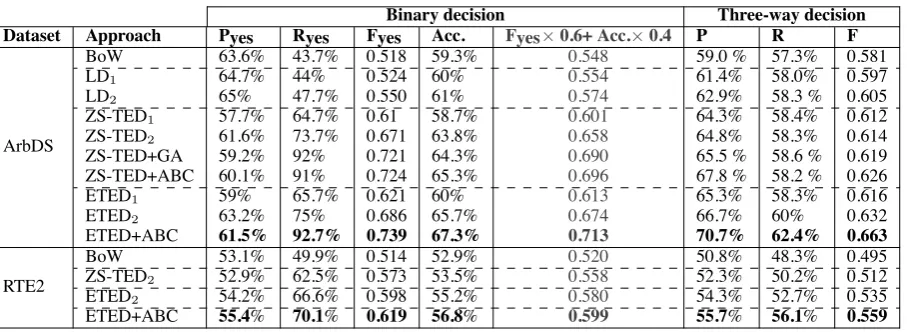
Simple binary decision (‘yes’ and ‘no’): T en-tailsHwhen the cost of matching is less (more in case of bag-of-words) than a threshold. The re-sults of this experiments, in terms of precision (P), recall (R) and f-score (F) for ‘yes’ class and accu-racy (Acc.), are shown in Table 1. ETED shows a substantial improvement over bag-of-words and Levenshtein distance (around 19% in f-score and 6% in total accuracy) and over ZS-TED (around 2% in f-score and 2% in total accuracy).
Although we are primarily interested in Arabic, we have carried out parallel sets of experiments on the English RTE2 parsed testset,1using the Prince-ton WordNet (PWN) as a lexical resource, with the input text converted to dependency trees us-ing Minipar (Lin, 1998). The pattern in Table 1 for English is similar to that for Arabic. ZS-TED is better than bag-of-words, ETED is a further im-provement over ZS-TED.
Making a three-way decision (‘yes,’ ‘unknown’ and ‘no’ (not ‘contradicts’) ): for this task we use two thresholds, one to trigger a positive an-swer if the cost of matching is lower than the lower threshold (exceeds the higher one for the bag-of-words algorithm) and the other to trigger a neg-ative answer if the cost of matching exceeds the higher one (mutatis mutandis for bag-of-words). Otherwise, the result will be ‘unknown.’ The rea-son for making a three-way decision is to drive systems to make more precise distinctions. There is a difference between knowing thatH does not
1
Cost (A) Single node (B) Subtree (more than one node)
Delete if X is a stop word =5, 0
else =7
Insert if Y is a stop word =5, double the sum of the costs of its parts else =100
Exchange if X subsumes Y =0, if a subtree S1 is identical to a subtree S2=0 if X is a stop word =5, else half the sum of the costs of its parts if Y subsumes or contradicts X=100
else =50
Figure 3: Intuition-based edit operation costs for the systems ZS-TED2 and ETED1 (X inT, Y inH).
Binary decision Three-way decision
Dataset Approach Pyes Ryes Fyes Acc. Fyes×0.6+ Acc.×0.4 P R F
ArbDS
BoW 63.6% 43.7% 0.518 59.3% 0.548 59.0 % 57.3% 0.581
LD1 64.7% 44% 0.524 60% 0.554 61.4% 58.0% 0.597
LD2 65% 47.7% 0.550 61% 0.574 62.9% 58.3 % 0.605
ZS-TED1 57.7% 64.7% 0.61 58.7% 0.601 64.3% 58.4% 0.612
ZS-TED2 61.6% 73.7% 0.671 63.8% 0.658 64.8% 58.3% 0.614
ZS-TED+GA 59.2% 92% 0.721 64.3% 0.690 65.5 % 58.6 % 0.619
ZS-TED+ABC 60.1% 91% 0.724 65.3% 0.696 67.8 % 58.2 % 0.626
ETED1 59% 65.7% 0.621 60% 0.613 65.3% 58.3% 0.616
ETED2 63.2% 75% 0.686 65.7% 0.674 66.7% 60% 0.632
ETED+ABC 61.5% 92.7% 0.739 67.3% 0.713 70.7% 62.4% 0.663
RTE2
BoW 53.1% 49.9% 0.514 52.9% 0.520 50.8% 48.3% 0.495
ZS-TED2 52.9% 62.5% 0.573 53.5% 0.558 52.3% 50.2% 0.512
ETED2 54.2% 66.6% 0.598 55.2% 0.580 54.3% 52.7% 0.535
ETED+ABC 55.4% 70.1% 0.619 56.8% 0.599 55.7% 56.1% 0.559
Table 1: Comparison between ETED, simple bag-of-words, Levenshtein distance and ZS-TED.
entail T and not knowing whether it does or not. Note that answering ‘no’ here means “I believe thatH does not entail T”, not“I believe that H
contradictsT.”
The results of this experiment, in terms of pre-cision, recall and f-score for ‘yes’ class, are shown in Table 1. Again, ETED shows a worthwhile im-provement bag-of-words and Levenshtein distance (around 6% in f-score) and over ZS-TED (around 4% in f-score).
5 Summary
We have described an extended version of tree edit distance (TED) that allows operations (i.e. delete, insert and exchange) both on single nodes and on subtrees. The extended TED with subtree opera-tions, ETED, is more effective and flexible than the ZS-TED, especially for applications that pay attention to relations among nodes (e.g. in lin-guistic trees, deleting a modifier subtree should be cheaper than the sum of deleting its components individually).
We have also investigated the use of different optimisation algorithms, and have shown that us-ing these produces better performance than settus-ing the costs of edit operations by hand, and that using the ABC algorithm produces better results for the
same amount of effort as traditional GAs.
The current findings, while preliminary, are quite encouraging. The fact that the results on our original testset, particularly the improvement in f-score, were replicated for a testset where we had no control over the parser that was used to produce dependency trees from theT-Hpairs pro-vides some evidence for the robustness of the ap-proach. We anticipate that in both cases having a more accurate parser (our parser for Arabic attains around 85% accuracy on the PATB, Minipar is re-ported to attain about 80% on the Suzanne corpus) would improve the performance of both ZS-TED and ETED.
Acknowledgements
References
B. Akay and D. Karaboga. 2012. A modified artificial bee colony algorithm for real-parameter optimiza-tion.Information Sciences, 192(0):120 – 142.
M. Alabbas and A. Ramsay. 2011. Evaluation of com-bining data-driven dependency parsers for Arabic. InProceeding of 5th Language & Technology Con-ference: Human Language Technologies (LTC’11), pages 546–550, Pozna´n, Poland.
M. Alabbas and A. Ramsay. 2012. Improved POS-tagging for Arabic by combining diverse taggers. In L. Iliadis, I. Maglogiannis, and H. Papadopoulos, editors, Artificial Intelligence Applications and In-novations (AIAI), volume 381 ofIFIP Advances in Information and Communication Technology, pages 107–116. Springer Berlin Heidelberg, Halkidiki, Thessaloniki, Greece.
M. Alabbas. 2011. ArbTE: Arabic textual en-tailment. In Proceedings of the Second Student Research Workshop associated with RANLP 2011, pages 48–53, Hissar, Bulgaria. RANLP 2011 Organ-ising Committee.
M. Alabbas. 2013. A dataset for Arabic Textual Entailment. InProceedings of the Second Student Research Workshop associated with RANLP 2013, Hissar, Bulgaria. RANLP 2013 Organising Commit-tee.
R. Bar-Haim, I. Dagan, I. Greental, and E. Shnarch. 2007. Semantic inference at the lexical-syntactic level. In Proceedings of 22nd AAAI Conference on Artificial Intelligence (AAAI-07), pages 871–876, Vancouver, British Columbia, Canada. The AAAI Press.
P. Bille. 2005. A survey on tree edit distance and related problems. Theoretical Computer Science, 337(1-3):217–239.
W. Black, S. Elkateb, H. Rodriguez, M. Alkhalifa, P. Vossen, A. Pease, and C. Fellbaum. 2006. Intro-ducing the Arabic WordNet project. InProceedings of the 3rd International WordNet Conference (GWC-06), pages 295–299, Jeju Island, Korea.
I. Dagan, O. Glickman, and B. Magnini. 2005. The PASCAL recognising textual entailment challenge. InProceedings of the 1st PASCAL Recognising Tex-tual Entailment Challenges, pages 1–8, Southamp-ton, UK.
E. Demaine, S. Mozes, B. Rossman, and O. Weimann. 2009. An optimal decomposition algorithm for tree edit distance. ACM Transactions on Algorithms (TALG), 6(1):2:1–2:19.
M. Diab. 2009. Second generation tools (AMIRA 2.0): fast and robust tokenization, POS tagging, and base phrase chunking. In Proceedings of the 2nd International Conference on Arabic Language Re-sources and Tools, pages 285–288, Cairo, Eygpt. The MEDAR Consortium.
N. Habash, O. Rambow, and R. Roth. 2009. MADA+TOKAN: a toolkit for Arabic tokenization, diacritization, morphological disambiguation, POS tagging, stemming and lemmatization. In Proceed-ings of the 2nd International Conference on Arabic Language Resources and Tools, Cairo, Eygpt. The MEDAR Consortium.
S. Harmeling. 2009. Inferring textual entailment with a probabilistically sound calculus. Natural Lan-guage Engineering, 15(4):459–477.
M. Heilman and N. Smith. 2010. Tree edit models for recognizing textual entailments, paraphrases, and answers to questions. In Human Language Tech-nologies: The 2010 Annual Conference of the North American Chapter of the Association for Compu-tational Linguistics, pages 1011–1019, Los Ange-les, California, USA. Association for Computational Linguistics.
J. Herrera, A. Peñas, and F. Verdejo. 2005. Textual entailment recognition based on dependency analy-sis and WordNet. InProceedings of PASCAL Work-shop on Recognizing Textual Entailment, pages 21– 24, Southampton, UK.
J. Herrera, A. Peñas, A. Rodrigo, and F. Verdejo. 2006. UNED at PASCAL RTE-2 challenge. In
Proceedings of the 2nd PASCAL Challenges Work-shop on Recognising Textual Entailment, pages 38– 43, Venice, Italy.
P. Kilpeläinen. 1992. Tree matching problems with applications to structured text databases. Technical Report A-1992-6, Department of Computer Science, University of Helsinki, Helsinki, Finland.
P. Klein, S. Tirthapura, D. Sharvit, and B. Kimia. 2000. A tree-edit-distance algorithm for comparing sim-ple, closed shapes. InProceedings of the eleventh annual ACM-SIAM symposium on Discrete algo-rithms, pages 696–704. Society for Industrial and Applied Mathematics.
P. Klein. 1998. Computing the edit-distance between unrooted ordered trees. In Proceedings of the 6th Annual European Symposium on Algorithms (ESA ’98), pages 91–102, Venice, Italy. Springer-Verlag.
M. Kouylekov and B. Magnini. 2005. Recognizing textual entailment with tree edit distance algorithms. InProceedings of the 1st PASCAL Recognising Tex-tual Entailment Challenge, pages 17–20, Southamp-ton, UK.
S. Kübler, R. McDonald, and J. Nivre. 2009. Depen-dency Parsing. Synthesis Lectures on Human Lan-guage Technologies. Morgan & Claypool Publish-ers.
E. Marsi, E. Krahmer, W. Bosma, and M. Theune. 2006. Normalized alignment of dependency trees for detecting textual entailment. InProceedings of the 2nd PASCAL Challenges Workshop on Recognis-ing Textual Entailment, pages 56–61, Venice, Italy.
R. McDonald, K. Lerman, and F. Pereira. 2006. Mul-tilingual dependency parsing with a two-stage dis-criminative parser. In10th Conference on Computa-tional Natural Language Learning (CoNLL-X), New York, USA.
Y. Mehdad and B. Magnini. 2009. Optimizing tex-tual entailment recognition using particle swarm op-timization. InProceedings of the 2009 Workshop on Applied Textual Inference (TextInfer ’09), pages 36–43, Suntec, Singapore. Association for Compu-tational Linguistics.
A. Meyers, R. Yangarber, and R. Grishman. 1996. Alignment of shared forests for bilingual corpora. In Proceedings of the 16th Conference on Com-putational Linguistics, volume 1, pages 460–465, Copenhagen, Denmark. Association for Computa-tional Linguistics.
J. Nivre, J. Hall, J. Nilsson, A. Chanev, G. Eryigit, S. Kübler, S. Marinov, and E. Marsi. 2007. Malt-Parser: a language-independent system for data-driven dependency parsing. Natural Language En-gineering, 13(02):95–135.
M. Pawlik and N. Augsten. 2011. RTED: a robust algorithm for the tree edit distance. Proceedings of the VLDB Endowment, 5(4):334–345.
V. Punyakanok, D. Roth, and W. Yih. 2004. Nat-ural language inference via dependency tree map-ping: An application to question answering. Com-putational Linguistics, 6:1–10.
A. Ramsay and Y. Sabtan. 2009. Bootstrapping a lexicon-free tagger for Arabic. In Proceedings of the 9th Conference on Language Engineering (ES-OLEC’2009), pages 202–215, Cairo, Egypt.
J. Russell and R. Cohn. 2012. Particle Swarm Opti-mization. Book on Demand Ltd.
A. Stern and I. Dagan. 2011. A confidence model for syntactically-motivated entailment proofs. In Pro-ceedings of Recent Advances in Natural Language Processing (RANLP 2011), pages 455–462, Hissar, Bulgaria. RANLP 2011 Organising Committee.
A. Stern, R. Stern, I. Dagan, and A. Felner. 2012. Ef-ficient search for transformation-based inference. In
Proceedings of the 50th Annual Meeting of the As-sociation for Computational Linguistics, volume 1, Jeju Island, Korea. The Association for Computer Linguistics.
M. Wang and C. Manning. 2010. Probabilistic tree-edit models with structured latent variables for tex-tual entailment and question answering. In Proceed-ings of the 23rd International Conference on
Com-putational Linguistics (Coling 2010), pages 1164– 1172, Beijing, China. Association for Computa-tional Linguistics, Tsinghua University Press.