Multimodal Behaviour and Feedback in Different Types of Interaction
Costanza Navarretta*, Patrizia Paggio*±
University of Copenhagen*, University of Malta±Njalsgade 140, build. 25, 4th floor 2300 Copenhagen S – DK*
Msida MSD 2080, Malta±
E-mail: [email protected], [email protected]
Abstract
In this article, we compare feedback-related multimodal behaviours in two different types of interactions: first encounters between two participants who do not know each in advance, and naturally-occurring conversations between two and three participants recorded at their homes. All participants are Danish native speakers. The interactions are transcribed using the same methodology, and the multimodal behaviours are annotated according to the same annotation scheme. In the study we focus on the most frequently occurring feedback expressions in the interactions and on feedback-related head movements and facial expressions. The analysis of the corpora, while confirming general facts about feedback-related head movements and facial expressions previously reported in the literature, also shows that the physical setting, the number of participants, the topics discussed, and the degree of familiarity influence the use of gesture types and the frequency of feedback related expressions and gestures.
Keywords: multimodal corpora, dyadic and group interactions, feedback
1.
Introduction
This paper compares verbal and non-verbal feedback expressions in two Danish multimodal corpora. Although the setting and the communicative situation of the two corpora are quite different, both corpora have been annotated according to the same multimodal annotation scheme. This allows us to compare how feedback is expressed by means of linguistic expressions and gestures in different communicative situations. In this study we use gestures as a general term comprising non-verbal behaviours in general, although our analysis focuses on head movements and facial expressions. The expression of feedback through head movements has been investigated in interactions in different languages. Studies have dealt with various aspects such as the relation between head movement type and type of communicative function (Argile 1975, McClave 2000), culture-specific characteristics of feedback-related head movements (Maynard 1987, Cerrato 2007, Jokinen et al. 2008, Rehm et al. 2009, Lu et al. 2010, Jokinen and Allwood 2010, Paggio and Navarretta 2011), the relation between verbal feedback expressions, prosody, facial expressions and head movements (Paggio and Navarretta 2010, Navarretta and Paggio 2010), the prediction of feedback head gestures from linguistic features and eye gaze (Fujie et al. 2004).
In the present study we look at how feedback is expressed by gestures and speech in the same language, but in two different communicative situations involving people who have different degrees of familiarity. The effect of familiarity on speech flow in Japanese is discussed e.g. in Campbell (2007), where it is claimed that as familiarity between speakers increases over time, so does the speech flow. In other words, Japanese speakers who become familiar tend to be less silent when chatting to each other. We wanted to see whether we could observe a similar tendency in a multimodal
environment. Another interesting issue that our corpora allow us to investigate is whether multimodal behaviour, in particular the way speakers give each other feedback, changes with the number of participants while keeping the situation type stable. The participants in the interactions in our corpora are Danish native speakers. In the remainder of the paper, first we present our corpora (Section 2), and we describe the annotation methodology (Section 3). Then, we analyse and discuss the feedback data from the two corpora (Section 4) and finally, we conclude (Section 5).
2.
The corpora
The first corpus is the Danish NOMCO corpus of first encounters (Paggio et al. 2010; Navarretta et al. 2011). It contains 12 dyadic (two participants) meetings of the duration of approximately 5 minutes each. The two participants in each meeting do not know each other in advance and have been told to try to get acquainted through the conversation. All the participants are university students or people with a university education aged between 21 and 36. Half of them are males and half are females. Each person participated in two meetings, one with a person of the same gender and one with a person of the opposite gender.
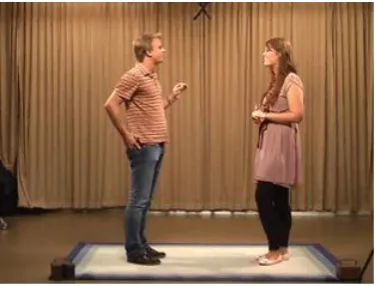
The interactions were video-recorded in a studio. The participants were standing in front of each other while being engaged in the conversation. The participants were recorded by three cameras, one taking a panorama view of them from the side (Figure 1), and the other two taking mid shots of each of them (Figure 2).
Figure 1: A combined frontal view of one First encounter
Figure 2: Panorama view from a NOMCO first encounter interaction
The second corpus used in this study consists of video-recordings of spontaneous interactions between two or three persons who are well acquainted. The participants were recorded in their private homes sitting around a table, drinking, eating and talking freely about various subjects comprising soccer, family relations and the current economic crisis. The recordings are part of a larger database, the MOVIN database, and have been collected and transcribed according to conversation analysis (CA) conventions by researchers at the University of Southern Denmark (MacWhinney and Wagner 2010). Part of the MOVIN video recordings and CA transcriptions are freely available from the talkbank homepage1. In the present study, four interactions are included for a total of 25 minutes. Five women, all aged 50+ were involved in the interactions
Figure 3 shows a snapshot from one of the triadic interactions.
3.
The annotations
Both corpora are transcribed orthographically and time-aligned at the word level. In the first encounters word stress and pauses are included in the transcription. In the conversations between acquainted persons the orthographical transcription and alignment at the word
1
http://talkbanken.org
level was added reusing the existing CA transcriptions (Navarretta 2011b).
In both corpora expressions such as øhm and hm as well as laughter have been transcribed.
Figure 3: A snapshot from a triadic MOVIN interaction
The transcriptions of both corpora were imported into the ANVIL tool (Kipp 2004), which was used to annotate the gestures and their relation with speech (Paggio and Navarretta 2011, Navarretta 2011a, Navarretta2011b). In figure 4 a print screen from the ANVIL tool with a dyadic MOVIN interaction is shown.
Figure 4: Print screen from the ANVIL tool
The multimodal annotations follow the MUMIN annotation scheme (Allwood et al. 2007), which provides pre-defined feature-value pairs accounting for different gesture shapes and functions. Here, we focus on feedback-related words, head movements and facial expressions.
Table 1 shows the features and values used to annotate the shape of head movements and facial expressions used in this study.
Head movements are described with two features, one indicating the type of movement and the other explaining whether the movement is performed once or more times. Facial expressions include here only a feature for the general expression of the face.
Gesture feature Gesture value
HeadMovement Nod, Tilt, Up-nod, Shake, Waggle, SideTurn, HeadBackward, HeadForward, Other
HeadRepetition Single, Repeated
Face Smile, Laughter, Scowl, FaceOther
Table 1: Head movement and facial expressions
Feedback feature Feedback value
Basic
CPU (Contact, Perception, Understanding)
Other (Contact, Perception) or (Contact)
Direction Give, Elicit, GiveElicit Agreement Agree, Disagree
Table 2: Feedback features
The first feature indicates whether there is feedback. In this study the only relevant value is CPU, which indicates that the gesturer’s behaviour shows signs of contact, perception and understanding. The second feature says whether the participant is giving, eliciting, or giving as well as eliciting feedback. Finally, the Agreement feature indicates whether the participant agrees with the interlocutor or not.
4.
Analysis of the annotated data
The present analysis is based on 10 of the videos from the first encounters corpus (about 50 minutes in total), 2 dyadic interactions from the MOVIN corpus (about 10 minutes) and 3 triadic interactions still from MOVIN (about 25 minutes in total).
4.1 Feedback-related words
There are 13,735 tokens (words, laughs and øhm
expressions) in the first encounters corpus, while there are 2216 tokens in the dyadic MOVIN data, and 3170 in the triadic interactions.
In these study, we account for the most commonly occurring expressions related to feedback, in other words
yes and no expressions, yes/no expressions henceforth. These expressions comprise the following words: ja
(yes), jo (yes), jamen (well), vel (well), okay, nej (no), næh (no).
In the first encounters corpus, there are 1051 yes/no expressions, corresponding to 0.78% of the tokens. In the dyadic MOVIN data there are 152 yes/no expressions (0.68% of the tokens) and in the triadic MOVIN data there are 376 (1.18% of the tokens). Thus, there are more yes/no expressions in the first encounters than in the dyadic conversations between well-acquainted speakers, but there are significantly more yes/no expressions in the triadic interactions than in the dyadic ones.
There are probably two explanations for these differences. On the one hand, people who are getting
acquainted may be prone to providing linguistic feedback to each other more than speakers who know each other, as can be seen from the two sets of dyadic interactions. The difference between dyadic and group interactions, on the other hand, may partly be explained by the fact that sometimes in triadic interactions two participants express feedback both verbally and through gestures simultaneously. The difference may also be partly due to the fact that yes/no expressions are also used to regulate turn taking, which is obviously more complex in the group situation.
The most frequently occurring feedback word is ja in all three interaction types.
4.2 Feedback-related Head Movements
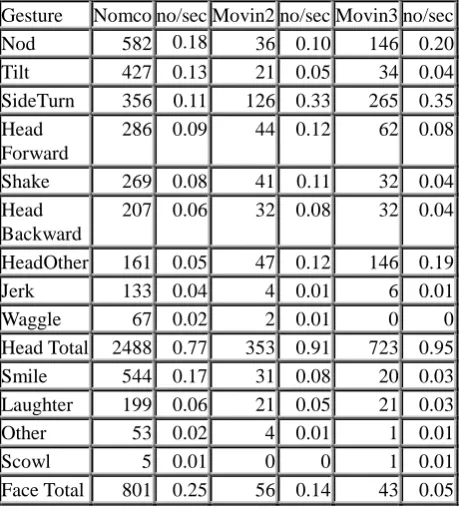
The number of head movements annotated in the three datasets and their frequency per second are in Table 3. These figures indicate that the participants in the first encounters moved their heads less frequently than those in the interactions between well-acquainted people, and that well-acquainted people produced head movements with similar frequency regardless of the number of speakers. If number of gestures is taken to be indicative of interaction flow, these figures would seem to parallel Campbell’s claims in the gestural modality. Well-acquainted people both gesture and talk more fluently than people who do not know one another. The difference in gesture frequency, however, is probably also determined by the different physical settings, by the participants’ age and the discussed topics.
Gesture Nomco no/sec Movin2 no/sec Movin3 no/sec
Nod 582 0.18 36 0.10 146 0.20
Tilt 427 0.13 21 0.05 34 0.04
SideTurn 356 0.11 126 0.33 265 0.35 Head
Forward
286 0.09 44 0.12 62 0.08
Shake 269 0.08 41 0.11 32 0.04
Head Backward
207 0.06 32 0.08 32 0.04
HeadOther 161 0.05 47 0.12 146 0.19
Jerk 133 0.04 4 0.01 6 0.01
Waggle 67 0.02 2 0.01 0 0
Head Total 2488 0.77 353 0.91 723 0.95
Smile 544 0.17 31 0.08 20 0.03
Laughter 199 0.06 21 0.05 21 0.03
Other 53 0.02 4 0.01 1 0.01
Scowl 5 0.01 0 0 1 0.01
Face Total 801 0.25 56 0.14 43 0.05
Table 3 Head Movements in the Corpora