Getting insight by giving insight
Development of an instrument to benchmark the integral
performance of intensive care departments
Author
Drs. L.M. Brouwer
Supervisors
Prof. dr. Ir. J.J. Krabbendam
Dr. ir. K. Visscher
Prof. dr. J. Bakker
Ir. A.F. van Hoorn
Preface
enabling the intensive care departments to learn from each other. First, as teachers say the best way to learn something is to explain it to someone else, intensive care management can get insight in their own department by giving others insight in their department. This enhances the insight they have in their own organisation, because in order to inform others about strong and weak points in their organisation, they first have to map the knowledge of their own organisation. Second, collective learning only can take place, if the departments together give sufficient insight in their organisations to have enough material combined as a base for discussions. Bundling the combined knowledge and opinions and comparing the different data, can then lead to insight in practices and performances of the intensive care departments. Concluding, giving insight is of utmost importance to get insight and to learn about best practices and performances.
Not only the ICUs learned during the project. By trying to give the departments insight in their practices and performances, I got a lot of insight in the way these organisations function. I learned how to involve and motivate people, how to coordinate a project and how to design and use a benchmarking method. I could not have done this alone. I would like to thank Arjan van Hoorn for his support during the whole process and prof. dr. Jan Bakker for trusting me to think of a way to benchmark ICU performance. Prof. dr. ir Krabbendam and dr. ir. Visscher helped me to formulate the theoretical section and to write this report. They did stimulate me to keep improving my work. The Erasmus Medical centre was a perfect basis for my research, and I wish to especially thank the people and the successive interns of cluster 17, who helped me with practical matters and made daily attendance pleasant during the seven months of the project I attended to cluster 17 daily.
Management Summary
MotivationThe intensive care is a relatively young department; it is only has been ten years the first ICUs were organized as stand-alone units. Intensive care is expensive: around 10 percent of the hospital budget is spend here, while only a small percentage of patients has to be treated on the ICU. With the rising pressure on hospitals to lower costs, the ICU has to deliver high quality care in an efficient way. Nevertheless, little information is available on how to optimally organize care on intensive care departments. Intensive cares do have a considerable amount of information about their patients, but they do not share information considering organizational set-up with each other. In this thesis, we develop an instrument to let the ICUs learn from each other in the area of ICU management by means of benchmarking. By giving insight in their organisational characteristics and reflecting on the provided data, the ICUs can develop more knowledge about good ICU management.
Developed benchmarking methodology
The developed methodology exists of the following phases. First, benchmark partners are chosen. Then, a stakeholder analysis is conducted to develop an understanding of the stakeholder groups having an interest in and an influence on the ICU. The third phase is to identify important processes on the ICU that could fit the concept of benchmarking and make a choice for a process on which the project is aimed. With the help of a developed questionnaire, in the fourth phase, information about patient streams through and system- and control characteristics of the participating ICUs are gathered. In phase 5 a performance indicator set is developed, of which the scores are gathered in phase 6. Phase 7 involves the analysis of the scores and making the link between contingency factors and scores on performance indicators. With this information, hospitals can then write and implement improvements. At last, the benchmark cycle is evaluated by the participants.
Results for benchmarking on the ICU
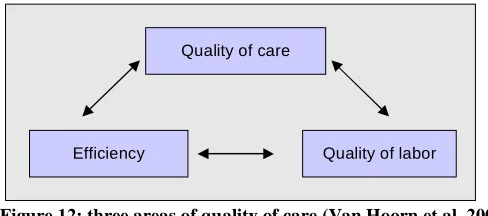
The partners involved in the benchmarking ICU project are all ICUs with a teaching licence, mostly part of a university medical centre. Salient stakeholders of the ICU are the IC nurses, staff, patients, referring physicians and the hospital board. The dominant coalition exists of the IC physician and the hospital board. Integral ICU management was chosen as the focus of our benchmark project, with the possibility to focus on more specific ICU processes later in the process. Through a literature review and interviews with stakeholder representatives, a unique set of performance indicators was developed. This indicator set measures, by means of structure, process, and outcome indicators, how the ICUs perform in the areas of quality of care, efficiency, and quality of work, representing the interests of the mentioned stakeholders. The remaining phases will be conducted in coming months.
Conclusion and recommendations
Content
1 INTRODUCTION ... 8
1.1 Introduction to the ICU ... 8
1.1.1 The ICU: from open to closed format ... 8
1.1.2 Patients taken up on the intensive care ... 9
1.1.3 Daily routines on the ICU ... 9
1.2 Developments leading to an emphasis on efficiency ... 10
1.2.1 Need for efficiency of the ICU ... 10
1.2.2 Initiatives to improve quality ... 11
1.2.3 The use of benchmarking ... 12
1.3 Problem statement ... 13
1.3.1 Research objective ... 13
1.3.2 Central research question... 14
1.3.3 Research questions ... 14
1.4 Definitions ... 14
1.4.1 ICU performance ... 14
1.4.2 Benchmarking ... 15
1.4.3 Best practice ... 17
1.4.4 Discussion concerning benchmarking and best practices ... 17
1.5 Research framework and reading guide ... 18
2 THEORETICAL FRAMEWORK 1: DEVELOPING A METHODOLOGY FOR BENCHMARKING OF THE ICU ... 20
2.1 Classification of benchmarking projects ... 20
2.1.1 Types of benchmark projects ... 20
2.1.2 Combining goals, subjects, level of analysis and research method ... 22
2.2 Benchmarking within a hospital setting ... 23
2.2.1 Assumptions underlying benchmarking ... 23
2.2.2 Implications for the methodology of benchmarking on the ICU ... 24
2.3 Facilitating collective learning ... 25
2.3.1 Inter-organizational learning ... 25
2.3.2 Conditions for successful collective learning ... 27
2.3.3 Implications of collective learning conditions to our project ... 28
2.4 Developing our benchmarking methodology ... 29
2.4.1 The benchmarking process ... 29
2.4.2 Selecting processes and partners ... 31
2.4.3 Incorporating stakeholders ... 31
2.4.5 Evaluation of the benchmark cycle ... 32
2.4.6 Adapted benchmarking methodology ... 32
2.5 Conclusion methodology development ... 32
3 THEORETICAL FRAMEWORK 2: SELECTING MODELS FOR THE PHASES IN THE BENCHMARKING ICU METHODOLOGY ... 34
3.1 Phase 2: stakeholder analysis ... 34
3.1.1 The dominant coalition of an organization ... 34
3.1.2 The stakeholder typology of Mitchell (1997) ... 35
3.2 Phase 4: analysis of process and contingency variables ... 37
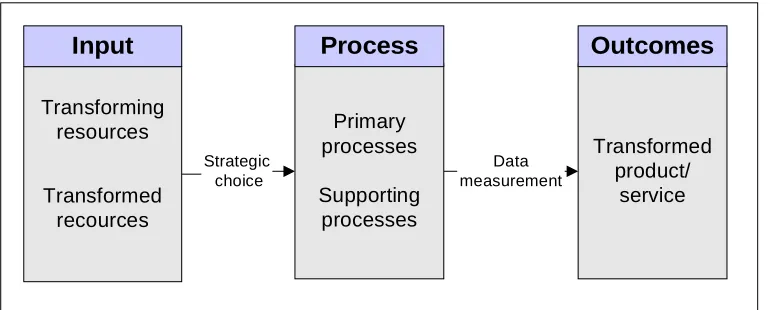
3.2.1 The transformation process model ... 37
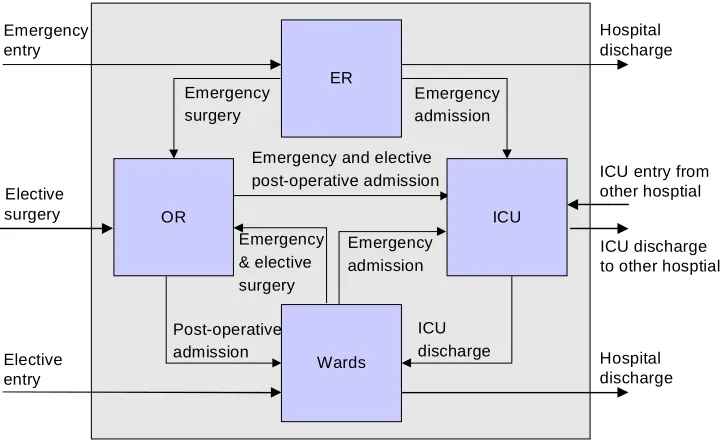
3.2.2 The patient streams model ... 38
3.3 Phase 6: development of a performance indicator set ... 39
3.3.1 A short history of IC performance evaluation: what can we learn from the past? ... 39
3.3.2 Developing a performance measurement framework ... 42
3.3.3 Combing the models in a framework for performance indicators for ICU evaluation ... 43
3.4 Conclusion model selection ... 45
4 DESIGN OF BENCHMARK PHASES AND INSTRUMENTS... 46
4.1 Phase 1: choice for comparable partners ... 46
4.1.1 Phase objective ... 46
4.1.2 Phase link with theory ... 46
4.1.3 Phase methodology ... 47
4.2 Phase 2: perform a stakeholder analysis ... 47
4.2.1 Phase objective ... 47
4.2.2 Phase link with theory ... 47
4.2.3 Phase methodology ... 48
4.3 Phase 3: choice for a comparable process ... 48
4.3.1 Phase objective ... 48
4.3.2 Phase link with theory ... 49
4.3.3 Phase methodology ... 49
4.4 Phase 4: description and analysis of process and contingency variables ... 49
4.4.1 Phase objective ... 49
4.4.2 Phase link with theory ... 49
4.4.3 Phase methodology ... 50
4.5 Phase 5: development of performance indicators in conjunction with the stakeholders ... 51
4.5.1 Phase objective ... 51
4.5.2 Phase link with theory ... 52
4.6 Phase 6: unambiguous and integral measurement ... 53
4.6.1 Phase objective ... 53
4.6.2 Phase link with theory ... 53
4.6.3 Phase methodology ... 53
4.7 Last phases of the benchmark cycle ... 54
4.7.1 Analysis of performance differences ... 54
4.7.2 Developing and implementing of improvement plans by the hospitals ... 54
4.7.3 Evaluation of the benchmark cycle ... 54
4.8 Conclusion phase and instrument design ... 54
5 PILOT PROJECT: RESULTS OF THE FIRST BENCHMARK CYCLE ... 55
5.1 Phase 1: choice for comparable partners ... 55
5.1.1 Phase results ... 55
5.1.2 Phase evaluation ... 55
5.2 Phase 2: perform a stakeholder analysis ... 56
5.2.1 Phase results ... 56
5.2.2 Phase evaluation ... 58
5.3 Phase 3: choice for a comparable processes ... 59
5.3.1 Phase results ... 59
5.3.2 Phase evaluation ... 59
5.4 Phase 4: description and analysis of process and contingency variables ... 60
5.4.1 Phase results ... 60
5.4.2 Phase evaluation ... 64
5.5 Phase 5: development of performance indicators in conjunction with the stakeholders ... 65
5.5.1 Phase results ... 65
5.5.2 Identifying stakeholders interests ... 69
5.5.3 Phase evaluation ... 73
5.6 Phase 6: Unambiguous and integral measurement ... 74
5.6.1 Phase results ... 74
5.7 Conclusion on the pilot execution of the first benchmark cycle ... 76
6 DISCUSSION AND CONCLUSION ... 77
6.1 Contributions to knowledge of benchmarking ... 77
6.2 Discussion and recommendations ... 78
6.2.1 Recommendations to successfully finish the first benchmark cycle ... 78
6.2.2 Discussion on benchmarking vs. innovation ... 78
6.2.3 Recommendations on the processes benchmarked after the first benchmark cycle ... 79
6.2.4 Recommendations on the partners with whom to benchmark after the first benchmark cycle ... 79
6.3 Conclusion ... 80
REFERENCES ... 81
Benchmarking IC
Plato1
Introduction
In this chapter an introduction to the intensive care department and the benchmark project that will be conducted with the intensive care departments is given. It is motivated why there is a need for a benchmark instrument for the intensive care departments and recent movements in and around the organization of intensive care departments, leading to a grown emphasis on transparency and efficiency, are stipulated. The problem statement guiding the following research is formulated and important concepts to the project are defined.
1.1
Introduction to the ICU
First, we depict the intensive care department as it functions in the Netherlands. This will give a perspective on its functioning which will make clear in what kind of organization the benchmark project is started up.
1.1.1 The ICU: from open to closed format
At intensive care units, patients with disruptions of the vital functions are treated and monitored. The differentiated patient mix and specialized staff make it one of the most complex departments in the hospital. Critical care is a relatively young profession; although since World War II special areas in the hospital were designed for the most injured patients, only for a few years the ICUs have been -alone department, with ICU specialists having formal responsibility for all treatments on the ICU. For most hospitals, this means that with the transition from an open to a closed format, the ICUs moved away from the influence of the referring specialisms they were once part of. This is reflected in the number of ICU departments that are rebuild or have planned to rebuild the IC department to integrate the specialized units into one general department.
Next to the changing role of the intensive care physician, other important issues concerning the role and responsibilities of the ICU are also in development. It is still recent there was made a distinction in ICUs with minimal resources (level 1) to highly equipped ICUs that must be able to handle all patients (level 3) (CBO, 2006). In the last two years, discussions were held concerning the number of beds that should be available and where (Hautvast et al., 2001), the criteria ICUs should handle around the admission and discharge of patients (NVIC, 2000), and the coordinating role in the region of level 3 ICUs concerning patient placement and transport (Inspectie van de Gezondheidszorg, 2005; NOVA, 2007). So, the intensive care in most hospitals operates in a dynamic playing field and is currently an organization in development.
1.1.2 Patients taken up on the intensive care
A level 3 ICU handles around 1500 to 3000 admissions each year, of patients with around 300 different diagnoses. Many of the patients are treated for a combination of multiple diagnoses. As defined in the Dutch admission and discharge guideline, in order to admit a patient an ICU physician must expect the patient to profit from the admission on the ICU (NVIC, 2000). ICU admission must provide value that cannot be delivered by general wards and must lead to an increase or at least stabilization of the health status of the patient. The patients are referred to the ICU by all kind of physicians, stemming from multiple places in the hospital.
Patients arriving to the ICU have covered different ways before arriving on the ICU1:
A large part has undergone a procedure and comes from the operating room (OR), mostly via the recovery room. Surgery patients coming from the OR can be subdivided in planned or elective patients, of whom the surgery was planned and a place on the ICU could be
reserved, and urgent or unplanned patients, who underwent an urgent procedure which was not planned on beforehand.
Another part of the patients are medical patients, who did not undergo surgery in the 24 hours before ICU admission. They arrive on the ICU after having visited the emergency room (ER) or are (re) admitted from the wards after a worsening of their condition.
Both categories of patients can also be admitted to the ICU via the ICU of another hospital. In practice, patients are transferred between hospitals when they are too severely injured to be handled in the sending ICU. It is also possible that a patient is transported to another ICU because there are capacity problems on the ICU that has sent the patient to the admitting ICU.
The patients are treated and guarded by a team of specialized nurses and physicians assisted by highly technological equipment. ICU physicians are specialists (commonly internists, anesthesiologist or surgeons) that have followed an additional education of two years concerning intensive care medicine. Critical care medicine is not a medical specialism, but is called an area of interest. IC nurses also have had two years of extra education on top of their general nurse education. Both nurses and physicians are scarce, and many ICUs have to close beds because they cannot guarantee quality of care for more patients with their current staff capacity.
Common equipment of an ICU includes mechanical ventilation to assist breathing, dialysis machinery for renal problems; a web of intravenous lines, all kinds of tubes and pumps, drains and catheters; and a wide array of drugs to treat or sedate the patients and to prevent infections of the vulnerable patient.
1.1.3 Daily routines on the ICU
As described, the patient mix on the ICU is diverse, and all patients receive multiple different therapies. This results in a lot of different processes that take place next to each other and asks for flexibility of the workforce in combination with many skills. Besides taking care for the patient, in teaching hospitals also research is done and nurses and physicians are educated, on the bedside or in classes.
1
Since processes on the ICU have grown by experience, and are not designed, daily routines vary in every ICU. For example, the way care is tuned between ICU nurse and physician or ICU physician and referring specialist varies in every hospital. Also, it depends on the hospital whether the individual staff members work for one, or for all of the different units of which the IC department exists. Differences also exist in the way the division of beds takes place. During the day, different departments and sometimes physicians from other hospitals call to ask a place on the ICU for their patient. On some ICUs, these request for beds are handled by one physician, on others it depends on the one who answers the phone. Most hospitals do have a protocol in which guidelines concerning the admission and discharge of patients are registered. It differs per hospital how much insight the ICU has in the predetermined question for beds. Most hospitals get the planning from the operating theatre in advance, but other patients are not foreseen in advance.
In most ICUs, three shifts are scheduled each day. Based on the level of the ICU and sometimes on the level of disease of the patient, there are 1, 2 or in the night 3 patients for which the ICU nurse is responsible. In the morning, ICU physicians and assistants, and depending on the hospital, also the nurses or some of the referring specialists, make a first round along the patients on the unit. Physicians set the treatment policy for each patient and communicate this to the responsible nurse. In the following hours, nurses provide care to the patients. Two main areas in patient care can be distinguished, namely, the processes related to patient medical care and those related to patient comfort (Hariharan, Dey, Chen, Moseley, & Kumar, 2005). Patient care exists of giving therapeutic interventions: for example, settling invasive lines, removing respiration tubes in deserving patients, and bedside procedures like monitoring the patient conditions. Furthermore, blood samples are taken for lab tests and patients are brought to the radiology department to make for example x-rays. Providing patients comfort is achieved by the appropriate use of sedatives and muscle relaxants, and by the attitude of the staff being friendly and keep the patient and their relatives informed. In the morning, physicians perform medical practices, speak with family of the patients, write patient reports or consult other physicians. Also, often ICU physicians are asked to consult elsewhere in the hospital or to visit the ER to help with diagnosing and transporting an emergency patient to the ICU. Around noon, most ICUs have scheduled a multi-disciplinary meeting in which the treatment policy of patients is discussed in a team of ICU and referring physicians, pharmacists, nurses, a laboratory worker, an ethicist and/or neurologists. Who exactly are present and if all or only part of the patients is discussed differs among the hospitals and depends on the patients on the unit. After the meeting, the treatment policy is adapted and the bedside care is continued. Around three and eleven, the new shift of nurses arrives and the transfer of responsibility for the patients takes place.
1.2
Developments leading to an emphasis on efficiency
In the past ten years, IC organizations have been experiencing several developments. As a result, many ICUs have changed their organizational structure or are still in a transition process. We introduce benchmarking as a way to guide improvements.
1.2.1 Need for efficiency of the ICU
number of beds on the ICU is restricted. Capacity problems exist on most ICUs, since budget and especially personnel is scarce and the demand for ICU beds for patients is often larger than then the available number of beds. In a research to the extent of this capacity problem in the Netherlands, almost 10% of the total number of patients needing a place on the ICU was rejected and had to be placed elsewhere because there was no capacity on the initial ICU that was approached (Hautvast et al., 2001). This illustrates the importance of the capacity problem. Efficiency of providing care, combined with high quality of care, is therefore important to pursue, so that the resources that are available can be used optimally to treat as much patients as possible in a responsible way (Reis Miranda, 1991). In this respect, a strict admission and discharge policy is also important, and IC physicians are working on this subject. Now the ICU has become not only a resource intensive environment, but also a centralized location in the hospital with well-defined borders, it is a natural place in the hospital to think about management and efficiency of care.
Investigating the efficiency of hospitals adheres to a national trend: since the population is aging and costs of care keep rising, the Dutch government, the public and insurers are pushing healthcare providers to become more efficient and transparent (see e.g. Better Faster Program, 2003). Not only economic reasons exist for the quest to improve performance; since patients in the hospital are vulnerable, they should be able to trust the hospital they lay in. It was argued by the Institute of Medicine that, while the amount of evidence-based knowledge about medicine is enormous, there is much to be gained in the quality of care actually provided to patients (Corrigan, 2001). This gap
government in previous years only controlled hospitals once every year through the Inspection of Healthcare, hospitals now have to give more and more information regularly. Already, hospitals have to give information about a set of hospital-wide indicators. In a recent letter, the Minister of Welfare indicated that it is his intention that in the coming years, intensive cares have to provide more information, since they take care of the most vulnerable patients (Klink, 2007).
Currently, there is no structured knowledge available about the differences and similarities in organization between the ICUs of the university medical centers. This is maybe due to the competition between teaching hospitals in the area of attracting staff and patients. The ICUs have no overview of existing differences in organization and organizational performance. Especially the ICU, with its complex patient mix and the network function within the hospital, is a department where many processes take place next to each other. Since most of these processes emerged from daily practices and were not designed for optimal performance, it is likely that some gains can be found in a research with respect to the best organization of an ICU.
1.2.2 Initiatives to improve quality
indicator scores. This probably does not reflect the differences in patient diversity and difficulty of
indicators. Therefore, these lists mainly provide value as a marketing instrument, and are not useful for helping to improve the quality or efficiency of care (Berg, 2003). Besides parties that publish lists of indicators, there are companies that perform benchmark investigations for healthcare institutions. A disadvantage of their approach is that the healthcare institutions do not really participate in the benchmark project, since they only have to deliver data and therefore do not develop a thorough knowledge about their own operations. To really improve efficiency and quality of care, initiatives from inside the hospitals have to be taken.
The hospital sector itself also took several initiatives to improve the quality of care on the ICU. To assure quality of care, the professional association of intensive care physicians took initiative to formulate a guideline to provide clarity concerning the organization of daily practices on the ICU (CBO, 2006). Local physicians wrote ICU protocols, based on national guidelines to standardize processes. Also, professional audits are held to evaluate the quality of the audited ICU. Professional audit committees visit ICUs of level III to grant or prolong education licenses. A large proportion of hospitals participate in the NICE foundation, which collects and analyzes indicators of quality of care and provides hospitals with their data compared to national averages. Furthermore, van der Voort and Keesman (2004) developed an indicator set to measure quality of care on the ICU.
None of these initiatives evaluates the ICU organization as a whole in a structured way with the aim to improve care. Guidelines are very specific for parts of the processes on the ICU. Audits do
educate. Furthermore, these reports remain often confidential so hospitals cannot learn from each other. The data provided by NICE do offer the possibility to compare the own hospital to the mean of all Dutch hospitals. Since there exist large differences between hospitals, comparing the score of the own hospital to the mean score of all these hospitals offers limited information. The indicator set of der Voort and Keesman (2006) is made only by physicians, while Edgar (2006) argues that a broader group of physicians, hospital boards and for example the inspection of healthcare should develop indicators and norms. As a result, the set of Van der Voort et al. focuses only on the medical side of performance, and does not involve measures for efficiency. All these measures offer some form of insight in a part of the ICU, but a general framework and methodology to measure and improve the integral ICU organization is lacking.
1.2.3 The use of benchmarking
Intensive care department heads of several Dutch medical centers have now expressed their interest
Learning from each other can be reached with benchmarking. The definition of benchmarking used here (and elaborated on in the definition section of this chapter) is the following:
Benchmarking is a continuous and systematical process used for generating steering information by the measurement and comparison of performance, with the objective of finding starting points to improve the own performance by implementing best practices (Poerstamper, Mourik-van Herk, & Veltman, 2007).
operation rooms (ORs) investigated in which areas they could learn from each other, especially in the area of OR utilization and patient satisfaction. The project was successful in making it possible not only to show where differences in performance existed, but also which mechanisms could explain these differences and who to turn to when an OK department wants to improve its organizational practice in a certain area. But, even more important, the project succeeded in letting ORs speak with each other for the first time, and give insight in their organization. This project showed that, although benchmarking is often used for ranking, it could also be used as a basis for inter-organizational learning. The benchmarking steps developed for the OK can be used as a guideline for the benchmarking ICU process; since the ICUs want to learn from each other and are primary looking for infrastructural improvements, benchmarking is a proper method (Hayes, Pisano, Upton, & Wheelwright, 2006).
1.3
Problem statement
Summarizing the above, it can be stated that both external parties as well as the ICUs themselves see the urgency for a better understanding of structures and process of organizing care. However, although there are several initiatives to get insight in a part of ICU performance, there is no tradition of transparency and sharing of best practices between different hospitals. A framework for comparing and improving ICUs is lacking. Although some external parties try to make care more transparent, they do not succeed in giving more insight in the mechanisms leading to good quality of care. Benchmarking can be used to enable the ICUs themselves to get the insight in the structures, processes and outcomes they aim for.
1.3.1 Research objective
The aim is now, to design a benchmarking instrument to measure performance of the ICU. The following research objective can be formulated:
After participating in this research, the ICUs have a benchmark instrument for ICU performance measurement that can be used for inter-organizational learning in the area of organization and management.
The following more specific aims are served by this project:
- Enable the ICUs to meet and exchange information
-
- Make accessible information concerning the link between organizational set-up and
performance, this can serve as a basis for strategic choices
The value of the benchmark instrument to be developed can be determined by the level to which it helps the ICUs to learn from each other. By using the instrument and the model to evaluate current performance, and performance differences between them, the ICUs should be able to identify possibilities for improvement of their own departments.
1.3.2 Central research question
The central research question, following from the research objective, is how to enable the participating ICUs to use benchmarking as a means to learn.
What should a benchmark instrument look like, to benchmark the performance of the eight IC departments participating in this research, and how should the ICUs use it?
What we exactly mean with benchmarking and performance is elaborated on in the definitions section, paragraph 1.4.
The value of our research project will be the provision of an instrument and a model with which we can use the instrument, to enable the ICUs to learn from each other.
1.3.3 Research questions
To find an answer to the central problems, we break up the central research question in two questions. As stated above, benchmarking is a systematical process, so we need to find a method for the process of benchmarking:
1) With which methodology can we use benchmarking to enable the ICUs to learn from each other?
With answering this question, we find out what benchmarking exactly is, how it can be used in our project with the ICUs and which methodology we should use to perform benchmarking in this context. This information will provide us the basis for answering our second research question. Now we have defined the steps we have to take in the benchmark process, we can ask what we need to provide to the ICUs to enable them to undertake the project. The second question therefore relates to the instruments the ICUs need to perform benchmarking:
2) What instruments do the ICUs need to perform benchmarking using the developed methodology?
In chapter 2, we will try to find information helping us to answer the two research questions.
1.4
Definitions
In this paragraph, we clarify the concepts central to the research.
1.4.1 ICU performance
In order to survive, all organizations have to constantly align their resources and capabilities to the needs of their environment. Although they are protected by several structures to prevent it from too much influences of the market, this also holds for hospitals and hospital departments. Hamel and Prahalad (1993) state that the wishes of the different stakeholders, internal or external to the organization, inevitably stretch the resources and capabilities of an organization from time to time. All organizations must therefore make choices in the needs they want to serve primary.
Scott (1995) suggests that organizations are political arenas in which different groups attempt to institutionalize the performance criteria that serve their interest. In any organization, the decision making process and the strategic choice for certain performance objectives is inevitably influenced by organizational politics. Pfeffer (1992) states that these kind of conflicts are resolved by bargaining among the different coalitions, in which some coalitions can exert more power than others. In other words, performance objectives found in an organization tend to reflect the interests of those who comprise the dominant coalition in a firm (Waggoner et al. 1999). We therefore should incorporate the opinion of the dominant stakeholders in the evaluation instrument of performance in one way or another, to ensure it represents ICU performance as perceived by the dominant coalition of key stakeholders. In section 3.1 we elaborate on the concepts of stakeholders and dominant coalitions, and explain how we can identify them and use them in the creation of a performance measurement system.
The stakeholder view of performance is well suited to hospitals. Their main aim is to provide care to those that need it. For the ICU, performance can therefore be described as the balancing of the demands of the several stakeholder groups:
1.4.2 Benchmarking
Gathering intelligence about the competitors of an organization to improve the own operations is hardly a new idea. Historically, industrial growth and development has been advanced by imitation of technology and business practices in countries around the globe. Started at Xerox at 1979, benchmarking as a formal practice was introduced. Benchmarking is described by Camp (1989) as the search for industry best practices that lead to superior performance. In the industry sector it is an important instrument: in the last decade, benchmarking constantly was one of the five most used management tools worldwide (Bain & Company, 2007). There are several reasons to use benchmarking: it can make it possible to assess the own position in comparison to others, it can provide starting points for learning and improvement and it can be used to increase transparancy. Also, if performed well benchmarking can give insight in the relation between management practices
and performance (Poerstamper et al., 2007). assess
A limitation of benchmarking is often the focus on quantative data, resulting in a lack of understanding were the data came from and what they mean for the organizational processes. Without a notion of how the underlying processes work, it is hard to improve these processes. Benchmarking can also elicit losing the focus on customers or clients, when an institution focuses too much on improving the numbers. Examples of situations were a focus on short-term numbers can lead to, are employee burnout and errors and irritated customers and suppliers caused by a focus on financial goals (McNair & Leibfried, 1992).
Another limitation of benchmarking may be that many organization fail to implement improvements in processes properly. Proof of the effect of benchmarking on organizational improvement is lacking. Although benchmarking is a popular tool, when asked, only 4 percent of the public institutions knows how to adapt their procedures and systems to improve performance at the end of the benchmark process (Accenture, 2006) and an even smaller percentage also undertakes these actions. According to Freytag and Hollenson (2001)
plays an important role in the inability to improve after benchmarking. Tactics not invented by the organization members themselves are perceived inferior by definition, which does make it a lot less likely that best practices from others are accepted. Another reason they mention why benchmarking is often not effective is resistance to change. Whether a best practice is good or not, change is always difficult since employees and managers, like all people, tent to resist a change, especially when it is imposed on them and when it requires a change in their view of the world, or mental schemes.
There are several definitions of benchmarking. Some of them stipulate comparison, others improvement and there are also definitions that point out learning as important aim of benchmarking. The Benchmarking OK project used the following definition as their working definition:
Benchmarking is a method to compare a function, activity or process of an organization with the best
excellent performance (Vries & Togt, 1995).
This definition links well to the aim of the study to compare academic ICUs to find best practices to improve the own performance. The definition given by the Dutch government is the following:
Benchmarking is the comparison of different (parts of) organizations with the central aim of learning from each other. Stated differently: the process of the systematical search for performances and the related processes and practices of participating organizations with the aim of learning from each other (Ministerie van Binnenlandse zaken en koninkrijksrelaties, 2007).
The last definition mentioned here is the one provided by Poerstamper et al. for benchmarking in a healthcare environment:
Benchmarking is a continuous and systematical process used for generating steering information by the measurement and comparison of efficiency and quality of performance, with the objective of finding starting points to improve the own performance by implementing best practices (Poerstamper et al, 2007).
Remarkable in this definition is that benchmarking is seen as a continuous process and not as a one-off event. Another notion in this definition is the multidimensional character of benchmarking: both efficiency and quality of performance are measured and compared, to avoid improvement actions in which efficiency is improved but quality declines, or the other way around, which is quiet essential, especially in the hospital sector. The definition stipulates that benchmarking is meant to generate steering information that can be used to improve the way input variables are used to generate outcomes. This avoids that benchmarking is seen as a process that only gives insight: the goal is to really use the results to change the way value is provided. The definition also gives a clue about how to improve: by using best practices to find starting point for improving the own performance.
1.4.3 Best practice
(Wikipedia, 2007). This definition is quiet vague. Prax (2000) gives us a better definition:
A best practice is every practice, knowledge or know-how, which showed its effectiveness or its value in (part of) a company and which is applicable to another (part of the) company.
He remarks that to be used as a best practice, it should be possible to transfer a practice to another part of the organization (or another organization, in the case of external benchmarking). However,
1.4.4 Discussion concerning benchmarking and best practices
e activities in which a company outperforms others exist largely of intangible competences, originating from years of experience. It is discussible whether it is possible to identify and copy exactly those practices that lead to the high performance aimed for. The biggest impediments to best practice transferring are often knowledge-related factors, such as causal ambiguity about the exact production factors and the interaction of those factors leading to success (Szulanski, 2000), and a lack
new external knowledge (Crossan, Lane, & White, 1999).
The third limitation of best practice adoption relates to the strategic role of operations. Companies can achieve competitive advantage through operations by aligning their operations to the strategic choices they make (Chase, Aquilano, & Jacobs, 2001). When simply best practices of others are adopted, the role of strategic analysis and
decision-improvement technique to adopt next. Therefore, the competitive advantage operations can provide will disappear (Hayes et al., 2006). Also, conditions for success will change. In a competitive environment, long-term success lies not only in the adoption of the right operational practices, but in the ability to adapt to changing environmental circumstances and to keep improving performance over time (Hayes et al., 2006). Where the practice first helped the donating company to outperform the competitors, their practice now has become the norm and lost its value as basis for differentiation, or providing unique competitive value. Of course, the company donating the knowledge has the advantage of the learning process it has gone through developing the practice, which will maybe help it to develop new competitive practices. The adopting firms do not have this advantage and will end up striving to adopt the next best practice. Also,
Lastly, a best practice is only best for the aim it is meant for. If companies have different strategic objectives, the processes leading to fulfill these objectives will be different. It is therefore important to have a clear view on the objectives of the institution before trying to copy best practices from others.
Concluding, best practices can be used as a starting point for improvement, but have to be treated as indications and not as solutions. First, one should judge how much the best practice actually contributes to performance. Also, one should critically assess whether the best practice is useful for improvement of the own performance, paying attention to the strategic goals, organizational culture and environment of the own organization. Even then, it is perfectly possible there are other, and maybe better, ways to improve performance.
1.5
Research framework and reading guide
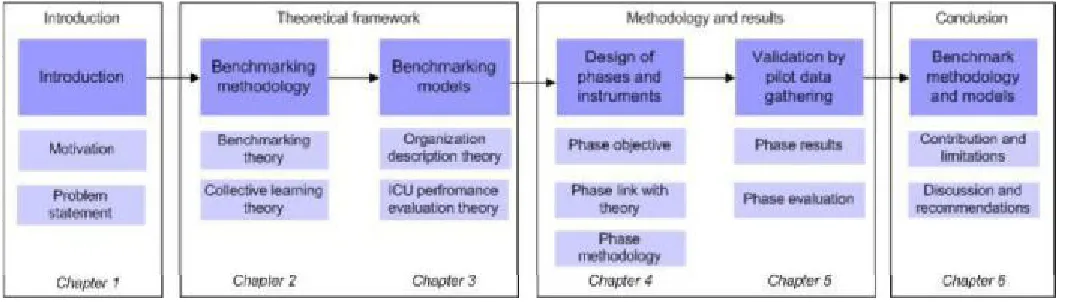
In the following sections, we will first try to find information to answer our research questions by the use of relevant literature. We do this in two sections: first we develop a benchmark methodology with the help of literature on benchmarking and learning. Some phases will speak for itself, in others a model is needed as a basis with which to develop an instrument to describe for instance the people relevant to the ICUs or the performance of the ICUs. In that way, we distract from the literature a benchmarking methodology and models we can use as a basis for the instruments we need to execute the phases of the methodology.
Following, in the methodology section, we will describe how every step in the benchmark process should be executed. In this section, of each phase the phase objective, the phase link with theory and the methodology of the phase is elaborated on. For each step, we use the models identified in the theoretical section as a basis for the instrument we will use in the benchmarking IC process. The result is a detailed benchmarking methodology especially fitted to the ICUs.
evaluation of the participating ICUs. The results section describes the results of using the instruments on the ICU: it covers both the data delivered by the ICU and evaluates the benchmark process.
In the last section of our research, we discuss the developed methodology and instruments and give recommendations for further use.
The research framework displays the important parts of this thesis (figure 1).
2
Theoretical framework 1: Developing a methodology for
benchmarking of the ICU
As described in the last section, to be able to benchmark the IC departments, we have to understand and find a methodology for the process of benchmarking. Therefore, in the first part of this chapter, we elaborate on the types of benchmarking projects and the methodology of benchmarking. Also we ask ourselves, whether we can use benchmarking in a hospital environment. To this purpose, we examine some assumptions underlying benchmarking, to deduct some requirements to our benchmark model and methodology. Since the aim of our project is to enable inter-organizational learning, we than examine the link between benchmarking and learning. We give an overview of organizational learning theory and look to how we can adapt our benchmark methodology to the aim of letting the ICUs learn from each other.
Figure 2: Place of section 2 within the research framework
2.1
Classification of benchmarking projects
Not all benchmarking projects are the same. Goals, principles, the nature of the group with whom benchmarking is performed and the level of analysis differ per project. The type of benchmark project one wants to conduct has an influence on the methodology and the type of model to use. Therefore, in this paragraph, we elaborate on common benchmarking classifications and reflect on the place of the benchmarking IC project.
2.1.1 Types of benchmark projects
Classification of benchmark projects can be done according to the following criteria (Poerstamper et al., 2007):
Goal and benchmark principle. The goals institutions want to reach with the use of benchmarking are plenty. Finding best practices to improve the own operations, legitimating the strategy,
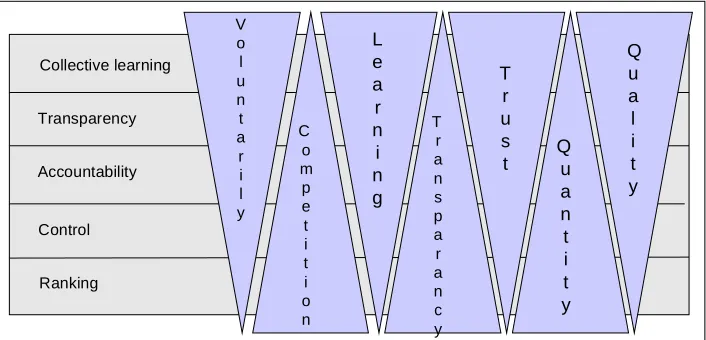
Figure 3: Goals of benchmarking (Dutch government position on benchmarking, 2004)
evaluating the performance in comparison to others, examining the strengths and weaknesses, learning from each other and testing whether the institution complies to certain norms are a few examples of goals companies try to reach with benchmarking (www.kwaliteitsmeter.nl). Although one benchmark project can cover multiple goals, the goal of the project has implications for the benchmark process.
Different goals will sometimes have conflicting implications for the benchmark process (figure 3). Because of conflicting goals, it is important to decide beforehand what the goal of benchmarking is and to make clear and take explicit measures to arrange the process in an according way. For example, a benchmark with the goal of ranking will happen in a climate of competition and will involve quantitative comparisons. Benchmarking here is based on performance comparison.
Contradictory, when the goal is to learn from each other like our project, the benchmark process will have to take place in a climate of trust, it should be based on voluntary participation and the focus is likely to lie on qualitative measures. Also, it would be appropriate to not focus on performance comparison only, but try to link performance to organizational structures and processes.
Subject. What we want to benchmark is dependent on the goal of benchmarking:
Performance benchmarking is making a comparison of pure key figures or other performance measures
Process benchmarking goes beyond performance measures and compares how business processes are performed, not only how well they are performed.
Strategic benchmarking is the comparison of strategic decisions and dispositions at a higher level.
Selecting a different subject will naturally lead to other gained knowledge. Of course, subjects can overlap: it is possible that, while benchmarking processes, conclusions about performances and strategy can be drawn based on the acquired knowledge.
Comparison group. Against whom can you benchmark? Four kinds of comparison groups are described in literature (Anderson, 1995):
Internal benchmarking. Comparison against sub-structures within the same organization. Competitive benchmarking, comparison against the best direct competitors.
Functional benchmarking, comparison against organizations that are not necessarily a competitor, but that perform related tasks within the same technological area or business. Generic benchmarking, comparison against the best, regardless of industry or markets
The level of analysis. The level of analysis can be a whole company, but also a department, a process or a certain function of the institution. This has consequences for the level of detail that can be reached.
that if the performance of the best participant is close to that of the other participants, benchmarking will not deliver spectacular results.
Research method. The benchmark can have different structures. The level of involvement of the participants depends on the research method chosen. The benchmark project can be performed by the institutions itself or by an external company, which will make the effort required from the participants lower since they can profit from the methods and standards used by the external company (Poerstamper et al., 2007). This will likely also lower the expected benefit of the project, since the process of benchmarking itself delivers the participating institutions valuable knowledge concerning their own organization, their ability to learn, and the way the results of the benchmark project need to be interpreted and used. Since our goal is learning from each other, it is important to involve the ICUs as much as possible in the process.
2.1.2 Combining goals, subjects, level of analysis and research method
In theory, all combinations between goals, research method, subject and comparison group can be made. Nevertheless, it is better to adjust these to each other.
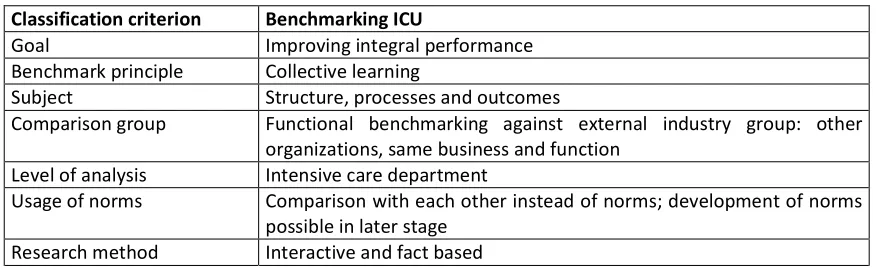
Using the above-mentioned typology to describe benchmarking on the ICU, we come to the following categorization (table 1). As stated before, the main aim of the benchmarking project is learning from each other in the area of ICU management. After the project, the participating ICUs will have more knowledge about integral IC management, which they can use to improve their own performance. We aim to reach this by making a collective comparison of structure and control characteristics, in combination with performance indicators. These performance indicators should not only measure outcomes, but also the way the organization tries to accomplish these outcomes; so process indicators should also be involved. A group of teaching ICUs conducts the benchmarking project, which makes the benchmark group external (outside the own organization), but with comparable functional partners. The level of analysis is primary the ICU: although its place in the hospital and the borders of the ICU with other departments are also described, our primary focus is the ICU itself. Performance can be compared with norms when available, if not only with each other. The research method is active: the ICUs themselves have an active role in the choice of indicators and processes to be benchmarked. The method is also fact based: the ICUs have to found their claims with facts. As stated in the theoretic section, the active role the ICUs have to play will stimulate to think about their own performance and facilitate the learning process.
Table 1: Benchmarking ICU Profile (based on the classification scheme of PriceWaterHouseCoopers)
Classification criterion Benchmarking ICU
Goal Improving integral performance
Benchmark principle Collective learning
Subject Structure, processes and outcomes
Comparison group Functional benchmarking against external industry group: other organizations, same business and function
Level of analysis Intensive care department
Usage of norms Comparison with each other instead of norms; development of norms possible in later stage
2.2
Benchmarking within a hospital setting
There are several aspects in a hospital environment that differ from the industrial sector that can have an influence on the process and results of benchmarking. Some characteristics of the value providing process in healthcare differ from that in most industries: for example, the provision of health care brings a lot of uncertainty, health care processes can often not be easily interrupted, health care is a service that cannot be stored, health care provision can have radical consequences on the life of patients, and clinicians posses a considerable amount of professional autonomy (Houdenhoven, Wullink, Hans, & Kazemier, 2005). Other differences between financial oriented companies and the quality-oriented hospitals are the large number of interfaces between the patient and the hospital and the level of external legislation around the provision of care. This can have consequences on the process of benchmarking. Since benchmarking as a method is developed for industrial firms we should check whether the assumptions underlying benchmarking are valid for the hospital sector. It may be that to use benchmarking in a hospital, some special care should be given to the benchmarking process to make sure the results expected can be met.
2.2.1 Assumptions underlying benchmarking
To test whether the assumptions underlying benchmarking are valid in the hospital environment, the following assumptions, as identified by Wareham and Gerrits (2004), are discussed for the hospital sector:
Homogeneity of organizations. To apply knowledge of one organization in another assumes some degree of homogeneity between the two organizations. Since hospitals are complex organizations, attention should be given to the degree to which the participating IC units are comparable. One large cause of variability between hospitals, the variation in patient mix, should be investigated to be able to argue whether the hospitals operate in comparable environments. As stated before, intensive care departments are relatively young and not standardized. Therefore, similarities and differences in organizational set-up should be clearly established early in the process, to make it possible to take these into account in later phases of the project.
Universal yardstick. Identifying best practices implies the existence of some kind of absolute measurement method with which performance of the different participants can be measured in a standardized way. This implies that to benchmark, we have to develop an instrument that is accepted and understood by all participants. Ideally, we could then compare the performance of the participants with this method to a well-established norm. In the words of Mainz (2003)
Transferability. Benchmarking assumes that practices that are successful in one organization can be applied in another organization and will provide similar results. Wareham et al. (2004) argue, as stated earlier in the elaboration on best practices, that it is almost never the case that practices can be duplicated. But it is part of the learning experience to understand whether identified practices could conflict with existing organizational structures and cultures (Fernandez et al, 2001). An advantage of benchmarking in a hospital is that medical tasks are largely standardized by means of the professional education staff and nurses have received. However, since the organizations are all relatively young and in different stages of growth, this does not count for their organizational practices. Therefore, in our research it is important that relevant similarities and differences of the ICUs are described, in order to be able to judge whether it would be possible to transfer practices from one hospital to the other. The issue of transferability is somewhat contradictory to the subject of diversity; to profit from benchmarking, variation in the participating institutions is needed to ensure there are differences in processes. The art of benchmarking is to find partners that operate in a comparable environment and are subjected to comparable conditions, but have differences in the way they have organized their business to serve their objectives.
Alienability and stickiness. Alienability refers to the question whether knowledge can be extracted from its context. If hospital practices that lead to good performance are largely based on tacit knowledge, this knowledge may be difficult to transfer to other hospitals. r a practice from the source organization to the receiving organization (Szulanski, 2000). A co-operating knowledge donor and a willing and able knowledge recipient facilitate a successful transfer process. To ensure learning can take place in our project, we therefore should create an environment in which this is possible. We will come back to this subject later in this section.
Validation. Pointing to a best practice presumes one can measure which practice is best. Where in the industry sector it is often common practice to measure performance, in hospitals this is less embedded in culture. We should pay attention to validation on two subjects in our research: the data that we gather should be valid and reliable, and the performance indicators we are going to use to evaluate performance also have to be both valid and reliable.
Regarding to the data, we should therefore make sure the questions we ask are clear and cannot be interpreted in multiple ways. Also, we have to ensure that the data we get from the hospitals is reliable: it should be gathered in a structured way and checked for inconsistencies. Regarding the validity of the performance indicators, we should check the literature to find indicators that are already validated to ensure we use a valid and accepted instrument. However, we will probably also have to construct new performance indicators. To validate those, we should make use of the knowledge of the participants.
2.2.2 Implications for the methodology of benchmarking on the ICU
First, we should include a step in the process in which we make it possible to assess how comparable the ICUs are concerning the patient streams they have to handle and the organizational environment in which they operate. For interpretation of the performance differences, it is important to have an idea about, for example, the availability of a medium care department in the hospital and the number of hospital beds per each ICU bed. Furthermore, the questionnaire we will use must be able to give us starting points for describing differences and similarities in organizational set-up to get an idea of the transferability of practices. We will have to keep this in mind when designing a model.
Second, the performance measurement model should incorporate indicators that are accepted by the ICU stakeholders, so we should take a close look to earlier research that is done to the measurement of ICU performance. This is especially important for medical indicators, to which a lot of research is done.
Third, it is important to pay attention to the way we are going to gather data. Since not all hospitals do gather patient information in a reliable way, we should assess for each hospital how reliable the information is they deliver. Regarding to the benchmark instruments we design, we should try to let the participants validate them by incorporating several feedback rounds in the research process.
Lastly, we should pay attention to creating an environment that stimulates learning. Therefore, in the next paragraph, we look to some models concerning stimulating collective learning.
2.3
Facilitating collective learning
In this paragraph, we describe what collective learning is and look at methods usable to facilitate collective learning. First we describe shortly what learning is and how inter-organizational learning takes place. To do this, we use the framework developed by Crossan, Lane & White (1999), that helps us to understand how learning in and between organizations works. Then, we mention how learning in the benchmark project can be enabled, by naming implications for our methodology and model.
2.3.1 Inter-organizational learning
Learning happens when knowledge is processed and the range of potential behaviors increases (Huber, 1991). Learning occurs at two levels: the learning of new knowledge and accompanying this process, the abilities of dealing
better understood and new mental models are formed when knowledge is acquired. This means, that learning has two components: the acquisition of knowledge and the enhancement of learning capabilities (Inkpen, 2000). The acquisition of new knowledge is called single-loop learning. The resulting better insight is called double loop learning (Argyris & Schon, 1978).
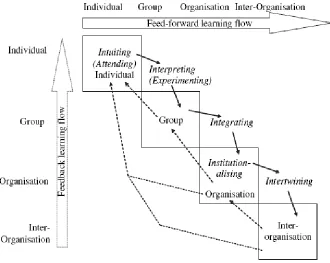
When knowledge is transferred from the individual to the collective level, this is called organizational learning. Following, learning can also take place between organizations: this is inter-organizational learning. Crossan et al. (1999) distinguish four social and psychological micro-processes, linking learning at individual, group and organizational levels:
Intuiting -conscious recognition of the possibilities inherent in a personal stream of
they attempt to interact with that individual. Interpreting
Dialogue and joint action are crucial for the development of this shared understanding. Institutionalizing
structures, procedures and strategy.
So far, this model describes how learning within an organization, or intra-organizational learning, takes place. Our goal is to let the separate companies learn from each other. To this end, Holmqvist (2003) defines inter-organizational learning as learning between organizations where there (initially) is a low degree of interdependency. Jones and McPherson (2006) add the component of inter-organizational learning to this framework by defining a fifth process: intertwining of knowledge (figure 4).
Figure 4: framework for learning on multiple levels (Crossan et al., 1999)
It indicates active engagement between the firm and its external knowledge network and implicates that learning mechanisms are at the interstices between organizations and not just within organizational boundaries. It can be achieved by transferring knowledge from one organization to the next, as well as by creating new knowledge through interaction between the partners. How are intra- and inter organizational learning related? Holmqvist (2003) argued that while intra-organizational learning often leads to exploitation of the available experience, while inter-organizational learning can deliver new insights and can lead to exploration. To engage in the process of intertwining knowledge, collective learning can be used. We define collective learning as learning that happens when people learn from the knowledge of others through a shared process. In this respect, benchmarking can be seen as such a process, making collective learning operational. Enabling
proc
Transparancy 2.3.2 Conditions for successful collective learning
Now we have explained the place of collective learning in the knowledge management theory, we will try to find theories explaining how we can make collective learning successful. Larsson, Bengtsson, Henriksson, & Sparks (1998) state that successful learning in alliances depends on the transparency and receptivity of the partners. Transparency is the degree to which one partner gives others access to the own build-up organizational knowledge, and receptivity is the degree to which knowledge provided by the partners is taken up. In collective learning between organizations, there exists a tension between collaboration and competition, called the inter-organizational learning dilemma by Larsson et al (1998). This stems from it being rational for an individual organization to adopt the strategy of maximizing individual learning,
by taking the most knowledge with the least effort, in other words, be very receptive but not transparent. This is especially true if the partners are direct competitors. At the same time, the total value of the joint learning is reduced by the relative withdrawal of effort of the partners. Another problem is that some partners may adopt a strategy of only delivering minimal effort: giving some transparency but lacking receptivity. These partners will not maximize the learning potential. Therefore, to maximize learning one should take efforts to increase both transparency as well as receptivity (figure 5).
In literature, we can find the following concerning receptivity. The concept of absorptive capacity (Cohen & Levinthal, 1990) can be used to define factors stimulating receptivity of the partners.
Basically, this means that to acquire and internalize knowledge from another organization, one should first have a certain level of knowledge about how the own operations function (Cohen et al., 1990)
which would allow the recipient of knowledge to learn from others. To learn, a certain level of absorptive capacity is needed, but the learning process it selves will increase this capacity by the process of double-loop learning explained above: by sharing and talking about knowledge capabilities of dealing with this knowledge are enhanced. Another proposition concerning receptivity is that the greater the value and relevance of the knowledge of the partner, the greater the motivation will be to start knowledge acquisition efforts (Inkpen, 2000). Therefore, it is important that the aims of the process are shared and clear from the start of the project on, there is a commonality of interests and participants are motivated to learn. Practically, we can enhance receptivity by involving multiple persons per organization; so participants can talk about and reflect on the acquired knowledge and work together to use this knowledge in their own organization. Also, we can stimulate receptivity by making it easier to interpret knowledge, with the help of instruments.
Transparency of the participants is more likely to be reached when they trust each other and the process (Lane & Lubatkin, 1998). Two things can stimulate trust between the partners. The first is a long-term orientation, which increases the motivation for every partner to not take actions against the partners to avoid splitting up before the long-term goals are reached (Bleeke and Ernst, 1991, Heide and John, 1993). Another means to ensure trust between partners is to establish safeguards against cheating (Lane et al. 1998). These means are mainly important in the beginning stage of the partnership, since the partner relationship develops and trust is, if everything goes fine, empowered by the process of working together (Gulati, 1995).
To learn how we can ensure trust in the process, we look to the findings of Kim and Mauborgne (1997). They argue that while people do, of course, care about the outcomes of a process, the way these outcomes are reached have a huge effect on the commitment and trust they have in the
following features as described by Kim et al.:
Engagement means involving the relevant individuals in the decisions that affect them, for
and assumptions. Discussion sharpens the thinking process and allows for learning.
Explanation means that we should ensure everyone understands why decisions are taken. This allows people to accept decisions, even when their own idea is rejected. It also serves as feedback, enabling learning.
Expectation clarity requires that when a decision is taken, the new rules are set clearly. Everybody involved should have a clear idea about what is expected of him, what the new goals and milestones are and which responsibility rests on whom. In this way, everybody can focus on his own task.
Many literature resources point to the essential role of top management support in ensuring engagement: should go beyond making money, time and resources available and must be committed to the process and spread the importance of the project (Karlf, Lundgren, & Froment, ; Poerstamper et al., 2007; Szulanski, 2000)
2.3.3 Implications of collective learning conditions to our project
Now we have described how inter-organizational learning takes place and how we can enhance transparency and receptivity, we can distract some conditions for successful benchmarking on the ICU. Under this conditions, intertwining of knowledge can take place.
organizations easy should be developed. Hereto, a questionnaire especially fitted to the ICUs can be used, assessing system- and control characteristics of each hospital needed to understand the nature of each intensive care department.
To increase transparency, a climate of trust should be created by adopting a long-term orientation, therefore it should be made clear that benchmarking is a recurring process in which cycle after cycle
verbal agreement can be used to assure data will not be shared with others than the participants and data stay in the possession of the providers. Later in the process, a contract containing detailed agreements concerning anonymity of the participants can be signed. For enabling transparency, we also have to make use of an instrument to make it possible interpret information from each organization. To this end, we can use the same questionnaire that we provided to the ICUs to order their own information. The participants also have to be engaged in every phased of the project to
stakeholders should be engaged in developing the instruments we will use during the project. This will take more time than using predefined sets, but will make sure the instruments fit to the participants and will increase the sense of ownership.
Concerning enabling a fair process to take place, it is first of importance to engage in project management. Phases should be defined clearly, with expected end results and expectations of the participants. For the IC process, this is somewhat difficult in because the participants are not fully committed to the project from the start. Nobody has to participate and the hospitals have to be tempted to commit themselves to the project. Nevertheless, a clear methodology and project plan should be available to establish clarity of the aims of each phase. This prevents sticking to, for example, defining definitions of indicators, for too long. It should be ensured participants are informed about the way outcomes have to be interpreted and how they can be translated to improvement measures. After each phase, participants should decide whether they want to continue with the project or not to ensure motivation.
2.4
Developing our benchmarking methodology
Now we have described what benchmarking is, have ascertained benchmarking can be used in our project and have examined how we can stimulate collective learning, we can choose a methodology.
2.4.1 The benchmarking process
There are many models that describe the steps we need to take to benchmark. Although they differ in several aspects like the number of phases and the phase they put most emphasis on, they all distinguish the following parts (Poerstamper et al., 2007):
A preparation phase in which the aim of the project is