Volume 2009, Article ID 878105,15pages doi:10.1155/2009/878105
Research Article
Likelihood-Maximizing-Based Multiband Spectral Subtraction
for Robust Speech Recognition
Bagher BabaAli, Hossein Sameti, and Mehran Safayani
Department of Computer Engineering, Sharif University of Technology, Tehran, Iran
Correspondence should be addressed to Bagher BabaAli,[email protected]
Received 12 May 2008; Revised 17 December 2008; Accepted 19 January 2009
Recommended by D. O’Shaughnessy
Automatic speech recognition performance degrades significantly when speech is affected by environmental noise. Nowadays, the major challenge is to achieve good robustness in adverse noisy conditions so that automatic speech recognizers can be used in real situations. Spectral subtraction (SS) is a well-known and effective approach; it was originally designed for improving the quality of speech signal judged by human listeners. SS techniques usually improve the quality and intelligibility of speech signal while speech recognition systems need compensation techniques to reduce mismatch between noisy speech features and clean trained acoustic model. Nevertheless, correlation can be expected between speech quality improvement and the increase in recognition accuracy. This paper proposes a novel approach for solving this problem by considering SS and the speech recognizer not as two independent entities cascaded together, but rather as two interconnected components of a single system, sharing the common goal of improved speech recognition accuracy. This will incorporate important information of the statistical models of the recognition engine as a feedback for tuning SS parameters. By using this architecture, we overcome the drawbacks of previously proposed methods and achieve better recognition accuracy. Experimental evaluations show that the proposed method can achieve significant improvement of recognition rates across a wide range of signal to noise ratios.
Copyright © 2009 Bagher BabaAli et al. This is an open access article distributed under the Creative Commons Attribution License, which permits unrestricted use, distribution, and reproduction in any medium, provided the original work is properly cited.
1. Introduction
By increasing the role of computers and electronic devices in today’s life, using traditional interfaces such as mouse, keyboard, buttons, and knobs is not satisfying, so the desire for more convenient and more natural interfaces has increased. Current speech recognition technology offers the ideal complementary solution to more traditional visual and tactile man-machine interfaces. Although state-of-the-art speech recognition systems perform well in the laboratory environments, accuracy of these systems degrades drasti-cally in real noisy conditions. Therefore, improving speech recognizer robustness is still a major challenge. Statistical speech recognition at first learns the distribution of the acoustic units using training data and then relates each part of the speech signal to a class in the lexicon that most likely generates the observed feature vector. When noise affects the speech signal, distributions characterizing the extracted features from noisy speech are not similar to the corresponding distributions extracted from clean
speech in the training phase. This mismatch results in misclassification and decreases speech recognition accuracy [1,2]. This degradation can only be ameliorated by reducing the difference between the distributions of test data and those used by the recognizer. However, the problem of noisy speech recognition still poses a challenge to the area of signal processing.
In recent decades, to reduce this mismatch and to compensate for the noise effect, different methods have been proposed. These methods can be classified into three categories.
subtraction (SS) [3–9], Wiener filtering [10,11], and model-based speech enhancement [12–14] are widely used instances of this approach. Among signal compensation methods, SS is simple and easy to implement. Despite its low computational cost, it is very effective where the noise corrupting the signal is additive and varies slowly with time.
Feature Compensation. This approach attempts either to extract feature vectors invariant to noise or to increase robustness of the current feature vectors against noise. Rep-resentative methods include codeword-dependent cepstral normalization (CDCN) [15], vector Taylor series (VTS) [16], multivariate Gaussian-based cepstral compensation (RATZ) [17], cepstral mean normalization (CMN) [18], and RASTA/PLP [19, 20]. Among all methods developed in this category, CMN is probably the most ubiquitous. It improves recognition performance under all kinds of conditions, even when other compensation methods are applied simultaneously. So, most speech recognition systems use CMN by default.
Classifier Compensation. Another approach for compensat-ing noise effects is to change parameters of the classifier. This approach changes statistical parameters of the distribution in a way to be similar to the distribution of the test data. Some methods such as parallel model combination (PMC) [21] and model composition [22] change the distribution of the acoustic unit so as to compensate the additive noise effect. Other methods like maximum likelihood linear regression (MLLR) [23] involve computing a transformation matrix for the mixture component means using linear regression. However, these methods require access to the parameters of the HMM. This might not always be possible; for example, commercial recognizers often do not permit the users to modify the recognizer components or even access it. Classifier compensation methods usually require more computations than other compensation techniques and introduce latencies due to the time taken to adapt the models.
In recent years, some new approaches such as multi-stream [24] and missing features [25] have been proposed for dealing with the mismatch problem. These techniques try to improve speech recognition performance by giving less weight to noisy parts of the speech signal in the recog-nition process considering the fact that the signal-to-noise ratio (SNR) differs in various frequency bands [26]. More recently, a new method was proposed for distant-talking speech recognition using a microphone array in [27]. In this approach, called likelihood-maximizing beamforming, information from the speech recognition system itself is used to optimize a filter-and-sum beamformer.
Not all methods described above are equally applicable or effective in all situations. For instance, in commercial speech recognition engines, users have no access to features extracted from the speech signal. So in these systems, it is only possible to use signal compensation methods. Even in systems with accessible features, computational efficiency may restrict the use of compensation methods. Therefore, in
such cases SS-based methods seem to be suitable. Different variations of the SS method originally proposed by Boll [3] were developed over the years to improve intelligibility and quality of noisy speech, such as generalized SS [28], nonlinear SS [7], multiband SS [29], SS with an MMSE STSA estimator [30], extended SS [31], and SS based on perceptual properties [32,33]. The most common variation involved the use of an oversubtraction factor that controlled to some degree the amount of speech spectral distortion caused by subtraction process. Different methods were proposed for computing the oversubtraction factor based on different criteria that included linear [28] and nonlinear functions [7] of the spectral SNR of individual frequency bin or bands [29] and psychoacoustic masking thresholds [34].
In conventional methods [35–39] incorporating SS as a signal compensation method in the front end of speech recognition systems, there is no feedback from the recog-nition stage to the enhancement stage, and they implicitly assume that generating a higher quality output waveform will necessarily result in improved recognition performance. However, speech recognition is a classification problem, and speech enhancement is a signal processing problem. So, it is possible that by applying speech enhancement algorithms the perceived quality of the processed speech signal is improved but no improvement in recognition performance is attained. This is because the speech enhancement method may cause distortions in the speech signal. The human ear may not be sensitive to such distortions, but it is possible that the speech recognition system be sensitive to them [40]. For instance, in telephony speech recognition where a clean speech model is not available, any signal compensation technique as judged by a waveform-level criterion will result in higher mis-match between improved speech features and the telephony model. Thus, speech enhancement methods improve speech recognition accuracy only when it generates the sequence of feature vectors which maximize the likelihood of the correct transcription with respect to other hypotheses. Hence, it seems logical that each improvement in the preprocessing stage be driven by a recognition criterion instead of a waveform-level criterion such as signal to noise ratio or signal quality. It is believed that this is the underlying reason why many SS methods proposed in literature result in high-quality output waveforms but do not result in significant improvements in speech recognition accuracy.
Noise s
p
ect
r
um
Noisy s
p
eech s
p
ect
r
um
DCT
HMMs Noisy speech
VAD
Noise
Multiband spectral subtraction
. . .
. . . . . .
log
M L(α)
α
MaximizeL(α)
Σ
Σ
Σ
+
+
+
−
−
− αB
α2
α1
Figure1: Block diagram of the proposed framework.
To implement this idea with the assumption of mel frequency cepstral coefficients (MFCCs) feature extraction and an HMM-based speech recognizer, we use an utterance for which the transcription is given and formulate the relation between SS filter parameters and the likelihood of the correct model. The proposed method has two phases: adaptation and decoding. In the adaptation phase, the spec-tral oversubtraction factor is adjusted based on maximizing the acoustic likelihood of the correct transcription. In the decoding phase, in turn, the optimized filter is applied for all incoming speech.Figure 1shows the block diagram of the proposed approach.
The remainder of this paper is organized as follows. In Section 2, we review SS and multiband SS. Formulae for maximum likelihood-based SS (MLBSS) are derived in
Section 3. Our proposed algorithm and its combination with CMN technique are described in Sections 4 and 5, respectively. Extensive experiments to verify the effectiveness of our algorithm are presented in Section 6, and finally in
Section 7, we present the summary of our work.
2. Spectral Subtraction (SS)
SS is one of the most established and famous enhancement methods in removing additive and uncorrelated noise from noisy speech. SS divides the speech utterance into speech and nonspeech regions. It first estimates the noise spectrum from nonspeech regions and then subtracts the estimated noise from the noisy speech and produces an improved speech signal. Assume that clean speechs(t) is converted to noisy speechy(t) by adding uncorrelated noise,n(t), wheretis the time index:
y(t)=s(t) +n(t). (1)
Because the speech signal is nonstationary and time variant, the speech signal is split into frames; then by applying the Fourier transform and doing some approximations, we obtain the below generalized formula
|Yn(k)|T ∼= |Sn(k)|T+|Nn(k)|T, (2) wherenis the frame number andYn(k), Sn(k), andNn(k) are thekth coefficient of the Fourier transform of thenth noisy speech, clean speech, and noise frames, respectively, alsoT
is the power exponent. SS has two stages which we describe briefly in the following subsections.
2.1. Noise Spectrum Update. Because estimating the noise spectrum is an essential part of the SS algorithm, many methods have been proposed [41, 42]. One of the most common methods, which is the one used in this paper, is given by [28]
|Nn(k)|T= ⎧ ⎪ ⎪ ⎨ ⎪ ⎪ ⎩
(1−λ)|Nn−1(k)|T+λ|Yn(k)|T
if|Yn(k)|T< β|Nn(k)|T, |Nn−1(k)|T otherwise,
(3)
where |Nn(k)| is the absolute value of the kth Fourier transform coefficient of the nth noisy speech frame, and 0≤λ≤1 is the updating noise factor. If a largeλis chosen, the estimated noise spectrum changes rapidly and may result in poor estimation. On the other hand, if a smallλis chosen, despite the increased robustness in estimation when the noise spectrum is stationary or changes slowly in time, it does not permit the system to follow rapid noise changes. In turn,β
is the threshold parameter for distinguishing between noise and speech signal frames.
2.2. Noise Spectrum Subtraction. After noise spectrum esti-mation, we should estimate the clean speech spectrum,Sn(k), using
|Sn(k)|T
= ⎧ ⎪ ⎪ ⎨ ⎪ ⎪ ⎩
|Yn(k)|T−α|Nn(k)|T
if|Yn(k)|T−α|Nn(k)|T> γ|Yn(k)|T,
γ|Yn(k)|T otherwise,
whereαis the oversubtraction factor chosen to be between 0 and 3 and is used to compensate for mistakes in noise spectrum estimation. Therefore, in order to obtain better results, we should set this parameter accurately and adap-tively. The parameter γ is the spectral floor factor which is a small positive number assuring that the estimated spectrum will not be negative. We estimate the initial noise spectrum by averaging the first few frames of the speech utterance (assuming the first few frames are pure noise). Usually for the parameter T, a value of 1 or 2 is
chosen. We have T = 1 yielding the original magnitude
SS and T = 2 yielding the power SS algorithm. Errors
in determining nonspeech regions cause incorrect noise spectrum estimation and therefore may result in distortions in the processed speech spectrum. Spectral noise estimation is sensitive to the spectral noise variation even when the noise is stationary. This is due to the fact that the absolute value of the noise spectrum may differ from the noise mean causing negative spectral estimation. Although the spectral floor factorγ prevents this, it may cause distortions in the processed signal and may generate musical noise artifacts. Since Boll’s [3] research was introduced, several variations of the method were proposed in literature to reduce the musical noise. These methods were developed to perform noise suppression in autocorrelation, cepstral, logarithmic and, subspace domains. A variety of preprocessing and postprocessing methods attempt to reduce the presence of musical noise while minimizing speech distortion [43–46].
2.3. Multiband Spectral Subtraction (MBSS). Basic SS assumes that noise affects the whole speech spectrum equally. Consequently, it uses a single value of the oversubtraction factor for the whole speech spectrum. Real world noise is mostly colored and does not affect the speech signal uniformly over the entire spectrum. Therefore, this suggests the use of a frequency-dependent subtraction factor to account for different types of noise. The idea of nonlin-ear spectral subtraction (NSS), proposed in [7], basically extends this capability by making the oversubtraction factor frequency dependent and subtraction process nonlinear. Larger values are subtracted at frequencies with low SNR levels, and smaller values are subtracted at frequencies with high SNR levels. Certainly, this gives higher flexibility in compensating for errors in estimating the noise energy in different frequency bins.
The motivation behind the MBSS approach is similar to that of NSS. The main difference between MBSS and NSS is that the MBSS approach estimates one oversubtraction factor for each frequency band, whereas the NSS approach estimates one oversubtraction factor for each individual Fast Fourier Transform (FFT) bin. Different approaches based on MBSS have been proposed. In [47], the speech spectrum is divided into a considerably large number of bands, and a fixed value for the oversubtraction factor is used for all bands. In Kamath and Loiziou’s method [29], an optimum oversubtraction factor is computed for each band based on the SNR. Another method (similar to the work presented in [29]) proposed in [48] uses the Berouti et al. SS method [28] on each critical band over the speech spectrum.
We select the MBSS approach because it is computa-tionally more efficient in our proposed framework. Also, as reported in [49], the speech distortion is expected to be markedly reduced with the MBSS approach. In this work, we divide the speech spectrum using mel-scale frequency bands (inspired by the structure of the human ear cochlea [29]) and use a separate oversubtraction factor for each band. Therefore, oversubtraction vector is defined as
α=[α1,α2,. . .,αB], (5)
where B is the number of the frequency bands. From
this section we conclude that the oversubtraction factor is the most effective parameter in the SS algorithm. By adjusting this parameter for each frequency band, we can expect remarkable improvement in performance of speech recognition systems. In the next section, we present a novel framework for optimizing vectorαbased on feedback information from the speech recognizer back end.
3. Maximum Likelihood-Based Spectral
Subtraction (MLBSS)
Conventional SS uses waveform-level criteria, such as maxi-mizing signal to noise ratio or minimaxi-mizing mean square error, and tries to decrease the distance between noisy speech and the desired speech. As mentioned in the introduction, using these criteria should not necessarily decrease word error rate. Therefore, in this paper, instead of a waveform-level criterion, we use a word-error-rate criterion for adjusting the spectral oversubtraction vector. One logical way to achieve this goal is to select the oversubtraction vector in a way that the acoustic likelihood of the correct hypothesis in the recognition procedure is maximized. This will increase the distance between the acoustic likelihood of the correct hypothesis and other competing hypotheses, such that the probability that the utterance be correctly recognized will be increased. To implement this idea, the relation between the oversubtraction factor in the preprocessing stage and the acoustic likelihood of the correct hypothesis in the decoding stage is formulated. The derived formulae depend on the feature extraction algorithm and the acoustic unit model. In this paper, MFCCs serve as the extracted features and hidden Markov models with Gaussian mixtures in each state as acoustic unit models. Speech recognition systems based on statistical models find the word sequence most likely to generate the observation feature vectorsZ = {z1,z2,. . .,zt} extracted from the improved speech signal. These observa-tion features are a funcobserva-tion of both the incoming speech signal and the oversubtraction vector. Statistical speech recognizers obtain the most likely hypothesis based on Bayes’ classification rule:
w=arg max
w P
(Z(α)|w)P(w), (6)
the best recognition performance. Similar to both speaker and environmental adaptation methods for the adjusting oversubtraction vectorα, we need access to adaptation data with known phoneme transcriptions. We assume that the correct transcription of the utterancewC is known. Hence, the value of P(wC) can be ignored since it is constant regardless of the value ofα. We can then maximize (6) with respect toαas
α=arg max α
(P(Z(α)|wC)). (7)
In an HMM-based speech recognition system, the acoustic likelihood P(Z(α) | wC) is the sum of all possible state sequences for a given transcription. Since most state sequences are unlikely, we assume that the acoustic likelihood of the given transcription is estimated by the single most likely state sequence; such assumption also reduces compu-tational complexity. IfSCrepresents all state sequences in the combinational HMM andsrepresents the most likely state sequence, then the maximum likelihood estimation ofαis given by
α=arg max α,s∈SC
i
log P(zi(α)|si)
+
i
log P(si|si−1,wC)
.
(8)
According to (8), in order to findα, the acoustic likelihood of the correct transcription should be jointly maximized with respect to the state sequence and αparameters. This joint optimization has to be performed iteratively.
In (8), the maximum likelihood estimation of α may become negative. This usually happens when test speech data is cleaner than train speech data, for example, when we train the acoustic model by noisy speech and use it in clean environment. In such cases, the oversubtraction factor is negative and adds noise to the speech spectrum, but this is not an undesired effect; in fact, this is one of the most important advantages of our algorithm because adding noise PSD to the noisy speech spectrum decreases the mismatch and consequently results in better recognition performance.
3.1. State Sequence Optimization. Noisy speech is passed through the SS filter, and feature vectorsZ(α) are obtained
for a given value α. Then optimal state sequence s =
{s1,s2,. . .,st} is computed using (9) given the correct phonetic transcription,wC:
s=arg max s∈SC
i
log P(zi(α)|si)
+
i
log P(si|si−1,wC)
.
(9)
State sequencescan be simply computed using the Viterbi algorithm [50].
3.2. Spectral Oversubtraction Vector Optimization. Given the state sequences, we want to findαso that
α=arg max α
i
log(P(zi(α)|si))
. (10)
This acoustic likelihood can not be directly optimized with respect to the SS parameters for two reasons. First, the statistical distributions in each HMM state are complex density functions such as mixture of Gaussians. Second, some linear and nonlinear mathematical operations should be performed on the speech signal for extracting feature vectors, that is, the acoustic likelihood of the speech signal is influenced by theαvector. Therefore, obtaining a closed-form solution for computing the optimal α given a state sequence is not possible; hence, nonlinear optimization is used.
3.2.1. Computing Gradient Vector. We use gradient-based approach to find the optimal value of the α vector. Given an optimal state sequence in the combinational HMM, we defineL(α) to be the total log likelihood of the observation vectors. Thus,
L(α)= i
log(P(zi(α)|si)). (11)
The gradient vector∇αL(α) is computed as
∇αL(α)=
∂L(α)
∂α0
,∂L(α)
∂α1
,. . .,∂L(α)
∂αB−1
. (12)
Clearly, computing the gradient vector depends on both the statistical distributions in each state and the feature extraction algorithm. We derive ∇αL(α) assuming that each state is modeled by K mixtures of multidimensional Gaussians with diagonal covariance matrices. Let μik and
ik be the mean vector and covariance matrix of the kth Gaussian density function in state si, respectively. We can then write the sum of the acoustic likelihood given an optimal state sequences= {s1,s2,. . .,st}as
L(α)= i
log
K
k=1
exp(Gik(α))
, (13)
whereGik(α) is defined as
Gik(α)=exp
−1
2(zi(α)−μik) T−1
ik
((zi(α)−μik)+log(τikκik)
.
(14)
In (14),τik is the weight of thekth mixture in theith state, andκikis a normalizing constant. Using the chain rule, we have
∇αL(α)= i
K
k=1
γik(α)∂Gik(α)
∂α , (15)
whereγikis defined as
γik=
exp(Gik(α))
K
j=1exp(Gi j(α))
∂Gik(α)/∂αis derived as
∂Gik(α)
∂α =
∂zi(α)
∂α −1
ik
(zi(α)−μik). (17)
By substituting (17) into (15), we get
∇αL(α)= i
K
k=1
γik(α)∂zi(α)
∂α −1
ik
(zi(α)−μik). (18)
In (18), ∂zi(α)/∂α is the Jacobian matrix, as in (19), comprised of partial derivatives of each element of the ith frame feature vector with respect to each component of the oversubtraction vectorα:
Ji=∂zi
∂α = ⎛ ⎜ ⎜ ⎜ ⎜ ⎜ ⎜ ⎜ ⎜ ⎜ ⎜ ⎜ ⎜ ⎜ ⎜ ⎝
∂z0i
∂α0 ∂z1
i
∂α0 · · · ∂zCi−1
∂α0 ∂z0 i ∂α1 ∂z1 i
∂α1 · · · ∂zC−1
i
∂α1
..
. ... · · · ...
∂z0i
∂αB−1 ∂zi1
∂αB−1 · · · ∂zCi−1
∂αB−1
⎞ ⎟ ⎟ ⎟ ⎟ ⎟ ⎟ ⎟ ⎟ ⎟ ⎟ ⎟ ⎟ ⎟ ⎟ ⎠ . (19)
The dimensionality of the Jacobian matrix isB×C, whereBis the number of elements in vectorαandCis the dimension of the feature vector. The full derivation of the Jacobian matrix when the feature vectors are MFCC is given in the following subsection.
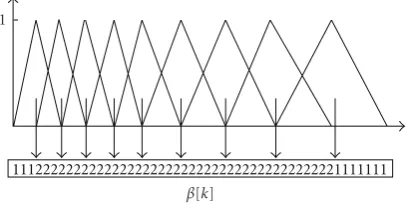
3.2.2. Computing Jacobian Matrices. Every element of the feature vector is a function of all elements of theα vector. Therefore, to compute each element of the Jacobian matrix, we should derive formulas for the derivation of the feature vector from the SS output. Assume that x[n] is the input signal andX[k] is its Fourier transform. We set the number of frequency bands in multiband SS equal to the number of mel filters, that is, for each mel filter we have one SS filter coefficient. Since mel filters are a series of overlapping triangular weighting functions, we defineαj[k] as
αj[k]=
αj ωj≤k≺ωj+1,
0 otherwise, (20)
whereωjandωj+1are lower and upper bound of thejth mel
filter. The output of the SS filter,Y[k], is computed as
|Y(k)|2=
|X[k]|2− B
j=1
αj[k]
β[k]|N[k]|
2
×U
|X[k]|2− B
j=1
αj[k]
β[k]|N[k]|
2
+|X[k]|2U
B
j=1
αj[k]
β[k]|N[k]|
2− |X[k]|2
,
(21)
where U is the step function,|N[k]|2 is the average noise
spectrum of frames labeled as silence, and β[k] is the
1112222222222222222222222222222222222222221111111 β[k]
1
Figure2: Schematic ofβvector.
kth element of the β vector having the value of 2 in the overlapping parts of the mel filter and value of 1 otherwise (Figure 2).
The gradient of|Y(k)|2with respect to elements of theα
vector is found as
∂Yi2[k]
∂αj = ⎧ ⎪ ⎨ ⎪ ⎩
−|N(k)|2
β[k] ifωj≤k≺ωj+1,
0 otherwise.
(22)
In our experiments, ten frames from the beginning of the speech signal are assumed to be silence. We update the noise spectrum using (3), and thelth component of the mel spectral vector is computed as
Mil= N/2
k=0
vl[k]· |Yi[k]|2, 0≤l≤L−1, (23)
wherevl[k] is the coefficient of thelth triangular mel filter bank andNis the number of Fourier transform coefficients. We calculate the gradient of (23) with respect toαas
∂Ml i
∂αj = N/2
k=0
v[k]∂Yi2[k]
∂αj = − N/2
k=0
v[k]|N[k]|2
β[k] . (24)
We can obtain the cepstral vector by first computing the logarithm of each element of the mel spectral vector and then performing a DCT operation as
∂zc i
∂αj = L−1
=0
Φcl
Mli
∂Ml i
∂αj = − l−1
=0
Φcl
Mil N/2
k=0
v[k]|N[k]|2
β[k] , (25)
whereΦis a DCT matrix with dimensionC∗L.
Using the gradient vector defined in (18), the αvector can be optimized using the conventional gradient-based approach. In this work, we perform optimization using the method of conjugate gradients.
Spectral subtraction optimization block Initial
parameters
False
True
Stop Start
Estimate state sequence
Spectral subtraction optimization
Desired errorrate?
spectral subtraction Feature
extraction
Computing total log likelihood
Total log likelihood converges?
Compute gradient of the over - subtraction vector
Update over - subtraction vector
False
True Details
Multiband
Multiband spectral subtraction
User says an utterance with a known transcription
Test on validation set
Figure3: Flowchart of the proposed MLBSS algorithm.
this problem involves the joint optimization of theαvector, as the SS parameters, and the most likely state sequence for the given transcription. It was performed by iteratively estimating the optimal state sequence for a given α vector using the Viterbi algorithm and optimizing the likelihood of the correct transcription with respect to theαvector for that state sequence. For the reasons originally discussed in
Section 3.2, the likelihood of the correct transcription cannot be directly maximized with respect to the α vector, and therefore we do so using conjugate gradient descent as our optimization method. Therefore, inSection 3.2, we derived the gradient of the likelihood of the correct transcription with respect to theαvector.
4. MLBSS Algorithm in Practice
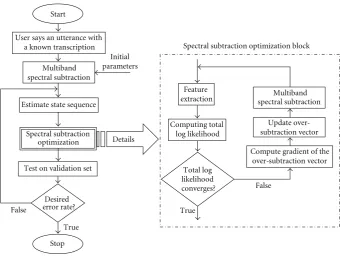
In Section 3, a new approach to MBSS was presented in which the SS parameters are optimized specifically for speech recognition performance using feedback information from the speech recognition system. Specifically, we showed how the SS parameters (vectorα) can be optimized to maximize the likelihood of an utterance with known transcription. Obviously, here we should answer the following question: if the correct transcription is known a priori, why should there be any need for recognition? The answer is that the correct transcription is only needed in the adaptation phase. In the decoding phase, the filter parameters are fixed.Figure 3
shows the flowchart of our proposed algorithm.
First, the user is asked to speak an utterance with a known transcription. The utterance is then passed through the SS filter with fixed initial parameters. After that, the most likely state sequence is generated using the Viterbi [50]
algorithm. The optimal SS filter is then produced given the state sequence. Recognition is performed on a validation set using the obtained optimized filter. If the desired word error rate is reached the algorithm is finished, otherwise the new state sequence is estimated.
Figure 3 also shows the details of the SS optimization block. This block iteratively finds the oversubtraction vector which maximizes the total log likelihood of the utterance with a given transcription. First, the feature vector is extracted from the improved speech signal, and then the log likelihood is computed given the state sequence. If the likelihood does not converge, the gradient of the oversub-traction vector is computed, and the oversuboversub-traction vector is updated. SS is performed with the updated parameters, and new feature vectors are extracted. This process is repeated until the convergence criterion is satisfied.
adaptation is usually done as an additional training session in a specific environment, and thus it is not possible to incorporate new environment characteristics for parameter adaptation.
The adaptation data can be aligned with HMMs in two different ways. In supervised adaptation, the identity of the adaptation data is always known, whereas in the unsupervised case it is not; hence, adaptation utterances are not necessarily correctly aligned. Supervised adaptation is usually slow particularly with speakers whose utterances result in poor recognition performance because only the correctly classified utterances are utilized in adaptation.
5. Combination of MLBSS and CMN
In the MLBSS algorithm described in Sections 3 and 4, relations were derived under the assumption of additive noise. However, in some application such as distant-talking speech recognition, it is necessary to cope not only with additive noise but also with the acoustic transfer function (channel noise). CMN [18] is a simple (low computational cost and easy to implement) yet very effective method for removing convolutional noise, such as distortions caused by different recording devices and communication channels. Due to the presence of the natural logarithm in the feature extraction process, linear filtering usually results in a constant offset in the filter bank or cepstral domains and hence can be subtracted from the signal. The basic CMN estimates the sample mean vector of the cepstral vectors of an utterance and then subtracts this mean vector from every cepstral vector of the utterance. We can combine CMN with the proposed MLBSS method by mean normalization of the Jacobian matrix. Letzi(α) be the mean normalized feature vector:
zi(α)=zi(α)− 1 T
T
i=1
zi(α). (26)
The partial derivative of zi(α) with respect to α can be computed as
∂zi(α)
∂α =
∂zi(α)
∂α − 1
T
T
i=1 ∂zi(α)
∂α , (27)
where this equation is equal to mean normalization of the Jacobian matrix.
Hence, features mean normalization can easily be incor-porated into the MLBSS algorithm presented inSection 4. To do so, the feature vectorzi(α) in (11) is replaced by (zi(α)− μz(α)) whereμz(α) is the mean feature vector, computed over all frames in the utterance. Becauseμz(α) is a function ofαas well, the gradient expressions also have to be modified. Our experimental results have shown that in real environments better results are obtained when MLBSS and CMN are used together properly.
6. Experimental Results
In this section, the proposed MLBSS algorithm is evaluated and is also compared with traditional SS methods for speech
recognition using a variety of experiments. In order to assess the effectiveness of the proposed algorithm, speech recognition experiments were conducted on three speech databases: FARSDAT [51], TIMIT [52], and a recorded database in a real office environment. The first and second test sets are obtained by artificially adding seven types of noises (alarm, brown, multitalker, pink, restaurant, volvo, and white noise) from the NOISEX-92 database [53] to the FARSDAT and TIMIT speech databases, respectively. The SNR was determined by the energy ratio of the clean speech signal including silence periods and the added noise within each sentence. Practically, it is desirable to measure the SNR by comparing energies during speech periods only. However, on our datasets, the duration of silence periods in each sentence was less than 10% of the whole sentence length; hence, the inclusion of silence periods is considered acceptable for relative performance measurement. Sentences were corrupted by adding noise scaled on a sentence-by-sentence basis to an average power value computed to produce the required SNR.
Speech recognition experiments were conducted on Nevisa [54], a large-vocabulary, speaker-independent, con-tinuous HMM-based speech recognition system developed in the speech processing lab of the Computer Engineering Department of Sharif University of Technology. Also, it was the first system to demonstrate the feasibility of accurate, speaker-independent, large-vocabulary continuous speech recognition in Persian language. Experiments have been done in two different operational modes of the Nevisa system: phoneme recognition on FARSDAT and TIMIT databases and isolated command recognition on a distant talking database recorded in a real noisy environment. The reason for reporting phoneme recognition accuracy results instead of word recognition accuracy is that in the former case the recognition performance lies primarily on the acoustic model. For word recognition, the performance becomes sensitive to various factors such as the language model type. The phoneme recognition accuracy is calculated as follows:
Accuracy (%)=N−S−D−I
N ∗100%, (28)
withS,D, andIbeing the number of substitution, deletion, and insertion errors, andNthe number of test phonemes.
6.1. Evaluation on Added-Noise Conditions. In this section, we describe several experiments designed to evaluate the performance of the MLBSS algorithm. We explore sev-eral dimensions of the algorithm including the impact of SNR and type of added noises on recognition accuracy, performance of the single-band version of the algorithm, recognition accuracy of the algorithm on a clean test set, and test sets with various SNR levels when models are trained in noisy conditions.
common dialects of the Persian language. The male-to-female population ratio is two to one. There are a total of 405 sentences in the database and 20 utterances per speaker. Each speaker has uttered 18 randomly chosen sentences plus two sentences which are common for all speakers. Sentences are formed by using over 1000 Persian words. The database is recorded in a low-noise environment with an average SNR of 31 dB. One can consider FARSDAT as the counterpart of TIMIT in Persian language. Our clean test set is selected from this database and is comprised of 140 sentences from 7 speakers. All of the other sentences are used as a training set. To simulate a noisy environment, testing data was contaminated by seven types of additive noises at several SNRs ranging from 0 dB to 20 dB with 5 dB steps to produce various noisy test sets. Therefore, the test set does not consider the effect of stress or the Lombard effect on the production of speech in noisy environments.
The Nevisa speech recognition engine was used for our experiments. The feature set used in all the experiments was generated as follows. The speech signal, sampled at 22050 Hz, is applied to a pre-emphasis filter and blocked into frames of 20 milliseconds with 12 ms of overlap. A Hamming window is also applied to the signal to reduce the effect of frame edge discontinuities, and a 1024-point FFT is calculated. The magnitude spectrum is warped according to the mel scale. The obtained spectral magnitude spectrum is integrated within 25 triangular filters arranged on the mel frequency scale. The filter output is the logarithm of the sum of the weighted spectral magnitudes. A decorrelation step is performed by applying a discrete cosine transform. Twelve MFCCs are computed from the 25 filter outputs [53]. First-and second-order derivatives of the cepstral coefficients are calculated over a window covering five neighbouring cepstral vectors to make up vectors of 36 coefficients per speech frame.
Nevisa uses continuous density hidden Markov modeling with each HMM representing a phoneme. Persian language consists of 29 phonemes. Also, one model was used to represent silence. All HMMs are left to right and they are composed of 5 states and 8 Gaussian mixtures in each state. Forward and skip transitions between the states and self-loop transitions are allowed. Covariance of each Gaussian is modeled by a single diagonal matrix. The initialization of parameters is done using linear segmentation, and the seg-mentalk-means algorithm is used to estimate the expected parameters after 10 iterations. The Nevisa decoding process consists of a time-synchronous Viterbi beam search.
One of the 140 sentences of the test set is used in the optimization phase of the MLBSS algorithm. After filter parameters are extracted, speech recognition is performed on the remaining test set files using the obtained optimized filter.Table 1 shows phoneme recognition accuracy for the test speech files. To evaluate our algorithm, our results are compared with the Kamath and Loizou’s [29] multiband spectral subtraction (KLMBSS) method which uses an SNR-based optimization criterion. In the KLMBSS method implementation, the speech signal is first Hamming win-dowed using a 20-millisecond window and a 10-millisecond overlap between frames. The windowed speech frame is
0 10 20 30 40 50 60 70 80 90 100
Phoneme
rec
og
nition
rat
e
(%)
0 5 10 15 20
SNR (dB) Berouti’s SS
MLBSS
Figure4: Phoneme recognition accuracy rate (%) as function of SNR with Berouti et al.’s speech enhancement approach and single-band MLBSS scheme.
then analyzed using the FFT. The resulting spectrum and the estimated noise spectrum are divided into 25 frequency bands using the same mel spacing as the MLBSS method. The estimate of the clean speech spectrum in theith band is obtained by
|Si(k)|2=
⎧ ⎪ ⎪ ⎨ ⎪ ⎪ ⎩
|Yi(k)|2−α
iδi|Ni(k)|2 if|Yi(k)|2−α
iδi|Ni(k)|2>0,
β|Yi(k)|2 otherwise,
(29)
whereαiis the oversubtraction factor of theith band, δiis a bandsubtraction factor, andβis a spectral floor parameter that is set to 0.002.
From the experimental results, as shown inTable 1, we observe the following facts. With regards to various noise types and various SNRs, results show that the proposed method was capable of improving recognition performance relative to a classical method. In some cases, Kamath and Loizou’s method achieves lower performance than the baseline. This is due to spectral distortions caused by not adjusting the oversubtraction factors thus destroying the discriminability used in pattern recognition. This mismatch reduces the effectiveness of the clean trained acoustical models and causes recognition accuracy to decline. Higher SNR differences between training and testing speech cause a higher degree of mismatch and greater degradation in the recognition performance.
Table1: Phoneme recognition accuracy (%) on FARSDAT database.
Noise type Method 0 dB 5 dB 10 dB 15 dB 20 dB
Alarm
No enhance 34.49 43.89 52.94 59.40 66.09
KLMBSS 34.56 45.19 53.64 59.73 66.17
MLBSS 35.01 46.64 55.06 61.80 68.32
Brown
No enhance 64.99 72.61 76.07 77.16 77.34
KLMBSS 66.66 73.19 75.84 77.56 77.16
MLBSS 67.30 75.76 78.76 79.34 79.68
Multitalker
No enhance 32.41 42.62 52.71 61.01 67.47
KLMBSS 33.56 44.62 52.51 62.90 68.65
MLBSS 33.79 46.23 56.56 64.69 70.45
Pink
No enhance 21.34 31.37 44.35 55.59 69.84
KLMBSS 22.78 35.33 47.27 60.09 69.07
MLBSS 23.24 37.06 49.98 62.92 74.20
Restaurant
No enhance 32.24 41.70 52.48 61.94 70.24
KLMBSS 33.58 45.59 55.88 63.85 70.20
MLBSS 34.14 46.12 56.21 66.59 73.45
Volvo
No enhance 62.17 65.34 68.86 75.20 76.36
KLMBSS 63.09 68.03 71.17 74.88 76.78
MLBSS 63.61 68.78 72.01 76.39 78.82
White
No enhance 19.43 31.37 43.25 54.61 66.32
KLMBSS 19.57 30.83 42.28 53.66 63.55
MLBSS 22.84 36.78 48.02 59.50 70.86
Table2: Phoneme recognition accuracy rate (%) in clean environ-ment.
Dataset No enhance KLMBSS MLBSS
TIMIT 66.43 53.75 66.79
FARSDAT 77.28 76.24 77.36
6.3. Experimental Results in Clean Environment. Front-end processing to increase noise robustness can sometimes degrade recognition performance under clean test condi-tions. This may occur as speech enhancement methods such that SS can generate unexpected distortions for clean speech. As a consequence, Even though the performance of an MLBSS algorithm is considerably good under noisy environments, it is not desirable if the recognition rate decreases for clean speech. For this reason, we evaluate the performance of the MLBSS algorithm not only in noisy conditions but also on the clean original TIMIT and FARSDAT databases. Recognition results obtained from the clean conditions are shown in Table 2 where we can find that the recognition accuracy of the MLBSS approach is even a bit higher than that of the baseline while the KLMBSS method shows noticeable decline. This phenomenon can be interpreted that the MLBSS approach has the ability to compensate for the effects of noise, so only the mismatch is reduced.
6.4. Experimental Results in Noisy Training Conditions. In this section, we evaluate the performance of the MLBSS algorithm in noisy training conditions by using noisy speech data in the training phase. Recognition results obtained from the noisy training conditions are shown in Figure 5, where the following deductions can be made: (i) higher SNR difference between the training and testing speech causes higher degree of mismatch, and therefore results in greater degradation in recognition performance; (ii) in matched conditions, where the recognition system is trained with speech having the same level of noise as the test speech, best recognition accuracies are obtained; (iii) the MLBSS is more effective than the KLMBSS method in overcoming environmental mismatch where models are trained with noisy speech but the noise type and the SNR level of noisy speech are not known a priori; (iv) in the KLMBSS method, lower SNR of the training data results in greater degradation in recognition performance.
0 10 20 30 40 50 60 70 80 90 100
Phoneme
rec
og
nition
rat
e
(%)
0 5 10 15 20 25
SNR (dB) No enhance
KLMBSS MLBSS
(a)
0 10 20 30 40 50 60 70 80 90 100
Phoneme
rec
og
nition
rat
e
(%)
0 5 10 15 20 25
SNR (dB) No enhance
KLMBSS MLBSS
(b)
Figure5: Phoneme recognition accuracy rate (%) as a function of the signal-to-noise ratio of the speech being recognized, where the recognition system has been trained on noisy speech. In (a) and (b), system has been trained with additive white noise at SNR 10 dB and 20 dB noisy speech, respectively.
Table3: Phoneme recognition accuracy (%) in changing SNR conditions.
Noise type SNR Approach
No enhance KLMBSS Off-line MLBSS On-line MLBSS
White 10→ 20 55.03 54.92 58.76 61.02
White 20→ 10 57.36 57.68 60.71 62.24
Alarm 10→ 20 58.42 59.15 61.09 63.83
Alarm 20→ 10 60.22 61.21 63.11 65.16
vector is computed from the processed utterance, and this new vector is subsequently used to recognize the remainder of the test data. In the case of incremental on-line adaptation, only correctly recognized test utterances are utilized for adaptation (supervised approach). A new oversubtraction vector is always computed after one correctly recognized utterance has been processed.
In order to further evaluate the performance of the on-line version of the proposed algorithm in noise varying conditions, we carry out a number of experiments where the SNR of the added noise was made artificially time varying. For this, we varied the SNR linearly from an initial value to final within each utterance. Recognition
results are shown in Table 3 where 10 → 20 indicates
that the SNR was changed linearly within a sentence such that it was 10 dB at the beginning and 20 dB at the end. For this time-varying SNR condition, the on-line MLBSS algorithm yielded the best recognition performance among the evaluated approaches when white noise was used. What should be noted here is that the KLMBSS algorithm resulted in only a modest improvement over the baseline for time-varying SNR conditions; in fact, in the 10 → 20 case, it even decreased recognition performance.
6.6. Evaluation on TIMIT Database. All the above experi-ments were done on the FARSDAT database which is the
counterpart of TIMIT for Persian language. In order to verify the performance of the MLBSS algorithm, the same experiments as those described inSection 6.1were devised on the TIMIT database and were conducted using the Nevisa system. The results are reported inTable 4. As can be seen, the obtained results are in agreement with the results obtained with the FARSDAT database.
It can be concluded from the aforementioned experi-ments that the MLBSS algorithm has the capability to signif-icantly increase the robustness of the recognition system on artificially noise-added data. However, a direct comparison is still missing as the desired performance is needed for real environments. Therefore, a third set of experiments was performed and will be described below.
6.7. Evaluation on Data Recorded in Real Environment. To formally quantify the performance of the proposed algo-rithm in comparison with commonly used SS techniques, speech recognition experiments were carried out on speech
data recorded in a real noisy office environment. The
experiments were specifically set up to generate a worst-case scenario of combined interfering point source and background noise to illustrate the potential of the robustness scheme in a complex, real-life situation.
Table4: Phoneme recognition accuracy (%) on TIMIT database.
Noise type Method 0 dB 5 dB 10 dB 15 dB 20 dB
Alarm
No enhance 19.46 28.95 37.06 46.07 52.91
KLMBSS 20.16 27.47 38.21 45.06 49.33
MLBSS 21.42 31.97 40.38 48.25 54.97
Brown
No enhance 40.60 48.53 56.46 61.92 63.96
KLMBSS 40.72 49.09 53.29 54.67 54.97
MLBSS 43.12 54.31 60.56 64.58 65.05
Multitalker
No Enhance 13.99 23.60 34.35 43.78 51.89
KLMBSS 14.04 25.80 35.15 42.96 49.45
MLBSS 15.98 26.17 37.44 47.17 54.49
Pink
No enhance 8.85 13.29 20.68 28.49 37.86
KLMBSS 10.63 15.89 22.62 33.43 41.90
MLBSS 11.17 17.21 24.84 33.77 43.14
Restaurant
No enhance 13.33 20.78 30.15 40.00 48.89
KLMBSS 16.34 25.47 33.81 40.30 46.07
MLBSS 16.71 25.76 34.43 42.22 50.09
Volvo
No enhance 44.44 48.59 53.39 57.36 61.02
KLMBSS 43.00 48.25 51.13 52.93 54.19
MLBSS 46.25 51.51 55.53 59.38 63.04
White
No Enhance 3.72 8.47 15.68 23.96 31.77
KLMBSS 5.11 9.61 20.90 25.72 35.98
MLBSS 5.86 11.91 22.38 28.31 36.29
tested with noisy data captured from a microphone placed 2 m away from the speaker. We collected the training dataset using a close-talking microphone in a quiet office using 16 female and 32 male talkers; each uttered 30 commands such as turn on/off or open/close different devices in an office. We gathered the test data in the office environment depicted inFigure 6. For the test set, 22 male and 11 female talkers, different from those used to produce the training dataset, uttered commands at a 2 m distance from the microphone. Room dimensions were 4.5 m×3.5 m×3.5 m which resulted in a reverberation time of approximately 300 milliseconds (T60∼=0.3 s). There were some sources of noise
such as 3 computers and a loudspeaker propagating office noise from the NOISEX database at a 40-degree angle with the wall. The average SNR of the test set was 15 dB. We partitioned this test set into two sets, and MFCCs were cal-culated. Speech recognition was performed using the Nevisa system in isolated command recognition mode. Isolated commands are modeled by fifteen states left-to-right HMMs with no skip (2 Gaussians/state). CMN was performed on the training utterances. The results of our different experiments are shown inFigure 7. In all experiments, KLMBSS, MLBSS, CMN, SS + CMN, and MLBSS + CMN are compared. Results show that adding CMN to the enhancement techniques compensates for the channel effect. This figure also shows that combining CMN with MLBSS is more effective than all
other combinations and reduces the error rate by up to 35 percent relative to MLBSS alone and up to 44 percent relative to the no-enhance baseline.
From these experiments, the following deductions can be made: (i) each approach is able to improve the robustness of the system; (ii) MLBSS combined with CMS yields the high-est robustness to noise among the approaches invhigh-estigated; (iii) while the robustness of the MLBSS approach is slightly inferior to that of the KMBSS, it yields better performance when combined by CMS.
7. Summary
40 2 m
2 m Noise speaker
Speaker 4.5 m
3.5 m
Height of the room 3.5 m
Figure6: Map of experimental room, showing the position of the talker, noise source, and computers.
0 10 20 30 40 50 60 70 80 90 100
Er
ro
r
rat
e
(%)
No enhance
KLMBSS MLBSS CMN KLMBSS +CMN
MLBSS +CMN
Figure7: Error rate (%) of the Nevisa system in isolated command recognition operational mode on data recorded in real environment versus different combinations of the proposed MLBSS algorithm, KLMBSS, and CMN.
The proposed algorithm has been tested and compared to classical SS algorithms using various noise types and SNR levels. Experimental results show that the proposed algo-rithm leads to considerable recognition rate improvements. Hence, we can conclude that using feedback information from a speech recognizer in the front-end enhancement pro-cess can result in significant improvements when compared to classical enhancement methods.
In future works, we are planning to evaluate discrimi-native methods instead of likelihood maximizing schemes. Another possible future extension of this work includes the utilization of the uncertainty associated with the enhanced features using an uncertainty decoding approach.
Acknowledgments
This research was in part supported by a grant from Iran Telecommunication Research Center (ITRC). The first author would also like to thank Tiago Falk and Ebrahim Kazemzadeh for their valuable comments and careful proof-reading of this paper.
References
[1] P. J. Moreno,Speech recognition in noisy environments, Ph. D. dissertation, ECE Department, Carnegie Mellon University, Pittsburgh, Pa, USA, 1996.
[2] B. Raj and R. M. Stern, “Missing-feature approaches in speech recognition,”IEEE Signal Processing Magazine, vol. 22, no. 5, pp. 101–116, 2005.
[3] S. Boll, “Suppression of acoustic noise in speech using spectral subtraction,” IEEE Transactions on Acoustics, Speech, and Signal Processing, vol. 27, no. 2, pp. 113–120, 1979.
[4] A. Fischer and V. Stahl, “On improvement measures for spectral subtraction applied to robust automatic speech recog-nition in car environments,” inProceedings of the Workshop on Robust Methods for Speech Recognition in Adverse Conditions, pp. 75–78, Tampere, Finland, May 1999.
[5] J. Huang and Y. Zhao, “An energy-constrained signal subspace method for speech enhancement and recognition in white and colored noises,”Speech Communication, vol. 26, no. 3, pp. 165– 181, 1998.
[6] W. M. Kushner, V. Goncharoff, C. Wu, V. Nguyen, and J. N. Damoulakis, “The effects of subtractive-type speech enhance-ment/noise reduction algorithms on parameter estimation for improved recognition and coding in high noise environ-ments,” inProceedings of the IEEE International Conference on Acoustics, Speech, and Signal Processing (ICASSP ’89), vol. 1, pp. 211–214, Glasgow, Scotland, May 1989.
[7] P. Lockwood and J. Boudy, “Experiments with a nonlinear spectral subtractor (NSS), hidden Markov models and the projection, for robust speech recognition in cars,” Speech Communication, vol. 11, no. 2-3, pp. 215–228, 1992.
[8] C. Ris and S. Dupont, “Assessing local noise level estimation methods: application to noise robust ASR,”Speech Communi-cation, vol. 34, no. 1-2, pp. 141–158, 2001.
[9] E. Visser, M. Otsuka, and T.-W. Lee, “A spatio-temporal speech enhancement scheme for robust speech recognition in noisy environments,”Speech Communication, vol. 41, no. 2-3, pp. 393–407, 2003.
[10] J. Porter and S. Boll, “Optimal estimators for spectral restora-tion of noisy speech,” in Proceedings of the IEEE Interna-tional Conference on Acoustics, Speech, and Signal Processing (ICASSP ’84), vol. 9, pp. 53–56, San Diego, Calif, USA, March 1984.
[11] V. Stahl, A. Fischer, and R. Bippus, “Quantile based noise estimation for spectral subtraction and Wiener filtering,” in
Proceedings of the IEEE International Conference on Acoustics, Speech, and Signal Processing (ICASSP ’00), vol. 3, pp. 1875– 1878, Istanbul, Turkey, June 2000.
[12] Y. Ephraim, D. Malah, and B.-H. Juang, “On the application of hidden Markov models for enhancing noisy speech,”IEEE Transactions on Acoustics, Speech, and Signal Processing, vol. 37, no. 12, pp. 1846–1856, 1989.
[13] H. Sameti, H. Sheikhzadeh, L. Deng, and R. L. Brennan, “HMM-based strategies for enhancement of speech signals embedded in nonstationary noise,” IEEE Transactions on Speech and Audio Processing, vol. 6, no. 5, pp. 445–455, 1998. [14] V. Stouten, H. Van hamme, and P. Wambacq, “Model-based
feature enhancement with uncertainty decoding for noise robust ASR,”Speech Communication, vol. 48, no. 11, pp. 1502– 1514, 2006.
[16] P. J. Moreno, B. Raj, and R. M. Stern, “Data-driven envi-ronmental compensation for speech recognition: a unified approach,”Speech Communication, vol. 24, no. 4, pp. 267–285, 1998.
[17] P. J. Moreno, B. Raj, E. Gouvea, and R. M. Stern, “Multivariate-Gaussian-based cepstral normalization for robustspeech recognition,” inProceedings of the International Conference on Acoustics, Speech, and Signal Processing (ICASSP ’95), vol. 1, pp. 137–140, Detroit, Mich, USA, May 1995.
[18] S. Furui, “Cepstral analysis technique for automatic speaker verification,” IEEE Transactions on Acoustics, Speech, and Signal Processing, vol. 29, no. 2, pp. 254–272, 1981.
[19] H. Hermansky, “Perceptual linear predictive (PLP) analysis of speech,”Journal of the Acoustical Society of America, vol. 87, no. 4, pp. 1738–1752, 1990.
[20] H. Hermansky and N. Morgan, “RASTA processing of speech,”
IEEE Transactions on Speech and Audio Processing, vol. 2, no. 4, pp. 578–589, 1994.
[21] M. J. F. Gales and S. J. Young, “Robust continuous speech recognition using parallel model combination,”IEEE Transac-tions on Speech and Audio Processing, vol. 4, no. 5, pp. 352–359, 1996.
[22] A. P. Varga and R. K. Moore, “Hidden Markov model decomposition of speech and noise,” in Proceedings of the IEEE International Conference on Acoustics, Speech, and Signal Processing (ICASSP ’90), vol. 2, pp. 845–848, Albuquerque, NM, USA, April 1990.
[23] C. J. Leggetter and P. C. Woodland, “Speaker adaptation of continuous density HMMs using multivariate linear regres-sion,” in Proceedings of the 3rd International Conference on Spoken Language Processing (ICSLP ’94), pp. 451–454, Yokohama, Japan, September 1994.
[24] H. Misra, Multi-stream processing for noise robust speech recognition, Ph.D. thesis, Swiss Federal Institute of Technology, Zurich, Switzerland, 2006.
[25] M. Cooke, P. Green, L. Josifovski, and A. Vizinho, “Robust automatic speech recognition with missing and unreliable acoustic data,”Speech Communication, vol. 34, no. 3, pp. 267– 285, 2001.
[26] B. Raj, M. L. Seltzer, and R. M. Stern, “Reconstruction of missing features for robust speech recognition,” Speech Communication, vol. 43, no. 4, pp. 275–296, 2004.
[27] M. L. Seltzer, B. Raj, and R. M. Stern, “Likelihood-maximizing beamforming for robust hands-free speech recognition,”IEEE Transactions on Speech and Audio Processing, vol. 12, no. 5, pp. 489–498, 2004.
[28] M. Berouti, R. Schwartz, and J. Makhoul, “Enhancement of speech corrupted by acoustic noise,” in Proceedings of the IEEE International Conference on Acoustics, Speech, and Signal Processing (ICASSP ’79), vol. 4, pp. 208–211, Washington, DC, USA, April 1979.
[29] S. Kamath and P. Loizou, “A multi-band spectral subtraction method for enhancing speech corrupted by colored noise,” in
Proceedings of the IEEE International Conference on Acoustics, Speech, and Signal Processing (ICASSP ’02), pp. 4160–4164, Orlando, Fla, USA, May 2002.
[30] B. L. Sim, Y. C. Tong, J. S. Chang, and C. T. Tan, “A parametric formulation of the generalized spectral subtraction method,”
IEEE Transactions on Speech and Audio Processing, vol. 6, no. 4, pp. 328–337, 1998.
[31] P. Sovka, P. Pollak, and J. Kybic, “Extended spectral subtrac-tion,” inProceedings of European Signal Processing Conference (EUSIPCO ’96), pp. 963–966, Trieste, Italy, September 1996.
[32] Y. M. Cheng and D. O’Shaughnessy, “Speech enhancement based conceptually on auditory evidence,” inProceedings of the IEEE International Conference on Acoustics, Speech, and Signal Processing (ICASSP ’91), pp. 961–964, Toronto, Canada, April 1991.
[33] N. Virag, “Single channel speech enhancement based on masking properties of the human auditory system,” IEEE Transactions on Speech and Audio Processing, vol. 7, no. 2, pp. 126–137, 1999.
[34] J. Lim, “Evaluation of a correlation subtraction method for enhancing speech degraded by additive white noise,” IEEE Transactions on Acoustics, Speech, and Signal Processing, vol. 26, no. 5, pp. 471–472, 1978.
[35] J. Chen, K. K. Paliwal, and S. Nakamura, “Sub-band based additive noise removal for robust speech recognition,” in
Proceedings of the 7th European Conference on Speech Com-munication and Technology (EUROSPEECH ’01), pp. 571–574, Aalborg, Denmark, September 2001.
[36] M. Fujimoto, J. Ogata, and Y. Ariki, “Large vocabulary continuous speech recognition under real environments using adaptive sub-band spectral subtraction,” inProceedings of the 6th International Conference on Spoken Language Processing (ICSLP ’00), vol. 1, pp. 305–308, Beijing, China, October 2000. [37] M. Kleinschmidt, J. Tchorz, and B. Kollmeier, “Combining speech enhancement and auditory feature extraction for robust speech recognition,”Speech Communication, vol. 34, no. 1-2, pp. 75–91, 2001.
[38] S. V. Vaseghi and B. P. Milner, “Noise compensation methods for hidden Markov model speech recognition in adverse envi-ronments,”IEEE Transactions on Speech and Audio Processing, vol. 5, no. 1, pp. 11–21, 1997.
[39] H. Yamamoto, M. Yamada, Y. Komiri, and Y. Ohora, “Esti-mated segmental SNR base adaptive spectral subtraction approach for speech recognition,” Tech. Rep. SP94-50, IEICE, Tokyo, Japan, 1994.
[40] J. C. Junqua and J. P. Haton,Robustness in Automatic Speech Recognition: Fundamentals and Applications, Kluwer Academic Publishers, Norwell, Mass, USA, 1995.
[41] H. G. Hirsch and C. Ehrlicher, “Noise estimation techniques for robust speech recognition,” in Proceedings of the IEEE International Conference on Acoustics, Speech, and Signal Processing (ICASSP ’95), vol. 1, pp. 153–156, Detroit, Mich, USA, May 1995.
[42] S. Rangachari and P. C. Loizou, “A noise-estimation algorithm for highly non-stationary environments,”Speech Communica-tion, vol. 48, no. 2, pp. 220–231, 2006.
[43] O. Cappe, “Elimination of the musical noise phenomenon with the Ephraim and Malah noise suppressor,”IEEE Transac-tions on Speech and Audio Processing, vol. 2, no. 2, pp. 345–349, 1994.
[44] Z. Goh, K.-C. Tan, and T. G. Tan, “Postprocessing method for suppressing musical noise generated byspectral subtraction,”
IEEE Transactions on Speech and Audio Processing, vol. 6, no. 3, pp. 287–292, 1998.
[45] S. A. Raki, S. Makino, H. Sawada, and R. Mukai, “Reducing musical noise by a fine-shift overlap-add method applied to source separation using a time-frequency mask,” in Pro-ceedings of the IEEE International Conference on Acoustics, Speech, and Signal Processing (ICASSP ’05), vol. 3, pp. 81–84, Philadelphia, Pa, USA, March 2005.
[47] L. Singh and S. Sridharan, “Speech enhancement using critical band spectral subtraction,” inProceedings of the 3rd Interna-tional Conference on Spoken Language Processing (ICSLP ’98), pp. 2827–2830, Sydney, Australia, December 1998.
[48] K.-G. Wu and P.-C. Chen, “Efficient speech enhancement using spectral subtraction for car hands-free applications,” in
Proceedings of the IEEE International Conference on Consumer Electronics (ICCE ’01), vol. 2, pp. 220–221, Los Angeles, Calif, USA, June 2001.
[49] P. C. Loizou,Speech Enhancement: Theory and Practice, CRC Press, Boca Raton, Fla, USA, 2007.
[50] A. Viterbi, “Error bounds for convolutional codes and an asymptotically optimum decoding algorithm,”IEEE Transac-tions on Information Theory, vol. 13, no. 2, pp. 260–269, 1967. [51] M. Bijankhan and M. J. Sheikhzadegan, “FARSDAT—the speech database of Farsi spoken language,” inProceedings of the 5th Australian International Conference on Speech Science and Technology (SST ’94), pp. 826–829, Perth, Australia, December 1994.
[52] V. Zue, S. Seneff, and J. Glass, “Speech database development at MIT: TIMIT and beyond,”Speech Communication, vol. 9, no. 4, pp. 351–356, 1990.
[53] A. P. Varga, H. J. M. Steeneken, M. Tomlinson, and D. Jones, “The NOISEX-92 study on the effect of additive noise on automatic speech recognition,” Tech. Rep., Defense Evaluation and Research Agency (DERA), Speech Research Unit, Malvern, UK, 1992.