Steady-State VEP-Based Brain-Computer Interface
Control in an Immersive 3D Gaming Environment
E. C. Lalor,1S. P. Kelly,1,2C. Finucane,3R. Burke,4R. Smith,1R. B. Reilly,1and G. McDarby1 1School of Electrical, Electronic and Mechanical Engineering, University College Dublin, Belfield, Dublin 4, Ireland
Emails:[email protected],[email protected],[email protected],[email protected]
2The Cognitive Neurophysiology Laboratory, Nathan S. Kline Institute for Psychiatric Research, Orangeburg NY 10962, USA Email:[email protected],
3Medical Physics and Bioengineering, St. James’s Hospital, P.O. Box 580, Dublin 8, Ireland Email:[email protected]
4EOC Operations Center, Microsoft Corporation, Sandyford Industrial Estate, Dublin 18, Ireland Email:[email protected]
Received 2 February 2004; Revised 19 October 2004
This paper presents the application of an effective EEG-based brain-computer interface design for binary control in a visually elaborate immersive 3D game. The BCI uses the steady-state visual evoked potential (SSVEP) generated in response to phase-reversing checkerboard patterns. Two power-spectrum estimation methods were employed for feature extraction in a series of offline classification tests. Both methods were also implemented during real-time game play. The performance of the BCI was found to be robust to distracting visual stimulation in the game and relatively consistent across six subjects, with 41 of 48 games successfully completed. For the best performing feature extraction method, the average real-time control accuracy across subjects was 89%. The feasibility of obtaining reliable control in such a visually rich environment using SSVEPs is thus demonstrated and the impact of this result is discussed.
Keywords and phrases:EEG, BCI, SSVEP, online classification, overt attention.
1. INTRODUCTION
The concept of a brain-computer interface (BCI) stems from a need for alternative, augmentative communication, and control options for individuals with severe disabilities (e.g., amyotropic lateral sclerosis), though its potential uses extend to rehabilitation of neurological disorders, brain-state mon-itoring, and gaming [1]. The most practical and widely ap-plicable BCI solutions are those based on noninvasive elec-troencephalogram (EEG) measurements recorded from the scalp. These generally utilize either event-related potentials (ERPs) such as P300 [2] and visual evoked potential (VEP) measures [3], or self-regulatory activity such as slow corti-cal potentials [4] and changes in cortical rhythms [5,6,7]. The former design, being reliant on natural involuntary re-sponses, has the advantage of requiring no training, whereas the latter design normally demonstrates effectiveness only after periods of biofeedback training, wherein the subject learns to regulate the relevant activity in a controlled way.
Performance of a BCI is normally assessed in terms of information transfer rate, which incorporates both speed and accuracy. One BCI solution that has seen considerable
success in optimizing this performance measure relies on steady-state visual evoked potentials (SSVEPs), a periodic response elicited by the repetitive presentation of a visual stimulus at a rate of 6–8 Hz or more [8]. SSVEPs have been successfully utilized in both above-mentioned BCI designs—gaze direction within a matrix of flickering stim-uli is uniquely manifest in the evoked SSVEP through its matched periodicity [3,9], and also the self-regulation of SSVEP amplitude has been reported as feasible with appro-priate feedback [10].
movements) is located on the opposite side of the head to the visual cortex over which the SSVEP is measured. Though these characteristics are well affirmed by the success of cur-rent SSVEP-based BCIs [3,9], it is not known to what degree performance may be compromised by concurrent unrelated visual stimulation, where an individual’s visual resources are divided, as in a video gaming environment.
In this paper, the authors wish to address a novel applica-tion of the SSVEP-based BCI design within a real-time gam-ing framework. The video game involves the movement of an animated character within a virtual environment. Both the character and environment have been modelled as 3D volumes. The lighting and virtual camera position change in response to the character’s movements within the envi-ronment. Overall, the result is a very visually engaging video game.
The SSVEP response constitutes only a portion of the overall set of visual processes manifest in the ongoing EEG during game play. In this study, we address the challenge of extracting and processing SSVEP measures from a signal of such indeterminate complexity in real time for BCI control.
The design of the SSVEP-based BCI was split into two parts. First, a preliminary offline analysis was conducted to determine the most favourable signal processing methodol-ogy and choose suitable frequencies. Once satisfactory offline analysis results were obtained, the full real-time game was implemented. Performance of the real-time BCI game when played by six normal subjects is presented.
2. PRELIMINARY ANALYSIS 2.1. Methods
(A) Subjects
Five male subjects, aged between 23 and 27, participated in the preliminary study. All subjects had normal or corrected-to-normal vision.
(B) Experimental setup
Subjects were seated 70 cm from a 43 cm (“17”) computer monitor. EEG was acquired in a shielded room from two Ag-AgCl scalp electrodes placed at sitesO1 andO2, according to the 10–20 international electrode-positioning standard [12], situated over the left and right hemispheres of the primary vi-sual cortex, respectively. Skin-electrode junction impedances were maintained below 5 kΩ. Each channel, referenced to the right ear lobe on bipolar leads, was amplified (20 K), 50 Hz line filtered, and bandpass filtered over the range 0.01– 100 Hz by Grass Telefactor P511 rack amplifiers. Assuming that eye movement and blink artifacts did not threaten sig-nal integrity at frequencies of interest, neither horizontal nor vertical EOG signals were recorded. Subjects were monitored visually throughout for continued compliance. Signals were digitized at a sampling frequency of 256 Hz.
Initial testing of the experimental setup involved acquir-ing data from two subjects while gazacquir-ing at either a circu-lar yellow flicker stimulus on black background or a sim-ilarly sized rectangular black and white checkerboard pat-tern, modulated at several test frequencies between 6 Hz and
25 Hz. On visual inspection of power spectra, it was found that the checkerboard pattern produced a more pronounced SSVEP than a flicker stimulus modulated at the same fre-quency. Furthermore, it has been found that to elicit an SSVEP signal at a certain frequency, a flicker stimulus must be modulated at that frequency, while a checkerboard pattern need only be modulated at half that frequency, as the SSVEP is produced at its rate of phase-reversal or alternationrate [13]. This is an important consideration when using a stan-dard monitor with refresh rate of 100 Hz. Hence, checker-board patterns were chosen as stimuli in the following pre-liminary tests and BCI game. From this point, checkerboard frequencies will be given in terms of alternation rate, equiva-lent to the frequency of the SSVEP produced.
Twenty five seconds of eyes-closed data were first ac-quired for each subject to accurately locate alpha frequency. Testing then proceeded with several 25-second trials during which the subject viewed a full-screen checkerboard pattern at frequencies between 6 Hz and 25 Hz, excluding the indi-vidual’s alpha band [9]. The power spectra for these data were examined and the two frequencies eliciting the largest SSVEPs were identified. The subject then underwent 25-second trials in which he viewed each one of two bilateral checkerboard patterns phase-reversing at the two selected frequencies and this was repeated with positions reversed, giving a total of 4 trials. Each 4×4 checkerboard pattern’s medial edge was situated 4.9◦bilateral to a central cross, cen-tered on the horizontal meridian, and subtended a visual an-gle of 6.5◦vertically and 7.2◦horizontally. These dimensions
were determined empirically.
(C) Feature extraction
Two feature extraction methods were employed for compar-ison in the preliminary data. Each was aimed at utilizing the separable aspects of the SSVEP signals. For both methods, each 25-second trial was divided into approximately 50 over-lapping segments, each of which counts as a single case for which the feature(s) is derived. Both 1-second and 2-second segments were used for comparison, with a view to assessing speed achievable by using each method in real time.
Method 1: squared 4-second FFT
In this method, each one- or two-second segment was ex-tracted using a Hamming window, zero-padded to 1024 sam-ples (4s), and the fast Fourier transform (FFT) was calculated and squared. A single feature was extracted for each segment:
F1(n)=log
Xn(f1) Xn(f2)
, (1)
where
Xn=mean2
FFTxn(t)O1, FFTxn(t)O2, (2)
40 38 36 34 32 30 28 26 24 22 20 18 16 14 12 10 8 6
Frequency (Hz) 0
0.2 0.4 0.6 0.8 1
No
rm
al
iz
ed
P
S
D
17 Hz 20 Hz
Figure1: Power spectra for full-screen checkerboard trials at 17 and 20 Hz for subject 1. Spectra were calculated using the squared FFT method averaged across the entire 25-second trial.
Method 2: FFT of autocorrelation
This method is similar in that it also corresponds to calculat-ing a PSD estimate. In this case, the autocorrelation function is calculated for each segment followed by the FFT:
F2(n)=log
Yn(f1) Yn(f2)
, (3)
where
Yn=mean
FFTRxxnO1, FFTRxxnO2, Rxxn(t)=Exnt0
xnt0−t ,
(4)
where the second formula in (4) is the autocorrelation func-tion of thenth segmentxn(t).
This method of PSD estimation is more resilient to noise due to the fact that the autocorrelation of white noise is zero at all nonzero latencies.
(D) Classification
Linear discriminants were used as the classifier model for this study, providing a parametric approximation to Bayes’ rule [14]. In the case of both feature extraction methods, this corresponds to calculating a threshold in one dimension. Optimization of the linear discriminant model is achieved through direct calculation and is very efficient, thus lending itself well to real-time applications.
Performance of the LDA classifier was assessed on the preliminary data using 10-fold cross-validation [14]. This scheme randomly divides the available data into 10 approxi-mately equal-sized, mutually exclusive “folds.” For a 10-fold cross-validation run, 10 classifiers are trained with a different fold used each time as the testing set, while the other 9 folds are used for the training data. Cross-validation estimates are generally pessimistically biased, as training is performed us-ing a subsample of the available data.
Results
All subjects during preliminary testing were reported to be fully compliant in following given directions. Analysis of power spectra during full-screen checkerboard trials resulted in the selection of 17 Hz and 20 Hz as the bilateral checker-board frequencies. These frequencies were employed in each of the four test trials for all subjects. Power spectra for full-screen checkerboard trials for a representative subject are shown inFigure 1.
Note that peaks exist at both the frequency of modula-tion of each constituent square of the checkerboard (hence-forth referred to as the first harmonic) and the alterna-tion rate (second harmonic). Both the flicker stimulus and checkerboard SSVEP frequency effects described above are exhibited in the spectrum due to the large size of the con-stituent squares of the full-screen checkerboard pattern. As expected, the second harmonic was more dominant once the checkerboards were made smaller such that the pat-tern as a whole could be viewed in the subjects’ foveal vi-sion.
The power spectra for left and right gaze directions for a representative subject are shown inFigure 2. It can be seen that for this subject, the magnitude of the SSVEP response to a 17 Hz stimulus is greater than that for a 20 Hz stim-ulus, which demonstrates the need for classifier training to determine a decision threshold. Each subject’s alpha rhythm caused little contamination of the spectra, being of low am-plitude during testing—rapid stimulus presentation results in very little cortical idling in the visual cortex, and short trial length prevents arousal effects known also to affect al-pha [15].
40 38 36 34 32 30 28 26 24 22 20 18 16 14 12 10 8 6
Frequency (Hz) 0
0.2 0.4 0.6 0.8 1
No
rm
al
iz
ed
P
S
D
17 Hz 20 Hz
Figure2: Power spectra for left and right gaze directions for subject 4. Spectra were calculated using the squared FFT method averaged across the entire 25-second trial.
Table1: Offline performance for Method 1 averaged over two checkerboard configurations.
Subject 2nd harmonic only 1st + 2nd harmonic
1s window 2s window 1s window 2s window
Subject 1 88.4% 92.2% 79.3% 88.2%
Subject 2 72.2% 79.0% 70.4% 74.3%
Subject 3 58.7% 62.0% 62.4% 69.3%
Subject 4 75.7% 81.4% 67.4% 72.9%
Subject 5 57.0% 54.2% 52.1% 50.8%
Average across subjects 70.4% 74.4% 66.3% 71.1%
addressed. This results in the augmented feature
F1(n)=log
meanXn(f1),Xn(f1/2) meanXn(f2),Xn(f2/2)
(5)
for Method 1 and similarly for Method 2.
For both methods, analysis using 2-second segments is shown to perform better than 1-second segments. Also it can be seen that inclusion of the first harmonic in the augmented feature in fact degraded performance slightly. Performance of these two methods was comparable, with the more noise-resilient autocorrelation method performing marginally bet-ter as expected.
3. REAL-TIME BCI GAME
3.1. Methods
(A) MindBalance—the game
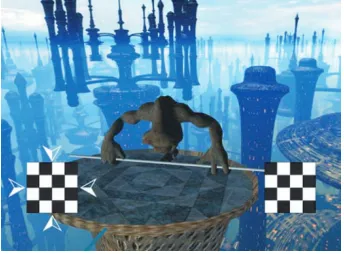
The object of the MindBalance game is to gain 1D control of the balance of an animated character on a tightrope using only the player’s EEG. As mentioned inSection 1, the game involves the movement of the animated character within a virtual environment, with both the character and envi-ronment modelled as 3D volumes. The lighting and virtual
camera position change in response to the character’s move-ments within the environment. During the game, a musical soundtrack as well as spoken comments by the character are also played over the aforementioned speakers to make the game more engaging.
A checkerboard is positioned on either side of the charac-ter. These checkerboards are phase-reversed at 17 and 20 Hz. A game begins with a brief classifier training period. This requires the subject to attend to the left and right checker-boards as indicated by arrows for a period of 15 seconds each. This process is repeated three times (Figure 3). During this training period, audio feedback is continually presented using speakers located behind the subject. The audio feed-back is in the form of a looped double-click sound, the play speed of which is linearly related to the feature (F1 in the case of Method 1 orF2 in the case of Method 2). Feedback is presented in order to ensure compliance during the critical training period.
Table2: Offline performance for Method 2 averaged over two checkerboard configurations.
Subject 2nd harmonic only 1st + 2nd harmonic
1s window 2s window 1s window 2s window
Subject 1 89.8% 96.1% 82.9% 89.1%
Subject 2 71.0% 80.4% 73.2% 80.8%
Subject 3 61.7% 65.8% 62.7% 73.5%
Subject 4 80.1% 82.3% 71.9% 78.9%
Subject 5 59.5% 62.0% 59.4% 55.0%
Average across subjects 72.4% 77.3% 70.0% 75.5%
Figure3: The training sequence.
which the character is losing balance (Figure 4). The char-acter’s off-balance animation lasts for 3 seconds. This du-ration was chosen to give the player time to realize which checkerboard required fixation to elicit the required SSVEPs and help the character regain his balance. At the end of the 3-second animation, a decision based on the most re-cent 1 or 2 seconds of EEG is obtained. To allow for bet-ter game play, a second more pronounced off-balance 3-second animation was used in order to give a player a sec-ond chance in the case where an incorrect decision was obtained from the EEG. There was also an optional play mode where an EEG feature value within a certain range of the decision threshold, when detected at the end of the off-balance animation, resulted in no decision being taken and the original 3-second off-balance animation being sim-ply replayed. This dead zone was removed during our online tests.
(B) Signal processing and the C# engine
The overall processing system is shown in Figure 5. In or-der to carry out this study, a programming engine and plat-form were required, capable of rendering detailed 3D graph-ics while at the same time processing continuous EEG data to control a sprite within the game. This was accomplished using a combined graphics, signal processing, and network communications engine implemented in C#.1One machine
1Implemented by the MindGames Group at Media Lab Europe.
Figure4: The character loses balance during the game.
is dedicated to the rendering of the 3D graphics while a sec-ond machine was dedicated to the real-time data acquisition and signal processing of the EEG data. This signal processing engine allows selection of signal processing functions and pa-rameters as objects to be included into a chain of signal pro-cessing blocks to perform the required propro-cessing. Whenever a decision on the fate of the animated character is required, a request in the form of a UDP packet is sent over the local area network to the signal processing machine which sends back a decision based on the most recent feature extracted from the EEG.
(C) Interface equipment of game control
The setup for the real-time BCI game was similar to that used in the preliminary offline analysis. One difference was the amplification stage in which the Grass Telefactor P511 rack amplifiers were replaced by Biopac biopotential amplifiers.
The subject was seated in front of a large screen on which a 140×110 cm image was projected. Within the game pic-tured in Figures3and4, each 4×4 checkerboard pattern’s medial edge was situated 8.5◦bilateral to the tightrope,
cen-tered on the horizontal meridian, and subtended a visual an-gle of 11.4◦vertically and 11.8◦horizontally.
(D) Subjects and test protocol
Audio/ visual feedback
O1 &O2 channels
Amplier s and Þlters
Data bu er 1 or 2 s at 256 Hz
Auto correlation
Hamming window & zero pad 1024-point
FFT PSD estimate Feature
selection Freq. power
ratio Feature
translation (log) 3D graphics
game engine
Figure5: Flowchart of signal processing stages employed in real-time BCI game.
Table3: Percentage of correct decisions in real-time game play, us-ing Method 1 with second SSVEP harmonic only.
Subject 1s window 2s window
Subject 1 75.0% 100%
Subject 2 72.7% 100%
Subject 3 75.0% 70.6%
Subject 4 69.2% 100%
Subject 5 87.5% 78.2%
Subject 6 100% 88.2%
Average across subjects 79.9% 89.5%
Each subject was asked to play the game eight times. Four of the games were played where the EEG was analyzed by the FFT method described above as Method 1 for the of-fline data. In two of these games, the decision on the fate of the tightrope walking character was based on a 1-second window of EEG data, and in the other two games, the deci-sion was based on a 2-second window. The other four games were played using EEG analyzed by Method 2, the autocor-relation followed by FFT method. Again, two games used 1-second segments of EEG data and two games used 2-1-second segments.
On average, there were eight trials per game. This varied from game to game as a result of the random number of steps taken by the character between losses of balance and the fact that in seven of the 48 games played, two consecutive errors occurred resulting in the character falling from the tightrope and the end of the game.
Results
Tables3and4list the percentage of correct decisions result-ing in the desired regain of balance on the tightrope. In seven of the 48 games played, two consecutive errors occurred re-sulting in the character falling from the tightrope, causing the game to end. Three of the six subjects did not allow the character to fall offthe tightrope in any of the eight games.
One objective measure of BCI performance is the bit rate, as defined by Wolpaw [16]. For a trial withNpossible sym-bols in which each symbol is equally probable, the probabil-ity (P) that the symbol will be selected is the same for each
Table4: Percentage of correct decisions in real-time game play, us-ing Method 2 with second SSVEP harmonic only.
Subject 1s window 2s window
Subject 1 87.5% 91.7%
Subject 2 50.0% 58.3%
Subject 3 85.7% 46.2%
Subject 4 85.7% 75.0%
Subject 5 63.6% 100%
Subject 6 87.5% 92.3%
Average across subjects 76.7% 77.3%
symbol, and each error has the same probability, then the bit rate can be calculated as follows:
Bits per symbol=log2N+P·log2P+ (1−P)·log2 1−P N−1, Bit Rate=bits per symbol∗symbols per minute.
(6)
In the case of the present study, one symbol is sent per trial. Using this definition of bit rate and given that each trial lasts for 3 seconds and the peak accuracy for the real-time system is 89.5%, the bit rate is 10.3 bits/min.
4. DISCUSSION
The results from this study indicate that the distinct SSVEP responses elicited by phase-reversing checkerboard patterns can be successfully used to make binary decisions in real time in a BCI-controlled game involving a visually elaborate envi-ronment.
The two feature extraction methods can be directly com-pared for the offline data, given that the methods were used to classify the same data set. The results for both methods are comparable, with Method 2 performing marginally better than Method 1. This may be due to the resilience of Method 2 to uncorrelated noise.
a relatively small number of trials, a direct comparison be-tween the methods in the real-time tests is not as meaningful. The fact that Method 1 performs better than Method 2 may be attributable more to the anomalous performance of sub-jects 2 and 3 during the games played using Method 2 than to the feature extraction method itself.
In both online and offline testings, classification based on 2-second windows exceeded that of 1-second windows for all features. This is to be expected as a 2-second window gives higher-frequency resolution and allows more accurate extraction of the SSVEP peak amplitudes. As mentioned ear-lier, a bit rate 10.3 bits/min is achievable using the full trial length of 3 seconds, allowing for the time taken for the sub-ject to respond to the loss of balance of the character in the game and for the elicitation of the SSVEP. It is also useful to calculate theoretical bit rate maxima based purely on the 1- and 2-second EEG windows. This gives a peak bit rate of 15.5 bits/min for the 2-second window and 16.6 bits/min for the 1-second window. It is worth noting that the bit rate defined in (6) is designed to encourage accuracy over speed and as a result, the penalty incurred by the drop in accuracy almost negates the doubling of the number of symbols per minute achieved using the 1-second window.
The decrease in performance obtained by the inclusion of the first harmonic in the offline testing may be attributed to noise added to the first harmonic due to activity in the alpha band. It was for this reason that the frequencies of the stimuli were originally chosen outside the alpha range and only the second harmonic was used in the real-time testing.
Two additional interesting observations were made dur-ing both the offline and online testdur-ings. Firstly, the two inves-tigators who themselves participated as subjects in the study achieved better performance both in terms of accuracy in the offline analysis and in terms of success in completing the game. This implies that either practice or a more motivated approach to stimulus fixation results in a more pronounced visual response. This may be thought of in terms of visual attention. Endogenous modulation of SSVEP response has been reported as possible in relation to both foveal fixated stimuli [10] and covertly attended stimuli in peripheral vi-sion [17]. The improved discriminability of the SSVEP with increased “conscious effort” may be related to the ability of the subject to focus selective attention on the fixated stimu-lus, as well as the ability to inhibit processing of distractors in the peripheral visual field.
Secondly, in post-experiment debriefing, subjects re-ported that audio feedback during training aided in the suc-cessful sustained fixation on a particular stimulus and the inhibition of responses to distractions. Also, in the case of an error causing the character to drop to the second level of imbalance, subjects found it possible to adjust their fix-ation strategy, most notably through observing the checker-board as a whole rather than specifically fixating on any indi-vidual elements or allowing perception of the phase reversal as a moving pattern. These adjustments in fixation strategy prompted by the discrete presentation of biofeedback during the game in conjunction with the motivation to succeed in the task evoked by the immersive environment may be the
reason for the better average performance during the real-time sessions (peak 89.5%) when compared with the offline results (peak 75.5%).
A possible explanation for the high performance of this BCI design in spite of continuous distracting stimulation may be offered by considering the underlying physiology. The topographic organization of the primary visual cortex is such that a disproportionately wide cortical area is devoted to the processing of information from the central or foveal region of the visual field, and thus directing one’s gaze at a desired repetitive stimulus produces an SSVEP response to which all other responses to competing stimuli are small in comparison.
The SSVEP BCI design has not been actively employed in alternative or augmentative communication (AAC) for the disabled. This is partly due to the fact that, for successful operation, the subject’s ocular motor control must be fully intact to make selections by shifting gaze direction. Given the range of accessibility options available for the disabled, it is only in very extreme cases, such as those where reli-able eye movement is not possible, that a communication medium driven by EEG generated by the brain itself is ap-plicable.
While the need for reliable ocular motor control is a prerequisite for using the BCI described in this paper, we speculate that the use of the BCI to control a character in an engaging game such as that described may prove a use-ful tool in assisting with motivational issues pertaining to ALS patients. As BCI systems take considerable training to master, typically several months, this system may serve to encourage patients to train for a greater length of time. It may also be possible that through continued and regular playing of the game, an ALS patient may be able to retain an acceptable level of control, even after ocular motor con-trol has deteriorated to the point where eye-tracking sys-tems are no longer feasible. This would involve detection of changes in the amplitudes of the SSVEP as modulated by attention to the stimuli in one’s peripheral vision. In order to explore this idea, the authors are currently extending this study to covert visual attention, in which subjects direct at-tention to one of two bilateral stimuli without eye move-ment.
Also worthy of investigation is the presentation of more stimuli in order to give multidimensional control in the 3D environment.
5. CONCLUSION
ACKNOWLEDGMENTS
We wish to acknowledge Phil McDarby for his assistance in designing the gaming environment. We would also like to thank the subjects who participated in the experimental ses-sions.
REFERENCES
[1] J. R. Wolpaw, N. Birbaumer, D. J. McFarland, G. Pfurtscheller, and T. M. Vaughan, “Brain-computer interfaces for com-munication and control,”Clinical Neurophysiology, vol. 113, no. 6, pp. 767–791, 2002.
[2] L. A. Farwell and E. Donchin, “Talking offthe top of your head: toward a mental prosthesis utilizing event-related brain potentials,”Electroencephalography and Clinical Neurophysiol-ogy, vol. 70, no. 6, pp. 510–523, 1988.
[3] E. E. Sutter, “The visual evoked response as a communication channel,” inProc. IEEE/NSF Symposium on Biosensors, pp. 95– 100, Los Angeles, Calif, USA, September 1984.
[4] N. Birbaumer, A. Kubler, N. Ghanayim, et al., “The thought translation device (TTD) for completely paralyzed patients,” IEEE Trans. Rehab. Eng., vol. 8, no. 2, pp. 190–193, 2000. [5] G. Pfurtscheller and F. H. Lopes da Silva, “Event-related
EEG/MEG synchronization and desynchronization: basic principles,” Clinical Neurophysiology, vol. 110, no. 11, pp. 1842–1857, 1999.
[6] G. Pfurtscheller and C. Neuper, “Motor imagery and direct brain-computer communication,”Proc. IEEE, vol. 89, no. 7, pp. 1123–1134, 2001.
[7] J. R. Wolpaw, D. J. McFarland, G. W. Neat, and C. A. Forneris, “An EEG-based brain-computer interface for cursor control,” Electroencephalography and Clinical Neurophysiology, vol. 78, no. 3, pp. 252–259, 1991.
[8] D. Regan,Human Brain Electrophysiology: Evoked Potentials and Evoked Magnetic Fields in Science and Medicine, Elsevier, New York, NY, USA, 1989.
[9] M. Cheng, X. Gao, S. Gao, and D. Xu, “Design and implemen-tation of a brain-computer interface with high transfer rates,” IEEE Trans. Biomed. Eng., vol. 49, no. 10, pp. 1181–1186, 2002. [10] M. Middendorf, G. R. McMillan, G. L. Calhoun, and K. S. Jones, “Brain-computer interfaces based on the steady-state visual-evoked response,”IEEE Trans. Rehab. Eng., vol. 8, no. 2, pp. 211–214, 2000.
[11] K. E. Misulis, Spehlmann’s Evoked Potential Primer, Butterworth-Heinemann, Boston, Mass, USA, 1994. [12] F. Sharbrough, G.-E. Chatrian, R. P. Lesser, H. L¨uders, M.
Nuwer, and T. W. Picton, “American electroencephalographic society guidelines for standard electrode position nomencla-ture,” Clinical Neurophysiology, vol. 8, no. 2, pp. 200–202, 1991.
[13] G. R. Burkitt, R. B. Silberstein, P. J. Cadusch, and A. W. Wood, “Steady-state visual evoked potentials and travelling waves,” Clinical Neurophysiology, vol. 111, no. 2, pp. 246–258, 2000. [14] B. D. Ripley,Pattern Recognition and Neural Networks,
Cam-bridge University Press, CamCam-bridge, UK, 1996.
[15] W. Klimesch, “EEG alpha and theta oscillations reflect cogni-tive and memory performance: a review and analysis,”Brain Research Reviews, vol. 29, no. 2-3, pp. 169–195, 1999. [16] J. R. Wolpaw, H. Ramoser, D. J. McFarland, and G.
Pfurtscheller, “EEG-based communication: improved accu-racy by response verification,”IEEE Trans. Rehab. Eng., vol. 6, no. 3, pp. 326–333, 1998.
[17] S. T. Morgan, J. C. Hansen, and S. A. Hillyard, “Selective at-tention to stimulus location modulates the steady-state visual evoked potential,”Proceedings of the National Academy of Sci-ences of the United States of America, vol. 93, no. 10, pp. 4770– 4774, 1996.
E. C. Lalor received the B.E. degree in
electronic engineering from University Col-lege Dublin, Ireland, in 1998 and the M.S. degree in electrical engineering from the University of Southern California in 1999. He is currently working towards the Ph.D. degree in the Department of Elec-tronic and Electrical Engineering in Uni-versity College Dublin, Ireland. From 2002 to 2005, he worked as a Research
Asso-ciate with Media Lab Europe, the European research partner of the MIT Media Lab. His current interests include brain-computer interfaces and signal processing applications in neuro-science.
S. P. Kellyreceived the B.E. degree in
elec-tronic engineering and Ph.D degree in bio-chemical engineering from University Col-lege Dublin, Ireland, in 2001 and 2005, respectively. He is currently a Postdoc-toral Research Fellow in the Cognitive Neu-rophysiology Laboratory, Nathan S. Kline Institute for Psychiatric Research in New York. His current research interests include the neurophysiology of selective attention
and multisensory integration in humans, and EEG-based brain-computer interfacing for alternative communication and con-trol.
C. Finucanewas born in Dublin in 1979. He
graduated from University College Dublin (UCD) in 2001 with a B.S. degree in elec-tronic engineering. He subsequently com-pleted an M. Eng. Sc. degree at UCD and the National Rehabilitation Hospital for work entitled “EEG-based brain-computer inter-faces for the disabled” in 2003 before join-ing the Department of Medical Physics, St. James’s Hospital, Dublin, where he
cur-rently works as a Medical Physicist. Finucane’s research interests include the development of novel brain-computer interfaces, neu-rophysiological signal analysis, biomedical applications of multi-media, wireless and Internet technologies, and biological systems modelling.
R. Burkereceived the B.S. Eng. degree in
R. Smithobtained the B.E. degree in elec-tronic engineering from University College Dublin (UCD), Ireland, in 2002. He subse-quently completed an M. Eng. Sc. at UCD for research that focused on neurophysi-ological signal processing and the devel-opment of brain-computer interfaces. His research primarily focuses on EEG-based BCIs and their possibilities in the field of neurological rehabilitation.
R. B. Reillyreceived his B.E., M. Eng. Sc.,
and Ph.D. degrees in 1987, 1989, and 1992, all in electronic engineering, from the Na-tional University of Ireland. Since 1996, he has been on the academic staffin the Department of Electronic and Electrical Engineering at University College Dublin. He is currently a Senior Lecturer and re-searches into neurological signal processing and multimodal signal processing. He was
the 1999/2001 Silvanus P. Thompson International Lecturer for the IEE. In 2004, he was awarded a US Fulbright Award for re-search collaboration into multisensory integration with the Nathan S. Kline Institute for Psychiatric Research, New York. He is a re-viewer for the Journal of Applied Signal Processing and was Guest Editor for the mini issue on multimedia human-computer inter-face, September 2004. He is the Republic of Ireland Representative on the Executive Committee of the IEEE United Kingdom and Re-public of Ireland Section. He is an Associate Editor for IEEE Trans-actions on Multimedia and also a reviewer for IEEE TransTrans-actions on Biomedical Engineering, IEEE Transactions on Neural Systems and Rehabilitation Engineering, IEEE Transactions on Industrial Electronics, Signal Processing, and IEE Proceedings Vision, Image & Signal Processing.
G. McDarbyobtained the B.E. and M.S.
de-grees in electronic engineering from Uni-versity College Dublin, Ireland, in 1988 and 1995, respectively. He received the Ph.D. de-gree in biomedical signal processing in 2000 from the University of New South Wales, Sydney. Since 2000, he has worked as a principal Research Scientist in Media Lab Europe leading a multidisciplinary group called MindGames. His research is focused