www.business.unsw.edu.au
School of Economics
Australian School of Business
UNSW Sydney NSW 2052 Australia
http://www.economics.unsw.edu.au
ISSN 1323-8949
ISBN 978 0 7334 2784-8
The views expressed in this paper are those of the authors and do not necessarily reflect those of the School of Economic at UNSW.
Extending the Aaron Condition for
Alternative Pay-As-You-Go Pension Systems
Miriam Steurer
Extending the Aaron Condition for
Alternative Pay-As-You-Go Pension Systems
Miriam Steurer
∗School of Economics University of New South Wales
Sydney 2052, Australia
E-Mail: [email protected]
August 18, 2008
Welfare comparisons between funded and pay-as-you-go (PAYG) pension systems are often made using the Aaron condition. However, the Aaron condition as usually stated is not precise enough about the exact form of the PAYG pension system. PAYG pen-sion systems can be either of the defined-benefit or defined-contribution variety. They can also differ with regard to intra-generational redistribution. For example, pension benefits can be flat or earnings related. Here, four alternative PAYG pension systems are considered. It is shown that each system generates its own Aaron condition. In addition, the standard Aaron condition assumes that the wage rate and labor partici-pation rate does not vary across individuals and that the rate of population growth is constant and exogenous. These assumptions are also relaxed. Using US data covering the period 1933-2001, I then show that the results of comparisons between PAYG and funded systems depend critically on exactly which variety of PAYG system is being compared, and that PAYG systems are becoming less attractive over time as fertility rates decline. (JEL H55, J13, J14)
Keywords: Aaron Condition; Pay-As-You-Go Pension; Funded Pension; Defined Con-tribution; Defined Benefit; Labor Participation Rate; Fertility Rate
1
Introduction
In the first decades after World War II it seemed that pay-as-you-go (PAYG) pension systems provided countries with a cheap way of supporting retirees. The generation that failed to accumulate adequate funds for retirement due to war, the great depression, and (in some countries) hyper-inflation, could receive pensions without contributing to the system. Growing populations and rapid economic growth meant that the internal rate of return of PAYG pension systems were high and that financing even the most generous unfunded system in the future seemed not that onerous. But recent declines in the fertility rates and the resulting pressures on many governments’ budgets are causing governments to reassess their pension systems.
One crucial (and much discussed) distinction between different pension systems is whether they are funded or PAYG (see e.g., Feldstein 1985, Davis 1995, Blake 2000, and Bolle 2000). In funded systems each generation saves for their own retirement. Thus no inter-generational redistribution exists. In PAYG systems the current young workers finance the pension benefits of the current old generation and will in turn receive payments from the young when they themselves are old. Thus there exists an inter-generational transfer from young to old in each period.
Welfare comparisons between funded and PAYG pension systems have sometimes been made using the Aaron condition (based on work by Samuelson 1958 and Aaron 1966), which shows how the relative performance of these systems depends on the inter-est rate and the growth rate of wages and fertility.1 However, the Aaron condition as it is usually stated assumes steady state conditions and does not take into consideration that PAYG pension systems can differ in a number of important ways.
PAYG systems (as well as funded systems) can be organized either on a defined benefit (DB) or defined contribution (DC) basis.2 This distinction – although not much
1For empirical examples see Davis (1995) or Blake (2000).
discussed in the pension literature – is very important when discussing PAYG pension systems where contributions of one generation benefit another. In DB systems the pension benefit formula is fixed in advance but the contribution rate that is needed to finance the system will adjust depending on economic and demographic developments. In DC systems it is the pension contributions that are fixed over time with the pen-sion levels adjusting to economic and demographic changes. DB systems provide more income security for the retirees but less security about the cost of running the system (the necessary tax contributions). A DC system on the other hand provides certainty about the contribution levels (tax rates) but will provide reduced income security for retirees.
In recent years a number of papers have considered the impact of declining fertility rates on PAYG pension systems. However, the importance of the distinction between DB and DC PAYG pension systems has been largely overlooked.
This difference is of particular importance when discussing the so called “pension crisis” in many OECD countries arising from declining fertility rates (see Disney 2000 and Cigno and Werding 2007). While it is true that DB-PAYG systems will lead to increased public spending (deficits) as population aging occurs, this is not the case for a DC-PAYG system. In a DC-PAYG system population aging will lead to downward pressure on the level of pension benefits (thus reducing the replacement rate) rather than putting upward pressure on the budget deficit. Thus population aging in a
DC-be confused with the “notional defined contribution system” which is sometimes referred to as a DC system in the pensions literature. The basic structure of a notional defined contribution system remains PAYG, but with a number of elements that provide a close link between taxes paid by individuals and their pension entitlements. Generally each worker receives a virtual pension account into which funds from his/her payroll taxation are credited (but generally not received). At the end of the working life individuals then receive a pension that is closely linked to the virtual funds they accumulated in their virtual pension accounts. In this sense notional defined contribution systems are closely linked to the earnings related defined contribution (ER-DC-PAYG) systems considered in this article.
PAYG system would lead to an “old age poverty crisis” instead of a budget deficit crisis.
It is therefore important that countries fully understand the implications of switch-ing (or not switchswitch-ing) from one system to another. Most countries currently have DC-PAYG pension systems. However, recently, a small but growing number of coun-tries have introduced DC-PAYG systems under the guidance of the World Bank, as part of the transition from DB-PAYG systems to fully funded DC systems (see Holzmann and Hinz 2005). Chile is probably the country that comes closest to a pure DC system. However, DC elements have recently been introduced in a number of countries that previously had pure DB systems (for example in Sweden, Italy, Poland, Latvia, and Russia).
Another distinction is whether pension benefits are related to an individual’s prior labor market performance or not.3 Here I refer to a system in which pension payments are related to prior market performance (or tax contribution) as “earnings related” (ER) and those in which no such connection exists as “flat” systems.4 Under earnings related (ER) systems individual pension benefits are linked (proportionally) to an individual’s prior labor market income - and therefore also to her prior tax payments if the pension system is funded by a payroll tax. When retiring in period t+ 1 an old person who has worked in period t receives a public pension which is proportionally linked to her tax contributions in period t via the replacement rate. For funded ER systems this replacement rate is directly related to the market interest rate. In ER-PAYG systems there is generally no direct link to the market interest rate. Depending on whether
3Pension payments could also be linked to individual fertility levels (see Kolmar 1997, Cigno,
Lu-porini and Pettini 2003, and Cigno and Werding 2007). Kolmar (1997), in particular, considers some of the implications of fertility based payments for the Aaron condition. I do not consider fertility based payments here.
4In the literature these two forms of PAYG pension systems are sometimes referred to as Bismarckian
the ER-PAYG system is of the defined benefit (DB) or the defined contribution (DC) variety, the replacement rate is known to the individual in advance (in the DB case) or not (in the DC case).
In all types of ER systems, high income earners receive higher pension payments than low income earners. Thus, there may be little intra-generational redistribution in ER-systems. In contrast, in a flat system every old person of a generation receives the same pension payments independently of her prior market performance and prior tax payments. Thus, in a flat system, there exists intra-generational redistribution. Differences in the performance of flat and ER systems can only be investigated within a model that allows for heterogeneous agents. This heterogeneity across agents can arise either from differences in wage rates across individuals or due to differences in labor participation rates.
The remainder of this article is structured as follows. First, the standard Aaron condition is derived. Then it is shown how the Aaron condition generalizes when the wage rate and labor participation rate are allowed to vary across individuals. Once we allow for heterogeneity across individuals, the question then arises as to whether there is any intra-generational redistribution within the PAYG pension system. This issue is not addressed by the standard Aaron condition. I consider two varieties of DC-PAYG pension system. The first is an earnings related (ER) system with no intra-generational redistribution. The second is a flat system in which all retirees of a particular generation receive the same pension benefit irrespective of how much they have paid into the system. These two pension systems generate different Aaron conditions. For DB-PAYG pensions, again, once I allow for variations in wage and labor participation rates, a distinction can be drawn between ER-DB-PAYG and flat-DB-PAYG pension systems. These pension systems also generate their own Aaron conditions. In total, I consider four possible scenarios. These are illustrated in Table 1. Using US data covering the period 1933-2001, I then show that the results of comparisons between
PAYG and funded systems depend critically on exactly which variety of PAYG system is being compared, and that PAYG systems are becoming less attractive over time as fertility rates decline.
Insert Table 1 Here
2
The Standard Aaron Condition
The Aaron condition compares the rates of return of a funded and PAYG pension system.5 I consider an overlapping generations setting where each individual is assumed to live for two periods. In the first period, an individual works and in the second she is retired. Aaron (1966) assumes that the economy is in steady state (i.e., population and wages are growing at a constant rate). This assumption will be relaxed in subsequent sections. If the economy is in steady state (and there is no heterogeneity between individuals) the rate of return from DB and DC PAYG pension systems is identical and thus there will be only one type of Aaron condition.
The (gross) rate of return on a funded pension system earned by an individual is given by the gross market interest rate, 1 +r. The rate of return on a PAYG pension system for any individual is determined by the ratio of benefits received and contribu-tions paid, q/p, where q is the replacement rate (i.e., the fraction of net income earned when young that an individual receives upon retirement), and p is the contribution to the PAYG pension system made by a young individual. Assuming its budget is bal-anced with respect to the PAYG pension system, the government faces the following budget constraint in each period t:
wt−1Nt−1q= (1 +γ)wt−1(1 +n)Nt−1p, (1) where wt−1 and Nt−1 denote, respectively, the wage rate and the number of young people in period t − 1. (1 + γ) and (1 +n) denote the growth rate of wages and
population from one period to the next, both of which are assumed to be exogenous. The left-hand side of (1) depicts the pension liability of the government to the present old generation while the right-hand side depicts the total pension contributions of the young generation. From (1) it follows that q/p = (1 +γ)(1 +n). This implies that a funded pension system generates a lower rate of return than a PAYG pension system if the gross market interest rate satisfies the following inequality:
(1 +r)<(1 +γ)(1 +n). (2)
If the inequality is reversed, then a funded pension system generates a higher rate of return than a PAYG pension system.
3
Modifying the Aaron Condition for DC-PAYG
Pension Systems
3.1
An Earning-Related-Defined-Contribution (ER-DC) PAYG
Pension System
The Aaron condition as stated in (2) is only one of a number of Aaron conditions that could be derived for PAYG pension systems. In steady state the ratio q/p remains constant over time, and thus the rate of return on DB and DC type PAYG systems will be the same. Outside steady state however the ratio q/p will not remain constant but will reflect economic and demographic developments. In DC systemspis kept fixed while q will vary over time to balance the government budget. In DB systems on the other hand q will be fixed while p will vary over time.
Aaron (1966) also assumes that the wage rate and labor participation rate is the same for all individuals of the same generation. This section considers the implications of relaxing these assumptions in DC systems. Discussion of defined benefit (DB) systems
is deferred until the next section.
Once wage and labor participation rates are allowed to differ across individuals, the issue of intra-generational redistribution becomes important. Two alternative DC-PAYG pension systems are considered here. The first is an earning related (ER) system with no intra-generational redistribution.
Let wti and zti denote, respectively, the wage rate and labor participation rate of individual iin the young generation of period t. qt+1 is the replacement rate in period t+1 whilep is the (fixed) contribution rate to the PAYG system. Assuming there is no intra-generational redistribution, the government budget constraint in period t+ 1 now becomes qt+1 Nt X i=1 witzti =p Nt+1 X j=1 wjt+1ztj+1. (3)
As before, a young individual in periodtearns a higher return on the PAYG pension system as compared to a funded system if (1+rt+1)< qt+1/p. In other words, the Aaron condition is (1 +rt+1)< PNt+1 j=1 w j t+1z j t+1 PNt i=1witzti .
If we assume that the covariance between the wage rate and labor participation rate across individuals in each generation is zero, then it follows that PNt+1
j=1 w
j t+1z
j
t+1 =
Nt+1wt+1zt+1 and PNi=1t wtizti =Ntwtzt.6 In this case, the Aaron condition reduces to
(1 +rt+1)<(1 +γt+1)(1 +nt+1)(1 +gt+1), (4)
where 1 +γt+1 = wt+1/wt, 1 +nt+1 = Nt+1/Nt and 1 + gt+1 = zt+1/zt. This new
version of the Aaron condition now includes the growth rate of labor participation, and recognizes that the growth rate of wages and population can vary over time.
6This assumption is less problematic for men than for women. MaCurdy, Green, and Paarsch (1990)
find that both income and substitution effects of wage changes are close to zero for prime aged men. However, female labor force participation tends to be positively correlated with the wage rate (p. 1999, Ehrenberg and Smith 1996).
3.2
A Flat-Defined-Contribution (Flat-DC) PAYG Pension
Sys-tem
Consider now a flat-DC PAYG pension system. Under this system all retirees in period
t+ 1 receive the same pensionQt+1, irrespective of how much they paid into the pension system the previous period. This means that the PAYG pension redistributes from high income individuals to low income individuals in each generation. The government’s budget constraint in period t+ 1 is now
NtQt+1=p
Nt+1 X
i=1
wti+1zti+1, (5)
where NtQt+1 represents the total payout to the old generation in period t+ 1, while
pPNt+1
i=1 wit+1zit+1 represents the pension contributions of the young in period t+ 1. Individual iwho is young in period t will prefer the PAYG system over the market system if the internal rate of return of the pension system dominated that of the mar-ket; that is if Qt+1/(pwtizti) > (1 +rt+1). Using the government budget constraint to substitute for Qt+1, this inequality can be rearranged as follows:
(1 +rt+1)< PNt+1
i=1 wti+1zti+1
Ntwtizti .
This inequality represents the Aaron condition for the flat DC-PAYG system. It differs from the ones above in that now it is no longer the case that all individuals of a given generation must have the same ranking of a funded and PAYG pension. In particular, the higher individual i’s income (i.e., wi
tzit), the less likely it is that she will prefer the
PAYG pension system to the funded system.
If we again assume that the covariance between the wage rate and labor participation rate across individuals in each generation is zero, then for a young individual with the average income in periodt, this Aaron condition reduces to the same inequality as under an ER-DC-PAYG system. The PAYG system is preferred to the market system if:
4
Modifying the Aaron Condition for DB-PAYG
Pension Systems
4.1
An Earning-Related-Defined-Benefit (ER-DB) PAYG
Pen-sion System
Under a DB-PAYG system, the payment received on retirement is fixed, while the tax rate on workers is adjusted to balance the government’s budget. Again I compare a PAYG and funded pension system from the perspective of a young individual in period
t. One important difference with DB-PAYG systems as compared with DC-PAYG systems is that, from the perspective of the young generation in period t, the relevant government budget constraint is the one for period t not t+ 1. This is because this is where the pension contribution ratevtis set to balance the budget. The pension benefit
rate x remains unchanged over time in an ER-DB-PAYG system.
Again, as in the previous section, I allow wage and labor participation rates to differ across individuals. This in turn makes the issue of intra-generational redistribution important and hence it is again necessary to consider the implications of an earnings related as well as a flat system.
An earnings related (ER) DB-PAYG system with no intra-generational redistribu-tion leads to the following government budget constraint in period t:
x Nt−1 X i=1 wit−1zti−1 =vt Nt X j=1 wjtz j t. (6)
The left hand side of (6) represents the benefits accrued by the old in periodt, while the right hand side represents the pension contributions of the young in periodt. As before, a young individual in period t earns a higher return on the PAYG pension system if
x/vt >(1 +rt+1). In other words, the Aaron condition is (1 +rt+1)< PNt j=1w j tz j t PNt−1 i=1 wti−1zti−1 .
If we assume that the covariance between the wage rate and labor participation rate across individuals in each generation is zero, then the Aaron condition can be rewritten as
(1 +rt+1)<(1 +γt)(1 +nt)(1 +gt), (7)
where 1 +γt =wt/wt−1, 1 +nt=Nt/Nt−1, and 1 +gt=zt/zt−1.
4.2
A Flat-Defined-Benefit (Flat-DB) PAYG Pension System
Consider now a flat-DB PAYG pension system. This means all retirees in period t+ 1 receive the same pension X, irrespective of the size of their individual contribution,
vtwtizti, paid into the pension system in period t. The PAYG pension, therefore,
re-distributes from high income individuals to low income individuals in each generation. The government’s budget constraint in period t is now
Nt−1X =vt Nt
X
i=1
wtizti. (8)
Individual i who is young in period t will prefer the PAYG system if X/(vtwitzit) >
(1 +rt+1). Substituting for vt by using the period t government budget constraint [8],
we get the following Aaron condition for individual i of generation t: (1 +rt+1)< PNt i=1witzti Nt−1w j t−1z j t−1 .
Like the flat-DC-PAYG pension, not all individuals of a given generation need neces-sarily have the same ranking of a funded and PAYG pension. Once again, the higher the value of wtizti, the less likely it is that individual i will prefer the PAYG pension system to the funded system.
If the covariance between the wage rate and labor participation rate across individ-uals in each generation is zero, then for the young individual with the average income in period t, both the wage and labor participation rates drop out of the Aaron condition which reduces to
4.3
The Sustainability of DB-PAYG Pension Systems
The Aaron conditions derived above for DB-PAYG pension systems assume that the system does not collapse in periodt+ 1 due to a lack of young people. Sustainability is never an issue for DC-PAYG systems. If the fertility rate, wages or labor participation decline from one generation to the next then this simply means that retirees get a worse return from the pension system than they would have otherwise. In contrast, under a DB-PAYG system, each period the government has a fixed liability to the old generation. The main concern here is declining fertility rates in countries with generous earnings related DB-PAYG systems, such as Germany, Austria and Italy. The birth rate per woman by 2002 had fallen to 1.39 in Germany, 1.40 in Austria and 1.19 in Italy (see Central Intelligence Agency 2002). In these situations, it is possible that to balance its budget the government may have to raise the tax rate to a level that the working population will not tolerate. Clearly, in such cases the maintenance of the pension system becomes incompatible with a balanced budget. It is important that this issue is kept in mind when interpreting Aaron conditions for DB-PAYG pension systems - especially when it comes to making comparisons into the future.
5
Implications of the Modified Aaron Conditions
for the United States
Using US data over the period 1933-2001 and projections to 2023, I calculate all four of the Aaron conditions discussed above. It will be shown that these Aaron conditions differ quite significantly. In particular, the question of whether individuals prefer un-funded over un-funded systems becomes problematic in some cases as situations arise in which certain unfunded systems are preferred over certain funded systems which in turn are preferred over other unfunded systems. It should be emphasized that the results
presented here are only illustrative. None of the PAYG pension systems considered here is a close match for the actual pension system in place in the US during this period. Nor do I attempt to calculate the actual rate of return received by US residents.
My objective is to demonstrate the importance of finding the Aaron condition that corresponds as closely as possible to the pension system that individuals are actually facing. I show that the welfare ranking of the funded and PAYG pension system can depend on which Aaron condition is used, and that “double switches” (i.e., one type of PAYG system being preferred to a funded system which in turn is preferred to another PAYG system) can easily occur with real data.
Here I assume each period in the overlapping generations model lasts 25 years. However, I will refer to cohorts rather than generations, since the gap between each cohort in our analysis is only five years. The first cohort is young in the period 1933-1958, and old in the period 1958-1983. The second cohort is young from 1938-1963, and old from 1963-1988. Later cohorts are staggered at five year intervals. The last cohort considered is young from 1998-2023 and old from 2023-2048.
Consider first the generation that is young (and working) in the period 1933-1958 and retired from 1958-1983.7 It is assumed that the midpoint of the period is representa-tive of the period as a whole with regard to the real wage and labor participation rates. The number of young people in each cohort is proxied by the total number of births 13 years before the start of the period. In other words, the number of young workers in the 1933-1958 cohort is determined by the number of births in 1920.8 Therefore, it is assumed implicitly that there is no net immigration of young people. Immigration of old people does not matter if they are not eligible to receive the pension.
7The assumption that the period over which an individual works is of equal length to the period
of retirement is unrealistic. Also, no account is being taken of increases in longevity over time. The former assumption will tend to bias the results towards preferring the funded pension system, while the latter effect will partially counteract it.
The real interest rate for each period is computed by compounding 3-month treasury bills over 25 years.9 This should be viewed as a lower bound on the rate of return on a funded pension system, and hence biases the results towards preferring the PAYG system.
I compare here the Aaron conditions derived assuming the covariance between the wage and labor participation rates is zero for individuals of the same generation. Ev-idence suggests that the covariance during the twentieth century was around zero for men but positive for women.10 Furthermore, it must be remembered that the population growth rate and labor participation rate might not be independent of the pension sys-tem itself.11 So counterfactual comparisons of hypothetical PAYG systems with funded pension systems based on actual data are not strictly valid. However, my objective here is simply to illustrate that PAYG pensions can differ significantly in the returns they generate and that using a single measure like the Aaron condition to compare PAYG with funded systems will generally not provide reliable results.
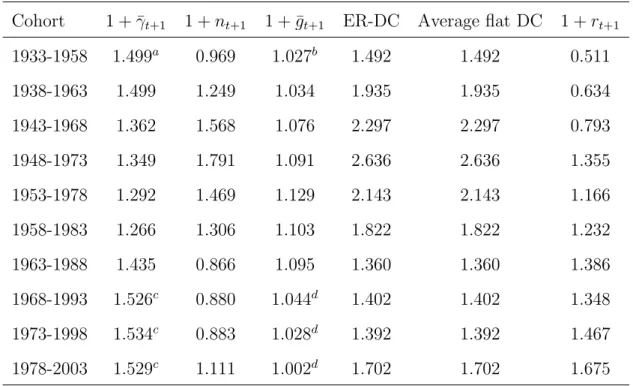
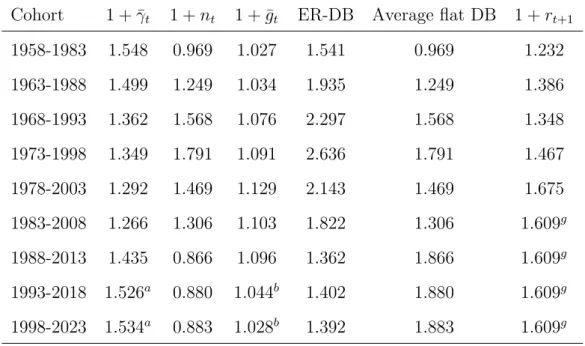
The specific Aaron conditions for DC-PAYG and DB-PAYG pension systems are shown below in Tables 2 and 3, respectively.12 From equation (4) it follows that the (gross) rate of return on the earnings related DC-PAYG system, denoted by (1 +Mt+1), in Table 2 is equal to (1+γt+1)(1+nt+1)(1+gt+1).13 As shown in section 3 above, this is
9Source: 3-Month Treasury Bill Rate, Secondary Market, H.15 Release, Federal Reserve Board of
Governors, www.federalreserve.gov/releases/h15/data.htm. Nominal interest rates are deflated by the Consumer Price Index for All Urban consumers: All Items, U.S. Department of Labor, Bureau of Labor Statistic, www.bls.gov/cpi/home.htm.
10Again, see MaCurdy, Green, and Paarsch 1990 and Ehrenberg and Smith 1996.
11For example, if the rearing of children is time intensive, higher female labor participation would
be associated with lower fertility rates.
12See Davis (1995), Willmore and Bertucci (1999), and Blake (2000) for alternative estimates of the
traditional Aaron condition for different countries.
13(1 +γ
t+1) denotes the growth rate of real mean wages. These data are taken from the U.S. Census
Bureau, Table P-3, www.census.gov/hhes/income/histinc/p03.html. (1 +gt+1) denotes the growth
also the rate of return for the averageindividual under a flat DC-PAYG system. From equation (7) it follows that the rate of return on the ER-DB-PAYG system, denoted by (1 +Mt), in Table 3 is equal to (1 +γt)(1 +nt)(1 +gt). The Aaron condition for the
average individual under a flat DB-PAYG system, in contrast, simply equals (1 +nt).
Insert Table 2 Here Insert Table 3 Here
Table 2 compares the rate of return of defined contribution PAYG systems with that of a funded system (1 +rt+1). It can be seen that for the first six cohorts (starting in 1933), the return from the DC-PAYG system (whether of the earnings related or flat variety) exceeds that from the funded system. For later cohorts the return from funded pension provision improves significantly while the return from DC systems tends to decline (due to the decline in population growth rates).
Table 3 compares the rate of return of defined benefit (DB) systems (flat or earnings related) with that of a funded system. For the first six cohorts (starting in 1958), the return from the ER-DB-PAYG system exceeds that from the funded system. For the final three cohorts, this result is reversed and a funded system provides the highest return. This reversal is due to the lower population growth rate (1 +nt) over the later
cohorts. Assuming that this trend in lower population growth continues in the future, funded systems will continue to provide higher returns for cohorts to come. The return from the flat DB-PAYG system is the worst of the three with no tendency to improve as it is completely based on the declining population growth rate.
For five of the cohorts it is possible to compute rates of return for both defined-contribution (DC) and defined-benefit (DB) PAYG systems. Table 4 provides a ranking of the return of all pension systems that were discussed above for these cohorts.
Insert Table 4 Here
These findings raise a number of interesting issues. First, for four out of five of
these cohorts, ER-DB pensions gave the highest return. However, the rate of return from ER-DB pensions has been declining over the last few cohorts. This is primarily due to the falling fertility rate, which eventually starts to affect retirees under an ER-DB-PAYG system as well. DC systems experienced falling returns earlier because of the difference in reference periods (DB systems depend on the growth rate of wages, fertility, and labor participation in periodt+ 1 while DC systems depend on the growth rates in period t).
Second, the flat DB system generally gave the worst return of all systems (last in the ranking 3 out of 5 times) as its return is solely based on the diminishing population growth rate.
Third, for all but one of the cohorts the return of the funded system lay between two types of PAYG systems.
Fourth, if the ER-DC-PAYG system was projected forward further it is probable that its rate of return would remain below that of the funded system. Thus, it seems that the cohort that is young in the period 1988-2013 is at a threshold beyond which the rate of return on both ER-DC and ER-DB PAYG systems are likely to fall below the rate of return on a funded system. The return on flat DB-PAYG systems for the average person has always been lower than under a funded system except for the cohorts that were young in 1968-1993 and 1973-1998.
6
Conclusion
This article has shown that comparisons of the rates of return of PAYG and funded pension systems are rather more complex than is suggested by the original Aaron con-dition which does not distinguish between different types of PAYG systems. The key distinctions are between defined benefit (DB) and defined contribution (DC) PAYG sys-tems, and between earnings related and flat rate PAYG systems. The standard Aaron
condition also fails to take account of variations in the labor participation rate both within and across generations.
To obtain actual estimates of the rates of return on PAYG systems a number of simplifying assumptions had to be made. However, two clear results emerge from the analysis. First, the result of a comparison between a PAYG and funded system can be very sensitive to how the PAYG system is specified. Second, the rate of return on a PAYG system becomes increasingly unattractive over time when the fertility rate declines, as it has in most OECD countries in the last few decades.
References
Aaron, H. J. (1966), The Social Insurance Paradox, Canadian Journal of Economics and Political Science 32, 371-374.
Blake, D. (2000), Does it Matter what Type of Pension Scheme You Have? Economic Journal 110(461), F46-F81.
Bolle, P. (2000), Pension Reform: What the Debate Is About, International Labour Review 139(2), 197-212.
Central Intelligence Unit (2002), The World Factbook, www.cia.gov/cia/publications/ factbook/index.html.
Cigno, A., Luporini, A., and Pettini, A. (2003): Transfers to families with children as a principal-agent problem, Journal of Public Economics87, 1165-1177.
Cigno, A. and Werding, M. (2007), Children and Pensions. CESifo Book Series, MIT Press, Cambridge MA.
Davis, P. D. (1995), Pension Funds: Retirement-Income Security and Capital Markets: an International Perspective Oxford University Press Inc., New York.
Disney, R. (2000), Crises in Public Pension Programmes in OECD: What are the Reform Options?, The Economic Journal 110, F1-F23.
Ehrenberg, R. G. and Smith R. S. (1996), Modern Labor Economics: Theory and Policy, Sixth Edition, Addison-Wesley Educational Publishers Inc.
Feldstein, M. (1985), The Optimal Level of Social Security Benefits, Quarterly Journal of Economics 100, May 1985, 303-20.
Holzmann, R. and Hinz, R. (2005), Old Age Income Support oin the 21st Century. The World Bank, Washington DC.
Kolmar, M. (1997), Intergenerational Redistribution in a Small Open Economy with Endogenous Fertility, Journal of Population Economics 10(3), 335-356.
MaCurdy, T., Green, K., and Paarsch, H. (1990), Assessing Empirical Approaches for Analyzing Taxes and Labor Supply, Journal of Human Resources 25, 415-490. Samuelson, P. A. (1958), An Exact Consumption-Loan Model of Interest With or
Without the Social Contrivance of Money, Journal of Political Economy 66(6), 467-82.
Steurer, M. (2008), Fertility Decisions and the Sustainability of Public Pension Sys-tems. PhD Dissertation, School of Economics, University of New South Wales, Sydney, Australia.
Willmore, L. and Berucci, G. (1999), Public Versus Private Provision of Pensions, DESA Discussion Paper 1, United Nations.
Table 1: Different PAYG Pension Systems
Defined contribution Defined benefit
Earnings related ER-DC-PAYG ER-DB-PAYG
Flat Flat DC-PAYG Flat DB-PAYG
Table 2: Aaron Conditions for DC-PAYG Pension Systems
Cohort 1 + ¯γt+1 1 +nt+1 1 + ¯gt+1 ER-DC Average flat DC 1 +rt+1
1933-1958 1.499a 0.969 1.027b 1.492 1.492 0.511 1938-1963 1.499 1.249 1.034 1.935 1.935 0.634 1943-1968 1.362 1.568 1.076 2.297 2.297 0.793 1948-1973 1.349 1.791 1.091 2.636 2.636 1.355 1953-1978 1.292 1.469 1.129 2.143 2.143 1.166 1958-1983 1.266 1.306 1.103 1.822 1.822 1.232 1963-1988 1.435 0.866 1.095 1.360 1.360 1.386 1968-1993 1.526c 0.880 1.044d 1.402 1.402 1.348 1973-1998 1.534c 0.883 1.028d 1.392 1.392 1.467 1978-2003 1.529c 1.111 1.002d 1.702 1.702 1.675 Notes:
a: The mean wage in 1945 is based on value of 1947.
b: The labor participation rate of 1948 is substituted for the missing value of 1945.
c: Based on extrapolation of mean wage data up to 2001.
Table 3: Aaron Conditions for DB-PAYG Pension Systems
Cohort 1 + ¯γt 1 +nt 1 + ¯gt ER-DB Average flat DB 1 +rt+1
1958-1983 1.548 0.969 1.027 1.541 0.969 1.232 1963-1988 1.499 1.249 1.034 1.935 1.249 1.386 1968-1993 1.362 1.568 1.076 2.297 1.568 1.348 1973-1998 1.349 1.791 1.091 2.636 1.791 1.467 1978-2003 1.292 1.469 1.129 2.143 1.469 1.675 1983-2008 1.266 1.306 1.103 1.822 1.306 1.609g 1988-2013 1.435 0.866 1.096 1.362 1.866 1.609g 1993-2018 1.526a 0.880 1.044b 1.402 1.880 1.609g 1998-2023 1.534a 0.883 1.028b 1.392 1.883 1.609g Notes:
a: Based on extrapolation of mean wage data up to 2001.
b: The labor participation rate of 2002 is substituted for the missing value of 2005.
c: Based on extrapolation of wage rate series from 1992-2001.
Table 4: Ranking of returns from PAYG and funded systems
Cohort Highest return 2nd highest 3rd highest 4th highest
1958-1983 DC ER-DB funded av. flat DB
1963-1988 ER-DB funded DC av. flat DB
1968-1993 ER-DB av. flat DB DC funded
1973-1998 ER-DB av. flat DB funded DC
1978-2003 ER-DB DC funded av. flat DB
Note: DC stands for ER-DC PAYG as well as the average return from the flat DC PAYG system, as the rates of return from these two are identical.