UTU at SemEval-2016 Task 10: Binary Classification for Expression
Detection (BCED)
Jari Bj¨orne and Tapio Salakoski
Department of Information Technology, University of Turku Turku Centre for Computer Science (TUCS)
Faculty of Mathematics and Natural Sciences, FI-20014, Turku, Finland
Abstract
The SemEval 2016 DiMSUM Shared Task concerns the detection of minimal semantic units from text and prediction of their coarse lexical categories known as supersenses. Our approach is to define this task as a binary clas-sification problem approachable by straight-forward machine learning methods.
We start by detecting semantic units by match-ing text spans against several large dictionar-ies, including the English WordNet, expres-sions derived from the Yelp Academic Dataset and concepts from the English Wikipedia, generating a set of potential supersenses for each matched span. For each potential su-persense and text span pair a binary machine learning example is defined. We classify these examples using an ensemble method, taking as the final predicted supersense the one with the highest confidence score.
Our system achieves good performance on the supersense classification task but has limited performance for detection of multi-word se-mantic units. We show that the task of super-sense prediction can be effectively defined as a binary classification task.
1 Introduction
The SemEval 2016 DiMSUM Shared Task1
con-cerns the detection of minimal semantic units
and their semantic classification using supersenses
(Schneider et al., 2016). The minimal semantic units can consist of either single words ormultiword expressions (MWE) in cases where multiple words
1http://dimsum16.github.io/
form a lexical item. The concept of MWE as used in the DiMSUM task is described in detail in Schneider et al. (2014). Thesupersensesare broad-coverage, coarse lexical categories, 26 for nouns and 15 for verbs. These supersenses mostly correspond to the WordNet lexicographer files. A detailed description of the supersenses is in Schneider and Smith (2015). Automated supersense tagging has previously been explored by e.g. Curran (2005), Ciaramita and Altun (2006) and Johannsen et al. (2014).
In the DiMSUM task systems must both detect the minimal semantic units and assign correct super-senses for them. The final metric of the shared task is the averaged performance on these tasks, which are also evaluated independently. The systems can approach these tasks either independently (e.g. in a pipeline) or through a joint model.
We approach the DiMSUM task as a machine learning classification task where examples are gen-erated for all semantic units found in a pre-defined dictionary. These semantic units are classified into one of the 41 supersenses by generating an example for each possible semantic unit + supersense pair, turning the task of assigning one of many super-senses into a binary classification problem. In this manner, the task becomes a generalized machine learning task for which almost any classifier can be used.
The DiMSUM shared task defines three subtasks or data conditions in which the systems can partic-ipate, varying in the amount of resources that are allowed to be used. Thesupervised closedcondition defines the most limited case where participants can use the labeled training corpus, the English
Net lexicon and two sets of Brown word clusters. In thesemi-supervised closedcondition the Yelp Aca-demic Dataset can also be used, and in theopen con-dition systems may use any and all resources avail-able.
2 Data and Methods
2.1 Datasets
The DiMSUM corpus and evaluation tools, version 1.5, were provided by the task organizers. The cor-pus consists of a training and test set. The train-ing set is a unified combination of the STREUSLE 2.1 corpus of web reviews, and the Ritter and Low-lands Twitter datasets, and consists of 4,799 sen-tences with tokenization, POS, MWE and super-sense annotation. The test set consists of 1,000 sen-tences from online reviews, tweets and TED talk transcripts, with only tokenization and POS anno-tation.
The Yelp’s Academic Dataset2, which
con-sists of JSON objects describing 13,490 busi-nesses, 330,071 reviews and 130,873 users, was used with permission from Yelp Inc. WordNet version 3.0 (Fellbaum, 1998) was used through NLTK version 3.1 (Bird et al., 2009). For the English Wikipedia, the dump of titles in the main namespace enwiki-20160113-all-titles-in-ns0.gz was used3. Wikipedia page categories were
downloaded using the Wikipedia Python library4by
Jonathan Goldsmith.
2.2 System Overview
Our system follows a straightforward machine learn-ing approach where examples are first generated and then classified using a standard classifier library. The task specific code is in the example generation part, which consists of two steps: 1) detection of minimal semantic units and 2) assignment of candi-date supersenses for these units.
The detection of minimal semantic units is a rule-based step consisting mostly of dictionary matching. One sentence is processed at a time, one token at a time. For each token, the token itself and the follow-ing five tokens are first tested for a match, then the
2https://www.yelp.com/academic_dataset 3https://dumps.wikimedia.org/enwiki/ 4https://github.com/goldsmith/Wikipedia
token and the next four tokens, and so on until just the token on its own. A set oftaggersare applied for each span of tokens, and if any of the taggers finds a match, one or more examples are generated.
All tokens that are part of the matched set are then “consumed” and example generation continues from the next free token. In this manner, each token is assigned to the longest matched minimal semantic unit. As a consequence, each token may belong to a maximum of one candidate semantic unit. We do not attempt to detect disjoint MWEs.
A tagger will provide for each positive match a list of potential supersenses. A feature vector is built for each combination of the matched span of tokens and potential supersenses, with the example containing the correct supersense labeled as a positive and the rest as negatives.
2.3 Taggers
In our system taggers are the modules that detect minimal semantic units among the tokens in the sen-tence. For each set of consecutive tokens each tagger can generate zero or more candidate supersenses. Each unique candidate supersense will then be used to produce one example for classification.
TheWordNet taggeris used in all three conditions as the primary tagger. Tested tokens are joined to a span by first using their lemmas and if no match is found by using their exact words. For the joined span all synsets are retrieved from WordNet and for each synset the corresponding lexicographer file name is added as a potential supersense. In the case of the noun.Topsfile name the span itself is added as a supersense if it directly matches a known super-sense.
2.3.1 The Yelp Tagger
The Yelp tagger is used in the semi-supervised closed and open conditions. First, three types of information are extracted from the Yelp Academic Dataset. For business objects the name of the busi-ness itself is used, but busibusi-nesses also contain infor-mation on nearby schools and neighborhoods, and these are likewise added to the dictionary. When matching token sets, the businesses provide the
n.groupsupersense and schools and neighborhoods then.locationsupersense. Exact matches are tested for all of these cases.
Many business names have a common last noun, as in “Harvard Square Cafe” or “Minami Sushi”. Thus, for token sets consisting only of nouns and proper nouns (POS tagsNOUNorPROPN) a match is generated if the last token in the set matches the last token of any Yelp business or location. Can-didate supersenses are generated based on all Yelp objects in which a token from the set is found in a corresponding position (first, middle or last). In ad-dition to then.groupandn.locationsupersenses the additional supersensen.foodis generated for the to-ken “Restaurants”.
Yelp user objects contain the first name and the last initial of the user. All first names are added to a dictionary. When detecting potential matches, first names of more than two characters are used as matches for then.personsupersense, tested against the first token in sets of no more than two upper-cased tokens.
2.3.2 The Wikipedia Tagger
The Wikipedia tagger is used only in the open
condition. All token sets for which a match cannot be provided by the WordNet tagger are compared against the list of Wikipedia page titles. Before matching the parenthesized disambiguation parts are removed from the titles. For matching titles, poten-tial supersenses are provided according to the cate-gories of that page. A page category can match zero or more DiMSUM supersenses.
Common Wikipedia page categories, present in pages for titles matching the DiMSUM training set, are manually assigned to supersenses if they are rel-evant for the DiMSUM task. For example, a cate-gory ending in “births” (e.g. “1968 births”) corre-sponds to the n.personsupersense, common media
categories such as “album”, “game”, “television” or “comics” correspond to n.communication and any category ending in “companies” ton.group.
Based on these rules, the page categories of all matched Wikipedia titles are automatically mapped to supersenses. This mapping is done only for the subset of Wikipedia page titles found in the entire DiMSUM corpus, as processing the large Wikipedia dataset is quite time consuming. In this way, the resulting subset of 1,110 page titles and categories linked to corresponding DiMSUM supersenses can also be easily distributed alongside our source code.
2.4 Feature Representation
For each candidate token set + supersense pair a fea-ture vector is built for machine learning. The same feature representation is used in all three DiMSUM task conditions.
For each token in the set a feature is built for the
lemma,POSandwordvalues. For the first and last tokens in the set, additional copies of these features are built, marked with the token’s position. If the set consists of only a single token, an additional copy of these features is likewise built, marking that they come from a single-token example.
For the whole set of tokens, the consecutive
lemma, POS and word values of the entire set are catenated together as features. The supersense of the token set + supersense pair is added as a feature. The supersenses of all the other examples generated for the same token set are also added as features distinct from the supersense feature of the current pair.
2.5 Machine Learning
3 Results and Discussion
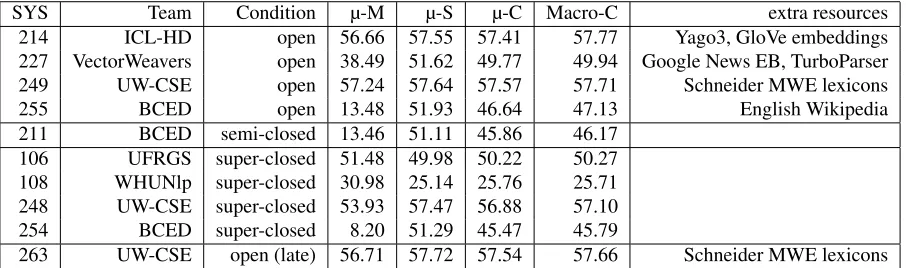
The official results for the six teams participating in the DiMSUM shared task are shown in Table 1. Us-ing the primary metric of the shared task, macro-averaged performance over both the minimal se-mantic unit detection and supersense assignment tasks, our system (BCED) was ranked third out of four participants in thesupervised closedcondition, fourth out of four participants in theopencondition and was the only participating system in the semi-supervised closedcondition.
3.1 Minimal Semantic Units
Compared to the other systems, the major limita-tion in our system was in the deteclimita-tion of the min-imal semantic units. Our approach of detecting known MWEs, even using a very large dictionary such as the Wikipedia, was not sufficient to cover the scope of the DiMSUM MWEs, which consist of not only compound words and common idioms, but also more generalized noun phrases.
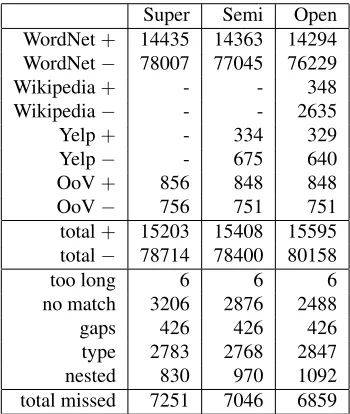
The numbers of generated examples are shown in Table 2. The vast majority of examples are detected by the WordNet tagger. It’s notable how few addi-tional positives are detected with the Wikipedia and Yelp dictionaries, even though the Wikipedia tag-ger considers only examples missed by the Word-Net tagger. The number of examples detected by the OoV tagger doesn’t change much between the con-ditions, as it mostly matches special cases not in any of the dictionaries.
The primary issue with the dictionary matching approach is that approximately a third of real pos-itive examples are missed in all three conditions. The addition of first the Yelp and then the Wikipedia taggers decreases this number by 392 examples but compared to the total missed this is a relatively small improvement. Looking at the categories of the missed examples, MWEs that aretoo long (longer than six tokens) and those with gaps fall outside the scope of the system. Inclusion of the Yelp and Wikipedia taggers reduces the token sets for which
no matchis found by a considerable 718 examples, but there is a corresponding increase of 64 missing
typeexamples for which a correct candidate super-sense was not found.
Finally, the nested category highlights an
inter-Super Semi Open WordNet+ 14435 14363 14294 WordNet− 78007 77045 76229
Wikipedia+ - - 348
Wikipedia− - - 2635
Yelp+ - 334 329
Yelp− - 675 640
OoV+ 856 848 848
OoV− 756 751 751
total+ 15203 15408 15595
total− 78714 78400 80158
too long 6 6 6
no match 3206 2876 2488
gaps 426 426 426
[image:4.612.339.514.59.266.2]type 2783 2768 2847 nested 830 970 1092 total missed 7251 7046 6859
Table 2:Example generation for the training corpus. Each col-umn corresponds to one of the conditions. The uppermost rows show the positive and negative examples generated by each of the four taggers, followed by the combined totals. After these are shown the five categories of false negative examples fol-lowed by their totals.
esting issue in example generation. Even while the Yelp and Wikipedia taggers provide more matches, at the same time the number of examples that are un-detectable due to being nested within a false, longer MWE increases by 262. The issue of missing nested examples could be solved by generating examples for matched nested spans, but the corpus annotation might not be compatible with this approach, as each token can belong to a maximum of one annotated semantic unit. In the case of strong MWEs, for ex-ample in the idiom “close call”, it is not clear what, if any, supersense the “call” token alone could be assigned (Schneider et al., 2014). However, in an MWE such as “cricket bat” (n.artifact) it is clear what the meaning of “bat” is, and likewise, “cricket” refers to the sport. Nevertheless, there is no annota-tion within MWEs, so while “cricket” alone has the supersense n.act, nested in “cricket bat” it has no supersense of its own. Thus, examples generated for nested spans would be inconsistent with non-nested examples.
3.2 Supersense classification
SYS Team Condition µ-M µ-S µ-C Macro-C extra resources 214 ICL-HD open 56.66 57.55 57.41 57.77 Yago3, GloVe embeddings 227 VectorWeavers open 38.49 51.62 49.77 49.94 Google News EB, TurboParser 249 UW-CSE open 57.24 57.64 57.57 57.71 Schneider MWE lexicons
255 BCED open 13.48 51.93 46.64 47.13 English Wikipedia
211 BCED semi-closed 13.46 51.11 45.86 46.17 106 UFRGS super-closed 51.48 49.98 50.22 50.27 108 WHUNlp super-closed 30.98 25.14 25.76 25.71 248 UW-CSE super-closed 53.93 57.47 56.88 57.10 254 BCED super-closed 8.20 51.29 45.47 45.79
[image:5.612.81.534.60.194.2]263 UW-CSE open (late) 56.71 57.72 57.54 57.66 Schneider MWE lexicons
Table 1: The results of the DiMSUM 2016 shared task (provided by task organizers). Micro- and macro-averaged F-scores are shown for (M) MWE detection, (S) supersense assignment and (C) their combination. EB refers to embeddings.
assignment worked quite well (See Table 1). For su-persenses, our approach reached F-scores of around 51% while the best performing systems were at 57%. Thus, our system placed 2nd and 3rd in terms of supersenses in the supervised closed and open
conditions. As only 19% of all annotated minimal semantic units have more than one token the im-pact of MWE detection on supersense classification is limited.
The supersense classification is the only machine learning step in our system. Like most classifiers, the parameters of the Extra Trees Classifier must be optimized on known data for best performance. For parameter optimization, we used three-fold cross-validation on the training corpus, using one of the STREUSLE, Ritter and Lowlands datasets for per-formance estimation at a time and the other two for training.
Parameter optimization highlighted a conflict in using one binary classification step for both detect-ing MWEs and assigndetect-ing the supersenses. Gener-ally, the performance of the Extra Trees Classifier can be increased by increasing the ensemble size, and we noticed such increases while testing sizes from the default of 10 estimators up to 100. How-ever, while the overall classification performance in-creased, the classifier became increasingly likely to not take any chances with MWE examples, assign-ing them all as negative. Only by decreasassign-ing en-semble size to 2 it became possible to detect at least some MWEs, albeit at the cost of slightly reduced performance on supersense assignment.
4 Conclusions
We developed a binary classification system for the DiMSUM 2016 task of detecting minimal semantic units and their supersenses. Our system consists of a customizable dictionary matching step for example generation, followed by a classification step.
The main advantage of this system is its simplic-ity. Standard machine learning systems can be ap-plied for the classification of the generalized binary examples. As only one machine learning step is used, parameter optimization can likewise be per-formed in a standard cross-validation loop. The dic-tionary matching step can be quickly extended by adding new taggers for different vocabularies.
The primary shortcoming of the system is its low performance on MWE detection. This is largely a result of the dictionary matching approach being only partially applicable for the task of detecting the DiMSUM corpus MWEs. We speculate that using machine learning to follow the annotated scope of the MWEs would be a better approach for this part of the task.
Nevertheless, our system achieved good perfor-mance on supersense classification, indicating that binarizing this multi-class task is a valid approach. Moreover, even with a simple feature representation consisting only of token attributes and their combi-nations, comparatively high performance could be achieved.
We publish all of our experimental code, our Wikipedia derived datasets and our detailed results as an open source project5.
References
Steven Bird, Ewan Klein, and Edward Loper. 2009. Nat-ural language processing with Python. O’Reilly Me-dia, Inc.
Massimiliano Ciaramita and Yasemin Altun. 2006. Broad-coverage sense disambiguation and information extraction with a supersense sequence tagger. In Pro-ceedings of the 2006 Conference on Empirical Meth-ods in Natural Language Processing, pages 594–602. Association for Computational Linguistics.
James R. Curran. 2005. Supersense tagging of unknown nouns using semantic similarity. In Proceedings of the 43rd Annual Meeting on Association for Compu-tational Linguistics, ACL ’05, pages 26–33, Strouds-burg, PA, USA. Association for Computational Lin-guistics.
Christiane Fellbaum. 1998. WordNet. Wiley Online Li-brary.
Pierre Geurts, Damien Ernst, and Louis Wehenkel. 2006. Extremely randomized trees. Machine learn-ing, 63(1):3–42.
Anders Johannsen, Dirk Hovy, H´ector Martınez Alonso, Barbara Plank, and Anders Søgaard. 2014. More or less supervised supersense tagging of twitter. Proc. of* SEM, pages 1–11.
F. Pedregosa, G. Varoquaux, A. Gramfort, V. Michel, B. Thirion, O. Grisel, M. Blondel, P. Prettenhofer, R. Weiss, V. Dubourg, J. Vanderplas, A. Passos, D. Cournapeau, M. Brucher, M. Perrot, and E. Duches-nay. 2011. Scikit-learn: Machine learning in Python.
Journal of Machine Learning Research, 12:2825– 2830.
Nathan Schneider and Noah A Smith. 2015. A corpus and model integrating multiword expressions and su-persenses. In NAACL HLT 2015, The 2015 Confer-ence of the North American Chapter of the Associa-tion for ComputaAssocia-tional Linguistics: Human Language Technologies, Denver, Colorado, USA, May 31 - June 5, 2015.
Nathan Schneider, Spencer Onuffer, Nora Kazour, Emily Danchik, Michael T Mordowanec, Henrietta Conrad, and Noah A Smith. 2014. Comprehensive annota-tion of multiword expressions in a social web corpus. InProceedings of the Ninth International Conference on Language Resources and Evaluation (LREC-2014), Reykjavik, Iceland, May 26-31, 2014.