TRANSFORMATIONAL
TRANSFORMATIONAL
LEADERSHIP
LEADERSHIP
EXTRAORDINARY LEADERS
ABLE TO INSPIRE FOLLOWERS TO PERFORM BEYOND COMMONLY HELD
EXPECTATION
CHARACTERISTICS OF
CHARACTERISTICS OF
TRANFORMATIONAL
TRANFORMATIONAL
LEADERS
LEADERS
1 CHARISMA – LEADERS ABILITY TO AROUSE DEVOTION & INVOLVEMENT
2 INSPIRATION – INCREASE FOLLOWERS AWARENESS & UNDERSTANDING OF
3. INDIVIDUALIZED CONSIDERATION
LET SUBORDINATE DEVELOP CAPABILITIES
TREAT FOLLOWERS ON ONE TO ONE BASIS
RAISE FOLLOWERS NEEDS PERPECTIVES
4. INTELLUCTUAL STIMULATION 4. TAKE RISK
TRANFORMATIONAL
TRANFORMATIONAL
LEADERS
LEADERS
• CHARISMA- ADA VISI,MISI,MARUAH PEKERJA DIHORMATI DAN ADA RASA KEPERCAYAAN TERHADAP KEMAMPUAN MAREKA
• INSPIRATION- KOMUNIKASI,GUNA SIMBOL BAGI SESUATU USAHA
• INTELECTUAL STIMULATION- CEKAP,RASIONAL DALAM MENYELESAIKAN MASALAH
• INDIVIDUALIZED CONSIDERATION- PERHATIAN
IS DEVELOPMENT ORIENTED FOR THE PURPOSE OF CHANGE
FOCUS ON THE INDIVIDUAL SUBORDINATE
DEVELOPMENT TO ENHANCE THEIR PERFORMANCE. SO THE LEADER SHOULD FOCUS ON:
• ABILITY TO SHOW CONFIDENCE • VISION / MISION
DIMENSI KEPEMIMPINAN
DIMENSI KEPEMIMPINAN
TRANFORMATIONAL
TRANFORMATIONAL
• DEVELOPMENT OF VISION AND GOALS
• DEVELOPMENT OF COLLABORATIVE
DECISION MAKING STRUCTURE
• SYMBOLIZING GOOD PROFESSION PRACTICE
• PROVIDING INDIVIDUAL SUPPORT
• PROVIDING INTELLECTUAL STIMULATION
• HOLDING HIGH PERFORMANCE
TRANSACTIONAL
TRANSACTIONAL
LEADERSHIP
LEADERSHIP
CONTINGENT REWARDS - BASED ON
EXCHANCE RELATIONSHIP.
FOLLOWER’S COMPLIANCE IS
EXCHANGED FOR EXPECTED REWARDS
CONCENTRATE ON CLARIFYING,
CONTINGENT REWARDS (EXCHANGE OF
APPROPRIATE REWARDS FOR MEETING
OBJECTIVES THAT HAD BEEN AGREED)
TRANSACTIONAL LEADERS PRACTICE
MANAGEMENT BY EXCEPTION
DO THE WORK,BILA ADA PROBLEM BARU
KAITAN TRANFORMATIONAL
KAITAN TRANFORMATIONAL
LEADERSHIP DGN SEKOLAH
LEADERSHIP DGN SEKOLAH
1 VISION- LEADER IDENTIFY NEW
OPPORTUNITY FOR HIS SCHOOL. HE SHOULD DEVELOP,INSPIRE AND
ARTICULATE OTHERS ALSO - CONSENSUS ON SCHOOL GOALS AND PRIORITIES
3
SYMBOLIZE GOOD PRACTICE- LEADER
SET EXAMPLE,LEADER DEMONSTRATE
OPENNESS TO CHANGE BASED ON
NEW UNDERSTANDING
4
PROVIDE INDIVIDUAL
SUPPORT.LEADER RESPECT
5
INTELECTUAL STIMULATION –
LEADER CHALLENGE STAFF TO
REEXAMINE AND RETHINK TO DO
WORK
6 HIGH PERFORMANCE EXPECTATION:
LEADER EXPECTS EXCELLENCE,
WHO ARE THE TRANSFOMATIONAL
SCHOOL LEADERS?
THEY ARE THOSE PRINCIPAL WHO SET
HIGH STANDARDS OF CONDUCT AND
BECOME A ROLE MODEL GAINING
TRUST,RESPECT AND CONFIDENCE
FROM TEACHER
THEY ARTICULATE THE FUTURE
THOSE WHO QUESTION THE
STATUS QUO AND CONTINUOUSLY
INNOVATE, EVEN AT THE PEAK OF
SUCCESS
THOSE WHO ENERGIZE
TEACHERS TO DEVELOP AND
•
TRANSFORMATIONAL LEADERSHIP
INVOLVES INFLUENCE BY A LEADER ON
SUBORDINATES,BUT THE EFFECT ON THE
INFLUENCE IS TO EMPOWER
SUBORDINATES TO PATICIPATE IN THE
PROCESS OF TRANSFORMING THE
CHARACTERISTICS OF
TRANSFORMATIONAL
IDEALIZED ATTRIBUTTES/
IDEALIZED ATTRIBUTTES/
BEHAVIOR (CHARISMA)
BEHAVIOR (CHARISMA)
•
INSTILL PRIDE IN OTHERS
•
GO BEYOND THEIR SELF INTEREST
•
ACT IN WAYS THAT BUILD OTHER’S
RESPECT
•
DISPLAY A SENSE OF POWER AND
COMPETECE
•
MAKE PERSONAL SACRIFICES
•
TALK ABOUT MOST IMPORTANT OF
HAVING A STRONG SENSE OF
PURPOSE
•
CONSIDER THE MORAL AND ETHICAL
CONSEQUENCES OF DECISION
•
CHAMPION EXCITING NEW
POSSIBILITIES
•
TALK ABOUT THE IMPORTANCE OF
INSPIRATIONAL
INSPIRATIONAL
MOTIVATION-INSPRING
MOTIVATION-INSPRING
OTHER
OTHER
•
TALK OPTIMISTICALLY ABOUT THE
FUTURE
•
TALK ENTHUSIASTICALLY ABOUT WHAT
NEED TO BE ACCOMPLISHED
•
ARTICULATE A COMPELLING VISION OF
THE FUTURE
•
PROVIDE AN EXCITING IMAGE
INTELLECTUAL
INTELLECTUAL
STIMULATIONS-STIMULATE
STIMULATIONS-STIMULATE
OTHERS
OTHERS
• REEXAMINE CRITICAL ASSUMPTION
• GET OTHERS TO LOOK AT PBROLEMS FROM MANY DIFFERENT ANGLES
• SUGGEST NEW WAYS IN LOOKING AT HOW TO COMPLETE ASSIGNMENTS
• ENCOURAGE NON- TRADITIONAL THINKING TO DEAL WITH TADITIONAL PROBLEMS
INDIVIDUAL
INDIVIDUAL
CONSIDERATION:
CONSIDERATION:
COACHING AND
COACHING AND
DEVELOPEMENT
DEVELOPEMENT
• SPEND TIME TEACHING AND COACHING
• TREAT OTHERS AS INDIVIDUALS RATHER THAN JUST MEMBER OF THE GROUP
• CONSIDER INDIVIDUALS AS HAVING
DIFFERENT NEEDS, ABILITIES,& ASPIRATION
• HELP OTHERS TO DEVELOP THEIR STRENGTHS
LEADERS ARE CHANGE AGENTS – LEADERS ARE SEEN AS ONE WHO CAN RESPOND TO CHANGE POSITIVELY AND ONE WHO ACTIVELY CREATES
CHANGE , THEY ARE TRANSFORMATIONAL LEADERS
FOLLOWERS ARE ELEVATED FROM THEIR EVERYDAY ‘SELVES’ TO THEIR BETTER ‘SELVES’
THESE LEADERS CAN BE ANYBODY IN THE
TRANSFORMATIONAL LEADERS AND
EFFECTIVNESS
1. TRANSFORMATIONAL LEADERSIP HAS BEEN SHOWN TO HAVE A DIRECT POSITIVE
RELATIONSHIP WITH PERFORMANCE
2. TRANFORMATIONAL LEADERSHIP MAY
RESULT IN HIGHER LEVEL OF SATISFACTION AND EFFECTIVENESS AMONG THE
3. U.S MARINE OFFICERS WERE MORE PRODUCTIVE WITH THIS
TRANSFORMATIONAL LEADERSHIP
4. FINANCIAL PERFRMANCES OF 27
BUSINESS FIRMS WAS HIGHER WHEN THE 27 PRESIDENTS WERE EVALUATED AS
TRANSFORMATIONAL
5. THERE WAS A SIGNIFICANT RELATIONSHIP BETWEEN
6. TRANSFORMATIONAL LEADERSHIP IS THE MOST APPROPIATE STYLE OF ACHIEVING
TEACHER’S PERFORMANCES BEYOND THEIR USUAL LIMITS, AND IN DEVELOPING
TEACHER’S POTENTIAL.
7. EMPLOYEE OF A MANUACTURING FIRM HAVE GREATER SATISFACTION WITH
TRANSFORMATIONAL LEADERSHIP AND VIEWED THE APPROACH AS MORE
8. TRANSFORMATIONAL LEADER BEHAVIOUR HAS INFLUENCE ON SUBORDINATES’TRUST AND SATISAFCTION. THE CORE
CHARACTERISTIC OF TRANSFORMATIONAL BEHAVIOUR – ‘INDIVIDUAL
CONSIDEATION’AND ‘INTELECTUAL
STIMULATION’ARE THE KEY DETERMINANTS OF TRUST AND SATISFACTION
9. LEADERS WHO EXHIBITS IDEALIZED
LEADERSHIP – BECAUSE THEIR
ASSOCIATES HAVE TRUST IN SUCH
LEADERS, THEY EMULATE THE
LEADERS’S BEHAVIOUR,THEY ASSUME
THE VALUES THE LEADER PORTRAY,
AND THEY ARE COMMITTED TO
ACHIEVING THE LEADER’S VISION, EVEN
IF SACRIFICES AE NECESSARY.
RUMUSAN
BURNS (1978) DAN BASS (1985)
PREFERED TO STUDY‘EXTRA
ORDINARY LEADERS’
THE LEADERS FOCUS ON THE
INDIVIDUALS DEVELOPMENT OF
WHAT ARE THE RESULT OF
WHAT ARE THE RESULT OF
THIS
THIS
KIND OF LEADERSHIP?
KIND OF LEADERSHIP?
Evidence of the effect transformational leadership,
according to Leithwood, is “uniformly positive.” He cites two findings from his own studies: (1) transformational leadership practices have a sizable influence on teacher collaboration, and (2) significant relationships exist between aspect of
transformational leadership and teachers’ own reports of changes in both attitudes toward school improvement and altered instructionl behavior.
EXAMPLES OF STRATGIES TO PRACTICE TRANFORMATIONL LEADERSHIP
• Visit each classroom everyday; assist in
classroom ,encourage teachers to visit one another’s classes.
• Help teachers work smarter by seeking different interpretations and checking out assumptions;
place individual problems in the larger perspective of the whole school; avoid commitment to
• Use action research teams or school improvement teams as a way of sharing power. Give everyone responsibilities and involve staff in governance
functions. For those not participating, ask them to be in charge f a committee.
• Find the good things that are happening and
publicly recognize the work of staff and students
• Survey the staff often about their wants and needs. Be receptive to teachers’ attitudes and
philosophies. Use active listening and show people you truly care about them.
• Let teachers experiment with new ideas. Share and discuss research with them. Propose questions for people to think about.
• Bring workshops to your school where it’s
• When hiring new staff, let them know you want them actively involved in school decision – making; hire teachers with a commitment to collaboration.
• Have high expectations for the teachers and
• Use bureaucratic mechanism to support teachers, such as finding money for a project or providing
time for collaborative planning during the workday. Protect teachers from the problems of limited time, excessive paperwork, and demands from other
agencies.
• Let teachers know they are responsible for all
Analysis of Head of Departments
Analysis of Head of Departments
Leadership Styles: Implication for Improving
Leadership Styles: Implication for Improving
Research University Management Practices
Research University Management Practices
Zaidatol Akmaliah Lope Pihie*
Zaidatol Akmaliah Lope Pihie*
Amir Sadeghi
Amir Sadeghi
Habibah Elias
Introduction
Introduction
• The vision of Malaysia’s government for the
country is to be a fully developed nation by 2020
(National Higher Education Action Plan, 2007).
• The vision of government for higher education
sector is to transform Malaysia to an international center of higher education excellence until 2020 and beyond.
• In order to facilitate the transformation of the higher education sector, Ministry of Higher Education (MoHE) has chosen four public
Leadership and lecturers’ Job Satisfaction
Leadership and lecturers’ Job Satisfaction
as crucial factors of organizational
as crucial factors of organizational
effectiveness
effectiveness
• Based on National Higher Education Action Plan
(2007) leaders and lecturers are two important factors for achieving goals of higher education transformation.
• Job satisfaction positively affects employees’
performance, commitment and reduces their absenteeism and turnover. This in turn leads to organizational effectiveness and goal
achievement.
• Leadership style as a key factor affects
Transformational Leadership: As a
Transformational Leadership: As a
new Paradigm
new Paradigm
• Transformational leadership refers to the process of building commitment to the organization’s objectives and empowering followers to accomplish these objectives.
• In this leadership style, leaders use their personal values, vision,
commitment to a mission, and passion to energize and move others towards accomplishment of organizational goals.
• Applying transformational leadership gives a set of capabilities to leaders to recognize the need for change, to create a vision to guide that change, and to carry out the change effectively.
• This leadership style is significant to the continued success of organizations because it enhances team cohesion,
Transactional Leadership
Transactional Leadership
• Transactional leadership emphasizes the
transaction or exchange that takes place among leaders, colleagues, and followers.
• This exchange is based on the leader discussing
with others what is required and specifying the
conditions and rewards these others will receive if they fulfill those requirements.
• This type of leadership focuses on maintaining the
status quo and motivating people through contractual agreement.
• This form of leadership is basically the same as
Laissez-faire Leadership
Laissez-faire Leadership
•
Laissez-faire
leadership is the avoidance or
absence of leadership.
•
This type of leader gives up responsibility,
and do not use their authority.
•
A laissez-faire leader exhibits passive
indifference about the task and subordinates
by ignoring problems as well as subordinates’
needs.
Methods
Methods
•
A quantitative correlational study.
•
Participants: academic staff of three
Malaysian RUs
•
Sampling procedure: stratified proportional
random sampling
•
Simple size: 305
•
Instruments: MLQ 5x and WFJSDS
Findings
Findings
Variables Mean SD Interpretation MLQ Norms
Transformational 2.52 .72 Fairly often 2.85
Idealized Influence (attribute) 2.55 .82 Fairly often 2.94 Idealized Influence (behavior) 2.61 .80 Fairly often 2.77 Inspirational Motivation 2.73 .84 Fairly often 2.92 Intellectual Stimulation 2.37 .76 Sometimes 2.78 Individualized Consideration 2.33 .79 Sometimes 2.85
Transactional 2.02 .53 Sometimes 1.86
Contingent Reward 2.54 .82 Fairly often 2.87 Management-by-Exception
(active)
2.20 .83 Sometimes 1.67
Management-by-Exception 1.33 .80 Once in a 1.03
Findings
Findings
Variable Mean SD Interpretation
Intrinsic Satisfaction 3.65 .43 Moderate
Achievement 3.60 .48 Moderate Growth 3.73 .55 High
Recognition 3.52 .65 Moderate Responsibility 3.49 .57 Moderate The Work Itself 3.91 .50 High
Extrinsic Satisfaction 3.47 .52 Moderate
Interpersonal Relations 3.82 .54 High Policy and
Administration
3.32 .62 Moderate
Salary 3.12 .83 Moderate Supervision 3.52 .68 Moderate
Findings
Findings
Variables Intrinsic Satisfaction
Extrinsic Satisfaction
Overall
Satisfaction
Transformational .365** .506** .465**
Transactional .263** .297** .297**
Laissez-faire -.192** -.356** -.297**
Table 3: The Descriptive Statistics, Zero-order Correlation of Head of Departments’ Transformational, Transactional and Laissez-faire Leadership
Findings
Findings
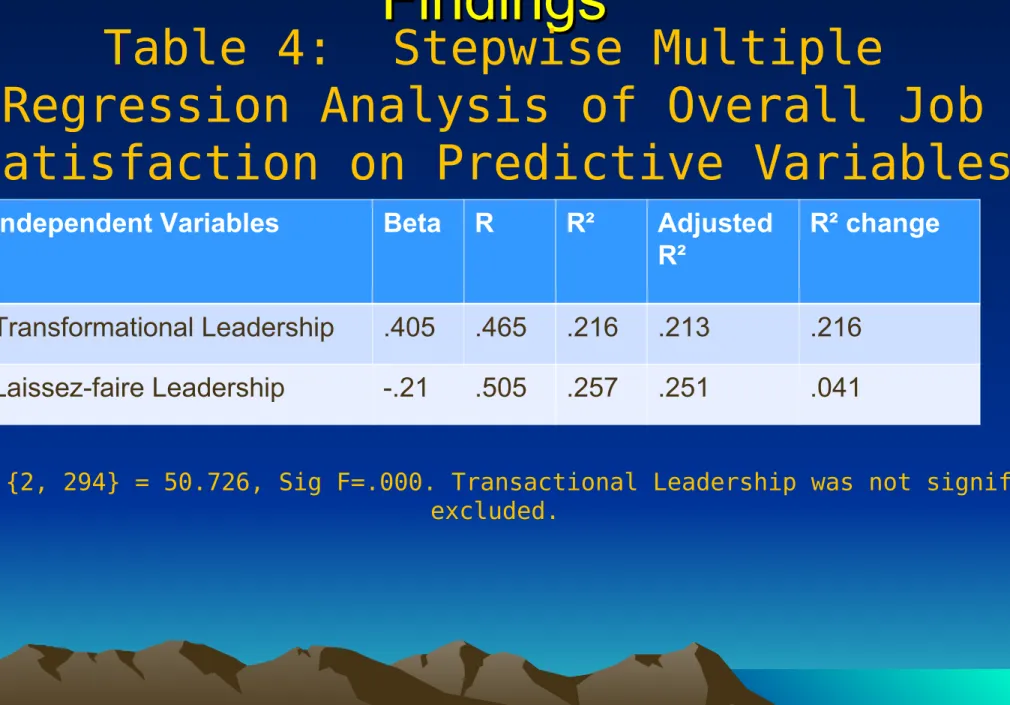
Independent Variables Beta R R² Adjusted R²
R² change
Transformational Leadership .405 .465 .216 .213 .216
Laissez-faire Leadership -.21 .505 .257 .251 .041
Table 4: Stepwise Multiple
Regression Analysis of Overall Job
Satisfaction on Predictive Variables
Discussion
Discussion
• The lecturers perceived their heads of departments fairly often exhibit transformational and sometimes display transactional leadership behavior. They perceived the heads of
departments once in a while exhibit laissez-faire leadership.
• Based on the findings for intrinsic satisfaction, the work itself received the highest mean score, followed by growth,
achievement, recognition, while responsibility had the lowest mean score.
• In terms of extrinsic satisfaction, interpersonal relations received the highest mean score at a high level of
satisfaction, followed by working condition, supervision, policy and administration, while salary received the lowest mean
Discussion
Discussion
• In terms of the relationship between transformational
leadership and respondents’ intrinsic, extrinsic and overall job satisfaction, the findings demonstrated positive and moderate correlations between this type of leadership and intrinsic,
extrinsic, and overall satisfaction.
• Findings revealed a positive and weak relationship between the heads of departments’ transactional leadership and
lecturers’ intrinsic, extrinsic, and overall satisfaction.
• In connection with laissez-faire leadership and respondents’ intrinsic, extrinsic and overall satisfaction, the findings
disclosed that there are negative and weak correlations
between laissez-faire leadership and respondents’ intrinsic as well as overall satisfaction. Also there was a negative and
Discussion
Discussion
• The results of stepwise multiple regression
analysis demonstrated among the three different types of leadership, transformational and laissez-faire leadership styles were the significant
predictors of overall job satisfaction.
• They explained 26% of the variance in overall
satisfaction.
• Transformational leadership was the prominent
Conclusion
Conclusion
• The findings revealed that RUs heads of departments exhibited a combination of transformational, transactional, and laissez-faire leadership styles.
• Research Universities, as forefronts of transforming Malaysia’s higher education into centers of excellence, require
administrators who should pay more attention to lecturers’
creativity and innovation to solve the institutional problems with a new point of view.
• They should consider lecturers’ need as an important issue and try their best to delegate appropriate responsibility to them,
coach lecturers as persons who can be capable individuals that can help RUs to confront with complicated situations.
• Since the RUs were selected to be the forefront of Malaysian higher education institutions in obtaining characteristics of