Running head: EVALUATING THE NEED FOR A MASTERS DEGREE
Graduate Education: Evaluating the Need for a Masters Degree Program in Fire/EMS for Executive Fire Officer Student and Graduates at The George Washington University
Executive Leadership
BY: Jeffrey T. Lindsey
The George Washington University
Washington D.C.
An applied research project submitted to the National Fire Academy as part of the Executive Fire Officer Program
Certification Statement
I hereby certify that this paper constitutes my own product, that where the language of others is set forth, quotation marks so indicate, and that the appropriate credit is given where I have used the language, ideas, expressions, or writings of another.
Abstract
The problem is The George Washington University (GWU) does not offer any degree programs in fire science, which makes it difficult for Executive Fire Officer (EFO) students to transfer Executive Fire Officer Program credits into the master’s degree program. The purpose of this research was to look at venues to be able to use EFO credits in a master’s degree program at GWU. The research questions this paper addressed are: a. Are EFO students and alumni interested in a master’s degree program in fire/emergency medical services (EMS)? b. What other universities give college credit at the master’s degree level for EFO coursework? c. What is the most appropriate delivery format to deliver a masters degree in fire/EMS?
A survey was conducted by the author of current EFO students and graduates. A review of colleges and universities listed on the Fire and Emergency Services Higher Education website were reviewed. The results demonstrated that there is an interest in a master’s degree that EFO graduates and students are interested in a master’s degree that combines EMS and fire. In addition, there is interest in being able to transfer their EFO course credits to a master’s degree program. This study presents a proposal to combine the EFO program into the current Emergency Services Management degree offered by GWU.
Table of Contents Certification Statement ...2 Abstract ...3 Table of Contents...4 Table of Figures ...6 Tables...7 Introduction...8 Overview...8 Research Method...8 Problem Statement...8 Purpose of Study...8 Research Questions...9 Summary...9
Background and Significance ...9
Overview...9
Background ...10
GWU Master Courses ...10
EFO Courses ...13
Career Advancement...16
Linkage to Executive Leadership Course ...18
Summary ...18
Literature Review...19
Overview...19
Literature...19
Graduate Schools...21
Arizona State University East Fire Programs...22
Grand Canyon University...24
University of New Haven...26
University of Florida...30
University of Illinois at Chicago...31
Southwestern College...31
Eastern Kentucky University...31
Anna Maria College...34
Oklahoma State...35
Influence of the Project...39
Summary...39 Procedures...40 Overview...40 Procedures...40 Sample Population...41 Limitations...41 Summary...42 Results...42 Overview...42 Demographics...42
Are EFO student and alumni interested in a master's degree program in fire/EMS?...44
What other universities give college credit at the master's degree level for EFO coursework?...47
What is the most appropriate delivery format to deliver a master's degree in fire/EMS?...47
Survey Comments...48
Summary...48
Discussion ...49
Overview...49
Relationship between Results and Specific Findings...49
Author's Interpretation...50 Summary...51 Recommendations...52 Overview...52 Proposed Curriculum...52 Summary...54 References...55 Appendix A...57 Appendix B ...59
Table of Figures
Figure 1 National Professional Development Model (FESHE, nad)...17
Figure 2 EFO Year Completed ...43
Figure 3 Degree Earned by Respondent ...44
Figure 4 Level of Interest in Earning a Master's Degree ...45
Figure 5 Credits for EFO Courses ...46
Figure 6 Interest in a Dual Enroll Program - Fire/EMS...47
Tables
Introduction
Overview
The Introduction will define the problem and the purpose this paper will address. This section will identify the specific research methods used and establish the research questions.
Research Method
The research method will be a combination evaluative and action research.
A survey will be distributed to current and graduate EFO students. A review will be conducted of the various universities that the FESHE program has identified as offering a masters degree.
Problem Statement
The problem is The George Washington University (GWU) does not offer any degree programs in fire science, which makes it difficult for Executive Fire Officer (EFO) students to transfer Executive Fire Officer Program credits into the master’s degree program.
The purpose of this research is to look at venues to be able to use EFO credits in a master’s degree program at GWU.
Research Questions
The research questions this paper will resolve are: a. Are EFO students and alumni interested in a master’s degree program in fire/emergency medical services (EMS)? b. What other universities give college credit at the master’s degree level for EFO
coursework? c. What is the most appropriate delivery format to deliver a masters degree in fire/EMS?
Summary
This section defined the problem and the purpose for this paper. It also identified the specific research methods used and established the research questions to be answered by this study.
Background and Significance
Overview
This section will provide the background analysis of the problem. It will provide sufficient evidence to justify the study from an organizational perspective, based in past, present, and probable future impact on organizational effectiveness. It will also establish the definitive linkage between the research problem and specific content area of the Executive Leadership course.
Background
There are essentially two components. The first is the curriculum for the master’s in Emergency Services Management that GWU offers. The second component is the Executive Fire Officer program administered by the National Fire Academy. The EFO courses are ACE approved for the graduate level if the research paper is completed. It is an assumption that the EFO courses will be transferred to a graduate level program at university toward the credit hours needed for a master’s degree. Currently, the master’s degree program at GWU does not accept the transfer of the EFO courses toward the credit hours needed for the completion of the master degree. The following illustrates the courses required for the master’s degree at GWU and the courses to complete the EFO program.
GWU Master Courses
The GWU master’s degree in emergency services management offers a focused
curriculum in emergency services. The student must successfully complete the required 33 credit hours in all three divisions, or transfer comparable coursework as approved by the admission department in the School of Health Sciences. The three divisions are professional core, research core, and emergency services concentration.
There are three courses with three credit hours per course for the professional core. The courses and there descriptions are: a. HSCI 240: Issues and Trends in Health Systems It is
an analysis of key contemporary issues in U.S. health and social policy that affect the design and structure of the health care system. The health policy process and initiatives that shape care delivery. B. HSCI 241: The Health Care Enterprise An overview of global business principles related to health care systems: management of patient-centered care delivery; marketing, finance, and fiscal management principles; information, technology, and quality improvement. HSCI 223: Topics in Health Care Leadership This course covers the theories and styles of leadership, including organizational management and values, strategic planning, communication strategies, managing change, and negotiating conflict in the context of the health care delivery system.
There is a research core, which has two, three credit hour courses. They are: a. HSCI 270: Research Methods for Health Professionals IThis course covers the methodological issues of basic, applied, and clinical research. Students develop the knowledge and skills to critically appraise and synthesize research results, analyze qualitative and quantitative data, evaluate evidence-based methods, develop research questions, and identify
appropriate inquiry methodologies. Students become familiar with all elements of a research proposal, including those relating to the use of human subjects and informed consent. b. HSCI 271: Research Methods for Health Professionals IIThis course
continues with the methodological issues of basic, applied, and clinical research. Students develop the knowledge and skills to critically appraise and synthesize research results, analyze qualitative and quantitative data, evaluate evidence-based methods, develop research questions, and identify appropriate inquiry methodologies. Students become
familiar with all elements of a research proposal, including those relating to the use of human subjects and informed consent.
The last division is the emergency services concentration. There are six, three credit hour courses. They are: a. EHS 201: Response to High-Impact Emergencies This course covers the strategies for an effective response to large-scale and high-impact emergencies examined as the managerial foundation for development of a response policy. b. EHS 202: Analysis of Emergency Service Systems This course gets into the analysis of policy, managerial strategy, and organizational structure of emergency service systems. It also discusses the operational response enhancement/sustainment, intra- and interagency interaction, emergency response coordination across jurisdictional boundaries. c. EHS 203: Legal and Regulatory Obligations of Emergency Services This course covers laws, regulations, and standards pertaining to emergency services. d. EHS 204: Public
Information Management of Emergency ServicesThis course covers the public
information management for emergency services executives, managers, and supervisors. e. EHS 205: Strategic Emergency Response This course covers the strategic analysis of counterterrorism response requirements for the emergency service organization. It also gets into the determination of vulnerabilities and trends; development of operational doctrine. f. EHS 275: Leadership and Change in Emergency Services Management A capstone course focusing on the concept of leadership within the contexts of health professionals, health systems, and health policy.
EFO Courses
Executive Development is the entry course for the EFOP. It is intended to provide a framework in which leadership is a process whereby you and others perform adaptive work. The three primary curriculum themes of the course are leadership, research, and change. Through a combination of theory, case-study analysis, reflection, introspection, and self- and observer-based assessment, participants learn how to enhance personal/ team development and engage in applied research. Executive Development course units include leadership, teams, change management, research, change and creativity, research practicum, management innovations, service quality, organizational culture, ethics and change management, and research proposals. There is a required pre-course assignment dealing with applied research and book reading. The SCE recommendation for this course is in the graduate or upper division baccalaureate degree category, 3 semester hours in Personnel Management, Public Administration, Organizational Behavior, Management, or Fire Science Management as an elective. Students who are EFOP
participants will be eligible to receive graduate-level credit with successful completion of the Applied Research Project.
Strategies for Community Risk Reduction is the second course. The course description states that our communities face multiple hazards which pose risks of harm to life,
property, and the quality of life. Natural, human caused, and weather related hazards such as earthquakes, chemical releases, and tornados, vary in size and scope. The risks these hazards present include, but are not limited to, destructive fires, burns, falls, motor vehicle mishaps, poisonings, and drowning. A community's initial response to the effects
of these hazards is made by the emergency services: police, fire, rescue, and emergency medical services agencies. Building upon a model of public awareness, education, and training used successfully to reduce the incidences and severity of destructive fires, many fire departments have taken a proactive prevention approach to other community risks. Recognizing their unique role as protectors of the citizens, many progressive fire departments have initiated and implemented programs to reduce the community's risks and mitigate the consequences of these. The Strategies for Community Risk Reduction course provides a framework for a fire department to utilize in its expanded role as the lead agency for community risk reduction. Topics covered in the course include: the role and responsibilities of the leader of the community risk reduction efforts, data collection and assessment of the community's risks, gaining internal as well as external support for community risk reduction, strategizing, developing, implementing, and evaluating a risk reduction plan specific to the student's community. According to the course catalog ACE has not yet reviewed this course.
The third course is Executive Analysis of Fire Service Operations in Emergency
Management. This course is designed to prepare senior staff officers in the administrative functions necessary to manage the operational component of a fire and rescue department effectively. Since the subject matter is comprehensive, maximum use of the students' time is required. Some of the areas covered are risk assessment, incident documentation, media/political considerations, standards, legal mandates, capability assessment, damage assessment, emergency operations, Integrated Emergency Management System (IEMS), Multi-Agency Coordination Systems (MACS) including the Emergency Operations
Center (EOC), and emergency information systems. This course meets the NIMS requirements for ICS 300 and ICS 400. Throughout the course, students are presented with a series of senior-staff-level issues that require extensive analysis and action. The actions implemented are applied to a mock community in order to evaluate the
effectiveness of these decisions relative to the fire and rescue department's operational readiness. The course is very intense and uses lecture, case study, simulation, scenario, and student participation as instructional media. A joint simulation exercise will be conducted with the Emergency Management Institute during this course. ACE
recommendation is in the upper division baccalaureate or the graduate degree category, 3 semester hours in Fire Science, Public Administration, Emergency Medical Services, or Emergency Management. Only EFO students can receive graduate credit for this course by completing the research project.
The final course is Executive Leadership. This concluding course was designed specifically to provide a framework of executive-level competencies by focusing
primarily on issues and areas of personal effectiveness. The curriculum includes self- and observer-based survey assessment instruments, case study analysis, role playing, and experiential activities. Participants complete a "self-assessment and development plan" to create desirable goals in the areas of their professional, personal, community, and family life. Course units include leadership, multiple roles, decision skills, influencing, leaders teaching leaders, storytelling, persuasion, succession planning, and evaluating. ACE recommendation is in the graduate or upper division baccalaureate degree category, 3 semester hours in Organizational Behavior, Fire Service Management, Personnel
Management, Public Administration, or Management as an elective. Students who are EFOP participants will be eligible to receive graduate-level credit with successful completion of the Applied Research Project.
Career Advancement
The FESHE model promotes education and training to progress through the various levels of leadership positions in the fire service. The following is the strategic goal of the FESHE model. Working collaboratively, the professional development community will produce a: a. National model for an integrated, competency-based system of fire and emergency services professional development. b. National model for an integrated system of system of higher education from associate's-to-doctoral degrees. c. Well-trained and academically-educated fire and emergency services preparing the nation for all hazards. (FESHE Strategic Goal, 2008)
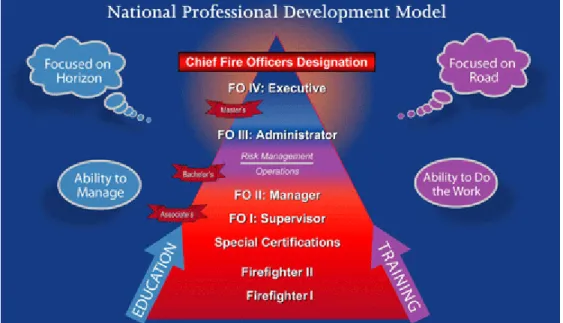
The national professional development model is illustrated in figure 1. This model shows the progression of the firefighter from firefighter I to the executive level which is fire officer IV. The fire officer IV is considered the executive or in most cases the fire chief of the department.
Figure 1 National Professional Development Model (FESHE, nad)
The International Association of Fire Chiefs developed a book on officer development. The book models the four levels of fire officers as denoted by the FESHE model. The book promotes that the executive fire office, which is the fourth level of the pyramid, as having a master’s degree or in the processing of a earning a master’s degree. The
education component of this level denotes all graduate level courses. (Broman, 2003) The International Association of Fire Chiefs mission statement is: To provide leadership to career and volunteer chiefs, chief fire officers and managers of emergency service organizations throughout the international community through vision, information, education, services and representation to enhance their professionalism and
capabilities.(IAFC Mission Statement, 2008) There is a strong commitment to
professional development with education being a major component for the fire chiefs internationally.
The Center for Public Safety administers the Chief Fire Officer Designation credentialing process. In order to be eligible for credentialing as a Chief Fire Officer, there are two areas the candidate must satisfy. The first is education and the second is experience. If the candidate has a master’s degree and five years experience as a chief officer they are eligible to be qualified as a chief fire officer candidate (Chief Fire Officer Designation Application, 2008). There are a number of other combinations that the candidate can do to become qualified; however, if the candidate has a master’s degree it is a much easier process for eligibility. The candidate receives 150 points for a master’s or PhD, which is the minimum number of points needed for this category. The points also help the
candidate maximize their total number of points needed for becoming designated as a Chief Fire Officer.
Linkage to Executive Leadership Course
This research project fits into the Executive Leadership as part of the professional
development and transition portion of the course. A presentation of FESHE was made by Mr. Ed Kaplan demonstrating the education model for fire officers for the Executive Leadership class the author attended. The Executive Leadership course is the last course in the EFO program. At this point, the expectation is that you are preparing to lead your organization and be ready to step to the level of fire chief or executive officer of the department.
Summary
This section provided the background analysis of the problem. It provided sufficient evidence to justify the study from an organizational perspective, based in past, present,
and probable future impact on organizational effectiveness. It also established the definitive linkage between the research problem and specific content area of the Executive Development course.
Literature Review
Overview
This section will discuss the findings of others that were reviewed. It will describe
summary statements on how the findings/observations of others influenced of the project. The sources in this section date back to no further than 1998.
Literature
As survey was conducted by Lowe and Cohilas (2006) of 200 EFO participants, 161 returned the survey. One of the questions was to look at college degrees. 65% or 105 EFO respondents pursued an additional college degree program after earning the EFO title. Forty-four respondents pursued baccalaureate degrees, 56 pursued master degrees, three pursued doctoral degrees and two pursued other degree programs such as law. (Lowe & Cohilas, 2006)
Curmode, Brazill, & Leslie, (2007) wrote in an article what the criteria must be satisfied in order to be qualified to be promoted the position of deputy fire chief or fire marshal. The criteria includes: a. By the year 2009, individuals must have a bachelor's degree in a
relevant fire science or management development program. b. By 2012, they must have a master's degree. c. Individuals must be CFO graduates; pursuit of the EFO is strongly recommended. d. Candidates are encouraged to attend a minimum of two annual
conferences and attend all relevant staff meetings. e. Subject to the availability of funds, individuals are encouraged to attend the National Fire Academy. f. If fiscal resources permit, candidates are encouraged to complete all relevant courses offered by the Wichita State University's Center for Management Development. g. Individuals should have successfully completed or currently be enrolled in the National Safety Officer Certification program. h. If all of these qualifications are met or are being pursued actively, individuals become qualified to sit for the deputy chief assessment center or the fire marshal assessment center.
To qualify for the position of chief, all of the previous prerequisites must be satisfied, along with any related training or education mandated by the director of public safety, the assistant county manager, the county manager, and/or the board of county
commissioners. In the near future the district will be developing assessment center criteria for these three top fire district positions. (Curmode, Brazill, & Leslie, 2007)
This is one department’s requirements for promotion to the upper leadership positions in the department. This department is not unique. The position descriptions for job ads for assistant, deputy, and fire chiefs require many of these same attributes. This study did not look at requirements for these positions in any depth; however, on review of the
Chief’s website, many of the requirements included the EFO program completion and a master’s degree was preferred. (IAFC Career Center, 2008)
Graduate Schools
There are twelve graduate schools in nine states that offer some type of master’s program in fire science. (Table 1)
Arizona
Arizona State University East Fire Programs Grand Canyon University
Connecticut
University of New Haven Florida
University of Florida Fire and Emergency Services Distance Education Illinois
University of Illinois at Chicago Kansas
Southwestern College Kentucky
Eastern Kentucky University Fire & Safety Engineering Technology Program Massachusetts
Worcester Polytechnic Institute Fire Protection Engineering and Center for Fire Safety Studies
New Mexico
Southwestern College Oklahoma
Oklahoma State University Southwestern College
Table 1 Graduate Schools who offer Master's Degrees in Fire
The following describes the curriculum for those programs that offer a master’s degree with the emphasis on fire.
Arizona State University East Fire Programs
A minimum of 33 semester hours is required for the degree program. Of these, a minimum of 15 semester hours must be 500-level courses and part of the approved program. Specific credit requirements vary within each department. The minimum requirements are as follows: a. Technical Concentration Core (12 semester hours); b. Technical Concentration Electives (9-15); c. Optional Related Electives (0-6); d. Research course (3); e. Research (3); for a total of 33 semester hours.
A maximum of nine semester hours of appropriate coursework completed before admission may be included in the program of study for the degree program. Maximum six-semester-hours of these nine may be transferred into the program of study from another institution. Consideration can be given for up to six semester hours for Executive Fire Officer Program courses completed at the National Fire Academy. Approval must be obtained from the Fire Service Programs coordinator to use EFOP course work as partial fulfillment of the requirements.
Each of the courses is three credit hours unless otherwise noted. The curriculum is as follows: a. Fire Service Administration (FSA): FSA 500 Research Methods. (1 – 12 credit hours) Fire Administration Relationship of fire administration and the role of executive fire administrator in administration of complex issues in a dynamic
environment.; FSA 502 Managing Change in the Fire Service Dynamics of organizational change and the effect change has on the delivery of fire services to the community.; FSA 503 Fire Service and the Community Theoretical concepts of public service to build an understanding of how the fire service fits within the community.; FSA 510 Fire
Department Budgeting and Finance Functions of budgeting and finance in fire departments within the context of the public sector.; FSA 522 Leadership in the Fire Service Leadership theories analyzed in a variety of contexts within public and private organizations, then applied to the leadership challenges in the fire service.; FSA 530 Public Policy in the Fire Service Public policy and the fire services' role in the making of public policy in the community.; FSA 540 Applied Research Methods in the Fire Service
Research methods applicable to problems that arise in the fire service, including
assessments of programs and customer service research.; FSA 550 Fire Service Program Management Functions of developing and managing fire service programs. This course is designed for advanced students of fire service administration.; FSA 551 Fire Prevention and Public Fire Education Managing fire prevention organizations and administering fire prevention programs in a contemporary society.; FSA 552 Emergency Medical Services Administration Complex issues of administering an Emergency Medical Services (EMS) division in a fire department.; FSA 553 Special Operations in the Fire Service Focuses on the variety of special emergency services operations provided by contemporary fire departments.; FSA 554 Emergency Fire Operations Administration Delivery of emergency services to a community by a contemporary fire department.; b. FSA 580 Practicum. (1 – 12 credit hours); Fire Service Practicum Structured practical fire service research experience that is supervised by an approved fire service professional or faculty member. (Fire Service Programs, 2008)
Grand Canyon University
A master of science in Leadership with an Emphasis in Disaster Preparedness and Crisis Management is offered with a required 36 credits to complete the degree. Twelve credit hours of EFO coursework are transferrable into the program.
Each of the courses is three credit hours. The courses are: a. MGT 623 Organizational Development and Change: An exploration of the behavioral forces and relationships that
influence organizational effectiveness and change. Topics include the study of intervention strategy and application skills.; c. MLE 617 Leadership and Innovation: Students will understanding and apply various models of problems solving. They will learn various techniques, strategies and skills appropriate for creative and innovative thinking.; d. EFL 627 Disaster Preparation and Crisis Management: Students will receive the preparation necessary to uniquely manage and make critical decisions regarding a major incident or disaster. The course focuses on specialized decision-making processes involving analytical methods and information management; interaction with other agencies and effective coordination of roles and efforts within a structured command system offer the crisis manager decisions in an unstructured environment; major events that have happened to the fire service; and how to prepare for the unexpected, including how to be a strong leader dealing with instant life and death decision making on the emergency scene.; e. EFL 628 Environmental Issues and Hazard Management: Students will learn about Fire Service's role in protecting the environment from damage; the potential environmental impact of various types of emergency incidents; the roles of various agencies in mitigating incidents that may be hazardous to the environment, including federal, state, and local laws, regulations, and ordinances; and planning, resource management, and other related issues.; f. EFL 670 Contemporary Issues in Disaster Preparedness & Crisis Management: Provides students with the opportunity to explore several major contemporary issues in crisis management and disaster
preparedness. Students will conduct independent research and present their findings on community preparedness, and the leadership and management of contemporary
position on a controversial issue and engage in debate with students who have taken the opposing position. (Program of Study: Master of Science in Leadership with an Emphasis in Disaster Preparedness and Crisis Management, 2005)
University of New Haven
Students are required to complete a minimum of 39 credits of graduate work, which may include an internship in fire science. Transfer credit from other institutions may be permitted subject to the graduate school policy on transfer credit. Students in the fire science degree program are required to complete the core courses; a concentration in fire administration, fire/arson investigation, fire science technology or public safety
management; and 18 credits of electives. Students must take either FS 690 Research Seminar or FS 693 Internship. A six-credit thesis may replace one elective and the research seminar or internship requirement.
Each of the courses is three credit hours unless otherwise noted. The courses include: a. FS 625 Chemistry of Fires and Explosions: An examination of the basic organic
chemistry and combustion and explosive properties of flammable materials. The course covers chemical principles underlying fires and explosions. Further, it goes through the chemical properties of various synthetic materials and the products of their combustion. Fire retardant materials and chemicals used in fire extinguishment.; b. FS 631
Organization and Management of Public Fire Protection: A presentation of modern management principles and techniques to the organization and delivery of the array of services that communities have come to expect from the fire service. The traditional and
evolving roles of the fire service to protection, prevention, risk analysis and community service are also considered.; c. FS 632 Strategic Planning for the Fire Service: The application of systematic long range or “master” planning in determining the types and levels of community fire service. As part of this course each student will develop a strategic plan for a public safety organization using one of the commonly accepted approaches to strategic planning in the public domain.; d. FS 633 Issues in Public Safety Professional Responsibility This course addresses the unique ethical problems and environments in which public safety services are delivered. Specific issues to be covered include: public safety discretion, codes of conduct and discipline, and the ethical exercise of the “public trust.” It goes through the investigation of the ways in which organizations can anticipate and plan for ethical problems.; e. FS 634 Issues in Public Safety
Management Provides public safety professionals with a broad view of current topics in the field. Utilizing lectures, discussions and case studies, the course will consider the results of applying the principles of modern public management practices and principles in a public safety context.; f. FS 649 Fire Scene Investigation and Arson Analysis (4 credits) The techniques of crime scene documentation and investigation as they relate to fire and explosion scenes. It discusses evidence recognition and collection. There is a laboratory analysis of fire scene, arson accelerant and explosion scene residues. It also discusses the scientific proof of arson.; g. FS 650 Arson for Profit: This course provides an overview of the financial techniques needed to investigate arson-for-profit fires, with an emphasis on sources of information, identification and analysis of financial
documents.; h. FS 661 Systems Approach to Fire Safety: The systems approach to fire safety as used by fire protection engineers, fire science technicians and fire administrators
in analyzing and designing fire safety in buildings. It considers the various routes that can be followed to achieve low budget, logical, cost-effective ways of accomplishing
predetermined fire safety goals.; i. FS 663 Fire Protection Systems Application: A study of the application of various fire protection systems and programs to fire/life safety problems. An in-depth review of certain fire protection codes and standards and the proper interpretation of each will be included. Use of codes and standards to determine specific protection requirements will be emphasized.; j. FS 664 Terrorism A detailed discussion and review of the consequences of terrorism and the offensive measures taken by emergency response organizations to prevent, deter and respond to terrorism
incidents.; k. FS 665 Legal Aspects of Fire and Arson Investigation: The legal principles underlying and governing the conduct of criminal investigations, with particular
emphasis on arson. The course covers the criminal law relating to arson, establishment of the crime, investigation and prosecution procedures in arson cases.; l. FS 666 Industrial Fire Protection: Prepares fire professionals to make decisions on various fire protection schemes in industry and other commercial property situations. Since fire protection responsibilities are often delegated to the occupational safety or security manager, the course provides background in fire protection for these individuals. m.; FS 667 Fire and Building Codes, Standards and Practices: The study of building and fire codes and regulations as they relate to the prevention and incidence of structural fires. It discusses contemporary building and fire codes and practices, and their enforcement and model building codes. Fire prevention and control through building design.; n. FS 668 Fire and Casualty Insurance Practices A study of financial risk and decision making. There is discussion on insurance rate making and relation to risk and other factors. Insurance
adjustment and economic factors that must be considered in fire and accident
investigations is part of the course. o.; FS 669 Dynamics, Evaluation and Prevention of Structural Fires A detailed analysis of the factors and physical processes that govern the growth and spread of fire and its products within a structure. It includes a review and an evaluation of national, state and local fire loss data leading to the development of fire prevention strategies.; p. FS 670 Selected Topics: An examination and evaluation of the current and future problems faced by today’s fire, public safety, insurance and security professionals. q.; FS 681 Seminar/Research Project in Public Safety Management I Prerequisite: 18 undergraduate/graduate hours in a public safety discipline or permission of the program coordinator. It covers problems in public safety management and current techniques being used to deal with them. Requires a supervised research project directly related to the topic and weekly meetings with faculty throughout the term. Format for course may vary; a three-day specially scheduled seminar may be included.; r. FS 682 Seminar/Research Project in Public Safety Management II: A second course in the field of public safety management.; s. FS 683 Seminar/Research Project on Comparative Public Safety Systems: Prerequisite: 18 undergraduate/graduate hours in a public safety discipline or permission of the program coordinator. Examination, assessment and comparison of various approaches used in protecting the public’s health and safety. Current management approaches to public safety problems. Requires a supervised
research project directly related to the topic and weekly meetings with faculty throughout the term. Format for course may vary; a three-day specially scheduled seminar may be included.; t. FS 684 Fire/Accident Scene Reconstruction Application of the principles of reconstruction of the scene of a fire or accident, including proper procedure for
examining physical evidence to determine the cause. It places an emphasis on preparation of reports, testimony for hearings and trials, rendering of advisory opinions to assist in resolution of disputes affecting life and property.; u. FS 690 Research Project
Prerequisite: 30 graduate credit hours. This is a major research project under the supervision of the director of the fire science program.; v. FS 693 Internship: The student's formal educational development complemented by field experience in various fire science settings or agencies. Under faculty supervision, the student engages in field experience and produces a comprehensive project report analyzing the internship experience.; w. FS 695 Independent Study: A directed, independent learning experience with the topic and format to be agreed upon by the student and supervising faculty.; x. S 698 Thesis I Prerequisite: 15 graduate hours. There are periodic meetings and discussions of the individual student’s progress in the preparation of a thesis.; y. FS 699 Thesis II A continuation of Thesis I. (Fire Science Program, 2008)
University of Florida
The University of Florida does not have any information of a graduate degree in emergency services or fire service on their website. (Fire Programs, 2007)
University of Illinois at Chicago
The University of Illinois at Chicago only offers a certificate program and not a graduate degree. (The Emergency Management and Continuity Planning (EMCP) Certificate, 2008)
Southwestern College
Southwestern College only offers a certificate in Homeland Security. They do not offer a graduate degree. (Homeland Security Certificate, 2006)
Eastern Kentucky University
The program curriculum at Eastern Kentucky University is designed to provide students with a broad background in safety, security and emergency management, plus the option of more in-depth knowledge of one specific area through thesis research or electives. The curriculum includes courses in safety management, homeland security, occupational health, security management, fire protection, risk management, and emergency
management. This section will look specifically at the fire protection degree to remain consistent with the theme of this research. The program requires students to complete 36 credit hours of courses. Students have the option to prepare a thesis or select two
additional support courses from the support course list to fulfill the final 6 credit hour requirement. The additional courses to select from are not listed in this paper.
The four, three credit hour courses that are required for the fire and emergency service degree are: a. SSE 820 Strategic Planning for the Fire and Emergency Services
Comprehensive strategic planning including theory and value of strategic planning are examined. Steps to develop a strategic plan are examined and discussed. Student will assimilate a mock strategic plan for their organization that examines organizational development with consideration given to resource management.; b. SSE 824 Leadership in Fire and Emergency Services Leadership issues including developing as a leader, leadership styles, decision skills, influencing persuasion, and storytelling are examined. Characteristics of effective leaders are examined and discussed. Students will evaluate their leadership skills, shortcomings and develop a plan for obtaining needed inventory of leadership skills within themselves and their organizations.; c. SSE 825 Public Sector Finance and Budgeting This class examines the relationship of fire department budgeting within the scope of overall financial management of municipal governments. Funding sources including taxes, supplements from other governments, and grants are explored. Cost accounting and auditing are explored. Students will demonstrate their understanding of complex financial management issues by preparing arguments for prioritization of fire service issues over other governmental considerations.; d. SSE 829 Public Emergency Services. Prerequisite: departmental approval. Overview of the theories and techniques of management practices regarding the operation and delivery of public sector emergency services. Agency coordination, budgetary considerations, resource assessment, and liability issues are emphasized.
There are six, three credit core courses required. They are: a. SSE 815 Safety, Security & Emergency Management Administration. Prerequisite: Departmental Approval. This
course examines administrative principles regarding organizing/managing functional areas of fire, safety, and security. It provides a development of
organizational/administrative structure to include policy formulation, objectives, managerial tasks, and impact evaluations within safety, security and emergency
management frameworks.; b. SSE 822 Workers Compensation/Labor Law. Prerequisite: Departmental Approval. This course is a comprehensive study of workers compensation and regulations; National Labor Relations Act; Title VII; A.D.E.A.; and other relevant laws applicable to the functional areas of safety, security and emergency management.; c. SSE 826 Emergency Prep/Response. Prerequisite: departmental approval. This course is an indepth study of the planning process, program development, training methods, etc., for response to man-made and natural emergencies/disasters for both private and public entities.; d. SSE 865 Auditing for Safety, Security & Emergency Management.
Prerequisite: Departmental Approval. This course provides theory and application of auditing in safety, fire, security and emergency management settings. This course is a comprehensive study of risk/threat exposure and assessment.; e. SSE 880 Research & Planning for Safety, Security & Emergency Management. Prerequisite: Departmental Approval. Identification/evaluation of problems, data interpretation, research/planning, models/applications for contemporary approaches to proactive safety, security and emergency management.; f. SSE 833 Legislation & Legal Compliance Prerequisite: departmental approval. Comprehensive study and analysis of federal/state regulations and legislation such as OSHA, EPA, etc., which mandate compliance with certain safety, health, and environmental conditions and practices relating to work performed in
occupational, industrial, and comparable settings. (Fire and Safety Engineering Technology, 2005)
Anna Maria College
Anna Marie College’s offers a Master of Arts in Fire Science and Administration. The curriculum provides the student with tangible administrative and operational knowledge, skills, and abilities that are essential to success in light of the expanded role and higher expectations of contemporary fire and rescue operations.
To earn a master's degree in Fire Science and Administration, students must complete seven required courses, six elective courses, as well as a publicly-defended, written graduate thesis.
Students may also take electives from related graduate programs. A maximum of six transfer credits may be accepted from other graduate programs as well as National Fire Academy Executive Fire Officer Program and the Massachusetts Firefighting Academy Chief Fire Officer Program.
The required courses include: a. Ethical Theory (Division of Graduate Studies requirement); b. Organizational Theory and Behavior; c. Essentials of Emergency Management; d. Command and Control of Significant Events; e. Fire Service Strategic Planning and Risk Analysis; f. Fire Service Communication and Technology g.
Anna Maria offers a diverse range of elective courses, including: a. Incident Command Systems; b. Hazardous Materials Management; c. Human Resource Management; d. Strategies for Radiological Response; e. Multiple Agency Coordination and
Management. (Fire Science, 2008)
WPI
This program is not applicable as it is designed for fire engineers. (Fire Protection Engineering, 2008)
Oklahoma State
The Fire & Emergency Management Program was developed for those students directly involved in or related to the field of Fire and Emergency Services. Acceptance is based on the background and educational experiences of each student.
Students accepted into the program will be required to complete a minimum of nine credit hours on campus. This may be accomplished through attending Summer and Fall Institutes (weeklong seminars). Students may also transfer up to 15 credit hours from other universities. All transfer credits must be at the Graduate level. Six credits may be applied as Core credits – these credits must meet point-per-point within the syllabus – as the courses offered on campus. Nine credits may be applied as Elective credit from any
area of study as long as they are Graduate level work. Total number of credits to graduate is 39.
Courses are designed to provide a unique, flexible, comprehensive education comprised of classroom instruction, interactive practicum, opportunities for professional workshops, and the measurement and evaluation of skills learned through a final assessment center.
This program is also designed to focus on the needs of nontraditional students. In order to meet those needs three delivery methods have been established.
Courses are available at a distance utilizing independent studies, internet-enhanced coursework, and compressed video formats. In addition, the program offers weeklong intensive study courses on the Stillwater campus every summer and at other selected times.
The courses are as follows: a. Seminar in Fire and Emergency Management This course focuses on current and future issues affecting the administration and management of fire and emergency services. A major focus of the course is on the intersection of fire and emergency service delivery and the external environment.; b.
Readings in Public Administration and Public Policy This constitutes an individual reading component of the classical works in public Administration. Students will be required to take this course their first semester in the program.; c. Seminar in Public Management Introduction to the general principles of management as they are applied in the public sector. Topics include systems theory, organizational design, and techniques of supervision.; d. Seminar in Organizations: Design, Structure, and Processes Analyzes governmental units and public sector agencies. Attention will be given to the principal theoretical models for their design and structure. Also seeks to understand system-subsystem relationships in the processes of decision making, communication, influence, and leadership.; e. Seminar in Public Personnel Administration An analysis of structure and role of human resources, focusing on the development of the public service,
personnel planning, personnel functions, and issues in personnel relations. A special emphasis will be on labor management relations.; f. Seminar in Program Design and Evaluation Methodology of planning and evaluation of government programs. The course emphasizes research design and alternative methods for handling threats to validity of research results. Also includes the politics of program planning and evaluation.; g. Seminar in Public Policy Analysis An introduction to public policy analysis with emphasis on the examination of public policy areas, including fire protection policy.; h. Seminar in Quantitative Methods Presents an introduction to the foundations and use of quantitative methods in political science/public administration. Major topics include systematic research in political science/public administration; research design;
measurement techniques; and data analysis.; i. Seminar in Public Budgeting and Finance Presents an introduction to the major processes and practice involved in governmental
budgeting in the United States at the national, state, and local level.; j. Understanding and Responding to Terrorism This course explores the experience of non-state terrorism in the U.S. and Western European democracies in the late 20th century. Major topics include: (1) understanding terrorism as a political, social, and historical phenomenon; (2) the current the future threat of terrorism, both foreign and domestic; (3) governmental choices in responding to terrorism in democratic societies and; (4) U.S. anti-terrorism policies and considerations that emergency responders face in preparing for and responding to terrorist incidents.; k. Seminar in Emergency Management
This seminar examines various topics in emergency management such as terrorism, emergency management planning-mitigation, response, and recovery, or delivering emergency medical services (EMS).; l. Public Sector Dispute Resolution
Labor relations and employment issues in the public sector, and the various methods for resolving government personnel conflicts without resort to violence or litigation. Focuses on labor law, employment law and Alternative Dispute Resolution as they apply to government employment.; m. Risk Assessment in Emergency Management Planning Risk assessment for the emergency manager and fire department manager. This course covers the concepts of risk assessment, its use in emergency management planning, and its limitations. It covers the applications to emergency management. Specifically
designed for FEMP students, but of interest to students in environmental management.; n. Community Relations in Environmental and Emergency Management Preparation for the environmental manager, emergency manager, and fire department manager to
communicate and negotiate with the public and media concerning environmental threats to human health routine and non-routine releases of chemicals and radioactive materials.
Strategies for community-based planning, emergency preparedness, environmental response, site damage, and conflict management.
There are also specialization areas. The specialization areas include, but are not limited to: a. environmental science; b. business; c. health administration; d. political science; e. sociology; f. labor relations; g. organizational behavior. (Fire and Emergency
Management Program, 2004)
Influence for the Project
The literature clearly indicates the lack of focus on this subject area. The need for the program was identified in the previous section. After reviewing the available programs at the colleges and universities that offer a program in fire and EMS, and allows the transfer of EFO course credits is not prevalent. This makes a positive influence on the author to move the project forward with The George Washington University graduate program in Emergency Services Management.
Summary
This section discussed the findings of others that were reviewed. There was limited literature on the topic. The universities that offer a master degree in fire services were discussed. The sources in this section dated back to no further than 1998.
Procedures
Overview
The procedures used in this project are delineated to the level to permit replication. The procedures achieve the stated purpose. This section will define the total population and the process used for selecting a sample will be described in detail. Any limitations of the project will be noted in this section.
Procedures
A survey was developed by the author (Appendix A). The survey was designed to
determine the level of education of the respondent and the year the Executive Fire Officer candidate completed the EFO program. The survey was to allow the respondent to
determine their level of interest in a graduate program whereby their EFO course credits would count towards a graduate degree.
This survey did not discriminate whether the respondent already had a graduate degree. The survey was designed to determine the interest of the respondent if they had the opportunity to use their EFO credits to apply towards a graduate degree would they take advantage of the opportunity.
The survey was made available using Survey Monkey. Survey Monkey is a commercially designed survey program available on the Internet. The link to the survey site was
listserv. It was posted on the Society of Executive Fire Officers website and sent out via their listserv. Last, it was sent out on the TRADE listserv.
The list of universities and colleges that offer a master’s degree program in fire and emergency services were found on the FESHE website.
Sample Population
The sample population consisted of EFO prospective students, students, and graduates. There was not a specific number of each population rather it was an open survey. The sample population consisted of those individuals who are on the listserv of the Florida Fire Chief’s Association, TRADE listserv and the Society of Executive Fire Officers. A total of 150 individuals responded to the survey administered for this project.
Limitations
The sample population may not be representative of the entire EFO population. The survey was not focused enough to eliminate those who already have earned a master’s degree and are not seeking another master’s degree. In the future, the survey should discriminate to the degree to focus only those that are actually seeking to earn a master’s degree in emergency services and are completing or have completed the EFO program.
The universities and colleges that were reviewed were listed on the FESHE website for graduate programs. There may be additional universities or colleges that offer a master’s degree that accept EFO coursework.
Summary
The procedures used in this project are delineated to the level to permit
replication. The procedures achieved the stated purpose. This section defined the total population and the process used for selecting a sample was described in detail. Any limitations of the project were noted in this section. Any terms with an ambiguous concept was defined.
Results
Overview
The results of the study are defined in this section. The detailed results of all procedures are provided. The specific answers to the original research questions are provided in this section. The comprehensive analysis of data is included. There are tables and figures presented regarding the findings of the results.
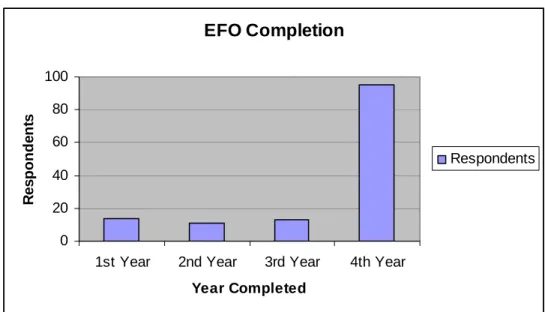
There were 150 respondents to the survey. There were 14 respondents who completed their first year of the EFO program, 11 completed their second year, 13 completed third year and 95 completed their fourth year. (Figure 3)
EFO Completion 0 20 40 60 80 100
1st Year 2nd Year 3rd Year 4th Year Year Completed R e s ponde nt s Respondents
Figure 2 EFO Year Completed
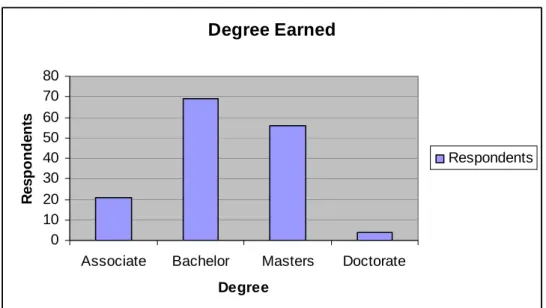
The majority of the respondents have completed a bachelor’s degree. There were over a third of the respondents who earned a master’s degree and the vast majority of the others completed an associate degree. There were four who earned a doctorate degree. (figure 4)
Degree Earned 0 10 20 30 40 50 60 70 80
Associate Bachelor Masters Doctorate Degree R e s ponde nt s Respondents
Figure 3 Degree Earned by Respondent
Are EFO students and alumni interested in a master’s degree program in fire/EMS?
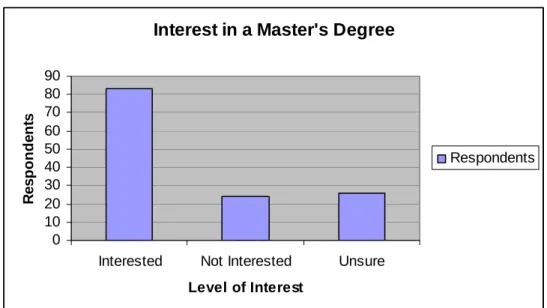
There were 134 answered the question of whether they were interested in a master’s degree. As noted previously, there were a number of individuals who participated in the survey that already had a master or doctorate degree. There were 84 respondents of the respondents are interested in earning a master’s degree. There were 24 who were not interested in earning a master’s degree and 26 were not sure of their interest level in pursuing a master’s degree. (Figure 5)
Interest in a Master's Degree 0 10 20 30 40 50 60 70 80 90
Interested Not Interested Unsure Level of Interest R e s ponde nt s Respondents
Figure 4 Level of Interest in Earning a Master's Degree
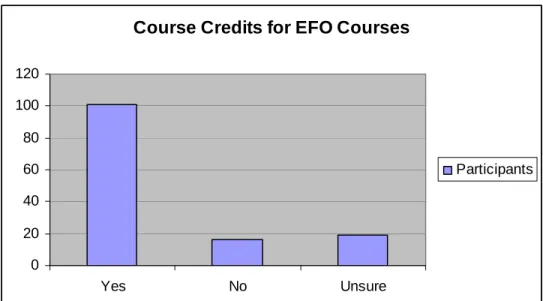
The participants were asked whether they would enroll in a master’s degree if they knew their EFO courses would count toward their credit hours for their master’s degree. The response was overwhelmingly in favor of their EFO courses counting towards their master’s degree. There were 136 of the participants that answered this question. There were 101 who stated they would enroll if their EFO courses counted towards their credit hours for their master’s degree. There were 16 who said no and 19 that were unsure. The 16 that checked no may already have earned their master’s degree. (Figure 6)
Course Credits for EFO Courses 0 20 40 60 80 100 120 Yes No Unsure Participants
Figure 5 Credits for EFO Courses
The survey inquired to whether the participant would enroll in a master’s degree program that is a dual discipline program in fire and EMS. There were 62 who responded that they would enroll in a dual discipline master’s program, 33 that would not and 41 who were unsure. (Figure 7)
Dual Master's - Fire/EMS
0 10 20 30 40 50 60 70 Yes No Unsure Participants
Figure 6 Interest in a Dual Enroll Program - Fire/EMS
What other universities give college credit at the master’s degree level for EFO coursework?
Grand Canyon University allows up to 12 credit hours to transfer into their master’s degree from the EFO program. (Ken Blanchard School of Business, 2008). Arizona State University allows six semester hours of credit from the EFO program to transfer into their program. Anna Maria College allow 6 semester hours of credit to transfer from the EFO program into their program. The other universities and colleges do not make any
indication of allowing transfer credit from the EFO program into their master’s degree program.
What is the most appropriate delivery format to deliver a masters degree in fire/EMS?
There were 133 participants who answered this question. The majority of the participants, 83 participants, would like to enroll in a master’s degree that had a combination of
traditional and on-line format. There were 41 who wanted an on-line format and 4 who wanted a traditional format. (Figure 8)
Delivery Format 0 10 20 30 40 50 60 70 80 90 On-line Traditional Classroom Combination Delivery Format Participants
Figure 7 Preferred Delivery Format
Survey Comments
The final portion of the survey allowed those who participated in the survey to make any comments. The unedited comments are listed in Appendix B. The overwhelming theme of the comments was positive. The ability to take a master’s degree program that EFO students/graduates can transfer their EFO coursework toward the credit hours required for the master’s program.
Summary
The results of the study were defined in this section. The detailed results of all procedures were provided. The specific answers to the original research questions were provided in this section. The comprehensive analysis of data was included. There were tables and figures presented regarding the findings of the results.
Discussion
Overview
The relationship between the study results and specific findings of others is discussed in this section. The author’s interpretation of the study results is presented in this section. The organizational implications are stated in this section.
Relationship between Results and Specific Findings
The results of the survey illustrate that EFO students/graduates are interested in pursuing a master’s degree whereby they can transfer the EFO program coursework to apply towards their degree. There were three universities that currently allow the EFO coursework to transfer into their programs.
The survey conducted by Lowe and Cohilas (2006) of 200 EFO participants, 161 returned the survey. The results showed that 65% or 105 EFO respondents pursued an additional college degree program after earning the EFO title. Fifty-six respondents pursued master degrees. (Lowe & Cohilas, 2006) This is a good indication and concurs with the results of this study that EFO students/graduates pursue a master’s degree.
The author found limited research on this subject; however, an article by Curmode, Brazill, & Leslie, (2007) that certain criteria must be satisfied in order to be qualified to be promoted the position of deputy fire chief or fire marshal. It noted that by 2012, they
must have a master's degree. To qualify for the position of chief, all of the previous prerequisites must be satisfied, along with any related training or education mandated by the director of public safety, the assistant county manager, the county manager, and/or the board of county commissioners. (Curmode, Brazill, & Leslie, 2007)
This is one department’s requirements for promotion to the upper leadership positions in the department. This department is not unique. The position descriptions for job ads for assistant, deputy, and fire chiefs require many of these same attributes. This study did not look at requirements for these positions in any depth; however, on review of the
qualifications for these positions on job ads on the International Association of Fire Chief’s website, many of the requirements included the EFO program completion and a master’s degree was preferred. (IAFC Career Center, 2008)
Author’s Interpretation
The author is convinced that the results are indicative of the need for a master’s degree where the EFO student can transfer their EFO course credits into the program. The George Washington University is at a perfect intersection to be the leader in instituting such a degree. The current master’s degree is Emergency Services Management. It does not denote fire not does it denote EMS. This is a great opportunity.
The results of the survey clearly demonstrate that EFO students/graduates are interested in such a program and ability to transfer their credits. The fire service responds to EMS
calls and the need for a person academically educated to the level of a master’s degree that encompasses both fire and EMS makes them more valuable in that they have not focused on one or the other area. If a fire department is a combination fire and EMS response agency, the personnel who lead the agency should receive academic preparation in both fire and EMS.
In addition, the colleges and universities that offer a master’s degree in fire service are focused more on the fire side of the house and not on the EMS side. This puts the leaders at loss by not having a solid background in both areas.
The delivery format of the program showed an overwhelming response to a combination classroom and on-line program. The EFO program is traditional classroom approach with four, two week in length courses offered at the National Fire Academy in Emmitsburg, Maryland. The remaining coursework offered through The George Washington
University is currently delivered through a learning management system on the Internet. By keeping the courses in their current formats will meet the need of the EFO
student/graduate to be able to take the program in a combination setting. This is not to say that courses may not be evaluated in the future at GWU to be offered in a traditional classroom format. A number of the colleges and universities reviewed for this study offer a week long or other time frame for certain on-campus courses. This could be emulated by GWU.
The relationship between the study results and specific findings of others was discussed in this section. The author’s interpretation of the study results was presented in this section. The organizational implications were stated in this section.
Recommendations
Overview
This section will support the data that was collected. The recommendations listed are related to the stated problem and purpose in this section. Future readers will find the recommendations for their organization documented in this section.
Proposed Curriculum
The GWU master’s degree in emergency services management offers a focused
curriculum in emergency services. The degree program would offer two tracks. The first track would be for those seeking a concentration in medical services. The coursework would remain the same as the current curriculum. The second track would be a master’s degree in emergency services management with an emphasis on fire/EMS management. The three divisions of professional core, research core, and emergency services
concentration would remain the same.
HSCI 240: Issues and Trends in Health Systems; HSCI 241: The Health Care Enterprise; HSCI 223: Topics in Health Care Leadership; b. Research Core (6 credits) HSCI 270: Research Methods for Health Professionals I ; HSCI 271: Research Methods for Health Professionals II; c. Emergency Services Concentration (18 credits): EHS 201: Response to High-Impact Emergencies; EHS 202: Analysis of Emergency Service Systems; EHS 203: Legal and Regulatory Obligations of Emergency Services; EHS 204: Public Information Management of Emergency Services; EHS 205: Strategic Emergency Response; EHS 275: Leadership and Change in Emergency Services Management.
The second track would be the fire/EMS management track and would consist of: a. Professional Core (9 credits) HSCI 240: Issues and Trends in Health Systems; HSCI 241: The Health Care Enterprise; Executive Development ; Research Core (6 credits): b. HSCI 270: Research Methods for Health Professionals I; HSCI 271: Research Methods for Health Professionals II ; c. Emergency Services Concentration (18 credits): Executive Analysis of Fire Service Operations in Emergency Management; EHS 202: Analysis of Emergency Service Systems; EHS 203: Legal and Regulatory Obligations of Emergency Services; EHS 204: Public Information Management of Emergency Services; Strategies for Community Risk Reduction; Executive Leadership.
The option of the two tracks will allow an individual who completed the EFO program to transfer their four courses to the program. ACE recommends that each course be awarded three credit hours. This format takes into account the recommendation. The EFO student would be able to transfer 12 credit hours into the master’s degree program and would
need to complete 21 additional credit hours in order to earn their master’s degree in Emergency Management Services with a Fire/EMS emphasis.
The program would be offered in a distance learning format through a learning management system on the Internet. The students of the EFO program are located in various parts of the United States and for that matter the world. A distance learning program would afford the best opportunity for students to have the most access to earning a masters degree. Consideration needs to be paid to creating a combination format as the results clearly indicate that the EFO student would prefer a combination of delivery methods.
Summary
This section supported the data that was collected. The recommendations listed were related to the stated problem and purpose in this section. Future readers will find the recommendations for their organization documented in this section.
References
Broman, J. (2003). Officer Development Handbook: International Fire Chiefs Association.
Chief Fire Officer Designation Application. (2008). Retrieved August 6, 2008, from http://publicsafetyexcellence.org/Portals/0/resources/applications/Version%204-0.doc
Curmode, G. E., Brazill, R., & Leslie, J. H. (2007). Promotional Progress, Fire Chief.
The Emergency Management and Continuity Planning (EMCP) Certificate. (2008). Retrieved August 3, 2008, from
http://www.uic.edu/depts/oee/emergencymanagement/
FESHE Strategic Goal. (2008). Retrieved August 6, 2008, from
http://www.usfa.dhs.gov/nfa/higher_ed/feshe/feshe_strategic.shtm
Fire and Emergency Management Program. (2004). Retrieved August 25, 2008, from http://polsci.okstate.edu/graduate/femp/
Fire and Safety Engineering Technology. (2005). Retrieved August 25, 2008, from http://www.fireandsafety.eku.edu/
Fire Programs. (2007). Retrieved August 3, 2008, from http://classes.bcn.ufl.edu/fes/
Fire Protection Engineering. (2008). Retrieved August 3, 2008, from http://www.wpi.edu/Academics/Depts/Fire/
Fire Science. (2008). Retrieved August 24, 2008, from
http://www.annamaria.edu/?controller=academics&action=details&id=43
Fire Science Program. (2008). Retrieved August 3, 2008, from http://www.newhaven.edu/5922/
Fire Service Programs. (2008). Retrieved August 3, 2008, from http://poly.asu.edu/technology/imt/fire/
Homeland Security Certificate. (2006). Retrieved August 3, 2008, from http://www.southwesterncollege.org/cert-detail.cfm?id=5
IAFC Career Center. (2008). Retrieved August 8, 2008, from http://www.iafc.org/candidatecentersearchresults.cfm
IAFC Mission Statement. (2008). Retrieved August 6, 2008, from http://www.iafc.org/displaycommon.cfm?an=1
Ken Blanchard School of Business. (2008). Retrieved August 6, 2008, from http://business.gcu.edu/index.php?cid=graduate_programs
Lowe, B., & Cohilas, A. (2006). Heads of the Class. Retrieved August 7, 2008, from http://firechief.com/management/firefighting_heads_class/index.html
Program