Does the Factor Theory of Satisfaction Explain Political
Voting Behaviour?
Peter Schofield and Peter Reeves
Abstract
Purpose – The validity of the three factor theory of satisfaction in explaining
consumer decision making for products and services is well established. This paper explains voter perceptions and voting behaviour in the 2010 UK General Election on the basis of this theory, by evaluating the differential impact of government
performance on key political issues defined as hierarchical voter satisfaction factor types.
Design/methodology/approach – British Election Survey (2010) data is used to test the relative influence of hierarchical voter satisfaction factor types in predicting: (1) the perceived overall performance of the former Labour government; (2) actual voting behaviour. Sequential and multinomial logistic regression models are used in (1) and (2), respectively.
Findings – ‘Basic’ factors explain more of the variance in perceived overall
government performance and voting behaviour than ‘performance’ factors. There are significant positive main and interaction effects on Conservative and Liberal
Democrat party votes from Labour’s under performance on the ‘basic’ factors. The results have important implications for political marketing and voting behaviour research.
Originality/value – The study establishes the relevance of the three factor theory of satisfaction within a political marketing context. It demonstrates that, controlling for party loyalty, perceived government performance on the hierarchical voter satisfaction factors explains voter perceptions and voting behaviour to a significant degree. In particular, it highlights the criticality for voting behaviour of both the direct and indirect impacts of ‘basic’ factor under performance.
Keywords – political marketing, three factor theory, voting behaviour,
Paper type - Research paper
Acknowledgement – The authors would like to thank Professors’ Harold, D. Clarke, David Sanders, Marianne, C. Stewart, Paul Whiteley and the University of Essex for making available on-line the British Election Study (BES 2010) database which provides the data for this study.
Introduction
In recent decades the study of political marketing has emerged as a ‘significant area of international research in contemporary marketing’ (Harris and Lock, 2010, p.297) with a number of different trajectories. One of these trajectories has been the
application of consumer behaviour theory to voting behaviour (Ben-ur and Newman, 2010; Newman, 1999; Newman, 2002; Newman and Sheth, 1985). A number of factors have been found to influence the decisions of voters including: demographics, involvement, issues and policies, social imagery, emotion, candidate image, current events, personal events, epistemic issues, identity and partisanship. Our study, while in the tradition of attempting to understand voter perceptions and behaviour,
represents a departure from the existing models in this stream of political marketing, in that it explains voting behaviour using the ‘three factor theory of satisfaction’ (Kano et al, 1984). The validity of the ‘three factor theory’ to explain consumer satisfaction and behavioural intention has been established in other areas of marketing (e.g. Deng and Pei, 2009; Matzler et al, 2004; Mittal et al, 1998), but hitherto its relevance to political marketing, and in particular to explaining actual voting behaviour remains untested.
Traditional models of consumer satisfaction are based on the assumption that attribute-level performance and both overall satisfaction and behaviour, or
behavioural intention, are linked through a linear and symmetrical relationship. As attribute performance increases, satisfaction and intention to both positively endorse the product or service and to repurchase also increase, the opposite being the case when attribute performance decreases. However, an increasing body of research has found evidence to show that the relationship between attribute-level product
performance and both satisfaction and behavioural intention is nonlinear and
asymmetrical for certain product and service attributes (e.g. Deng and Pei, 2009; Oh, 2001; Matzler et al, 2003). This relationship is explained by the three factor theory, which is underpinned by the notion of a dynamic importance construct, i.e. the connection between the perceived performance and perceived importance of attributes is causal. Thus, when performance changes importance also changes according to the downward sloping performance-importance response (PIR) function, which is
typically steeper at lower than higher performance due to higher sensitivity to the former (Deng et al, 2008; Matzler and Sauerwein, 2002; Sampson and Showalter, 1999). Within a political marketing context, it follows that where an issue is
important for voters, under performance by a political party on this issue is likely to have a negative impact on votes ceteris paribus. It is therefore surprising that voting behaviour has not yet been considered within the context of the three factor theory of satisfaction despite the growing body of research relating to voters as consumers (O’Cass, 2002).
The purpose of this research was to assess the predictive ability of a voting behaviour model based on the three factor theory of satisfaction using data from the 2010 UK General Election. The model uses measures of voter satisfaction with Labour government performance on nine issues over their previous term of office as independent variables. The validity of this approach is supported by the fact that
‘only important issues really affect voting’ (Konstantinidis, 2008 p. 325). We examined the impact of both party loyalty and voter satisfaction factor type, controlling for loyalty, on both the perceived overall performance of the Labour government and on actual voting behaviour in 2010.
Theoretical Background and Hypotheses
Predicting Voting Behaviour
Some of the earliest interest in voters as consumers emanates from consumer research studies largely undertaken in the 1970s, which focussed on demographic variables and the notion of involvement in various U.S electoral contests (Nakanishi, Cooper and Kassarjian, 1974; Rothschild, 1978; Swinyard and Conney, 1978). A limitation of this early research is that it uses a variety of variables, communication tools and electoral contexts which limits its theoretical and empirical utility. However, this was followed by a major theoretical advancement in voter behaviour prediction (Newman, 1981; Newman and Sheth, 1985). Newman and Sheth (1985) predicted political choices with over 90% accuracy, by using seven variables: issues and policies, social imagery, emotional feelings, candidate image, current events, personal events in the voter’s life, and epistemic issues. Interestingly, their model exceeds predictions which were made on the basis of either demographics or involvement. It was later refined to a five variable predictive model based on political issues, social imagery, candidate personality, situational contingency and epistemic value (Newman and Sheth, 1987). The model has been replicated on a number of occasions (Ben-ur and Newman, 2010; Newman, 1999; Newman, 2002). Its fundamental axiom is that voters are consumers of service offered by a politician or political party, and the results consistently demonstrate the impressive predictive utility of the model. For example, Newman’s (2002) study showed 98.9% and 97.8% predictive accuracy for party and candidate choice, and Ben-ur and Newman’s (2010) model achieved 93% predictive accuracy for a party candidate. More recently, the original model
(Newman and Sheth, 1985) has been adapted and re-examined in international comparative studies. The variables included issues and policies, current events, candidate image, personal events, social imagery, epistemic issues, media and emotion (See Cwalina et al, 2004; 2010). The results indicate that while the model is useful as a theoretical framework for predictive analysis of voter behaviour, not all the variables are relevant; the variables with greatest predictive power will be determined on an election by election basis (O’Cass, 2002).
O’Cass (2002) returns to the notion of political involvement and to demographics in his study of a contested seat in the Federal Lower House of Representatives in Australia. He found that involvement was influenced by gender and education level, and thatinvolvement affects satisfaction with politics and choice of both candidate and party. O’Cass and Nataraajan (2003), using data collected from an Australian state election, found that voter concern significantly influences voter involvement. They also showed that voter involvement influences both voter confidence and satisfaction, and that voter confidence influences satisfaction. A further study by O’Cass (2003) found that locus of control over political
circumstances influences voter decision involvement and vice-versa, and that voters’ perception of risk influences their level of involvement. Additionally, voter feelings and involvement were found to influence voter satisfaction, while voter feelings, involvement and satisfaction all individually influenced voting stability.
Baines et al (2003) examined national policies, local policies, leaders, values and candidates as indicators of voting behaviour during the 2001 British General Election. They found that respondents’ perceived performance on these issues predicted voting intention more effectively than their perceived importance, voter demographics or characteristics. Moreover, in a later study, based on the 2005 British General Election, Baines et al (2005) found that party image perceptions are also better predictors of voting intention than demographics for major U.K political parties.
More recent studies have employed alternative approaches in an attempt to understand voting behaviour in specific political contexts. Newman (2007) has undertaken a longitudinal analysis of U.S. elections between 1980 and 2000 using fuzzy set analysis. French and Smith (2010) have adopted a mental mapping approach to understand how voters view U.K political brands. Phillips et al (2010) used means end laddering to examine how voters may be segmented in accordance with their decision processes to facilitate campaign message design. Additionally, Baines et al (2011) used longitudinal real time tracking studies of floating voters in the 2010 British General Election to gain insights into how communication channel experiences influence floating voter decisions.
Voter Loyalty
The concept of loyalty and its influence on voting behaviour has been under
researched in the political marketing literature, although there has been some limited discussion in terms of political brand loyalty. Needham (2006) argues that political parties, like business organisations, need to focus on repeat business given the proliferation of choice and social dealignment. Butler and Collins (1994) have also discussed the issue of voter loyalty in regard to the tactical voter or counter-consumer, who may vote for a party (or candidate) which is not their first choice in order to prevent an unwanted party/candidate winning an electoral contest. Moreover, Gerber et al (2010) have examined the influence of partisan identification on political
outcomes and found a causal relationship between partisanship and voting behaviour.
Loyalty’s lack of consideration in political marketing appears to reflect the debate over the meaning of the loyalty construct in the wider marketing literature. Day (1969) argued that loyalty consists of both attitudinal and behavioural
dimensions, while in the context of branding, Jacoby and Chestnut’s (1978) seminal text referred to a wide range of competing loyalty measures. Nevertheless, a
significant number of methodologically robust quantitative studies in the last 20 years have continued to examine brand loyalty from the behavioural perspective (e.g. Bayus, 1992; Dekimpe et al, 1997; Liu, 2007; Sharp, 2010).
Dick and Basu (1994, p. 99) define customer loyalty “as the strength of the relationship between an individual’s relative attitude and repeat patronage”. They note that customer loyalty can be affected by cognitive, affective and conative
antecedents. They also contend that there can be: (1) latent loyalty where there is low repeat patronage despite a high relative attitude towards the brand, and (2) spurious loyalty where there is a high level of repeat patronage but low relative attitude towards the brand (ibid p. 101). Oliver (1999) classifies loyalty according to four sequential phases: cognitive, affective, conative, and action loyalty, a typology which has been influential in the design of a number of other studies (e.g. Evanschitzky and Wunderlich, 2006; Olsen et al., 2013; Yi and La, 2004).
There is debate within the literature as to whether satisfaction automatically leads to consumer loyalty. A stream of research has shown that the satisfaction loyalty link is a complicated and sometimes unpredictable relationship (Anderson and Mittal, 2000; Agustin and Singh, 2005; Baumann et al, 2012; Mittal, and Lassar, 1998; Mittal and Kamakura, 2001; Oliva et al, 1992). Nevertheless, a number of studies have found a relationship between satisfaction and intention to purchase (e.g. Cronin et al, 1992; Oliver, 1980; Oliver and Swan, 1989). However, it should be noted that intention does not necessarily lead to action (Oliver op cit).
More recently, the focus of loyalty has begun to shift to understanding attitudinal loyalty and how it influences the relationships consumers have with their brands (e.g. Aurier and Lanauze, 2012). For example, Fournier and Yao (1997) use qualitative methods to critique the ‘black and white’ dichotomous notion of brand loyalty/ brand disloyalty, and argue for a refocus of research on consumer brand relationships. Delgado-Ballester and Munuera-Alemán (2001) have also examined customer trust in the context of consumer brand loyalty. In addition, whilst earlier loyalty research tended to examine products, more recent studies have focussed on the service sector (e.g. Han et al, 2008; Harris and Ezeh, 2008; Moore et al, 2012). Within this context, Wirtz and Mattilla (2003) have argued that consumers are loyal to services to reduce risk in their consumption behaviour. This resonates with the fundamental maxim of Newman and Sheth’s (1985) predictive model of voter behaviour: voters are consumers of service offered by a politician or political party. From this perspective, loyalty is defined behaviourally as repeat voting for the same political party. Within the framework of our study, it was important to identify the influence of loyalty on voter perceptions of party performance and on voting
behaviour, and then control for loyalty to test the relevance of the three factor theory. We therefore hypothesised that:
H1. Loyalty has a significant influence on perceived political party performance;
H2. Loyalty has a significant influence on voting behaviour.
The Factor Theory of Satisfaction in Politics
Prior research has confirmed the existence of three types of hierarchical factors based on their importance in relation to overall performance or satisfaction (e.g. Anderson and Mittal, 2000; Deng and Pei, 2009; Matzler and Sauerwein, 2002; Ting and Chen,
2002). We have reinterpreted Matzler et al.’s (2004) description of the three factors (basic, excitement and performance factors) to conceptualise the theory of voter satisfaction within a political marketing context, as follows:
1. Basic factors (dissatisfiers). These are minimum requirements that cause voter dissatisfaction if they are not delivered, but do not result in voter satisfaction if they are delivered.
2. Excitement factors (satisfiers). These factors increase voter satisfaction if delivered but do not result in voter dissatisfaction if not delivered. They surprise and delight the voter.
3. Performance factors (hybrid factors). These factors produce satisfaction for voters if delivered and lead to dissatisfaction for voters if they are missing.
Theoretically, excitement factors become important determinants of voter satisfaction when overall performance is high, but are unimportant when overall performance is low. Conversely, basic factors are critical when performance is low and their influence on overall voter satisfaction decreases when performance increases. By comparison, performance factors produce voter satisfaction when performance is high and dissatisfaction when performance is low. It therefore follows that if either important performance factors or basic factors are perceived to be under performing, the negative impact on voter satisfaction is likely to be substantial, whereas under performance on excitement or unimportant performance factors is likely to be less critical. This paper tests the relevance of the factor theory of satisfaction in the context of voter perceptions and behaviour. It does this by
examining the differential effects of the Labour party’s performance on issues which fulfil basic requirements and minimise voter dissatisfaction (basic factors), compared with those which add value and increase voter satisfaction (excitement factors) and those which do both (performance factors). Given the result in the 2010 UK General Election i.e. Labour party defeat, we therefore hypothesised, while controlling for loyalty (based on voting behaviour in the 2005 General Election), that:
H3. Basic factor performance has the highest impact on the perceived overall performance of the Labour party;
H4. Basic factor performance has the highest impact on voting behaviour.
Methodology
Participants and Variables
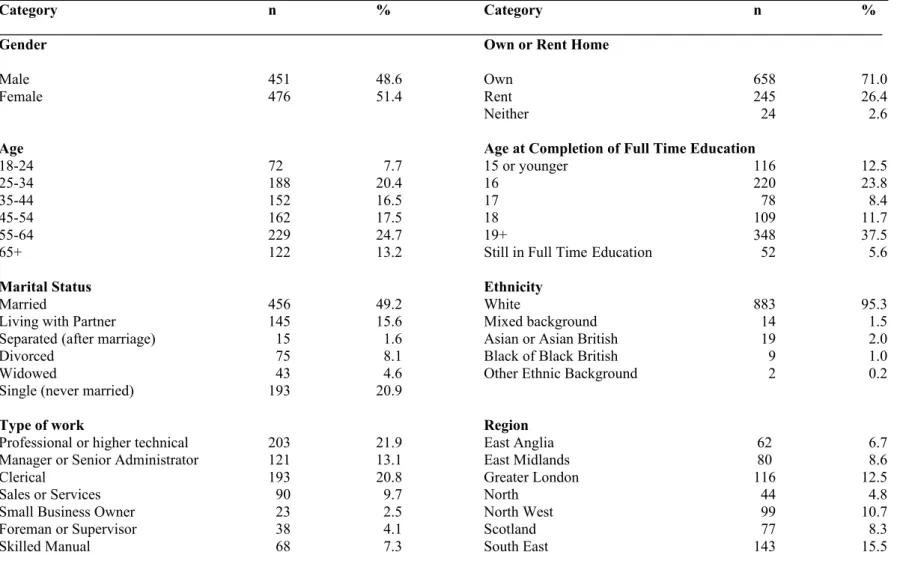
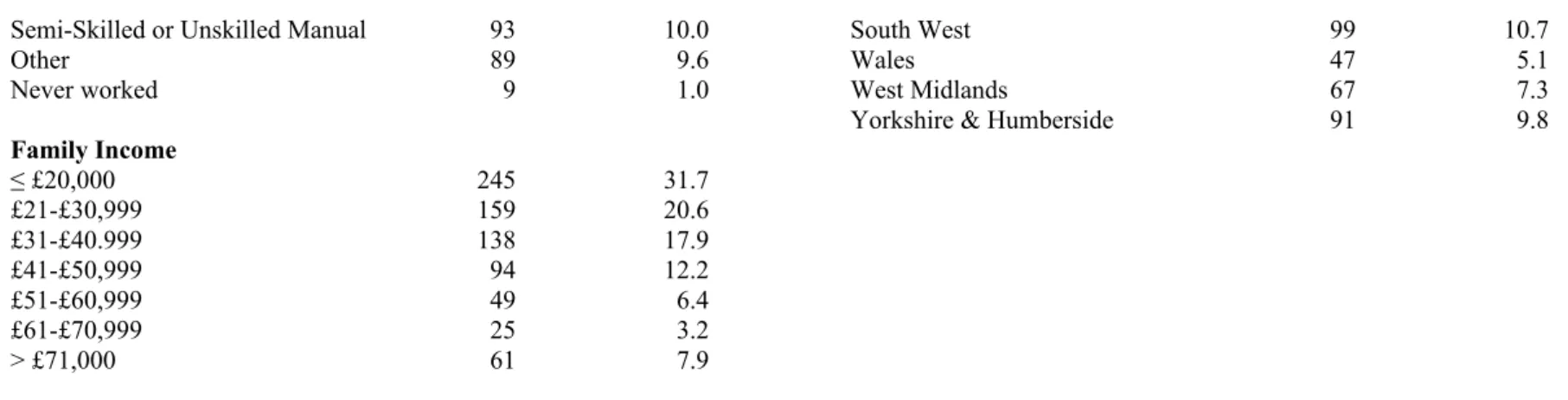
The British Election Study (BES, 2010) data set (n = 927) was used as the sample for the study; all demographic details are provided in Table 1. The BES (2010) data set provided respondent ratings on the former Labour government’s ‘handling’ of nine key issues: crime, immigration, NHS, terrorism, the economy (generally), war in Afghanistan, the financial crisis, education and taxation. These performance
measures, together with the data set’s measure of the perceived overall performance of the former Labour government, facilitated the testing of the factor theory of satisfaction in this context. The BES (2010) data set also featured each respondent’s voting behaviour in both the 2010 and 2005 UK General Elections; this provided a
behavioural measure of loyalty: ‘action loyalty’ (Oliver, 1999). The impact of both party loyalty and the former Labour government’s handling of each of the nine issues, statistically controlling for loyalty, on their perceived overall performance as a
government and on voting behaviour in the 2010 election, could therefore be assessed. Sequential multiple regression and multinomial logistic regression models,
respectively, were used for this purpose.
The use of policies as performance measures in the context of the factor theory of satisfaction is supported by the criticality of the concept of market orientation in a political marketing context (Ormrod and Henneberg, 2010a; 2010b) in that party policies must satisfy voters. As such, party performance on key policies is a viable measure of voter satisfaction. We acknowledge that a range of factors in addition to policy issues have been found to influence voter perceptions and behaviour (e.g. Baines et al, 2011; Cwalina et al, 2004; 2010; O’Cass, 2002; Newman and Sheth, 1987). However, they were either not suitable for use as performance measures, not directly comparable with the policy issue performance measures because of the response set or scale formats which were used in the BES (2010), or not measured in the survey and therefore unavailable. By comparison, the directly comparable policy issue ratings enabled both their classification as hierarchical voter satisfaction factor types and the evaluation of their differential impact on perceived overall performance and voting behaviour. This, in turn, enabled an assessment of the viability of the factor theory of satisfaction in regard to explaining voter perceptions and behaviour in the 2010 UK General Election.
The scaled data for both perceptions of the former Labour government’s ‘handling’ of the nine issues and the ‘general performance’ measure was reverse coded (using the original labels) from low positive values to low negative values. As such, perceptions of the former Labour government’s handling of the issues was assessed on 5-point scales, labelled ‘Very Badly’ (1), ‘Fairly Badly’ (2), ‘Neither’ (3), ‘Fairly Well’ (4) and ‘Very Well’ (5). The perceived overall performance of the former Labour government was assessed on a 5-point scale, labelled ‘Very Bad Job’ (1), ‘Bad Job’(2), ‘Neither’ (3), ‘Good Job’ (4) and ‘Very Good Job’ (5).
Table 1 about here
Method of Classification for the Hierarchical Factors
The hierarchical factor structure of the nine key issues and the asymmetric impact of the Labour party’s handling of the issues on their perceived overall performance in the 2010 election were identified using penalty-reward contrast analysis. Regression analysis with dummy variables was employed to identify value-enhancing
form dummy variables expressing basic factors (value of 1).
Secondly, ratings on the perceived overall performance scale were then regressed against the dummy variables expressed as
‘penalties’ and ‘rewards’ to identify the hierarchical factor types (Brandt, 1988). For each of the nine issues, two measures were therefore obtained: i.e. how high and low performance by the Labour party on the particular issue impacted on their perceived overall performance. Partial correlation coefficients were used instead of standardized multiple regression coefficients. The former represent a measure of the linear association between Labour’s perceived overall performance, as the dependent variable, and the perceived performance of each independent variable after adjusting for the linear effect of the other issues; this ensures that the potential effects of
multicollinearity among the independent variables is avoided (Hair et al, 2009). The constant in the regression equation is the average of all the referent groups on perceived overall performance. As such, ‘penalties’ are expressed as the amount subtracted from the constant i.e. low perceived performance and ‘rewards’ represent the amount added to the constant i.e. high perceived performance (Matzler et al, 2004). If the reward exceeds the penalty, the issue is considered to be an excitement factor or satisfier and if the penalty exceeds the reward, the issue is a basic factor or ‘dissatisfier’. If the reward and penalty are equal, there is a symmetrical relationship between the party’s handling of the issue and their perceived overall performance; in other words, the issue (performance factor) results in a favourable perception of their overall performance, if it was handled well, but an unfavourable perception if it was handled badly (Figure 1).
Figure 1 about here
Results and Discussion
The Satisfaction Factor Structure of the Key Political Issues
The results of the analysis show that the nine key issues identified in the British Election Study (BES, 2010) vary in their impact on the perceived overall performance of the Labour party at high (good) and low (poor) levels of handling. The Labour party’s handling of two of the issues: immigration and terrorism, has no significant impact on perceived overall performance. As such, they could not be classified as hierarchical voter satisfaction factor types. Had they reached significance, the reward/penalty balance (Figure 1) suggests they are performance factors.
significant when their handling is poor, but insignificant and either non-existent or small when their handling is good. For crime and taxation, there is no positive impact on perceived overall
performance even when the party’s handling of these issues was rated highly; there is only a statistically significant penalty for under performance on these issues. For the economy (generally) and war in Afghanistan, the reward for high perceived performance on these issues has no significant impact on perceived overall performance. By contrast, there is a significant negative impact on perceived overall performance, particularly in the case of the economy (generally). The penalty for under-performing on the latter is considerable, and far outweighs that for the other three basic factors, which have similar negative impacts. This shows that handling of the economy (generally) is the most critical basic factor by a considerable margin, i.e. the key dissatisfier; it also indicates that an intra-group two-tier hierarchy exists within the basic factors.
The three remaining issues are ‘performance’ factors: NHS, financial crisis and education because there are statistically
significant penalties for poor performance on the issues, and significant rewards for high performance in all three cases.
Education has higher rewards and penalties than either the NHS or financial crisis, but there is considerable scope in all three cases for either positive or negative impact on overall performance depending on the party’s handling of the issue. It should also be noted that while the reward for good handling and the penalty for poor
handling of both education and the financial crisis are relatively well balanced, for the NHS the reward for good performance is
outweighed by the penalty for poor performance. Not surprisingly, no excitement factors were identified because the nine variables represent key issues which are critically important for voters. Table 2 provides a summary of the issues as hierarchical voter satisfaction factor types.
Table 2 about here
The Impact of Loyalty and Hierarchical Factor Type on the Former Labour Government’s Perceived Overall Performance
The results from sequential multiple regression analyses showing the relative impact of the former Labour government’s handling of the nine key issues on their perceived overall performance in shown in Table 3. First, the influence of party loyalty, based on votes for Labour, Conservatives and the Liberal Democrats in the 2005 General Election, was examined (Model 1) and subsequently controlled for. The result shows that overall the net effect of voting behaviour in the 2005 General Election has a highly significant negative influence and explains 33% of the variance in the Labour party’s perceived overall performance.
Table 3 about here
Model 2 shows the significant impact of voting in 2010 on perceived overall performance and the results from a one-way ANOVA (Table 4) show that the
negative impact is the net result of significant differences in loyalty (F = 280.04; df = 2; p<0.001) to the Conservative party (M = 1.72; SD = 0.85) and Liberal Democrat party (M = 2.88; SD = 1.18) versus Labour loyalty (M = 4.07; SD = 0.70).
Furthermore, a post hoc test showed highly significant differences in perceived former Labour government performance on all nine issues on the basis of loyalty to all three parties. In all cases, Labour voter ratings were significantly higher than Liberal Democrat voter ratings which, in turn, were significantly higher than Conservative voter ratings. As such, hypothesis 1 (Loyalty has a significant influence on perceived political party performance) is supported.
Table 4 about here
There was also a statistically significant strong association between voting in 2005 and voting in 2010 by party (χ2 = 486.63; p<0.001; Cramer’s V = 0.65) (Table
5). It is interesting to note that 88.89% of subjects who voted Conservative in 2005 voted for them in 2010, 82.52% of subjects who voted Liberal Democrat in 2005 voted for them in 2010, and 63% of those who voted Labour in 2005 remained loyal in 2010. Moreover, just under one quarter (24.55%) of those voting Labour in 2005 voted Liberal Democrat in 2010 and 12.45% voted Conservative; by comparison, only 8.74% and 1.52% of those voting Liberal Democrat and Conservative respectively in 2005 switched to Labour in 2010. Hypothesis 2 (Loyalty has a significant influence on voting behaviour) is therefore supported.
Table 5 about here
Model 3 in Table 3 shows that when the effects of loyalty are statistically controlled for, Labour’s perceived handling of the nine key issues explains 73% (an additional 58%) of the variance in Labour’s perceived overall performance. Five of the issues make significant individual positive contributions to the overall
performance after the effects of voting in 2005 and 2010 are controlled. Not surprisingly, the former Labour government’s poor handling of the economy
(generally) (BF), the primary dissatisfier, makes the largest contribution. The former government’s handling of crime (BF) and taxation (BF) also have significant impacts on their perceived overall performance, although the effect of the latter was expected to be higher given the comparative penalty for low performance in taxation (Figure 1). Moreover, it is notable that war in Afghanistan (BF) fails to have a significant impact on the party’s overall performance. This result also supports the notion of an intra-group hierarchy among the basic factors. More importantly, it shows that basic factor under performance explains most of the variance (0.64) in Labour’s perceived overall performance compared with performance factor impact (financial crisis: 0.14;
education: 0.10; NHS: not statistically significant). Hypothesis 3 (Basic factor
performance has the highest impact on the perceived overall performance of the Labour party) is therefore supported.
The Impact of Hierarchical Satisfaction Factor Type on Voting Behaviour in 2010 To assess the impact of hierarchical satisfaction factor type on voting behaviour in the 2010 General Election and to test for main and interaction effects, a multinomial logistic regression model was used. The model accurately classifies 85.9% of Labour votes and 89.5% of Conservative votes, but only 38.6% of Liberal Democrat votes in 2010 (Table 6). The weak prediction of the latter may result from the relatively small size of the party by total votes in comparison with Labour and Conservative parties. This means that given the constituency based voting system in the U.K, the Liberal Democrat party will not gain seats in proportion to their total market share because the latter is spread unevenly across constituencies. Therefore, in some constituencies, Liberal Democrat supporters may have voted tactically based on their expectations of realistic outcomes. Such tactical voting may be an issue for all parties, but is more acute for smaller parties in the UK given the ‘first past the post’ system of British parliamentary elections. The model may therefore have performed more satisfactorily with a proportional system of voting. However, the model has performed well overall given that voters in the UK resolve some incongruities between partisanship and policy evaluation through selective attribution, i.e. favoured parties are not always blamed for policy failures, while less favoured parties are not always credited with policy successes (Marsh and Tilley, 2010). Moreover, some inaccuracy may have also resulted from distortion relating to retrospective or hypothetical evaluations of opposition party competence to handle key issues in the absence of proven capability in office over the same time period (Green and Jennings, 2012).
The results (Table 6) show that there are significant main and interaction effects for the key issues. The first section shows the significant effects for each of the key issues on Conservative party votes in 2010 with Labour votes as the referent group, while the other variables in the model are held constant. There are significant main effects on Conservative party votes from Labour’s poor performance on four of the nine issues: handling of crime (BF); education (PF); the financial crisis (PF); taxation (BF). The β statistics represent the multinomial logit estimates for the impact of the former government’s handling of these issues on Conservative votes relative to Labour votes. For a one unit improvement in Labour’s handling of these issues, the log-odds of voting Conservative would decrease by 0.97 units (crime), 0.73 units (education), 0.47 units (financial crisis) and 0.35 units (taxation). The Exp β statistics represent the odds ratios for the predictors. All figures (<1) indicate that the risk of the outcome falling in the comparison group (voting Conservative), relative to the referent group (voting Labour), significantly decreases as the perception of Labour’s handling of the issue improves. The confidence intervals (CI) for crime and education indicate that the relationship between the dependent and independent variables in this sample is true of the voting population. For financial crisis and taxation, the
confidence intervals indicate that the direction of this relationship may be unstable in the population as a whole and this limits the generalisability of these particular findings. The results suggest that had Labour’s performance on these four issues, but
particularly crime (BF) and education (PF), been better they would have gained more votes from those who voted Conservative.
Table 6 about here
While there are main effects for only four of the issues, there are significant interaction effects between six of them: handling of the economy (generally) (BF); taxation (BF); crime (BF); immigration (U); financial crisis (PF); war in Afghanistan (BF). Notably, all of the basic factors have significant interaction effects. The interaction of handling of the economy (generally) (BF) and taxation (BF), together with the interaction of handling of crime (BF) and the financial crisis (PF), and the interaction of their handling of war in Afghanistan (BF) and the financial crisis (PF) all have significant negative impacts. For perceived improvements in these particular combinations, the log-odds of voting Conservative rather than Labour would decrease by 1.47, 1.00 and 0.79 units, respectively. This result lends support to hypothesis 4 (Basic factor performance has the highest impact on voting behaviour). It also indicates that there were additional votes to be gained from improvements in the handling of these issues over and above those from the direct effects from the improvements.
The interaction effect of the former government’s handling of crime (BF) and the economy generally (BF), and their handling of immigration (U) and the financial crisis (PF) are also significant. However, for perceived improvements in the combined handling of crime and the economy (generally), the multinomial log-odds of voting Conservative rather than Labour would increase by 1.40 rather than decrease, and the confidence intervals indicate that this is true of the voting population. This effect may result from loyalty to the Conservative party combined with factor type and both perceived performance and importance of the issues from the perspective of
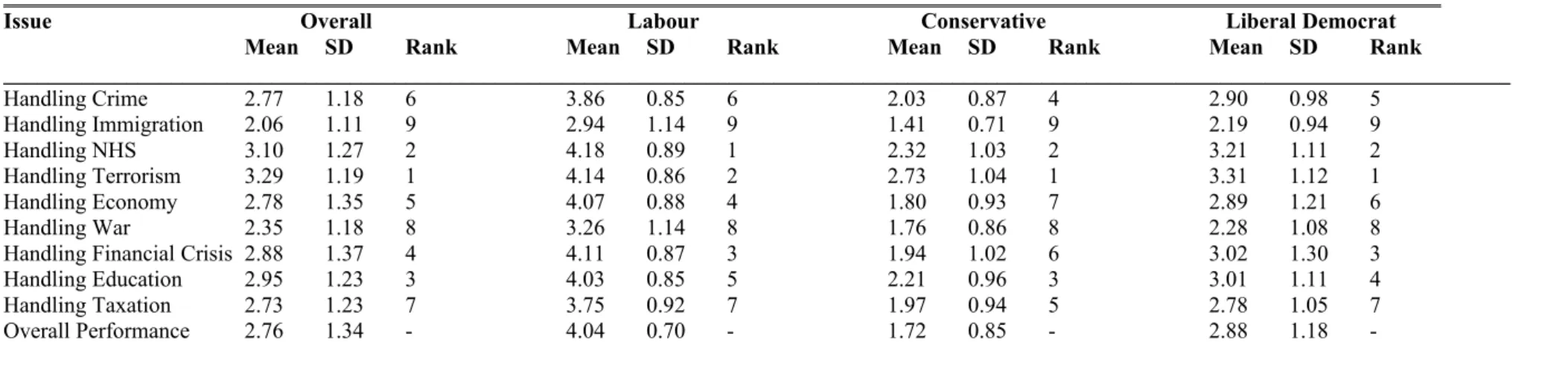
Conservative voters. Handling of crime and the economy (generally) are basic factors. As such, the positive impact of improved performance may be negligible given that Conservative voters’ perceived performance of the former government’s handling of crime and the economy (generally) was rated as poor and ranked 4th (mean: 2.03) and
7th (mean: 1.80) out of nine, respectively (Table 4); this may explain why the voters
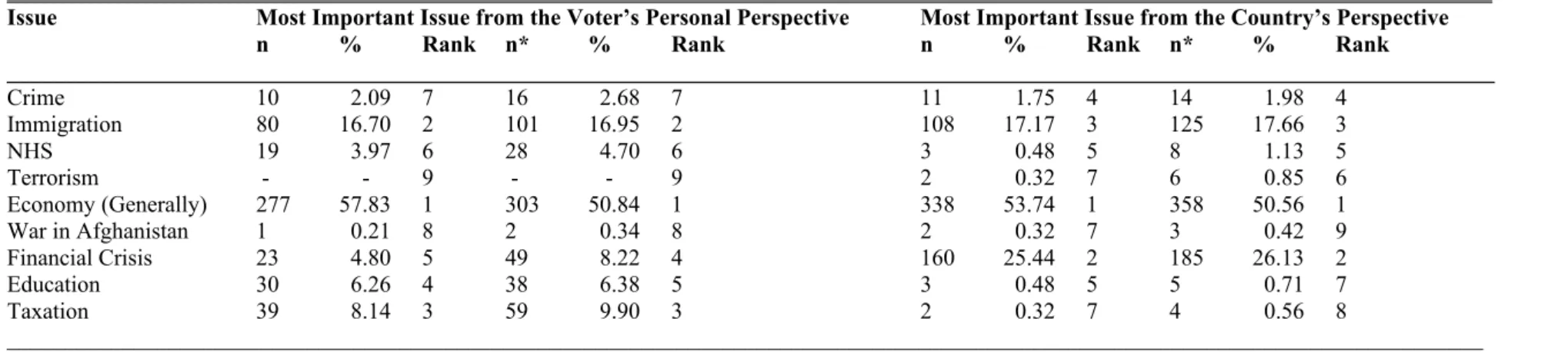
were not inclined to switch. Moreover, although crime is ranked fourth in importance from the country's perspective, it is ranked seventh from a personal perspective (Table 7). Therefore, given the high importance of the economy (generally) from both country and personal perspectives, it is likely that the combined effects of party loyalty and low perceived performance have accounted for this anomaly. Immigration was unable to be classified as a hierarchical voter satisfaction factor type; we have therefore excluded its interaction with the financial crisis from the discussion.
The last section of Table 6 shows the significant main and interaction effects for the key issues on Liberal Democrat party votes in 2010 with Labour votes as the referent group, while the other variables in the model are held constant. There are significant main effects on Liberal Democrat party votes from Labour’s poor
performance on four of the classified issues: handling of crime (BF); education (PF); war in Afghanistan (BF); taxation (BF), three of which are basic factors. Immigration
(U) is again excluded from the discussion because it was unable to be classified as a hierarchical voter satisfaction factor type. For a one unit perceived improvement in the handling of the classified issues, the multinomial log-odds of voting Liberal Democrat rather than Labourwould decrease by 0.63 units (crime), 0.63 units
(education), 0.43 units (war in Afghanistan) and 0.36 units (taxation). Moreover, the confidence intervals show that the results are generalizable, which indicates that had Labour’s performance on these issues, particularly on crime and education, been more favorably perceived they would have gained more votes from those who voted Liberal Democrat. Therefore overall, the results indicate that improvements in five of the issues: handling of crime (BF), education (PF), taxation (BF), the financial crisis (PF) and war in Afghanistan (BF), but particularly the first three, would have significantly increased the number of votes for Labour at the expense of both Conservative and Liberal Democrat votes. By comparison, improvements in Labour’s handling of the financial crisis (PF) would have persuaded Conservative voters to vote Labour whereas improvements in their handling of war in Afghanistan (BF) would have persuaded Liberal Democrat voters to vote Labour.
There are significant interaction effects between four of the issues. As was the case with the Conservative comparison group, the interaction of the former
government’s handling of the economy (generally) (BF) and taxation (BF) produced the largest highly significant effect. For the combined effect of perceived
improvements in these two areas, the log-odds of voting Liberal Democrat rather than Labour would be expected to decrease by 1.16. The Exp β statistic for this interaction indicates that the risk of voting Liberal Democrat relative to voting Labour
significantly decreases as the effect of the perception of Labour’s handling of the issues in combination improves. This also lends support to hypothesis 4.
By contrast, the interaction effect of the former government’s handling of the NHS (PF) and war in Afghanistan (BF) indicates that for combined improvements in these two areas, the log-odds of voting Liberal Democrat rather than Labour would be expected to increase by 0.55 rather than decrease. This indicates that the risk of voting Liberal Democrat relative to voting Labour significantly increases as the perception of Labour’s combined handling of these issues improves; for both interaction effects, the results are generalizable. The positive impact on Liberal Democrat votes of the latter possibly results from loyalty, and both the perceived performance and importance of these issues for Liberal Democrat voters. While the Labour government’s handling of the NHS is ranked second (mean: 3.21) for performance by Liberal Democrat voters, their handling of war in Afghanistan is ranked eighth out of nine (mean: 2.28) (Table 4). Moreover, both issues have low perceived importance ranks (Table 7), which appears to have negated the effect of Labour’s improved performance.
Table 7 about here
Overall, the findings show that basic factor performance has the highest impact on voting behaviour. Hypothesis 4 is therefore supported. Generally, basic factor under performance has a significant negative impact on Labour votes as
expected. In addition, the large majority of significant interaction effects involve basic factors either in combination with other basic factors, or with performance factors, notwithstanding the complexity of the basic and performance factor
interactions. The results therefore demonstrate the relevance of the three factor theory within a political marketing context, and particularly in relation to perceived political party performance and voting behaviour. A summary of the key results is given in Table 8.
Table 8 about here
Conclusions
This study is differentiated from previous research in this area because it has
examined the impact of loyalty and political party handling of key issues on perceived overall party performance and voting behaviour within the context of the three factor theory of satisfaction. As such, it makes an important contribution to the political marketing literature and voter behaviour research. Political party loyalty was found to have a strong influence on both perceptions of the former Labour government’s overall performance, and on voting behaviour in the 2010 UK General Election.
Moreover, there were highly significant differences in perceived former Labour government performance on all nine issues on the basis of loyalty to all three parties, as expected. Labour voter ratings were significantly higher than Liberal Democrat voter ratings which, in turn, were significantly higher than Conservative voter ratings. Loyalty was therefore controlled, and the variance in voting behaviour explained by Labour’s handling of the key issues indicated that party credibility and reliability relating to the important issues, significantly impacts on votes.
Theoretical Contribution
The study makes a theoretical contribution by demonstrating the value of the three factor theory of satisfaction (Deng and Pei, 2009; Kano et al, 1984; Matzler et al, 2003; Matzler 2004; Matzler and Sauerwein, 2002; Ting and Chen, 2002) to a new area of consumer decision making, that of voter satisfaction and voting behaviour. Within this context, it also provides an insight into the relationship between voter satisfaction and loyalty, which builds upon previous consumer behaviour research (Anderson and Mittal, 2000; Agustin and Singh, 2005; Baumann et al, 2012; Mittal and Lassar 1998; Mittal and Kamakura 2001; Oliva et al, 1992). The results show that seven of the nine key political issues were reliably classified as hierarchical factors. Four were ‘basic’ factors or ‘dissatisfiers’: crime; the economy (generally); war in Afghanistan; taxation. The remaining issues were classified as ‘performance’ factors: the NHS; financial crisis; education. The basic factors were found to explain more of the variance in Labour’s perceived overall performance than the performance factors, while controlling for loyalty. Basic factor performance also had the highest impact on actual voting behaviour. This is an important finding because it
demonstrates the relevance of the three factor theory of satisfaction to political marketing. Another important contribution of the research is the identification of an intra-group hierarchy within the basic factors, based on the comparison of the
penalties for basic factor low performance, and the proportion of variance in both perceived overall performance and voting behaviour explained by the individual basic factors. Within this context, the economy (generally) was highlighted as the primary basic factor or key dissatisfier; this resonates with research findings relating to the link between voting behaviour and government performance, particularly in economic affairs (Marsh and Tilley, 2010)
The study furthermore extends the political marketing literature by empirically testing the under-researched variables: loyalty and satisfaction, in this context. Hence it adds to research over the last 15 years in political marketing that uses a variety of new models to predict and understand voter behaviour (e.g. Baines et al, 2003; 2005, 2011; Ben-ur and Newman, 2010; Cwalina et al, 2004, 2010; French and Smith, 2010; Newman, 2007; O'Cass, 2002; O'Cass and Nataraajan, 2003).
The study also demonstrates how political science data can be used effectively in consumer behaviour studies and provides a theoretically grounded method for predicting actual voting behaviour using consumer satisfaction in the form of voter perceptions of party performance. This resonates with the behavioural loyalty
literature (e.g. Bayus, 1992; Dekimpe et al, 1997; Liu, 2007; Sharp, 2010). The study also confirms the predictive validity of the model with respect to voting behaviour in that it accurately classifies 85.9% of Labour votes and 89.5% of Conservative votes but only 38.6% of Liberal Democrat votes. The latter probably results from the constituency based voting system in the UK, the relatively small size of the party by total votes, and tactical voting by Liberal Democrat supporters. The overall accuracy of the model may have also been affected by selective attribution and hypothetical evaluations of opposition party competence to handle key issues in the absence of proven capability.
Management Implications
A further contribution of the research, which demonstrates the practical value of applying the theoretical model in this context, relates to the identification of Labour party under performance on key issues. Through the classification of political issues as theoretical satisfaction factor types, the study has highlighted areas of particular weakness which resulted in voters switching to both the Conservative and Liberal Democrat parties. Labour’s perceived under performance on the basic factors, both directly and indirectly (in terms of influencing perceptions of their performance in other areas) had the largest negative impact, although the party’s perceived under performance on some of the performance factors was also critical. Improvements in Labour’s handling of the financial crisis (PF) and taxation (BF), but particularly crime (BF) and education (PF), would have gained more votes from those who voted Conservative. By comparison, higher performance on crime (BF), education (PF), immigration (U), war in Afghanistan (BF) and taxation (BF), would have gained more votes from those who voted Liberal Democrat. From a strategic resource
management perspective, focusing on improved performance in three areas: taxation, crime and education, rather than on issues where they feel they have a strong
reputation for competence (Green and Jennings, 2012), would have directly increased the number of Labour votes at the expense of other parties.
Overall, from a managerial perspective, the findings demonstrate the criticality of basic factor performance on voting behaviour. Public perceptions of basic factor performance therefore need to be monitored, and both performance on particular issues and communication about the handling of these issues needs to be managed more effectively during the government’s term of office. This will improve perceived overall party performance and potentially attract more votes and avoid losing votes. As is the case with companies which rely on large and infrequent consumer
purchases, political parties need to market themselves effectively to win an election, minimize post-voting dissonance and promote brand loyalty. The results therefore support Baines et al’s (2003) recommendations that political parties should consider psychographic segmentation in addition to the more traditional behavioural (loyalty) and geo-demographic approaches, notwithstanding resource constraints and
operational difficulties.
Limitations and Recommendations for Future Research
While the paper makes an important theoretical contribution to the political marketing literature and provides a foundation for the further study of voter satisfaction, its limitations should be noted. The study was conducted using data from a single election: theBritish Election Study (BES, 2010) data set; it was therefore constrained by the relatively small sample size (n = 927) and the lack of additional variables which were directly comparable with the policy issue measures that could be used to test the relevance of the three factor theory in the context of predicting voting
behaviour. It should also be noted that while the impact of the ‘basic’ factors on the Labour party’s perceived overall performance was greater than ‘performance’ factor impact, the former government’s handling of immigration and terrorism were unable to be classified as hierarchical factor types and were
therefore untested. The predictive validity of the Liberal Democrat voting behaviour model (and possibly that for the other two parties) was also constrained by the constituency based voting system and its tactical voting behaviour.
both domestically and internationally. Moreover, future studies should combine policy issues with other variables which have been investigated elsewhere such as the personality and image of party leaders (Davies and Mian, 2010) as performance measures within the three factor theoretical framework to improve the predictive validity of the model. The model should also be tested in countries with a proportional system of voting to eliminate bias from tactical voting among members of relatively small sub-samples.
References
Agustin, C. and Singh, J. (2005), “Curvilinear effects of consumer loyalty
determinants in relational exchanges”, Journal of Marketing Research, Vol. 42, No. 1, pp. 96-108.
Anderson, E.W. and Mittal. V. (2000), “Strengthening the satisfaction-profit chain”,
Journal of Service Research, Vol. 3, No.2, pp. 107-120.
Aurier, P. and de Lanauze, G.S. (2012), “Impacts of perceived brand relationship orientation on attitudinal loyalty: An application to strong brands in the packaged goods sector”, European Journal of Marketing, Vol. 46, Nos. 11-12, pp. 1602-1627. Baines, P.R., MacDonald, E.K, Wilson, H., and Blades, F. (2011), “Measuring communication channel experiences and their influence on voting in the 2010 British General Election”, Journal of Marketing Management, Vol.27, No. 7-8, pp. 691-717. Baines, P.R, Worcester, R.M, Jarrett, D. and Mortimore, R. (2003), “Market
segmentation and product differentiation in political campaigns: A technical feature perspective”, Journal of Marketing Management, Vol. 19, No. 1/2, pp. 225-249. Baines, P.R, Worcester, R.M, Jarrett, D. and Mortimore, R. (2005), “Product attribute-based voter segmentation and resource advantage theory”, Journal of Marketing Management, Vol. 21, No. 9/10, pp. 1079-1115.
Baumann, C., Elliott, G. and Burton, S. (2012), “Modelling customer satisfaction and loyalty: survey data versus data mining”, Journal of Services Marketing, Vol.26, No. 3, pp. 148-157.
Bayus, B.L. (1992), “Brand loyalty and marketing strategy: An application to home appliances”, Marketing Science, Vol.11, No.1, pp. 21-38.
Ben-Ur, J. and Newman, B.I. (2010), “A marketing poll: An innovative approach to prediction, explanation and strategy”, European Journal of Marketing, Vol. 44, Nos. 3/4, pp. 515-538.
Brandt, D.R. (1988) “How service marketers can identify value-enhancing service elements”, Journal of Services Marketing, Vol. 2, No. 3, pp. 35-41.
Butler, P. and Collins, N. (1994), “Political marketing: structure and process”,
European Journal of Marketing, Vol.28, No.1, pp. 19-34.
BES (2010), The British Election Study (BES) by Clarke, H.D., Sanders, D., Stewart, M.C, and Whiteley, P. http://www.bes2009-10.org/. Data File:
CSES2010MISH10.SAV.
Cronin, J.J, and Taylor, S.A. (1992), “Measuring service quality: A reexamination and extension”, Journal of Marketing, Vol. 56, No. 3, pp. 55-68.
Cwalina, W., Falkowski, A. and Newman, B.I. (2010), “Towards the development of a cross-cultural model of voter behavior: Comparative analysis of Poland and the US”, European Journal of Marketing, Vol. 44, Nos. 3/4, pp. 351-368.
Cwalina, W., Falkowski, A., Newman, B.I. and Vercic,D. (2004), “Models of voter behavior in traditional and evolving democracies: Comparative analysis of Poland, Slovenia, and U.S.”, Journal of Political Marketing, Vol. 3, No.2, pp. 7-30.
Davies, G. and Mian, T. (2010), “The reputation of the party leader and the party being led”, European Journal of Marketing, Vol. 44, Nos. 3/4, pp. 331-350. Day, G.S. (1969), “A two-dimensional concept of brand loyalty”, Journal of Advertising Research, Vol. 9, No. 3, pp. 29-35.
Dekimpe, M.G., Steenkamp, J.E.M, Mellens, M. and Abeele, P.V. (1997), “Decline and variability in brand loyalty”, International Journal of Research in Marketing,
Vol.14, No. 5, pp. 405-420.
Delgado-Ballester, E. and Munuera-Alemán, J.L. (2001), “Brand trust in the context of consumer loyalty”, European Journal of Marketing, Vol. 35, Nos.11/12, pp.1238-1258.
Deng, W-J., Kuo, Y-F. and Chen, W-C. (2008), “Revised importance-performance analysis: Three factor theory and benchmarking”, The Service Industries Journal, Vol. 28, No. 1, pp. 37-51.
Deng, W-J. and Pei, W. (2009), “Fuzzy neural based importance-performance
analysis for determining critical service attributes”, Expert Systems with Applications, Vol. 36, No. 2, Part 2, pp. 3774-3784.
Dick, A.S. and Basu, K. (1994), “Customer loyalty: Toward an integrated conceptual framework”, Journal of the Academy of Marketing Science, Vol.22, No.2, pp. 99-113.
Evanschitzky, H. and Wunderlich, M. (2006), “An examination of moderator effects in the four-stage loyalty model”, Journal of Service Research, Vol. 8, No. 4, pp. 330-345.
Fournier, S. and Yao, J.L. (1997), “Reviving brand loyalty: a reconceptualization within the framework of consumer-brand relationships”, International Journal of Research in Marketing, Vol.14, No.5, pp. 451-472.
French, A. and Smith, G. (2010), “Measuring political brand equity: A consumer oriented approach”, European Journal of Marketing, Vol. 44, Nos. 3/4, pp. 460-477. Gerber, A.S., Huber, G. A. and Washington, E. (2010), “Party affiliation, partisanship, and political beliefs: A field experiment”, American Political Science Review, Vol. 104, No. 4, pp. 720-744.
Green, J. and Jennings, W. (2012), “Valence as macro-competence: An analysis of mood in party competence evaluations in Great Britain”, British Journal of Political Science, Vol. 42, No. 2, pp. 311-343.
Hair, J. F., Black, W.C., Babin, B.J. and Anderson, R.E. (2009), Mutivariate data analysis, 7th edition, Englewood Cliffs, NJ: Prentice Hall.
Han, X., Kwortnik, R.J. and Wang, C. (2008), “Service loyalty: an integrative model and examination across service contexts”, Journal of Service Research, Vol. 11, No. 1, pp. 22-42.
Harris, L.C. and Ezeh, C. (2008), “Servicescape and loyalty intentions: An empirical investigation”, European Journal of Marketing, Vol. 42, Nos. 3/4, pp. 390-422.
Harris, P. and Lock, A. (2010), ““Mind the gap”: The rise of political marketing and a prospective on its future agenda”, European Journal of Marketing, Vol.44, No. 3/4, pp. 297-307.
Jacoby, J. and Chestnut, R.W. (1978), “Brand loyalty measurement and management”, New York: Wiley.
Kano, N., Seraku, N., Takahashi, F. and Tsuji, S. (1984), “Attractive quality and must-be quality”. Hinshitsu: The Journal of the Japanese Society for Quality Control,
Vol. 14, No.2, pp.39-48.
Konstantinidis, I. (2008), “Who sets the agenda? Parties and media competing for the electorate’s main topic of political discussion”, Journal of Political Marketing, Vol. 7, No. 3/4, pp. 323- 337.
Liu, Y. (2007), “The long-term impact of loyalty programs on consumer purchase behaviour and loyalty”, Journal of Marketing, Vol. 71, No. 4, pp.19-35.
Marsh, M. and Tilley, J. (2010), “The attribution of credit and blame to governments and its impact on vote choice”, British Journal of Political Science, Vol. 40, No.1, pp. 115-134.
Matzler, K., Bailom, F., Hinterhuber, H.H., Renzl, B. and Pichler, J. (2004), “The asymmetric relationship between attribute-level performance and overall customer satisfaction: A reconsideration of the importance–performance analysis”, Industrial Marketing Management, Vol. 33, No. 4, pp. 271-277.
Matzler, K. and Sauerwein, E. (2002), “The factor structure of customer satisfaction: An empirical test of the importance grid and the penalty-reward-contrast analysis”,
International Journal of Service Industry Management, Vol. 13, No. 4, pp. 314-332. Matzler, K., Sauerwein, E. and Heischmidt, K.A. (2003), “Importance-performance analysis revisited: The role of the factor structure of customer satisfaction”, The Service Industries Journal, Vol. 23, No. 2, pp. 112-129.
Mittal, B. and Lassar, W.M, (1998), “Why do customers switch? The dynamics of satisfaction versus loyalty”, Journal of Services Marketing, Vol. 12, No. 3, pp. 177-194.
Mittal, V. and Kamakura, W. A. (2001), “Satisfaction, repurchase intent, and
repurchase behavior: Investigating the moderating effect of customer characteristics”,
Journal of Marketing Research, Vol. 38, No.1, pp. 131- 142.
Mittal, V., Ross, W.T., and Baldasare, P.M. (1998), “The asymmetric impact of negative and positive attribute-level performance on overall satisfaction and repurchase intentions”, Journal of Marketing, Vol. 62, No.1, pp. 33-47.
Moore, M.L., Ratneshwar, S. and Moore, R.S. (2012), “Understanding loyalty bonds and their impact on relationship strength: A service firm perspective”, Journal of Services Marketing, Vol. 26, No. 4, pp. 253-264.
Nakanishi, M. Cooper, L.G. and Kassarjian, H.H. (1974), “Voting for a political candidate under conditions of minimal information”, Journal of Consumer Research,
Vol.1, No. 2, pp. 36-43.
Needham, C. (2006), “Brands and political loyalty”, Journal of Brand Management,
Vol. 13, No.3, pp. 178-187.
Newman, B.I. (1981), “The prediction and explanation of actual voting behavior in a presidential primary election”, Unpublished PhD Thesis, University of Illinois at Urbana-Champaign.
Newman, B.I. (1999), “A predictive model of voter behavior: The re-positioning of Bill Clinton”, In, Newman, B.I. (Ed.) Handbook of Political Marketing, (pp. 259-282), Thousand Oaks, CA: Sage.
Newman, B.I. (2002), “Testing a predictive model of voter behavior on the 2000 U.S. Presidential election”, Journal of Political Marketing, Vol. 1, No. 2-3, pp. 159-173. Newman, B.I. and Sheth, J.N. (1985), “A model of primary voter behavior”, Journal of Consumer Research, Vol. 12, No. 2 pp. 178-187.
Newman, B.I. and Sheth, J.N (1987), “A theory of political choice behaviour”, New York: Praeger.
Newman, P. (2007), “American voters’ statements of positive and negative preference for candidates and parties 1980-2000: A fuzzy set investigation of predictive ability”,
Journal of Political Marketing, Vol. 6, No. 2/3, pp.109-140.
O’Cass, A. (2002), “A micromodel of voter choice: Understanding the dynamics of Australian voter characteristics in a Federal Election”, Psychology & Marketing, Vol. 19, No. 12, pp. 1025-1046.
O’Cass, A. (2003), “Electoral choice: The effect of voter control and involvement on satisfaction and voting stability”, Journal of Political Marketing, Vol.3, No. 1, pp. 61-85.
O’Cass, A. and Nataraajan, R. (2003), “At the polls: Continuing to explore voter psychology”, Journal of Political Marketing, Vol. 2, No.2, pp. 67-81.
Oh, H. (2001), “Revisiting importance-performance analysis”, Tourism Management, Vol. 22, No. 6, pp. 617-627.
Oliva, T.A., Oliver, R.L, and MacMillan, I.C. (1992),”A catastrophe model for developing service satisfaction strategies”, Journal of Marketing, Vol. 56, No. 3, pp. 83-95.
Oliver, R.L. (1999), “Whence consumer loyalty?” Journal of Marketing, Vol.63, No. 4 (Special Issue) pp. 33-44.
Oliver, R.L. (1980), “A cognitive model of the antecedents and consequences of satisfaction decisions”, Journal of Marketing Research, Vol. 17, No.4, pp. 460-469. Oliver, R.L. and Swan. J.E. (1989), “Consumer perceptions of interpersonal equity and satisfaction in transactions: A field survey approach”, Journal of Marketing, Vol. 53, No.2, pp. 21-35.
Olsen, S.O., Tudoran, A.A, Brunsø, K. and Verbeke, W. (2013), “Extending the prevalent consumer loyalty modelling: The role of habit strength”, European Journal of Marketing, Vol. 47, Nos. 1/2, pp. 303-323.
Ormrod, R.P. and Henneberg, S.C. (2010a), “An investigation into the relationship between political activity levels and political market orientation”, European Journal of Marketing, Vol. 44, Nos. 3/4, pp. 382-400.
Ormrod, R.P. and Henneberg, S.C. (2010b), “Understanding voter orientation in the context of political market orientation: Is the political consumer king?” Journal of Marketing Management, Vol.26, No.1-2, pp. 108-130.
Phillips. J.M., Reynolds, T.J., and Reynolds, K. (2010), “Decision-based voter
segmentation: An application for campaign message development”, European Journal of Marketing, Vol. 44, Nos. 3/4, pp. 310-330.
Rothschild, M.L. (1978), “Political advertising: A neglected policy issue in marketing”, Journal of Marketing Research, Vol.15, No.1, pp. 58-71.
Sampson, S. E., and Showalter, M. J. (1999), “The performance – importance response function: Observations and implications”, The Service Industries Journal, Vol. 19, No. 3, pp. 1-25.
Sharp, B. (2010), How Brands Grow: What Marketers Don’t Know, Oxford University Press: Melbourne, Australia.
Swinyard, W.R. and Conney, K.A. (1978), “Promotional effects on a high - versus low- involvement electorate”, Journal of Consumer Research, Vol. 5, No, 1 pp. 41-48.
Ting, S-C. and Chen, C-N. (2002), “The asymmetrical and non-linear effects of store quality attributes on customer satisfaction”, Total Quality Management, Vol. 13, No. 4, pp. 547-569.
Wirtz, J. and Mattila, A.S. (2003), “The effects of consumer expertise on evoked set size and service loyalty”, Journal of Services Marketing, Vol.17, No.7, pp. 649-665. Yi, Y. and La, S. (2004), “What influences the relationship between customer
satisfaction and repurchase intention? Investigating the effects of adjusted
expectations and customer loyalty”, Psychology & Marketing, Vol. 21, No.5, pp. 351-373.
Figure 1: The Asymmetric Impact of the Labour Party’s Handling of the Key Issues on Perceived Overall Performance
C ri m e Im m ig ra ti o n N H S Te rr o ri sm Ec o n o m y (G e n e ra l) W ar in A fg h an is ta n Fi n an ci al C ri si s Ed u ca ti o n Ta xa ti o n -0.35 -0.3 -0.25 -0.2 -0.15 -0.1 -0.05 5.55111512312578E-17 0.05 0.1 0.15
-0.0290.019 -0.021 0.062000000000001
0.045
0.018 Column1
Reward for Good Handling (Positive Impact on Per-formance)
Table 1: British Election Study (2010) Sample
___________________________________________________________________________________________________
Category n % Category n %
______________________________________________________________________________________________________________________
Gender Own or Rent Home
Male 451 48.6 Own 658 71.0
Female 476 51.4 Rent 245 26.4
Neither 24 2.6
Age Age at Completion of Full Time Education
18-24 72 7.7 15 or younger 116 12.5
25-34 188 20.4 16 220 23.8
35-44 152 16.5 17 78 8.4
45-54 162 17.5 18 109 11.7
55-64 229 24.7 19+ 348 37.5
65+ 122 13.2 Still in Full Time Education 52 5.6
Marital Status Ethnicity
Married 456 49.2 White 883 95.3
Living with Partner 145 15.6 Mixed background 14 1.5
Separated (after marriage) 15 1.6 Asian or Asian British 19 2.0
Divorced 75 8.1 Black of Black British 9 1.0
Widowed 43 4.6 Other Ethnic Background 2 0.2
Single (never married) 193 20.9
Type of work Region
Professional or higher technical 203 21.9 East Anglia 62 6.7
Manager or Senior Administrator 121 13.1 East Midlands 80 8.6
Clerical 193 20.8 Greater London 116 12.5
Sales or Services 90 9.7 North 44 4.8
Small Business Owner 23 2.5 North West 99 10.7
Foreman or Supervisor 38 4.1 Scotland 77 8.3
Semi-Skilled or Unskilled Manual 93 10.0 South West 99 10.7
Other 89 9.6 Wales 47 5.1
Never worked 9 1.0 West Midlands 67 7.3
Yorkshire & Humberside 91 9.8
Family Income
≤ £20,000 245 31.7
£21-£30,999 159 20.6
£31-£40.999 138 17.9
£41-£50,999 94 12.2
£51-£60,999 49 6.4
£61-£70,999 25 3.2
> £71,000 61 7.9
______________________________________________________________________________________________________________________
Notes: British Election Study (2010) database was used for the research (n = 927):http://www.bes2009-10.org/
Table 2: The Key Issues as Voter Satisfaction Factor Types ______________________________________________
Issue Factor Type
_______________________________________________________
Handling Crime BF
Handling the Economy (Generally) BF Handling War in Afghanistan BF
Handling Taxation BF
Handling the NHS PF
Handling the Financial Crisis PF
Handling Education PF
Handling Immigration U
Handling Terrorism U
Notes: BF: Basic Factor; PF: Performance Factor; U: Unclassified.
Table 3: The Impact of Party Loyalty and the Labour Party’s Handling of the Key Issues on their Perceived Overall Performance in Government
___________________________________________________________________________________________
Independent Variables β t
______________________________________________________________________________
Model 1: Adjusted R2 = 0.12; F = 82.21; p <0.001
Vote in 2005 General Election -0.36*** -9.07
Model 2: Adjusted R2 = 0.15; F = 52.79; p <0.001; R2 Change = 0.03; p <0.001
Vote in 2005 General Election -0.25*** -5.47
Vote in 2010 General Election -0.21*** -4.53
Model 3: Adjusted R2 = 0.73; F = 144.90; p <0.001; R2 Change = 0.58; p <0.001
Vote in 2005 General Election -0.03 (ns) -1.21
Vote in 2010 General Election -0.03 (ns) -1.03
Handling the Economy (Generally) (BF) 0.36*** 6.19
Handling Crime (BF) 0.14 ** 3.26
Handling the Financial Crisis (PF) 0.14** 3.21
Handling Education (PF) 0.10* 2.40
Handling Taxation (BF) 0.08* 2.30
Handling NHS (PF) 0.06 (ns) 1.61
Handling Immigration (U) -0.03 (ns) -0.85 Handling the War in Afghanistan (BF) 0.03 (ns) 0.96
Handling Terrorism Risk (U) 0.02 (ns) 0.67
________________________________________________________________________________
Notes: BF: Basic Factor; PF: Performance Factor; U: Unclassified Factor.
*significant at the p <.05 level; ** significant at the p <.01 level; *** significant at the p <.001 level; ns = nonsignificant. 21 cases deleted due to Mahalanobis distance >25
VIF values: 1.00 (Model 1); 1.38 (Model 2); 1.45-5.92 (Model 3). Tolerance statistics: 0.65 (Model 1); 0.35 - 0.73 (Model 2); 0.43 - 0.68 (Model 3).
Predictor variance dimension loadings indicate the absence of collinearity in the data. In both models, confidence intervals indicate that the estimates are likely to be representative of 95% of other samples.
Table 4: Perceived Performance on the Key Issues by Party Vote in 2010
_________________________________________________________________________________________________________________________________________________________________
Issue Overall Labour Conservative Liberal Democrat Mean SD Rank Mean SD Rank Mean SD Rank Mean SD Rank
_______________________________________________________________________________________________________________________________________
Handling Crime 2.77 1.18 6 3.86 0.85 6 2.03 0.87 4 2.90 0.98 5
Handling Immigration 2.06 1.11 9 2.94 1.14 9 1.41 0.71 9 2.19 0.94 9
Handling NHS 3.10 1.27 2 4.18 0.89 1 2.32 1.03 2 3.21 1.11 2
Handling Terrorism 3.29 1.19 1 4.14 0.86 2 2.73 1.04 1 3.31 1.12 1
Handling Economy 2.78 1.35 5 4.07 0.88 4 1.80 0.93 7 2.89 1.21 6
Handling War 2.35 1.18 8 3.26 1.14 8 1.76 0.86 8 2.28 1.08 8
Handling Financial Crisis 2.88 1.37 4 4.11 0.87 3 1.94 1.02 6 3.02 1.30 3
Handling Education 2.95 1.23 3 4.03 0.85 5 2.21 0.96 3 3.01 1.11 4
Handling Taxation 2.73 1.23 7 3.75 0.92 7 1.97 0.94 5 2.78 1.05 7
Overall Performance 2.76 1.34 - 4.04 0.70 - 1.72 0.85 - 2.88 1.18
-___________________________________________________________________________________________________________________________________________
Notes: One Way between groups ANOVA (Perceived performance by Labour, Conservative and Liberal Democrat vote in the 2010 General Election: F = 280.04; df = 2; p < 0.001 showed significant differences between the three groups on all
Table 5: Cross Tabulation of Voting Behaviour in 2005 and 2010 by Party
______________________________________________________________________________________________________ ____________
Political Party Labour Conservative Liberal Democrat Total (2010) (2010) (2010)
__________________________________________________________________________________________________
Conservative (2005) 3 176 19 198
Liberal Democrat (2005) 9 9 85 103
Labour (2005) 172 34 67 273
Total 184 219 171 574
______________________________________________________________________________________________________
Table 6: Impact of Labour’s Handling of the Key Issues, as Factor Types, on Voting Behaviour in the 2010 General Election
____________________________________________________________________________________________________________________
1. Classification of votes: n Predicted (%)
_____________________________________________________________________________________________________________________________________
Labour 184 158 85.9%
Conservative 219 196 89.5%
Liberal Democrat 171 66 38.6%
_________________________________________________________________________________________________________________________________________________________________________
2. Impact of Key Issues: (Reference Group: Labour Votes)
β SE Wald df p Exp β C.I. (95%)
_______________________________________________________________________________________________________________________________________ Comparison Group: Conservative Votes
Main Effects:
Handling Crime (BF) -0.97* 0.23 17.86 1 <0.001 0.38 0.24 – 0.60
Handling Education (PF) -0.73* 0.23 9.62 1 0.002 0.48 0.31 – 0.77
Handling Financial Crisis (PF) -0.47* 0.26 3.19 1 0.05 0.63 0.38 – 1.05
Handling Taxation (BF) -0.35* 0.20 3.16 1 0.04 0.71 0.48 – 1.04