© 2015, IRJET.NET- All Rights Reserved
Page 2355
DYNAMIC CLUSTERING BASED FAULTY NODE DETECTION IN SECURITY
CRITICAL WSN
Bhawna Sharma
1, Er. Kapil
2, Er.Aakash Goyal
31
M. tech. Student, SITM, Sonepat; [email protected]
2
H.O.D., CSE deptt., SITM, Sonepat; [email protected]
3
A.P. CSE deptt., JIET, Jind; [email protected]
---Abstract- A number of security critical systems like sensors deployed in a chemical plant to monitor the gas leakage, monitoring nuclear radiation level in particular area for example near any nuclear power plant to prevent nuclear radiation spill etc. are the applications where dynamic clustering are applied . Energy of each node is fixed in wireless sensor network so energy conservation is major task in our dynamic nodes clustering based methodology because of the fact that batteries can’t be replaced or recharged. We proposed a new concept of dynamic topology in safety critical application of wireless sensor network adding concept of clustering based on distance from neighbouring nodes to the system model of trust voting algorithm to detect faulty nodes.
Keywords: Sensor nodes, Topology, Dynamic, Security, Cluster-based, Critical systems.
I. INTRODUCTION
WSN is a network that consists of microelectronics system nodes having limited power and processing capability which record and report various physical variables related to the environment in which they are deployed. A WSN consists of spatially distributed autonomous sensors to cooperatively monitor physical or environmental conditions, such as temperature, sound, vibration, pressure, motion or pollutants. When taking a number of security critical systems like sensors deployed in a chemical plant to monitor the gas leakage, monitoring nuclear radiation level in particular area for example near any nuclear power plant to prevent nuclear radiation spill etc. are the applications where dynamic clustering are applied instead of static just like for application like highway bridge etc. Faulty reading nodes detection can trigger the alarm and locate the source when abnormal data are generated. Generally, protocol complexity, node deployment, heterogeneity, requirement of GPS device, etc. are major issues for a given system model. A SN also called mote is a node in
WSN that is capable of performing some processing, gathering sensory information and communicating with other connected nodes. Due to recent technological advances, the manufacturing of small and low cost sensors became technically and economically feasible. The sensing electronics measure ambient condition related to the environment surrounding the sensor and finding patterns in data that do not conform to expected normal behaviour. These anomalous patterns are often
referred to as outliers, anomalies, discordant
observations, exceptions, faults, defects, aberrations, noise, errors, damage, surprise, novelty, peculiarities or contaminants in different application domains.
Types of Faulty reading node: When the complete data
is analyzed as per the central data approach by any central authority faulty reading nodes can be identified properly and can be tackled appropriately at the corresponding station. When type of data is considered the faulty reading nodes can be classified as local and global faulty reading nodes:
Local Faulty reading nodes: Taking the point that local
© 2015, IRJET.NET- All Rights Reserved
Page 2356
variation is that historical values are used fordetermining the wrong or faulty value in the given sensor network. Another option is adding historical reading of their own; where the value of neighbour is taken to determine the value is proper or not i.e. the anomaly is based on the feedback from the neighbour node. When compared with the second approach the first one lags as it doesn’t provide that much accuracy and robustness in the detection of faulty reading nodes.
Global Faulty reading nodes: Global faulty reading
nodes are popular as they have global perspective and also they draw more attention as they focus on the complete characteristics of WSN instead of working locally like local faulty reading node. On basis of different network architecture, different type of identification can be done on many nodes. All the data collected id transmitted to sink node in the centralized architecture. It delay the response time very much and cause a lot of communication overhead. Cluster head collect the data and identifies faulty reading node in cluster based approach. It has better response time and energy consumption as compared to the former one.[4,5]
Faulty reading node Sources and HandlingThere are
three likely faulty reading node sources in WSNs:
(a) Noise and errors which result in fault detection [2]
(b) Events which result in event detection [3].
(c) Malicious attacks which finally lead to intrusion detection.
Faulty reading node handling is carried out by performing these three important steps:
Faulty reading nodelabelling:Faulty reading
nodelabelling stands for detection of faulty reading node from the given dataset it is performed with the help of various faulty reading node detection algorithms.
Faulty reading node Identification:Faulty reading
node identification deals with faulty reading node detection as event or error or any kind of noice.
Faulty reading node Accommodation: Once an
observation is identified as a potential faulty reading node, analysis should begin to determine whether an assignable cause can be found for the spurious result. If none of the reason can be found, a repetition can be suggested, the potential error node data should be backed up for future consequences. Robust statistical methods such as weighted least-squares regression minimize the effect of afaulty reading node observation. Robust faulty reading node detection techniques should be employed when the number of faulty reading nodes is large, so that the resulting data distribution is not skewed, however non-robust techniques can be
employed when the number of faulty reading nodes is small.
III. SECURITY CRITICAL APPLICATIONS
In WSNs, faulty reading nodes can be defined as, “those measurements that significantly deviate from the normal pattern of sensed data” [6]. This definition is based on the fact that in WSN SNs are assigned to monitor the physical world and thus a pattern representing the normal behaviour of sensed data may exist. Recently, the topic of faulty reading node detection in WSNs has attracted much attention. According to potential sources of faulty reading nodes as mentioned earlier, the identification of faulty reading nodes provides data reliability, event reporting, and secure functioning of the network. Here, we exemplify the essence of faulty reading node detection in several real-life applications.
Environmental monitoring
Security critical application include various areas like chemical plant in which sensor nodes are deployed to monitor the gas leakage and keep the system alert in case of any emergency condition. Also, in nuclear plant to monitor radiation level a security critical wireless sensor network is used. To monitor the temperature in thermal plant is also such kind of application.
IV. PROPOSED WORK
Faulty reading node detection in WSNs is needed in many applications that monitor abnormal behaviours, measurements, and events. For example, a sensor network, embedded in a highway bridge around beams or columns for detailed building structural monitoring, can give early warning of any structural weakness or deterioration, reducing the chance of unexpected failures. Faulty reading node detection helps pinpoint the accurate locations of the weakening parts, especially in the early stage of the problem development. Faulty reading node detection can trigger the alarm and locate the source when abnormal data are generated. Habitat
monitoring for endangered species is another
application in which animals will be attached with small non-intrusive sensors. Faulty reading node detection
© 2015, IRJET.NET- All Rights Reserved
Page 2357
observation of an individual animal and maybe morehuman interactions. The proposedalgorithm is as follow
START
1. Deploy a wireless sensor network in an area
100*100 using rand() i.e. random number generator in MATLAB.
2. Dynamic clustering is used in determining
cluster head on the basis of distance with no of cluster head changes every time and CH will allot time schedule to each of the member nodes of that cluster. A node will transmit only during its TDMA schedule an remain sleeping at other time to save energy. [8]Sensor Rank [7] is then used to calculate rank of each node for the purpose of voting in error reading node detection. We can formulate SensorRank of Si ,
denoted as ranki, as follows:
wherepj,i is the transition probability from state i
to state j.
3. Trust Voting algorithm [7] is used which
consists of two phases Self-diagnosis and Neighbour diagnosis phase. Vote with high Sensor Rank are more reliable, whereas the votes from the neighbours with low Sensor Rank should pitch less weights.If a neighbour with a high Sensor Rank has a small association node, they will not provide good decision for each other.
4. Collection of faulty reading node data within the
cluster using CH, it will send data to the BS. Aggregated data from the BS can be forwarded to every cluster for proper recognition.
STOP
V. SIMULATION AND RESULT
The proposed model is simulated in MATLAB 7.9. It introduces performance evaluation matrices used to analyze performance of the presented model. The basic parameters used for simulations are listed in table 1.
Table 1: Parameters employed in Simulation
Parameter Value
Field Size 100m X 100m
No. of Nodes 100
Probability of cluster 0.2
Initial Energy of sensor node 100 J
Min Reading 1
Max Reading 10
Efs 10 J/bit/m2
© 2015, IRJET.NET- All Rights Reserved
Page 2358
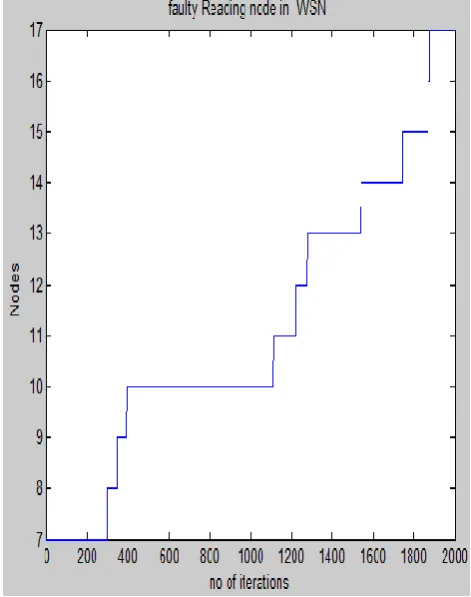
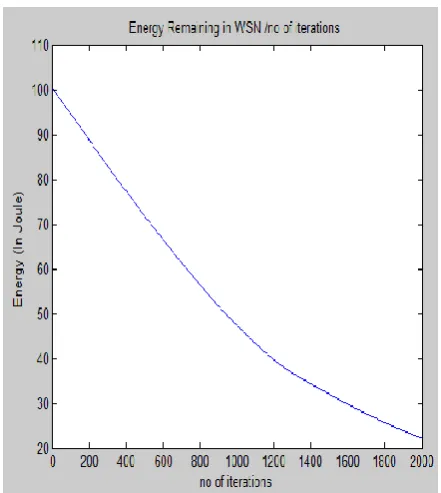
Fig 1 A) No of faulty reading nodes in WSN B) No ofcluster heads/no of iterations Figure 2 A) Energy remaining in WSN/Faulty Nodes B)
© 2015, IRJET.NET- All Rights Reserved
Page 2359
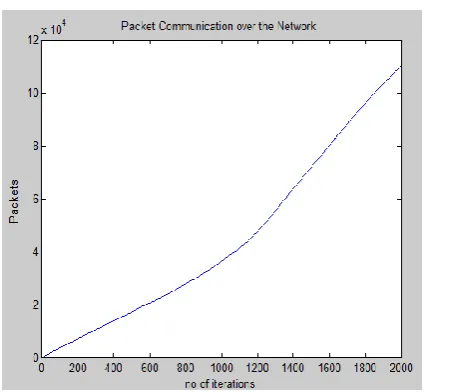
Figure 3 A) Packet comm. over the cluster head B) Packetcomm. over the network
VII. CONCLUSION
We proposed a new concept of dynamic topology in safety critical application of wireless sensor network adding concept of clustering based on distance from neighbouring nodes to the system model of trust voting algorithm to detect faulty nodes. So that no problem arise in safety critical systems but also saving energy by the use of clustering with Sensor Rank concept. The cluster head of each cluster detect Faulty nodes from cluster and send this information to the Base Station. We also implemented the proposed dynamic clustering algorithm in MATLAB with around huge number of iteration to completely analyse various factors.
VII FUTURE SCOPE
The proposed work can be simulated using fixed number of cluster heads and static topology for the same environment.A dedicated node can be there to which a default high energy can be given. The CH of each cluster hand over the data to this node and this node will perform all the calculation in place of CH. Further recovery mechanism for the CHs can also be provided in future. It can also be compared to other algorithms like major voting and weight voting algorithm under same simulation criteria.
REFERENCES
[1]Marcos August M. Vieira, Claudionor N. Coelho Jr., DigenesCecilio da Silva Junior, and Jose M. da Mata, “Survey on Wireless Sensor Network Devices”,in proceedings of the ETFA ’03 IEEE Conference on Emerging Technologies and Factory Automation, vol. 1, pp. 537 – 544, September 2003.
[2]Y. Zhang, “Observing the Unobservable -Distributed Online Outlier Detection in Wireless Sensor Networks”, PhD thesis, University of Twente, June 2010.
[3]S. Rajasegarar, J. C. Bezdek, C. Leckie, and M. Palaniswami, “Elliptical anomalies in wireless sensor networks,” ACM Trans. Sen. Netw., vol. 6, pp. 7:1– 7:28, January 2010.
[4]Y. Zhang, N. Meratnia, and P. Havinga, “Outlier detection techniques for wireless sensor networks: A survey,” IEEE Communications Surveys & Tutorials, vol. 12, no. 2, pp. 159–170, 2010.
[5]Peng Jiang, “A New Method for Node Fault Detection
in WSNs”, in proceedings of Sensors,ISSN 1424-8220, Vol. 9 Issue 2, pp. 1282, February 2009. [6]Chandola, V., Banerjee, A. and Kumar, V., “Outlier
detection: a survey”, Technical Report, University of Minnesota, 2007.
[7]Xiang Yan Xiao, Wen Chi Peng, Chih Chieh
Hung,Taiwan “using sensor rank for in network detection of faulty reading in wireless sensor networks, Elsevier conference on sciences, Beijing, Febuarary, 2014.
[8]Wendi Rabiner Heinzelman, AnanthaChandrakasan,
and HariBalakrishnan, “Energy-Efficient