© 2015, IRJET.NET- All Rights Reserved
Page 1402
The Application of Pattern Recognition Technology in the Diagnosis
and Analysis on the Multiclass Cancer Detection
1
Pratibha Sao,
2Praveen Chouksey,
3Rohit Miri
1
Mtech Scholar , CSE Department, Dr.C.V.Raman University, Chhattisgarh, India
2Assistant Professor, CSE Department, Dr.C.V.Raman university, Chhattisgarh, India
3HOD, CSE Department, Dr.C.V.Raman University, Chhattisgarh, India
---***---Abstract- Today biggest problem face person and main
factor are responsible like lack of research, monitoring
and control system. The growing relatively high
compatibility rates for different type survivor cancer, the surviving the disease have never been better. The a good number recent approximation of the 5to 10-yr family member continued existence rate cross all type of cancers and all infection stages is 65%. This figure soar to over 90% for some of the most common cancers if they are detect premature (e.g., prostate, breast, and colon). The high occurrence charge and good continued survival rates encompass resulted in over 9 million cancer survivors at present breathing in the combined state this information has spur a major do research effort into strategy to improve quality of life (QOL), lessen the danger of reappearance and other disease and make bigger continued continuation in this inhabitants. The reason of this document is to give an overview of the possible position of physical work out in this attempt. More specifically, I will make available a concise general idea of cancer treatment and their personal property on QOL, recapitulate the available research on exercise in
cancer survivors, present recently over and done with
experiment from the, and propose information for potential do research incidentally all the way through this term paper I use the expression cancer survivor as not compulsory by the local Coalition for Cancer Survivorship to pass on to any human being diagnose with cancer, from the time of innovation and for the sense of balance of being.
Key Words: surviving cancer. Pattern recognition,the
program Visualize. retinex algorithms, contrast
enhancement
1 INTRODUCTION
even though the view for current cancer is over and over again very good, it approximately always require medical involvement The nearly everyone common behavior modalities for cancer are surgical course of action emission treatment, and complete treatment (i.e., drugs). These health check intervention include standard continued existence
compensation, other than theImplications for QOL are not
inconsequential. Surgery is performing on the subject of
62% of cancer survivors [1]. Depending on the position and degree of the procedure, significant morbidity be talented of approach on the area under discussion of (e.g., scrape tricky situation contamination beating of function reduce succession of movement diarrhea, dispend, affection, be deficient in of awareness. in intemperance of 52% of disease survivors might experience energy treatment at some summit throughout the behavior procedure emission treatment is naturally deliver in frequent little dose fraction over a 5- to 8-wk stage to make the most of the homicide of growth cell and reduce the injure to standard cell on the other hand, toxicity to usual handkerchief does occur but is needy on the location with the purpose of is irradiated tenderness scorching concentrated flexibility, decrease series of movement, unsettled proclivity, exhaustion dry entrance, diarrhea, lung fibrosis, and cardiomyopathy[2]. Universal treatment (i.e., drugs) is agreed for various cancer the three most important type of universal rehabilitation be chemotherapy, endocrine or hormone treatment, and biologic otherwise immunotherapy. Chemotherapy is further over and over again than not manage intravenously or in words and is prearranged in frequent course or cycle 2–4 wk not together over a 3- to 6-month period. Chemotherapy may cause a range of unhelpful proceedings together with low energy anorexia, unsettled stomach anemia, neutropenia, thrombocytopenia, marginal neuropathies, ataxia, and cardio toxicity. Hormone treatment is more often than not administer vocally (incessantly or from time to time) for a lot of years and can have important side personal property such as influence increase power hammering proximal power Achilles' heel, fat gathering in the case and countenance osteoporosis, exhaustion, boiling flash, and greater than before vulnerabilityto infection last but not least, biologic therapy are the most up-to-date treatment and pressure the body’s have possession of protection mechanism to do something in opposition to malignant cell or potentiate the personal property of additional drugs. These treatment have a propensity to be enhanced tolerate but can at a standstill bring into being considerable surface personal property comparable to chemotherapy. all the time more, arrangement of the most important cancer behavior modalities (surgical procedure radiotherapy, and universal
treatment) are second-handto satisfaction cancer. The time
© 2015, IRJET.NET- All Rights Reserved
Page 1403
cancer survivors possibly willbe treat on manifold occasion
with several modalities for a lot of months at a time [2,3]. as a result, it is straightforward to make out that such long-drawn-out and serious health check treatment may take a profound toll on the objective, purposeful, affecting, spiritual, and communal interests of cancer survivors. Early detection of cancer through screening has been deter-mined to reduce mortality from cancers of the colon and rectum, breast, uterine cervix, and lung. Screening refers to testing in individuals who are asymptomatic for a particular disease (i.e., they have no symptoms that may indicate the presence of disease). In addition to detecting cancer early, screening for colorectal or cervical cancers can identify and result in the removal of abnormalities that may become precancerous and prevent potential progression to cancer.157 Following the recommendations for cancer screening from the American Cancer Society is an important complement to healthy behaviors that reduce the risk of developing and dying from cancer [4,5]. The American Cancer Society screening guidelines for the early detection of cancer are on page 37.
Improving access to and utilization of cancer screening is a key part of the Society’s efforts to help people stay well. The Society and many other public health advocates consider health care reform necessary because the 48.6 million individuals in the US who lack health insurance experience barriers to appropriate health care, including preventive services such as cancer screening. The Affordable Care Act (ACA), which became law in March 2010, empowers states to reshape and improve their health delivery systems to fit the needs of their citizens [6]. While many challenges will remain, health care reform legislation is a critical component for improving access to care. The American Cancer Society Cancer Action Network (ACS CAN), the Society’s nonprofit, nonpartisan advocacy affiliate, has worked diligently with multiple partners for comprehensive health reform legislation to improve access to timely, effective, and high-quality prevention, detection, and cancer treatment services.
2. RELATED WORK
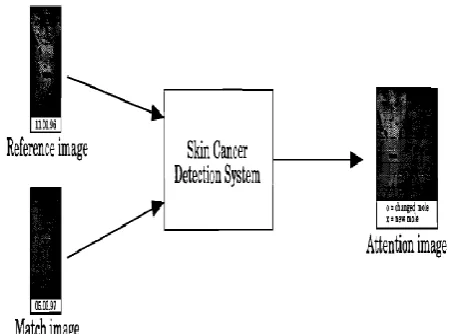
The skin cancer detection system: System compares the
two images and searches for changed and newly appeared moles. First it Figures out where the moles are in both images by a process called segmentation, which produces positional and feature (such area, perimeter, colour etc.) information for all the moles in both images. After this the images are registered or matched, such that moles that represent the same mole in the two images are labelled as the same mole[7]. Moles with the same label form a so-called mole pair. Moles that were not paired with another mole are new moles and are possible skin cancer candidates [8]. Finally the moles that do from a pair with another mole are compared on their features to see if they have changed over a period of time between the two photo sessions[9]. The
moles that have changed are also possible skin cancer candidates.
The attention image is a compilation of the input images in which the moles that are new or have changed are indicated by a certain marker [10].
Visualization
The final stage of the Skin Cancer detection system is visualizing which moles might have become cancerous so that the attending physician can subject them to a closer inspection[11]. The visualization process is performed by the program Visualize.
Figure 8: Skin Cancer Detection System
Comparison:
The moles, of the mole pairs found by the registration process, have to be compared to see if they have changed, i.e. might have become cancerous. This is done by the comparison process which is implemented by the Khoros program Compare[6,12]. This program recalls the features of the paired reference and match mole in the reference and match features file and checks if the features are different. If the features in the successive reference and match image have changed more than a certain threshold then the mole is labelled as "changed". The results are written to the Mole Difference File.
Features
© 2015, IRJET.NET- All Rights Reserved
Page 1404
among other things, the lighting conditions can vary fromimage to image. The approach taken here is to characterize the moles using features such as area, perimeter, colour variations etc. These features are then used to check if a mole has changed. Thus a feature that measures the irregularity of the mole border can be used to discern between a malignant and a benign mole [13]. These tailor-made features for the diagnosis of moles are also very useful when comparing moles for changes because if a mole changes from benign to malignant, it will certainly be one of these features that will change drastically [12].
Most diagnostic features can be summarized in the ABCD-rule which was introduced by Friedman et al. to improve the diagnostic accuracy when diagnosing moles. The mnemonic ABCD stands for features that describe early malignant melanoma:
- Asymmetry: One half of the mole does not match the other half;
- Border irregularity: The edges are ragged, notched and blurred;
- Colour: The pigmentation is uniform. Shades of tan, brown and black are present;
- Diameter: Bigger than 6 mm and growing.
The most basic features of a mole are its area and perimeter, using these features the compactness and irregularity index can be calculated[6]. The compactness of an object is defined as the ratio of area to perimeter and it measures if the object is strongly concentrated around a point or whether it has a more elongated structure. The irregularity of the mole border is measured by the irregularity index which is defined as the ratio of the area and the square of the perimeter[9]. Both features are defined in such a way that higher values, indicate a higher chance that the mole is malignant. In fractal dimensions are used to describe the irregularity of the mole border. Other features can be calculated if the centre of mass of the mole is known. Polar distances are distances from the centre of mass to the boundary of the mole. Especially, a high variance in the polar distances correlates with the existence of a melanoma. another feature is the ratio of the minimum to the maximum polar distance, called eccentricity[8]. The distance between the centre of mass and the centre of the minimum area surrounding rectangle of the mole, called "distance rectangle" can also serve as a very discriminating feature. The asymmetry of the mole, captured in a feature called the asymmetry index, is also used as a discriminative feature [2]. Some very important features are extracted from the colour components because the homogeneity or irregularity of the colors inside the mole is indicative of the malignity of that mole[4]. Malignant moles tend to have many different tones of colors, where as benign mole are very uniform in their coloring. This results in a high variance in the colour components of the pixels in a malignant mole [5]. Ercal use relative colour components to measure the colour of the mole relative to the colour of the surrounding skin to equalize variations caused by lighting, photography or the digitalization process.
Detecting Features: In the Skin Cancer detection system
the features of the moles in the reference and match images are calculated by the Khoros program Detect Features. It uses the mole positions in the Mole Pattern File to locate where the moles are in the images and then copies the mole into a smaller image to increase processing speed [4]. Using the marker information in the Mole Pattern File, the mole images are scaled such that the reference and match mole images have the same scale. Otherwise it is not possible to compare the features of the reference and the corresponding match mole. Meter this features are calculated [5]. This process of copying, scaling and feature calculation is done for every mole in the reference and match image. The features of the reference moles are written to the Reference Feature File and the match mole features are written to the Match Feature File [6].
3. OBJECTIVE
The Application of Pattern Recognition Technology in the Diagnosis and Analysis on the Multiclass Cancer Detection
4. PROPOSED APPROACH
The proposed colour and contrast enhancement scheme is simulated on standard color images of improved skin lesion segmentation such as peppers and also on few real time images. Low contrast images were subjected to the retinex based enhancement techniques i.e. MSRCR and SSR. It was observed experimentally that SSR scheme is able to enhance to a much better extent than MSR. The image results obtained using SSR contains much higher image details such as edges and color information are preserved even under noisy conditions. Since there is no standard objective criteria for comparing the results subjective results are presented below. The simulation work is based on MATLAB and it is therefore included the survey of research work where MATLAB based simulation is implemented.
By using of retinex theory we can improve the performance of our Skin cancer detection system[13]. When we acquire the image from any external source like digital camera, medical equipment, etc. Then some possibility occurs for image degradation which cause features cannot be calculated more preciously. To avoid this problem we adopt retinex theory which is based on lightness for improve the quality of image[14]. There are various retinex algorithms for image enhancement like single scale retinex, multi scale retinex, multi scale retinex with color restoration, etc[11].
© 2015, IRJET.NET- All Rights Reserved
Page 1405
more medical professional practice these strategies regularlyand routine, a reduction in this epidemic is certainly an achievable goal.
Fig 6.1 : proposed Approach
The work in the present thesis primarily focuses on retinex theory of skin lesion image enhancement. The work reported in this thesis is summarized and also presents dimension and colour contrast of the work. The last section provides some scope for further development.
5. RESULT
The performance of the newly technique is determined by
computing the minimum indication of deviation between the
white pixels situation on the last of the alternatives in the
ground truth figure and the white pixels from the perimeter
of the picture segmented by our method. To assess the fault
we designed the standard movement way, mean and RMS
fault evaluate the border replacement compare the ground
fact and the segmented skin images. The investigation
database is describe in Table 1 and it be a able to noticed
that correct performance outcome were obtained for the
primary five-malignant cells images (M1 to M5), while the
fault find out for M6 image are bigger. This is motivated by
the reality that the crossing point between the disease and
healthy skin is very uncertainty and thisready to complex to
suggestionaccurately the delineate of the skin cancer.
Fig.3 Ground truth for skin cancer m1 to m6
6. CONCLUSION
The goal of this research paper is to present a innovative
technique designed fordivisionof skin cancer malignancy
images by evaluate adaptively the color and consistency in order. The major originality of this move toward is the progress of an adopt spatially consistent color images clustering systemthat is build in the execution of a color reformation fragment technique. The resultant color-texture
techniques prove to manufacture correct segmentationof at
a low levelpromise skin cancer images that are clear by biggest color and surface non-by direction. This research paper is constant and we arrangement to explore customs of improvement correctness and to appraise the well performance of our technique when apply to biggest collections of skin cancer disease images.
7. FUTURE WORK
Future work is suitable for determining relative patterns of cancer disease and prediction of class label of new patients. This approach is also suitable for identifying relative patterns between attributes of some more diseases.
Input database Image
Restoration technique
used like MSR- CR
Skin Cancer Detection
System
© 2015, IRJET.NET- All Rights Reserved
Page 1406
8. APPLICATION
i. M
edical Health Care Improvement
ii. m
prove Efficiency in Health Care Services
iii. e
search improvement in image processing
iv. e
dical low cost and improve quality
v. o
vernment and private health management services growing
REFERENCES
[1] Maryvonne Miquel and Anne Tchounikine, “Software Components Integration in Medical Data Warehouses:a Proposal,” Proceedings of the 15 th IEEE Symposium on Computer-Based Medical Systems (CBMS 2002) 1063-7125/02 $17.00 © 2002 IEEE.
[2] Daniel Ramot, Menahem Friedman, Gideon Langholz, and Abraham Kandel, “Complex Fuzzy Logic,” 1063-6706/03$17.00 © 2003 IEEE.
[3] pasiluukka and tapiolepp¨alampi, “Similarity Classifier with generalized mean applied to medical data using
different preprocessing methods” ,
0-7803-9158-6/05/$20.00 © 2005 IEEE.
[4] mykolapechenizkiy, Alexey Tsymbal and seppopuuronen, “Local Dimensionality Reduction within Natural Clusters for Medical Data Analysis,” Proceedings of the 18th IEEE Symposium on Computer-Based Medical Systems (CBMS’05) 1063-7125/05 $20.00 © 2005 IEEE.
[5] Shoji Hirano and shusakutsumoto, “Strucutural Comparison and Cluster Analysis of Time-Series Medical Data”.
[6] S. Cavuto and E.Grossi, “The fuzzy nature of health and disease,” 1 -4244-0363-4/06/$20.00 ©2006 IEEE.
[7] Nikhil R. Pal, “A fuzzy rule based approach to identify biomarkers for diagnostic classification of cancers,” 1-4244-1210-2/07/$25.00 C 2007 IEEE.
[8] Mila Kwiatkowska, M. Stella Atkins, Najib T. Ayas, and C. Frank Ryan, “Knowledge-Based Data Analysis: First Step Toward the Creation of Clinical Prediction Rules Using a New
Typicality Measure,” IEEE TRANSACTIONS ON
INFORMATION TECHNOLOGY IN BIOMEDICINE, VOL. 11, NO. 6, NOVEMBER 2007.
[9] Sang C. Suh, Sam. Saffer and Naveen Kumar Adla, “Extraction Of Meaningful Rules In A Medical Database,” 2008 Seventh International Conference on Machine Learning and Applications.
[10] Umair Abdullah, Jamil Ahmad and Aftab Ahmed, “Analysis of Effectiveness of Apriori Algorithm inmedical Billing Data Mining,” 2008 International Conference on Emerging Technologies IEEE-ICET 2008 Rawalpindi, Pakistan, 18-19 October, 2008.
[11] Weidong Mao and Jinghe Mao, “The Application of Apriori-Gen Algorithm in the Association Study in Type 2 Diabetes,” 978-1-4244-2902-8/09/$25.00 ©2009 IEEE.
[12] PING-HUNG TANG AND MING-HSENG TSENG ,
“MEDICAL DATA MINING USING BGA AND RGA FOR
WEIGHTING OF FEATURES IN FUZZY K-NN
CLASSIFICATION,” Proceedings of the Eighth International Conference on Machine Learning and Cybernetics, Baoding, 12-15 July 2009.
[13] thannobaribarg, siripornsupratid and
chidchanoklursinsap, “Contemporary Classification on Medical Data based on Non-Linear Feature Extraction,” 2009 International Conference on Computational Science and Its Applications.
[14] alaqabaja, Mohammed Alshalalfa, redaalhajjand Jon okne, “Multiagent Approach for Identifying Cancer Biomarkers,” 2009 IEEE International Conference on Bioinformatics and Biomedicine.