R E S E A R C H
Open Access
Continuous transmit in cognitive radio
systems: outage performance of selection
decode-and-forward relay networks over
Nakagami-
m
fading channels
Mohammed Ridouani
1*, Aawatif Hayar
2and Abdelkrim Haqiq
3Abstract
Cognitive radio is a promising technology that uses radio spectrum opportunistically and efficiently. In this paper, we present the performance of ‘Always transmit’ strategy, which consists of allowing the cognitive source to transmit over all time slots and in any time slot. Thus, the cognitive source will be able to operate continuously whenever either the primary user is active or absent. The proposed strategy is projected into dual-hop communication systems with decode-and-forward and relay selection over independent but not necessarily identically distributed
Nakagami-mfading channels. We derive the closed-form expressions of the outage probability, and we analyze the performance. Simulation results show that the strategy ‘Always transmit+Relay’ outperforms other conventional cognitive radio strategies and the use of relays enhances the performance in deep fading channel.
Keywords: Continuous transmit in cognitive radio; Decode-and-forward relay; Spectrum sensing; Interference constraints; Interweave approach; Underlay approach; Nakagami-mfading; Outage probability
1 Introduction
Recently, significant attention has been given to cogni-tive radio as a new technology that uses radio spectrum opportunistically and efficiently and which allows new applications to share currently allocated spectrum while the quality of service (QoS) at primary side is guaranteed. There are three approaches of cognitive radio used to access licensed or unlicensed band [1]: spectrum inter-weave, spectrum underlay, and spectrum overlay.
a- Spectrum interweave (interference avoiding):the sec-ondary user (SU) uses the first part of time slot(iT)(first phase) for ‘spectrum sensing’ to detect spectrum hole (spectrum not currently used by primary user) and make a secondary user decisionHs(i)at time slot(iT), and begin-ning transmission in the second phase, only if the result of sensing in the first phase isHs(i) =H0(hole is detected,
i.e., primary user is absent). In this approach, the SU does not interfere with primary user.
*Correspondence: [email protected]
1Computer Sciences Department, GREENTIC/UH2C/EST, Casablanca, Morocco Full list of author information is available at the end of the article
b- Spectrum underlay (interference controlling):the SU can transmit simultaneously with primary user over the same spectrum and through all time slots (iT) only if the interference generated by secondary transmitter (cog-nitive transmitter) at primary receiver is tolerable and controlled by an acceptable level, i.e., below a threshold or an outage probability limit that guarantees certain QoS for primary user’s communication.
c- Spectrum overlay (interference mitigating): the SU (cognitive transmitter) can transmit simultaneously with primary user over the same spectrum. In this approach, cognitive transmitter can transmit with any power, part of its power and time slot(iT)used for relaying primary user’s transmission, and the remainder of its power and time slot(iT)for own transmission.
Also, cooperative communications with amplify-and-forward (AF) or with decode-and-amplify-and-forward (DF) strategy have gained a great interest in the academic research circles. This is due to benefits over a fading chan-nel, like combating fading and shadowing, and increas-ing the system capacity. In [2], the authors shown that the best relay selection scheme can achieve the same
diversity-multiplexing tradeoff performance as the tradi-tional protocols. As researches go deep and broad, some works introduce cooperative communication techniques into cognitive radio, to enhance the secondary user’s data transmission and the reliability of primary user’s detection.
One of the QoS parameters for secondary system is the continuity of service. Continuous transmission for sec-ondary users is weakly addressed. Indeed, in [3,4], the SU transmits through underlay method either by controlling interference level [3,4] or outage probability limit. Nev-ertheless, underlay method underutilizes the spectrum, and SU does not transmit with high power even when primary user is absent. In [5,6], the SU transmits with the interweave method in the second phase only if the result of sensing in the first phase isHs(i) = H0. In [7],
mixed strategies introduced for cognitive transmission in the second phase based on the sensing results in the first phase. Many studies in the literature on such mixed strate-gies have been conducted [8-13], in their scenarios, the secondary user transmits through interweave method in the second phase if the result of sensing in the first phase isHs(i) = H0or transmits with underlay method in the
second phase if the result of sensing in the first phase isHs(i) = H1(hole is not detected, i.e., primary user is
active). However, none of these papers have considered the transmission in two phases, SU does not transmit over all time slots, it transmits only in the second phase, which decreases the spectrum efficiency as some part of the time slot is used for sensing instead of data transmission.
In most of the above presented strategies, sensing is a key functionality that affects the spectral efficiency of SU due to the time dedicated to sensing. However, two differ-ent architectures could be adopted to operate spectrum sensing and communication by using single radio or dual radio [14,15]. Nevertheless, in the single radio architec-ture, no communication is allowed during sensing phase. Our work aims at exploiting sensing phase for transmis-sion also optimizes the SU spectrum efficiency and thus adopts double radios architecture. To be able to do so without creating harmful interference to the primary user, we propose an underlay scheme with limited interference threshold.
In our previous works [16], where we have intro-duced our new strategy of transmission ‘Always Transmit (AT): to enhance the cognitive sources of data transmis-sion and to provide continuous transmit solution by using mixed strategies in cognitive radio context, which it per-formed via the combination of the underlay and inter-weave approaches depending on the activity of the primary system’ and have shown that it outperforms other conven-tional cognitive radio strategies for power transmission and interference management, in [17], where we have derived the closed form and analyzed the performance of
outage probability over Rayleigh fading, and in [18], where we have studied the trade-off between spectrum sensing duration and the QoS at cognitive network while guaran-teeing certain QoS at primary network controlled by the outage probability limit, over independent but not nec-essarily identically distributed Nakagami-mchannels. In (M Ridouani, A Hayar, A Haqiq, Continuous-transmit in cognitive radio systems: perform sensing and transmis-sion in parallel anytime. submitted to IEEE TWC ), we have shown that the use of (average transmitPav,
instanta-neous interferenceI) as power constraint is recommended for transmission, because it allows preserving the QoS of primary system at each time while guaranteing an out-age performance limit for the secondary of about 20% of maximum degradation, and due to fading and by using average transmit power constraint, the energy efficiency is improved.
Motivated by cooperative communications and our results in [17,18], in this paper, we extend our strategy ‘AT’ (the cognitive source (CS) will be able to transmit over all time slots and in any time slot, then, it will be able to operate continuously whenever either the primary user is active or absent) into cognitive relay selection. We derive the closed form of outage probability of relay selec-tion in dual-hop transmission over independent but not necessarily identically distributed (i.n.i.d.) Nakagami-m channels, with integer values of fading severity parameter m.
Our main contributions are summarized as follows: 1) The continuity of service: we propose a scenario that enhances secondary user QoS in terms of outage proba-bility by allowing it to transmit overall time slots and in any time slots. Therefore, the secondary can continue its transmission whether the primary user is active or absent. 2) We derive the closed-form expressions of the sec-ondary user outage probability for transmission scenario over both phases and over independent but not necessar-ily identically distributed Nakagami-m fading channels. And we analyze for this considered scenario the impact of spectrum sensing duration and spectrum hole detection, the transmit and the interference power constraints, and the number of relays and fading on the secondary outage probability (QoS).
3) We show that the proposed strategy ‘Always trans-mit + Relay’ outperforms other conventional cognitive radio strategies.
2 System model
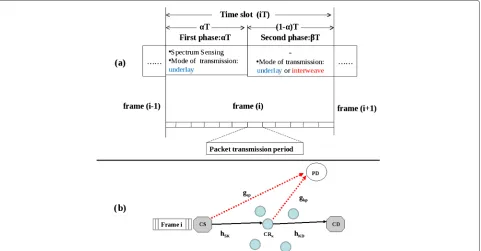
In this section, we describe the cognitive relay network of our scenario. As shown in Figure 1b, the primary destina-tion (PD) coexists with the cognitive nodes (CS, cognitive destination (CD), and N potential cognitive relay (CRk) k = 1, ..,N). Each cognitive node has a dual-radio archi-tecture, one radio chain is dedicated for spectrum sensing (see Section 2.1) while the other radio chain operates on a half-duplex mode, and it is dedicated for data transmis-sion and reception.
Notice here that, if we look only at the second radio chain, we can see that it operates on a half-duplex mode. If we look at the cognitive node (which consists of a two radio chains), one radio is dedicated for spectrum sens-ing (reception), the second chain for communication (for example, transmitting data: transmission), we can see that it operates, globally, on a full-duplex mode.
In this model, we consider a half-duplex mode and a dual-hop communication system with regenerative mode for data transmitting. Also, it is assumed that there is no direct transmission between CS and CD. So the data transmission from CS to CD is subdivided into two steps. In step one, the CS transmits its data (one packet) to (CRk) which is selected prior to a new transmission. In step two, the CRk decodes the received data and then re-encodes and forwards it to a CD.
Also, we consider that the transmission of CS and CRk process can move into two phases through a time slot(iT) as shown in Figure 1a. In the first phase (αT), the CS
(resp. CRk) transmits through underlay approach, in the meantime, each cognitive node senses the spectrum hole existence (activity of primary source (PS)). In the second phase((1−α)T), the CS (resp. CRk) transmits through interweave or underlay approach whether or not a hole is detected in the first phase, respectively.
The data (framei) structure of the proposed system is shown in Figure 1a. The time duration of the transmission of each frame is T. Each frame consists of many packet transmission periods, and we assume that each packet transmission period is very small subject to the time slot T, which we allow to suppose that each packet transmit-ted from CS to the best cognitive relay CRkand from CRk to the CD is via the same transmission mode (underlay or interweave), and the best cognitive relay CRkis selected to transmit all packets of a frameiduring the time slotiT.
We assume that the channel changes slowly, so the chan-nel remains constant during a one time slot. Also, we assume that the channels between any of the two nodes are independent but not necessarily identically distributed (i.n.i.d.) Nakagami-mchannels, with integer values of fad-ing severity parameterm, so that the probability distri-bution function (PDF) of the channel gains (|gsp|2,|hSK|2, |gkp|2, and|hKD|2) is statistically characterized by the Nak-agami distribution [19], wheregsp,hSK,gkp, andhKDare the fading coefficients of the channel from CS to PD, from CS to CRk, from CRkto PD, and from CRkto CD, respec-tively, as shown in Figure 1. LetXk = |hSK|2,Yk = |hKD|2, Z0= |gsp|2, andZk= |gkp|2.
Note thatXk,Yk, andZk(k=0, 1, ..,N)follow the prob-ability distribution pk(x), pk(y), and pk(z), respectively, and are independent of each other. Thus, the channel gain,
γ (γ =Xk,Yk,Zk), is distributed according to a gamma distribution given by (1) with different fading parameters
γxk,γyk,γzkand fading severity parametersmxk,myk,mzk:
pγ(γ )=
m
γ
mγm−1
(m)exp
−mγ γ
,γ ≥0,m≥1/2
(1)
where γ is the average channel gain (γ = E[γ]), mis the Nakagami fading severity parameter, and (.) is the gamma function [20].
The Nakagami fading model has proven useful for mod-eling multipath faded envelope in wireless channels and is widely accepted as best fit to model multipath prop-agation from severe to light fading. Indeed, it is known to accurately characterize a range of multipath and to model different fading conditions ranging from Rayleigh to strong Rician channels. As the fading parameter m tends to infinity, the Nakagami multipath fading channel converges to an AWGN channel.
For notation convenience, we use the notations as follows:
k : the k -th cognitive node (k=0refer to CS and k=1,. . .,Nrefer toCRk).
PSKandPKDare the transmit power of CS andCRk, respectively.
Hp(i): denote whether or not the licensed band is occupied by PS in the first phase of time slotiT. H0: the band is unoccupied by PS (andH1:
otherwise).
CS andCRkwill make a decisionHs(i)to transmit through interweave or underlay method in the second phase
Hs(i)=H0: considers the band is available, then, CS
andCRktransmit through interweave method Hs(i)=H1: considers the band is unavailable, then,
CS andCRktransmit through underlay method. Pa=Pr(Hp(i)=H0): the probability that there is a
hole (andPr(Hp(i)=H1)=1−Paotherwise). Pkf =Pr(Hs(i)=H1/Hp(i)=H0): the probability
that thek -th cognitive node has a false alarm. Pkd=Pr(Hs(i)=H1/Hp(i)=H1): the probability
that thek -th cognitive node detects the PS presence. ε: represent the fraction of a time slot utilized for data transmission in the first phase(ε=α)and second phase(ε=β=1−α)
Pα: the probability to be in the first phase.
Pβ =1−Pα: the probability to be in the second phase.
2.1 Spectrum sensing
Cooperative spectrum sensing can improve the perfor-mance of spectrum sensing by combating fading and shadowing and decreasing the detection time required. In this technique, each ofN +1 cognitive nodes (CS or CRk) contributes to sense spectrum holes. To protect pri-mary’s communication when PS is active (Hp(i)=H1), we
use the OR rule [21] (spectrum is not available (Hs(i) = H1) if any ofN +1 cognitive nodes sense the presence
of PS) which minimizes the probability of interfering at PD.
Each cognitive node periodically senses the channel like in [5,6,22]. We assume that it first estimates the noise floor and distinguishes the rest of the information bearing sam-ples for wireless signals [23]. After, it identifies the CS’s signal (the signal transmitted through underlay approach in the first phase (αT)) [23]. And finally, if it detects a col-lision (i.e., the CS’s signal is combined with other signal), then, it decides that the PS is active (a hole is not detected), else, it decides that PS is absent (a hole is detected).
We assume that theN+1 cognitive nodes use the same spectrum sensing detector and sense the spectrum hole existence through the same duration (αT), then, the coop-erative probabilities of detectionPdand false alarmPf are as follows:
Pd=1− N
k=0
1−Pkd
(2)
Pf =1− N
k=0
1−Pkf
(3)
2.2 Optimal power allocation
In the underlay approach, the CS’s (resp. CRk) transmis-sion power is constrained asPSKZ0≤I(resp.PKDZk≤I), whereIis the interference threshold that the interference generates by CS (resp. CRk) on the PD remains below it, and is constrained asPSK≤P(resp.PKD≤P) , wherePis the maximum transmission power.
In the interweave approach, there is just the maxi-mum transmission power constraint, then,PSK ≤ Pand PKD≤P.
For each time slotiT, in the first phase (first fraction of timeαT), the CS’s (resp. CRk) transmits through underlay approach, then, it transmits with a low powerPkUS(resp. PkUR). During the second phase ((1−α)T), the CS’s (resp. CRk) transmits through underlay approach with a low powerPkUS(resp.PURk ) or switch to interweave approach with a high power PkIS (resp. PkIR) based on the sensing result.
Subject to PSK ≤ P (resp.PKD ≤ P) andPSKZ0 ≤ I
andPkUS(resp.PkUR) used by CS (resp. CRk) in interweave and underlay respectively are as follow:
PkIS =PkIR=P (4)
According to the activity of PS and the sensing result, the synthesis of our scenario of transmission and the opti-mal power allocation in both phases are listed in Table 1.
3 Outage analysis of cognitive relay selection 3.1 Cognitive relay selection
If we select thek-th cognitive relay CRkfor data transmis-sion in dual-hop, the instantaneous capacity in underlay approach CkU (resp. interweave approach CIk) between cognitive source and cognitive destination is given by [24]:
CUk =min
In (7) and (8), we have assumed that any interference from the primary source is neglected (this can be possible if the primary transmitter is located far away from the sec-ondary users, or the interference is represented by the noise term under an assumption that the primary trans-mitter’s signal is generated by random Gaussian code-books [4]). The coefficientε(resp.β ) is due to the fact that onlyε(resp.β) fraction of a time slot is utilized for the CS’s and CRk’s data transmission phase. AndN0is the
noise variance. short-hand notation is as follow:
WkU =min
For the best relay selection scheme, and by using the max-min criterion [4,25] which maximizes the minimum of signal-to-noise ratios (SNRs) of the source-relay link and relay-destination link, we select the relay for which WkU(resp.WkI) is maximal in underlay (resp. interweave) approach.
then, consequently, we obtain for the instantaneous capacity in underlay approach CU (resp. interweave approachCI)
Given a predetermined transmission rate of the source CT, the outage probability mathematically defined as Pout=Pr(C<CT), whereCis the capacity of channel.
The outage probability in underlay approachPoutU,ε(resp. interweave approachPIout) is given:
PUout,ε=PrCU <CT
Table 1 The synthesis of the transmission scenario and the optimal power allocation in both phases
Phase and PS’s activity Sensing results Mode of Related probability CS’s CRk’s
fraction time transmission power power
Substituting (15) in (17) and (16) in (18), we obtain:
Hence, by using (11) and (12), we get:
PUout,ε=
Using Appendix (Equations 32 and 39) and replacingAby Uε
Replace Aby UPβ in Appendix (Equation 33), the closed form of (22) yields:
PIout=
Finally, the outage probability of our system is:
Pout=PαPfirst-phaseout +(1−Pα)P
which can also be written as:
Psecond-phaseout = Pa(1−Pf)+(1−Pa)(1−Pd)
Then, the closed form of outage probability of our strat-egy (Always transmit + Relay) is derived in (28):
Pout−AT−R=Pα
If CS and CRktransmit just through interweave approach, (28) can reduced to (29):
Pout−IN−R=Pα+(1−Pα)
If CS and CRk transmit just through underlay approach, (28) can reduced to (30):
If there is no rely (k=0), CS transmits data directly to PD without help of relays, (28) can reduced to (31):
Pout−AT−NR=Pα
1−
mx1,γx1,mz0,γz0,I
P, Uα
P
+(1−Pα)Pa
1−P1f+(1−Pa)
1−P1d
×
⎛ ⎝1−
mx1,mγxx11UβP
(mx1) ⎞ ⎠
+PaP1f+(1−Pa)P1d
×
1−
mx1,γx1,mz0,γz0, I
P, Uβ
P
(31)
4 Numerical results
Computer simulations were carried out in order to vali-date the performance of the proposed scenario (‘Always transmit + Relay’) based on the outage probability. We analyze the impact of the fraction α of time slot used for spectrum sensing and other parameters (number of relayN, fading severity parameters (mxk,myk,mzk,mz0),
the transmit (resp. interference) power constraintP(resp. I)) over data transmission. Throughout simulations, we have assumed a perfect spectrum hole detection, thus, Pfk =0.1(k=1,. . .,N)to use the cognitive channel with a higher chance with the interweave method, andPkd = 0.9(k = 1, ..,N)to protect the primary source transmis-sion. We consider thatPαfollows a uniform distribution, then,Pα =αandPβ =1−α. Also, in all simulations, we fix:γxk =γyk =γzk = γz0= 1 dB(k =1, ..,N),N0 =1,
Pa=0.8,CT =0.5, and we varyα,m,N,I, andP.
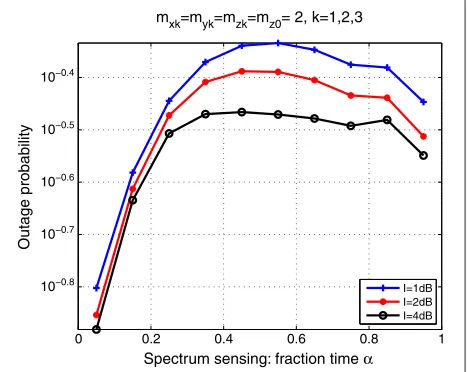
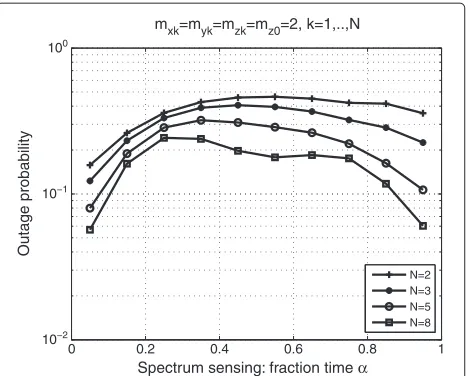
From the figures (Figures 2, 3, 4, 5, and 6), it has been observed that outage performances are degraded whenα increases; in contrast, we see a higher reduction of out-age probability, thus improving the system performance, when α is near 0. Indeed, when α is near 0, which is referred to as perfect sensing, the CS and CRk transmit with underlay method just in short timeαT in the first phase and can have more chance to transmit with the interweave method in a large amount of time(1−α)T in the second phase. But whenαincreases, the CS and CRk transmit in large time with the underlay method, and thus, the system is more probable to have an outage.
These figures also show that the outage probabil-ity decreases (which is the indication of performance improvement) asP,I, orNincrease. Indeed, a) if the trans-mit powerPat (CS and CRk) increases, then, the SNRs increase which denote the increase of their capacity and finally the decrease of their outage probability, b) when the interference thresholdIis increasing, the constraints are relaxed at the cognitive system side, so the system per-formance increases asIincreases, c) more relays in fading
0 0.2 0.4 0.6 0.8 1 10−0.8
10−0.7 10−0.6 10−0.5 10−0.4 10−0.3 10−0.2 10−0.1
Spectrum sensing: fraction time α
Outage probability
mxk=myk=mzk=mz0= 2, k=1,2,3
P=1dB P=5dB P=10dB
Figure 2Outage probability versus spectrum sensing overheadαfor different values of the transmission powerPat (CS and CRk).
channel network can combat fading and consequently, enhance the performance.
From Figure 5, we show that the outage probabil-ity decreases as probabilprobabil-ity of false alarmPf decreases. Indeed, whenPf is small, which means that the system of detection is more reliable, which thus leads the CS to transmit with interweave method instead of underlay method when primary system is absent. Also, while look-ing at Figure 5, we can observe that the outage probability of secondary system converges to the same point when
α go to 1, under a different value ofPf andPd. In fact, whenαgo to 1, the CS expires the whole of the time slot (iT) for sensing and transmits through the whole of the time slot (iT) via underlay mode in the first phase and can
0 0.2 0.4 0.6 0.8 1 10−0.8
10−0.7 10−0.6 10−0.5 10−0.4
Spectrum sensing: fraction time α
Outage probability
mxk=myk=mzk=mz0= 2, k=1,2,3
I=1dB I=2dB I=4dB
0 0.2 0.4 0.6 0.8 1 10−2
10−1 100
Spectrum sensing: fraction time α
Outage probability
mxk=myk=mzk=mz0=2, k=1,..,N
N=2 N=3 N=5 N=8
Figure 4Outage probability versus spectrum sensing overheadαfor different values of the number of relayN.
have no time in the second phase for transmitting through interweave mode whatever the probability value of detec-tionPdand/or of a false alarmPf, and even if primary user is not detected or there is no false alarm.
From Figure 6, we can see the advantage of the use relays in deep fading channel. In contrast, in poor fading channel, the use relays decrease the performance.
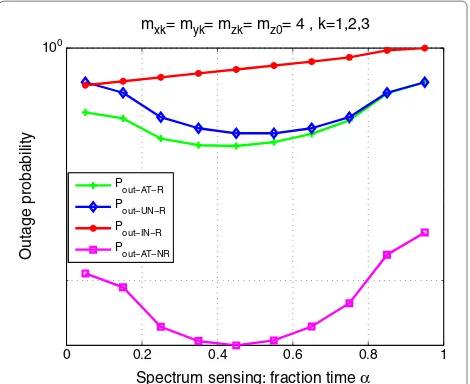
An interesting result found from Figure 7 (resp. Figure 8) is that our strategy (Always transmit + Relay) outperforms other conventional cognitive radio strategies like interweave or underlay approach in deep (resp. poor) fading channel.
0 0.2 0.4 0.6 0.8 1 10−0.9
10−0.8 10−0.7 10−0.6 10−0.5 10−0.4 10−0.3
Spectrum sensing: fraction time α
Outage probability
mxk=myk=mzk=mz0=2 , k=1,2,3
Pfk=0.1, Pdk=0.1
Pfk=0.1, Pdk=rand
Pfk=rand, Pdk=0.1
Pfk=rand, Pdk=rand
Figure 5Outage probability versus spectrum sensing overheadαfor a fixed/random values of the probabilities of false alarm and of detection.
0 0.2 0.4 0.6 0.8 1 10−0.9
10−0.7 10−0.5 10−0.3 10−0.1
Spectrum sensing: fraction time α
Outage probability
mxk, myk, mzk, mz0 ∈ {1,2,3,4} , k=1,2,3
mx= my= mz= [1 1 1], mz0= 1
mx= my= mz= [2 2 2], mz0= 2 mx=[1 2 2], my=[2 2 1],mz=[2 1 2], mz0= 2
mx= my= mz= [3 3 3], mz0= 3 mx= my= mz= [4 4 4], mz0= 4
poor fading
deep fading
Figure 6Outage probability versus spectrum sensing overheadαfor different values of the fading severity parameters (mxk,myk,mzk,mz0,
k=1,2,3).
Also, Figure 7 (resp. Figure 8) presents the comparison of the outage probability between our strategies (Always transmit + Relay) and (Always transmit + No-Relay) in deep (resp. poor) fading channel. As we have shown in [16] that the strategy ‘AT’ enhances the performance, the per-formance of a cognitive system can be more improved by using relays in deep fading channel, and it recommended not to use the relays in poor fading channel.
5 Conclusion
We have presented ‘Always transmit + Relay’ strategy for dual-hop transmission with decode-and-forward and
0 0.2 0.4 0.6 0.8 1
10−0.6 10−0.5 10−0.4 10−0.3 10−0.2 10−0.1 100 100.1
Spectrum sensing: fraction time α
Outage probability
mxk= myk= mzk= mz0= 2 , k=1,2,3
Pout−AT−R
Pout−UN−R P
out−IN−R
Pout−AT−NR
0 0.2 0.4 0.6 0.8 1 100
Spectrum sensing: fraction time α
Outage probability
Figure 8The outage probability of different strategies of transmission under a poor fading and a random average channel gain.
relay selection. The closed-form expressions of the out-age probability have been derived over independent but not identically distributed Nakagami-m fading channels on all nodes. Simulation results have shown that the per-formance increases as either the transmit power P, the interference power constraintI, and the number of relays N increases and when spectrum sensing duration α is small (near to 0). Finally, we have shown that the strategy ‘Always transmit + Relay’ outperforms other conventional cognitive radio strategies and the use of relays enhances the performance in deep fading channel. A future work is dedicated to explore some new ideas on how to per-form sensing and detecting the presence or the absence of the primary system while transmitting with underlay approach.
Appendix
Let Xk, Yk, and Zk(k = 0, 1, ..,N) follow the probabil-ity distributionpk(x),pk(y), and pk(z), respectively, and are independent random variables distributed according to gamma distribution given by the Equation (1) with dif-ferent fading parametersγxk,γyk,γzk and fading severity parametersmxk,myk,mzk:
, the cumulative distribution function oftk
Ftk(A)=Pr(tk <A)=Pr
Assumingmxis integer anda≥0. And using the fact that
Competing interests
The authors declare that they have no competing interests.
Author details
1Computer Sciences Department, GREENTIC/UH2C/EST, Casablanca, Morocco. 2Computer Sciences Department, GREENTIC/UH2C/ENSEM, Casablanca,
Morocco.3Department of Mathematics and Computer, GREENTIC/UH1/FST,
Settat, Morocco.
Received: 27 October 2014 Accepted: 21 March 2015
References
1. A Goldsmith, SA Jafar, I Maric, S Srinivasa, Breaking spectrum gridlock with cognitive radios: an information theoretic perspective. Proc. IEEE.
97(5), 894–914 (2009)
2. A Bletsas, H Shin, MZ Win, A Lippman, A simple cooperative diversity method based on network path selection. IEEE J. Sel. Areas Commun.
24(3), 659–672 (2006)
3. L Le, E Hossain, Resource allocation for spectrum underlay in cognitive radio networks. IEEE Trans. Wireless Commun.7(12), 5306–5315 (2008) 4. J Lee, H Wang, JG Andrews, Outage probability of cognitive relay
networks with interference constraints. IEEE Trans. Wireless Commun.
10(2), 390–395 (2011)
5. Y-C Liang, Y Zeng, E Peh, AT Hoang, Sensing-throughput tradeoff for cognitive radio networks. IEEE Trans. Wireless Commun.7(4), 1326–1337 (2008)
6. Y Zou, J Zhu, B Zheng, Y-D Yao, An adaptive cooperation diversity scheme with best-relay selection in cognitive radio networks. IEEE Trans. Signal Process.58(10), 5438–5445 (2010)
7. X Kang, YC Liang, HK Garg, L Zhang, Sensing-based spectrum sharing in cognitive radio networks. IEEE Trans. Vehicular Tech.58(8), 4649–4654 (2009)
8. J Oh, W Choi, inVehicular Technology Conference Fall (VTC 2010-Fall) 2010 IEEE 72nd. A hybrid cognitive radio system: a combination of underlay and overlay approaches, (2010), pp. 1–5
9. X Bao, P Martins, T Song, L Shen, Capacity of hybrid cognitive network with outage constraints. IET Commun.5(18), 2712–2720 (2011) 10. Y Zhang, PC Ching, Q Zhang, in2013 IEEE International Conference on
Acoustics, Speech and Signal Processing (ICASSP). Hybrid spectrum sharing with imperfect sensing in fading channels, (2013), pp. 5318–5322 11. X Tan, H Zhang, J Hu, Capacity maximisation of the secondary link in
cognitive radio networks with hybrid spectrum access strategy. IET Commun.8(5), 1751–8628 (2014)
12. M Usman, Koo, Insoo “Access Strategy for Hybrid Underlay-Overlay Cognitive Radios With Energy Harvesting,”. Sensors Journal, IEEE.
14(9), 3164–3173 (Sept. 2014)
13. J Zou, H Xiong, D Wang, CW Chen, Optimal power allocation for hybrid overlay/underlay spectrum sharing in multiband cognitive radio networks. IEEE Trans. Vehicular Technol.62(4), 1827–1837 (May 2013) 14. G Vardoulias, J Faroughi-Esfahani, G Clemo, R Haines, inProc. Int. Conf. 3G
Mobile Communication Technologies. Second International Conference on (Conf. Publ. No. 477). Blind radio access technology discovery and monitoring for software defined radio communication systems: problems and techniques (UK London, 2001), pp. 306–310
15. S Shankar, C Cordeiro, K Challapali, inNew Frontiers in Dynamic Spectrum Access Networks. DySPAN 2005. First IEEE International Symposium on. Spectrum agile radios: utilization and sensing architectures (Baltimore, Maryland, USA, 2005), pp. 160–169
16. M Ridouani, A Hayar, in20th International Conference on
Telecommunications. General scheme for always transmit solution in cognitive radio systems (Casablanca, Morocco, 2013), pp. 1–5 17. M Ridouani, A Hayar, inNext Generation Networks and Services (NGNS).
Outage probability based unified framework for always transmit solution in cognitive radio systems (Algarve, Portugal, 2012), pp. 59–65 18. M Ridouani, A Hayar, A Haqiq, in1st International Workshop on Cognitive
Cellular Systems (CCS). QoS of cognitive and primary networks and spectrum sensing tradeoff using always transmit strategy over Nakagami-m fading channels (Rhine River, Germany, 2014), pp. 1–5
19. M Nakagami, inStatistical Methods in Radio Wave Propagation. The m-distribution - a general formula of intensity distribution of rapid fading (England Pergamon Press, Oxford, 1960), pp. 3–36
20. IS Gradshteyn, IM Ryzhik,Table of Integrals, Series, Products, 4th ed. (Academic Press, San Diego, California, 2000)
21. E Peh, Y-C Liang, inWireless Communications and Networking Conference. WCNC 2007. Optimization for cooperative sensing in cognitive radio networks (Hong Kong, 2007), pp. 27–32
22. A Mariani, S Kandeepan, A Giorgetti, A, Periodic Spectrum Sensing With Non-Continuous Primary User Transmissions. Wireless Commun. IEEE Trans.14(3), 1636–1649 (2015)
23. A Gorcin, H Arslan, Signal identification for adaptive spectrum hyperspace access in wireless communications systems. IEEE Communications Magazine.52(10), 134–145 (Oct. 2014)
24. JN Laneman, DNC Tse, GW Wornell, Cooperative diversity in wireless networks: efficient protocols and outage behavior. IEEE Trans. Inform. Theory.50(12), 3062–3080 (2004)
25. A Muller, J Speidel, inIEEE International Conference on Communications ICC ’08. Relay selection in dual-hop transmission systems: selection strategies and performance results, (2008), pp. 4998–5003
Submit your manuscript to a
journal and benefi t from:
7Convenient online submission
7Rigorous peer review
7Immediate publication on acceptance
7Open access: articles freely available online
7High visibility within the fi eld
7Retaining the copyright to your article