Scholarship@Western
Scholarship@Western
Electronic Thesis and Dissertation Repository
9-16-2011 12:00 AM
Improving Search Engine Results by Query Extension and
Improving Search Engine Results by Query Extension and
Categorization
Categorization
Guo Mei
University of Western Ontario
Supervisor
Dr. Roberto Solis-Oba
The University of Western Ontario Graduate Program in Computer Science
A thesis submitted in partial fulfillment of the requirements for the degree in Doctor of Philosophy
© Guo Mei 2011
Follow this and additional works at: https://ir.lib.uwo.ca/etd
Part of the Artificial Intelligence and Robotics Commons, and the Other Computer Sciences Commons
Recommended Citation Recommended Citation
Mei, Guo, "Improving Search Engine Results by Query Extension and Categorization" (2011). Electronic Thesis and Dissertation Repository. 275.
https://ir.lib.uwo.ca/etd/275
This Dissertation/Thesis is brought to you for free and open access by Scholarship@Western. It has been accepted for inclusion in Electronic Thesis and Dissertation Repository by an authorized administrator of
AND CATEGORIZATION
(Thesis format: Monograph)
by
Guo Mei
Graduate Program in Department of Computer Science
A thesis submitted in partial fulfillment
of the requirements for the degree of
Doctor of Philosophy
The School of Graduate and Postdoctoral Studies
The University of Western Ontario
London, Ontario, Canada
c
School of Graduate and Postdoctoral Studies
CERTIFICATE OF EXAMINATION
Supervisor:
. . . . Dr. Roberto Solis-Oba
Supervisory Committee:
. . . . Dr. Hanan Lutfiyya
. . . . Dr. Sheng Yu
Examiners:
. . . . Dr. Bin Ma
. . . . Dr. Olga Veksler
. . . . Dr. Sheng Yu
. . . . Dr. Xingfu Zou
The thesis by
Guo Mei
entitled:
Improving Search Engine Results by Query Extension and Categorization
is accepted in partial fulfillment of the
requirements for the degree of
Doctor of Philosophy
. . . . Date
. . . .
Chair of the Thesis Examination Board
Special acknowledgment to my advisor Dr. Roberto Solis-Oba, who first sparked my interest
in Computer Science. I still remember the very first day I felt the beauty of algorithms when
I was in his lecture. It has been an honor to be his M.Sc. and Ph.D. student. His insight,
sense of humor and understanding has been a great help in overcoming many of the difficulties
throughout my master’s and doctoral program.
My family deserves a warm and special acknowledgment for the love and care. Without
their support, I could not have done it. This degree is for you, Mom and Dad.
I thank all the faculty and staffin the Department of Computer Science of the University of
Western Ontario; I have learned a lot from being in a lecture, being a TA or attending seminars.
Since its emergence, the Internet has changed the way in which information is distributed and it
has strongly influenced how people communicate. Nowadays, Web search engines are widely
used to locate information on the Web, and online social networks have become pervasive
platforms of communication.
Retrieving relevant Web pages in response to a query is not an easy task for Web search engines
due to the enormous corpus of data that the Web stores and the inherent ambiguity of search
queries. We present two approaches to improve the effectiveness of Web search engines. The
first approach allows us to retrieve more Web pages relevant to a user’s query by extending the
query to include synonyms and other variations. The second, gives us the ability to retrieve
Web pages that more precisely reflect the user’s intentions by filtering out those pages which
are not related to the user-specified interests.
Discovering communities in online social networks (OSNs) has attracted much attention in
recent years. We introduce the concept ofsubject-driven communitiesand propose to discover such communities by modeling a community using a posting/commentinginteraction graph which is relevant to a given subject of interest, and then applying link analysis on the interaction
graph to locate the core members of a community.
Keywords: Web Search, Query Extension, Query Categorization, Online Social Network,
Community Mining, Text Categorization, Link Analysis
Certificate of Examination ii
Acknowlegements iii
Abstract iv
List of Figures viii
List of Tables ix
List of Appendices x
1 Introduction 1
1.1 Web Directories and Web Search Engines . . . 5
1.1.1 HITS Algorithm . . . 7
1.1.2 PageRank Algorithm . . . 10
1.2 Text Classification . . . 11
1.2.1 Vector Space Model . . . 12
1.2.2 Na¨ıve Bayes Classifier . . . 14
1.2.3 Support Vector Machine . . . 15
1.2.4 Training Set . . . 17
1.2.5 Evaluation of Classifiers . . . 18
1.2.6 Hypertext classification . . . 19
1.3 Social Network Analysis . . . 20
2.1 Introduction . . . 23
2.2 Related Work . . . 24
2.3 Query Extension . . . 26
2.4 Query Categorization . . . 28
2.4.1 Word Classification . . . 28
2.4.2 Web Page Classification . . . 29
2.5 Implementation and Testing . . . 29
2.5.1 User Interface . . . 30
2.5.2 Query Extension Module . . . 31
2.5.3 Retrieval Module . . . 32
2.5.4 Categorization Module . . . 33
2.5.5 Ranking Module . . . 36
2.5.6 Testing . . . 39
Testing the Query Extension Module . . . 39
Testing the Word Classifier . . . 40
Testing the Web Page Classifier . . . 42
2.6 Conclusions . . . 46
3 Subject-Driven Community Mining 49 3.1 Introduction . . . 49
3.2 Related Work . . . 51
3.3 Community Mining . . . 52
3.3.1 Interaction Graph . . . 53
3.3.2 Link Analysis . . . 55
3.4 Experimental Results . . . 56
3.4.1 Data Set . . . 56
3.4.2 Results and Discussion . . . 57
4 Conclusion 63
Bibliography 67
A List of Categories used by our Query Categorization Module 77
B Database Scheme for LiveJournal 82
Curriculum Vitae 84
1.1 The tree-like structure of a Web directory and the path from the top level to a
subcategory. . . 2
1.2 Authorities and hubs. . . 8
1.3 Expanding the root set to a base set. . . 9
1.4 Hyperplane and the support vectors. . . 16
1.5 A social network of “like”. . . 21
3.1 Initialization and expansion of the interaction graph. . . 53
3.2 The core of the interaction graph representing the “astronomy” community in LiveJournal; the core is composed by the top 100 authorities and hubs. Au-thorities, marked as triangles, and hubs, are separated by the dashed line. The names of the top 3 authorities and hubs are also shown. . . 57
1.1 Contingency table. . . 18
2.1 Fields in the MySQL table PAGES. . . 33
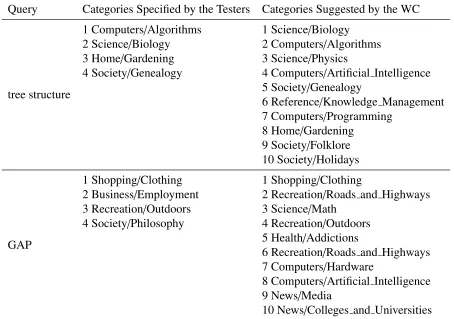
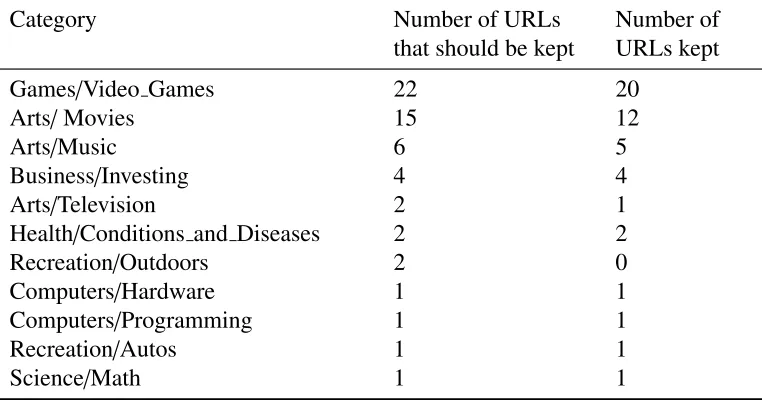
2.2 Comparison of categories specified by testers with categories suggested by word classification. . . 41
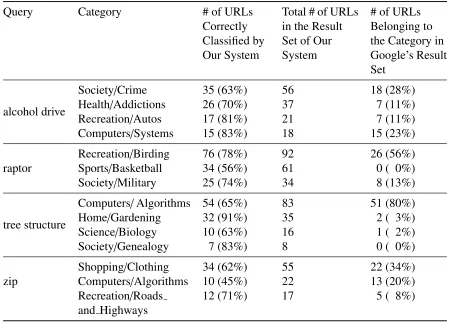
2.3 Accuracy of Query Categorization. . . 42
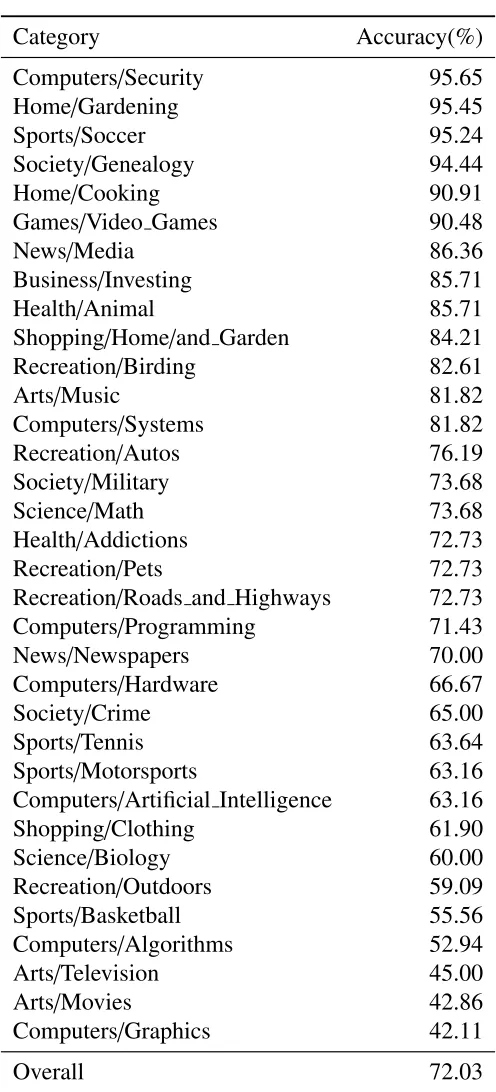
2.4 Overall accuracy of Query Categorization. . . 45
2.5 Completeness of Query Categorization with Query “crash review”. . . 46
3.1 Members with top ten authority and hub scores in the astronomy community. . 58
B.1 Table COMMENT. . . 82
B.2 Table GROUPS. Each entry contains data from an explicit community in Live-Journal. . . 82
B.3 Table INTERESTS. Each entry represents that the user with the given uid has this interest. . . 83
B.4 Table USER. . . 83
B.5 Table KNOWS. Each entry represents the fact that a user with ID uid lists the user with ID fid as a friend. . . 83
B.6 Table POST. . . 83
Appendix A List of Categories used by our Query Categorization Module . . . 77
Appendix B Database Scheme for LiveJournal . . . 82
Introduction
The origins of the Internet can be traced back to the 1960s [29], and its commercialization in
the 1990s resulted in its unprecedented popularity and incorporation into virtually every aspect
of modern human life. Today, the Internet, so-called the network of networks, carries a vast range of information and provides a multitude of services. It has become one of the largest
(if not the largest) information depositories and communication platforms in the world. For
example, in December 2010, the Internet became the largest source of news for Americans
[13], surpassing traditional media like TV, radio and newspaper.
Since its release in 1991 [73], the size of the World Wide Web (WWW, or the Web)1
has been expanding exponentially each year. An estimation of the number of the Web pages
cached by Web search engines is about 17 billion [55] as of July 12th, 2011, and the number
of Web pages that can be accessed by search engines only represents a small fraction of the
whole Web, according to [49]. How to locate information about a particular topic within the
enormous number of existing Web pages poses great challenges to information retrieval (IR).
Web directories and search engines emerged to cope with this problem.
1WWW is a system designed for accessing Web documents via the Internet; it defines a set of protocols
through which these documents are interconnected. Each Web document has a Uniform Resource Locator (URL) that specifies the location of the document. People can jump from document to document by following the URLs. The URLs in a Web document are callhyperlinks, and documents with hyperlinks are said to be written with
hypertext, the counterpart of plain text in which there are no hyperlinks.
Top
Arts Business Computers Games Recreation · · · Sports
Outdoor
· · · ·
Birding
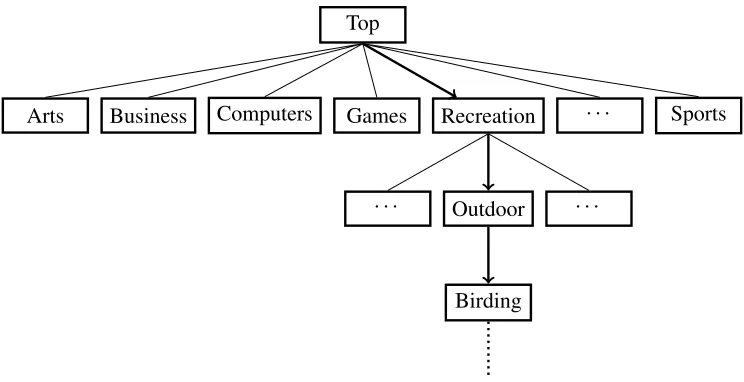
Figure 1.1: The tree-like structure of a Web directory and the path from the top level to a subcategory.
A Web directory is a directory of websites2, which organizes the websites by categories,
typically in a hierarchical way, which has a tree-like structure. Given a topic, a user can browse
the directory starting at the top level, finding the appropriate category at each level all the way
down to that subcategory which is most relevant to the topic, and browse websites listed in this
subcategory to find the desired information. Figure 1.1 illustrates the tree-like structure of a
Web directory, and the path from the top level to the ”Birding” category.
Web search engines work in a different way from Web directories. A typical Web search
engine consists of three components: A crawler (also named a spider or a robot), which collects
Web pages from the WWW by following hyperlinks connecting Web pages; an indexer, which
is essentially a database, optimized for searching, that stores locally the Web pages collected
by the crawler3; and a query server, which returns appropriate Web pages matching a user’s
query4, usually in most-relevant-first order.
It is proven by the success of Google [35], the largest Web search engine to date, that
mod-2A website is a collection of related web pages, which is usually managed by one entity, for example an
organization, a company or an individual.
3The storing of Web pages is also called caching; the process of caching Web pages and optimizing the
database for searching is called indexing.
ern search engines have been much more popular than Web directories. Web search engines
have several key advantages over Web directories: 1) Web search engines store many more
Web pages than Web directories do, because search engines can crawl Web pages
automat-ically; 2) Web search engines respond to a user’s query almost immediately, while it takes
time to browse Web directories; 3) The invention of link analysis algorithms like the PageRank
algorithm [11], boosted the effectiveness of search engines.
As we shall show in Section 1.1, Web search engines merely focus on the query words
in-stead of the users’ intention and that sometimes make search engines return results that are not
interesting to the user. Even though automatic Web page categorization does not work well on
the whole corpus of the WWW, its underneath techniques, especially data mining techniques,
can be employed to refine a Web search engines’ results and improve its effectiveness. In this
thesis, we proposeQuery Extensionto make the results returned by a search engine not limited by the query words, andQuery Categorizationwhich adds text classification technologies into Web search to present only the results more relevant to the users.
With the widespread availability and easy access of the Internet, communication services
such as electronic mail (email) services, bulletin board systems (BBS), instant messaging
ser-vices, blog5 services and online social network (OSN) services, have enabled entirely new
forms of social interaction. Here we refer to the OSN service as a service, platform, or
web-site, utilizing the Internet and the WWW, that focuses on building and reflecting the social
relations among people who share interests and activities. In the past few years OSNs have
gained significant popularity; for example, Facebook [24], an online social network website,
was the most popular website in the US in 2010 [20]. The scale (in terms of both geographical
span and size) and the complexity of OSNs have attracted a large amount of attention from
researchers, including computer scientists and sociologists, who try to understand the social
relations among members of an OSN, and the underneath structure of these relations. This
research area is usually called online social network analysis, and it includes exploring the
5Initially blog was the short term of “weblog”, but then it became more widely accepted than the original term
structure of OSNs, studying the relationships among users and their exchange of messages,
predicting the friendship between members, tracing the evolution of OSNs and mining
com-munities in OSNs.
Because of the popularity and size of OSNs, it is impossible for a member to interact with
every other member in an OSN. Usually a member only interacts with a few groups of
mem-bers; these groups can be considered as communities. Mining communities in OSNs often
re-veals interesting relationships among the members, such as common hobbies, social functions,
occupations, etc, and gives insight into the structure and organization of the different sectors
of an online society. Since the friendship network is a natural and intuitive representation of
an OSN, many research works focus on identifying communities in such a network. However,
the friendship network is based on only one kind of social relations and so it cannot represent
all interactions among OSN members. We introduce a new approach to identify communities
active on a given subject that uses a more general model than the friendship network.
At first sight, the challenges of information retrieval in the WWW and online social
net-works do not seem related, but the approaches used to deal with them are interconnected, and
usually involve technologies from semantic analysis, data mining and network analysis. For
example, the World Wide Web and OSNs can be modeled by graphs and analyzed using tools
from graph theory; lexical analysis and text classification can be applied on Web pages or
posts/comments in an OSN to understand their contents. In this thesis, we combine these
tech-nologies to address two very important problems: How to improve the effectiveness of search
engines and how to identify communities in OSNs.
This thesis is organized in the following way. In the remaining of this chapter, we briefly
introduce the basic notions of information retrieval, Web search, text and hypertext
classifica-tion, and social network analysis. In Chapter 2, we introduce Query Extension and Query
Cat-egorization designed to improve the effectiveness (in terms of completeness and accuracy) of
search engines. We also describe our implementation of these approaches, and our
communities in OSNs and present our experimental results. Finally in Chapter 4 we give a
summary of our work.
1.1
Web Directories and Web Search Engines
Looking back at the history of the WWW, we notice that the development of information
retrieval techniques for the Internet was a competition between Web directories and Web search
engines. However, Web directories and search engines were not developed independently; they
evolved together by trying to avoid the shortcomings of each other.
After the World Wide Web went public in 1991, researchers started to look for methods to
efficiently access information in the WWW. Both, Web directories and search engines, were
implemented when W3 Catalog, World Wide Web Wanderer, Aliweb and JumpStation were
released. W3 Catalog, which crawled specialized catalogs (maintained by hand) and built up a
searchable list, can be considered as a mixture of a Web directory and a search engine. World
Wide Web Wanderer was the first Web crawler, whose main purpose was to measure the size
of the WWW. Aliweb could return search results to the user upon receiving queries, but it did
not crawl the WWW. The Web pages it cached were submitted by other people. JumpStation
was the first Web search engine which implemented the three essential components of a Web
search engine (a crawler, an indexer, and a query server). In the early days, Web Search engines
indexed only the URL and the header6of a page. The first search engine which indexed the full
text of Web pages was WebCrawler, released in 1994, and it opened the door for many other
applications; to name a few, within one year of its debut came Lycos [53], Infoseek, AltaVista
[2], and Excite [23].
Web search engines crawl the WWW and index the Web pages they encounter. Typically,
a search engine extracts each word from a Web page and maintains a list of words for all pages
it caches. When a user sends a query, the search engine looks for the words in the query, and
6A portion of a Web document defined in the Hyper Text Markup Language (HTML) standard that usually
returns the URLs of Web pages matching the query. The order of the returned URLs is usually
most-relevant-first: Given a query, both types of Web search engines, those which index URLs
and headers and those which index the full text, rank Web pages based on the occurrence of
the query words; we call these search enginestext-indexingsearch engines. Dividing a search engine in three parts, a crawler which collects Web pages, an indexer which processes the pages
and a query server which takes care of the interaction with users, makes Web search engines
convenient to use: The response is fast, and the order of the returned URLs according to the
occurrences of the query seems intuitive. Web search engines soon became the main source
for people to access information in the WWW. In 1996, Excite became the exclusive search
service provider for big companies like Apple, Microsoft and Netscape.
The convenience of Web search engines attracted not only general users, but alsospammers, who are, in the context of Web search, individuals or companies who put deceiving text on their
Web pages to abuse a search engine’s ranking system. For example, one can put an excessive
repetition of popular query words like “car”, “NBA” or “rose cup” on a pornography page;
when a search engine indexes this page, it sees a number of these words and thus assumes that
this page is highly relevant to these queries. When a user sends one of these query words to
this search engine, the spam Web page is returned, even though it is not related to the query at
all.
Web directories came shortly after the first search engines were released. Yahoo!
Direc-tory [81] was born in 1994 and ODP (named Gnuhoo at that time) [64] in 1998. Both Yahoo!
Directory and ODP are manually compiled hierarchical directories. Within three years
Ya-hoo! became the largest search and navigational service provider in the United States [77].
One of the reasons behind the early success of Yahoo! is that Web search engines suffered
from spamming, to which Yahoo! Directory was immune, and the size of the WWW was not
unmanageable at that time for the use of manual methods7.
With the exponential expansion and continuous evolution of the WWW, manually
taining categories showed several drawbacks: 1) too much skilled manpower was required; 2)
difficult to keep a directory up to date; 3) highly subjective decisions could not guarantee the
precision of the directory [4]. Researchers have proposed different approaches to categorize
Web pages automatically [4, 5, 15, 16, 28]. However, the scalability of these algorithms is still
an open question and because of that the experiments based on these algorithms are limited to
merely small collections of Web pages [80]. To the best of our knowledge, none of the existing
commercial Web directories is built up using automatic categorization techniques.
To cope with spamming, new approaches of searching with hyperlinks emerged in 1998,
when the HITS algorithm [43] and the PageRank algorithm [11] were published. The latter
algorithm is now the essential technique on which Google, the most popular search engine to
date, is based. The success of Google forced Yahoo! to change its search service from Yahoo!
Directory to a Web search engine, namely Yahoo! Search [83]. As of May 2011, Google,
Yahoo! Search and Bing [6] held more than 95% of the shares in the search engine market,
according to a report [34] from the Search Engine Watch [70].
Since the HITS algorithm and PageRank algorithms gave information retrieval a new spin
that dramatically increased their effectiveness, in the next two sections, we give a brief
intro-duction to these algorithms.
1.1.1
HITS Algorithm
Based on the observation that the number of Web pages returned by text-indexing search
en-gines was too large for a human user to digest, Kleinberg proposed the HITS
(Hyperlink-Induced Topic Search) algorithm [43] to locate the most authoritative pages relevant to a given
query by analyzing the hyperlinks among Web pages. Kleinberg claimed that there are two
types of pages: Authorities andhubs. Authorities are Web pages which are highly relevant to a query, and hubs are Web pages which link to many authorities, as illustrated in Figure 1.2. A
directed graph is used to model the WWW. In the graph, a node represents a Web page, and a
the HITS algorithm works as follows:
Hubs Authorities
Figure 1.2: Authorities and hubs.
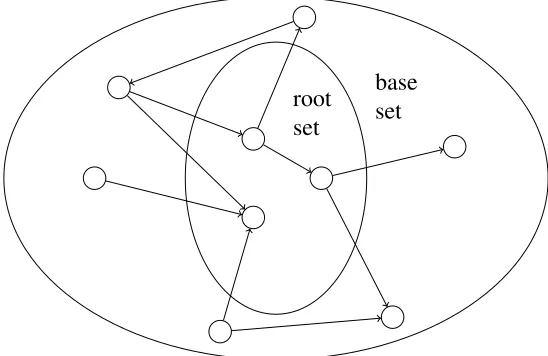
1. Starting from a user-supplied query, HITS assembles a root set of pages: A relatively small set of pages returned by any search engine on the query. It then expands this set
to a larger base set by adding any pages that point to, or are pointed to by hyperlinks contained in any page in the root set. We depict the relationship between the root set and
the base set in Figure 1.3.
2. Associate with each pagepahub weight h(p) and anauthority weight a(p), all initialized to 1. Letp →qdenote “phas a hyperlink pointing to pageq”. HITS iteratively updates the hub and authority weights as follows:
a(p)=X
q→p
h(q) (1.1)
and
h(p)= X
p→q
a(p). (1.2)
Thus, a single iteration replacesa(p) by the sum of the hub weights of pages pointing to p, and replacesh(p) by the sum of the authority weights of pages pointed to by p.
It can be proven that this iterative process converges to a stable set of authority and hub weights
after a polynomial number of rounds of Steps (1.1) and (1.2) [43]. HITS algorithm returnsh andaas the final hub weight and authority weight of each page.
root set
base set
Figure 1.3: Expanding the root set to a base set.
Hubs and authorities exhibit what could be called a mutually reinforcing relationship: A good hub is a page that points to many good authorities and a good authority is a page that
is pointed by many good hubs. Thus, HITS can be applied to various domains where the
mutually reinforcing relationship holds. For instance, an approach to categorize Web pages
using HITS algorithm was proposed in [14]. On the other hand, the HITS algorithm tends to
assign high scores to the nodes which reside in well connected subgraphs; these clusters in
the graph represent “communities” in the domain the graph models. For example, the HITS
algorithm can be applied to find important individuals in an online social network [41].
Although it set a new direction to locate information in the WWW by analyzing hyperlinks,
the HITS algorithm has some drawbacks which do not always allow it to properly deal with
the complexity of the WWW and the enormous diversity of existing Web pages. For example,
some of the links in a page are intended to navigate a website, and some others are
adver-tisements; HITS cannot distinguish these special purpose hyperlinks, which might pollute the
is noticed in [43] that the HITS algorithm returns authoritative pages dealing with “broader”
topics in the case of very specified query. It is also observed that for some queries, if the base
set contains a cluster of tightly connected Web pages, the output of HITS tends to drift towards
that cluster [5]. A study [10] has concluded that none of the common link-based analysis
algo-rithms are immune to the topic drift problem. It is worth to mention that numerous methods to
minimize the topic drift problem have been proposed, which usually involve content analysis
of Web pages [5, 14, 15, 16].
1.1.2
PageRank Algorithm
Sergey Brin and Lawrence Page published their PageRank algorithm in 1998 [11]. PageRank, just like the authority weight in HITS, is a measure of the authority of a page based on the hyperlinks between Web pages. Note that there is no notion of hub weightin the PageRank algorithm. The authority of a Web page pdepends on the number of incoming hyperlinks and on the authority of the pagesqwhich cite pthrough a link. ThePageRankof a Web page pis formally defined by
PR(p)=dX
q→p
PR(q)
h(q) +(1−d), (1.3)
whered ∈(0,1) is adamping factor8,h(q) is the number of hyperlinks in documentq,q → p denotes “qhas a hyperlink to page p”. It can be shown that Equation (1.3) has a unique (up to normalization) solution which can be computed efficiently [11].
The mutually reinforcing relationship of authorities and hubs of HITS is also valid when
computing PageRank: Good Web pages are known by other good pages. Not like the
text-indexing, in which the rank of a Web page is decided by the occurrence of the query, the
PageRank of a page is decided by surrounding pages, therefore it is more objective and
accu-rate. The PageRank algorithm directly inspired the foundation of Google. Google collects and
indexes Web pages as text-indexing search engines do, but it also computes the PageRank of
each page with respect to the whole Web. When a user sends a query to Google, Google returns
the pages containing the query, in the order of highest-PageRank-first, i.e.,
most-authoritative-page-first; this is what makes Google stand out among all Web search engines and this is the
reason why Google has been the largest search service provider since 2000 [29].
From the point of view that both of them use hyperlinks to calculate the importance of
Web pages, HITS and PageRank look very similar. But they differ from each other in some
essential ways. For instance, HITS is topic-related while PageRank is topic-free. In the HITS
algorithm the authority and hub weightsa(p) andh(p) have to be computed for each query, but the PageRankPR(p) needs to be computed only once, as long as the WWW remains the same.
1.2
Text Classification
Data mining approaches have been applied to text classification for about 20 years. In these
approaches, a general inductive process (also called thelearner) automatically builds a clas-sifier for a given category ci by extracting the characteristics of a set of documents that have
been manually labeled by an expert as either belonging to categoryci or not belonging toci.
This set of documents is called atraining setand the process of building the classifier is called trainingorlearning. From training, the inductive process determines the characteristics that a new unseen document must have in order to be classified underci. In data mining terminology,
the classification problem is an activity of supervised learning, since the learning process is “supervised” by the knowledge of the categories contained in the training samples provided by
a human expert.
The general procedure of text classification includes the following steps:
1. Gathering the training set. A set of samples are gathered and labeled.
2. Choosing a representation for the training set. In text classification, the vector space
3. Determining the learning method. Well known methods include, to name a few, Na¨ıve
Bayes, Support Vector Machine (SVM), Decision Tree, K-Nearest Neighborhood (KNN),
and Neural Networks.
4. Training the classifier and building the model using the learning method on the training
set.
5. Classifying unseen data by the model built in the previous step.
In this section, we describe two kinds of classifiers, Na¨ıve Bayes and Support Vector
Ma-chine(SVM), which are among the most widely employed data mining classifiers. Before we
start, we first introduce a text model on which those approaches can be applied.
1.2.1
Vector Space Model
To make text suitable for recognition by a classifier, a modelingorindexingprocedure which maps a text documentdjinto a compact representation of its content is required. In information
retrieval, thevector space modelis widely used for this purpose [27]. Documents are split into words by using simple syntactic rules, and words are usually transformed to some canonical
form (e.g., “reading” is transformed to “read”). Each canonical word, which is essentially a
feature of a document, represents a dimension in a Euclidean space, and documents are vectors
in this space: d~j = hw1j· · ·w|τ|ji, wherewi j is the weight of theith feature in the jth document
and, τ is the set of features. Different approaches have been explored to define the feature
setτand the weights of features wi j. For example, in the simplest approaches, called theset
of words modeland thebag of words model, features are words and the weight of a feature is either a binary number 0 or 1 (representing the presence or absence of the word), or the number
of times a word occurs in the documentdj, respectively [67, 68].
The intuitions that 1) the more often a feature occurs in a document, the more it is
represen-tative of the document, and 2) the more documents a feature occurs in, the less discriminating
Inverse Document Frequency, defined as:
tfidf(tk,dj)=#(tk,dj)·log |Tr|
#Tr(tk)
(1.4)
whereTris the set of documents, #(tk,dj) denotes the term frequency, i.e. the number of times a
termtkoccurs indj, and #Tr(tk) denotes the document frequency, i.e., the number of documents
inTr in which a termtk occurs. The tfidfis usually normalized in order for the weights to
fall in the interval [0,1].
The usefulness oftfidfcan be shown by an example. Given the query “ the black pearl”, a
search engine will find millions of pages containing all three words in its database; but which is
more relevant to the query, a page in which “the” occurs 100 times while “black” and “pearl”
occur only once, or a page in which each of “the” , “pearl” and “black” occurs 20 times?
Intuitively we know that the correct answer is the latter one, because “the” is so common in
English and “black” and “pearl” are more meaningful and occur more frequently in the second
page; however, simply counting the number of occurrences of the query words suggests the
opposite. In fact, the tfidfof “the” is low because #Tr(tk) in Equation (1.4) is usually large.
If the tfidfs of the three words, instead of the number of their occurrences, are added up
to calculate the ranks of pages, a more desirable rank will be achieved. Thus, tfidf can be
used to measure the relevance of a document to a query, and it is commonly employed by
text-indexing search engines.
Because Equation (1.4) assigns lowtfidfs to those words which are commonly used in all
documents like “the”, “are” or “in”, it is reasonable not to include the words with lowtfidf
in the feature vectors. This process is known asfeature selection.
Considering the facts that 1) the size of the vocabulary in a collection of documents is
usu-ally huge and thus the dimension of the feature vector is too large to be processed efficiently
language, feature selection is usually adopted to remove those non-informative features and
reduce the dimension of the feature vector [79]. We have shown that tfidf can be applied
for the purpose of feature selection; actually it is one of the most popular feature selection
measures. In text classification, other widely adopted feature selection measures include in-formation gainandmutual information: Information gain measures how much information is obtained for category prediction by knowing the presence or absence of a term in a document,
while mutual information measures the mutual dependence of a termtand a categoryc.
Given a set of training documents, for each unique word the tfidf, information gain or
mutual information is computed, and the terms whose tfidf/information gain/mutual
infor-mation are less than some predetermined threshold are removed from the feature space. This
procedure of feature selection can discard up to 90% of the training set vocabulary [78].
1.2.2
Na¨ıve Bayes Classifier
According to Bayes Theorem, the probability that a document represented by a vector of terms
~
dj =hw1j,· · · ,w|τ|jibelongs to categoryciis given by
Pr(ci|d~j)=
Pr(ci)Pr(d~j|ci)
Pr(d~j)
. (1.5)
The estimation ofPr(d~j|ci) is not easy since it is impossible to compute the probability of
~
dj given ci by considering only the training documents in ci, as d~j is not in ci. A common
strategy used to estimate this value is to assume that any two components (wk j) of the vectors
djare statistically independent of each other; thus, the distribution of vectorsd~j givencican be
decomposed as follows:
Pr(d~j|ci)=
|τ|
Y
k=1
Pr(wk j|ci) (1.6)
andPr(wk j|ci) can be estimated as follows, by considering the documents in the training set:
Pr(wk j|ci)=
# of termswk jinci
total # of all terms inci
Probabilistic classifiers which are based on the aforementioned “na¨ıve” assumption that
features of a document are independent are called Na¨ıve Bayes classifiers. In the training
phase, we compute the probability of each distinct termwk(thekth feature in the feature setτ)
inci using Formula 1.7, and computePr(ci) as the ratio of the number of documents inci over
the total number of documents in the training set. Then in the testing/classifying phase, given
a unseen document d~ = hw1,· · · ,w|τ|i, we can compute Pr(d~|ci) for each category ci using
Formula 1.6, and then output that categorycwhich makesPr(c)Pr(d~|c) maximum, i.e.,
c=argmaxci Pr(ci)Pr(d~|ci)=argmaxci Pr(ci)
|τ|
Y
k=1
Pr(wk|ci). (1.8)
Note that we do not need to worry aboutPr(d~j) in Equation (1.5) because 1) it is constant, given
a fixed set of documents, and 2) we care only about whichcimakes Equation (1.5) maximum,
and not what the value of Equation (1.5) is.
The assumption that the features are independent from each other does not seem to hold for
text documents in the real world, but despite this Na¨ıve Bayes classifiers perform surprisingly
well in practice, and still remain one of the most important classifiers.
1.2.3
Support Vector Machine
Given a set of vectors in a Euclidean space representing a collection of documents, each of
which belongs to one of two classes, a hyperplane9 which separates the vectors belonging to
each class in such a way that the separation, ormargin, between the two classes is maximum, is called the maximum-margin hyperplane. The vectors closest to the hyperplane are called support vectors. The term Support Vector Machine refers to those classifiers that build the hyperplane model to separate classes and to classify unseen data [19].
Formally, given a training set D = {(x~i,yi)}
|τ|
i=1 with respect to a category c where ~xi is a
vector representing a document,yi = 1 if ~xi ∈ candyi = −1 if ~xi < c, any hyperplane can be
9A hyperplane of ann-dimensional space is a subset of the space with dimensionn−1; it separates the space
x1 x2 + + + + + + + + + − − − − − − − − − ~
w·~
x−
b=
−1 ~
w·
~x− b= 1 ~ w· ~ x− b= 0 2
||~w ||
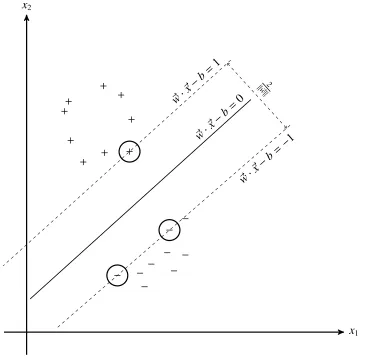
Figure 1.4: Hyperplane and the support vectors.
defined as the set or vectors~xthat satisfiesw~·~x−b=0, wherew~ is called the normal vector of the hyperplane, and the parameter kwb~k determines the offset of the hyperplane from the origin
along the normal vectorw~. We want to choosew~ andb to maximize the margin, or distance between the hyperplane and the support vectors. The distance between the two hyperplanes
passing through the support vectors is ||w2~||, so we want to minimize||w~||, subject to
~
w· ~xi −b≥1; i f yi = 1 (1.9)
and
~
The last two constraints can be combined into:
yi(w~· ~xi−b)≥ 1 (1.11)
for anyi= 1,· · · ,|τ|.
This is a quadratic programming problem, and can be solved by using mathematical
tech-niques. Figure 1.4 illustrates a hyperplane and its support vectors: Two classes of vectors are
marked by “+” and “−”. The maximum-margin hyperplane satisfiesw~·~x−b=0 and maximizes the margin ||w~2||; support vectors are marked with circles and satisfiesyi(w~ ·x~i)−b=1.
Theoretical and empirical evidence show that one remarkable property of SVMs is that their
ability to learn is independent of the dimensionality of the feature space [42]. SVMs choose a
hyperplane based on the margin which separates the vectors, not the number of features. This
property makes SVMs suitable for text classification, because the dimension of feature vectors
is usually high, and so feature selection is not necessary.
1.2.4
Training Set
In data mining and text classification, it is well known that the distribution of the labeled
sam-ples in the training set has a huge impact on the performance of the classifiers. For example,
when the learning process is based on an imbalanced data set10, the characteristics of the
ma-jority class can overwhelm those of the minority class, and the probability of misclassifying
an unseen document, which actually belongs to the minority class, as belonging to the
major-ity class is high [1, 40, 54, 87]. One of the common approaches to deal with the imbalanced
training set problem isre-sampling: Eitherdown-sampling, which extracts a smaller set of ma-jority samples while preserving all the minority samples, or up-sampling, which increase the number of minority samples by replicating them. Although down-sampling may lead to loss of
informative samples and up-sampling leads to higher computational cost and may amplify the
10In the training set, if there are significant fewer training samples from one class than from the other, the
labeling errors in the minority class, theoretical and empirical studies show that both methods
produce acceptable results, and thus are widely employed in real world application [40, 45, 76].
1.2.5
Evaluation of Classifiers
To estimate the accuracy of a classifier with respect to a training set,cross-validationis one of the most widely used techniques. In cross-validation, all labeled samples are divided evenly
intok subsets. Each subset is used as a test set for a classifier trained on the remainingk−1 subsets. The empirical accuracy is given by the average of the accuracies of thesekclassifiers. In the extreme case each subset consists of only one single example. This is calledleave one out cross-validation.
Label of the sample true false Classified as positive TP FP Classified as negative TN FN
Table 1.1: Contingency table.
Given a sample sfrom the test set which is labeled as eithertrueor false, indicating that either sbelongs to a category c or not, after feeding it into the classifier the output is either positive or negative, suggesting that s is classified as belonging to c or not. The statistical results of a cross-validation can be show in a contingency table as Table 1.1, in which TP, or
true positive, is the number of documents labeled as true and classified as positive; FP (false
positive), TN (true negative) and FN (false negative) are defined similarly. Two fundamental
measures for evaluating classifiers,recallandprecision, are defined as:
recall= TP
TP+TN (1.12)
and
precision= TP
In text classification, recall denotes how many truedocuments are successfully classified, and precision shows how many documents classified aspositiveare correctly classified. High recall and high precision imply that the classifier performs well, but they may be misleading if
examined alone. For example, a trivial classifier that says “positive” to any document will have
a perfect recall, but the precision will be low; a very strict classifier that rejects most documents
may have a high precision but low recall.
The concepts of recall and precision and their variations are widely applied to data mining
and information retrieval. For instance, in Web search, recall refers to the ratio of the actually
retrieved Web pages to the number of all pages which should be retrieved, and precision refers
to the ratio of number of Web pages relevant to the query to all pages retrieved. When
evalu-ating our approaches of Query Extension and Query Categorization, we use similar measures,
which will be introduced in Chapter 2.
1.2.6
Hypertext classification
The text classification techniques we introduced in the previous section are general approaches
that can be used for all text documents. However, new challenges arose with the emergence
of the WWW. Most Web pages are written in hypertext, which may bring in additional
infor-mative features, but can also introduce noise. For example, formating or font HTML tags like
<h1>,<b>, and <i>11 suggest the importance of the text, while the pages connected to a Web
page by hyperlinks may give hints on how to classify this page, but navigation links and
adver-tisements carry redundant, misleading information. Different approaches have been proposed
to extract the unique characteristics of hypertext to utilize the informative features and avoid
the deceptive ones for categorization.
The most intuitive approaches are either to treat hypertext as plain text without
distinguish-ing any HTML specifications, or to convert hypertext to plain text by discarddistinguish-ing all HTML
11In HTML standard, tags are used to define HTML elements, which are basic blocks of HTML documents.
tags. A simple improvement to the latter approach is to emphasize the elements which are
im-portant, for example by replicating the title, the headings, and the bold or italic elements. The
performance of these approaches merely depends on the accuracy of the chosen classification
technique and does not take advantage of the rich information of hyperlinks.
Some researchers suggest that instead of using only the content of a Web page for
clas-sification, the surrounding linked pages should be also considered. For instance, approaches
bringing the content of all linked pages, or selective information from linked pages like
em-phasized elements and, anchor text12is explored in [3, 14, 28].
On the other hand, inspired by the HITS algorithm, approaches to classify Web pages by
link analysis instead of text classification are proposed in [15, 16]. As mentioned in Section
1.1.1, the phenomenon of topic drift makes these approaches more suitable for clustering13
than for categorization.
Hypertext classification is still one of the most challenging areas in information retrieval.
The two most well known Web directories, Open Directory Project and Yahoo! Directory are
compiled by humans, and none of the existing commercial Web directories is built up using
automatic hypertext classification techniques.
1.3
Social Network Analysis
For better understanding the influence of social relations, social scientists have employed
net-work theory to model societies; this approach is called Social Network Analysis (SNA). Ac-cording to [9], SNA “provides an answer to a question that has preoccupied social philosophy
since the time of Plato, namely, the problem of social order: How autonomous individuals can
combine to create enduring, functioning societies”.
In social networks, one of the most important assumptions is the notion that individuals are
12The HTML element between<a>and</a>.
13Unlike “categorization”, which is related to a explicit subject, or category, “clustering” tends to discover well
Ted Bob
Carol
Alice
Figure 1.5: A social network of “like”.
embedded in the webs of social relations and interactions. In network models, the individuals
(or actors) are denoted by nodes, and the relations (or ties) between them are represented by
edges. SNAs focus on the ties among actors instead of the attributes of each actor. Figure 1.5
models a simple “like” relationship, in which each node denotes a person, and a directed link
a→bmeans that personalikes personb.
To collect the ties among actors, the full network method inquires every actor about their ties to all other actors. In some cases this method is impractical or too expensive; thesnowball method, which is similar to the expansion from the root set to the base set in the HITS algorithm (see Figure 1.3), adds new actors by following known actors’ ties.
One of the important properties of an actor is its power of influence in the network. Some
In this chapter we briefly reviewed the history of Web search engines and Web directories,
and the underneath information retrieval techniques, including some Web search algorithms
and text classification methods. We also introduced the basic concepts in social network
anal-ysis. In the next chapter, we present our approach to improve the effectiveness of Web search
Improvements on Existing Search Engines
2.1
Introduction
As mentioned in Chapter 1, Web search engines prevail these days as the dominant tool to find
information in the WWW due to their fast response time and acceptable accuracy. However,
sometimes it may still be hard for the average user to find the exact information they want by
querying a search engine. We observed two facts that might lead search engines to produce
undesirable results:
1. The result set returned by a search engine is based on thewordsof a user’s query, not the intentionof the user. For instance, if we search for “automaker” using a search engine like Google, surprisingly the search engine will not return in the result set any websites
from the leading companies in the automotive industry like GM or Toyota. The reason
why some of the most relevant Web pages are ignored by the search engine is that they
do not contain the words “automaker” on their websites.
2. The number of URLs in the result set returned by a search engine is sometimes huge and
may contain too many URLs not related to the user’s interests. For example, different
people sending the query “raptor” to a search engine looking for Web pages related to 1)
a basketball club based in Toronto, Canada, 2) some breeds of birds, 3) some kinds of
dinosaurs, or 4) a type of fighter aircraft, will get the exact same set of URLs. Users may
try different combinations of keywords to try to retrieve results which are more related
to their needs, but the way to combine the keywords differs from one search engine to
another.
Briefly speaking, looking for exact matches of query words in Web pages limits the ability
of Web search engines to return pages which are relevant to a query but do not contain the query
words; furthermore, the unclassified result sets returned by search engines make it difficult to
locate the pages that are most relevant for a particular user. To address the aforementioned
problems, we propose approaches to expand a query so that more Web pages will be introduced
into the result set, and to refine the result set by selecting the Web pages according to the user’s
intention so that mainly relevant pages are presented to the user; we call these approaches
Query Extension(QE) andQuery Categorization(QC), respectively.
In Section 1.2.5 we introducedrecallandprecisionfor the evaluation of text classifiers. In this thesis, we use the related termscompletenessandaccuracywhich will be formally defined in Section 2.5.6. For the time being, we loosely treat completeness as recall, and accuracy as
precision, since these terms refer to how many Web pages relevant to the query are retrieved,
and how many Web pages retrieved are relevant to the query, respectively.
2.2
Related Work
In Chapter 1 we have shown that text-indexing Web search engines are vulnerable to spamming,
and link-based analysis algorithms like HITS suffer from topic drift. Moreover, although the
PageRank algorithm ranks Web pages by analyzing the hyperlinks contained in them, the set of
pages that are included in the result set and returned to the user is still decided by the appearance
of the query words. We observe that Google suffers from the completeness problem, as the
previous “automaker” example shows.
search engines, which we can summarize in three categories: 1) Expanding query words by
employing a thesaurus [36, 58] or by extracting a conceptual frame for the query [30]; 2)
re-trieving Web pages by using fuzzy logic or soft computing techniques [63]; 3) using natural
language, instead of “keywords”, to specify a query and then reformulating it into a new query
more suitable for text-indexing search engines by performing inferences based on
“common-sense reasoning” [51]. Although the second and the third approaches could be employed to
help na¨ıve users who have little knowledge of Web search engines and do not know how to
combine keywords, they will not help more knowledgeable users who are familiar with and
utilize Web search engines frequently. In addition, these two approaches are complex and their
implementations are complicated. Thus, we believe that they are not the answer to the
incom-pleteness problem. The first category of approaches promises to increase the number of URLs
in the result set, however it also introduces more irrelevant Web pages; without appropriate
post-processing, it will be more difficult for users to locate the information that they need.
Our approach extends a query in a similar but simpler way compared to the first category, and
avoids the undesirable results by our post-processing technique ofQuery Categorization.
Looking back at text-indexing search engines and link-based search algorithms discussed
earlier, we observe that none of them takes into account the user’s intention (other than the
original query). For example, with a simple query like “raptor”, there is no way to tell whether
the user is interested in the basketball clubToronto Raptors, or the jet fighterF-22, so search engines can only return a mixture of every kind of Web pages related to the query word
“rap-tor”. The order in which the Web pages are presented to the user represents the importance
granted by the search engine to each page within the whole collection, but this importance
does not necessarily correspond to what the user wants.
Researchers have proposed various approaches using Web Page Categorization
technolo-gies to increase the accuracy of search engines. As shown in [21, 22], an interface showing
category information in search results is very effective. The works in [18, 44] show approaches
conceptual way, but without the user involved and, furthermore, they do not present the results
in a way friendly to the user’s intention. In [46, 50, 61], user’s interests are discovered from
the user’s searching history and/or browsing history; this approach has to monitor the user’s
behavior for a long period of time, and it would fail in the situation when several users share a
computer. In [26, 85], search results are divided into concept clusters to help the users find the
information they need; however, unlike a category, a concept cluster is difficult to define and
thus might cause confusion. The research in [32] shows an approach for modifying a query
according to the category specified by the user; the modified query is then sent to a search
engine. Modifying a query to include category information involves deep knowledge of how
certain search engine handles keywords in a query, so the same approach would fail when
applied to a different search engine.
In this paper, we proposeQuery Extensionto improve the completeness of a search engine, andQuery Categorizationto increase the accuracy of the search results. In the next two sections we give a detailed discussion ofQuery ExtensionandQuery Categorization. Our test system and the analysis of the testing results are presented in Section 2.5.
2.3
Query Extension
There is no restriction on which kind of content is published on the WWW, and there are
no guidelines for content providers specifying how a Web page should be presented. To be
more specific, content providers could, for example, use various words to refer to the same
term because of the existence of synonyms. For instance, one could use any of the words
vehicles, automobiles, cars, or evenautoson Web pages dealing with cars without leading to any misunderstandings. However, such freedom can get text-indexing Web search engines in
trouble.
When a user issues a query to a search engine, the search engine returns mainly Web pages
instead of the query words themselves are usually not included in the result set. This may not
be desirable since the user is looking for information about the query, but not necessarily about
the query words themselves, i.e., the result set is incomplete.
To overcome this incompleteness problem and to improve the coverage of the result set,
we propose here to extend a query so it includes not only the original query words but also
some variations; synonyms are reasonable extensions for the original query. We take this idea
a step further: When we send, for example, the query “vehicle” to a search engine, why are
those Web pages containing the plural “vehicles” sometimes omitted? We should consider the
singular and plural forms of nouns as query extensions, as well as the different tenses of verbs,
and the comparative and superlative degrees of an adjective, i.e., the inflected forms of words.
To yield query extensions, we propose to construct a dictionary of synonyms and inflected
forms, that we call theinflection dictionary, for English words. There are good synonym dic-tionaries like WordNet [25], and the well-known Merriam Webster Thesaurus [59], both of
which are manually compiled. Some approaches for the automatic construction of a thesaurus
are discussed and experimentally compared in [69] with WordNet, and the conclusion is that
the quality of the results obtained with automatic methods is not as good as that of WordNet.
Therefore, it is reasonable for us to use WordNet and Merriam Webster Thesaurus when
build-ing the synonym part of the inflection dictionary. The Merriam Webster Dictionary provides
inflected forms for irregular adjectives, nouns and verbs, while regular inflected forms could
be derived by using grammatical rules, for example, add “ed” to verbs for the past tense, add
“s”to nouns for the plural form. Therefore, given an English word, we can generate a list
of synonyms by consulting WordNet and Merriam Webster Thesaurus, and a list of inflected
forms can be selected from the Merriam Webster Dictionary and by using grammatical rules.
We implemented a Perl script for the construction of the dictionary, and we examined the
dictionary entries by hand; the implementation details will be given in Section 2.5.2. Each
entry in the inflection dictionary has the form e → I, where I = {s1,s2, . . . ,sm} is a list of
{w1,w2, . . . ,wn}, we augment each wordwi with its inflection set Ii, so the queryqis extended
to a product setQ= I1×I2×. . .×In, and each new queryqk0 inQhas the form{I1l,I2j, . . . ,Int},
whereIiyis theyth entry in the inflection setIi. An example of the this procedure is shown in
Section 2.5.2.
2.4
Query Categorization
Regardless of how Web pages are collected, it is the goal of a Web search engine to organize
them in a well-ordered way when returning the result set to the user. This ensures that the
URLs of those pages which are, both of high quality and relevant to the query appear before
others.
Using the above “automobile” example, one important observation is that the different
meanings of the same query can be categorized. For example, in the Open Directory Project,
websites about prices of used cars are in the category “Shopping: Vehicles”, and sites about
the history of automobiles can be found under “Recreation: Autos: Enthusiasts”. Inspired by
this observation, finding a way to categorize a query and then return the Web pages in the same
category as the query would be a good attempt to improve the search results. This approach
could be separated in two steps: The first is to identify the category of the query, and the second
is to decide how closely related a given Web page from the result set is to this category.
2.4.1
Word Classification
To identify the category of the query we have to consider the following facts. Most English
words have multiple meanings (polysemy) depending on the context and, therefore, could be
classified into several categories. For example, while the term “tree” is used as a type of data structure in Computer Science, we also know whattree means as a life form. Consequently, when a user sends a query to a search engine, it is the user and no one else who knows what
decide to which category the query belongs. We decided to present the user with some possible
categories (the procedure used to select the categories is described in Section 2.5.4) and the
user can either pick one of them, or if the proposed categories are not satisfying enough, the
user could choose any other category from a directory.
It is worth mentioning that our strategy to pick a category for the query complies with the
typical approaches used in automatic categorization of words, the basic steps of which include
dictionary lookup and ambiguity removal [37, 66].
2.4.2
Web Page Classification
Given a category specified by the user, we need to decide which Web pages from the result
set belong to this category, so that only relevant pages are presented to the user. We have
introduced several text classification techniques using thevector space modelin Section 1.2. In this thesis, we use these techniques to categorize Web pages. We give implementation
details in Section 2.5.4. Briefly speaking, a training set which consists of high quality Web
pages classified into categories is collect beforehand; classifiers (for words and Web pages) are
trained using the training set (tfidf is used as the weight of each word in feature vectors).
Then the following Query Categorization procedure is used:
• Categorize the query by using word classification, as described in Section 2.4.1.
• Use a search engine to collect Web pages according to the specified query.
• Classify the Web pages in the result set and discard those pages which do not belong to
the query’s category.
2.5
Implementation and Testing
To test the approaches proposed in this research, we implemented a system consisting of the
• A User Interface which parses the user query and presents the final results.
• A query extension module which extends the user’s query.
• A retrieval module which collects pages from a search engine.
• A categorization module which performs word and Web page classification.
• A ranking module.
Our system was implemented on a machine running Windows XP, and it was written in C++
under the Microsoft Visual Studio developing environment. We also implemented several
aux-iliary Perl scripts, for example to construct the inflection dictionary. We give below a
descrip-tion of these modules.
2.5.1
User Interface
For simplicity, a text terminal is used as the interface to read the input and present results to
the user. To compare the results obtained with our approach with the results from a
commer-cial Web search engine, we present both lists of results in a Web browser, side by side. The
interaction between the user and the system is listed below.
1. The user enters a query.
2. A list of categories is presented.
3. The user picks one category.
4. After processing the query, a Web browser is opened and the results are presented.
2.5.2
Query Extension Module
To expand a query, we implemented a Query Extension Module in the test system which
con-sults the inflection dictionary to get all synonyms and inflected forms of each query word. Each
inflection will replace the original word in the query to form new queries (as explained in
Sec-tion 2.4.1), which are passed to the retrieval module to obtain the expanded search result. Note
that since for multiple-word queries, the number of new queries could be impractical for the
retrieval module if every word is extended. Hence, we allow the option of enabling or disabling
query extension: If a query word is surrounded by square brackets “[” and “]”, the word will
be extended; other words will remain the same in the extended query.
When implementing the test system, we did not build a dictionary that contains every
En-glish word. Instead, for the purpose of testing our algorithm we only added into the inflection
dictionary the words which are used as queries in our tests. We installed a WordNet database in
our system and implemented a Perl script which 1) retrieves the synonyms of a given word from
the WordNet API, and 2) submits the word to Merriam Webster Thesaurus website and parses
the response to extract inflected forms. We noticed that the “synonyms” retrieved from
Word-Net are sometimes not really synonyms of the given word. For example, “estimate”, “gauge”,
“guess” and “judge” are returned as synonyms of the verb “approximate”; although “estimate”
and “guess”can be considered as synonyms of “approximate”, we do not think “gauge” and
“judge” are good ones. Therefore, we manually examined all synonyms of a given word to
ex-clude the misleading ones, and added into the inflection dictionary the regular inflected forms
including plural form of a noun, tenses of a verb and the comparative and superlative degrees of
an adjective. In total we created 47 entries in the inflection dictionary, two examples of which
are shown below.
algorithm algorithms algorithmic approach method process procedure
approximate approximated approximating approximates
Given the query “internet [ algorithm ]”, the brackets indicate that the word “algorithm” should
be expanded. The query extension module will search for inflections of the word “algorithm”
in the inflection dictionary, and form new queries by replacing “algorithm” with the inflections.
Therefore, the output of the query extension module is a list of these queries: “internet
algo-rithm”, “internet algorithms”, “internet algorithmic”, “internet approach”, “internet method”,
“internet process” and “internet procedure”, in this example.
2.5.3
Retrieval Module
As we know, a typical Web search engine consists of a crawler, an indexer, and a query server.
In this thesis, we did not use a Web crawler to download Web pages, instead we implemented
our algorithms on top of an existing search engine. This approach allowed us to focus our
attention on trying to improve the search engine’s effectiveness. We chose Google as the search
engine to be used to compare against our system for several reasons: 1) Google is currently the
largest search service provider in the world; it is reasonable to compare our approaches with
it; 2) the fact that Google returns Web pages based on the occurrences of query words and not
users’ intention is one of the motivations of this thesis; 3) Google provides the Google Web Search API 1 that allows software developers to query the Google search engine from their own programs.
Upon receiving a query from a user and extending it with the query extension module, the
retrieval module of our system sends the extended queries to Google, one by one. Google
returns a list of URLs for each extended query. The Web pages corresponding to these URLs
are then fetched by the retrieval module and stored in a MySQL [60] database, which has a
C API that allows our program to access the database. The database contains one main table,
1http://code.google.com/apis/websearch/, which is now claimed to be deprecated, but will still be available for
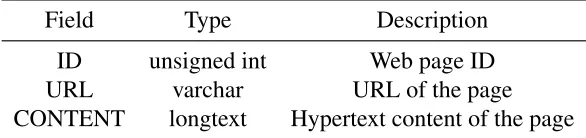
called “PAGES”. The fields in the table PAGES are shown in Table 2.1.
Field Type Description
ID unsigned int Web page ID URL varchar URL of the page CONTENT longtext Hypertext content of the page
Table 2.1: Fields in the MySQL table PAGES.
2.5.4
Categorization Module
As mentioned in Section 2.4, the categorization module is used to obtain the category
informa-tion of the user’s query, and to classify Web pages to decide which ones should be kept in the
result set. We used the Bow library [56] as our text classifier and we implemented Perl scripts
to parse Web pages and allow the Bow library to classify them.
Bow is a C library containing statistical text analysis and information retrieval tools which
implements classification methods including Naive Bayes and SVM. It takes a training set in
a-category-per-subdirectory fashion, i.e., the training-directory, or the directory which contains
the samples in the training set; it consists of subdirectories, each of which holds the samples
which belong to a category. This gives us flexibility to manipulate the classifier by organizing
the subcategories as we require. For example to make Bow a binary classifier, we train Bow
with a training-directory which consists of two subdirectories, each of which contains positive
and negative samples for a category; if we put training samples belonging to several categories
into different subdirectories, Bow will act as a multi-class classifier. After testing the
perfor-mance of different classification methods provided in Bow on, both, Web pages and query
words, we chose SVM to classify Web pages since SVM is very accurate for text classification,
as explained in Section 1.2.3, and chose Na¨ıve Bayes to classify query words because Na¨ıve
Bayes is very fast and its performance for word classification is similar to SVM.
The Web pages used to build our training set were collected from Google directory2, which